

The advertising landscape is experiencing a seismic shift in 2026. Imagine a world where AI agents negotiate media buys directly with each other, bypassing traditional programmatic advertising networks entirely. This isn't science fiction—it's the emerging reality of agent-to-agent ad trading, and it's creating unprecedented opportunities for savvy affiliate marketers who understand how to position themselves within these new commerce protocols.
Agent-to-Agent Ad Trading: New Revenue Streams for Affiliate Marketers in 2026 represents a fundamental transformation in how digital advertising inventory is bought, sold, and monetized. Instead of relying on traditional ad networks, demand-side platforms (DSPs), and supply-side platforms (SSPs), autonomous AI agents are now conducting direct negotiations using standardized protocols like the Agent Communication Protocol (ACP) and Model Context Protocol (MCP). For affiliate marketers, this shift opens doors to entirely new revenue models that were impossible just a year ago.
Key Takeaways
- AI agents are revolutionizing ad trading by negotiating directly with each other, eliminating traditional intermediaries and creating new affiliate opportunities
- ACP and MCP protocols provide standardized frameworks for embedding affiliate offers into agent-mediated commerce transactions
- Affiliate marketers can capture value at multiple touchpoints in the agent-to-agent ecosystem, from protocol integration to commission-based agent recommendations
- Early adopters gain significant advantages by establishing presence in agent training data and commerce protocol registries before markets become saturated
- Technical implementation requires understanding API integrations, protocol specifications, and agent behavior patterns to maximize revenue potential
Understanding Agent-to-Agent Ad Trading in 2026
What Makes Agent-to-Agent Trading Different?
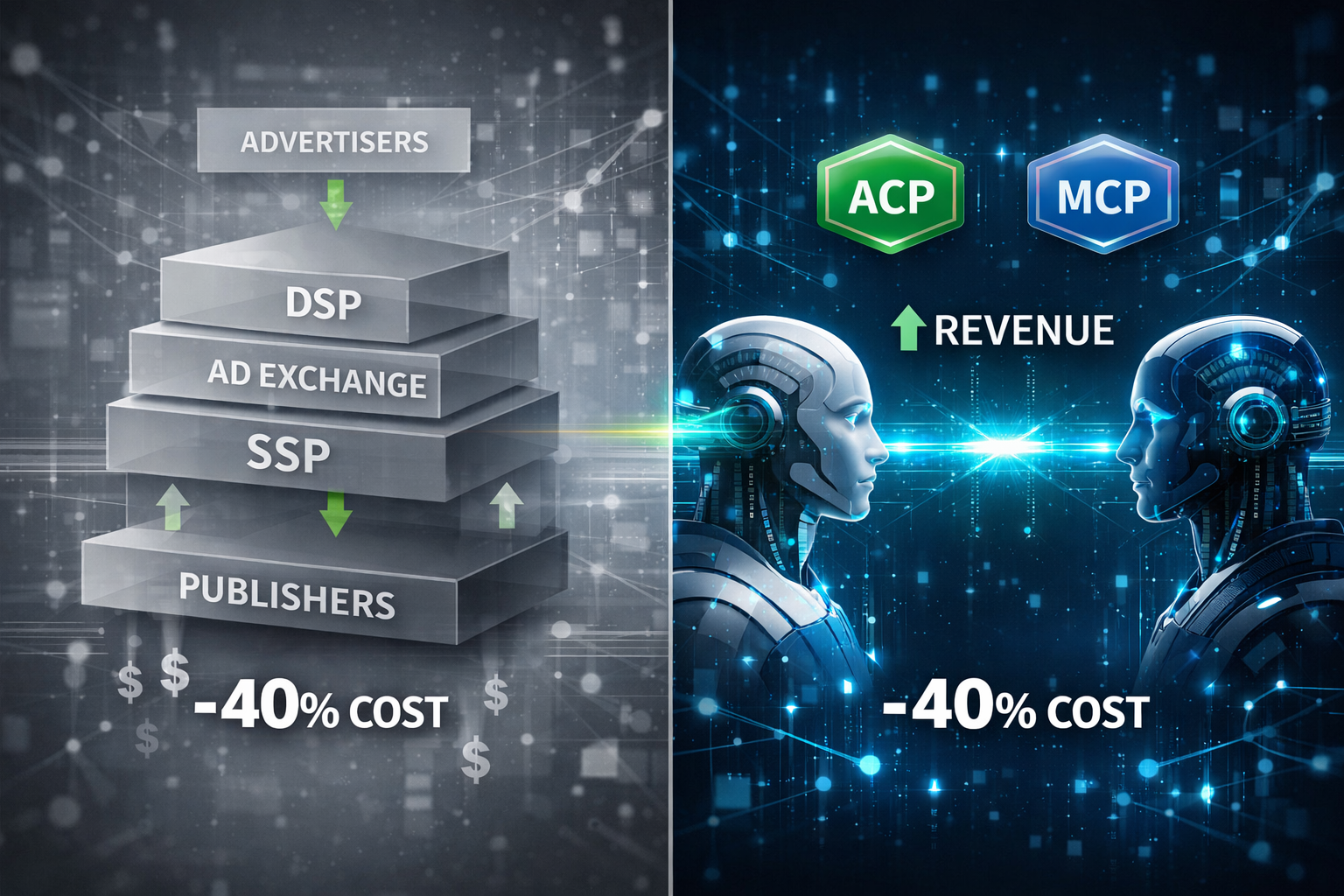
Traditional programmatic advertising involves multiple layers of intermediaries, each taking a cut of the advertising spend. Publishers list inventory through SSPs, advertisers bid through DSPs, and ad exchanges facilitate the auction—all while data management platforms (DMPs) track user behavior across the ecosystem.
Agent-to-agent ad trading eliminates these middlemen entirely. Instead, AI agents representing buyers and sellers communicate directly using standardized protocols. These agents:
- Negotiate pricing in real-time based on contextual relevance
- Evaluate ad placement quality without human intervention
- Execute transactions autonomously within predefined parameters
- Learn from outcomes to optimize future negotiations
For affiliate marketers, this creates opportunities to position offers where AI agents are making purchasing decisions on behalf of consumers. Rather than competing for ad space through traditional bidding, affiliates can now embed their offers directly into the decision-making frameworks that agents use.
The Role of ACP and MCP Protocols
The Agent Communication Protocol (ACP) and Model Context Protocol (MCP) serve as the foundational infrastructure for agent-to-agent commerce. Think of them as the "language" that AI agents speak when conducting business transactions.
ACP focuses on standardizing how agents:
- Exchange information about products and services
- Negotiate terms and conditions
- Verify transaction authenticity
- Report outcomes and performance metrics
MCP provides the contextual framework that allows agents to:
- Understand user intent and preferences
- Access relevant product databases
- Evaluate affiliate offers against user needs
- Maintain conversation context across multiple interactions
By understanding these protocols, affiliate marketers can structure their offers in ways that AI agents naturally discover, evaluate, and recommend. This is fundamentally different from traditional affiliate marketing strategies that rely on human decision-making.
New Revenue Streams for Affiliate Marketers in Agent-Mediated Commerce
Protocol-Level Affiliate Integration
The most lucrative opportunity in Agent-to-Agent Ad Trading: New Revenue Streams for Affiliate Marketers in 2026 lies in protocol-level integration. This means registering your affiliate offers directly within the ACP and MCP protocol registries that AI agents query when making recommendations.
How it works:
- Register with protocol marketplaces that maintain databases of verified affiliate offers
- Structure your offers using protocol-compliant schemas that include product details, commission rates, and conversion tracking parameters
- Optimize for agent discovery by including semantic tags and contextual metadata that align with common user queries
- Monitor agent recommendation patterns to understand which offers perform best in different contexts
This approach allows your affiliate offers to appear automatically when relevant queries occur, without requiring traditional advertising spend. The commission structure typically involves a protocol fee (2-5%) plus your standard affiliate commission.
Agent Training Data Positioning
AI agents learn from vast datasets that include product information, user reviews, and transaction histories. Forward-thinking affiliate marketers are now investing in positioning their offers within agent training datasets.
Practical strategies include:
- Creating comprehensive product documentation that agents can reference
- Publishing detailed comparison content that helps agents evaluate options
- Contributing to open-source commerce datasets with properly attributed affiliate links
- Partnering with agent developers to ensure your product category is well-represented
This is similar to traditional SEO but optimized for AI consumption rather than human readers. Just as learning how to do affiliate marketing once required understanding search engines, success in 2026 requires understanding how AI agents process and prioritize information.
Commission-Based Agent Recommendations
Some AI agent platforms now allow affiliate marketers to offer performance-based incentives directly to the agents themselves. This creates a symbiotic relationship where agents are motivated to recommend products that generate commissions.
Key considerations:
- Transparency requirements: Most platforms mandate clear disclosure when agents receive commissions
- Quality standards: Agents must prioritize user satisfaction over commission rates to maintain trust
- Competitive positioning: Higher commission rates can influence agent recommendations when multiple suitable options exist
- Performance tracking: Advanced attribution systems track which agents generate conversions
This model works particularly well for high-ticket affiliate marketing where commission amounts justify the additional complexity of agent-level tracking.
Implementing Agent-to-Agent Strategies: A Practical Framework
Step 1: Assess Your Current Affiliate Portfolio
Before diving into agent-to-agent trading, evaluate which of your existing affiliate offers are suitable for this new channel. Best candidates include:
- Products with clear, objective specifications that agents can easily compare
- Services with transparent pricing and well-documented features
- Digital products that can be delivered instantly through API integrations
- Recurring subscription offers that provide long-term commission value
Products requiring extensive human judgment or subjective evaluation may not perform as well in agent-mediated environments initially.
Step 2: Learn Protocol Specifications
Invest time in understanding ACP and MCP protocol documentation. While technical, this knowledge is becoming as essential as understanding SEO fundamentals was for digital marketers a decade ago.
Essential learning areas:
- JSON schema structures for product listings
- Authentication and verification requirements
- Commission tracking and attribution mechanisms
- Agent query patterns and response optimization
Many affiliate marketing courses are now incorporating protocol training into their curricula, recognizing this as a critical skill for 2026 and beyond.
Step 3: Register with Protocol Marketplaces
Several major protocol marketplaces have emerged as central hubs where AI agents discover affiliate offers:
| Marketplace | Focus Area | Commission Structure | Integration Difficulty |
|---|---|---|---|
| AgentCommerce Hub | General products | 3% protocol fee | Moderate |
| MCP Marketplace | Digital services | 2% protocol fee | Easy |
| ACP Exchange | High-value items | 5% protocol fee | Advanced |
| AutoAffiliate Network | Consumer goods | 4% protocol fee | Moderate |
Registration typically requires:
- Verified business credentials
- Product catalog in protocol-compliant format
- Commission rate specifications
- Conversion tracking endpoint configuration
Step 4: Optimize for Agent Discovery
Agent optimization differs significantly from traditional search engine optimization. Focus on:
Semantic clarity: Use precise, unambiguous language that agents can parse accurately. Avoid marketing hyperbole that humans understand contextually but agents may misinterpret.
Structured data: Implement comprehensive schema markup that provides agents with all necessary decision-making information upfront.
Contextual relevance: Tag your offers with detailed use-case scenarios so agents can match them to specific user needs.
Performance metrics: Include verifiable customer satisfaction data, return rates, and quality indicators that agents use for evaluation.
This approach aligns with broader affiliate marketing optimization techniques but requires additional technical precision.
Step 5: Monitor and Iterate
Agent-to-agent trading generates rich performance data that reveals:
- Which agent platforms drive the most conversions
- What query patterns lead to your offers being recommended
- How your commission rates compare to competitors
- Which product attributes agents prioritize in recommendations
Use this data to continuously refine your protocol listings, adjust commission structures, and identify new product opportunities. The feedback loop in agent-mediated commerce is significantly faster than traditional affiliate channels, allowing for rapid optimization.
Challenges and Considerations in Agent-to-Agent Ad Trading
Technical Complexity
Implementing Agent-to-Agent Ad Trading: New Revenue Streams for Affiliate Marketers in 2026 requires more technical sophistication than traditional affiliate marketing. You'll need to:
- Understand API integrations and webhooks
- Maintain protocol-compliant product feeds
- Implement real-time commission tracking
- Monitor agent behavior patterns
For marketers starting affiliate marketing with no money, the technical barriers may initially seem daunting. However, many platforms are developing user-friendly interfaces that abstract the complexity.
Trust and Verification
AI agents prioritize verified, trustworthy sources. Building credibility in agent-mediated ecosystems requires:
- Verified business credentials through protocol authentication systems
- Consistent performance history with low return rates and high customer satisfaction
- Transparent commission structures that don't create perverse incentives
- Accurate product information that matches actual specifications
Establishing this trust takes time but creates sustainable competitive advantages.
Competitive Dynamics
As more affiliate marketers recognize these opportunities, competition for agent attention will intensify. Early movers gain advantages through:
- Better positioning in agent training datasets
- Established relationships with protocol marketplace operators
- Historical performance data that agents use for quality assessment
- Brand recognition in agent recommendation algorithms
This makes 2026 a critical year for those looking to succeed in affiliate marketing by establishing presence before markets saturate.
Regulatory Considerations
Agent-to-agent commerce is attracting regulatory attention regarding:
- Disclosure requirements for AI-mediated recommendations
- Commission transparency and potential conflicts of interest
- Consumer protection in automated purchasing decisions
- Data privacy in agent-to-agent communications
Staying informed about evolving regulations is essential for long-term success in this space.
The Future of Agent-to-Agent Ad Trading Beyond 2026
Emerging Trends to Watch
Voice and conversational commerce integration: As voice assistants become more sophisticated, agent-to-agent trading will increasingly occur through conversational interfaces where users never see traditional advertisements.
Cross-protocol interoperability: Currently, ACP and MCP operate somewhat independently, but emerging standards aim to create seamless agent communication across different protocol ecosystems.
Blockchain-based commission tracking: Decentralized ledger systems are being tested for transparent, tamper-proof commission attribution in agent-mediated transactions.
Predictive agent behavior modeling: Advanced analytics platforms are emerging that help affiliate marketers predict which offers agents will prioritize based on historical patterns.
Preparing for the Next Evolution
Successful affiliate marketers in this space will:
- Maintain technical agility to adapt as protocols evolve
- Build diversified presence across multiple agent platforms and protocols
- Invest in data infrastructure that provides competitive intelligence on agent behavior
- Develop relationships with protocol developers and marketplace operators
- Stay informed about regulatory developments that may impact agent-mediated commerce
The principles of becoming a successful affiliate marketer remain constant—provide value, build trust, and optimize performance—but the technical implementation continues to evolve rapidly.
Conclusion: Seizing the Agent-to-Agent Opportunity
Agent-to-Agent Ad Trading: New Revenue Streams for Affiliate Marketers in 2026 represents one of the most significant shifts in digital commerce since the advent of programmatic advertising. By eliminating traditional intermediaries and enabling direct AI-to-AI negotiations, this new paradigm creates opportunities for affiliate marketers who understand how to position offers within agent decision-making frameworks.
The most successful marketers in this space will be those who:
✅ Act early to establish presence in protocol marketplaces and agent training data
✅ Invest in technical understanding of ACP, MCP, and emerging commerce protocols
✅ Focus on quality by providing accurate information and maintaining high customer satisfaction
✅ Monitor performance using agent-specific analytics to continuously optimize
✅ Stay adaptable as protocols, platforms, and regulations evolve
Your Next Steps
- Audit your current affiliate portfolio to identify offers suitable for agent-mediated commerce
- Register with at least one protocol marketplace to begin testing agent-to-agent trading
- Invest time learning ACP and MCP protocol specifications and best practices
- Start small with a pilot program before scaling to your entire product catalog
- Join communities of affiliate marketers experimenting with agent-to-agent strategies to share insights
The transition to agent-mediated commerce won't happen overnight, but the foundations are being laid in 2026. Affiliate marketers who understand and implement these strategies now will be positioned to capture disproportionate value as this ecosystem matures. The question isn't whether agent-to-agent ad trading will transform affiliate marketing—it's whether you'll be among the early adopters who benefit most from this transformation. 💡