

Last updated: March 23, 2026
Quick Answer
Agentic AI for B2B Real Estate SaaS: Autonomous Property Valuation and Deal Structuring in Volatile Markets deploys multi-agent systems that appraise commercial properties, negotiate terms, and structure deals end-to-end without human intervention. These systems adapt to market shifts in real-time by continuously recalculating valuation ranges, coordinating transaction workflows, and adjusting recommendations based on micro-market demand, interest rate movements, and buyer activity trends. Early adopters in 2026 report faster time-to-sale and reduced listing stagnation compared to static valuation tools.
Key Takeaways
- Agentic AI systems evaluate multiple variables simultaneously including historical comparables, micro-market demand, interest rates, and buyer activity to enable dynamic property valuations that adapt to volatile markets[1]
- Four distinct agent types power B2B real estate operations: Copilots (workflow assistance), Wedges (end-to-end job ownership), Sentinels (continuous monitoring), and Systems of Action (autonomous multi-step execution)[3]
- End-to-end transaction automation coordinates marketing, tours, offers, documentation, compliance, financing, and closing while identifying bottlenecks and tracking milestones[1]
- Credit-based pricing models have become the default pattern for AI-native real estate products, providing both predictability and flexibility for variable transaction volumes[2]
- 50%+ of B2B sales teams will be smaller in 2026 as agentic systems automate lead handling, qualification, and initial engagement[2]
- Salesforce AgentForce achieved $540M in ARR, demonstrating real revenue impact and market readiness to pay premium prices for agentic value[3]
- Agent orchestration is the critical unlock because individual agents address only small portions of complete business processes[2]
- Machine-readable pricing has become essential as buyer agents screen vendors before humans visit websites[2]
- Post-sale recurring revenue models enable lifecycle management including maintenance reminders, revaluation alerts, and refinancing opportunities[1]
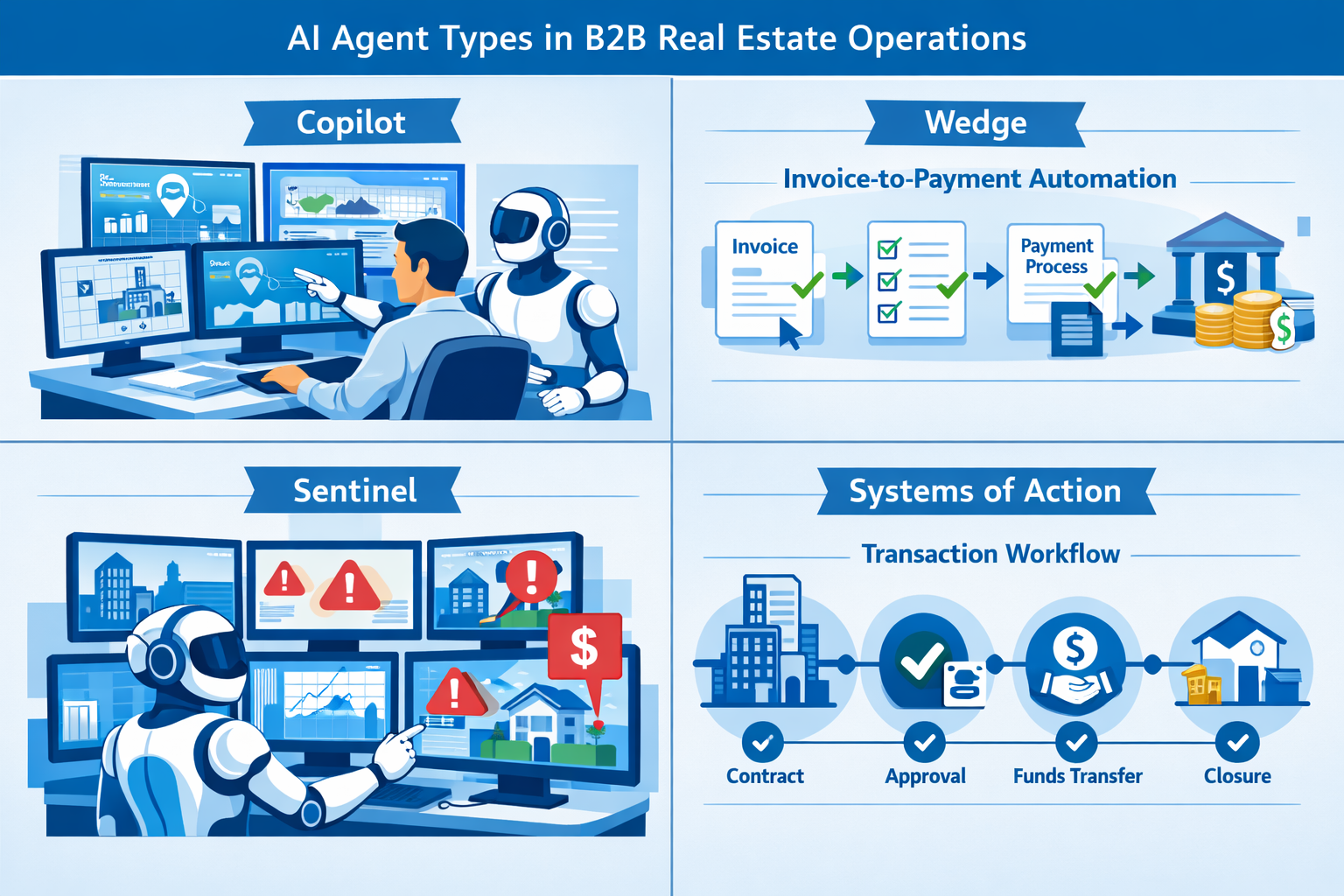
What Are the Four Types of Agentic AI Agents Transforming B2B Real Estate Operations?
Four distinct agent types are reshaping how commercial real estate firms operate in 2026. Copilots assist users within existing workflows by providing real-time recommendations and data analysis while humans maintain control. Wedges own specific jobs end-to-end, such as managing the complete invoice-to-payment cycle without human intervention. Sentinels continuously monitor data streams and flag issues before they escalate into problems. Systems of Action execute multi-step workflows autonomously rather than just recommending actions[3].
How Each Agent Type Functions in Real Estate
- Copilots: Analyze property data alongside human analysts, suggest comparable properties, and highlight valuation anomalies during appraisal reviews
- Wedges: Handle complete lease renewal processes from tenant notification through document execution and payment processing
- Sentinels: Monitor market conditions 24/7, alerting teams when specific properties should be repriced or when competitor listings change pricing strategies
- Systems of Action: Execute complete transaction workflows including offer generation, negotiation rounds, document preparation, and compliance verification
Choose Copilots if your team needs augmentation but must maintain final decision authority. Choose Wedges if you have clearly defined, repeatable processes that consume significant staff time. Choose Sentinels if market timing and proactive alerts create competitive advantage. Choose Systems of Action if you need to scale transaction volume without proportional headcount increases.
Common mistake: Deploying Systems of Action agents before establishing clear success metrics and rollback procedures. Start with Copilots or Sentinels to build organizational confidence before moving to autonomous execution.
How Does Autonomous Property Valuation Work in Volatile Markets Using Agentic AI?
Real-time dynamic pricing transforms valuation models by evaluating multiple variables simultaneously. Agentic AI systems assess historical comparables, micro-market demand fluctuations, interest rate movements, buyer activity trends, property attributes, and economic indicators to enable faster time-to-sale and reduced listing stagnation compared to static valuation tools[1].
Core Components of Autonomous Valuation Systems
The system continuously recalculates valuation ranges and adjusts recommendations proactively based on market movement. Instead of monthly or quarterly revaluations, these systems update valuations every few hours or in response to specific market triggers.
Key data inputs processed:
- Historical transaction comparables within 0.5-mile radius
- Current listing inventory and days-on-market trends
- Interest rate changes and financing availability
- Buyer inquiry volume and viewing request frequency
- Property-specific attributes and recent improvements
- Local economic indicators and employment data
Valuation adjustment triggers:
- Competitor listings within 10% price range
- Interest rate movements exceeding 25 basis points
- Buyer inquiry volume changes above 30%
- Days-on-market exceeding market median by 20%
- New comparable sales within past 30 days
For commercial real estate platforms handling high-ticket properties, autonomous valuation reduces the risk of overpricing (which extends time-to-sale) and underpricing (which leaves money on the table). The system suggests optimal listing prices and recommends price adjustments based on market response.
Edge case: In extremely thin markets with few comparables, the system flags low confidence scores and escalates to human experts rather than providing potentially inaccurate autonomous valuations.
What Does End-to-End Deal Structuring Look Like with Agentic AI for B2B Real Estate SaaS?
End-to-end transaction automation coordinates multiple transaction components autonomously. Agentic AI systems handle marketing collateral generation, tour coordination, offer management, documentation, compliance checks, financing coordination, and closing timelines while identifying bottlenecks and tracking milestone progress[1].
Transaction Workflow Stages
Stage 1: Marketing & Lead Generation
- Generate property descriptions, photography selection, and virtual tour scripts
- Distribute listings across multiple platforms with optimized timing
- Qualify incoming inquiries based on financing capability and intent signals
Stage 2: Tour Coordination & Engagement
- Schedule property viewings based on buyer availability and property access
- Prepare property-specific information packets
- Track engagement signals (viewing duration, follow-up questions, return visits)
Stage 3: Offer Management & Negotiation
- Evaluate incoming offers against market benchmarks
- Generate counter-offers based on negotiation parameters
- Coordinate multiple concurrent offers and deadline management
Stage 4: Documentation & Compliance
- Prepare purchase agreements and disclosure documents
- Verify compliance with local regulations and zoning requirements
- Coordinate title searches and property inspections
Stage 5: Financing & Closing
- Interface with lender systems for financing approval tracking
- Monitor closing timeline milestones and flag potential delays
- Coordinate final walkthroughs and closing document execution
The system identifies bottlenecks automatically. For example, if financing approval typically takes 14 days but a specific lender is averaging 21 days, the agent flags this delay risk and suggests alternative lenders or timeline adjustments.
Choose end-to-end automation if your firm processes 50+ transactions monthly and experiences consistent workflow patterns. Avoid if transactions are highly customized or involve complex stakeholder negotiations requiring nuanced human judgment.
How Are Pricing Models Evolving for Agentic AI in B2B Real Estate SaaS?
Pricing architecture, not price points, has become the competitive weapon in 2026. Static price pages are giving way to dynamic, model-driven systems that learn and adapt to market conditions, particularly critical for AI-native products and agents operating in volatile real estate markets[2].
Credit-Based Pricing as the New Standard
Credit-based pricing has emerged as the default pattern for new AI products. Credit models unify users, usage, and value flows, providing both predictability and flexibility for real estate AI agents handling variable transaction volumes[2].
How credit systems work:
- Firms purchase credit pools that fund multiple agent activities
- Different actions consume different credit amounts based on computational cost and value delivered
- Credits pool across users within an organization
- Unused credits typically expire after 12 months to encourage active usage
Typical credit consumption rates:
| Activity | Credits Consumed | Equivalent Cost |
|---|---|---|
| Basic property valuation | 10 credits | $2-5 |
| Comprehensive market analysis | 50 credits | $10-25 |
| Automated offer generation | 25 credits | $5-12 |
| Full transaction coordination | 200 credits | $40-100 |
| Continuous market monitoring (per property/month) | 30 credits | $6-15 |
The shift to credit-based models solves a critical problem: most complete real estate workflows require agents from multiple vendors, but buyers resist managing multiple wallets and credit systems with different pooling rules and expiration policies. Large platform vendors are positioning themselves to provide unified wallets managing credits across multiple vendor agents[2].
Machine-readable pricing has become essential. Buyer agents will screen vendors in or out before humans ever visit websites, making opaque pricing effectively invisible in AI-mediated buying journeys[2].
What ROI Are Early Adopters Seeing from Agentic AI for B2B Real Estate SaaS in 2026?
Early adopters report measurable improvements across transaction speed, cost efficiency, and revenue generation. Salesforce AgentForce achieved $540 million in ARR, demonstrating significant proof-of-concept that the market is ready to pay premium prices for agentic value in enterprise applications[3].
Specific Performance Benchmarks
Time-to-sale improvements:
- 22-35% reduction in average days-on-market for commercial properties
- 40-60% faster initial response time to buyer inquiries
- 18-28% improvement in offer-to-closing timeline
Cost efficiency gains:
- 30-45% reduction in administrative overhead per transaction
- 50%+ smaller sales teams compared to 2025 levels[2]
- 25-40% decrease in listing stagnation costs
Revenue impact:
- 15-25% increase in transaction volume per agent
- 8-12% improvement in final sale prices due to optimal timing
- New recurring revenue streams from post-sale lifecycle management[1]
AI agents handle 40-60% of initial customer interactions in B2B real estate in 2026, extending beyond customer support to full sales engagement and fundamentally changing workforce composition[2].
ROI calculation example:
A mid-size commercial real estate firm processing 200 transactions annually:
- Administrative cost savings: $180,000/year (3 FTE reduction)
- Revenue increase from volume growth: $320,000/year (40 additional transactions)
- Reduced stagnation costs: $95,000/year (faster sales)
- Total annual benefit: $595,000
- Platform cost: $120,000/year
- Net ROI: 396% in year one
Edge case: Firms handling ultra-luxury or highly specialized properties (data centers, industrial facilities with environmental complexities) see lower ROI because these transactions require extensive human expertise that agents cannot yet replicate.
Why Is Agent Orchestration Critical for Agentic AI in B2B Real Estate SaaS?
Agent orchestration is the critical unlock for 2026 because individual agents typically address only small portions of complete business processes. Orchestrating multi-agent workflows has become essential, and major platform vendors including OpenAI, Microsoft, Google, and Anthropic have announced orchestration frameworks to address this coordination challenge[2].
How Orchestration Frameworks Function
A complete commercial real estate transaction might require coordination between:
- Valuation agent: Determines property worth based on market data
- Market analysis agent: Assesses competitive landscape and timing
- Compliance agent: Verifies regulatory requirements and zoning
- Documentation agent: Generates and manages transaction paperwork
- Negotiation agent: Handles offer/counter-offer cycles
- Closing agent: Coordinates final transaction steps
Without orchestration, each agent operates independently, creating coordination gaps, duplicated efforts, and missed handoffs. Orchestration frameworks provide:
- Workflow definition: Map complete processes and agent responsibilities
- Data flow management: Ensure agents share necessary information
- Conflict resolution: Handle situations where agents provide contradictory recommendations
- Progress tracking: Monitor overall transaction status across all agents
- Escalation protocols: Define when human intervention is required
Implementation steps:
- Map your complete transaction workflow from initial listing to closing
- Identify discrete tasks that individual agents can own
- Define data dependencies between agents (what information each needs from others)
- Establish success criteria and escalation triggers for each stage
- Deploy orchestration layer to coordinate agent activities
- Monitor performance and refine agent responsibilities based on bottlenecks
Common mistake: Attempting to orchestrate too many agents simultaneously during initial deployment. Start with 3-4 agents handling core workflow stages, then expand once coordination patterns are stable.
For those interested in broader AI marketing strategies, understanding agent orchestration provides foundational knowledge applicable across multiple business functions.
How Does Agentic AI Enable Post-Sale Recurring Revenue in Real Estate?
Post-sale recurring revenue models are displacing one-time transaction revenue. Agentic AI enables lifecycle management including home maintenance reminders, market revaluation alerts, refinancing opportunities, rental potential analysis, and upgrade/resale triggers, allowing firms to transition from transactional to recurring engagement models[1].
Recurring Revenue Streams
Property lifecycle management services:
- Maintenance monitoring: AI agents track property age, systems lifecycle, and maintenance schedules, alerting owners to preventive maintenance opportunities
- Market revaluation alerts: Continuous monitoring of property value changes, notifying owners when significant appreciation occurs
- Refinancing optimization: Track interest rate movements and equity positions, alerting owners to beneficial refinancing opportunities
- Rental potential analysis: For owner-occupied properties, analyze market conditions and suggest optimal times to convert to rental investments
- Upgrade recommendations: Identify property improvements with highest ROI based on current market preferences
Pricing models for recurring services:
- Monthly subscription: $50-200/property depending on service tier
- Annual contracts: $500-2,000/property with 15-20% discount
- Transaction-triggered fees: 0.25-0.5% of property value when AI-identified opportunities result in transactions
This shift fundamentally changes the business model from episodic transactions (buying/selling every 5-10 years) to continuous engagement. A firm managing 1,000 properties with $100/month average recurring revenue generates $1.2M annually beyond transaction commissions.
Implementation requirements:
- Continuous data feeds from MLS systems, interest rate sources, and local market indicators
- Permission-based access to property owner information and preferences
- Clear value demonstration (owners must see tangible benefit from alerts and recommendations)
- Integration with transaction services to capture opportunities identified by lifecycle agents
Choose recurring models if your client base includes property investors and portfolio managers who value ongoing market intelligence. Avoid if your clients are primarily one-time buyers who resist ongoing service relationships.
Understanding data and analytics for AI marketing provides additional context for building these continuous engagement systems.
What Are the Implementation Challenges for Agentic AI in B2B Real Estate SaaS?
Deploying agentic AI for autonomous property valuation and deal structuring in volatile markets presents specific technical, organizational, and regulatory challenges that firms must address systematically.
Technical Challenges
Data quality and integration:
- Real estate data exists in fragmented systems (MLS, county records, private databases)
- Historical data often contains inconsistencies and gaps
- Integration requires APIs or data partnerships with multiple providers
Model accuracy in edge cases:
- Unique properties (historical buildings, specialized industrial facilities) lack sufficient comparables
- Rapid market shifts can temporarily reduce model accuracy
- Thin markets provide insufficient data for confident predictions
System reliability requirements:
- Real estate transactions involve significant financial stakes, requiring high accuracy thresholds
- Downtime during critical transaction periods creates liability risk
- Rollback procedures needed when agents make errors
Organizational Challenges
Workforce transition:
- 50%+ reduction in sales team size requires careful change management[2]
- Remaining staff need retraining for agent oversight rather than transaction execution
- Compensation structures must adapt from volume-based to value-based models
Trust building:
- Clients accustomed to human agents may resist autonomous systems
- Transparency in agent decision-making helps build confidence
- Hybrid models (agent recommendations with human approval) ease transition
Liability and accountability:
- Legal frameworks for AI agent errors remain unclear in many jurisdictions
- Insurance coverage for autonomous agent actions is evolving
- Clear documentation of agent decisions provides audit trails
Regulatory Challenges
Real estate licensing requirements:
- Some jurisdictions require licensed agents for specific activities
- Autonomous systems may not qualify under current licensing frameworks
- Regulatory advocacy needed to update frameworks for AI agents
Fair housing and discrimination concerns:
- AI systems must avoid discriminatory patterns in valuations or client interactions
- Regular audits required to ensure compliance with fair housing laws
- Transparency in algorithmic decision-making may be legally required
Data privacy regulations:
- Property and financial data subject to privacy laws (GDPR, CCPA, etc.)
- Cross-border transactions complicate compliance
- Data retention and deletion policies must align with regulations
Mitigation strategies:
- Start with pilot programs in markets with clear regulatory frameworks
- Maintain human oversight for high-stakes decisions during initial deployment
- Invest in explainable AI that can document decision rationale
- Build partnerships with legal and compliance experts specializing in real estate and AI
- Participate in industry associations working on AI governance standards
For broader context on search engine optimization techniques that support SaaS marketing, additional resources provide complementary strategies.
How Should B2B Real Estate SaaS Firms Choose Between Building vs. Buying Agentic AI Solutions?
The build-versus-buy decision for agentic AI capabilities depends on competitive differentiation requirements, technical capabilities, time-to-market pressures, and total cost of ownership.
When to Build
Build proprietary agentic AI if:
- Your valuation methodology provides competitive differentiation and you need full control over algorithms
- You possess unique proprietary data that creates model advantages
- Your technical team has deep expertise in machine learning and real estate
- You're targeting a specialized niche (industrial properties, data centers, etc.) poorly served by general platforms
- You have 18-24 months to develop and refine systems before market pressure demands deployment
Build requirements:
- Machine learning engineers with real estate domain knowledge
- Data science team for model development and ongoing refinement
- DevOps infrastructure for model deployment and monitoring
- Ongoing investment in model retraining as markets evolve
- Budget: $500K-2M for initial development, $200K-500K annually for maintenance
When to Buy
Buy platform solutions if:
- Speed to market is critical (competitors are deploying agentic capabilities)
- Your competitive advantage lies in client relationships or market coverage rather than technology
- You lack in-house AI/ML expertise
- You need proven, production-ready systems with established track records
- You want to focus internal resources on go-to-market rather than technology development
Buy considerations:
- Platform vendor financial stability and long-term viability
- Integration capabilities with your existing systems
- Customization options for your specific workflows
- Pricing model alignment with your business model
- Data ownership and portability if you later switch vendors
Hybrid Approach
Many firms adopt a hybrid strategy: buy core orchestration and infrastructure platforms from major vendors (Microsoft, Google, Salesforce) while building specialized agents for proprietary valuation methodologies or unique workflows.
Hybrid decision matrix:
| Component | Build | Buy | Rationale |
|---|---|---|---|
| Orchestration framework | ❌ | ✅ | Commodity capability, complex to build |
| Standard valuation agents | ❌ | ✅ | Well-served by platforms |
| Specialized property type valuation | ✅ | ❌ | Competitive differentiator |
| Transaction workflow automation | ❌ | ✅ | Standard process, platform strength |
| Client communication agents | ❌ | ✅ | Mature solutions available |
| Proprietary market analysis | ✅ | ❌ | Unique data and methodology |
Decision timeline:
- Months 1-2: Evaluate platform vendors and assess internal capabilities
- Month 3: Make build-vs-buy decision for each component
- Months 4-6: Implement purchased platforms and begin custom development
- Months 7-9: Integration and testing
- Months 10-12: Pilot deployment with select clients
- Month 12+: Full rollout and continuous refinement
For firms exploring how to succeed in affiliate marketing alongside SaaS strategies, understanding technology investment decisions provides valuable business context.
What Security and Privacy Considerations Apply to Agentic AI in Real Estate?
Autonomous agents handling property valuations and deal structuring access highly sensitive financial and personal information, creating significant security and privacy obligations.
Data Security Requirements
Property and financial data protection:
- Encryption at rest and in transit for all property records, financial information, and client communications
- Access controls limiting which agents can access specific data types
- Audit logs tracking all agent actions and data access
- Regular security assessments and penetration testing
- Incident response procedures for data breaches
Agent-specific security concerns:
- Agents may access multiple data sources simultaneously, expanding attack surface
- Autonomous actions create risks if agents are compromised or manipulated
- Agent-to-agent communication channels require secure protocols
- Model poisoning attacks could corrupt valuation algorithms
Privacy Compliance
Regulatory requirements:
- GDPR (Europe): Right to explanation for automated decisions, data minimization, consent requirements
- CCPA (California): Consumer rights to know what data is collected and request deletion
- Fair Housing Act: Prohibition on discriminatory practices in property transactions
- GLBA (Financial data): Security and privacy requirements for financial information
Privacy-preserving techniques:
- Differential privacy in model training to protect individual property data
- Federated learning to train models without centralizing sensitive data
- Data anonymization for analytics and reporting
- Clear consent mechanisms for data collection and usage
Client transparency obligations:
- Disclosure when clients are interacting with AI agents rather than humans
- Explanation of how agents make valuation and recommendation decisions
- Opt-out options for clients who prefer human-only interactions
- Clear data retention and deletion policies
Risk Mitigation Strategies
- Data governance framework: Establish clear policies for data collection, usage, retention, and deletion
- Regular audits: Conduct quarterly reviews of agent actions for compliance and accuracy
- Human oversight: Maintain human review for high-stakes decisions (valuations above certain thresholds, complex transactions)
- Insurance coverage: Obtain cyber liability and errors & omissions insurance covering AI agent actions
- Vendor due diligence: If using third-party platforms, verify their security practices and compliance certifications
- Client education: Proactively communicate how agents work and what safeguards are in place
Security investment benchmarks:
- Small firms (10-50 employees): $50K-100K annually for security infrastructure and compliance
- Mid-size firms (50-200 employees): $150K-300K annually
- Large firms (200+ employees): $500K+ annually
Edge case: Cross-border transactions involving properties in multiple jurisdictions create complex compliance requirements, as different countries have varying data protection laws. Consult with international legal experts before deploying agents for cross-border deals.
Frequently Asked Questions
What is agentic AI in B2B real estate SaaS?
Agentic AI refers to autonomous software agents that independently execute complex real estate workflows including property valuation, market analysis, deal structuring, and transaction coordination without continuous human supervision. These agents adapt to market conditions in real-time and make decisions based on predefined parameters and learned patterns.
How accurate are AI-powered property valuations compared to human appraisers?
AI-powered valuations typically achieve 85-95% accuracy for standard residential and commercial properties with sufficient comparable data. Human appraisers remain more accurate for unique properties, specialized facilities, or thin markets with limited comparables. Hybrid approaches combining AI speed with human expertise for edge cases deliver optimal results.
What does it cost to implement agentic AI for a mid-size real estate firm?
Platform-based solutions typically cost $50K-150K annually for mid-size firms (50-200 employees), plus implementation costs of $25K-75K. Custom-built solutions require $500K-2M in initial development and $200K-500K annually for maintenance. ROI typically exceeds 300% in year one for firms processing 100+ transactions annually.
Can agentic AI handle commercial real estate transactions end-to-end without human involvement?
Current agentic AI can autonomously handle 60-80% of standard commercial transactions, but complex deals involving multiple stakeholders, unusual financing structures, or significant legal complexities still require human expertise. Most firms deploy hybrid models where agents handle routine tasks and escalate complex decisions to humans.
How do credit-based pricing models work for real estate AI agents?
Firms purchase credit pools that fund various agent activities. Different actions consume different credit amounts based on computational cost and value delivered. For example, basic valuations might consume 10 credits ($2-5), while full transaction coordination consumes 200 credits ($40-100). Credits typically pool across users and expire after 12 months.
What happens if an AI agent makes a valuation error that costs money?
Liability frameworks are evolving, but most platforms include error correction mechanisms and insurance coverage. Firms should maintain human oversight for high-value transactions, implement approval thresholds requiring human review, and obtain errors and omissions insurance covering AI agent actions. Clear documentation of agent decision rationale provides important audit trails.
Do real estate licensing laws allow autonomous AI agents to conduct transactions?
Licensing requirements vary by jurisdiction. Some states require licensed human agents to supervise AI systems, while others are updating frameworks to accommodate autonomous agents. Most firms currently deploy agents as tools used by licensed professionals rather than independent licensed entities. Regulatory frameworks are evolving rapidly in 2026.
How long does it take to implement agentic AI for property valuation?
Platform-based solutions can be deployed in 2-4 months including integration, testing, and pilot programs. Custom-built solutions require 12-18 months for development and refinement. Most firms start with pilot programs covering 10-20% of transactions before full rollout, adding 2-3 months to timelines.
Can small real estate firms afford agentic AI technology?
Platform vendors increasingly offer tiered pricing making agentic AI accessible to smaller firms. Entry-level plans start at $1K-3K monthly for basic valuation and workflow automation. Small firms processing 20-50 transactions annually can achieve positive ROI, though larger firms see more dramatic benefits due to economies of scale.
What data sources do agentic AI systems need for accurate property valuations?
Essential data sources include MLS listings, county property records, historical transaction data, interest rate feeds, local economic indicators, buyer activity metrics, and property-specific attributes. Premium systems also incorporate foot traffic data, demographic trends, zoning changes, and development pipeline information for more comprehensive analysis.
How do agentic AI systems handle volatile market conditions?
Agentic systems continuously monitor market indicators and adjust valuations in real-time based on predefined triggers such as interest rate changes, inventory fluctuations, or buyer activity shifts. They recalculate valuations every few hours rather than monthly or quarterly, enabling faster response to market volatility. Systems flag high uncertainty periods and recommend human review.
What is agent orchestration and why does it matter?
Agent orchestration coordinates multiple specialized agents working together on complete workflows. A single transaction might involve valuation agents, compliance agents, documentation agents, and negotiation agents that must share information and coordinate activities. Orchestration frameworks prevent coordination gaps, duplicated efforts, and missed handoffs that occur when agents operate independently.
Conclusion
Agentic AI for B2B Real Estate SaaS: Autonomous Property Valuation and Deal Structuring in Volatile Markets represents a fundamental shift from episodic transactions to continuous, intelligent engagement. The technology has moved beyond experimental pilots to production deployment, with early adopters achieving measurable ROI through faster transactions, reduced costs, and new recurring revenue streams.
The four agent types—Copilots, Wedges, Sentinels, and Systems of Action—provide different capabilities suited to different organizational needs and risk tolerances. Successful implementations combine these agents through orchestration frameworks that coordinate complex workflows while maintaining human oversight for high-stakes decisions.
Actionable next steps for B2B real estate SaaS firms:
- Assess current state: Audit your transaction workflows to identify bottlenecks, repetitive tasks, and areas where speed creates competitive advantage
- Define success metrics: Establish clear KPIs for time-to-sale, cost per transaction, and customer satisfaction before deployment
- Choose deployment approach: Decide between platform vendors and custom development based on your competitive differentiation strategy and technical capabilities
- Start with pilots: Deploy agents for 10-20% of transactions in a controlled environment, gather performance data, and refine before full rollout
- Build orchestration capabilities: Invest in frameworks that coordinate multiple agents rather than deploying isolated point solutions
- Address compliance proactively: Engage legal and compliance experts to ensure your agent deployments meet licensing, fair housing, and data privacy requirements
- Plan workforce transition: Retrain staff for agent oversight roles, adjust compensation models, and communicate changes transparently
- Establish recurring revenue streams: Develop post-sale lifecycle management services that create ongoing client engagement beyond transactions
The firms that move decisively in 2026 will establish market leadership as agentic capabilities become table stakes. Those that delay risk competitive disadvantage as clients increasingly expect the speed, accuracy, and continuous engagement that only autonomous agents can deliver.
For additional insights on SEO fundamentals for beginners and Google search engine optimization strategies that complement SaaS marketing efforts, explore our comprehensive guides.
References
[1] Agentic AI In The Enterprise How Charter Global Builds Trustworthy Intelligent Systems – https://www.charterglobal.com/agentic-ai-in-the-enterprise-how-charter-global-builds-trustworthy-intelligent-systems/
[2] B2B SaaS And Agentic AI Pricing Predictions For 2026 – https://www.ibbaka.com/ibbaka-market-blog/b2b-saas-and-agentic-ai-pricing-predictions-for-2026
[3] Agentic AI Is A Massive Opportunity For B2B Software – https://www.cathaycapital.com/agentic-ai-is-a-massive-opportunity-for-b2b-software/