

The marketing landscape is experiencing its most profound transformation since the advent of search engines. In 2026, Agentic AI in Marketing: How Autonomous Agents Are Revolutionizing Affiliate Sales and Personalization represents more than just technological advancement—it marks a fundamental shift in how customers discover, evaluate, and purchase products. Unlike traditional AI tools that simply assist marketers, autonomous agents are now handling complete customer journeys from initial intent detection through final purchase, fundamentally reshaping affiliate marketing strategies and personalization approaches.
The transition from search-based discovery to conversational commerce is accelerating faster than industry experts predicted. OpenAI’s January 2026 announcement to test advertising in ChatGPT signals a pivotal moment: AI systems are becoming the primary interface between consumers and brands, replacing traditional search engines and static landing pages.[1] For affiliate marketers, this evolution demands an entirely new playbook—one centered on answer engine optimization, conversational intent, and delegated authority rather than keywords and click-through rates.
Key Takeaways
🎯 Autonomous agents are handling end-to-end purchase journeys, from detecting buyer intent in conversations to executing delegated purchases, fundamentally changing affiliate marketing attribution models.
💡 Answer engine optimization (AEO) is replacing traditional SEO, requiring marketers to track inclusion rates, citation rates, and assisted conversions instead of clicks and impressions.
🔄 Conversational intent has replaced keyword intent, demanding that affiliate marketers optimize for multi-turn dialogue and contextual understanding rather than single search queries.
📊 Product data now functions as creative assets, with clean inventory, accurate attributes, and structured merchandising becoming more important than traditional landing page design.
⚡ The “context marketer” discipline is emerging as a critical role that bridges the gap between traditional metrics and the nuanced behavioral patterns of AI-assisted customer journeys.
Understanding Agentic AI: Beyond Traditional Marketing Automation
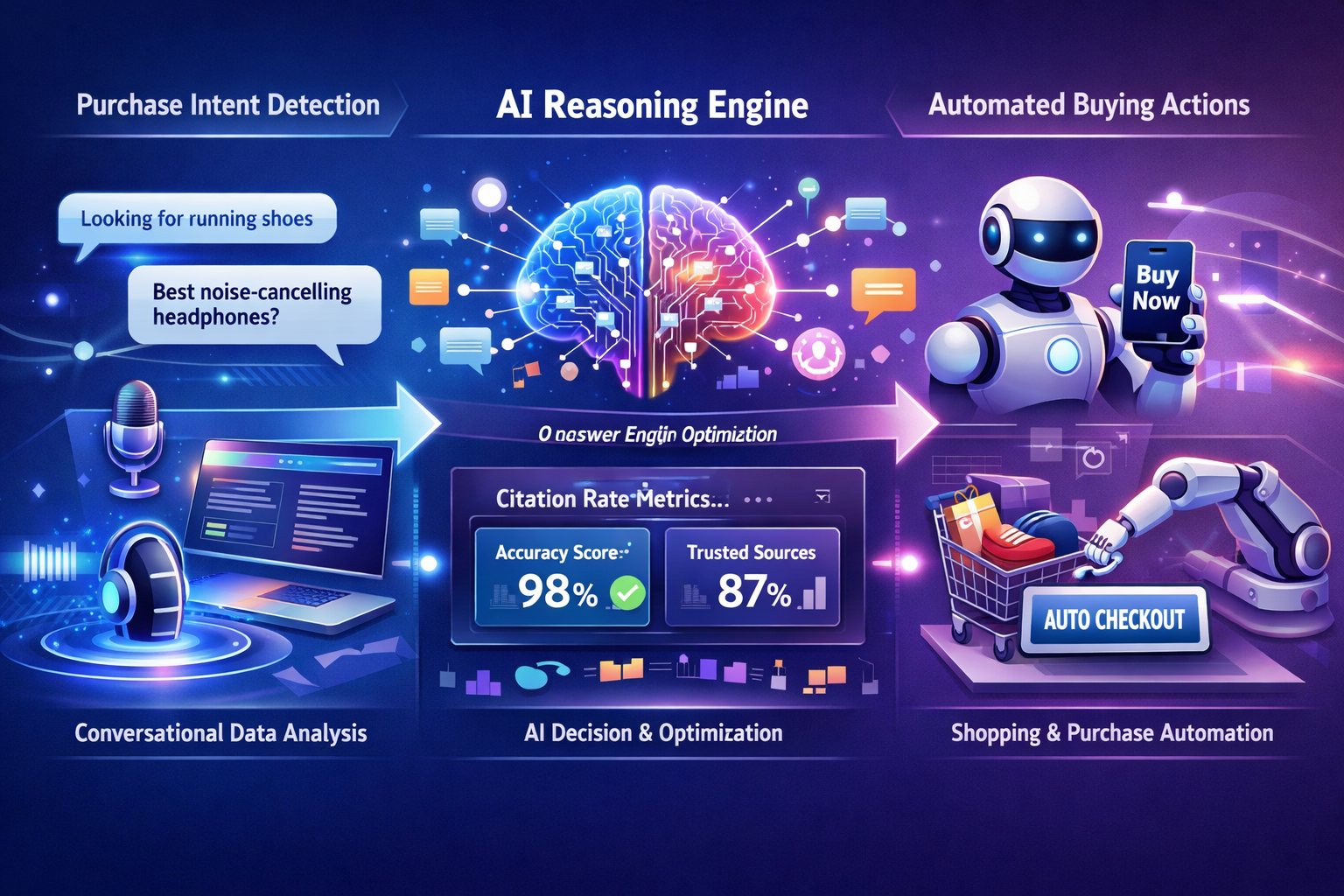
What Makes Agentic AI Different from Marketing AI Tools
Agentic AI represents a quantum leap beyond the marketing automation tools and AI assistants that dominated the previous decade. While traditional AI tools respond to human prompts and require constant oversight, agentic AI systems autonomously perceive their environment, reason through complex options, and take defined actions without continuous human intervention.[4]
The distinction between autonomous and assistive AI is critical for marketers to understand. Assistant-style copilots—like the AI writing tools many affiliates currently use—keep humans firmly in control, generating content or insights only when prompted. Agentic AI, conversely, operates with delegated authority, making decisions that previously required human judgment.[4]
Four core capabilities define true agentic AI systems:[5]
- Reasoning: Creative and contextual decision-making that adapts to nuanced situations
- Memory: Learning from interactions and adapting behavior over time
- Tool Use: Seamlessly operating across disparate systems and platforms
- Delegated Authority: Making autonomous decisions within defined parameters
For affiliate marketers, this means AI agents can now identify purchase intent during casual conversations, research relevant products across multiple merchants, compare prices and reviews, apply appropriate discount codes, and complete transactions—all without human intervention at any step.
The Shift from Search to Conversational Commerce
The fundamental interface between consumers and commerce is transforming. The progression is clear: search → chat → shopping → checkout.[1] This isn’t merely a new channel; it’s a complete reimagining of the customer journey.
Traditional affiliate marketing relied on intercepting customers during active search behavior—someone typing “best running shoes for marathon training” into Google represented clear purchase intent. The affiliate’s job was to rank for that keyword and present compelling product recommendations.
Conversational commerce operates differently. Purchase intent emerges organically during multi-turn dialogues where context accumulates across exchanges. A customer might discuss training plans with an AI assistant, mention upcoming race goals, describe previous injury concerns, and only then receive personalized product recommendations—all within a single conversation thread that never resembles traditional keyword searches.
This shift has profound implications for affiliate marketing strategies that have historically centered on keyword research and search engine rankings.
How Agentic AI Is Transforming Affiliate Marketing Operations
From Keyword Targeting to Conversational Intent
The death of keyword-based targeting represents one of the most disruptive changes for affiliate marketers in 2026. Conversational intent replaces keyword intent as the primary signal for relevance and targeting.[1]
Traditional attribution modeling—already complex with multi-touch attribution—becomes exponentially more challenging when customer journeys involve “influenced-by-assistant” pathways that don’t follow conventional last-click patterns.[1] An AI agent might research products across dozens of sources, synthesize reviews, compare specifications, and present recommendations without the customer ever clicking a traditional affiliate link.
Consider these fundamental changes:
| Traditional Affiliate Marketing | Agentic AI Affiliate Marketing |
|---|---|
| Target specific keywords | Optimize for conversational topics and contexts |
| Track clicks and conversions | Measure inclusion rates and citation rates |
| Create landing pages for search traffic | Structure product data for agent consumption |
| Focus on last-click attribution | Account for multi-agent influenced journeys |
| Optimize meta descriptions and titles | Optimize for answer engine visibility |
Marketers must now shift focus to answer engine optimization (AEO), tracking entirely new KPIs:[1]
- Inclusion Rate: How often your products/content appear in AI-generated responses
- Citation Rate: Frequency of being referenced as a trusted source
- Assisted Conversions: Purchases influenced by agent recommendations, even without direct clicks
These metrics require fundamentally different measurement infrastructure than traditional affiliate tracking systems. For those just learning how to do affiliate marketing, understanding these emerging metrics is as important as mastering traditional conversion optimization.
Product Data as Your Primary Creative Asset
Under emerging standards like Google’s Universal Commerce Protocol (UCP), which standardizes agentic shopping across merchants and payment providers, the quality of your product data has become your most important creative asset.[1]
Beautiful landing pages, compelling copy, and persuasive imagery still matter—but they’re increasingly secondary to structured, accurate, and comprehensive product information that AI agents can parse, understand, and present contextually.
The UCP framework includes capability declarations for:[1]
- ✅ Checkout processes
- ✅ Identity linking and authentication
- ✅ Order management and tracking
- ✅ Discount and promotion application
- ✅ Loyalty program integration
For affiliate marketers, this means partnering with merchants who provide clean, structured product feeds becomes more critical than ever. Agents can’t recommend products they can’t properly understand, regardless of commission rates.
Key product data elements that AI agents prioritize:
- Accurate, detailed specifications and attributes
- Real-time inventory and availability status
- Transparent pricing, including all fees
- Clear return policies and warranty information
- Verified customer reviews and ratings
- High-quality product imagery from multiple angles
- Compatibility and requirement information
Affiliates promoting products with incomplete or inaccurate data will find themselves increasingly excluded from agent recommendations, regardless of their SEO rankings or advertising spend.
Autonomous Purchase Decisions and Delegated Buying
Perhaps the most revolutionary aspect of Agentic AI in Marketing: How Autonomous Agents Are Revolutionizing Affiliate Sales and Personalization is the emergence of delegated buying authority. AI agents are beginning to make and execute purchase decisions on behalf of users within predefined parameters.
This capability is advancing fastest in “planning-oriented, repeatable decisions” such as:[3]
- 🛒 Weekly grocery shopping based on dietary preferences and household needs
- 👗 Outfit selection for specific occasions or weather conditions
- 🎁 Gift selection based on recipient preferences and occasion
- 🏠 Home improvement and seasonal refreshes
- 📦 Subscription refills and recurring purchases
High-friction tasks that previously required extensive human research—price comparisons, credibility verification, return policy analysis, and review validation—are automating most rapidly.[3] These were traditionally prime opportunities for affiliate marketers to add value through comparison content and trusted recommendations.
The challenge for affiliates: how do you maintain relevance when AI agents handle these research tasks autonomously? The answer lies in becoming the trusted data source that agents cite and recommend, rather than the intermediary that customers visit directly.
Strategies for Affiliate Marketers in the Agentic AI Era
Optimizing for Answer Engine Visibility
Answer Engine Optimization (AEO) represents the evolution of SEO for the conversational AI era. While traditional search engine optimization focused on ranking for specific queries, AEO centers on being selected, cited, and recommended by AI agents during multi-turn conversations.
Core AEO strategies for affiliate marketers:
Structure content for agent consumption: Use clear hierarchies, semantic HTML, and schema markup that AI systems can easily parse and understand.
Provide definitive, authoritative answers: AI agents prioritize sources that provide comprehensive, accurate information without requiring users to visit multiple sites.
Build citation-worthy expertise: Develop deep domain knowledge in specific niches rather than surface-level coverage across many topics. Agents cite specialists, not generalists.
Maintain factual accuracy: Inaccurate information damages your citation rate across all future queries. Quality control is paramount.
- Update content regularly: AI agents favor up-to-date information, particularly for time-sensitive topics such as
product availability, pricing, and specifications.
Optimize for conversational queries: Think about how people discuss topics naturally rather than how they search for keywords.
For affiliates exploring affiliate marketing opportunities in 2026, AEO expertise represents a significant competitive advantage that most competitors haven’t yet developed.
Designing for Conversations, Not Campaigns
The one-way messaging era is ending. Agentic AI enables always-on dialogue in which offers, tone, and timing adapt in real time based on conversational context.[2] Winning brands will compete on relevance frequency, not message volume.
This shift requires fundamentally rethinking affiliate content strategy:
Traditional Campaign Approach:
- Create promotional content around product launches
- Push messages to audience segments
- Optimize for immediate conversions
- Measure success by click-through and conversion rates
Conversational Approach:
- Develop comprehensive knowledge resources that address questions at all journey stages
- Enable AI agents to pull relevant information contextually
- Build trust through consistent, accurate information
- Measure success by citation rates and assisted conversions
Consider developing conversational content assets such as:
- Comprehensive product comparison databases
- Detailed specification and compatibility guides
- Use case and application scenarios
- Troubleshooting and support resources
- Transparent pros/cons analyses
These resources serve dual purposes: providing value to human visitors while functioning as authoritative sources that AI agents can reference and cite during conversations.
Building Multi-Agent Collaboration Systems
As agentic AI matures, marketing workflows increasingly involve multiple specialized agents collaborating rather than a single general-purpose assistant.[7] This creates new opportunities for affiliate marketers who understand how to position themselves within these multi-agent ecosystems.
The January 2026 ServiceNow-OpenAI partnership signals that agents are moving inside core business systems, not remaining isolated in creative tools.[1] This integration means AI agents will soon orchestrate complex workflows spanning:
- Customer research and intent detection
- Product discovery and comparison
- Inventory verification across merchants
- Price optimization and discount application
- Purchase execution and order tracking
- Post-purchase support and loyalty management
For affiliate marketers, success requires understanding where human expertise adds unique value within these automated workflows. Rather than competing with agents, the opportunity lies in becoming the trusted source that agents consult for domain expertise, product knowledge, and nuanced recommendations that require contextual judgment.
Those interested in how to become an affiliate marketer in this new era must develop skills in data structuring, API integration, and agent collaboration alongside traditional content creation and SEO.
Personalization at Scale Through Autonomous Agents
Real-Time Adaptive Personalization
Traditional personalization relied on segmentation—grouping customers by demographics, behavior, or preferences and delivering tailored experiences to each segment. Agentic AI enables individual-level personalization that adapts in real-time based on conversational context, immediate needs, and evolving preferences.
This represents a fundamental shift from static personalization rules to dynamic, contextual adaptation:
Segment-Based Personalization:
- Group customers into predefined categories
- Apply rules-based content and product recommendations
- Update segments periodically based on behavior
- Limited by segment granularity
Agentic Personalization:
- Understand individual context within specific conversations
- Adapt recommendations based on immediate needs and constraints
- Learn and evolve with each interaction
- Unlimited personalization granularity
For affiliate marketers, this means moving beyond demographic targeting toward contextual relevance. An AI agent helping someone plan a weekend hiking trip will recommend entirely different products than when assisting the same person with office setup—even though both conversations might happen on the same day.
The opportunity lies in providing agents with rich contextual signals about when, how, and why specific products deliver value in different scenarios. Product recommendations shift from “people like you bought this” to “this solves your specific situation.”
Memory and Learning Across Customer Journeys
One of the most powerful capabilities of agentic AI is persistent memory that accumulates across interactions.[5] Unlike traditional marketing automation that treats each session independently, AI agents build a comprehensive understanding of individual preferences, constraints, and goals over time.
This creates new possibilities for affiliate marketing:
- Preference learning: Agents remember product preferences, budget constraints, and quality priorities across multiple shopping occasions
- Relationship building: Trust compounds over time as agents consistently provide valuable recommendations
- Anticipatory recommendations: Agents can proactively suggest products based on predicted needs rather than reactive searches
- Lifecycle optimization: Understanding where customers are in product lifecycles enables timely upgrade or replacement recommendations
For affiliates, this shifts focus from one-time conversions to lifetime value optimization. Building relationships with AI agents that consistently cite your expertise and recommend your affiliate products creates compounding returns over time.
The challenge: traditional affiliate tracking cookies expire, but agent memory persists. New attribution models must account for influence that spans months or years of accumulated trust and recommendations.
The Economics of Answer-Native Advertising
ChatGPT Advertising and Answer-Native Ad Formats
OpenAI’s January 2026 announcement to test advertising in ChatGPT marks a watershed moment for affiliate marketers.[1] These answer-native ad formats appear at the bottom of AI-generated responses when relevant, clearly labeled, and dismissible—fundamentally different from search-based advertising.
Key characteristics of answer-native ads:[1]
- 📍 Contextually triggered by conversation content, not keywords
- 🎯 Appear only when genuinely relevant to the query
- 🏷️ Clearly labeled as sponsored content
- ❌ Dismissible without disrupting the conversation
- 🔒 Initially limited to US-based, logged-in adults on Free and Go tiers
For affiliate marketers, this creates new opportunities and challenges:
Opportunities:
- Reach customers during active research and decision-making conversations
- Target based on conversational intent rather than limited keyword searches
- Appear in context alongside organic recommendations
- Influence decisions at the moment of highest consideration
Challenges:
- Competition from direct merchant advertising
- Higher relevance thresholds than traditional PPC
- New creative formats optimized for conversational context
- Attribution complexity when ads appear alongside organic citations
Those exploring the best affiliate marketing programs for beginners should prioritize programs with robust tracking that can attribute conversions from these emerging ad formats.
Attribution in the Multi-Agent Era
Traditional last-click attribution was already inadequate for complex customer journeys. In the agentic AI era, attribution becomes exponentially more challenging as influenced-by-assistant journeys don’t follow conventional patterns.[1]
Consider a typical agentic purchase journey:
- Customer asks AI agent for workout advice
- The agent recommends a specific training approach
- Conversation naturally progresses to equipment needs
- Agent researches products across multiple sources (including your affiliate content)
- The agent synthesizes recommendations from various trusted sources
- Customer purchases through agent-facilitated checkout
- No traditional affiliate link click occurs
How do you attribute this conversion? The customer never visited your site, never clicked your affiliate link, yet your content directly influenced the agent’s recommendation.
Emerging attribution approaches:
- Citation tracking: Monitor when AI agents reference your content as sources
- Inclusion monitoring: Track product appearance in agent recommendations
- API-based attribution: Direct integration with agent platforms for influence tracking
- Probabilistic modeling: Statistical attribution based on citation patterns and conversion correlations
The introduction to AI in marketing requires understanding these new measurement paradigms alongside traditional metrics.
The Emerging “Context Marketer” Discipline
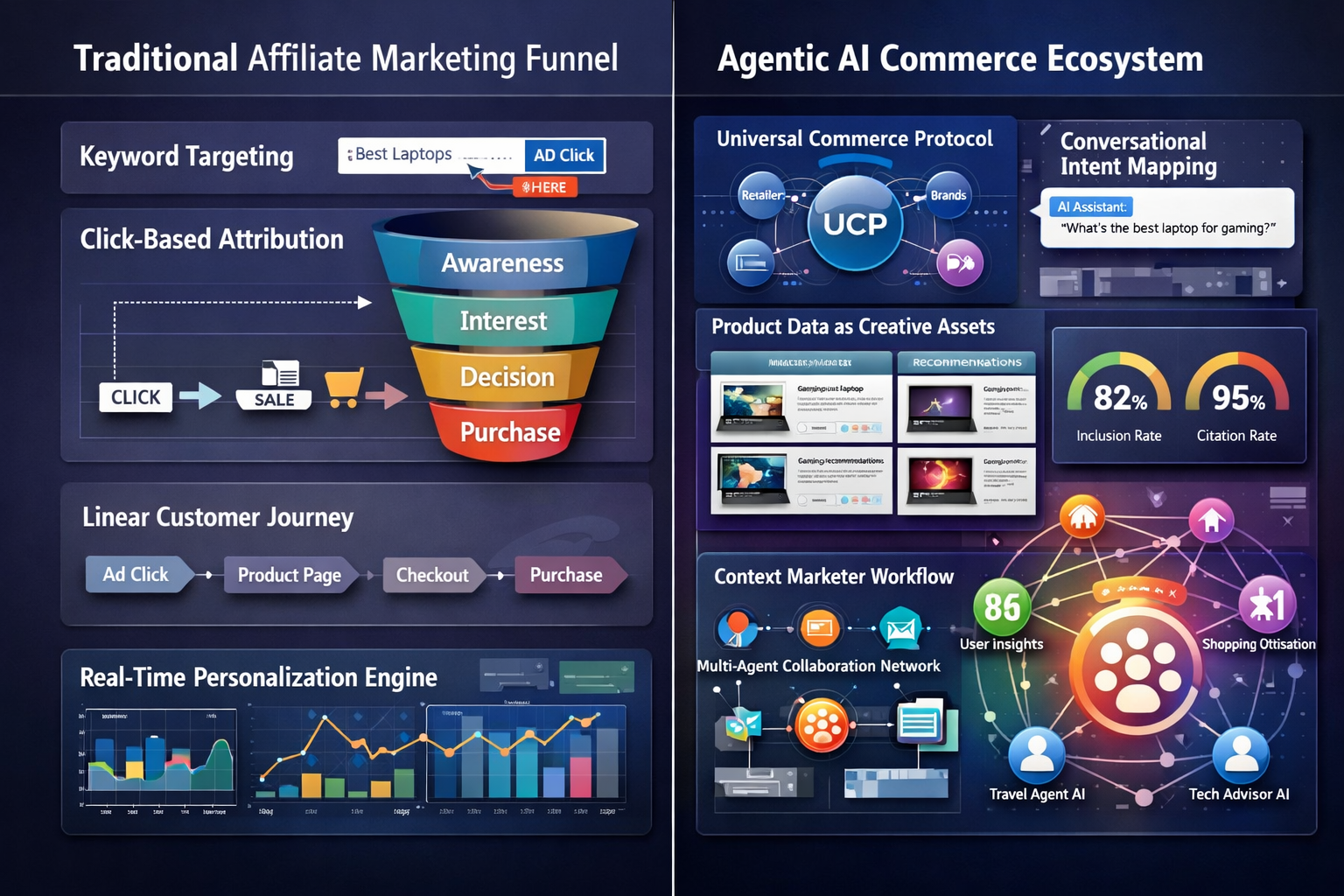
Beyond Data-Driven to Context-Aware Marketing
A new marketer archetype is rising in 2026: the context marketer.[4] This discipline bridges the gap where traditional data-driven metrics—clicks, opens, conversions—fail to explain why customers behave as they do.
Platform signals alone no longer explain customer behavior when AI agents mediate discovery, research, and purchase decisions. Context marketers understand:
- Conversational dynamics: How topics evolve through multi-turn dialogues
- Intent progression: How casual questions transform into purchase decisions
- Agent reasoning: How AI systems evaluate and prioritize information sources
- Contextual relevance: What makes recommendations appropriate for specific situations
This requires skills beyond traditional marketing analytics:
✅ Qualitative research: Understanding nuanced human needs and motivations
✅ Conversation design: Structuring information for dialogue-based discovery
✅ Semantic understanding: Grasping meaning beyond keyword matching
✅ Agent psychology: Comprehending how AI systems reason and decide
✅ Contextual mapping: Identifying when and why specific solutions fit specific situations
For affiliate marketers, developing context marketing skills creates a sustainable competitive advantage. While competitors optimize for yesterday’s metrics, context marketers position themselves for tomorrow’s conversational commerce ecosystem.
Competing on Relevance Frequency, Not Volume
The volume-based approach to affiliate marketing—publishing more content, sending more emails, creating more ads—is becoming counterproductive in the agentic AI era. Winning brands compete on relevance frequency: appearing at exactly the right moments with exactly the right information.[2]
This shift requires fundamental strategic changes:
Volume Strategy (Declining Effectiveness):
- Publish maximum content to capture long-tail keywords
- Send frequent promotional emails to maintain awareness
- Bid on broad keyword sets to maximize reach
- Optimize for impressions and traffic
Relevance Strategy (Rising Effectiveness):
- Create definitive resources on specific topics
- Provide value when customers need it, not on arbitrary schedules
- Target precise conversational contexts where you add unique value
- Optimize for citation rates and recommendation inclusion
AI agents don’t reward publishing frequency; they reward authoritative expertise. A single comprehensive, accurate, well-structured resource on a specific topic generates more agent citations than dozens of shallow articles targeting keyword variations.
For those starting affiliate marketing with no money, this is actually encouraging news. Quality and expertise matter more than content volume or advertising budgets.
Practical Implementation: Getting Started with Agentic AI Marketing
Audit Your Current Affiliate Assets for Agent Compatibility
Before launching new initiatives, assess how well your existing affiliate marketing assets work within agentic AI systems:
Content Audit Checklist:
- ✅ Structured data: Do you use schema markup for products, reviews, and comparisons?
- ✅ Factual accuracy: Can you verify every claim with authoritative sources?
- ✅ Comprehensive coverage: Do articles answer questions completely without requiring multiple sources?
- ✅ Clear hierarchy: Can AI agents easily parse your content structure?
- ✅ Conversational alignment: Does content address questions people actually ask?
- ✅ Product data quality: Are specifications, pricing, and availability accurate and current?
- ✅ Citation worthiness: Would you cite this content as an authoritative source?
Technical Infrastructure Audit:
- ✅ API accessibility: Can AI agents programmatically access your product data?
- ✅ Attribution tracking: Can you measure influence beyond traditional click-through?
- ✅ Real-time updates: Do product availability and pricing reflect the current status?
- ✅ Mobile optimization: Do conversational interfaces render your content properly?
This audit reveals gaps between your current approach and the requirements of agentic AI systems. Prioritize fixes that improve both human user experience and agent accessibility.
Build Your Answer Engine Optimization Foundation
Implementing AEO requires a systematic approach across content, technical, and strategic dimensions:
Phase 1: Foundation (Weeks 1-4)
- Implement comprehensive schema markup across all content
- Audit and correct factual inaccuracies in existing content
- Establish content update schedules to maintain currency
- Create structured product databases with complete specifications
Phase 2: Optimization (Weeks 5-8)
- Develop conversational content that addresses multi-turn query patterns
- Build comprehensive comparison resources that agents can cite
- Establish expertise signals through author credentials and source citations
- Optimize content structure for agent parsing and comprehension
Phase 3: Measurement (Weeks 9-12)
- Implement citation tracking across major AI platforms
- Monitor inclusion rates in agent-generated recommendations
- Establish baseline metrics for assisted conversions
- Create dashboards tracking AEO-specific KPIs
Phase 4: Refinement (Ongoing)
- Analyze which content types generate the highest citation rates
- Identify conversational contexts where you’re underrepresented
- Expand coverage in high-citation topics
- Continuously improve data quality and comprehensiveness
Those taking affiliate marketing courses online should seek programs that include AEO training alongside traditional SEO instruction.
Partner with Merchants Who Provide Agent-Ready Data
Your success in agentic AI marketing depends significantly on the quality of merchant product data. Prioritize partnerships with programs that provide:
🎯 Structured product feeds with comprehensive attributes
🎯 Real-time inventory and availability updates
🎯 API access for programmatic integration
🎯 Accurate specifications verified and regularly updated
🎯 High-quality imagery from multiple angles
🎯 Transparent pricing including all fees and restrictions
🎯 Clear policies for returns, warranties, and support
Merchants investing in agent-compatible infrastructure will capture a disproportionate share of AI-mediated commerce. Aligning with these forward-thinking programs positions you for success as agentic shopping accelerates.
When evaluating affiliate marketing opportunities, ask potential merchant partners specifically about their agentic AI readiness and product data infrastructure.
Future Outlook: What’s Next for Agentic AI in Marketing
The Standardization Wave: UCP and Beyond
Google’s Universal Commerce Protocol (UCP) represents “standardization-first” infrastructure for AI agent commerce.[1] This open standard aims to create interoperability across merchants, payment providers, and AI platforms—similar to how HTTP standardized web communication.
As UCP adoption accelerates through 2026 and beyond, expect:
- 🔄 Seamless cross-platform shopping: AI agents working consistently across different merchant systems
- 🛡️ Enhanced security and trust: Standardized authentication and verification protocols
- 📊 Improved attribution: Common frameworks for tracking agent-influenced conversions
- 🎁 Unified loyalty programs: AI agents automatically apply rewards across merchants
- 💳 Streamlined checkout: Consistent purchase experiences regardless of merchant
For affiliate marketers, standardization creates both opportunities and challenges. Lower friction benefits conversion rates, but also intensifies competition as agents can more easily compare offerings across merchants.
Success will increasingly depend on differentiation through expertise, trust, and contextual relevance rather than technical barriers or exclusive partnerships.
The Rise of Vertical-Specific Agents
While general-purpose AI assistants like ChatGPT capture headlines, specialized vertical agents are emerging for specific domains:[7]
- 🏥 Healthcare agents managing appointments, prescriptions, and wellness programs
- 💰 Financial agents optimizing investments, budgets, and insurance
- 🏠 Home management agents coordinating maintenance, utilities, and improvements
- 🚗 Transportation agents handling routes, bookings, and vehicle maintenance
- 🍽️ Nutrition agents planning meals, ordering groceries, and managing dietary needs
Each vertical presents unique affiliate opportunities for marketers who develop deep domain expertise. Becoming the authoritative source that healthcare agents cite for medical equipment recommendations, or that financial agents reference for insurance comparisons, creates defensible competitive positions.
The difference between affiliate marketing and digital marketing becomes even more pronounced as specialized agents require domain-specific optimization strategies.
Preparing for Fully Autonomous Commerce
The ultimate evolution of Agentic AI in Marketing: How Autonomous Agents Are Revolutionizing Affiliate Sales and Personalization is fully autonomous commerce, where AI agents handle complete purchase lifecycles with minimal human intervention.
Imagine AI agents that:
- 🤖 Monitor household inventory and automatically reorder supplies before depletion
- 📅 Anticipate seasonal needs and proactively research optimal products
- 💡 Identify opportunities for upgrades based on technological advances
- 🔍 Continuously monitor prices and automatically switch to better deals
- 🎯 Negotiate with merchant agents to optimize pricing and terms
In this future, affiliate marketing transforms from persuading individual consumers to influencing the AI agents that represent them. Your target audience becomes the algorithms that evaluate trustworthiness, expertise, and value rather than human readers.
Preparing for this future requires:
✅ Building machine-readable expertise signals
✅ Establishing verifiable authority in specific domains
✅ Creating comprehensive, structured knowledge resources
✅ Developing API-first content and data strategies
✅ Focusing on long-term trust over short-term conversions
Conclusion: Embracing the Agentic AI Revolution in Affiliate Marketing
Agentic AI in Marketing: How Autonomous Agents Are Revolutionizing Affiliate Sales and Personalization represents the most significant transformation in affiliate marketing since the emergence of search engines. The shift from keyword-based discovery to conversational commerce, from click-through attribution to citation-based influence, and from campaign-based messaging to contextual dialogue requires fundamental strategic evolution.
The marketers who thrive in this new era will be those who:
🎯 Embrace answer engine optimization as the new foundation of discoverability
🎯 Prioritize product data quality as their primary creative asset
🎯 Develop context marketing skills that go beyond traditional analytics
🎯 Build citation-worthy expertise in specific domains rather than surface-level coverage
🎯 Optimize for conversational intent instead of keyword targeting
🎯 Measure influence through inclusion rates and assisted conversions
🎯 Partner with agent-ready merchants who provide structured, accessible data
The transition won’t happen overnight, but the direction is clear. AI agents are becoming the primary interface between consumers and commerce, and affiliate marketers must adapt their strategies accordingly.
Actionable Next Steps
Ready to position your affiliate marketing for success in the agentic AI era? Start with these concrete actions:
This Week:
- Audit your top-performing content for agent compatibility
- Implement schema markup on product reviews and comparisons
- Test how AI assistants currently cite (or don’t cite) your content
- Identify factual inaccuracies that could damage citation rates
This Month:
- Develop one comprehensive, citation-worthy resource in your niche
- Establish relationships with merchants offering structured product data
- Create a dashboard tracking inclusion rates in AI-generated responses
- Begin optimizing content for conversational queries rather than keywords
This Quarter:
- Build a complete answer engine optimization strategy
- Develop expertise in context marketing and conversational design
- Experiment with answer-native advertising formats as they become available
- Establish new attribution models that account for agent-influenced journeys
The future of affiliate marketing belongs to those who understand that they’re no longer just optimizing for search engines or social algorithms—they’re building relationships with autonomous agents that will mediate billions of purchase decisions. Start building that foundation today.
For comprehensive guidance on navigating this transformation, explore our resources on AI marketing data and analytics and proven strategies to boost affiliate marketing income adapted for the agentic AI era.
References
[1] Weekly Ai Marketing Roundup January 21 30 2026 – https://marketingagent.blog/2026/01/30/weekly-ai-marketing-roundup-january-21-30-2026/
[2] Agentic Ai Ecommerce – https://www.salesmanago.com/blog/agentic-ai-ecommerce
[3] How Agentic Ai Will Reshape Shopping 2026 – https://www.emarketer.com/content/how-agentic-ai-will-reshape-shopping-2026
[4] Marketing Predictions Agentic Ai 2026 – https://www.snowflake.com/en/blog/marketing-predictions-agentic-ai-2026/
[5] Agentic Ai Marketing – https://contentmarketinginstitute.com/ai-in-marketing/agentic-ai-marketing
[6] Ai Update January 23 2026 Ai News And Views From The Past Week – https://www.marketingprofs.com/opinions/2026/54200/ai-update-january-23-2026-ai-news-and-views-from-the-past-week
[7] Agentic Ai 2026 Four Predictions – https://centricconsulting.com/blog/agentic-ai-2026-four-predictions/
[8] Beyond The Hype 8 Drivers For True Ai Transformation In The Agentic Age – https://www.weforum.org/stories/2026/01/beyond-the-hype-8-drivers-for-true-ai-transformation-in-the-agentic-age/
[9] Agentic Ai In Marketing – https://www.pwc.com/us/en/tech-effect/ai-analytics/agentic-ai-in-marketing.html
