

The marketing landscape has reached a tipping point. While most teams still juggle disconnected AI tools—a chatbot here, an analytics platform there—forward-thinking organizations are deploying something fundamentally different: autonomous AI agents that work together without human intervention. These Agentic AI Workflows: Revolutionizing Marketing Operations in 2026 represent a seismic shift from simple automation to intelligent, self-directed systems that plan, execute, and optimize campaigns around the clock.
The results speak for themselves. Organizations implementing these interconnected workflows are achieving 836% ROI and 41% conversion rates—numbers that seemed impossible just months ago.[1] But the transformation goes beyond metrics. CMOs are witnessing their teams shift from reactive task execution to strategic oversight, as AI agents handle everything from real-time lead scoring to autonomous budget reallocation across advertising platforms.
Key Takeaways
- 🚀 Agentic AI workflows deliver measurable business impact with organizations achieving 836% ROI and 41% conversion rates through autonomous, interconnected AI systems
- ⚡ Real-time autonomous optimization replaces manual processes, with AI agents working 24/7 to adjust campaigns, reallocate budgets, and personalize customer journeys without human intervention
- 🔄 Agent-to-agent commerce is emerging as a dominant interaction model in 2026, with customer AI assistants negotiating directly with brand-deployed agents
- 📊 Marketing teams report 73% faster campaign development and 68% shorter content creation timelines when leveraging agentic workflows
- 🎯 By 2028, at least 15% of day-to-day work decisions will be made autonomously through agentic AI, fundamentally reshaping marketing team structures
Understanding Agentic AI Workflows in Marketing
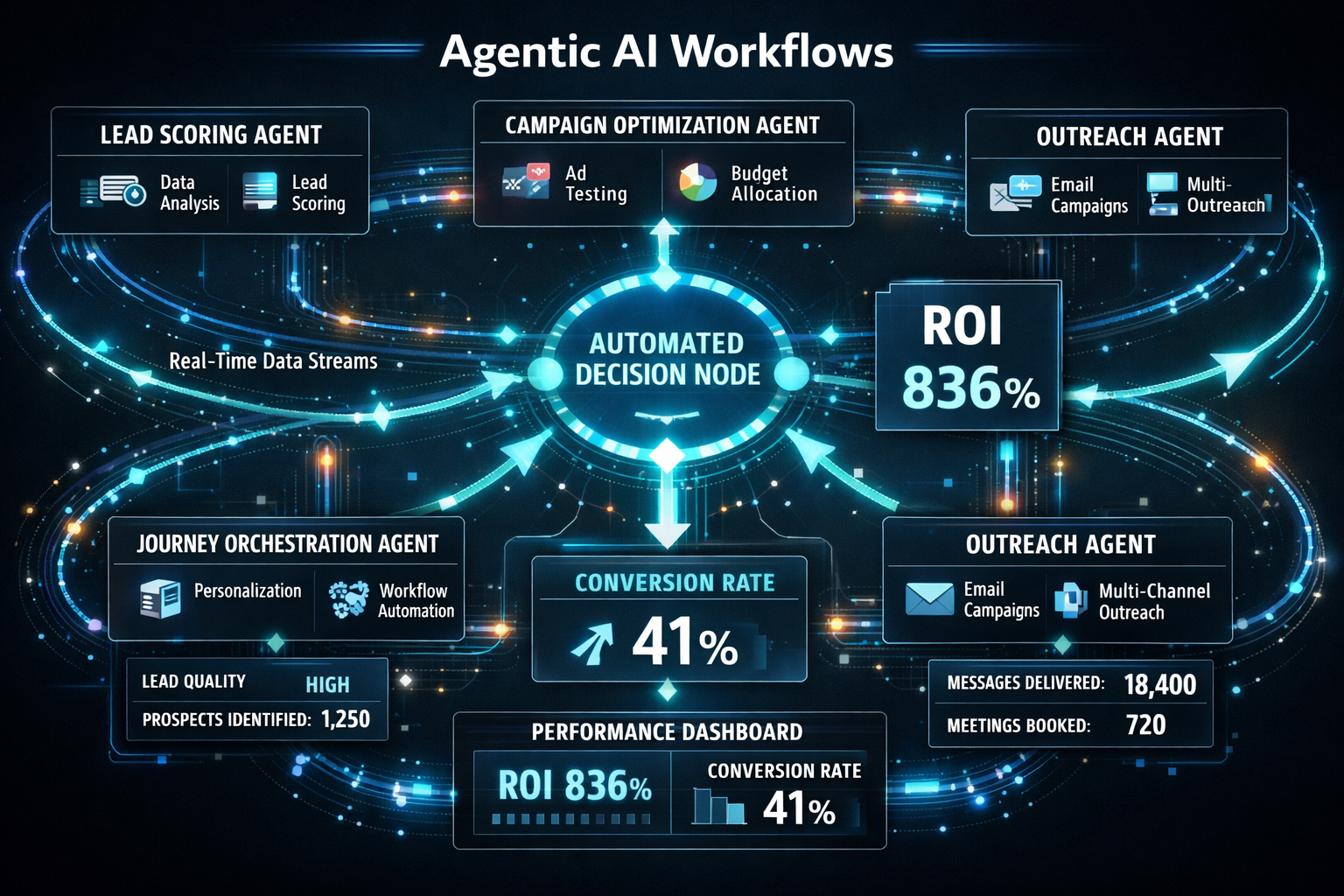
Agentic AI represents a fundamental evolution beyond traditional automation. While conventional marketing automation follows predetermined rules (“if X happens, do Y”), agentic systems can plan, reason, and adapt to changing circumstances. These AI agents operate with a degree of autonomy, enabling them to make decisions, learn from outcomes, and coordinate with other agents to achieve complex marketing objectives.
What Makes AI “Agentic”?
The defining characteristics of agentic AI include:
- Autonomous decision-making: Agents analyze situations and choose actions without waiting for human approval
- Goal-oriented behavior: Systems work toward defined objectives (increase conversions, reduce churn, optimize spend) rather than simply executing tasks
- Environmental awareness: Agents continuously monitor multiple data sources and adapt to changes in real-time
- Inter-agent collaboration: Multiple specialized agents communicate and coordinate to accomplish complex workflows
- Learning capabilities: Systems improve performance based on outcomes and feedback loops
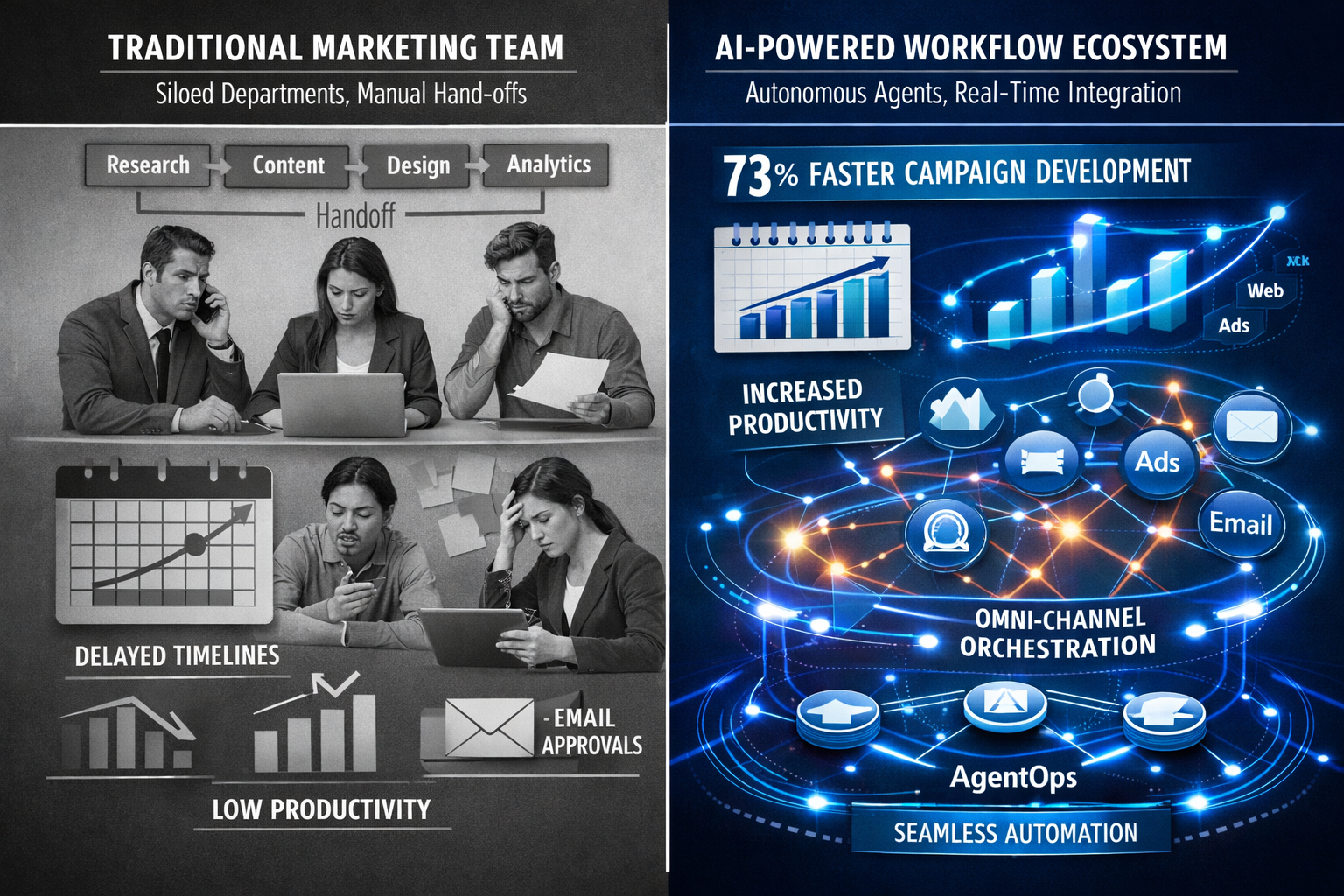
This represents a dramatic departure from the relay-race structure that defines most marketing teams today, where tasks pass sequentially from content creators to designers to campaign managers to analysts. In agentic workflows, specialized AI agents work simultaneously and collaboratively, compressing timelines and eliminating bottlenecks.
The Shift From Tools to Ecosystems
Traditional marketing technology stacks consist of isolated tools that require human operators to connect the dots. Marketers spend countless hours transferring data between platforms, interpreting analytics, and manually adjusting campaigns based on insights. AI Marketing: Automate & Boost Sales by 40% in 2025 highlighted early automation benefits, but 2026 has ushered in something far more sophisticated.
Agentic AI Workflows: Revolutionizing Marketing Operations in 2026 by creating interconnected ecosystems where:
- Lead Scoring Agents continuously assess prospect behavior across websites, email platforms, CRMs, and third-party intent data providers
- Campaign Optimization Agents automatically reallocate advertising budgets to top-performing channels and creative variations
- Journey Orchestration Agents design unique paths for each customer based on individual preferences and behaviors
- Outreach Agents adapt communication strategies in real-time, switching channels when engagement drops
These agents don’t just automate tasks—they autonomously manage entire marketing functions with minimal human oversight.
Real-World Applications of Agentic AI Workflows: Revolutionizing Marketing Operations in 2026
The theoretical promise of agentic AI becomes tangible when examining specific use cases that marketing teams are deploying right now. These implementations demonstrate how autonomous agents are transforming core marketing functions.
Dynamic Lead Scoring and Qualification
Traditional lead scoring assigns static points based on demographic data and basic behaviors. An agentic approach transforms this into a dynamic, real-time assessment that continuously evolves.[1]
How Lead Scoring Agents Work:
- Continuous monitoring across all customer touchpoints (website visits, email opens, content downloads, social media engagement)
- Intent signal integration from third-party data providers showing active research behavior
- Instant score adjustments when new information becomes available
- Automated alerts to sales teams when leads cross qualification thresholds
- Predictive analysis identifying which leads are most likely to convert within specific timeframes
One enterprise software company reported that their Lead Scoring Agent identified 32% more qualified opportunities than their previous rule-based system, while reducing false positives by 47%. The agent learned that prospects who viewed pricing pages multiple times across different devices showed higher purchase intent than those who simply downloaded whitepapers—a nuance their static scoring model had missed.
Autonomous Campaign Optimization
Ad Optimization Agents represent perhaps the most immediately impactful application of agentic workflows. These systems operate 24/7 across advertising platforms like Google Ads, LinkedIn, and Facebook, making budget allocation decisions that previously required constant human attention.[1]
Key Capabilities Include:
- Performance monitoring at granular levels (individual ads, audience segments, time periods)
- Budget reallocation moving spend from underperforming to high-converting campaigns in real-time
- Creative testing automatically launches new A/B tests and retires poor performers
- Bid optimization ,adjusting bids based on conversion likelihood and customer lifetime value
- Cross-platform coordination ensuring consistent messaging while optimizing channel-specific performance
A retail brand implementing Ad Optimization Agents achieved a 41% conversion rate while reducing its cost per acquisition by 28%. The agents discovered that their target audience responded better to video ads on mobile devices during the evening hours, automatically reallocating the budget to capitalize on this insight.[1]
For marketers looking to enhance their foundational strategies, exploring affiliate marketing optimization techniques can offer complementary approaches to improving performance.
Personalized Journey Orchestration
Journey Orchestration Agents create unique paths for each customer rather than forcing everyone through the same funnel. These agents select messages, channels, and timing based on individual preferences and behaviors.[1]
Orchestration Agent Decision-Making:
| Customer Segment | Preferred Channel | Optimal Timing | Content Type |
|---|---|---|---|
| Highly engaged email subscribers | Morning (8-10 AM) | Educational content, product updates | |
| Mobile-first millennials | Mobile app notifications | Evening (7-9 PM) | Video content, limited-time offers |
| Research-intensive B2B buyers | LinkedIn + Email | Midweek (Tue-Thu) | Case studies, ROI calculators |
| Price-sensitive shoppers | SMS + Retargeting ads | Weekend | Discount codes, comparison guides |
A financial services company deployed Journey Orchestration Agents that increased customer engagement by 156% by recognizing that some customers preferred detailed email communications while others responded better to brief SMS updates with links to self-service resources.
Predictive Churn Prevention
Churn Prevention Agents analyze behavioral patterns to identify customers at risk of leaving, then autonomously deploy retention strategies. These implementations have achieved 10-25% reductions in churn through proactive interventions.[1]
Agent Actions Include:
- 🎯 Identifying early warning signals (decreased login frequency, reduced feature usage, support ticket patterns)
- 💬 Triggering personalized outreach with relevant value propositions
- 🎁 Deploying targeted incentives (discounts, feature upgrades, exclusive content)
- 📞 Escalating high-value at-risk customers to human account managers
- 📊 Continuously learning which interventions work best for different customer segments
The Agent-to-Agent Commerce Revolution
Perhaps the most transformative aspect of Agentic AI Workflows: Revolutionizing Marketing Operations in 2026 is the emergence of agent-to-agent commerce. This represents a fundamental shift in how business transactions occur.[2]
How Agent-to-Agent Interactions Work
In traditional commerce, a customer researches products, compares options, and makes purchase decisions through direct interaction with brand websites and sales teams. In the agent-to-agent model:
- Customer AI assistants understand user preferences, budget constraints, and needs
- Brand-deployed agents maintain comprehensive product knowledge, inventory data, and pricing flexibility
- Automated negotiation occurs between these agents, with conversations that previously took minutes collapsing into single automated exchanges[2]
- Optimal matches are identified based on actual fit rather than marketing messaging
- Transactions complete with minimal human involvement
This shift has profound implications for marketing operations. Brands must optimize for machine understanding rather than human persuasion. Traditional SEO is being superseded by Large Language Model Optimization (LLMO) and Generative Engine Optimization (GEO), requiring marketers to structure product knowledge, inventory data, and customer preferences so that AI agents can efficiently process them.[3]
Preparing for Agent-Driven Discovery
Smart marketers are already adapting their strategies for this agent-to-agent future:
- Structured data implementation: Ensuring product information is machine-readable with comprehensive attributes, specifications, and use cases
- API-first architecture: Building systems that allow AI agents to query inventory, pricing, and availability in real-time
- Value proposition clarity: Articulating differentiation in ways that AI agents can objectively evaluate
- Dynamic pricing capabilities: Enabling agents to negotiate within defined parameters
- Integration readiness: Preparing systems to communicate with various customer AI platforms
Organizations that delay this transition risk becoming invisible to AI-powered discovery systems that increasingly mediate customer purchase decisions.
Operational Infrastructure: The Rise of AgentOps
Managing fleets of autonomous AI agents requires new operational frameworks. Enter AgentOps—a critical infrastructure layer analogous to how DevOps reshaped software deployment in the 2010s.[2]
What AgentOps Manages
Cost Control:
- Monitoring token usage and API calls across agent fleets
- Optimizing model selection (using smaller, cheaper models when appropriate)
- Preventing runaway spending from poorly configured agents
Reliability and Performance:
- Ensuring agents complete tasks successfully
- Monitoring response times and throughput
- Implementing fallback mechanisms when agents encounter errors
Compliance and Governance:
- Auditing agent decisions for regulatory compliance
- Maintaining transparency in automated decision-making
- Ensuring agents operate within defined ethical boundaries
Security:
- Protecting sensitive data accessed by agents
- Preventing prompt injection attacks
- Monitoring for unusual agent behavior that might indicate compromise
Organizations implementing robust AgentOps frameworks report 40% increases in order intake, doubled prospecting efforts, and contract cycle times cut by up to 50%.[6] These gains come from agents operating reliably at scale without the bottlenecks inherent in human-dependent processes.
For teams building comprehensive data foundations to support these systems, Data & Analytics for AI Marketing: Complete Guide 2025 provides essential frameworks.
Productivity Gains and Time Savings
The efficiency improvements from Agentic AI Workflows: Revolutionizing Marketing Operations in 2026 extend across the entire marketing function. Recent research reveals striking productivity gains:
Campaign Development Acceleration
Marketing teams using AI agents report:[8]
- 73% faster campaign development from concept to launch
- 68% shorter content creation timelines for multi-channel campaigns
- 5 hours per week saved on tasks that previously consumed significantly more time
- 3x increase in the number of campaign variations tested simultaneously
These time savings don’t just improve efficiency—they fundamentally change what’s possible. Teams can now test dozens of creative variations, personalize at individual customer levels, and respond to market changes within hours rather than weeks.
Resource Reallocation
The automation of routine tasks allows marketing professionals to focus on higher-value activities:
Before Agentic AI:
- 60% of time on execution (building campaigns, pulling reports, adjusting bids)
- 25% on analysis (interpreting data, identifying insights)
- 15% on strategy (planning, creative direction, positioning)
After Agentic AI Implementation:
- 20% on execution oversight (monitoring agent performance, handling exceptions)
- 30% on analysis (deeper strategic insights, market research)
- 50% on strategy (innovation, brand building, customer experience design)
This shift elevates marketing from a primarily executional function to a strategic driver of business growth.
Implementation Challenges and Considerations
While the benefits of agentic workflows are compelling, successful implementation requires navigating several challenges:
Data Quality and Integration
Agentic AI systems are only as good as the data they access. Organizations must:
- Consolidate data sources into unified customer profiles
- Ensure data accuracy through regular cleansing and validation
- Establish data governance, defining what agents can access
- Implement real-time synchronization across systems
Poor data quality leads to agent decisions based on incomplete or incorrect information, potentially damaging customer relationships and wasting budget.
Change Management
Shifting from human-driven to agent-driven workflows requires significant organizational change:
- Redefining roles as team members transition from execution to oversight
- Building trust in autonomous systems through transparency and gradual rollout
- Developing new skills in prompt engineering, agent configuration, and performance monitoring
- Overcoming resistance from team members who fear displacement
Successful implementations involve marketing teams in agent design, clearly communicating how automation enhances rather than replaces human judgment, and celebrating early wins to build momentum.
Ethical and Compliance Considerations
Autonomous agents raise important questions about accountability and fairness:
- Bias mitigation: Ensuring agents don’t perpetuate or amplify discriminatory patterns in data
- Transparency: Maintaining visibility into how agents make decisions
- Privacy protection: Preventing agents from accessing or using data inappropriately
- Regulatory compliance: Ensuring automated decisions meet industry-specific requirements
Organizations must establish clear governance frameworks before deploying agents at scale, with regular audits and human oversight of high-stakes decisions.
For those exploring broader marketing career opportunities in this evolving landscape, affiliate marketing jobs showcase emerging roles that blend traditional marketing expertise with AI capabilities.
Future Trajectory: What’s Next for Agentic Marketing
The evolution of Agentic AI Workflows: Revolutionizing Marketing Operations in 2026 is accelerating. Industry analysts predict several key developments:
Autonomous Decision-Making Expansion
By 2028, at least 15% of day-to-day work decisions will be made autonomously through agentic AI, with 33% of enterprise software solutions featuring this technology.[4] This means the majority of routine marketing decisions—budget allocations, content personalization, channel selection, and timing optimization—will be made without human involvement.
Multi-Agent Collaboration Sophistication
Current implementations typically deploy agents for specific functions (lead scoring, campaign optimization). The next wave involves sophisticated multi-agent collaboration where:
- Content Creation Agents generate campaign assets
- Brand Compliance Agents review for consistency and guidelines
- Localization Agents adapt messaging for different markets
- Distribution Agents select optimal channels and timing
- Performance Monitoring Agents track results and trigger optimizations
These agent teams will operate like high-performing human teams, but at machine speed and scale.
Predictive Strategy Development
Beyond executing campaigns, future agents will propose strategic recommendations:
- Identifying emerging market opportunities before competitors
- Suggesting new customer segments based on behavioral patterns
- Recommending product positioning adjustments based on sentiment analysis
- Predicting competitive moves and proposing counter-strategies
This elevates AI from tactical execution to strategic partnership.
Industry-Specific Agent Specialization
Generic marketing agents will give way to highly specialized agents trained on industry-specific data and optimized for sector-specific challenges:
- Healthcare Marketing Agents navigating HIPAA compliance and patient engagement
- Financial Services Agents balancing regulatory requirements with conversion optimization
- E-commerce Agents managing dynamic pricing and inventory-aware promotions
- B2B SaaS Agents orchestrating complex, multi-stakeholder buying journeys
These specialized agents will deliver superior performance by understanding industry nuances that generic systems miss.
Building Your Agentic Workflow Strategy
For marketing leaders ready to embrace this transformation, a structured approach ensures successful implementation:
Phase 1: Assessment and Preparation (Months 1-2)
Evaluate Current State:
- Audit existing marketing technology stack
- Identify manual, repetitive processes consuming significant time
- Assess data quality and integration readiness
- Review team skills and identify capability gaps
Define Objectives:
- Establish clear success metrics (efficiency gains, conversion improvements, cost reductions)
- Prioritize use cases based on potential impact and implementation complexity
- Secure executive sponsorship and budget allocation
Phase 2: Pilot Implementation (Months 3-5)
Start Small:
- Select one high-impact, lower-complexity use case for initial deployment
- Choose a contained pilot environment to minimize risk
- Implement robust monitoring to track agent performance
Recommended Pilot Use Cases:
- Ad Budget Optimization Agent: Manages spend allocation across paid channels
- Email Personalization Agent: Customizes messaging based on recipient behavior
- Lead Scoring Agent: Continuously assesses and prioritizes prospects
Learn and Iterate:
- Gather feedback from team members working alongside agents
- Identify unexpected challenges and refine configurations
- Document lessons learned for broader rollout
Phase 3: Expansion and Scaling (Months 6-12)
Broaden Deployment:
- Expand successful pilots to additional campaigns and channels
- Introduce new agent types addressing different marketing functions
- Build inter-agent workflows enabling collaboration
Develop AgentOps Capabilities:
- Implement monitoring and governance frameworks
- Establish cost controls and performance benchmarks
- Create escalation protocols for agent failures or anomalies
Upskill Team:
- Train marketers in agent configuration and prompt engineering
- Develop new performance metrics focused on strategic outcomes
- Redefine roles to emphasize oversight and strategy
For those seeking to understand how these advanced techniques fit within broader marketing frameworks, best affiliate marketing tips offers foundational strategies that remain relevant even as execution becomes increasingly automated.
The Competitive Imperative
The gap between organizations leveraging Agentic AI Workflows: Revolutionizing Marketing Operations in 2026 and those still operating with traditional structures is widening rapidly. Early adopters are achieving:
- Faster time-to-market launching campaigns in days rather than weeks
- Superior personalization delivering individualized experiences at scale
- Better ROI through continuous, autonomous optimization
- Enhanced customer experiences via perfectly timed, relevant interactions
- Strategic advantage by freeing human talent for innovation rather than execution
Meanwhile, organizations clinging to relay-race team structures face mounting challenges:
- 📉 Inability to compete on speed and agility
- 💸 Higher operational costs for comparable output
- 😞 Difficulty attracting top marketing talent who want to work with cutting-edge technology
- 📊 Suboptimal campaign performance compared to AI-optimized competitors
- 🔄 Burnout from teams overwhelmed by manual tasks that could be automated
The question is no longer whether to implement agentic workflows, but how quickly your organization can make the transition.
Conclusion: Embracing the Agentic Future
Agentic AI Workflows: Revolutionizing Marketing Operations in 2026 represents far more than incremental improvement in marketing automation. This is a fundamental reimagining of how marketing teams operate, shifting from human-dependent execution to AI-driven autonomous systems that work around the clock to achieve business objectives.
The evidence is clear: organizations implementing these workflows achieve 836% ROI, 41% conversion rates, and 73% faster campaign development.[1][8] But beyond the metrics, agentic AI liberates marketing professionals from routine execution, enabling them to focus on strategy, creativity, and the uniquely human aspects of building brands and relationships.
Your Next Steps
If you’re just beginning this journey:
- Educate your team on agentic AI capabilities and potential applications
- Audit your data infrastructure to ensure you have the foundation for agent deployment
- Identify one high-impact pilot use case to demonstrate value quickly
- Select technology partners with proven agentic AI capabilities
- Start small but think big about the long-term transformation
If you’re already implementing agentic workflows:
- Expand successful pilots to additional marketing functions
- Build AgentOps capabilities to manage agent fleets at scale
- Develop multi-agent collaboration workflows for complex campaigns
- Optimize for agent-to-agent commerce by implementing LLMO strategies
- Invest in team development ensuring marketers can thrive in this new paradigm
The marketing teams that will dominate in 2026 and beyond aren’t those with the largest budgets or the biggest staffs—they’re the ones that successfully harness autonomous AI agents to amplify human creativity and strategic thinking. The revolution is here. The only question is whether you’ll lead it or be left behind.
References
[1] Ai Agentic Workflows Marketing – https://thesmarketers.com/blogs/ai-agentic-workflows-marketing/
[2] How Ai Agents Will Reshape Every Part Of Marketing In 2026 – https://martech.org/how-ai-agents-will-reshape-every-part-of-marketing-in-2026/
[3] Agentic Ai Ecommerce – https://www.salesmanago.com/blog/agentic-ai-ecommerce
[4] Agentic Ai The Next Leap In Marketing Automation – https://www.aprimo.com/blog/agentic-ai-the-next-leap-in-marketing-automation
[5] Agentic Ai Marketing – https://contentmarketinginstitute.com/ai-in-marketing/agentic-ai-marketing
[6] Agentic Ai Takes The Wheel A Deep Dive Into 2026 – https://www.insentragroup.com/us/insights/not-geek-speak/generative-ai/agentic-ai-takes-the-wheel-a-deep-dive-into-2026/
[7] 10 Ai Marketing Trends For 2026 Agentic Ai And Search Shifts – https://www.adweek.com/brand-marketing/10-ai-marketing-trends-for-2026-agentic-ai-and-search-shifts/
[8] Ai Agents For Marketing Teams – https://www.mindstudio.ai/blog/ai-agents-for-marketing-teams
[9] Agentic Ai Strategy – https://www.deloitte.com/us/en/insights/topics/technology-management/tech-trends/2026/agentic-ai-strategy.html
