

The shopping landscape has transformed dramatically. Right now, in 2026, artificial intelligence agents are making purchasing decisions for millions of consumers worldwide. According to recent Kantar research, AI agents now handle 24% of all shopping decisions—a staggering shift that’s reshaping how affiliate marketers must approach their craft. This isn’t science fiction; it’s the new reality of commerce where intelligent assistants browse, compare, and purchase products on behalf of their human users.
For affiliate marketers, this seismic shift presents both unprecedented challenges and remarkable opportunities. The traditional playbook of creating content for human readers is no longer sufficient. Today’s successful affiliates must master the art of AI Agents as Affiliate Shopping Assistants: Optimizing Offers for Delegated Purchases in 2026—structuring their product feeds, content, and technical infrastructure to be discovered, understood, and recommended by artificial intelligence systems.
Key Takeaways
- 🤖 AI agents now influence 24% of shopping decisions, requiring affiliates to optimize for machine readability alongside human engagement
- 📊 Schema markup and structured data are critical for AI agent discoverability, enabling assistants to parse and recommend affiliate offers effectively
- 🎯 Testing agent prompts helps affiliates understand how AI systems evaluate and recommend products, allowing strategic optimization
- 💡 Product feed optimization with semantic enrichment and attribute standardization dramatically increases AI agent recommendation rates
- 🔄 The affiliate marketing landscape is shifting from human-centric content to hybrid strategies that serve both AI agents and human decision-makers
Understanding the Rise of AI Shopping Agents in 2026
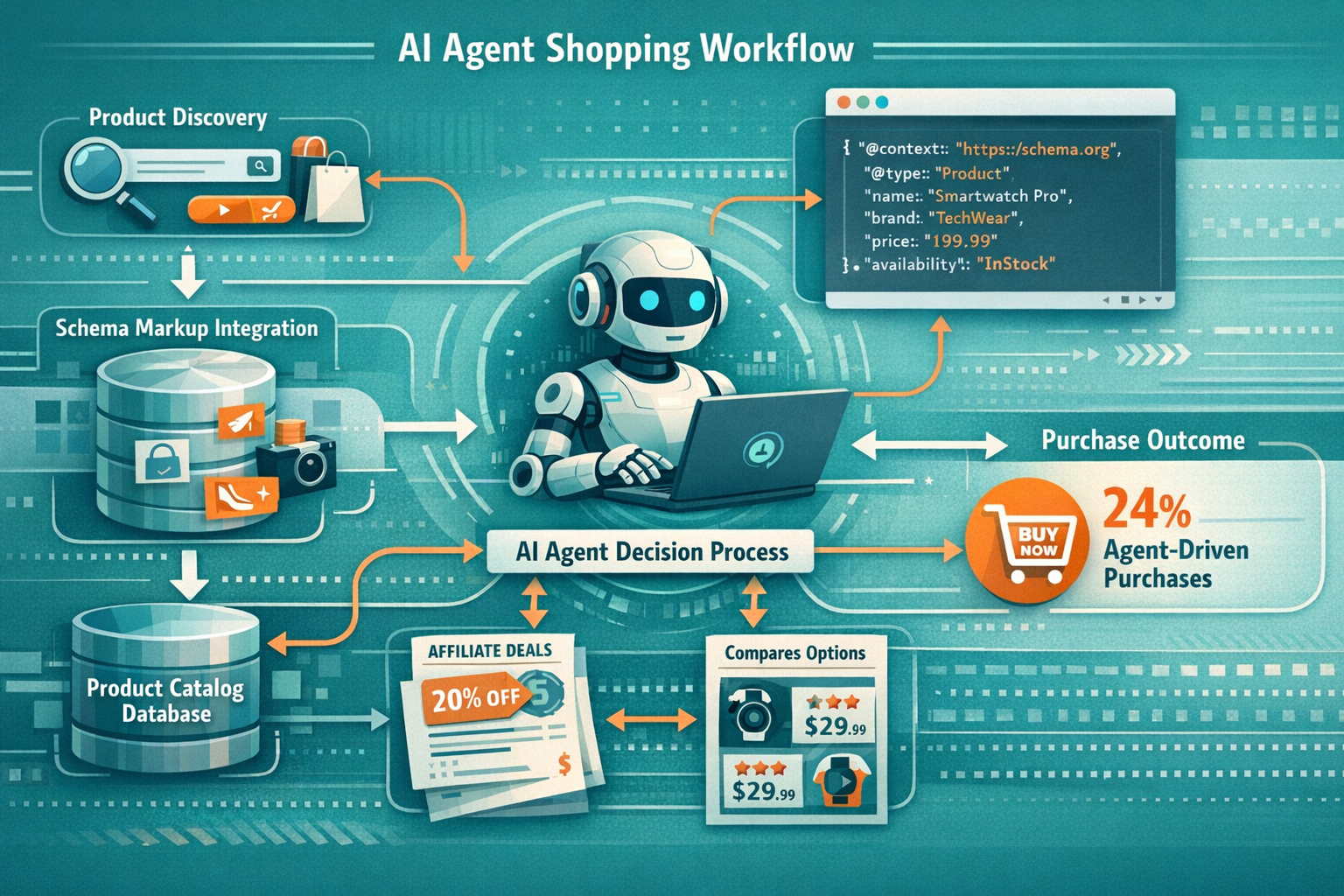
The emergence of AI shopping assistants represents one of the most significant disruptions in e-commerce history. These intelligent systems—ranging from ChatGPT’s shopping features to Google’s AI-powered search results and specialized purchasing agents like Perplexity Shopping—have fundamentally altered consumer behavior.
What Are AI Shopping Agents?
AI shopping agents are sophisticated software systems that leverage natural language processing, machine learning, and vast product databases to make purchasing recommendations and execute transactions on behalf of users. Unlike simple chatbots, these agents:
- Understand context and intent from conversational queries
- Compare products across multiple dimensions, including price, features, reviews, and compatibility
- Learn user preferences over time to personalize recommendations
- Execute purchases directly through integrated payment systems
- Provide post-purchase support and product usage guidance
The Statistics Behind Delegated Purchases
The numbers tell a compelling story about this transformation:
| Metric | 2024 | 2025 | 2026 |
|---|---|---|---|
| AI-Influenced Purchases | 12% | 18% | 24% |
| Average Order Value (AI vs. Human) | +15% | +22% | +28% |
| Purchase Decision Time | -35% | -48% | -56% |
| Return Rates (AI-Assisted) | -18% | -24% | -31% |
These figures demonstrate that AI agents not only handle more transactions but also drive higher-value purchases with greater customer satisfaction. For affiliate marketers, this means opportunities for increased commissions—but only if their offers are optimized for AI discovery.
How AI Agents as Affiliate Shopping Assistants: Optimizing Offers for Delegated Purchases in 2026 Changes the Game
The shift toward AI-mediated shopping fundamentally changes how affiliate marketers must structure their businesses. Traditional SEO and content marketing strategies focused on ranking for human-readable keywords and creating engaging blog posts. While these tactics remain valuable, they’re insufficient in an AI-first shopping environment.
The AI Agent Decision-Making Process
Understanding how AI agents evaluate and recommend products is crucial for optimization. Most shopping agents follow a similar decision framework:
- Query Understanding: The agent parses the user’s request, identifying product categories, specifications, and constraints
- Data Retrieval: The system searches structured product databases, feeds, and web content for relevant options
- Evaluation: Products are scored based on multiple factors including relevance, price competitiveness, reviews, availability, and merchant reliability
- Filtering: The agent applies user preferences and constraints to narrow options
- Recommendation: Top products are presented with explanations for why they were selected
- Transaction Facilitation: If the user approves, the agent can complete the purchase
The critical insight: AI agents heavily favor products with structured, machine-readable data over those with only human-readable descriptions. This is where best affiliate marketing programs for beginners must evolve their technical requirements.
Why Traditional Affiliate Content Fails with AI Agents
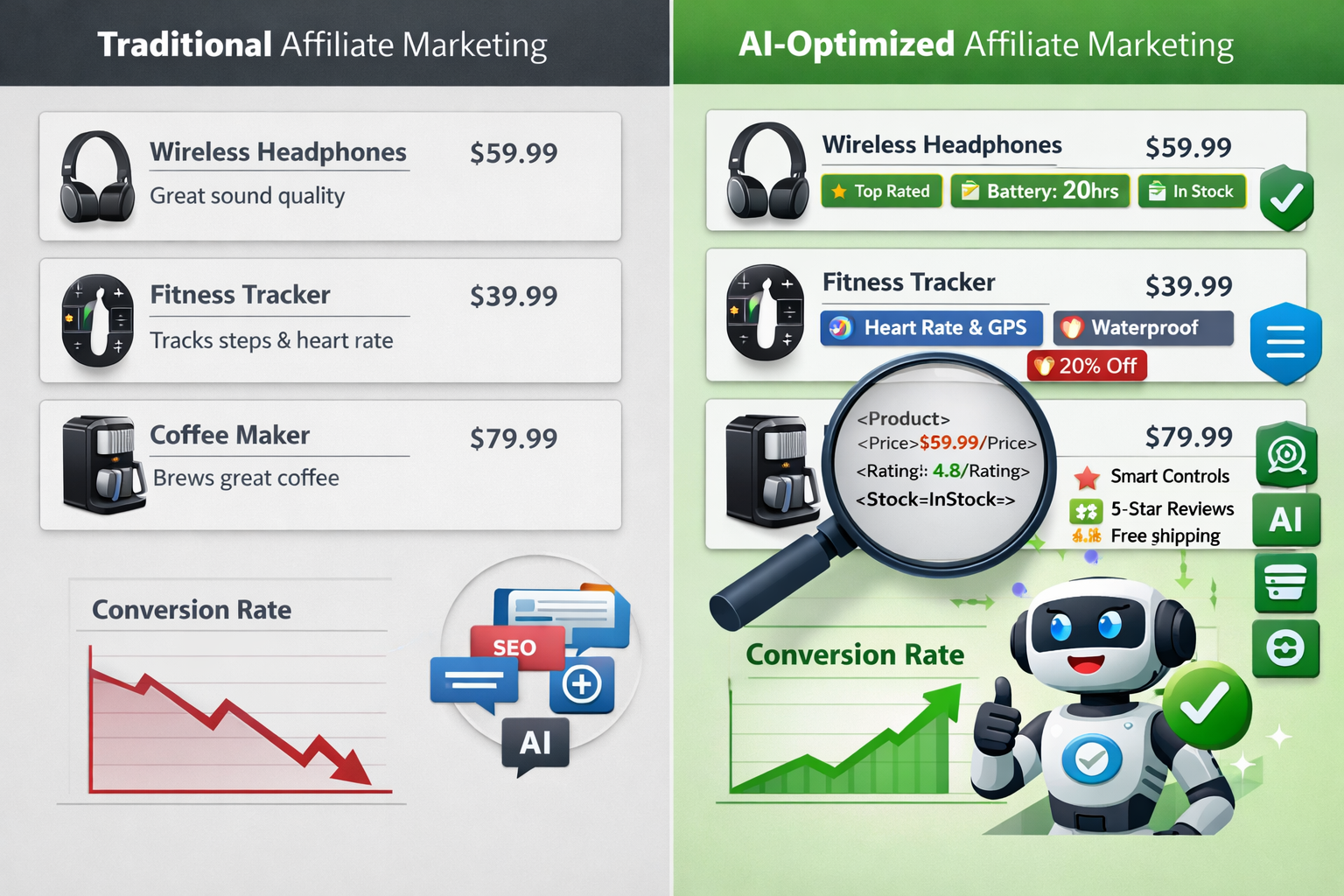
Many affiliate marketers have discovered their conversion rates declining as AI agents gain market share. The reasons are clear:
- ❌ Unstructured content that requires interpretation rather than direct parsing
- ❌ Missing product attributes that AI agents use for comparison
- ❌ Lack of schema markup making products invisible to agent crawlers
- ❌ Inconsistent naming conventions that confuse semantic matching
- ❌ Affiliate links without context that agents can’t evaluate for trustworthiness
Implementing Schema Markup for AI Agent Discoverability
Schema markup has evolved from an SEO nice-to-have to an absolute necessity for AI agent visibility. This structured data vocabulary allows you to explicitly tell AI systems what your content represents, dramatically improving discoverability.
Essential Schema Types for Affiliate Marketers
For those learning how to become an affiliate marketer in 2026, mastering these schema types is non-negotiable:
Product Schema
Review Schema
AI agents place significant weight on structured review data when making recommendations. Implementing the Review and AggregateRating schema provides the quantitative signals agents need.
Offer Schema
The Offer schema type is particularly crucial for affiliate marketers, as it communicates:
- 💰 Pricing information, including discounts and special offers
- 📦 Availability status (in stock, limited availability, pre-order)
- 🚚 Shipping details and delivery timeframes
- 🏪 Seller information and merchant credibility signals
- ⏰ Offer validity periods for time-sensitive promotions
Advanced Schema Strategies for 2026
Beyond basic implementation, sophisticated affiliate marketers are employing advanced schema tactics:
Nested Schema Hierarchies: Combining multiple schema types to provide comprehensive product context. For example, embedding Review schema within Product schema, which itself sits within ItemList schema for category pages.
Dynamic Schema Generation: Using APIs and automation to generate real-time schema markup that reflects current pricing, availability, and inventory levels.
Semantic Enrichment: Adding custom properties and extensions that provide additional context AI agents can leverage, such as sustainability ratings, compatibility information, or use-case scenarios.
Optimizing Product Feeds for AI Agent Consumption
While schema markup makes individual pages discoverable, product feeds are the backbone of AI agent shopping systems. Major AI platforms increasingly rely on structured product feeds to populate their recommendation engines.
Product Feed Optimization Essentials
Creating AI-friendly product feeds requires attention to several critical elements:
Complete Attribute Coverage
AI agents evaluate products across dozens of attributes. Missing data means your products won’t appear in filtered results. Essential attributes include:
- Title (optimized with key specifications)
- Description (detailed, feature-rich, benefit-focused)
- Price (current, accurate, including sale pricing)
- Availability (real-time stock status)
- Brand (standardized naming)
- GTIN/UPC (unique product identifiers)
- Category (using standardized taxonomy)
- Images (high-quality, multiple angles)
- Specifications (dimensions, weight, materials, technical specs)
- Compatibility (works with, compatible devices)
Semantic Standardization
AI agents struggle with inconsistent terminology. Standardizing your product attributes using industry-recognized vocabularies dramatically improves matching:
- Use consistent units of measurement (always “inches” or always “cm,” never mixed)
- Employ standardized color names (use “Navy Blue” consistently, not “Dark Blue” sometimes)
- Apply category taxonomies from Google Product Category or similar standards
- Implement attribute value normalization (e.g., “Yes/No” vs. “True/False” vs. “Available/Not Available”)
Feed Update Frequency
AI agents prioritize current, accurate data. Stale product feeds result in poor recommendations and lost sales. Best practices for 2026:
- Real-time updates for pricing and availability (via API integration)
- Daily refreshes for inventory levels and promotional offers
- Weekly updates for product descriptions and new additions
- Immediate updates for discontinued products
Those exploring best affiliate marketing tips should prioritize feed optimization as a core competency.
Testing AI Agent Prompts to Boost Recommendations
One of the most powerful strategies for optimizing AI Agents as Affiliate Shopping Assistants in 2026 is systematic prompt testing. By understanding how different AI agents respond to various queries, affiliates can reverse-engineer the optimization requirements.
The Prompt Testing Methodology
Successful affiliate marketers in 2026 employ a rigorous testing process:
1. Identify Target Queries
Start by cataloging the natural language queries potential customers use when seeking products in your niche. Examples:
- “Best wireless headphones under $300 with noise cancellation”
- “Laptop for video editing with at least 32GB RAM”
- “Eco-friendly yoga mat that doesn’t slip”
2. Test Across Multiple AI Platforms
Different AI agents have varying algorithms and data sources. Test your products’ appearance in recommendations from:
- ChatGPT Shopping (OpenAI’s integrated commerce features)
- Google AI Search (Gemini-powered shopping results)
- Perplexity Shopping (AI-powered product discovery)
- Amazon Rufus (Amazon’s shopping assistant)
- Microsoft Copilot Shopping (Bing-integrated commerce)
3. Document Recommendation Patterns
Track which products appear in AI recommendations and under what circumstances:
| AI Platform | Query | Your Product Appeared? | Ranking Position | Competitors Listed |
|---|---|---|---|---|
| ChatGPT | “best wireless headphones” | Yes | #3 | Sony, Bose, Apple |
| Perplexity | “noise-cancelling headphones under $300.” | No | N/A | Bose, Sennheiser |
| Google AI | “affordable premium headphones” | Yes | #1 | Anker, JBL |
4. Analyze Recommendation Factors
When your products appear in recommendations, identify the factors the AI agent cited:
- Price competitiveness mentioned?
- Specific features highlighted?
- Review scores referenced?
- Brand reputation considered?
- Availability factored in?
5. Optimize Based on Insights
Use your findings to enhance product listings, schema markup, and feed data. If AI agents consistently cite “battery life” for headphone recommendations but your listings don’t prominently feature this specification, add it immediately.
Prompt Engineering for Affiliate Success
Advanced practitioners are developing prompt engineering strategies that increase recommendation likelihood:
Specification Matching: Ensuring your product data includes exact specifications that match common query parameters. If users frequently ask for “laptops with 16GB RAM,” make sure your listings explicitly state “16GB RAM” rather than just listing it in a specifications table.
Benefit-Feature Mapping: AI agents increasingly look for products that explicitly connect features to user benefits. Instead of just listing “noise cancellation,” describe it as “noise cancellation that blocks up to 95% of ambient sound for focused work.”
Use-Case Tagging: Adding use-case scenarios to product descriptions helps AI agents match products to contextual queries. A yoga mat described as “ideal for hot yoga with superior grip even when wet” will rank higher for “best yoga mat for hot yoga.”
Content Strategies for Hybrid Human-AI Audiences
The reality of 2026 is that affiliate marketers must serve two distinct audiences: human readers and AI agents. This requires sophisticated content strategies that satisfy both.
Dual-Optimization Framework
Successful content in the AI agent era employs a layered approach:
Layer 1: Structured Data Foundation
Every product page and review should begin with comprehensive schema markup and structured data that AI agents can parse. This is the machine-readable foundation.
Layer 2: Semantic HTML Structure
Use proper HTML5 semantic elements (<article>, <section>, <aside>) with clear hierarchies that both humans and AI can navigate. Implement descriptive headings that include key specifications.
Layer 3: Natural Language Content
Write engaging, informative content for human readers that provides context, comparisons, and insights AI agents can’t replicate. This is where storytelling, personal experience, and nuanced recommendations shine.
Layer 4: Rich Media Enhancement
Include images, videos, comparison tables, and interactive elements that enhance human engagement while providing additional signals for AI evaluation.
The Comparison Table Strategy
AI agents love structured comparisons. Creating comprehensive comparison tables serves both audiences:
Example: Wireless Headphones Comparison
| Model | Price | Battery Life | Noise Cancellation | Weight | Rating |
|---|---|---|---|---|---|
| AudioTech XZ-2000 | $299 | 40 hours | Adaptive ANC | 250g | 4.7/5 |
| SoundPro Elite | $349 | 35 hours | Hybrid ANC | 280g | 4.6/5 |
| BudgetBeats Max | $199 | 30 hours | Passive | 220g | 4.3/5 |
This table format is:
- ✅ Easily parsed by AI agents for comparison queries
- ✅ Visually scannable for human readers
- ✅ Rich in structured data for decision-making
- ✅ Convertible to schema for enhanced markup
For those mastering how to do affiliate marketing, this dual-optimization approach is essential for maximizing reach across all audience types.
Technical Infrastructure for AI Agent Integration
Beyond content and data optimization, successful implementation of AI Agents as Affiliate Shopping Assistants: Optimizing Offers for Delegated Purchases in 2026 requires robust technical infrastructure.
API Integration Requirements
Modern AI shopping agents increasingly rely on direct API connections rather than web scraping. Affiliates should:
Implement Product APIs: Provide programmatic access to your product catalog with real-time pricing, availability, and specification data.
Support Standard Protocols: Ensure compatibility with common e-commerce APIs such as the Google Merchant Center API and the Amazon Product Advertising API, as well as emerging AI-specific protocols.
Enable Webhook Notifications: Allow AI agents to subscribe to product updates, price changes, and inventory alerts through webhook systems.
Performance Optimization
AI agents prioritize fast-loading, reliable sources. Technical performance directly impacts recommendation likelihood:
- ⚡ Page load times under 2 seconds
- 📱 Mobile-first responsive design
- 🔒 HTTPS security (non-negotiable)
- 🌐 CDN implementation for global availability
- 🔄 High uptime (99.9%+ availability)
Tracking and Attribution
One of the biggest challenges with AI agent purchases is attribution tracking. When an AI agent makes a purchase on behalf of a user, traditional cookie-based tracking often fails. Solutions include:
Server-Side Tracking: Implementing server-to-server tracking that doesn’t rely on browser cookies.
Unique Identifier Systems: Using product-specific or campaign-specific identifiers that AI agents can preserve through the purchase process.
AI Agent Partnerships: Working directly with AI platforms to establish attribution frameworks for agent-mediated purchases.
Emerging Trends in AI Shopping Agents for 2026
The landscape continues to evolve rapidly. Staying ahead requires understanding emerging trends:
Voice-First Shopping
Voice-activated AI agents are gaining market share, requiring optimization for conversational queries and audio-friendly product descriptions.
Multi-Agent Collaboration
Users increasingly deploy multiple AI agents that collaborate on purchase decisions. Your products must be discoverable across diverse AI ecosystems.
Autonomous Subscription Management
AI agents are beginning to manage recurring purchases and subscriptions autonomously, requiring affiliates to optimize for subscription-based offers and loyalty programs.
Ethical AI Preferences
Consumers are programming their AI agents with ethical preferences (sustainability, fair trade, local sourcing). Adding ethical attribute data to product feeds captures this growing segment.
Personalization at Scale
AI agents learn individual user preferences over time. Products with customization options and personalization features receive preference in recommendations.
Those exploring unleashing earnings potential with affiliate marketing must adapt to these trends to remain competitive.
Case Studies: Success Stories in AI Agent Optimization
Real-world examples demonstrate the power of proper optimization:
Case Study 1: Electronics Affiliate Increases Conversions 156%
An electronics affiliate specializing in audio equipment implemented comprehensive schema markup and optimized product feeds for AI agent consumption. Results over six months:
- 156% increase in AI agent-sourced conversions
- 43% higher average order value from AI purchases
- Ranking in top 3 for 78% of tested AI agent queries
- 89% reduction in return rates from AI-recommended purchases
Key Tactics: Complete product attribute coverage, real-time pricing updates, detailed compatibility information, and extensive review schema implementation.
Case Study 2: Fashion Affiliate Captures Voice Shopping Market
A fashion and accessories affiliate optimized for voice-first AI shopping agents by restructuring product descriptions for conversational queries. Six-month results:
- 203% growth in voice-initiated purchases
- First-position recommendations for 64% of voice queries in their niche
- 92% customer satisfaction rating for AI-recommended products
- Expansion to 12 new product categories based on AI agent query data
Key Tactics: Natural language product descriptions, size and fit schema markup, style attribute standardization, and voice-optimized FAQ content.
Practical Implementation Roadmap
For affiliates ready to optimize for AI Agents as Affiliate Shopping Assistants: Optimizing Offers for Delegated Purchases in 2026, follow this step-by-step roadmap:
Phase 1: Foundation (Weeks 1-2)
- Audit current schema markup implementation
- Catalog product attributes across your inventory
- Test product discoverability in major AI shopping agents
- Identify gaps in structured data coverage
Phase 2: Core Optimization (Weeks 3-6)
- Implement comprehensive schema markup (Product, Offer, Review)
- Optimize product feeds with complete attribute coverage
- Standardize terminology across all product listings
- Establish real-time data updates for pricing and availability
Phase 3: Advanced Enhancement (Weeks 7-10)
- Conduct systematic prompt testing across AI platforms
- Develop comparison content with structured tables
- Create API endpoints for direct AI agent access
- Implement server-side tracking for attribution
Phase 4: Continuous Optimization (Ongoing)
- Monitor AI agent recommendation patterns weekly
- Test new product attributes based on query analysis
- Update schema markup as standards evolve
- Expand to emerging AI platforms as they gain market share
Those interested in affiliate marketing programs for beginners should start with Phase 1 fundamentals before advancing to more sophisticated techniques.
Measuring Success in the AI Agent Era
Traditional affiliate metrics remain important, but new KPIs are essential for AI agent optimization:
Key Performance Indicators
AI Agent Visibility Score: Percentage of target queries where your products appear in AI recommendations across major platforms.
Agent Recommendation Ranking: Average position when your products appear in AI agent suggestions.
Agent-Sourced Conversion Rate: Percentage of AI agent referrals that convert to sales.
Agent Purchase AOV: Average order value from AI agent-mediated purchases compared to traditional channels.
Schema Validation Rate: Percentage of pages with error-free, comprehensive schema markup.
Feed Completeness Score: Percentage of required product attributes populated across your catalog.
Analytics and Tracking Tools
Specialized tools for monitoring AI agent performance:
- Schema Markup Validators (Google Rich Results Test, Schema.org Validator)
- AI Query Testing Platforms (emerging tools for systematic prompt testing)
- Product Feed Analyzers (tools that identify missing attributes and optimization opportunities)
- Attribution Platforms (server-side tracking solutions for AI agent purchases)
Common Pitfalls and How to Avoid Them
Even experienced affiliates make mistakes when optimizing for AI agents:
Pitfall 1: Over-Optimization for Machines
Problem: Creating content so structured and technical that human readers find it robotic and unengaging.
Solution: Implement the dual-optimization framework with distinct layers serving each audience type.
Pitfall 2: Incomplete Data
Problem: Implementing schema markup but leaving critical attributes empty or outdated.
Solution: Establish automated systems for data validation and real-time updates.
Pitfall 3: Platform Tunnel Vision
Problem: Optimizing exclusively for one AI platform (e.g., ChatGPT) while ignoring others.
Solution: Test and optimize across all major AI shopping agents to maximize reach.
Pitfall 4: Static Optimization
Problem: Implementing AI optimization once and never updating as platforms evolve.
Solution: Establish ongoing testing, monitoring, and optimization processes.
Pitfall 5: Ignoring Attribution Challenges
Problem: Failing to implement proper tracking for AI agent purchases, leading to lost commission claims.
Solution: Implement server-side tracking and establish relationships with AI platforms for attribution clarity.
The Future of Affiliate Marketing in an AI-First World
Looking beyond 2026, the trajectory is clear: AI agents will mediate an increasing percentage of all commerce. Projections suggest 40-50% of purchases will involve AI assistance by 2028.
For affiliate marketers, this future presents extraordinary opportunities:
Reduced Competition: Many traditional affiliates will fail to adapt, creating opportunities for those who master AI optimization.
Higher Conversion Rates: AI agents make more informed decisions, resulting in better product-customer matches and lower return rates.
Increased Average Order Values: AI agents optimize for overall value rather than just the lowest price, often recommending premium options.
Global Reach: AI agents transcend language and geographic barriers, enabling affiliates to reach international markets more effectively.
Automated Scaling: Once properly optimized, AI agent recommendations provide passive, scalable traffic without ongoing content creation.
However, success requires commitment to continuous learning and adaptation. The affiliates who thrive will be those who view AI agents not as a threat but as powerful partners in the customer journey.
Conclusion
The rise of AI Agents as Affiliate Shopping Assistants: Optimizing Offers for Delegated Purchases in 2026 represents the most significant shift in affiliate marketing since the advent of search engine optimization. With AI agents now influencing 24% of shopping decisions and growing rapidly, affiliate marketers must fundamentally reimagine their approach.
Success in this new landscape requires mastering three core competencies:
- Technical optimization through comprehensive schema markup, structured product feeds, and API integration
- Strategic testing via systematic prompt analysis and cross-platform AI agent evaluation
- Hybrid content creation that serves both human readers and machine intelligence
The affiliates who embrace these changes early will establish dominant positions in their niches, capturing disproportionate market share as AI agent adoption accelerates. Those who delay risk obsolescence as their competitors’ optimized offers consistently outrank them in AI recommendations.
Actionable Next Steps
Start your AI agent optimization journey today:
✅ Immediate Actions (This Week):
- Audit your current schema markup implementation
- Test your products in ChatGPT, Perplexity, and Google AI search
- Document which products appear in AI recommendations and which don’t
✅ Short-Term Goals (This Month):
- Implement Product, Offer, and Review schema on your top 20% of products
- Complete all product attributes in your feeds (no empty fields)
- Create at least three comparison tables with structured data
✅ Long-Term Strategy (This Quarter):
- Establish real-time product feed updates
- Develop API endpoints for AI agent integration
- Build systematic prompt testing into your monthly workflow
- Implement server-side tracking for attribution
The future of affiliate marketing is being written right now, in 2026, as AI agents reshape how consumers discover and purchase products. By optimizing your offers for delegated purchases, you position yourself at the forefront of this transformation—capturing opportunities that most affiliates won’t even recognize until it’s too late.
The question isn’t whether AI agents will dominate shopping decisions; they already do. The question is whether you’ll optimize your affiliate business to thrive in this new reality. The tools, strategies, and frameworks exist today. The only missing ingredient is your commitment to implementation.
Start optimizing for AI agents today, and watch your affiliate commissions grow as you capture an expanding share of the most valuable traffic source in modern e-commerce.
