

The ground beneath affiliate marketing is shifting in 2026. With 24% of AI users already relying on AI shopping assistants and OpenAI’s browser integrating agentic AI capabilities, the traditional model of optimizing for human clicks is becoming obsolete. AI agents are now the new gatekeepers of consumer purchase decisions, fundamentally changing how affiliate marketers must operate to remain competitive and profitable.
Understanding AI Agents as New Marketing Gatekeepers: How Affiliate Marketers Can Win in Delegated Purchase Decisions is no longer optional—it’s essential for survival in the rapidly evolving digital marketplace. This comprehensive guide explores the seismic shifts underway and provides actionable strategies for affiliate marketers ready to adapt.
Key Takeaways
✅ The click is dying: Traditional affiliate tracking is being replaced by API-based signals and attribution tokens that AI agents can read, requiring new infrastructure and measurement approaches.
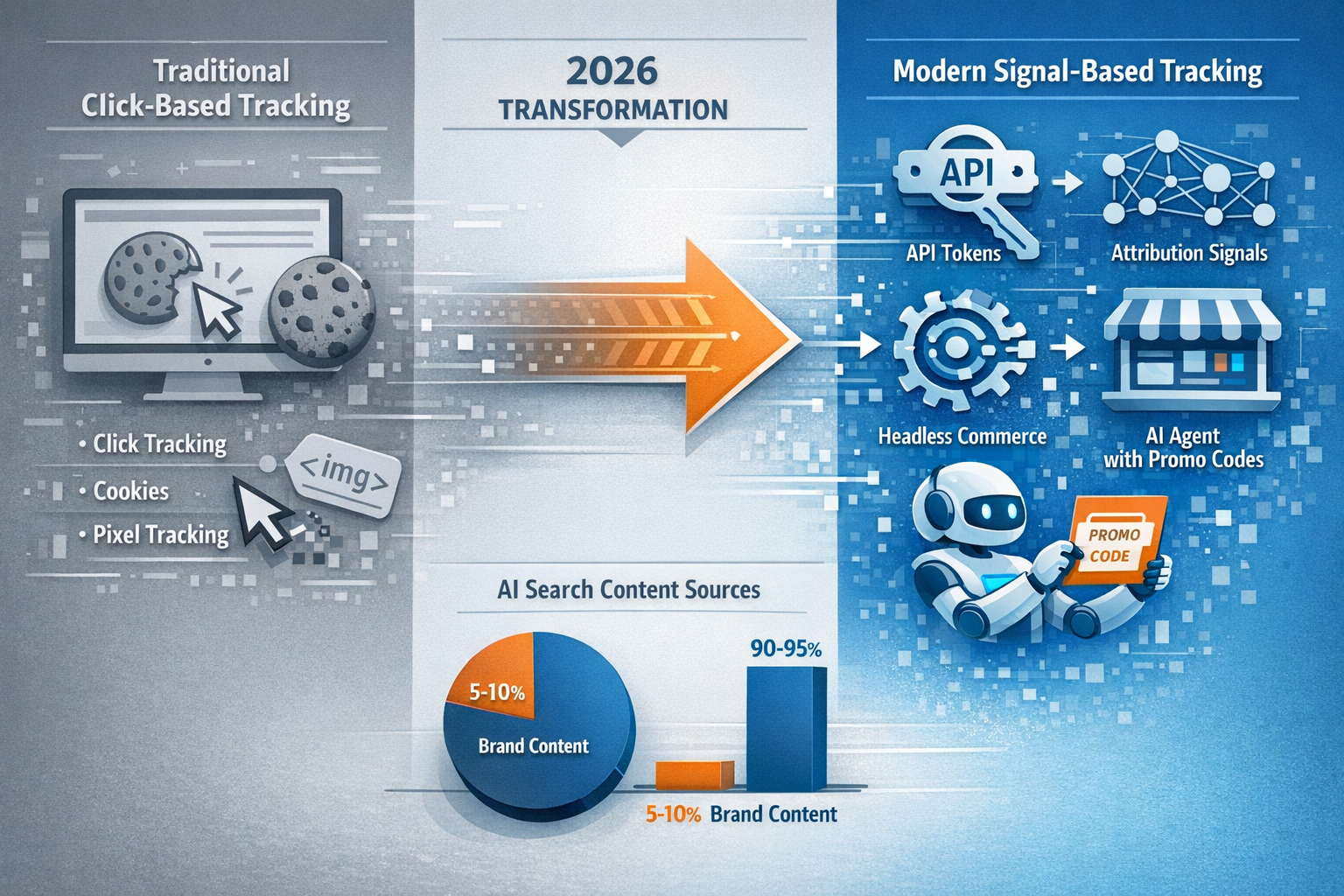
✅ Content sourcing has inverted: Brand content represents only 5-10% of AI search sources, while affiliate and user-generated content dominate what AI systems prioritize for recommendations[1].
✅ AI agents function as gatekeepers, not channels: Marketing to AI systems requires influencing framing and inclusion rather than traditional conversion-focused advertising[4].
✅ Data quality trumps keywords: Machine-readable, high-quality content now determines visibility in AI-powered discovery environments[1].
✅ Early AI adopters are winning: Affiliate marketers leveraging AI as a co-pilot report 5-10x effectiveness improvements in content creation, optimization, and analytics[3].
Understanding the Shift: From Clicks to Signals
The Death of the Click
For decades, the click has been the fundamental currency of affiliate marketing. Every commission, every attribution, every success metric has relied on tracking when a human user clicks a link. But in 2026, this foundation is crumbling.
AI agents don’t click. They make delegated purchase decisions through API calls, voice commands, and automated shopping processes. When an AI assistant orders your weekly groceries or replenishes your supplements, there’s no click to track[6].
This creates an existential challenge for traditional affiliate infrastructure. The solution? Headless tracking systems that issue unique promo codes or attribution tokens readable by AI models[6]. These signals allow affiliate networks to maintain attribution even when purchases originate through machine-to-machine communication rather than human interaction.
Why AI Agents Have Become Gatekeepers
AI agents function as “new gatekeepers of demand” rather than simple distribution channels[4]. Unlike search engines that present options for humans to choose from, AI agents make recommendations or even complete purchases autonomously.
This gatekeeper role means:
- 🤖 Reduced consumer choice: AI agents filter options before humans see them
- 📊 Algorithmic preference: Products and services are pre-selected based on AI training data
- 🎯 Influence over framing: How products are positioned matters more than traditional advertising
- 💡 Awareness-stage focus: Marketers must influence AI systems during training and data ingestion, not just at the point of sale
The influencer market’s growth to approximately $33 billion by the end of 2025 reflects this shift—creator content drives visibility in AI-powered environments because it’s the content AI systems actually consume and prioritize[1].
AI Agents as New Marketing Gatekeepers: The Content Inversion
The 90-10 Rule of AI Content Sources
Here’s a stunning statistic that should reshape every affiliate marketer’s strategy: brand site content accounts for just 5-10% of AI search sources, while affiliate and user-generated content comprise the vast majority of what AI systems prioritize[1].
This represents a complete inversion of traditional marketing dynamics. Previously, brands controlled their message through owned properties. Now, the content that affiliate marketers and creators produce has become the primary driver of visibility in LLM-based discovery environments.
| Content Source | Traditional Search Weight | AI Search Weight (2026) |
|---|---|---|
| Brand websites | 60-70% | 5-10% |
| Affiliate content | 15-20% | 40-50% |
| User-generated content | 10-15% | 30-40% |
| Other sources | 5-10% | 10-20% |
What This Means for Affiliate Marketers
This content inversion creates unprecedented affiliate marketing opportunities for those who understand how to leverage it:
- Your content matters more than ever: Reviews, comparisons, and educational content you create directly influences what AI agents recommend
- Quality over quantity becomes critical: AI systems prioritize authoritative, comprehensive content over keyword-stuffed articles
- Machine readability is essential: Structured data, clear formatting, and semantic markup help AI systems understand and utilize your content
For those wondering can you make money with affiliate marketing in this new landscape, the answer is increasingly yes—but only for those who adapt their content strategies to AI consumption patterns.
How Affiliate Marketers Can Win in Delegated Purchase Decisions
Strategy 1: Optimize for Machine Readability, Not Just Human Readers
Traditional SEO focused on keywords and backlinks. AI-era optimization requires a fundamentally different approach focused on data quality and machine comprehension[1].
Actionable steps:
- ✍️ Use structured data markup: Implement schema.org markup for products, reviews, and ratings
- 📝 Create clear hierarchical content: Use proper heading structures that AI can parse
- 🔢 Include specific data points: Prices, specifications, comparisons in machine-readable formats
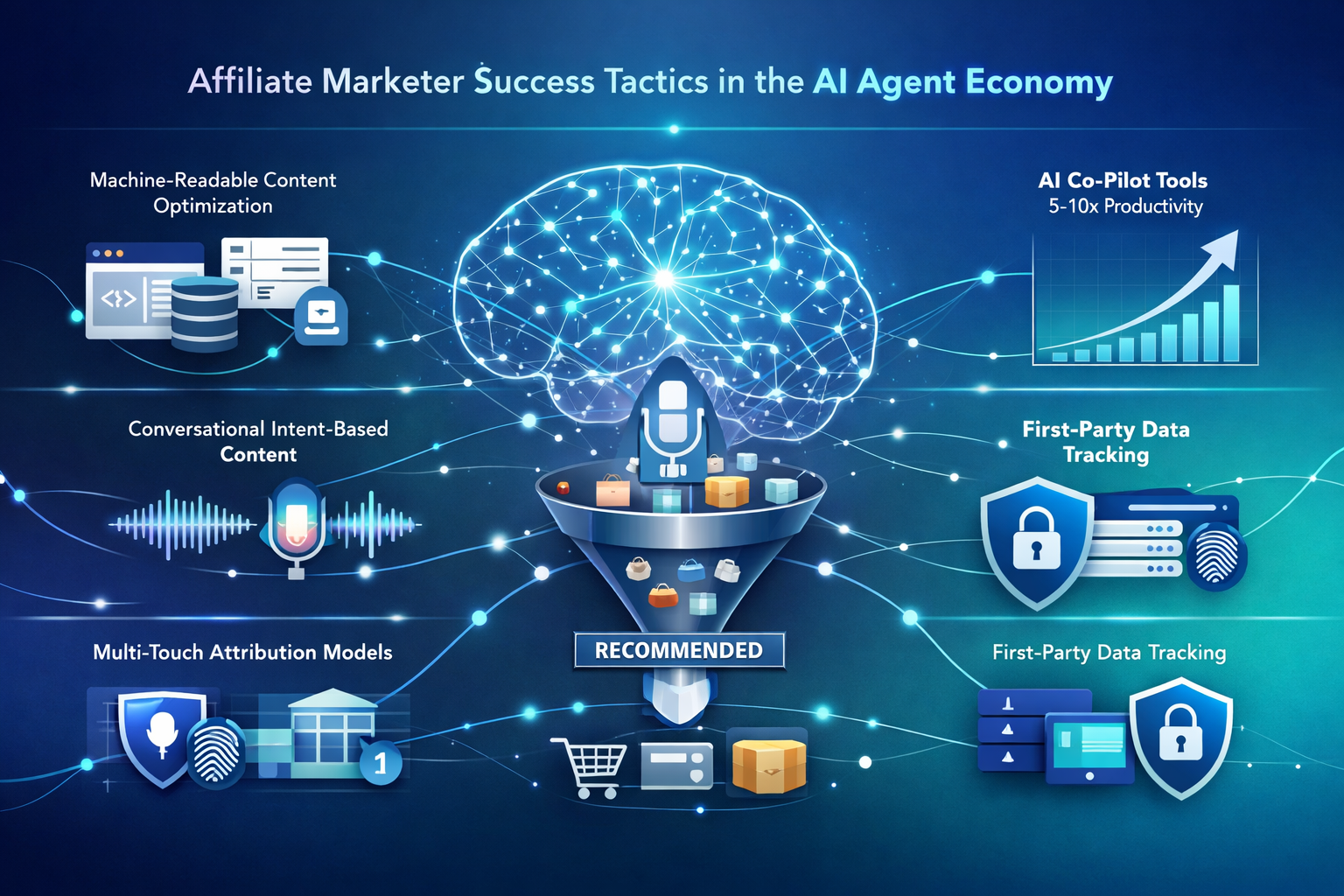
- 🗣️ Write conversationally: AI systems trained on natural language prioritize conversational, intent-based content[2]
- 🎙️ Optimize for voice search: Long-tail, question-based content captures voice assistant queries[2]
Strategy 2: Implement AI-Resilient Attribution Infrastructure
The shift from clicks to signals requires new tracking infrastructure. Forward-thinking affiliate marketers are already implementing:
Privacy-resilient attribution models:
- First-party data tracking that doesn’t rely on third-party cookies[2]
- Multi-touch attribution that credits multiple touchpoints in the customer journey[2]
- Attribution tokens that AI agents can include in API calls[6]
- Unique promo codes tied to specific affiliates that work across channels
These systems ensure you receive credit for your contributions even when AI agents mediate the purchase decision. Understanding how affiliate commissions work in this new environment is crucial for maximizing earnings.
Strategy 3: Leverage AI as Your Co-Pilot
The gap between average and elite affiliates in 2026 hinges on how effectively they leverage AI tools[3]. Early adopters report multiplying their effectiveness by 5-10x through strategic AI adoption[3].
High-impact AI applications for affiliates:
- 📊 Predictive analytics: AI tools identify trending products before they peak
- ✏️ Content generation: AI assists with creating comprehensive, SEO-optimized content at scale
- 🔍 Competitive analysis: Automated monitoring of competitor strategies and positioning
- 💬 Relationship management: AI-powered CRM systems optimize partner communications
- 🤖 Campaign optimization: Machine learning algorithms continuously improve ad performance
Those learning how to become an affiliate marketer in 2026 must treat AI proficiency as a core competency, not an optional skill.
Strategy 4: Focus on Awareness and Consideration, Not Just Conversion
Advertising inside AI systems operates fundamentally differently from traditional paid search. It functions as “paid influence over framing, inclusion and recommendation” rather than conversion-oriented advertising[4].
This requires a strategic shift:
Traditional affiliate focus:
- Bottom-of-funnel conversion content
- Direct response calls-to-action
- Immediate ROI metrics
AI-era affiliate focus:
- Top and middle-of-funnel educational content
- Building authority that influences AI training data
- Long-term brand association and positioning
- Awareness-stage content that AI systems reference
The top strategies for affiliate marketers in 2024 are evolving rapidly—what worked last year may be obsolete today.
Strategy 5: Create Comprehensive, Authoritative Content
AI systems prioritize high-quality, comprehensive content that thoroughly addresses user intent[1]. Thin, keyword-stuffed affiliate pages are being filtered out in favor of genuinely helpful resources.
Content characteristics that win AI visibility:
- 📚 Depth: Comprehensive guides that answer related questions
- 🎯 Specificity: Detailed product comparisons with actual data
- 🏆 Authority: Expert credentials and demonstrated knowledge
- 🔄 Freshness: Regularly updated content reflecting current information
- 🌐 Context: Content that addresses the broader topic ecosystem
Those pursuing how to succeed in affiliate marketing must invest in creating genuinely valuable resources rather than churning out low-quality content.
The Infrastructure Changes Reshaping Affiliate Marketing
Consolidation of Affiliate Programs as Core Infrastructure
Affiliate programs are evolving from standalone channels into core infrastructure for managing creator relationships, commissions, and attribution across all marketing channels[1].
Forward-thinking brands are integrating affiliate systems with:
- Display advertising campaigns
- Search advertising attribution
- Social media influencer partnerships
- AI-driven recommendation opportunities
- Multi-channel customer journey tracking
This consolidation creates opportunities for affiliates who can demonstrate value across multiple touchpoints rather than single-channel conversions.
Enhanced Multi-Touch Attribution Becomes Standard
The days of last-click attribution are ending. Modern affiliate networks are implementing improved tracking technologies that provide better insights into customer journeys and ensure fair payouts across AI-mediated touchpoints[2].
What this means practically:
- 💰 More credit for awareness content: Top-of-funnel content receives attribution
- 📈 Better data on customer paths: Understanding how AI agents fit into purchase journeys
- ⚖️ Fairer commission distribution: Multiple affiliates can receive credit for one sale
- 🔬 Improved optimization insights: Data reveals which content influences AI recommendations
Privacy-First Tracking Infrastructure
Anticipating expanded U.S. state data privacy regulations, affiliate networks are transitioning from cookie-based tracking to first-party data tracking and alternative attribution models[2].
This shift requires:
- 🛡️ Consent management: Proper user permission for data collection
- 🔐 Privacy-compliant tracking: Methods that work without third-party cookies
- 📱 Cross-device attribution: Tracking that works across phones, voice assistants, and browsers
- 🤝 Transparent data practices: Clear communication about how tracking works
AI Agents as New Marketing Gatekeepers: Practical Implementation
Step 1: Audit Your Current Content for AI Readability
Evaluate your existing affiliate content through an AI lens:
- ❓ Can AI systems easily extract key product information?
- ❓ Is your content structured with clear headings and data?
- ❓ Do you use schema markup for products and reviews?
- ❓ Is your content conversational and intent-focused?
- ❓ Does it address questions AI assistants might ask?
Step 2: Implement Attribution Token Systems
Work with your affiliate networks to ensure they support:
- Unique promo codes for each campaign
- Attribution tokens that work with API calls
- Multi-touch attribution models
- Privacy-compliant tracking methods
If your current networks don’t support these features, consider expanding to networks that do.
Step 3: Develop AI-Optimized Content Frameworks
Create content templates specifically designed for AI consumption:
Product review template:
- Structured product specifications
- Clear pros and cons lists
- Comparison tables with competitors
- FAQ sections addressing common questions
- Schema markup for ratings and reviews
Buying guide template:
- Intent-based section headings
- Decision-making frameworks
- Specific use case recommendations
- Voice-search optimized questions and answers
Step 4: Integrate AI Tools Into Your Workflow
Start small and expand your AI toolkit:
Beginner level:
- AI writing assistants for content drafts
- Automated research tools for product information
- Basic analytics for performance tracking
Intermediate level:
- Predictive analytics for trend identification
- AI-powered content optimization tools
- Automated competitive monitoring
Advanced level:
- Custom AI models trained on your niche
- Automated campaign optimization systems
- AI-driven relationship management platforms
For those interested in AI marketing, the integration of these tools can boost sales by 40% or more when implemented strategically.
Step 5: Monitor AI-Driven Performance Metrics
Traditional metrics like click-through rates are becoming less relevant. Focus on:
- 📊 AI visibility scores: How often your content appears in AI recommendations
- 🎯 Intent match rates: How well your content addresses user questions
- 🔄 Multi-touch attribution data: Your role in complex customer journeys
- 📈 Signal-based conversions: Purchases attributed through non-click mechanisms
- 💡 Content authority metrics: How AI systems rank your expertise
The Economic Context: Why This Matters Now
Affiliate marketing is transitioning from a cost-center to a strategic growth driver in 2026. Brands recognize the low upfront investment requirements and high ROI potential as cost-effective channels for reaching consumers amid:
- Economic uncertainty from tariff volatility
- Inflationary pressure on marketing budgets
- Reduced the effectiveness of traditional advertising
- Consumer preference for trusted recommendations over ads
Marketers focusing solely on traditional SEO in 2026 risk missing where the majority of purchasing decisions are actually occurring—inside AI agent interfaces and voice assistants.
Common Pitfalls to Avoid
❌ Ignoring the Shift Until It’s Too Late
Many affiliate marketers are waiting to see how AI agents evolve before adapting. This is a mistake. The infrastructure changes required take months to implement properly. By the time AI-mediated purchases become dominant, it will be too late to catch up.
❌ Treating AI Optimization as Just Another SEO Tactic
AI optimization isn’t traditional SEO with a few tweaks. It requires fundamentally rethinking content strategy, attribution models, and success metrics. Affiliates who treat it superficially will miss the opportunity.
❌ Focusing Only on Conversion Content
The awareness and consideration stages matter more in AI-mediated environments[4]. Affiliates who only create bottom-of-funnel content miss the opportunity to influence AI training data and recommendation algorithms.
❌ Neglecting Data Quality and Structure
AI systems can’t effectively utilize poorly structured content. Investing in proper schema markup, clear data presentation, and machine-readable formats is essential, not optional.
❌ Waiting for Perfect Attribution Solutions
Attribution in the AI era will never be as clean as traditional click tracking. Affiliates who demand perfect measurement before acting will miss the transition window. Implement the best available solutions now and iterate as technology improves.
The Future Landscape: What’s Coming Next
Agentic Commerce Becomes Mainstream
As AI agents gain more autonomy in making purchase decisions, expect:
- 🛒 Subscription management by AI: Agents automatically reorder products
- 💳 Budget-aware purchasing: AI agents optimize spending across categories
- 🔄 Proactive product discovery: Agents suggest products before users ask
- 🤝 Negotiation capabilities: AI agents that seek the best prices and terms
Voice Commerce Dominates Certain Categories
Voice-activated purchasing through smart speakers and assistants will capture significant market share in:
- Household consumables and groceries
- Routine replenishment items
- Simple, well-defined product categories
- Services with clear parameters
Affiliate marketers must optimize for voice search queries and conversational commerce patterns.
Creator Economy and Affiliate Marketing Merge
The distinction between influencers, content creators, and affiliate marketers is blurring. Successful marketers will:
- Build authentic audiences across platforms
- Create multi-format content (text, video, audio, interactive)
- Develop personal brands that AI systems recognize as authorities
- Leverage creator tools and affiliate infrastructure interchangeably
Understanding best affiliate marketing tips increasingly means understanding creator economy dynamics.
Regulatory Frameworks Evolve
Expect new regulations around:
- AI transparency in commerce
- Disclosure requirements for AI-mediated recommendations
- Attribution standards for algorithmic purchases
- Consumer rights in automated shopping
Staying compliant while these frameworks develop will be crucial for long-term success.
Conclusion: Adapting to Win in the AI Agent Era
AI Agents as New Marketing Gatekeepers: How Affiliate Marketers Can Win in Delegated Purchase Decisions represents the most significant shift in affiliate marketing since the rise of mobile commerce. The fundamental mechanics of the industry—how consumers discover products, how purchases are made, and how affiliates receive credit—are all transforming simultaneously.
The marketers who will thrive in this new landscape are those who:
✅ Embrace AI tools as force multipliers for their work
✅ Prioritize data quality and machine readability over keyword optimization
✅ Implement privacy-resilient, signal-based attribution infrastructure
✅ Create comprehensive, authoritative content that influences AI training data
✅ Focus on awareness and consideration stages, not just conversion
✅ Continuously adapt as AI capabilities and consumer behaviors evolve
Your Next Steps
This week:
- Audit 5-10 of your top-performing content pieces for AI readability
- Research which of your affiliate networks support attribution tokens
- Experiment with one AI tool for content creation or optimization
This month:
- Implement schema markup on your most important affiliate content
- Create one comprehensive, AI-optimized buying guide in your niche
- Set up tracking for AI-driven performance metrics
This quarter:
- Develop a complete AI-optimized content framework for your niche
- Transition to affiliate networks with modern attribution infrastructure
- Build AI tools into your standard workflow for content and optimization
The shift to AI agents as marketing gatekeepers is happening now, not in some distant future. Those who adapt quickly will capture disproportionate value as traditional competitors struggle to understand what’s changing. Those who wait will find themselves increasingly invisible in the AI-mediated marketplace.
The question isn’t whether AI agents will become the dominant gatekeepers of purchase decisions—they already are. The question is whether you’ll adapt your strategies to win in this new reality.
For comprehensive guidance on navigating this transition, explore our affiliate marketing strategies and learn what is affiliate marketing in the AI era. The future of affiliate marketing belongs to those who embrace the AI revolution today.
References
[1] How Affiliate Marketing Powers AI Search And Creator Commerce – https://martech.org/how-affiliate-marketing-powers-ai-search-and-creator-commerce/
[2] Affiliate Marketing – https://www.imd.org/blog/marketing/affiliate-marketing/
[3] The Future Of Affiliate Marketing 2026 Edition – https://www.mattmcwilliams.com/the-future-of-affiliate-marketing-2026-edition/
[4] Advertising Is About To Get A New Gatekeeper – https://www.gilroy.co.uk/insights/advertising-is-about-to-get-a-new-gatekeeper
[6] Affiliate Marketing Trends And What To Leave Behind – https://www.postaffiliatepro.com/blog/affiliate-marketing-trends-and-what-to-leave-behind/
