

The affiliate marketing landscape has transformed dramatically. In 2026, AI agents are autonomously negotiating commission rates without human intervention, engaging in sophisticated bidding wars that determine promotional priorities and revenue splits. While human marketers once spent hours crafting pitch emails to merchants, AI agents now handle these negotiations in milliseconds through standardized protocols like the Agent Commerce Protocol (ACP). Understanding AI Agents Negotiating Affiliate Commissions: Protocols for Agent-to-Agent Bidding Wars in 2026 is no longer optional—it's essential for maximizing affiliate earnings in an increasingly automated ecosystem.
This shift represents the most significant evolution in affiliate marketing since the industry's inception. Affiliates who master these new protocols are reporting 30% higher yields compared to traditional static commission structures, while those who remain on the sidelines watch their competitive advantage erode.
Key Takeaways
- 🤖 AI agents now autonomously negotiate commission rates through standardized protocols, eliminating human intervention and enabling real-time rate optimization
- 📊 Performance-based bidding wars allow high-performing affiliates to secure premium commission rates (10-25%) based on conversion data and traffic quality
- ⚡ Dynamic commission structures replace static rates, with continuous monitoring and adjustment based on seasonal trends, inventory levels, and competitive positioning
- 💰 Expected value calculations drive agent decisions, factoring in conversion probability, order value, and opportunity costs across multiple merchant partnerships
- 🔧 Integration with ACP and payment infrastructure from providers like Visa and Stripe enables seamless agent-to-agent transactions without manual contract management
Understanding AI Agents Negotiating Affiliate Commissions: The New Normal
The traditional affiliate model relied on static commission agreements negotiated once and revisited annually—if at all. This approach left significant money on the table for high performers while overcompensating low-quality traffic sources. In 2026, AI agents have fundamentally disrupted this model.
How Agent-to-Agent Negotiations Work
AI agents representing affiliates continuously monitor their performance metrics across multiple merchant partnerships. When performance thresholds are met, these agents automatically initiate commission increase requests to merchant-side AI agents. The negotiation happens through structured data exchanges rather than email threads.
Here's what a typical negotiation sequence looks like:
Step 1: Performance Verification 🔍
The affiliate agent compiles conversion data, average order values, customer lifetime value contributions, and traffic quality metrics.
Step 2: Expected Value Calculation 📈
The agent calculates the expected value of continuing the partnership at current rates versus reallocating promotional resources to competing merchants.
Step 3: Bid Submission 💼
A structured bid is transmitted to the merchant agent containing performance evidence and the requested commission rate.
Step 4: Counter-Offer or Acceptance 🤝
The merchant agent evaluates the request against inventory levels, profit margins, competitive positioning, and the affiliate's historical performance before responding.
Step 5: Contract Execution ✅
Upon agreement, the new rate is automatically implemented across tracking systems and payment infrastructure.
This entire process completes in seconds rather than weeks, enabling affiliates to capitalize on seasonal opportunities and market shifts in real-time.
The Data Advantage in Agent Negotiations
Unlike human negotiations that rely on intuition and incomplete information, AI agents leverage comprehensive attribution data that tracks entire customer journeys from first touchpoint to conversion. This sophisticated tracking provides unprecedented negotiation leverage.
For example, an AI agent might present this case to a merchant:
"We've driven 500 sales this month at 8% commission, with an average order value of $127 and a 35% repeat purchase rate within 90 days. Increase the commission to 10% and we'll prioritize your products over Competitor X, who currently offers 9% with lower AOV."
This data-driven approach removes the "awkwardness" of human negotiation while providing objective justification for rate increases. Merchants benefit too—they can identify and reward their highest-value partners automatically while reducing payouts to underperformers.
Protocols for Agent-to-Agent Bidding Wars in 2026
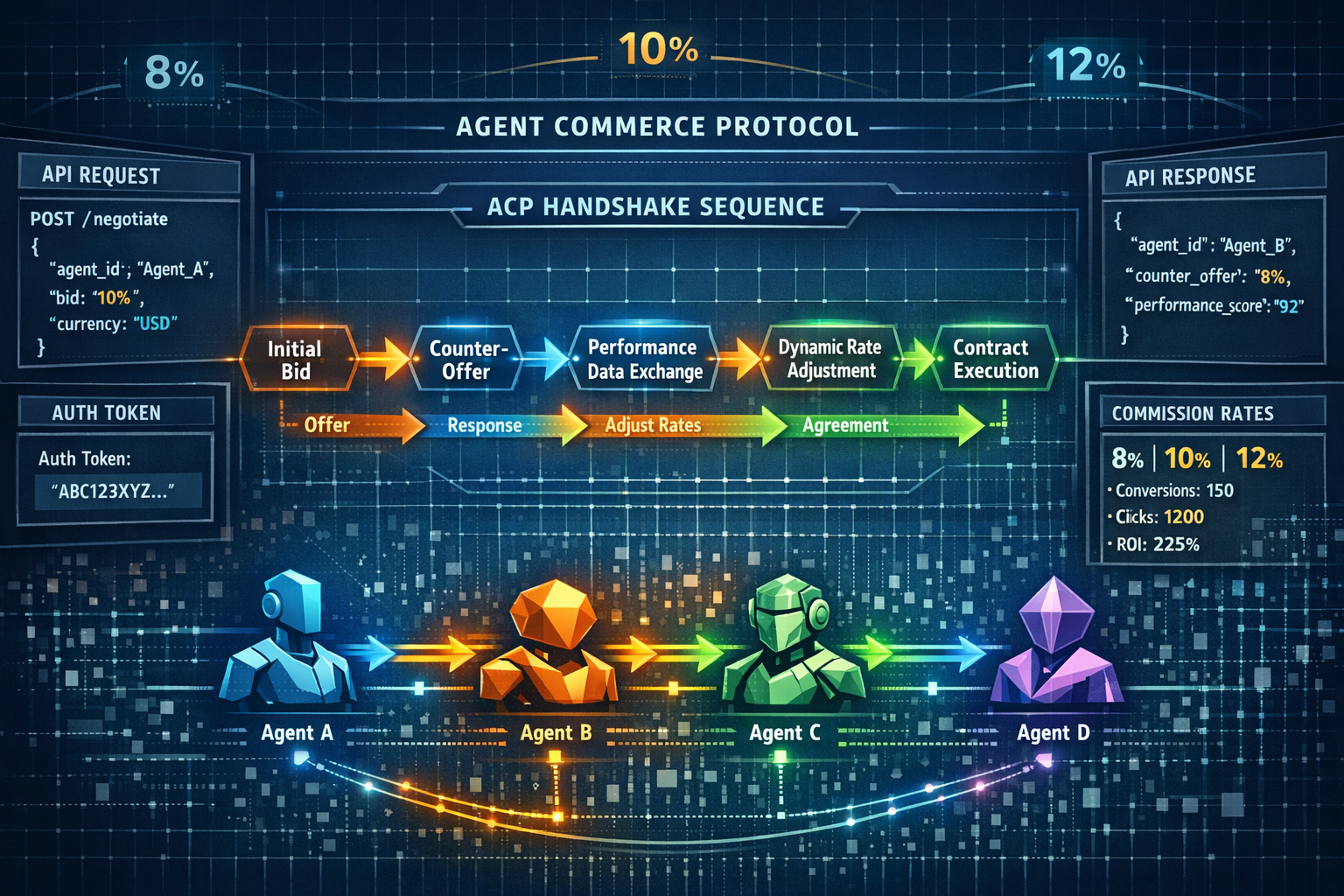
The infrastructure enabling AI Agents Negotiating Affiliate Commissions: Protocols for Agent-to-Agent Bidding Wars in 2026 relies on several key technical protocols and frameworks that have emerged as industry standards.
Agent Commerce Protocol (ACP)
The Agent Commerce Protocol serves as the primary communication standard for agent-to-agent negotiations. Developed collaboratively by major payment processors including Visa and Stripe, ACP provides a standardized format for:
- Authentication and agent identity verification
- Bid submission and counter-offer structures
- Performance data formatting and validation
- Contract terms and automated execution
- Dispute resolution mechanisms
ACP operates on a RESTful API architecture with JSON payloads, making integration straightforward for affiliates using modern marketing automation platforms. The protocol includes built-in security features to prevent bid manipulation and ensure data integrity.
Real-World Implementation: NBCUniversal Case Study
The first major demonstration of agent-led negotiation occurred during the NFL playoffs in Q1 2026, when NBCUniversal and FreeWheel completed a programmatic guaranteed deal entirely through AI agent negotiation. While this example comes from media buying rather than traditional affiliate marketing, the underlying protocols are identical.
The deal involved:
- Automated inventory assessment and availability confirmation
- Real-time pricing negotiation based on audience demographics
- Performance guarantee structuring with penalty clauses
- Automated contract execution and payment scheduling
This high-stakes transaction proved that AI agents could handle complex, multi-million-dollar negotiations without human oversight, paving the way for broader adoption across affiliate marketing channels.
Multi-Model Commission Structures
One of the most innovative developments in 2026 is the emergence of hybrid commission models that blend multiple compensation structures simultaneously. Platforms like Koah Labs now enable affiliates to earn through:
- Cost Per Click (CPC) for traffic generation
- Cost Per Mille (CPM) for impression-based campaigns
- Cost Per Acquisition (CPA) for completed conversions
AI agents automatically optimize which model to prioritize based on real-time performance data and expected value calculations. Partners using these hybrid structures report 40% monthly revenue increases and average eCPM rates of $10—significantly higher than single-model approaches.
Continuous Contract Monitoring
Unlike traditional affiliate agreements that remain static until renewal dates, AI agents implement continuous contract monitoring. This means:
✅ Real-time performance tracking against benchmarks
✅ Automatic renegotiation triggers when thresholds are met
✅ Dynamic rate adjustments for seasonal fluctuations
✅ Immediate response to competitive commission changes
✅ Opportunity cost analysis across merchant portfolio
This continuous optimization ensures affiliates always operate at peak commission rates relative to their performance level. For beginners entering affiliate marketing, understanding these dynamic structures is crucial for long-term success.
Strategies for Maximizing Returns Through Agent Bidding
To achieve the 30% yield improvements that leading affiliates are experiencing with AI Agents Negotiating Affiliate Commissions: Protocols for Agent-to-Agent Bidding Wars in 2026, marketers need to implement specific strategic approaches.
Portfolio Optimization Through Expected Value
AI agents evaluate opportunity costs between promoting different products by calculating expected value for each potential promotion:
Expected Value = (Conversion Probability × Average Order Value × Commission Rate) – Promotional Cost
This calculation runs continuously across all merchant partnerships, automatically reallocating promotional resources to the highest-value opportunities. The key insight: commission percentage alone doesn't determine profitability.
Consider this comparison:
| Merchant | Commission | AOV | Conversion Rate | Expected Value |
|---|---|---|---|---|
| Merchant A | 15% | $80 | 2.5% | $0.30 per click |
| Merchant B | 10% | $200 | 3.0% | $0.60 per click |
| Merchant C | 20% | $50 | 1.8% | $0.18 per click |
Despite Merchant C offering the highest commission percentage, Merchant B delivers the highest expected value per click. AI agents make these calculations across hundreds of products simultaneously, ensuring optimal resource allocation.
Performance-Based Escalation Tactics
Smart affiliates configure their AI agents with escalation triggers that automatically initiate commission increase requests when specific performance milestones are reached:
- 🎯 Volume Triggers: Request rate increase after X sales per month
- 📊 Quality Triggers: Negotiate premium rates when customer LTV exceeds benchmarks
- ⏰ Seasonal Triggers: Secure temporary rate boosts during peak shopping periods
- 🏆 Competitive Triggers: Match or exceed competitor commission offerings
The Text Partner Program exemplifies this approach, offering 20% lifetime recurring commission that automatically escalates to 22% after five paying customer referrals—a structure designed specifically for AI-driven referral volume.
Leveraging 100% Commission Retention Models
A revolutionary development in 2026 is the emergence of 100% commission retention platforms like ChatAds, which allow developers and affiliates to keep their entire commission while the platform charges transparent per-request API fees instead.
This model shifts the economics dramatically:
Traditional Model: Affiliate earns 50-70% of commission, platform takes 30-50%
100% Retention Model: Affiliate earns 100% of commission, pays fixed API fee per transaction
For high-volume affiliates, this structure can increase net earnings by 40-60% compared to traditional revenue-sharing arrangements. AI agents can automatically calculate the break-even point where API fees become more economical than percentage-based splits.
Integration with Payment Infrastructure
Major payment processors have built native support for agent-to-agent transactions, eliminating friction in commission payments. Visa and Stripe now offer:
- Instant settlement upon conversion confirmation
- Automated commission rate application
- Multi-currency support for global affiliate networks
- Dispute resolution through smart contract arbitration
This infrastructure removes the traditional 30-60 day payment delays, improving cash flow for affiliates and enabling more aggressive scaling strategies.
Implementing AI Agent Negotiation in Your Affiliate Business
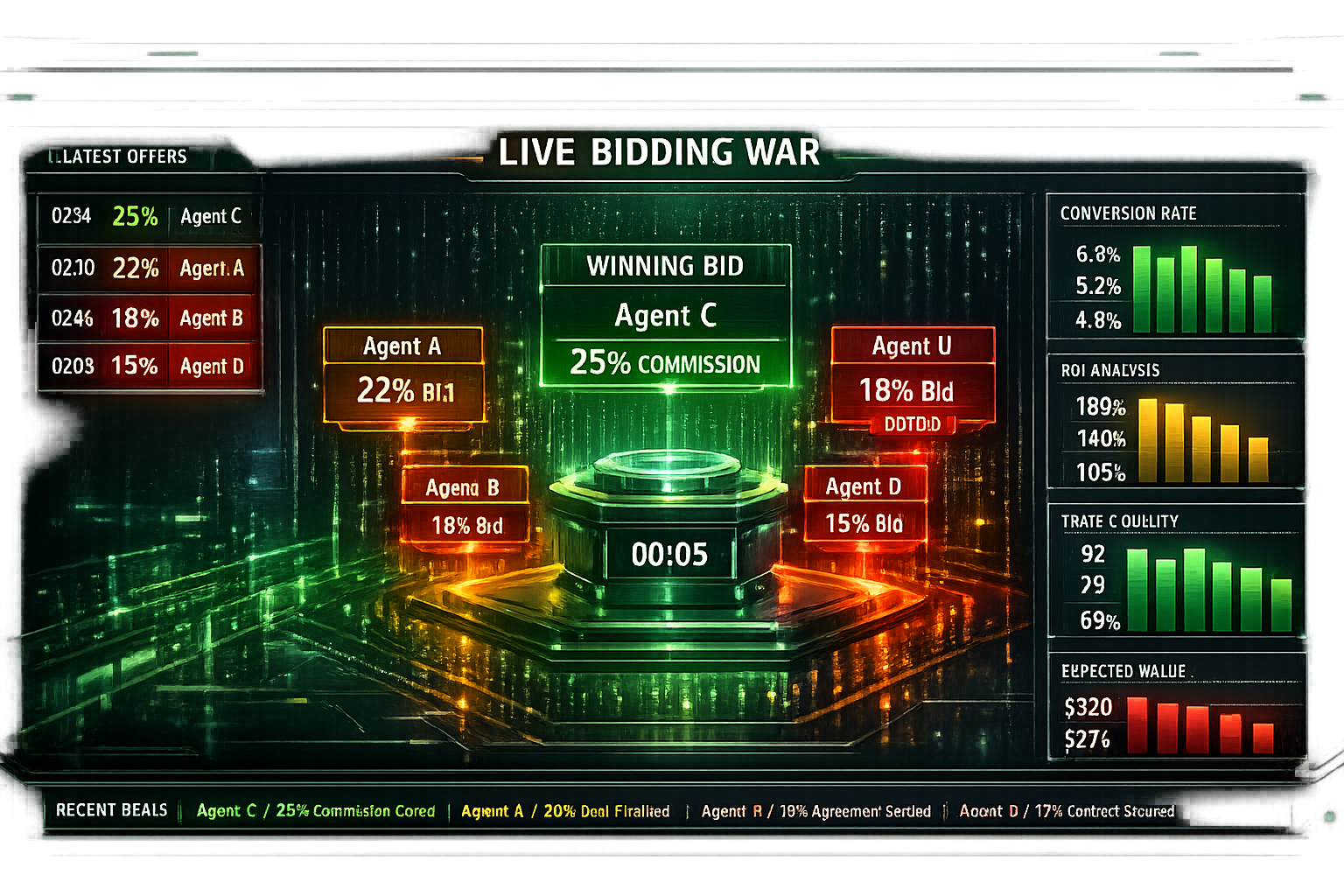
For affiliates looking to capitalize on AI Agents Negotiating Affiliate Commissions: Protocols for Agent-to-Agent Bidding Wars in 2026, implementation follows a clear roadmap.
Step 1: Platform Selection and Integration
Choose affiliate platforms and networks that support ACP integration. Leading platforms in 2026 include:
- ShareASale: Full ACP support with automated negotiation features
- CJ Affiliate: Advanced agent-to-agent bidding for premium merchants
- Impact: Comprehensive API for custom agent development
- Koah Labs: Native multi-model commission structures
Most platforms offer plug-and-play agent integration through WordPress plugins, Shopify apps, or standalone SaaS solutions. For those starting affiliate marketing with limited resources, several platforms offer free tiers with basic agent functionality.
Step 2: Configure Performance Thresholds
Set the parameters that trigger automatic negotiation attempts:
Minimum Performance Criteria 📊
- Sales volume thresholds (e.g., 100 sales/month)
- Conversion rate minimums (e.g., 2.5%)
- Average order value targets (e.g., $75+)
Negotiation Triggers 🎯
- Performance exceeds merchant average by X%
- Seasonal opportunity windows open
- Competitor offers higher rates
- Traffic quality scores improve
Fallback Strategies 🔄
- Maximum acceptable commission rates
- Minimum promotional commitment levels
- Alternative merchant priorities
Step 3: Data Infrastructure Setup
Ensure your tracking infrastructure captures the comprehensive attribution data that strengthens negotiation positions:
✅ First-touch attribution tracking
✅ Multi-touch journey mapping
✅ Customer lifetime value calculation
✅ Repeat purchase rate monitoring
✅ Traffic quality scoring
✅ Engagement metrics beyond clicks
This data feeds your AI agent's negotiation arguments and provides objective evidence for commission increase requests. Proper SEO and analytics foundations ensure accurate data collection.
Step 4: Continuous Optimization and Monitoring
While AI agents handle negotiations automatically, successful affiliates maintain oversight through:
- Weekly performance dashboards reviewing negotiation outcomes
- Monthly portfolio rebalancing based on expected value shifts
- Quarterly strategy reviews adjusting negotiation parameters
- Competitive intelligence monitoring for rate benchmarking
The goal isn't to micromanage individual negotiations but to ensure your agent's strategic parameters align with your business objectives.
Common Implementation Challenges
Challenge 1: Merchant Resistance 🚧
Some merchants haven't yet adopted agent-to-agent protocols. Solution: Prioritize merchants with ACP support while maintaining traditional relationships as secondary partnerships.
Challenge 2: Data Quality Issues 📉
Inaccurate tracking undermines negotiation leverage. Solution: Invest in robust attribution infrastructure before implementing agent negotiation.
Challenge 3: Over-Optimization ⚠️
Agents too aggressively pursuing rate increases may damage merchant relationships. Solution: Configure conservative escalation thresholds initially, then optimize based on acceptance rates.
Challenge 4: Technical Complexity 🔧
API integration and protocol implementation require technical expertise. Solution: Use managed platforms with built-in agent functionality rather than building custom solutions.
The Future of Affiliate Commission Structures
As AI Agents Negotiating Affiliate Commissions: Protocols for Agent-to-Agent Bidding Wars in 2026 becomes the industry standard, several trends are accelerating:
Consumption-Based Pricing Models
Traditional flat-rate commissions are giving way to dynamic consumption-based pricing that adjusts rates based on:
- Time of day and day of week
- Geographic location and local demand
- Inventory levels and supply constraints
- Customer segment and lifetime value potential
- Competitive landscape and market positioning
These models require continuous monitoring and adjustment—tasks perfectly suited for AI agents but impossible for human marketers to manage at scale.
Predictive Bidding Strategies
Advanced AI agents now employ predictive analytics to anticipate optimal negotiation timing:
- Forecasting seasonal demand spikes before they occur
- Predicting competitor commission changes based on market signals
- Identifying merchant cash flow patterns that increase acceptance rates
- Anticipating inventory constraints that create negotiation opportunities
This predictive capability enables proactive rather than reactive negotiation strategies.
Cross-Platform Commission Arbitrage
Sophisticated affiliates use AI agents to identify commission arbitrage opportunities across platforms:
- Product X offers 8% on Platform A but 12% on Platform B
- Merchant Y accepts higher rates through direct relationships than network partnerships
- Geographic variations create regional arbitrage opportunities
AI agents automatically route promotional efforts through the highest-paying channels while maintaining compliance with platform terms of service.
Blockchain-Based Smart Contracts
Emerging blockchain implementations enable trustless commission agreements through smart contracts that:
- Automatically execute payments upon conversion verification
- Eliminate dispute resolution delays
- Provide transparent performance tracking
- Enable fractional commission sharing among multiple affiliates
While still in early adoption phases, blockchain-based commission structures are gaining traction among tech-forward merchants and affiliates.
Conclusion: Embracing the Agent-Driven Affiliate Future
AI Agents Negotiating Affiliate Commissions: Protocols for Agent-to-Agent Bidding Wars in 2026 represents a fundamental shift in how affiliate relationships operate. The affiliates achieving 30% higher yields aren't necessarily driving more traffic or creating better content—they're simply leveraging automated negotiation protocols to secure premium commission rates based on their performance data.
The barrier to entry has never been lower. Major platforms now offer plug-and-play agent integration, eliminating the need for custom development. The data infrastructure required for effective negotiation is increasingly built into standard affiliate marketing programs, making sophisticated attribution accessible to beginners.
Actionable Next Steps
Ready to implement agent-driven commission negotiation? Follow this roadmap:
- Audit your current affiliate partnerships to identify which merchants support ACP or similar protocols
- Implement comprehensive attribution tracking to build the data foundation for negotiation leverage
- Select an agent-enabled platform that aligns with your technical capabilities and merchant relationships
- Configure conservative initial parameters for automated negotiation, then optimize based on results
- Monitor weekly performance to ensure your agent's strategies align with business objectives
- Gradually expand agent-driven negotiation across your entire merchant portfolio
The transition from static commissions to dynamic agent-negotiated rates isn't optional—it's inevitable. Merchants increasingly prefer working with data-driven partners who can demonstrate clear ROI, and AI agents provide the objective evidence that makes these relationships profitable for both parties.
Those who embrace these protocols now will establish competitive advantages that compound over time through better rates, stronger merchant relationships, and more efficient resource allocation. Those who wait risk becoming increasingly uncompetitive as the industry standard shifts toward automated negotiation.
The future of affiliate marketing is agent-driven, data-informed, and dynamically optimized. The question isn't whether to adopt these protocols—it's how quickly you can implement them to capture the 30% yield improvements that early adopters are already experiencing.
Start by exploring how AI is transforming affiliate marketing strategies and position yourself at the forefront of this revolutionary shift in commission structures.