

The landscape of search is experiencing its most dramatic shift since Google first indexed the web. In 2026, AI Answer Engines vs. Traditional Search: How Affiliate Marketers Should Rethink SEO in the Age of ChatGPT, Perplexity, and Google AI Overviews has become the defining challenge for affiliate marketers who once relied on ranking in the top three blue links to drive commissions. With AI Overviews now appearing in roughly 25-50% of Google searches [1][3], and 37% of consumers starting their searches with AI tools instead of traditional search engines [2], the rules of visibility have fundamentally changed.
For affiliate marketers, this shift is both alarming and opportunistic. While organic click-through rates for position one have plummeted 65.3% since AI Overviews rolled out [3], AI-driven traffic converts at 14.2%—five times higher than traditional Google traffic's 2.8% [1]. The question is no longer whether to adapt, but how to restructure content strategies to win citations in answer engines rather than just blue links in search results.
Key Takeaways
- AI Overviews appear in 25-50% of searches in 2026, with organic CTR for top positions declining 65% since rollout [1][3]
- 37% of consumers now start searches with AI tools instead of Google, citing frustration with ads and link-clicking [2]
- AI traffic converts 5x better than traditional search (14.2% vs 2.8%), making quality more valuable than quantity [1]
- Only 10% of users trust the first AI result, requiring multi-platform visibility and source attribution strategies [1]
- Affiliate marketers must optimize for entity recognition, structured data, and conversational queries to win citations in answer engines
Understanding the Fundamental Shift: AI Answer Engines vs. Traditional Search
The Death of the Blue Link (And What's Replacing It)
Traditional search operated on a simple premise: users enter keywords, Google returns ten blue links, and the top three positions capture the majority of clicks. This model created the foundation for search engine optimization techniques that affiliate marketers have relied on for decades.
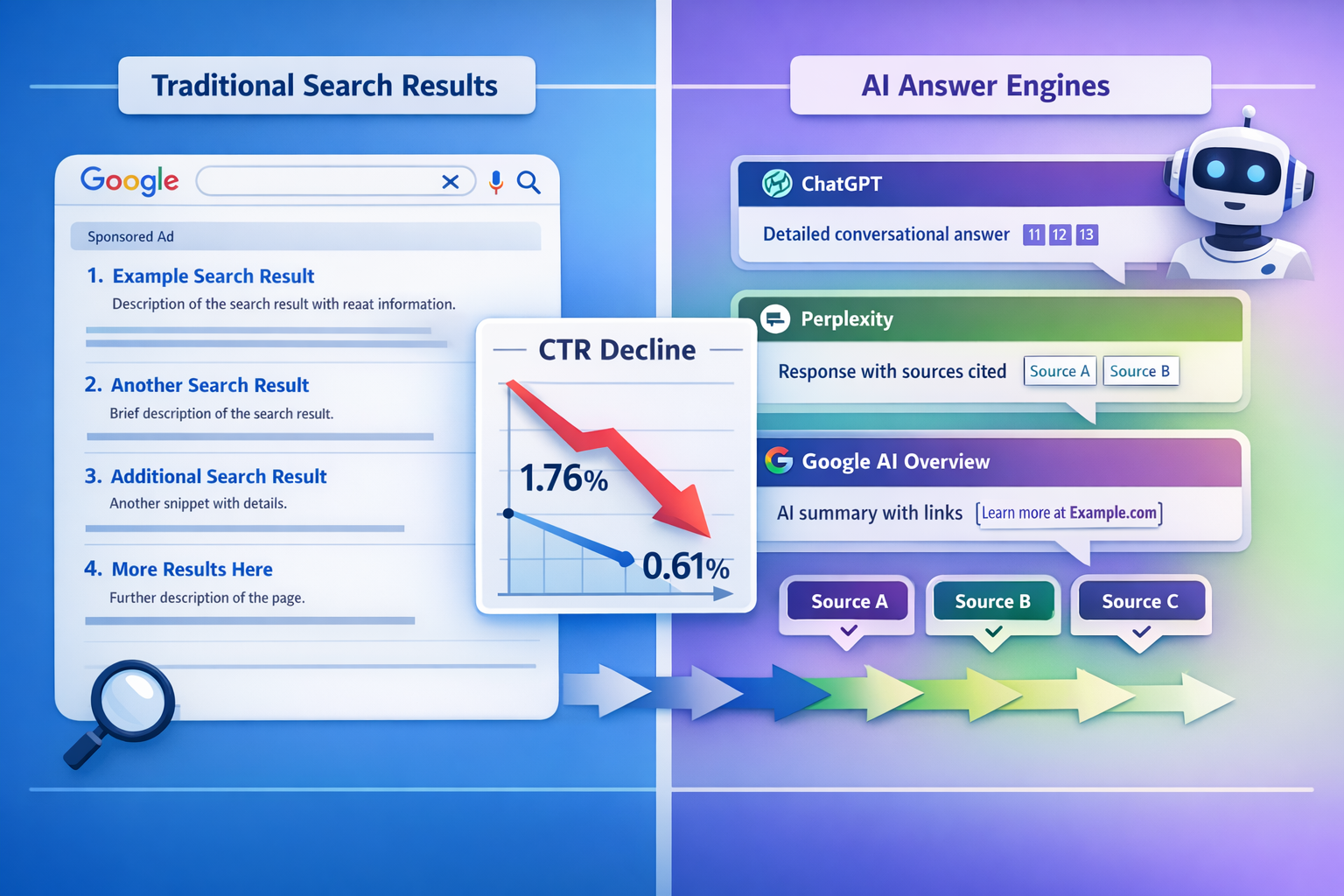
That model is collapsing. Nearly 8 out of 10 mobile searches now result in zero clicks to the open web [3][1], as AI summaries answer questions directly on results pages. When users ask "What's the best protein powder for weight loss?" they're increasingly receiving conversational answers with product recommendations embedded in ChatGPT, Perplexity, or Google's AI Overview—often without ever clicking through to an affiliate site.
The data reveals the magnitude of this transformation:
| Metric | Traditional Search | AI Answer Engines | Change |
|---|---|---|---|
| CTR for Position 1 | 1.76% (2023) | 0.61% (2026) | -65.3% [3] |
| Zero-Click Searches | ~40% desktop | 60-80% mobile | +50-100% [3][1] |
| Conversion Rate | 2.8% | 14.2% | +407% [1] |
| Time on Site | Baseline | +68% | Significant increase [1] |
Why Consumers Are Abandoning Traditional Search
According to recent research, consumers cite three primary frustrations with traditional search [2]:
- Too many clicks required (40%) – Users are tired of opening multiple tabs to find answers
- Overwhelming ads (37%) – Distinguishing paid results from organic content has become exhausting
- Difficulty getting straight answers (33%) – Traditional SERPs provide links, not solutions
This frustration has driven 75% of people to use AI search tools more than a year ago, with 43% using them daily or more frequently [1]. Among Gen Z, 28% now launch searches directly via AI chatbot [1].
For affiliate marketers, this creates both crisis and opportunity. The crisis: your perfectly optimized blog post ranking #1 for "best running shoes 2026" may never receive a click. The opportunity: if your brand gets cited in the AI answer, you could capture highly engaged traffic that converts at five times the traditional rate.
The New Visibility Landscape: Where AI Answer Engines Find Content
ChatGPT, Perplexity, and Google AI Overviews: How They Source Information
Understanding AI Answer Engines vs. Traditional Search: How Affiliate Marketers Should Rethink SEO in the Age of ChatGPT, Perplexity, and Google AI Overviews requires knowing how each platform selects sources:
ChatGPT (driving 77-87% of AI traffic to websites [1]) prioritizes:
- Authoritative domains with strong backlink profiles
- Content with clear entity relationships and structured information
- Recent, frequently updated sources for time-sensitive queries
- User-generated content from trusted platforms (Reddit is the #1 cited domain [1])
Perplexity focuses on:
- Real-time web crawling for current information
- Academic and research sources for technical queries
- Multi-source synthesis with transparent attribution
- Domain authority and topical expertise signals
Google AI Overviews leverage:
- Google's existing Knowledge Graph and entity database
- Content already ranking in traditional top 10 results
- Structured data markup (schema.org)
- E-E-A-T signals (Experience, Expertise, Authoritativeness, Trustworthiness)
"62% of consumers trust AI recommendations more when brand citations include source links" [1]
This trust factor is critical for affiliate marketers. Unlike traditional search where ranking alone drove clicks, answer engine visibility requires both citation and attribution. Your brand must appear in the answer AND be linked as a verifiable source.
The Reddit Phenomenon: Why User-Generated Content Dominates AI Citations
The most surprising insight from 2026 data: Reddit is the #1 most-cited domain in AI search with approximately 5,588 citations across tracked prompts [1]. This reveals a fundamental truth about how AI engines evaluate content quality.
AI models prioritize:
✅ Authentic user experiences over marketing copy
✅ Conversational, natural language over keyword-stuffed content
✅ Comparative discussions over single-product promotions
✅ Community validation over brand claims
For affiliate marketers, this means your traditional product review template—"Top 10 Best X for Y in 2026"—is losing effectiveness. AI engines prefer content that mirrors genuine human discussion, answers specific questions, and acknowledges trade-offs honestly.
How Affiliate Marketers Should Rethink SEO Strategy
From Keyword Optimization to Entity Optimization
Traditional keyword optimization focused on matching user search terms. AI answer engines focus on entity recognition—understanding the relationships between products, brands, features, use cases, and user needs.
Old approach:
Target keyword: "best budget laptop 2026"
Strategy: Repeat phrase in title, H2s, meta description
New approach:
Target entities: Laptop models (Dell Inspiron 15, HP Pavilion), price points ($500-$800), use cases (student, business), specifications (RAM, processor, battery life)
Strategy: Create comprehensive entity maps that AI can parse and connect
Practical implementation:
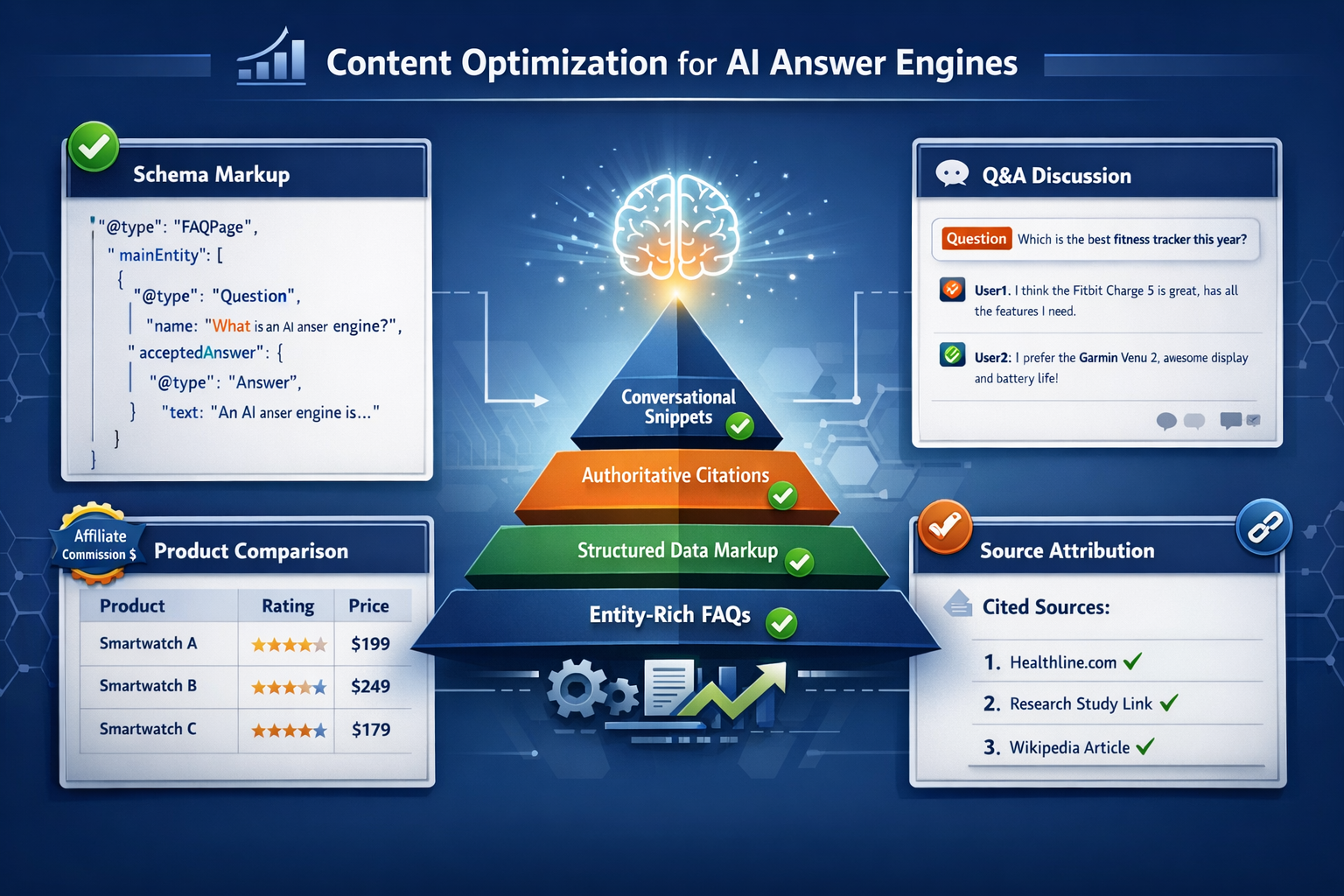
Build entity-rich FAQ sections that address specific questions:
- "What laptop under $700 has the best battery life for students?"
- "How does the Dell Inspiron 15 compare to the HP Pavilion for video editing?"
Use schema markup to help AI understand relationships:
- Product schema with detailed specifications
- FAQ schema for question-answer pairs
- Review schema with aggregate ratings
Create comparison matrices that AI can extract:
- Feature-by-feature product comparisons
- Price-to-performance analyses
- Use-case suitability ratings
Structured Data: The New Foundation of Discoverability
While traditional SEO treated structured data as optional, it's now mandatory for AI visibility. Answer engines rely on schema markup to understand content context and extract relevant information.
Priority schema types for affiliate marketers:
| Schema Type | Purpose | Impact on AI Citations |
|---|---|---|
| Product | Define specifications, pricing, availability | Enables direct product recommendations |
| Review | Aggregate ratings, author credentials | Builds trust signals |
| FAQ | Question-answer pairs | Powers conversational responses |
| HowTo | Step-by-step instructions | Surfaces in process queries |
| Article | Content metadata, authorship | Establishes topical authority |
Implementing these schemas helps AI engines understand not just what your content says, but what it means—the critical difference between being indexed and being cited.
Conversational Content Architecture: Writing for AI Understanding
AI answer engines process content differently than traditional search algorithms. They look for conversational patterns that mirror how humans actually discuss topics.
Transform your content structure:
Instead of: "The Best Protein Powders for 2026"
Write: "Which Protein Powder Should You Choose? A Complete Comparison"
Instead of: Dense paragraphs of features
Write: Clear Q&A format:
- Q: "What's the difference between whey and plant-based protein?"
- A: "Whey protein absorbs faster and contains all essential amino acids, making it ideal for post-workout recovery. Plant-based proteins like pea or hemp digest more slowly and work better for those with dairy sensitivities…"
This conversational structure makes it easier for AI to extract specific answers and attribute them to your content.
Multi-Platform Presence: The New Link Building
Traditional link building focused on acquiring backlinks to improve domain authority. In the AI era, citation building requires presence across the platforms AI engines trust most.
Strategic platform priorities:
- Reddit communities – Participate authentically in relevant subreddits, providing genuine value
- Quora – Answer specific questions with detailed, helpful responses
- Industry forums – Establish expertise in niche communities
- YouTube – Create video content that AI can transcribe and cite
- LinkedIn articles – Publish thought leadership content
The goal isn't just backlinks—it's creating a web of citations across trusted platforms that AI engines can triangulate when forming answers.
Practical Playbook: Structuring Content for Answer Engine Citations
The Four-Layer Content Framework
Based on analysis of successfully cited affiliate content in 2026, implement this four-layer structure:
Layer 1: Direct Answer (First 100 words)
- Immediately answer the primary question
- Use clear, conversational language
- Include the specific product/solution recommendation
- Example: "For most home users, the Dyson V15 Detect offers the best balance of power and convenience at $649…"
Layer 2: Entity-Rich Context (100-300 words)
- Define key entities (product names, brands, specifications)
- Explain relationships and comparisons
- Use structured lists and tables
- Implement schema markup
Layer 3: Detailed Analysis (300-800 words)
- Provide depth for users who click through
- Include personal experience and testing methodology
- Address edge cases and alternatives
- Build E-E-A-T signals
Layer 4: FAQ and Related Questions (200-400 words)
- Answer secondary questions AI might extract
- Create FAQ schema opportunities
- Link to related content on your site
Real Example: How AI Surfaces Affiliate Recommendations
Let's examine how AI engines currently cite affiliate content:
User query: "What's the best standing desk for under $500?"
Traditional search result:
Top 3 positions show listicles titled "10 Best Standing Desks 2026" with generic descriptions
AI Overview result:
"For under $500, the FlexiSpot E7 offers the best combination of stability and features. It includes a programmable height memory, can support up to 355 lbs, and has a quiet dual-motor system. The desk adjusts from 23.6" to 49.2", accommodating most users comfortably.
If you need a wider desktop, the Uplift V2 starts at $599 but frequently goes on sale. For budget-conscious buyers, the FEZIBO Electric Standing Desk at $279 provides basic functionality without premium features.
Sources: [StandingDeskReviews.com], [WireCutter], [Reddit r/StandingDesks]"
Why these sources won citations:
✅ Specific product recommendations with model numbers
✅ Quantifiable specifications (weight capacity, height range, price)
✅ Comparative context (best for X, alternative for Y)
✅ Source diversity (professional review site + trusted publication + community validation)
The affiliate sites that got cited used entity-rich content with structured data, not just keyword-optimized listicles.
Measuring Success in the AI Answer Engine Era
New Metrics That Matter
Traditional SEO metrics—keyword rankings, organic sessions, bounce rate—tell an incomplete story in 2026. Focus on these instead:
AI Citation Tracking:
- How often does your brand appear in AI answers?
- Which products get recommended most frequently?
- What questions trigger your content citations?
Traffic Quality Over Quantity:
- Conversion rate from AI referrals (target: 10-15% vs. 2-3% traditional)
- Time on site from AI traffic (should be 60%+ higher [1])
- Pages per session (AI visitors engage more deeply)
Multi-Platform Visibility:
- Citations across ChatGPT, Perplexity, Google AI Overviews
- Mentions in Reddit, Quora, and forum discussions
- YouTube video transcription citations
Tools for tracking AI visibility:
- Manual testing with varied AI platforms
- Brand monitoring tools that track AI citations
- Analytics segmentation by referral source
- Schema validation and entity recognition testing
The 48% Verification Factor
Remember: Only 10% of users trust the first AI result, while 48% verify answers across multiple platforms [1]. This means your affiliate marketing strategies must ensure consistent presence across AI engines, not just optimization for one.
Create a verification-friendly content ecosystem:
- Consistent product recommendations across your content
- Transparent methodology and testing criteria
- Clear disclosure of affiliate relationships
- Updated content that reflects current pricing and availability
Common Mistakes Affiliate Marketers Make in AI Optimization
❌ Mistake #1: Optimizing Only for Google
The problem: Many affiliate marketers still focus exclusively on traditional Google rankings, ignoring ChatGPT (77% of AI traffic [1]) and Perplexity.
The solution: Develop platform-specific content strategies. ChatGPT favors conversational depth, Perplexity prioritizes real-time accuracy, Google AI Overviews leverage existing Knowledge Graph data.
❌ Mistake #2: Keyword Stuffing Instead of Entity Building
The problem: Repeating "best laptop 2026" fifteen times doesn't help AI understand product relationships.
The solution: Build comprehensive entity networks. Define products, specifications, use cases, and user types with clear relationships.
❌ Mistake #3: Ignoring Structured Data
The problem: 68.94% of websites receive some AI traffic [1], but most lack proper schema markup to maximize citations.
The solution: Implement Product, Review, FAQ, and HowTo schema on all affiliate content. Validate with Google's Rich Results Test.
❌ Mistake #4: Creating Only Long-Form Content
The problem: While comprehensive content helps traditional SEO, AI engines often extract answers from concise, well-structured sections.
The solution: Use the four-layer framework above—direct answer first, then depth for those who need it.
❌ Mistake #5: Neglecting Multi-Platform Presence
The problem: Your website alone won't build the citation network AI engines trust.
The solution: Authentic participation in Reddit, Quora, YouTube, and industry forums creates the cross-platform validation AI engines prioritize.
For more guidance on avoiding common pitfalls, review our guide on 10 common affiliate marketing mistakes.
The Future of Affiliate Marketing in an AI-First World
Adaptation Strategies for 2026 and Beyond
Understanding AI Answer Engines vs. Traditional Search: How Affiliate Marketers Should Rethink SEO in the Age of ChatGPT, Perplexity, and Google AI Overviews is just the beginning. The landscape will continue evolving rapidly.
Emerging trends to monitor:
🔮 AI-native affiliate programs that provide structured data feeds specifically for answer engine integration
🔮 Conversational commerce where users complete purchases directly within AI chat interfaces
🔮 Attribution complexity as the customer journey fragments across multiple AI touchpoints
🔮 Trust verification systems that help users identify reliable AI recommendations
🔮 Personalized AI recommendations based on user history and preferences
The affiliate marketers who thrive will be those who view AI answer engines not as a threat to traditional SEO, but as an evolution requiring new skills and strategies.
Building an AI-Ready Affiliate Business
Transform your affiliate marketing approach with these foundational shifts:
- Invest in genuine expertise – AI engines increasingly prioritize demonstrated experience and credentials
- Build brand recognition – Being cited requires being known across multiple platforms
- Create structured content systems – Develop templates that consistently implement proper schema and entity relationships
- Test and iterate – Regularly query AI engines with your target questions to see what gets cited
- Diversify traffic sources – Don't depend solely on organic search; build email lists, social followings, and community presence
For those just starting out, our guide on how to become an affiliate marketer provides foundational strategies that work in both traditional and AI-first environments.
Conclusion
The shift from traditional search to AI answer engines represents the most significant change in digital marketing since mobile-first indexing. With AI Overviews appearing in up to 50% of searches, 37% of consumers starting with AI tools instead of Google, and organic CTRs declining 65% for top positions, affiliate marketers can no longer rely on ranking alone.
The data is clear: AI traffic converts 5x better than traditional search (14.2% vs 2.8%), spends 68% more time on sites, and represents a growing share of overall web traffic. But capturing this traffic requires fundamental changes to content strategy, technical implementation, and cross-platform presence.
Your Action Plan for AI Answer Engine Optimization
This week:
- Audit your top 10 affiliate pages for structured data implementation
- Test your primary product recommendations in ChatGPT, Perplexity, and Google
- Identify which competitors are getting cited and analyze their content structure
This month:
- Implement Product, Review, and FAQ schema on your highest-traffic pages
- Restructure at least 5 articles using the four-layer content framework
- Begin authentic participation in relevant Reddit communities and forums
This quarter:
- Build comprehensive entity maps for your primary affiliate niches
- Create cross-platform content presence (YouTube, Quora, LinkedIn)
- Develop tracking systems for AI citations and referral traffic quality
The future of affiliate marketing isn't about choosing between traditional SEO and AI optimization—it's about mastering both. Start implementing these strategies today, and you'll be positioned to capture the high-converting AI traffic that's reshaping digital commerce in 2026 and beyond.
For more comprehensive strategies, explore our best affiliate marketing tips and affiliate marketing optimization techniques.
References
[1] Ai Search Statistics – https://www.superlines.io/articles/ai-search-statistics/
[2] Consumers Start Searches Ai Not Google Study 467159 – https://searchengineland.com/consumers-start-searches-ai-not-google-study-467159
[3] 2026 State Of Generative Search Ai Seo Statistics – https://fuelonline.com/2026-state-of-generative-search-ai-seo-statistics/
 dfyadmin