

{"cover":"Professional landscape format (1536x1024) hero image featuring bold text overlay 'AI Brand Characters: Building Trust in Agentic Recommendation Engines' in extra large 72pt white sans-serif font with subtle gradient shadow, positioned center-upper third. Background shows futuristic split-screen composition: left side displays three diverse photorealistic AI-generated brand avatars (professional woman, friendly mascot character, tech expert) with glowing neural network connections; right side shows abstract representation of AI recommendation engine with floating product cards, trust badges, and affiliate commission flow visualization. Color palette: electric blue (#0066FF), white, silver accents, deep navy background. High-tech aesthetic with soft bokeh effects, professional lighting, magazine cover quality, editorial style representing convergence of AI characters and affiliate marketing trust systems in 2026.","content":["Landscape format (1536x1024) detailed infographic showing step-by-step workflow for creating AI-generated brand character using LTX Studio interface. Split into four quadrants: top-left shows character design parameters (facial features, clothing, personality traits) with adjustment sliders; top-right displays multi-language voice synthesis panel with waveform visualization showing 75+ language options; bottom-left illustrates brand consistency matrix comparing same character across different platforms (Instagram, YouTube, email, landing pages) with visual consistency score percentages; bottom-right shows affiliate campaign integration with character appearing in product recommendations, trust signals, and conversion tracking dashboard. Clean UI design, modern tech aesthetic, arrows showing process flow, color-coded sections in blue, green, and purple tones, professional marketing technology visualization.","Landscape format (1536x1024) conceptual illustration demonstrating trust-building mechanisms in agentic recommendation engines powered by consistent AI brand characters. Center features transparent 3D cube representing AI agent decision-making process with visible layers: bottom layer shows data inputs (user preferences, purchase history, browsing behavior); middle layer displays AI character evaluation criteria (consistency score, engagement metrics, authenticity signals); top layer reveals recommendation output with character-endorsed products highlighted. Surrounding the cube are four satellite elements: consumer trust meter showing 78% confidence increase, affiliate conversion funnel with character touchpoints marked, competitor comparison chart showing character consistency advantage, and privacy-compliant tracking system diagram. Futuristic design with holographic effects, glowing data streams, professional color scheme of teal, white, and gold accents, high-tech marketing visualization representing 2026 AI-powered affiliate ecosystem."]}
As we move deeper into 2026, the affiliate marketing landscape faces a revolutionary challenge: AI-powered recommendation engines are increasingly making purchase decisions on behalf of consumers. When AI agents evaluate which products to recommend, they don't just analyze price and features—they assess brand consistency, trustworthiness, and narrative coherence across every touchpoint. This shift demands a new approach: AI-Generated Brand Characters for Affiliate Consistency: Building Trust in Agentic Recommendation Engines.
The stakes are enormous. Affiliate marketing has emerged as a core growth strategy in 2026[1], with the global influencer market reaching approximately $33 billion by the end of 2025[1]. Yet here's the paradox: while 89% of marketers say they won't work with virtual influencers or AI-generated creator clones[3], the technology for creating persistent, consistent brand characters has never been more powerful or accessible.
The solution isn't replacing human creators—it's leveraging AI-generated brand characters to maintain visual and narrative consistency across every affiliate campaign, giving AI recommendation engines the coherent brand signals they need to favor your offers.
Key Takeaways
- 🎯 AI recommendation engines prioritize brand consistency when evaluating affiliate offers, making persistent brand characters essential for 2026 success
- 🤖 AI avatar platforms now support 75+ languages with 140+ voices[2], enabling localized brand character deployment across global markets
- 📊 77% of marketers repurpose creator content into paid ads[3], feeding AI ad algorithms the creative diversity needed for optimization
- 🔒 Privacy-compliant tracking becomes critical as U.S. state data regulations expand, requiring stable affiliate systems[1]
- ✅ Photorealistic avatars perform better for product-focused content while stylized characters reduce identity confusion[2]
Understanding AI-Generated Brand Characters for Affiliate Consistency
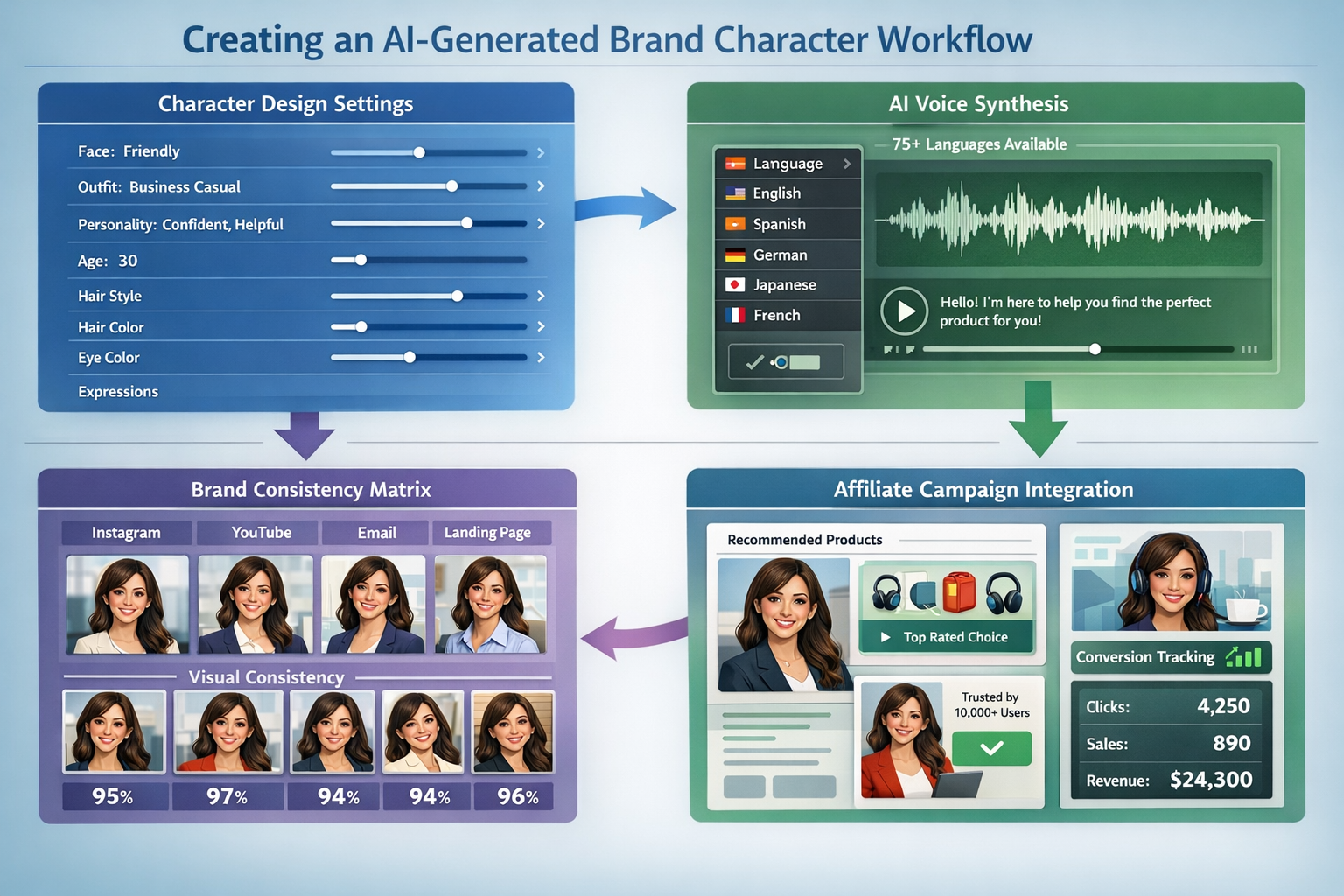
What Makes Brand Characters Essential in 2026
The affiliate marketing ecosystem has fundamentally changed. AI-powered search environments and agentic recommendation engines—systems that autonomously evaluate and suggest products—now dominate consumer decision-making. These engines don't just match keywords; they analyze brand coherence, consistency signals, and trust indicators across hundreds of touchpoints.
Traditional affiliate strategies relied on sporadic campaigns with inconsistent messaging. When an AI agent encounters your brand across different platforms and sees different visual identities, conflicting narratives, or fragmented messaging, it flags your offer as less trustworthy. The result? Your products get deprioritized in AI-generated recommendations.
AI-generated brand characters solve this problem by creating persistent personas that maintain perfect consistency across:
- Social media content (Instagram, TikTok, YouTube)
- Email marketing campaigns
- Landing pages and product pages
- Programmatic advertising
- Affiliate partner content
- AI-powered chatbot interactions
The Technical Capabilities of Modern AI Avatars
Today's AI avatar platforms have evolved far beyond basic animation. Tools like LTX Studio, Synthesia, and D-ID now offer:
| Feature | Capability | Business Impact |
|---|---|---|
| Language Support | 75+ languages, 140+ voices[2] | Localize characters for Brazil, Japan, DACH markets without re-shooting |
| Visual Realism | Photorealistic rendering with micro-expressions | Higher trust for product-focused content[2] |
| Cross-Platform Integration | API access for programmatic deployment | Consistent presence across all affiliate touchpoints[2] |
| Personality Customization | Adjustable tone, speaking style, emotional range | Align character with brand values and target demographics |
The strategic advantage isn't just technical—it's consistency at scale. A human creator might produce 3-4 pieces of content weekly. An AI brand character can appear in 50+ touchpoints daily, all with perfect visual and narrative alignment.
Why Marketers Remain Skeptical (And Why That's Actually Good)
The 89% of marketers who refuse to work with virtual influencers[3] aren't wrong—they're responding to a legitimate trust issue. Consumers respond to real people telling real stories[3], and no AI can replicate lived experience or authentic emotional connection.
But here's the critical distinction: AI-generated brand characters aren't trying to be human influencers. They're brand mascots, product experts, and consistent touchpoint personas designed to support—not replace—human creators.
Think of them as the digital equivalent of brand spokescharacters like the Geico Gecko or Flo from Progressive: memorable, consistent, and purpose-built for specific marketing functions. When implementing affiliate marketing strategies, these characters serve as the consistent thread connecting diverse campaigns.
Building Trust in Agentic Recommendation Engines Through Character Consistency
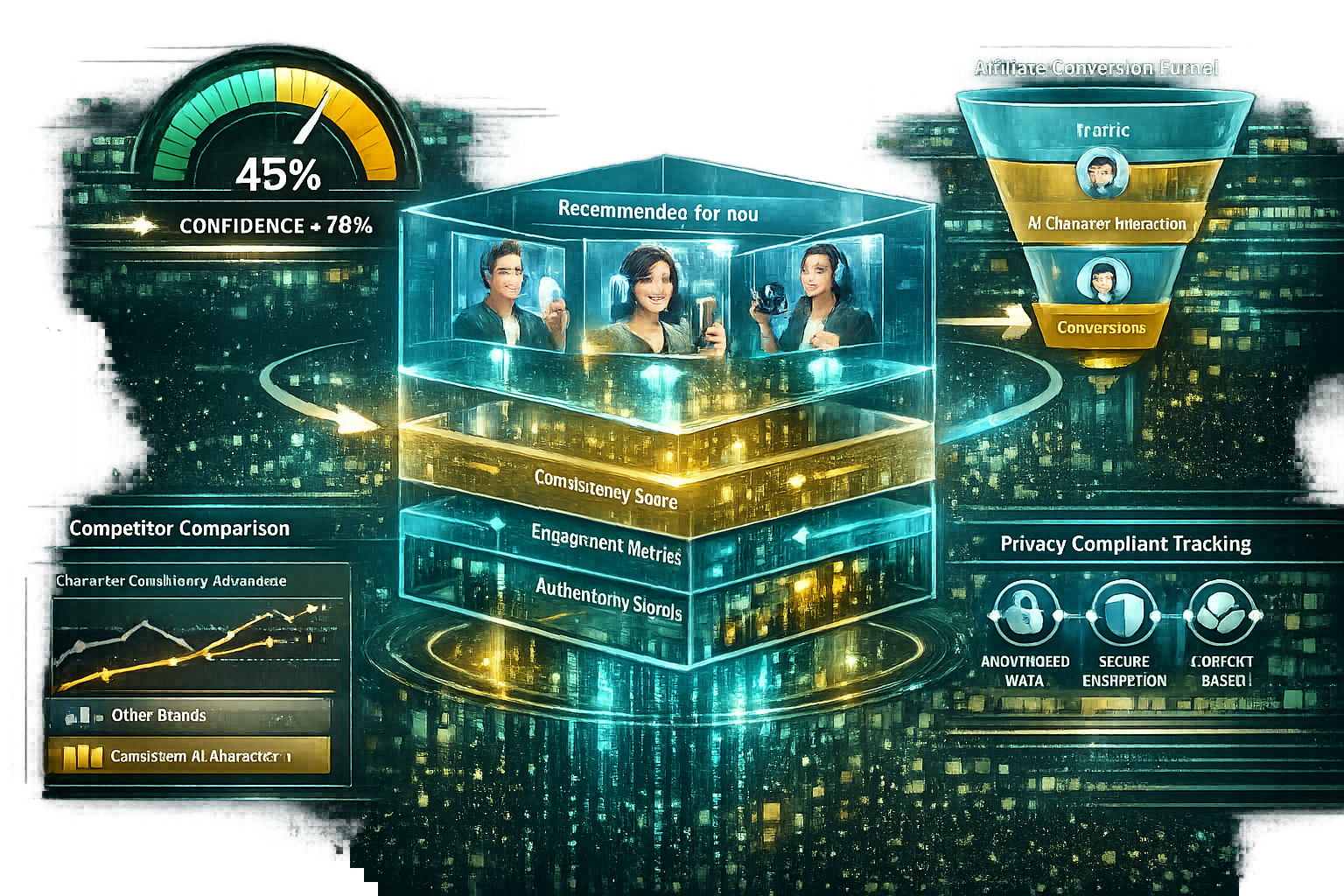
How AI Agents Evaluate Brand Trustworthiness
Agentic recommendation engines—the AI systems making delegated purchase decisions for consumers—use sophisticated evaluation frameworks. They analyze:
Visual Consistency Signals:
- Logo placement and sizing across platforms
- Color palette adherence (±5% tolerance)
- Character appearance consistency (clothing, features, styling)
- Background environment coherence
Narrative Consistency Signals:
- Messaging alignment across touchpoints
- Value proposition repetition
- Problem-solution framework consistency
- Tone and voice uniformity
Behavioral Consistency Signals:
- Response time patterns
- Customer service interaction quality
- Content publishing frequency
- Engagement authenticity metrics
When your AI-generated brand character appears consistently across these dimensions, recommendation engines assign higher trust scores to your affiliate offers. This directly impacts whether your products appear in AI-generated shopping lists, comparison tables, and purchase recommendations.
Step-by-Step: Creating Your AI Brand Character with LTX Studio
Step 1: Define Your Character's Core Identity
Before touching any software, document:
- Demographics: Age range, professional background, expertise area
- Personality traits: Friendly vs. authoritative, casual vs. formal, humorous vs. serious
- Visual style: Photorealistic vs. stylized, modern vs. classic
- Voice characteristics: Accent, speaking pace, energy level
Step 2: Generate Your Base Character in LTX Studio
LTX Studio offers cinematic-quality avatar generation:
- Input your character description (be specific: "30-year-old female tech expert, professional but approachable, wearing modern business casual, warm smile")
- Generate 5-10 variations
- Select the version that best matches your brand aesthetic
- Lock in facial features, body type, and default styling
Step 3: Create Character Style Guide
Export your character in multiple poses and expressions:
- Neutral (for product explanations)
- Enthusiastic (for promotional content)
- Thoughtful (for comparison content)
- Friendly (for customer service scenarios)
Document exact specifications: RGB color values, font pairings, background preferences.
Step 4: Develop Multi-Language Versions
Using the 75+ language capabilities[2]:
- Generate Portuguese version for Brazilian market
- Create Japanese version for Asian expansion
- Produce German version for DACH region
- Maintain visual consistency while adapting cultural elements (clothing, gestures)
Step 5: Deploy Across Affiliate Touchpoints
Integrate your character into:
- Email sequences: Product recommendations, cart abandonment, post-purchase follow-ups
- Landing pages: Hero sections, testimonial areas, FAQ sections
- Social media: Instagram Stories, YouTube intros, TikTok product demos
- Programmatic ads: Display banners, video pre-rolls, native advertising
- Affiliate partner kits: Provide character assets to affiliate marketing partners for consistent co-marketing
The Multi-Avatar Strategy for Demographic Targeting
Brands targeting multiple demographics benefit from maintaining several AI personas rather than a single character[2]. Consider this framework:
Product Line Segmentation:
- Budget-conscious character for entry-level products
- Premium expert character for high-ticket items
- Technical specialist for complex solutions
Geographic Segmentation:
- North American character (casual, direct communication)
- European character (sophisticated, privacy-conscious messaging)
- Asian market character (respectful, detail-oriented approach)
Demographic Segmentation:
- Millennial character (social-first, value-driven)
- Gen Z character (authentic, cause-focused)
- Gen X character (practical, ROI-focused)
Each character maintains its own consistency profile while rolling up to unified brand values. This allows AI recommendation engines to match the right character to the right consumer context, increasing relevance and trust.
Integrating AI Characters with Real Creator Partnerships
The most successful 2026 affiliate strategies combine AI-generated brand characters with authentic human creators. Here's how they work together:
AI Characters Handle:
- Consistent product education across platforms
- 24/7 customer service interactions
- Localized content for international markets
- High-frequency touchpoint maintenance
- Data-driven A/B testing of messaging
Human Creators Provide:
- Authentic testimonials and reviews
- Lived experience storytelling
- Emotional connection and relatability
- Community building and engagement
- Trend identification and cultural relevance
When learning how to succeed in affiliate marketing, this hybrid approach delivers the best results. AI characters ensure consistency for recommendation engines while human creators drive the authentic engagement that converts skeptical consumers.
Privacy-Compliant Tracking in the AI Character Ecosystem
As U.S. state data privacy regulations expand[1], affiliate tracking must evolve. AI-generated brand characters offer unique advantages:
First-Party Data Collection:
- Character interactions generate owned data
- Direct engagement metrics (not third-party cookies)
- Consent-based relationship building
- Transparent data usage policies
Stable Tracking Systems:
- Character-based attribution models
- Cross-platform identity resolution
- Privacy-preserving analytics
- Compliance-ready reporting
This infrastructure becomes increasingly valuable as traditional tracking methods face regulatory pressure. Your AI character becomes the persistent identifier connecting customer journeys across fragmented touchpoints.
Optimizing AI Characters for Meta's Andromeda Algorithm
Meta's AI ad engine analyzes billions of data points and rewards creative built around personas that reflect different motivators, identities, and emotional triggers[3]. This represents a fundamental shift from audience targeting to creative performance.
Your AI-generated brand character must deliver:
Creative Diversity:
- Multiple character variations (poses, expressions, contexts)
- Different messaging angles (problem-focused, solution-focused, benefit-focused)
- Varied visual treatments (close-ups, full-body, environmental shots)
Emotional Trigger Mapping:
- Fear of missing out (FOMO) character expressions
- Excitement and enthusiasm variations
- Trust and authority poses
- Empathy and understanding scenarios
Performance Optimization:
- A/B test character variations weekly
- Analyze which expressions drive highest CTR
- Identify which messaging angles convert best
- Feed winning combinations back into character library
The 77% of marketers repurposing creator content into paid ads[3] understand this principle. Your AI character becomes the consistent creative element that feeds Meta's algorithm the diversity it needs while maintaining brand coherence.
Measuring Success: KPIs for AI Character Affiliate Campaigns
Track these metrics to evaluate AI-Generated Brand Characters for Affiliate Consistency:
Consistency Metrics:
- Brand recognition scores across platforms
- Visual consistency audit scores (aim for 95%+)
- Message alignment ratings
- Cross-platform identity matching rates
Trust Metrics:
- AI recommendation engine inclusion rates
- Organic mention frequency in AI-generated content
- Consumer trust survey scores
- Return customer rates
Performance Metrics:
- Affiliate conversion rates (compare AI character vs. non-character campaigns)
- Cost per acquisition (CPA) improvements
- Customer lifetime value (CLV) increases
- Multi-touch attribution improvements
Efficiency Metrics:
- Content production cost per asset
- Time to market for new campaigns
- Localization speed for international markets
- A/B testing velocity
Conclusion: The Future of AI-Generated Brand Characters for Affiliate Consistency
As we progress through 2026, the integration of AI-Generated Brand Characters for Affiliate Consistency: Building Trust in Agentic Recommendation Engines has shifted from experimental tactic to strategic necessity. The brands winning in this environment understand a fundamental truth: AI recommendation engines favor consistency, and AI-generated brand characters deliver consistency at unprecedented scale.
The path forward requires balance. Maintain authentic human creator partnerships for emotional connection and lived experience storytelling. Deploy AI-generated brand characters for persistent, consistent touchpoints that signal trustworthiness to recommendation engines. Integrate both approaches into a cohesive strategy that serves both human consumers and AI agents evaluating your brand.
Actionable Next Steps
- Audit your current brand consistency across all affiliate touchpoints—identify gaps where AI characters could improve coherence
- Define 1-3 core brand characters based on your target demographics and product lines
- Create your first AI character using LTX Studio or similar platform, following the step-by-step process outlined above
- Deploy across 5 key touchpoints (email, landing page, social media, ads, affiliate partner kits)
- Measure consistency and trust metrics monthly, optimizing character performance based on data
- Scale successful characters to additional languages and markets
- Integrate with human creator partnerships for maximum authenticity and reach
The affiliate marketers who thrive in 2026 won't be those who resist AI—they'll be those who strategically leverage AI-generated brand characters to build the consistency that agentic recommendation engines demand, while preserving the authentic human connections that consumers crave.
Start building your AI brand character today. The recommendation engines are already evaluating your consistency. Make sure they like what they see.
For those just beginning their journey, explore our comprehensive guide on affiliate marketing for beginners to understand the foundational principles that make character-based strategies so effective.
References
[1] How Affiliate Marketing Powers Ai Search And Creator Commerce – https://martech.org/how-affiliate-marketing-powers-ai-search-and-creator-commerce/
[2] How To Create An Ai Influencer – https://creatify.ai/blog/how-to-create-an-ai-influencer
[3] Ai In Influencer Marketing How Brands Creators Are Scaling 2026 Partnerships – https://www.aspire.io/blog/ai-in-influencer-marketing-how-brands-creators-are-scaling-2026-partnerships