

The digital landscape has transformed dramatically. As 2026 unfolds, affiliate marketers face an unprecedented challenge: AI-generated content is flooding every channel, saturating feeds with generic product recommendations and templated reviews. The AI-Native Creative Flood: 7 Affiliate Differentiation Tactics to Cut Through Generated Content Noise has become essential knowledge for anyone seeking to maintain relevance and profitability in this evolving marketplace.
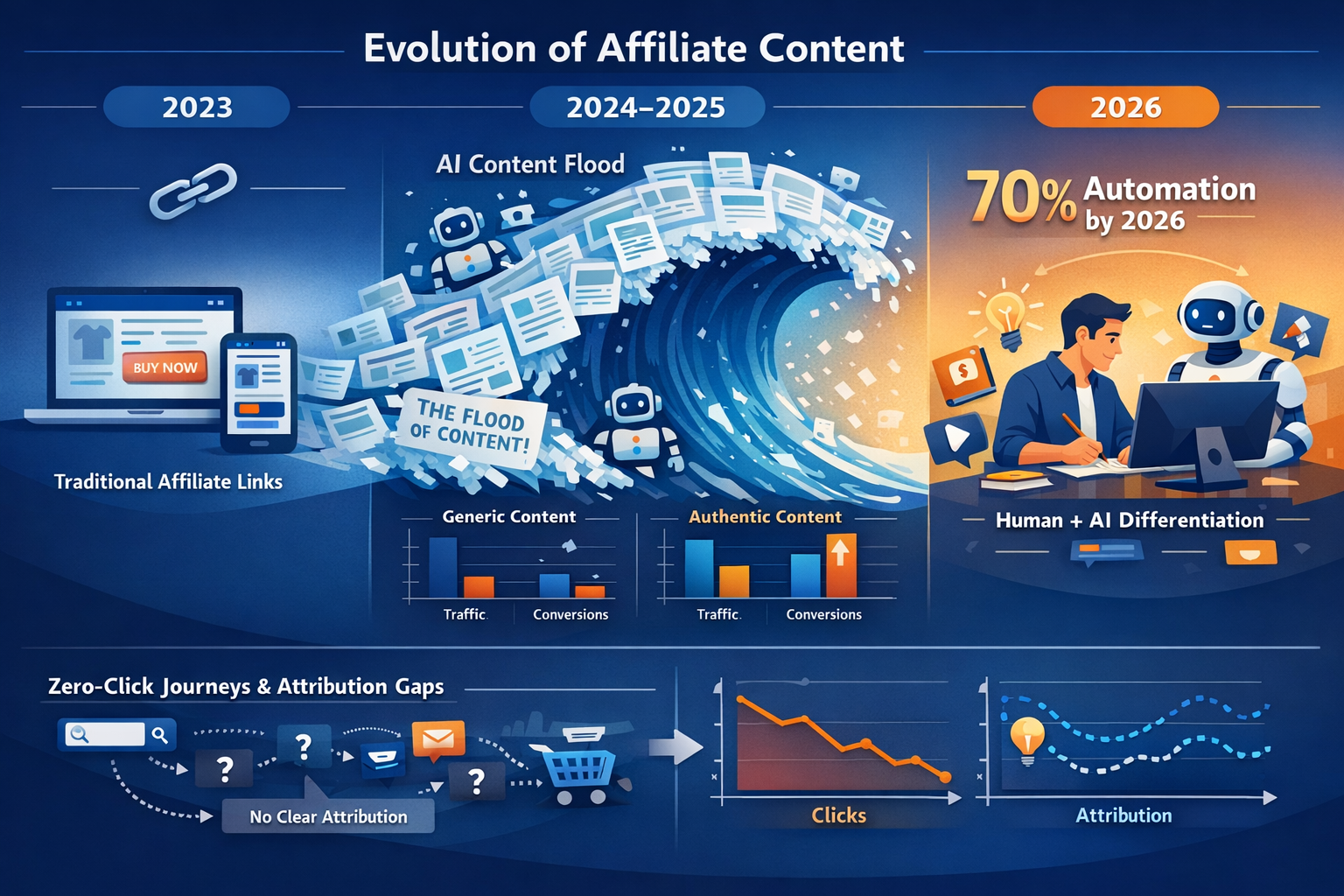
The statistics paint a stark picture. Automation is expected to handle 70% of routine campaign management tasks by 2026[1], while AI-driven discovery is creating “zero-click” journeys that collapse traditional affiliate attribution models[2]. Generic “Top 10” lists and template-based content have become completely commoditized, reducing link value and increasing the premium on authentic recommendations[3].
Yet within this challenge lies an extraordinary opportunity. While AI floods markets with cheap creative, successful affiliates are discovering that blending human cultural insights with AI speed—focusing on niche storytelling and UGC hybrids that models can’t replicate—creates sustainable competitive advantages. The consensus among industry experts is clear: “if AI is replacing you, you probably weren’t adding enough value to begin with”[2].
Key Takeaways
✅ Automation dominance: By 2026, 70% of routine affiliate campaign management will be automated, making human differentiation critical for success[1]
✅ Trust over transactions: Brands increasingly reward creators providing long-term product testing and honest opinions rather than generic link placements[3]
✅ Zero-click attribution crisis: AI summaries are absorbing top-of-funnel searches, requiring affiliates to shift toward directional content and brand uplift measurement[2]
✅ UGC and storytelling win: Story-driven recommendations and reusable user-generated content assets outperform isolated affiliate links, especially for high-ticket purchases[3]
✅ Performance-based evolution: Successful affiliate compensation models are shifting from flat fees to measurable outcomes tied to conversions and attributed sales[4]
Understanding the AI-Native Creative Flood Challenge
The Scale of AI Content Saturation
The affiliate marketing landscape has reached a critical inflection point. AI-generated content isn’t coming—it’s already here, and it’s overwhelming digital channels at unprecedented scale. Generic product roundups, automated comparison tables, and templated reviews now dominate search results and social feeds.
This content commoditization has materialized faster than most industry observers anticipated[3]. What once required hours of research and writing can now be generated in minutes, creating a race to the bottom where volume trumps value. The result? Link placements have lost significant value, and audiences have grown skeptical of recommendations that feel manufactured rather than earned.
Zero-Click Journeys and Attribution Collapse
Perhaps the most disruptive force reshaping affiliate marketing is the emergence of zero-click journeys. AI-driven discovery platforms are absorbing top-of-funnel searches directly into AI summaries, creating scenarios where influence exists but affiliate tracking disappears entirely[2].
This phenomenon particularly impacts offer-based and discount-code searches, where users previously clicked through affiliate links to access deals. Now, AI assistants can surface pricing information, compare options, and even facilitate purchases without traditional click-through attribution. For affiliate marketers relying on last-click attribution models, this represents an existential threat.
The Automation Acceleration
Research indicates that automation will handle 70% of routine campaign management tasks by 2026[1]. This includes:
- 🤖 Bid optimization and budget allocation
- 📊 Performance reporting and analytics
- 🔄 A/B testing and creative rotation
- 📧 Email sequence management
- 🎯 Audience segmentation and targeting
While this automation increases efficiency, it also means that technical campaign management alone no longer provides competitive differentiation. The value has shifted entirely to what automation cannot replicate: authentic human insight, genuine experience, and cultural relevance.
AI-Native Creative Flood: 7 Affiliate Differentiation Tactics to Cut Through Generated Content Noise
Tactic 1: Demonstrate Real Experience Through Long-Term Product Testing
The first and most powerful differentiation tactic is authentic product evaluation that goes far beyond templated reviews. Brands increasingly reward creators who provide long-term product testing, honest opinions (including what didn’t work), and specific use cases rather than generic link placements[3].
How to implement:
- Document your actual usage over weeks or months, not just initial impressions
- Share specific problems the product solved in your unique context
- Include honest critiques and limitations you discovered
- Provide comparison data from your real-world testing
- Show before/after results with verifiable evidence
This approach directly addresses the fundamental weakness of AI-generated content: it cannot genuinely use products. While AI can synthesize existing reviews and specifications, it cannot provide the nuanced, contextual insights that come from authentic experience.
For those just starting their affiliate journey, understanding how to select profitable affiliate marketing niches becomes crucial when deciding which products to test and review authentically.
Tactic 2: Create Story-Driven Recommendations and Curated Collections
Generic product lists are dead. Story-driven recommendations and curated collections outperform isolated affiliate links, particularly for high-ticket purchases with longer decision cycles[3].
Instead of “Top 10 Laptops for 2026,” successful affiliates are creating narratives like:
- “How I Built My Remote Video Production Setup for Under $3,000”
- “The Photography Gear That Survived My 6-Month Backpacking Journey”
- “My Kitchen Transformation: The 7 Tools That Changed How I Cook”
These narratives provide context, demonstrate expertise, and create emotional connection—elements that AI-generated content struggles to authentically replicate. The recommendations feel earned rather than algorithmic.
Key elements of effective story-driven content:
| Element | Purpose | Example |
|---|---|---|
| Personal challenge | Establishes credibility | “I struggled with back pain for years…” |
| Research journey | Shows due diligence | “I tested 12 different office chairs over 3 months…” |
| Specific outcomes | Provides proof | “My productivity increased 40% after switching…” |
| Honest trade-offs | Builds trust | “It’s expensive, but here’s why it’s worth it…” |
| Contextual fit | Helps targeting | “Perfect for small apartments, not ideal for large families…” |
Tactic 3: Develop Reusable UGC Assets That Brands Can Repurpose
Moving beyond standard affiliate promotion, successful creators are delivering user-generated content that brands can repurpose across their own marketing channels[3]. This transforms the affiliate relationship from transactional to strategic partnership.
UGC assets that provide exceptional value:
- 📸 High-quality product photography in real-world settings
- 🎥 Unboxing videos and first-impression reactions
- 📝 Detailed use-case tutorials and how-to guides
- 💬 Authentic testimonial quotes and soundbites
- 📊 Comparison charts based on hands-on testing
- 🎨 Creative applications and unexpected use cases
When brands can use your content in their email campaigns, social media, and product pages, you become far more valuable than someone simply placing affiliate links. This often leads to upgraded commission structures, exclusive deals, and long-term partnership opportunities.
Many successful affiliate marketing programs actively seek creators who can provide this level of content collaboration.
Tactic 4: Match Affiliate Strategy to Buyer Behavior and Purchase Intent
Not all affiliate placements are created equal. Sophisticated affiliates match their strategy to buyer behavior, using native checkout for impulse purchases and low-ticket items while using click-out links for high-ticket products with longer customer journeys[3].
Strategic placement framework:
Native checkout (embedded purchasing):
- Impulse-driven purchases under $50
- Consumable products with high repeat purchase rates
- Fashion and accessories with visual appeal
- Digital products with instant delivery
Click-out links (traditional affiliate):
- High-ticket items requiring research ($500+)
- Complex products needing specification comparison
- Services requiring consultation or customization
- Story-driven recommendations with educational content
This strategic approach recognizes that different products require different customer journeys. AI-generated content typically applies one-size-fits-all approaches, while human strategists can optimize for actual buyer psychology.
Tactic 5: Blend Human Cultural Insights with AI Speed
The most successful 2026 affiliates aren’t rejecting AI—they’re strategically combining human cultural insights with AI speed to create content that’s both timely and deeply relevant.
How to implement the human-AI hybrid approach:
- Use AI for research acceleration: Let AI tools gather product specifications, compile comparison data, and identify trending topics
- Apply human cultural filtering: Interpret trends through the lens of your specific audience’s values, pain points, and aspirations
- Add contextual relevance: Connect products to current cultural moments, seasonal needs, or emerging lifestyle shifts
- Inject authentic voice: Rewrite AI-generated drafts in your distinctive style with personal anecdotes
- Validate with community feedback: Test recommendations with your actual audience before publishing
This approach allows you to maintain the production speed necessary to compete while preserving the authenticity that AI cannot replicate. You’re not competing with AI on volume—you’re using AI as a research assistant while maintaining human editorial control.
Understanding the foundations of SEO for affiliate marketing helps ensure your human-AI hybrid content ranks effectively while maintaining authenticity.
Tactic 6: Focus on Directional and Descriptive Content Formats
As AI summaries increasingly dominate transactional searches, smart affiliates are shifting toward directional and descriptive content that maintains influence within LLM discovery[2].
High-value content formats for the AI era:
- 📚 Comprehensive buying guides: Deep educational content that AI summaries reference
- 🎬 YouTube and video-first formats: Visual content that’s harder for AI to replicate
- 🔍 Detailed comparison reviews: Nuanced evaluations that go beyond spec sheets
- 📖 Use-case explainers: “How to choose X for Y situation” content
- 🗣️ Social-first recommendations: Platform-native content with community engagement
- 📰 Industry trend analysis: Forward-looking perspectives that AI struggles to generate
These formats position you as a cited source rather than just a link destination. When AI assistants synthesize information about a product category, your comprehensive content becomes the authoritative reference they cite, maintaining your influence even in zero-click scenarios.
Tactic 7: Shift to Performance-Based Compensation Models
The final differentiation tactic involves evolving beyond traditional commission structures. Successful affiliates are moving from flat-fee content partnerships to performance-based models tied to measurable outcomes[4].
Modern compensation structures:
- 💰 Attributed sales with incrementality tracking: Proving you drove sales that wouldn’t have occurred otherwise
- 📈 Brand lift and awareness metrics: Demonstrating impact on brand consideration and recall
- 🎯 Conversion rate optimization bonuses: Earning more when your content converts at higher rates
- 🔄 Customer lifetime value sharing: Participating in long-term customer value, not just initial sale
- 📊 Hybrid models: Base commission plus performance bonuses for exceeding benchmarks
This approach aligns your incentives directly with brand outcomes, making you a strategic partner rather than a commodity traffic source. It also requires more sophisticated tracking and measurement, which creates a natural barrier to entry that AI-generated content cannot easily cross.
Exploring proven strategies to boost affiliate marketing income provides additional context for implementing performance-based approaches effectively.
Adapting Attribution Measurement for the AI Era
Accepting Less Deterministic Measurement
The affiliate channel may need to accept less deterministic measurement to remain relevant in AI-driven discovery[2]. This represents a significant mindset shift for an industry built on precise click-through attribution.
New measurement approaches:
- 📊 Brand uplift studies: Surveying audiences to measure awareness and consideration changes
- 🗨️ Qualitative feedback: “How did you hear about us?” post-purchase surveys
- 📈 Incrementality testing: Controlled experiments to isolate your actual impact
- 🔗 Multi-touch attribution: Recognizing influence across multiple touchpoints
- 📉 Baseline comparison: Measuring sales lift during campaign periods versus control periods
While less precise than click tracking, these methods provide a more accurate picture of your actual influence in an environment where traditional attribution breaks down.
Building Authentic Audience Access
The ultimate differentiation in 2026 is genuine audience access and trust. Publishers offering real influence and authentic community relationships are being rewarded while undifferentiated models decline[2].
This means:
- ✅ Building email lists with engaged subscribers who open and click
- ✅ Cultivating social media communities with genuine interaction
- ✅ Creating content that people actively seek out and share
- ✅ Establishing yourself as a trusted authority in specific niches
- ✅ Developing relationships where recommendations carry weight
When you have authentic audience access, you can demonstrate value to brands even when traditional attribution fails. Your recommendation moves the needle because your audience trusts you—and that trust cannot be automated or replicated by AI-generated content.
For those questioning the viability of this approach, understanding whether affiliate marketing is legitimate in 2026’s AI-driven landscape provides important context.
Implementing Your Differentiation Strategy
Start with Niche Selection and Specialization
The broader the niche, the more AI-generated content will flood it. Specialization is your competitive moat. Instead of “fitness products,” focus on “strength training equipment for home gyms under 500 square feet.” Instead of “productivity software,” specialize in “project management tools for creative agencies with remote teams.”
This specificity allows you to develop genuine expertise that AI cannot easily replicate. You become the go-to authority for a specific audience with specific needs.
Build Your Content Production System
Create a hybrid content production system that combines:
- AI-assisted research: Use tools to gather data, specifications, and market trends
- Human evaluation: Actually test products and develop genuine opinions
- Story development: Craft narratives that connect products to real problems
- Community validation: Test recommendations with your audience before publishing
- Performance optimization: Track what resonates and refine your approach
This system allows you to maintain competitive production speed while preserving the authenticity that creates differentiation.
Measure What Matters
Focus on metrics that indicate genuine influence:
- 📊 Engagement rate: Are people actually reading, watching, and interacting?
- 💬 Community feedback: What are people saying in comments and messages?
- 🔄 Return visitor rate: Do people come back to your content?
- 📈 Conversion quality: Are you driving high-value customers, not just clicks?
- ⭐ Brand partnership requests: Are brands seeking you out for collaboration?
These indicators reveal whether you’re building sustainable differentiation or just competing on volume.
The Future of Affiliate Marketing in an AI-Native World
The Value Shift from Links to Influence
The fundamental shift happening in 2026 is from links as commodities to influence as currency. Traditional affiliate marketing focused on placing links and driving clicks. The new model focuses on building trust and shaping purchase decisions—whether or not those decisions happen through trackable links.
This requires different skills:
- 🎯 Audience building and community management
- 📝 Storytelling and narrative development
- 🔬 Genuine product expertise and evaluation
- 🤝 Strategic brand partnerships
- 📊 Multi-channel influence measurement
Affiliates who develop these capabilities will thrive. Those who rely solely on link placement and SEO optimization will find themselves competing with AI at a game they cannot win.
Embracing the Hybrid Model
The most successful affiliates in 2026 aren’t purely human or purely AI—they’re strategic hybrids who use AI to enhance their capabilities while maintaining the human elements that create genuine value.
They use AI for:
- Research and data gathering
- Initial content drafts and outlines
- Performance analytics and optimization
- Audience segmentation and targeting
- Competitive intelligence
But they rely on human judgment for:
- Product selection and evaluation
- Story development and narrative
- Cultural relevance and timing
- Authentic voice and perspective
- Strategic decision-making
This hybrid approach creates sustainable competitive advantage that’s difficult for pure AI or pure human competitors to match.
Conclusion: Thriving in the AI-Native Creative Flood
The AI-Native Creative Flood: 7 Affiliate Differentiation Tactics to Cut Through Generated Content Noise represents both challenge and opportunity. While AI-generated content has commoditized generic product recommendations, it has simultaneously increased the premium on authentic, experience-based, story-driven affiliate marketing.
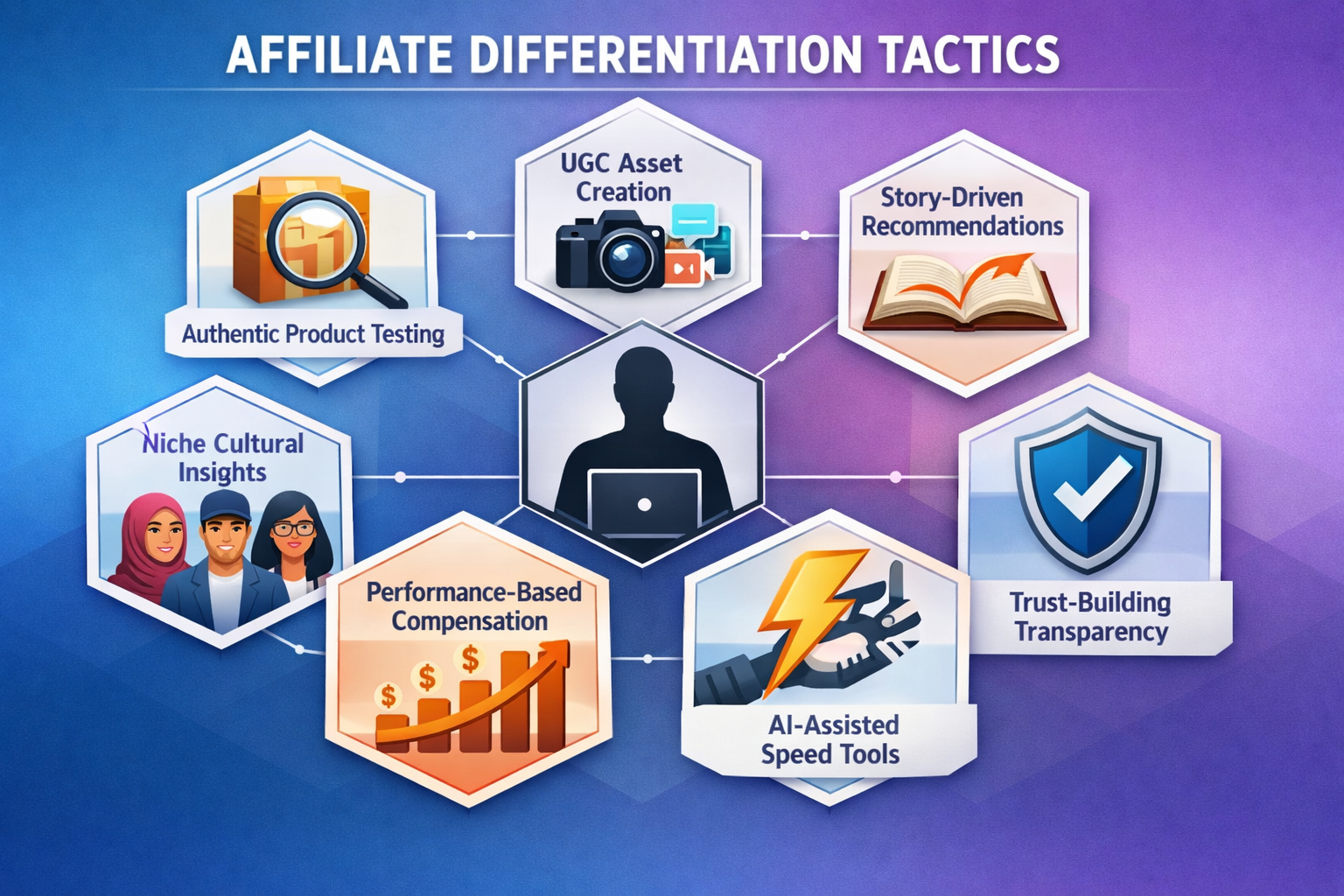
The seven tactics outlined in this guide—demonstrating real experience, creating story-driven recommendations, developing reusable UGC assets, matching strategy to buyer behavior, blending human insights with AI speed, focusing on directional content, and shifting to performance-based compensation—provide a comprehensive framework for differentiation.
The affiliates who will succeed in 2026 and beyond are those who recognize that AI is replacing commodity content, not genuine value creation. If your affiliate strategy can be replicated by AI, it probably will be. But if you’re building authentic audience relationships, developing genuine expertise, and creating content that reflects real human experience and cultural insight, you’re building something AI cannot easily replicate.
Your Next Steps
- Audit your current content: How much could be replicated by AI? What’s genuinely unique?
- Choose your specialization: What niche can you dominate through genuine expertise?
- Develop your testing protocol: How will you authentically evaluate products?
- Build your hybrid system: What AI tools will enhance your human capabilities?
- Measure influence, not just clicks: What metrics reveal your actual impact?
- Cultivate brand partnerships: Which brands align with your audience and values?
- Invest in community: How will you build authentic audience relationships?
The AI-native era of affiliate marketing rewards those who add genuine value. The question isn’t whether AI will change affiliate marketing—it already has. The question is whether you’ll differentiate yourself by combining human insight with AI capabilities to create something neither could achieve alone.
For those ready to implement these strategies, exploring comprehensive affiliate marketing programs that support differentiated approaches provides a strong foundation for success.
The content flood is real. The opportunity for differentiation has never been greater. The choice is yours.
References
[1] The Future Of Affiliate Marketing Ai Agents As Affiliates – https://www.jasminedirectory.com/blog/the-future-of-affiliate-marketing-ai-agents-as-affiliates/
[2] Ai Affiliate Marketing Fight Discovery 2026 – https://www.affilifest.com/blog/ai-affiliate-marketing-fight-discovery-2026
[3] Affiliate Platform Chaos In 2026 – https://logie.ai/news/affiliate-platform-chaos-in-2026/
[4] Adtech Trends – https://www.mgid.com/blog/adtech-trends
