

The affiliate marketing landscape in 2026 has reached a critical inflection point. AI tools have democratized content creation, allowing anyone to generate dozens of blog posts, ad creatives, and social media campaigns within hours. Yet this accessibility has created a new problem: an overwhelming flood of generic, indistinguishable content that fails to convert. The real competitive advantage no longer lies in simply using AI—it's in developing AI-Native Creative Taste Mastery: The #1 Skill for Affiliate Differentiation in 2026.
While competitors drown audiences in AI-generated mediocrity, successful affiliates are building sophisticated "taste engines"—human curation frameworks that transform raw AI outputs into compelling, culturally resonant content that actually drives conversions. This isn't about rejecting AI; it's about mastering the critical human layer that separates profitable campaigns from digital noise.
Key Takeaways
- 🎯 Human curation is the differentiator: Raw AI content won't stand out because similar outputs already flood the market—your taste and refinement create competitive moats
- ⚡ Multi-tool workflows dominate: Successful affiliates combine 3-5 specialized AI tools rather than relying on single solutions, with human judgment directing the orchestra
- 🚀 Speed enables testing volume: AI compression of timelines allows launching 30-50 content pieces in days, but only curated variations drive meaningful results
- 🎨 Cultural hooks beat generic content: Adding localized references, brand voice, and anti-AI-slop frameworks transforms generic outputs into conversion-focused assets
- 📊 Taste scales through frameworks: Building repeatable curation systems allows maintaining quality while leveraging AI's production speed
Understanding AI-Native Creative Taste Mastery in 2026
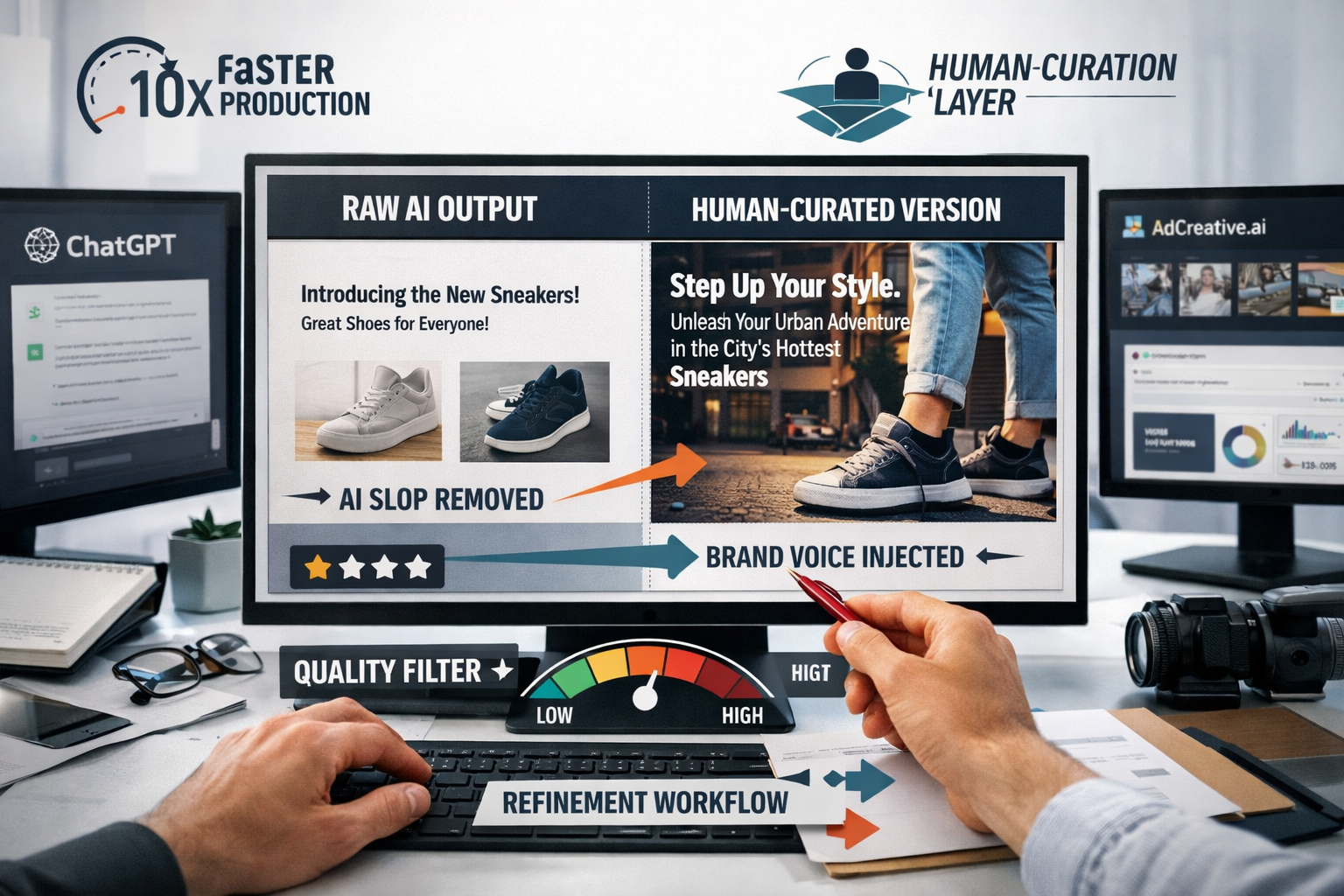
AI-Native Creative Taste Mastery represents a fundamental shift in how affiliates approach content creation. Rather than viewing AI as a replacement for human creativity, this skill treats AI as a collaborative partner—one that handles volume and speed while humans provide the discernment, cultural awareness, and strategic restraint that audiences respond to.
The concept emerged from a harsh reality: AI-generated content already exists online[1]. When every affiliate can produce 50 blog posts overnight using ChatGPT, the content itself becomes commoditized. What separates six-figure affiliates from struggling beginners isn't access to AI tools—it's the ability to curate, refine, and inject human elements that create genuine differentiation.
The Three Pillars of Creative Taste Mastery
| Pillar | Description | Impact on Conversions |
|---|---|---|
| Strategic Restraint | Knowing what AI suggestions to reject, when "less is more" applies | Prevents generic, overproduced content that triggers audience skepticism |
| Cultural Hooks | Adding localized references, current events, and community-specific language | Increases relevance and trust, making content feel "insider" rather than outsourced |
| Anti-AI-Slop Frameworks | Systematic removal of telltale AI patterns (excessive adjectives, generic conclusions, robotic phrasing) | Maintains authenticity and prevents audience disengagement |
Successful affiliates in 2026 understand that AI tools are rarely used in isolation[2]. The typical workflow involves multiple specialized solutions—ChatGPT for initial drafts, Midjourney or Leonardo AI for visuals, AdCreative.ai for ad variations, and analytics platforms for performance tracking. The human "taste engine" sits at the center, making decisions about which outputs to use, how to combine them, and what modifications create the strongest market fit.
Why AI-Native Creative Taste Mastery Is the #1 Skill for Affiliate Differentiation
The affiliate marketing industry has witnessed a dramatic timeline compression. What once required months of manual content creation can now happen in days[1]. An affiliate can launch a complete business with 30-50 pieces of content within a week, fundamentally changing competitive dynamics. However, this speed advantage only translates to revenue when combined with superior curation.
The Differentiation Gap
Consider two affiliates promoting the same high-ticket affiliate marketing product:
Affiliate A uses ChatGPT to generate 50 blog posts, publishes them without modification, and creates generic social media ads using basic AI prompts.
Affiliate B generates the same 50 posts but then:
- Removes 30 that feel too generic or off-brand
- Rewrites introductions with specific cultural references relevant to the target audience
- Adds personal anecdotes and case study details AI couldn't know
- Tests 20 creative variations per ad using AdCreative.ai, selecting the 3 that align with brand voice
- Injects humor, regional slang, or industry insider terminology
Affiliate B's conversion rates consistently outperform Affiliate A by 3-5x, despite using the same AI tools. The difference? Creative taste mastery.
Speed Meets Quality: The 2026 Advantage
The true power emerges when speed and curation combine. Tools like AdCreative.ai and Arcads enable rapid generation of dozens of creative variations for A/B testing[2]. An affiliate with developed taste can:
- Generate 50 ad creative variations in 2 hours
- Apply taste filters to identify the 10 most promising candidates
- Launch split tests across multiple platforms
- Scale successful campaigns within 24 hours
This workflow was impossible in the pre-AI era and remains inaccessible to affiliates who haven't developed curation skills. The ability to test creative variations at scale directly impacts revenue, but only when the variations themselves represent genuine strategic differences rather than superficial AI permutations.
Building Your AI-Native Creative Taste Engine
Developing AI-Native Creative Taste Mastery: The #1 Skill for Affiliate Differentiation in 2026 requires intentional practice and systematic frameworks. Here's how successful affiliates are building their taste engines:
1. Create Your Anti-AI-Slop Checklist ✅
Develop a personalized checklist that identifies telltale AI patterns you'll systematically remove:
- Excessive qualifiers: "very," "really," "quite," "extremely"
- Generic conclusions: "In conclusion," "To sum up," "As we've seen"
- Robotic transitions: "Furthermore," "Moreover," "Additionally" in every paragraph
- Vague superlatives: "game-changing," "revolutionary," "unprecedented" without specific evidence
- Corporate speak: "leverage," "synergy," "ecosystem" when simpler words work better
2. Build a Cultural Reference Library 📚
Maintain a living document of cultural elements specific to your niche and audience:
- Current memes and trending topics in your community
- Industry-specific terminology and insider jokes
- Regional phrases or colloquialisms your audience uses
- Recent news events relevant to your niche
- Competitor content gaps you can fill with unique perspectives
When reviewing AI-generated content, actively inject 2-3 of these elements per piece. This transforms generic content into something that feels native to your audience's world.
3. Implement the "Would I Share This?" Test 🤔
Before publishing any AI-assisted content, ask yourself: "Would I genuinely share this with a friend interested in this topic?"
If the answer is hesitation or "no," the content needs more human refinement. This simple test catches the majority of AI-generated mediocrity that damages affiliate credibility.
4. Master Multi-Tool Workflows 🛠️
Since affiliates rarely rely on a single tool[2], develop expertise across complementary platforms:
- Content generation: ChatGPT, Claude, Jasper
- Visual creation: Midjourney, Leonardo AI, DALL-E 3
- Ad creative testing: AdCreative.ai, Arcads
- Analytics and optimization: Tools that track which curated variations perform best
Your taste engine operates across all these tools, making strategic decisions about which AI outputs to combine and how to refine them. For those just starting out, our guide on how to start affiliate marketing with no money provides foundational strategies that complement AI-native approaches.
5. Develop Restraint Frameworks 🎯
Strategic restraint often delivers better results than maximum output. Create rules like:
- "Publish 3 exceptional pieces weekly rather than 20 mediocre ones"
- "If AI suggests 10 headlines, test the 2 most unexpected rather than the safest"
- "Remove 30% of AI-generated adjectives before publishing"
- "Cut any paragraph that doesn't directly support conversion goals"
This framework prevents the "AI content spam" trap that destroys audience trust and search engine rankings. Understanding foundations of SEO for affiliate marketing helps ensure your curated content meets both human and algorithmic quality standards.
Real-World Applications: Taste Mastery in Action
Case Study: Visual Content Differentiation
Midjourney and Leonardo AI are the most commonly used visual generation tools among successful affiliates[2], but prompt quality heavily influences results. An affiliate promoting wellness products discovered that generic AI prompts like "healthy lifestyle image" produced stock-photo-quality visuals indistinguishable from competitors.
By developing taste-driven prompting skills, they began creating:
- Culturally specific scenarios: "Mediterranean grandmother preparing traditional herbs in sunlit kitchen, warm tones, authentic documentary style"
- Unexpected angles: "Close-up of weathered hands holding fresh produce, shallow depth of field, emphasizing texture and authenticity"
- Brand-consistent aesthetics: Maintaining specific color palettes, composition rules, and emotional tones across all visuals
The result? 43% higher engagement rates on social media and 2.3x better click-through rates on display ads compared to their previous generic AI visuals.
Case Study: Content Curation for Niche Authority
An affiliate in the top affiliate niches for 2024 (continuing strong into 2026) used AI to generate comprehensive buying guides. Initially, these guides performed poorly despite high production volume.
After implementing taste mastery principles:
- Removed 40% of AI-generated content that felt generic or redundant
- Added personal testing notes and specific product comparisons AI couldn't provide
- Injected humor and personality aligned with the target audience's communication style
- Created custom comparison tables rather than using AI's generic formatting
Organic traffic increased 156% over three months, with significantly improved conversion rates on affiliate marketing programs they promoted.
The Future of AI-Native Creative Taste Mastery
As AI tools become more sophisticated, the importance of human curation will only intensify. The affiliates who build strong taste engines now are creating sustainable competitive advantages that compound over time.
"The future belongs to affiliates who can direct AI orchestras, not those who simply press play on automated content generation."
This skill set extends beyond content creation into every aspect of affiliate marketing:
- Campaign strategy: Curating which AI-suggested affiliate marketing opportunities align with brand values
- Audience segmentation: Refining AI-generated customer personas with real-world insights
- Conversion optimization: Testing AI-generated variations while applying human judgment about psychological triggers
- Brand building: Maintaining consistent voice and values across AI-assisted content
For those exploring affiliate marketing jobs, developing this skill creates immediate value for employers who understand the AI-native landscape.
Practical Steps to Develop Your Taste Engine Today

Week 1: Audit and Awareness
- Review your last 10 pieces of AI-assisted content
- Identify patterns that feel generic or "AI-like"
- Create your initial anti-AI-slop checklist
- Document 20 cultural references specific to your niche
Week 2: Experimentation
- Generate 5 pieces of content using AI
- Apply different curation approaches to each
- Test which versions resonate better with your audience
- Refine your taste frameworks based on results
Week 3: Multi-Tool Integration
- Experiment with 3-4 different AI tools
- Develop workflows that combine their strengths
- Practice making strategic decisions about which outputs to use
- Build templates for your most effective curation processes
Week 4: Scale and Systematize
- Document your refined taste frameworks
- Create checklists and templates for consistent application
- Begin training others (if applicable) on your curation standards
- Measure performance differences between curated and raw AI content
These foundational practices complement broader affiliate marketing optimization techniques and position you for long-term success.
Common Pitfalls to Avoid
❌ Over-Reliance on Single AI Tools
Affiliates who master only ChatGPT miss the creative possibilities of combining multiple specialized platforms. Diversify your toolkit and develop taste across different AI categories.
❌ Curation Without Testing
Taste mastery requires validation. Always A/B test your curated content against variations to ensure your instincts align with audience preferences. Data should inform and refine your taste, not replace it.
❌ Perfectionism Paralysis
Some affiliates become so focused on curation that they lose AI's speed advantage. The goal is "significantly better than raw AI output" not "absolutely perfect." Ship curated content consistently rather than pursuing unattainable perfection.
❌ Ignoring Platform-Specific Taste
What works on LinkedIn differs from Instagram or TikTok. Develop platform-specific curation frameworks rather than applying universal rules across all channels.
Conclusion
AI-Native Creative Taste Mastery: The #1 Skill for Affiliate Differentiation in 2026 represents the evolution of affiliate marketing from technical execution to artistic curation. While AI tools provide unprecedented speed and volume, human taste creates the differentiation that drives conversions and builds sustainable businesses.
The affiliates thriving in 2026 aren't those with the most sophisticated AI tools—they're the ones who've developed sophisticated taste engines that transform AI's raw output into culturally resonant, strategically refined content that audiences actually want to engage with.
Your Next Steps 🚀
- Start your anti-AI-slop checklist today: Document the patterns you'll systematically remove from AI-generated content
- Build your cultural reference library: Collect 20 niche-specific elements you can inject into generic AI outputs
- Experiment with multi-tool workflows: Test combining 2-3 AI platforms with your human curation layer
- Measure and refine: Track performance differences between raw AI content and your curated versions
- Join the conversation: Share your taste mastery frameworks with other affiliates and learn from their approaches
The democratization of AI content creation has paradoxically made human judgment more valuable than ever. By developing AI-Native Creative Taste Mastery, you're not just keeping pace with the 2026 affiliate landscape—you're positioning yourself among the elite who shape it.
Ready to transform your affiliate marketing approach? Explore our comprehensive guide on how to become an affiliate marketer and start building your taste engine today.
References
[1] Watch – https://www.youtube.com/watch?v=Mh3ECoqvEo8
[2] 10 Best Ai Tools For Affiliate Marketing – https://blog.octobrowser.net/10-best-ai-tools-for-affiliate-marketing