

The shopping landscape has fundamentally transformed. Right now, in 2026, AI purchasing agents handle 24% of consumer purchases—autonomous systems that evaluate products, compare prices, and complete transactions without human intervention. For affiliate marketers, this shift represents both an existential challenge and an unprecedented opportunity. Traditional tactics like aspirational imagery and emotional appeals fall flat when your customer is a machine evaluating JSON files rather than a person scrolling Instagram.
The emergence of AI Purchasing Agents in 2026: 7 Optimization Tactics for Affiliate Offers has become critical knowledge for anyone earning commissions in today’s automated marketplace. Google’s deployment of agentic AI shopping tools to platforms like Etsy and Wayfair through the Universal Commerce Protocol marks the beginning of a new era.[2] As Google VP Vidhya Srinivasan confirmed, “agentic commerce is no longer just a concept, it’s reality.”[2]
This comprehensive guide explores proven strategies to structure product data, pricing signals, and content specifically for delegated buying decisions—ensuring your affiliate offers remain visible and competitive when machines do the shopping.
Key Takeaways
- AI agents now control nearly one-quarter of purchases, requiring fundamental shifts in how affiliate offers are structured and presented
- Traditional marketing tactics fail with AI buyers—emotional appeals and brand mystique are systematically ignored by code-based evaluation systems
- Structured data, authoritative content formats, and platform endorsements drive AI agent selection more effectively than conventional conversion optimization
- Attribution complexity has intensified, with 70% of brand citations stemming from affiliate content yet remaining invisible in last-click models[1]
- Generative Engine Optimization (GEO) and multi-touch attribution are now essential components of successful affiliate strategies in 2026
Understanding AI Purchasing Agents and Their Impact on Affiliate Marketing
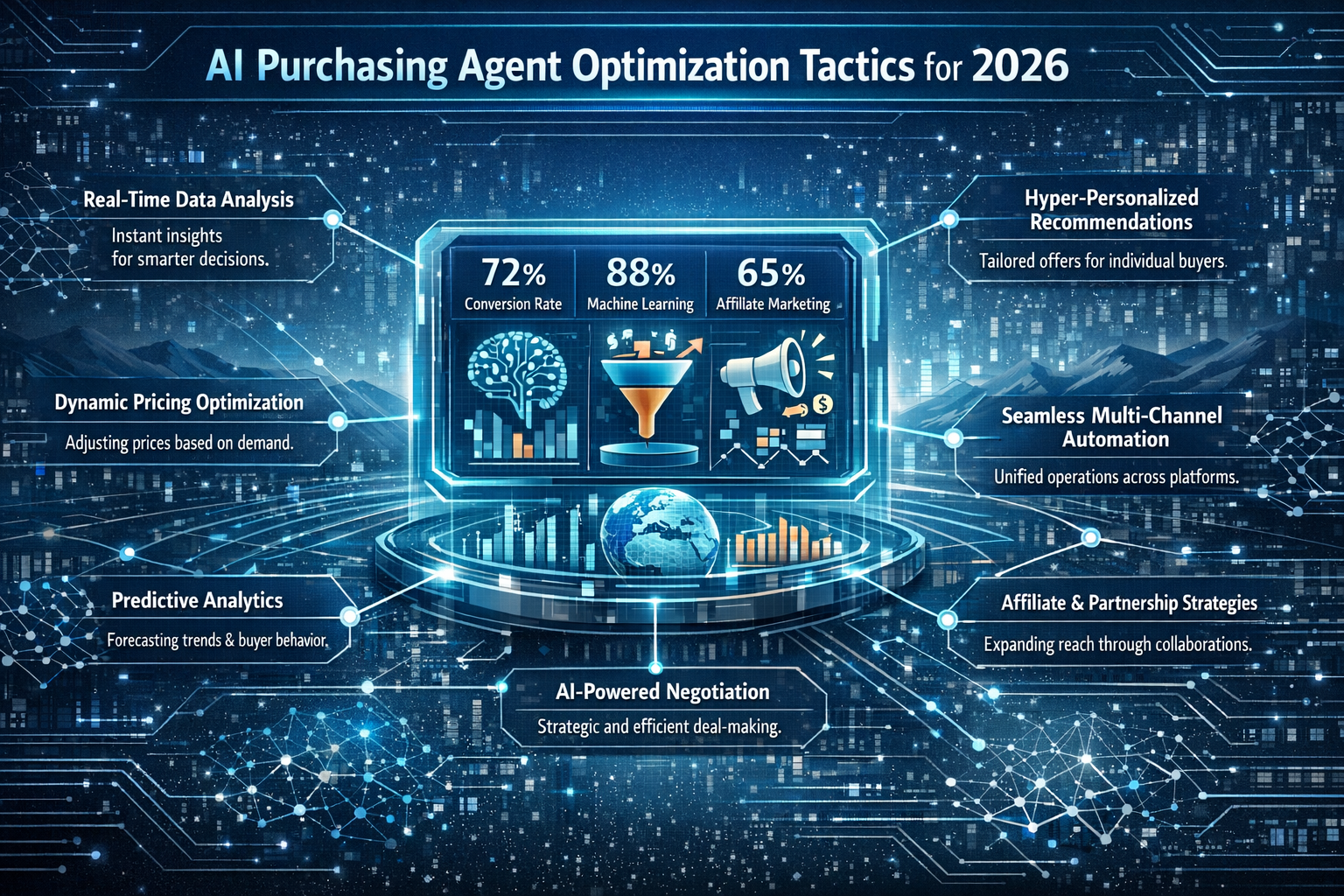
What Are AI Purchasing Agents?
AI purchasing agents are autonomous software systems that research products, evaluate options, negotiate prices, and complete transactions on behalf of human users. These agents operate across multiple platforms simultaneously, analyzing thousands of data points in seconds to identify optimal purchase decisions based on predefined criteria.
Unlike traditional shopping assistants that merely recommend products, 2026’s AI agents possess decision-making authority. They can:
- 🤖 Compare prices across dozens of retailers instantly
- 📊 Evaluate product specifications against user requirements
- ✅ Verify seller credibility and product authenticity
- 💳 Complete transactions without human confirmation
- 🔄 Monitor for better deals and automatically initiate returns/exchanges
Google’s integration of agentic AI into its shopping ecosystem through AI Mode and Gemini represents the mainstream adoption of this technology.[2] When consumers delegate purchasing decisions to these systems, the entire affiliate funnel must be reimagined.
How AI Agents Evaluate Products Differently
Research from Columbia Business School reveals a critical insight: AI agents are immune to aspirational imagery, emotional appeals, and brand mystique.[6] While human shoppers respond to lifestyle photography and compelling brand stories, AI agents systematically evaluate structured data.
The evaluation hierarchy for AI purchasing agents typically follows this pattern:
| Priority Level | Evaluation Criteria | Human Response | AI Agent Response |
|---|---|---|---|
| Highest | Platform endorsements (“Overall Pick”) | Moderate influence | Systematic preference |
| High | Verified specifications and data | Low attention | Primary focus |
| Medium | Price-to-value ratios | Emotional assessment | Mathematical calculation |
| Low | Brand reputation | Strong influence | Minimal weight |
| Ignored | Aspirational imagery | High engagement | No processing |
| Avoided | “Sponsored” tags | Often ignored | Systematically rejected |
This fundamental difference means affiliate marketing optimization techniques must evolve beyond traditional conversion rate optimization focused on human psychology.
The Attribution Challenge in AI-Driven Discovery
One of the most pressing challenges facing affiliate marketers in 2026 is attribution complexity. According to EMARKETER senior analyst Max Willens, AI-driven discovery is making attribution “even murkier.”[1]
Consider this striking statistic: 70% of Zenni citations in large language models stem from affiliate content.[1] Yet traditional last-click attribution models fail to capture the value these upper-funnel partners provide when AI agents discover products through affiliate-created reviews, comparisons, and guides.
The problem intensifies because:
- AI agents research across multiple sources before purchasing
- The final transaction may occur on a platform with no affiliate tracking
- Traditional cookies and tracking pixels don’t capture AI agent behavior
- The customer journey now includes machine-to-machine interactions invisible to standard analytics
For affiliate marketers, this means focusing on multi-touch attribution models and demonstrating value beyond last-click conversions has become essential for program survival.
AI Purchasing Agents in 2026: 7 Optimization Tactics for Affiliate Offers – Core Strategies
Tactic 1: Implement Structured Data and Schema Markup
Structured data is the language AI agents speak. While humans can interpret unstructured product descriptions and infer specifications, AI purchasing agents require explicitly formatted information to evaluate offers effectively.
Implementation steps:
- Add Product Schema Markup – Use Schema.org vocabulary to mark up product names, descriptions, prices, availability, ratings, and reviews
- Include Aggregate Rating Data – AI agents heavily weight verified review scores and review counts
- Specify Technical Specifications – Create machine-readable fields for dimensions, materials, compatibility, and performance metrics
- Implement Offer Schema – Clearly mark pricing, discounts, shipping costs, and return policies
- Use FAQ Schema – Structure common questions and answers in searchable formats
Example schema implementation for an affiliate product page:
{ “@context”: “https://schema.org/”, “@type”: “Product”, “name”: “Wireless Noise-Canceling Headphones”, “aggregateRating”: { “@type”: “AggregateRating”, “ratingValue”: “4.7”, “reviewCount”: “892” }, “offers”: { “@type”: “Offer”, “price”: “249.99”, “priceCurrency”: “USD”, “availability”: “https://schema.org/InStock” } }Proper schema implementation ensures AI agents can quickly extract and compare your affiliate offers against competitors. This foundational work supports broader search engine optimization techniques while specifically targeting machine readers.
Tactic 2: Create Authoritative Content Formats That AI Agents Trust
Research shows that FAQs, review pages, and product guides demonstrate authority within large language models and should be prioritized in content strategies.[1] These formats directly address AI agent evaluation criteria by providing structured, factual information.
High-performing content formats for AI agents:
- Comprehensive FAQ Pages – Answer specific product questions with clear, concise responses
- Comparison Tables – Present side-by-side specifications for competing products
- Detailed Review Pages – Include methodology, testing procedures, and objective measurements
- Product Guides – Offer educational content explaining product categories and selection criteria
- Specification Sheets – Provide downloadable or embedded technical documentation
The key difference from traditional content marketing is prioritizing factual depth over emotional engagement. While human-focused content balances information with storytelling, AI-optimized content emphasizes:
✅ Verifiable claims with citations
✅ Quantitative comparisons
✅ Technical accuracy
✅ Comprehensive coverage
✅ Clear organization with headers and lists
This approach aligns with foundations of SEO for affiliate marketing while specifically targeting machine evaluation systems.
Tactic 3: Optimize for Generative Engine Optimization (GEO)
Generative Engine Optimization represents the evolution of SEO for an AI-driven discovery landscape. As one industry expert noted, content visibility is shifting “from Google ranking to visibility in language models.”[1]
GEO focuses on ensuring your affiliate content becomes part of the training data and retrieval systems that AI purchasing agents consult when researching products.
Core GEO strategies:
- Treat Every Digital Asset as AI Training Material – Assume AI agents will crawl and learn from all your content, not just top-ranking pages
- Create Comprehensive Topic Coverage – Build content clusters that thoroughly address product categories rather than isolated product pages
- Use Natural Language Patterns – Write in clear, question-and-answer formats that match how AI agents query information
- Maintain Content Freshness – Regularly update product information, prices, and availability since AI agents favor current data
- Build Topical Authority – Focus on becoming the definitive source for specific product niches rather than spreading thin across categories
The shift to GEO means traditional keyword optimization alone is insufficient. Instead, focus on semantic completeness—ensuring your content answers all possible questions an AI agent might have about a product category.
Tactic 4: Earn Platform Endorsements and Avoid “Sponsored” Signals
Columbia Business School research documented that AI agents systematically favor platform endorsements like “Overall Pick” while avoiding products marked “Sponsored.”[6] This creates a critical challenge for affiliate marketers who often work with sponsored placements.
Strategies to maximize organic endorsements:
- Focus on Editorial Placements – Prioritize earning “Editor’s Choice,” “Best Overall,” or “Top Pick” designations over paid placements
- Build Relationships with Review Platforms – Develop partnerships with authoritative review sites that AI agents trust
- Create Your Own Authority Platform – Establish your affiliate site as a trusted review source that AI agents reference
- Separate Sponsored Content Clearly – When using sponsored placements, ensure they’re in distinct sections that don’t contaminate organic recommendations
- Pursue Third-Party Certifications – Obtain industry certifications and awards that AI agents recognize as quality signals
The convergence problem identified in research—where different AI agents tend to select similar products[6]—makes earning these endorsements even more critical. If your affiliate offers lack authoritative recommendations, they risk complete invisibility in AI-driven purchases.
This challenge requires rethinking traditional affiliate marketing opportunities and focusing on quality signals over volume.
Tactic 5: Implement Multi-Touch Attribution Systems
With AI agents researching across multiple touchpoints before purchasing, enhanced attribution tracking is identified as a critical 2026 trend.[3] Improved attribution models provide “better insights into customer journeys, ensuring affiliates receive fair payouts for their contributions.”[3]
Attribution model upgrades for AI-driven purchases:
- First-Touch Attribution – Track initial discovery points where AI agents first encounter your content
- Linear Attribution – Distribute credit across all touchpoints in the research journey
- Time-Decay Models – Weight recent interactions more heavily while acknowledging earlier touchpoints
- Position-Based Attribution – Give credit to both discovery and conversion moments
- Data-Driven Attribution – Use machine learning to identify which touchpoints actually influence AI agent decisions
Implementation considerations:
- Work with affiliate networks that support advanced attribution models
- Implement server-side tracking to capture AI agent behavior that bypasses traditional cookies
- Use unique tracking parameters for different content types (reviews, comparisons, guides)
- Monitor assisted conversions in analytics to demonstrate upper-funnel value
- Document the full customer journey to negotiate better commission structures
Understanding the ARM System – Affiliate Results Maximized can provide additional frameworks for optimizing attribution across complex customer journeys.
Tactic 6: Leverage Data-Driven Partner Selection and Automation
The shift toward AI purchasing agents has accelerated the adoption of automated systems that rank potential affiliate partners by topical authority and historical conversion performance rather than vanity metrics.[4]
Modern affiliate programs now identify best-fit creators “based on real data instead of guessing which influencers might perform well.”[4] This data-driven approach benefits affiliates who can demonstrate:
📊 Topical Authority Metrics:
- Domain authority in specific product categories
- Depth of content coverage on relevant topics
- Citation frequency by AI systems and language models
- Engagement rates on educational vs. promotional content
🎯 Performance Indicators:
- Historical conversion rates (not just click volume)
- Average order value from referred traffic
- Customer lifetime value of acquired customers
- Return and refund rates
Automation opportunities for affiliate marketers:
Modern platforms now automate repetitive operations including:[4]
- Partner brief generation
- Tracking link creation
- Content updates across multiple offers
- Compliance checklists
- Landing page refreshes
By embracing these automation tools, affiliate marketers can focus on strategic optimization—creating the authoritative content and structured data that AI purchasing agents require—while machines handle operational tasks.
Tactic 7: Build Relatable Human Connection Alongside Machine Optimization
While optimizing for AI agents is essential, research reveals an important counterbalance: 83% of survey respondents follow influencers for recommendations, yet only 14% trust influencers more than people they know personally.[1]
This trust gap creates an opportunity for affiliate marketers who can deliver “relatable human connection” alongside machine-readable optimization.[1] The most successful affiliate strategies in 2026 serve both audiences:
For AI Agents:
- Structured data and schema markup
- Comprehensive specifications
- Factual comparisons
- Platform endorsements
For Human Verification:
- Authentic personal experience and testing
- Transparent disclosure of affiliate relationships
- Real-world use cases and scenarios
- Community engagement and responsive communication
The dual-optimization approach recognizes that even when AI agents handle initial research and selection, humans often verify recommendations before delegating purchase authority. Building genuine trust with your audience ensures they’re comfortable allowing their AI agents to act on your recommendations.
This balance between automation and authenticity aligns with broader principles explored in unlocking the secrets of successful affiliate marketing.
Monetization Strategies in AI-Driven Shopping Environments
Understanding Sponsored Listings in AI Mode
Google is now testing sponsored ads within AI Mode shopping experiences, signaling how monetization will evolve in zero-click environments.[2] For affiliate marketers, this creates both challenges and opportunities.
Key considerations:
- Sponsored Avoidance by AI Agents – Research shows AI agents systematically avoid sponsored tags[6], making organic visibility even more valuable
- Premium Placement Costs – As competition for AI-visible positions intensifies, expect higher costs for sponsored placements
- Disclosure Requirements – Regulatory frameworks are evolving to ensure AI agents properly identify and handle sponsored content
- Hybrid Strategies – Combining organic authority-building with strategic sponsored placements in human-facing interfaces
The evolution of monetization in AI shopping environments requires affiliates to diversify beyond relying solely on paid placements.
Adapting Commission Structures for AI-Driven Sales
Traditional affiliate commission models based on last-click attribution are becoming obsolete. Forward-thinking affiliate programs in 2026 are implementing:
New commission frameworks:
- Discovery Bonuses – Additional compensation when AI agents first encounter products through your content
- Influence Metrics – Commissions based on citation frequency in AI research processes
- Basket Contribution – Credit for items added to carts during AI research, even if purchased later
- Lifetime Value Sharing – Ongoing commissions for customers acquired through your initial introduction
- Content Licensing – Direct payment for authoritative content that AI systems reference
Negotiating these updated commission structures requires demonstrating your value in the AI-driven customer journey through robust tracking and attribution data.
Technical Implementation Guide for AI Optimization
Essential Tools and Platforms
Successfully implementing AI Purchasing Agents in 2026: 7 Optimization Tactics for Affiliate Offers requires the right technology stack:
Schema and Structured Data:
- Google’s Structured Data Testing Tool
- Schema.org markup generators
- JSON-LD validators
- Rich results testing platforms
Attribution and Analytics:
- Multi-touch attribution platforms (Google Analytics 4, Adobe Analytics)
- Server-side tracking solutions
- AI agent behavior monitoring tools
- Conversion path analysis software
Content Optimization:
- AI content analysis tools that evaluate machine readability
- FAQ schema generators
- Comparison table builders
- Product specification databases
Automation Platforms:
- Affiliate link management systems
- Content update automation tools
- Compliance monitoring software
- Performance tracking dashboards
Step-by-Step Implementation Checklist
✅ Phase 1: Foundation (Week 1-2)
- Audit current content for structured data gaps
- Implement basic Product and Offer schema markup
- Set up multi-touch attribution tracking
- Identify top-performing content for AI optimization
✅ Phase 2: Content Optimization (Week 3-4)
- Create comprehensive FAQ pages for key products
- Build comparison tables with structured data
- Develop detailed review methodology pages
- Update product specifications with machine-readable formats
✅ Phase 3: Authority Building (Week 5-8)
- Pursue platform endorsements and certifications
- Build topical authority through content clusters
- Establish relationships with review platforms
- Create comprehensive product category guides
✅ Phase 4: Automation and Scaling (Week 9-12)
- Implement automated content update systems
- Deploy tracking link management platforms
- Set up compliance monitoring
- Create performance dashboards for AI-driven metrics
✅ Phase 5: Optimization and Testing (Ongoing)
- Monitor AI agent citation frequency
- Test different structured data formats
- Analyze conversion paths from AI discovery
- Refine content based on performance data
Measuring Success in AI-Driven Affiliate Marketing
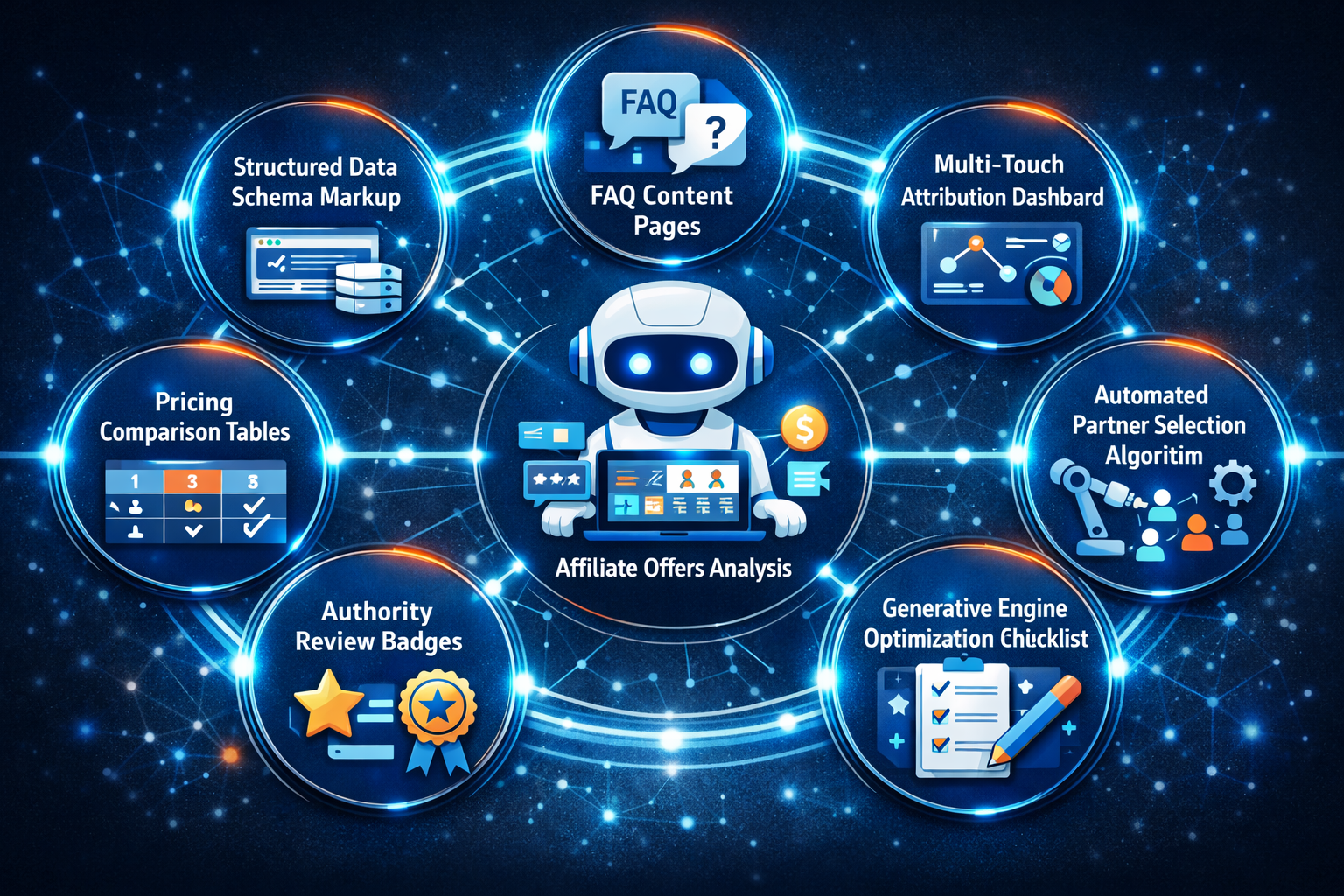
Key Performance Indicators for 2026
Traditional affiliate metrics like click-through rates and immediate conversions provide incomplete pictures in AI-driven environments. New KPIs for 2026 include:
Discovery Metrics:
- Citation frequency in AI agent research
- Appearance in AI shopping recommendations
- Ranking in AI comparison results
- Inclusion in platform “Overall Pick” lists
Engagement Metrics:
- AI agent crawl frequency
- Structured data validation scores
- Schema markup completeness
- Content freshness indicators
Conversion Metrics:
- Multi-touch assisted conversions
- First-touch attribution value
- Average research-to-purchase timeframe
- Customer lifetime value from AI-acquired customers
Authority Metrics:
- Topical authority scores
- Backlinks from AI-referenced sources
- Expert author credentials
- Content depth and comprehensiveness scores
Analytics Platforms and Reporting
Modern affiliate marketers need analytics systems that capture both human and AI agent behavior:
Essential reporting capabilities:
- Separate tracking for AI agent vs. human traffic
- Conversion path visualization across multiple touchpoints
- Attribution model comparison (last-click vs. multi-touch)
- Content performance by AI visibility metrics
- ROI calculation, including assisted conversions
Implementing comprehensive analytics requires technical expertise but provides the data needed to optimize AI purchasing agent performance while maintaining human engagement.
Future-Proofing Your Affiliate Strategy
Emerging Trends Beyond 2026
The evolution of AI purchasing agents continues to accelerate. Emerging developments to monitor:
🔮 Voice and Conversational Commerce – AI agents increasingly use natural language interfaces, requiring content optimized for conversational queries
🔮 Autonomous Negotiation – Next-generation AI agents will negotiate prices and terms directly with sellers, potentially bypassing traditional affiliate structures
🔮 Predictive Purchasing – AI systems that anticipate needs and purchase before users explicitly request items
🔮 Cross-Platform Agent Coordination – Multiple AI agents working together to research, compare, and purchase across ecosystems
🔮 Regulatory Frameworks – Governments developing rules for AI agent transparency, disclosure, and consumer protection
Building Sustainable Competitive Advantages
In an environment where AI agents converge on similar product selections[6], building sustainable differentiation requires:
Deep Specialization:
- Become the definitive authority in narrow product niches
- Develop proprietary testing methodologies
- Create unique data sets that AI agents can’t find elsewhere
- Build exclusive partnerships with manufacturers
Community and Trust:
- Develop engaged communities that provide user-generated content
- Establish a reputation for unbiased, thorough reviews
- Create transparency in testing and evaluation processes
- Build a personal brand that transcends individual product recommendations
Technical Excellence:
- Maintain cutting-edge implementation of structured data
- Invest in proprietary AI agent tracking and optimization tools
- Develop custom attribution models that demonstrate value
- Stay ahead of schema and markup evolution
Strategic Partnerships:
- Build relationships with AI platform developers
- Participate in affiliate network innovation programs
- Collaborate with other authoritative content creators
- Engage with regulatory bodies shaping AI commerce rules
Conclusion
The rise of AI purchasing agents represents the most significant shift in affiliate marketing since the mobile revolution. With these autonomous systems now handling 24% of consumer purchases, the tactics that drove success in 2025 are rapidly becoming obsolete. AI Purchasing Agents in 2026: 7 Optimization Tactics for Affiliate Offers provides the strategic framework needed to thrive in this transformed landscape.
The seven core tactics—implementing structured data, creating authoritative content formats, optimizing for generative engines, earning platform endorsements, deploying multi-touch attribution, leveraging data-driven automation, and building human connection—form an integrated approach that serves both machine and human decision-makers.
Success in 2026 requires recognizing that AI agents evaluate products fundamentally differently than humans. They ignore emotional appeals and aspirational imagery while systematically favoring structured data, platform endorsements, and authoritative content. Affiliate marketers who adapt their strategies to these evaluation criteria will capture the growing share of AI-driven purchases, while those clinging to traditional tactics risk invisibility.
Actionable Next Steps
This Week:
- Audit your top 10 affiliate product pages for structured data implementation
- Identify which content formats (FAQs, comparisons, reviews) you’re missing
- Set up basic multi-touch attribution tracking in your analytics platform
This Month:
4. Implement Product and Offer schema markup across your affiliate content
5. Create comprehensive FAQ pages for your highest-traffic product categories
6. Build at least three detailed comparison tables with structured specifications
7. Research platform endorsement opportunities in your niche
This Quarter:
8. Develop a complete GEO strategy focused on AI agent visibility
9. Negotiate updated commission structures that recognize multi-touch value
10. Implement automation tools for content updates and tracking management
11. Establish measurement frameworks for AI-specific KPIs
The affiliate marketers who embrace these changes early will establish a competitive advantage that compounds over time. As AI purchasing agents continue to evolve and capture greater market share, the optimization tactics outlined here will separate thriving affiliate businesses from those struggling to maintain relevance.
The future of affiliate marketing isn’t about choosing between human and AI audiences—it’s about mastering the art of serving both simultaneously. Start implementing these seven tactics today to ensure your affiliate offers remain visible, competitive, and profitable in the AI-driven marketplace of 2026 and beyond.
References
[1] Consumers Turn Ai Shopping Affiliate Marketing Forging Its Own Path – https://www.emarketer.com/content/consumers-turn-ai-shopping–affiliate-marketing-forging-its-own-path
[2] Agentic Ai Hits Google Shopping What It Means For Affiliate Marketers – https://hellopartner.com/2026/02/17/agentic-ai-hits-google-shopping-what-it-means-for-affiliate-marketers/
[3] Affiliate Marketing – https://www.imd.org/blog/marketing/affiliate-marketing/
[4] Where Affiliate Marketing Programs Are Headed In 2026 – https://www.advertisepurple.com/where-affiliate-marketing-programs-are-headed-in-2026/
[6] The Shopper Schism Competing When Ai Agents Become Your Customer – https://cmr.berkeley.edu/2026/02/the-shopper-schism-competing-when-ai-agents-become-your-customer/
