

{"cover":"Professional landscape format (1536x1024) hero image featuring bold text overlay 'AI-Ready Website Structures for Affiliate Commissions in 2026' in extra large 72pt white sans-serif font with subtle gradient shadow, centered in upper third. Background displays futuristic holographic interface showing schema markup code, AI assistant icons (ChatGPT, Perplexity, Gemini logos), interconnected website architecture nodes, and data streams. Color scheme: electric blue, white, neon green accents. High contrast, magazine cover quality, editorial tech aesthetic with depth of field effect.", "content":["Detailed landscape format (1536x1024) illustration showing split-screen comparison: left side displays traditional flat website structure with disconnected blog posts, right side shows modern intent-driven architecture with hierarchical clusters, topical authority pyramids, and interconnected content nodes. Visual elements include schema.org markup snippets overlaid on pages, internal linking arrows flowing between related content, buyer persona icons at different funnel stages, and conversion pathway highlights. Color-coded sections represent informational, comparison, and review content types. Clean infographic style with annotations and data flow indicators.", "Comprehensive landscape format (1536x1024) technical diagram illustrating AI assistant citation process: center shows affiliate website page with visible structured data markup (JSON-LD code snippets for Product, Review, FAQPage schemas), arrows pointing to three AI assistant interfaces (ChatGPT, Perplexity, Gemini) displaying direct answer cards pulling from the structured content. Visual includes trust signals like star ratings, price comparisons, author credentials, and FAQ accordion elements. Annotations highlight key schema properties, entity relationships, and citation-worthy content patterns. Professional tech documentation aesthetic with color-coded data types and clear visual hierarchy."]}
The affiliate marketing landscape has fundamentally shifted. In 2026, winning affiliate commissions no longer depends solely on ranking in traditional search results. AI-Ready Website Structures for Affiliate Commissions: Schema and Content Patterns to Win AI Assistant Representations in 2026 have become the new battleground, where AI assistants like ChatGPT, Perplexity, and Gemini directly cite and recommend products without users ever clicking through to your site. This zero-visit visibility represents both a challenge and an enormous opportunity for affiliate marketers who understand how to structure their content for machine consumption.
The question is no longer "How do I rank #1 on Google?" but rather "How do I become the source AI assistants trust and cite when users ask for product recommendations?" This article reveals the exact schema markups, page layouts, and content frameworks that make affiliate sites citation-worthy in the age of conversational AI.
Key Takeaways
- 🏗️ Intent-driven site architecture replaces isolated blog posts with interconnected content clusters that build topical authority AI assistants recognize
- 📊 Structured data markup (Product, Review, FAQPage schemas) makes your content machine-readable and citation-worthy for AI responses
- 🎯 Context-aware conversion patterns embed affiliate links based on buyer psychology and page intent rather than simple hyperlink placement
- ⚡ AI-assisted content generation reduces publishing timelines from hours to minutes while maintaining quality and consistency
- 🔄 Automatic internal linking systems improve crawlability and topical relevance without manual link management overhead
Understanding AI-Ready Website Structures for Affiliate Commissions in 2026
The fundamental shift in affiliate marketing strategies requires understanding how AI assistants evaluate and cite sources. Traditional SEO focused on keyword density and backlinks. AI-ready structures prioritize structured data, topical authority, and verifiable information patterns that language models can confidently reference.
The Architecture of Intent-Driven Affiliate Sites
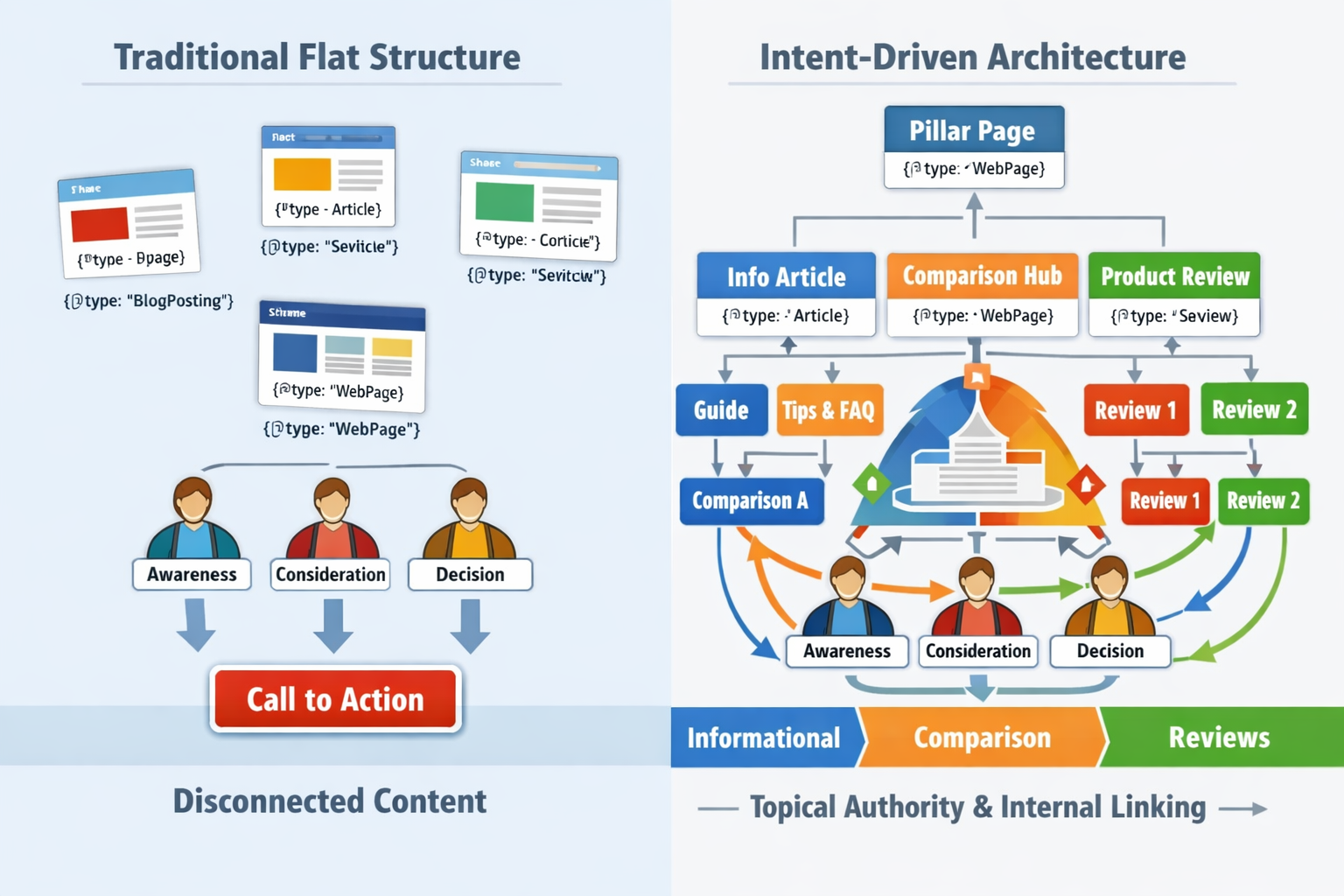
Modern affiliate platforms now generate websites around intent clusters rather than standalone articles. This approach organizes content into interconnected systems where informational posts, comparison pages, and detailed reviews support each other hierarchically[1].
Key architectural components include:
- Category hub pages that establish topical authority
- Comparison matrices linking to individual product reviews
- FAQ sections answering specific buyer questions
- Supporting informational content addressing related search queries
This structure allows topical authority to compound across related content, making the entire site more valuable to AI systems seeking comprehensive, trustworthy sources[1]. When someone asks an AI assistant "What's the best project management software for small teams?", sites with proper intent-driven architecture become prime citation candidates.
Schema Markup: The Language AI Assistants Understand
Structured data is the bridge between human-readable content and machine-parsable information. In 2026, implementing the right schema types isn't optional—it's essential for AI visibility.
Critical schema types for affiliate sites:
| Schema Type | Purpose | Key Properties |
|---|---|---|
| Product | Defines product entities | name, description, brand, offers, aggregateRating |
| Review | Marks review content | itemReviewed, reviewRating, author, datePublished |
| FAQPage | Structures Q&A content | mainEntity, Question, Answer |
| HowTo | Guides and tutorials | step, tool, supply, totalTime |
| Organization | Publisher credibility | name, logo, sameAs, contactPoint |
Leading affiliate marketing platforms now generate pages with clean URL structures and schema markup automatically, reducing manual implementation overhead while improving crawlability[1].
Building Content Patterns That Win AI Assistant Citations
The Anatomy of Citation-Worthy Affiliate Content
AI assistants favor content that demonstrates expertise, comprehensiveness, and verifiability. Your content structure must make these qualities immediately apparent to both human readers and machine parsers.
Essential content elements:
1. Structured Comparison Tables
AI systems excel at extracting tabular data. Comparison tables with clear headers, consistent formatting, and specific data points become prime citation material.
| Product | Price | Key Feature | Best For | Rating |
2. Explicit Pros and Cons Lists
Bulleted advantages and disadvantages provide extractable insights AI assistants can reference directly in responses.
3. FAQ Sections with FAQPage Schema
Questions and answers marked with proper schema become featured snippets in AI responses. Structure FAQs around actual user queries discovered through keyword research[7].
4. Expert Author Credentials
AI systems evaluate source authority. Include author bios with relevant expertise, credentials, and verifiable social profiles linked through Organization schema.
5. Specific, Quantifiable Claims
Replace vague statements like "very affordable" with precise data: "$49/month for teams up to 10 users." AI assistants can verify and cite specific information more confidently[2].
Conversion-Focused Page Templates for AI-Era Affiliates
The most successful affiliate sites in 2026 use preset layouts designed around documented buyer behavior stages rather than custom designs[1]. These templates align with how users interact with AI-recommended products.
High-converting template structures:
Product Review Template:
- Quick verdict box (schema-marked rating)
- Key specifications table
- Detailed feature analysis
- Comparison with alternatives
- Pricing breakdown
- FAQ section
- Context-aware CTA placement
Comparison Page Template:
- Side-by-side feature matrix
- Use case recommendations
- Individual product summaries
- Winner declarations by category
- Related comparison links
These templates incorporate native CTA logic systems that treat affiliate links as first-class components with conversion rules based on page type, user intent, and scroll depth[1]. Modern platforms embed these rules automatically, moving beyond simple hyperlink insertion.
For affiliates exploring different program types, understanding which platforms support these advanced template systems becomes crucial for competitive advantage.
Implementing AI-Ready Technical Infrastructure
Automated Internal Linking for Topical Authority
Manual internal linking becomes impractical at scale. AI-ready affiliate sites implement automatic internal linking logic that connects category hubs with supporting reviews based on semantic relationships[1].
Benefits of automated linking systems:
- ✅ Consistent topical clustering
- ✅ Improved crawl efficiency
- ✅ Reduced orphan pages
- ✅ Dynamic relationship updates as content grows
Platforms like Emergent generate SEO-optimized pages with these linking systems built-in, allowing affiliates to focus on content strategy rather than technical link management[1].
Asset Generation for Enhanced Credibility
AI-powered platforms now automatically generate images, comparison tables, charts, and even social proof elements (Reddit quotes, YouTube embeds) directly into affiliate reviews[3]. This standardizes professional presentation without manual design overhead.
Automatically generated assets include:
- Product comparison charts
- Feature breakdown infographics
- Pricing timeline visualizations
- Trust indicators (review aggregations)
- Social proof compilations
These assets improve both user engagement and AI assistant confidence in citing your content, as visual data representations signal comprehensive coverage.
Speed and Mobile Optimization
AI assistants increasingly factor page experience signals into source selection. Sites that load slowly or provide poor mobile experiences receive lower citation priority.
Technical optimization checklist:
- ⚡ Core Web Vitals compliance (LCP < 2.5s, FID < 100ms, CLS < 0.1)
- 📱 Mobile-responsive design with touch-friendly CTAs
- 🖼️ Optimized image formats (WebP, lazy loading)
- 🔒 HTTPS security across all pages
- 🗜️ Minified CSS/JS and CDN delivery
For those starting out, our guide on how to become an affiliate marketer covers these technical foundations in detail.
Content Strategy for Zero-Visit Visibility
Creating AI-Citable Product Descriptions
When AI assistants answer product queries, they synthesize information from multiple sources. Your product descriptions must be specific, structured, and verifiable to earn citations.
AI-citable description framework:
1. Lead with Specificity
"Notion is a freemium productivity platform combining wikis, databases, and project management for teams of 1-1000+ users, starting at $0/month for individuals."
2. Include Quantifiable Metrics
- Pricing tiers with exact numbers
- User capacity limits
- Storage specifications
- Performance benchmarks
3. Address Common Questions
Anticipate and answer questions users ask AI assistants: "Does it work offline?", "What's the learning curve?", "How does it compare to Asana?"
4. Cite Verifiable Sources
Reference manufacturer specifications, third-party reviews, and user testimonials with dates and attribution.
Leveraging AI Content Generation Strategically
AI-assisted website builders now generate initial site structures, layouts, and page types in minutes versus hours of manual work[2]. However, successful affiliates in 2026 understand the balance between automation and human expertise.
Strategic AI content use:
✅ Appropriate AI Applications:
- Initial content drafts and outlines
- Product specification summaries
- FAQ generation from common queries
- Comparison table population
- Meta description variations
❌ Human-Required Elements:
- Personal testing experiences
- Nuanced product comparisons
- Brand voice and personality
- Strategic positioning decisions
- Final quality verification
The most successful affiliate marketing optimization techniques combine AI efficiency with human judgment and expertise.
Audience Behavior Analysis for Hyper-Targeted Content
AI systems analyze audience interests, purchase likelihood, and engagement patterns to develop campaigns that resonate with specific user requirements[2]. This data-driven approach replaces intuition-based content planning.
Implementation strategies:
- Platform-level analytics identify trending products and optimal traffic sources in real-time[2]
- Conversion tracking reveals which content types drive actual affiliate revenue
- Engagement metrics show which sections users spend time reading
- Search query analysis uncovers gaps in your content coverage
Tools like Shopify's AI assistant Sidekick analyze traffic trends and provide actionable suggestions for improving performance while tracking sales data and customer behavior[4].
Advanced Schema Implementation Examples
Product Schema for Affiliate Reviews
{
  "@context": "https://schema.org/",
  "@type": "Product",
  "name": "Project Management Tool X",
  "description": "Cloud-based project management platform for teams 5-500",
  "brand": {
    "@type": "Brand",
    "name": "Tool X Inc"
  },
  "offers": {
    "@type": "Offer",
    "price": "29.00",
    "priceCurrency": "USD",
    "availability": "https://schema.org/InStock"
  },
  "aggregateRating": {
    "@type": "AggregateRating",
    "ratingValue": "4.6",
    "reviewCount": "847"
  }
}
This structured data allows AI assistants to extract pricing, availability, and ratings without parsing unstructured text.
Review Schema for Credibility
{
  "@context": "https://schema.org/",
  "@type": "Review",
  "itemReviewed": {
    "@type": "Product",
    "name": "Project Management Tool X"
  },
  "reviewRating": {
    "@type": "Rating",
    "ratingValue": "4.5",
    "bestRating": "5"
  },
  "author": {
    "@type": "Person",
    "name": "Jane Smith"
  },
  "reviewBody": "After testing for 90 days with a team of 12..."
}
Proper Review schema establishes authorship and rating credibility that AI systems factor into source trustworthiness.
FAQPage Schema for Direct Answers
{
  "@context": "https://schema.org",
  "@type": "FAQPage",
  "mainEntity": [{
    "@type": "Question",
    "name": "Does Tool X integrate with Slack?",
    "acceptedAnswer": {
      "@type": "Answer",
      "text": "Yes, Tool X offers native Slack integration..."
    }
  }]
}
FAQ schema makes your content the source for direct AI assistant responses to specific questions.
Scaling Your AI-Ready Affiliate Business
Creative Volume Over Individual Campaign Refinement
Successful 2026 affiliate strategies emphasize generating multiple content angles using AI to enable rapid testing and optimization[5]. Dominance goes to marketers who scale creative volume rather than endlessly refining individual campaigns.
Volume-based approach:
- Create 10 variations of product descriptions
- Test multiple comparison frameworks
- Generate diverse content hooks
- Produce varied visual assets
- Experiment with different CTA placements
AI tools reduce the cost of content variation to near-zero, making high-volume testing economically viable for individual affiliates.
Automation for Operational Efficiency
Email marketing and ad placement automation reduces manual task overhead significantly[2]. AI-powered systems:
- Schedule emails at optimal times based on recipient behavior
- Adjust advertisements based on performance metrics
- Track clicks, conversions, and revenue in real-time
- Identify underperforming content for optimization
- Suggest trending products worth covering
This automation allows affiliates to focus on strategy and relationship-building rather than execution details.
Building Multi-Channel Presence
AI assistants increasingly pull information from diverse sources beyond traditional websites. Successful affiliates establish presence across:
- YouTube (video reviews with transcripts)
- Reddit (authentic community participation)
- LinkedIn (professional credibility)
- Medium/Substack (thought leadership)
- Podcasts (audio content)
Each channel contributes to your overall topical authority and increases citation opportunities. For those interested in expanding reach, exploring high ticket affiliate marketing opportunities can maximize revenue per conversion.
Measuring AI-Ready Performance
Beyond Traditional Metrics
Standard affiliate metrics (clicks, conversions, revenue) remain important, but AI-era success requires tracking:
New performance indicators:
| Metric | What It Measures | Why It Matters |
|---|---|---|
| AI Citation Rate | Frequency your content appears in AI responses | Direct visibility without clicks |
| Zero-Click Impressions | Times users see your brand via AI | Brand awareness and authority |
| Schema Coverage | Percentage of pages with proper markup | Technical readiness |
| Topical Authority Score | Comprehensive coverage of subject areas | AI source selection factor |
| Content Freshness | Update frequency of key pages | Recency signals for AI systems |
Tools for AI-Ready Monitoring
While traditional analytics platforms track website traffic, new tools help monitor AI visibility:
- Schema validators (Google Rich Results Test)
- AI citation tracking (manual monitoring of AI assistant responses)
- Topical authority analyzers (content gap identification)
- Structured data monitoring (error detection and fixes)
Regular audits ensure your technical infrastructure remains optimized as AI systems evolve.
Conclusion
AI-Ready Website Structures for Affiliate Commissions: Schema and Content Patterns to Win AI Assistant Representations in 2026 represent a fundamental evolution in affiliate marketing. Success no longer depends solely on traditional search rankings but on becoming the trusted source AI assistants cite when users seek product recommendations.
The path forward requires three core commitments:
Technical Excellence: Implement comprehensive schema markup, automated internal linking, and optimized site architecture that makes your content machine-readable and citation-worthy.
Strategic Content: Create intent-driven content clusters with verifiable data, structured comparisons, and expert analysis that AI systems can confidently reference.
Continuous Adaptation: Monitor AI citation patterns, test content variations at scale, and evolve your approach as AI assistant capabilities advance.
Actionable Next Steps
This Week:
- Audit your top 10 affiliate pages for schema markup coverage
- Implement Product and Review schemas on key conversion pages
- Create or enhance FAQ sections with FAQPage schema
This Month:
- Restructure content into intent-driven clusters around major topics
- Set up automated internal linking between related content
- Generate comparison tables for your top product categories
This Quarter:
- Build comprehensive topical authority in your primary niche
- Establish multi-channel presence (YouTube, Reddit, LinkedIn)
- Implement AI-assisted content generation workflows
The affiliate marketers who thrive in 2026 and beyond will be those who recognize that visibility without clicks is the new frontier. By structuring your website for AI assistant citations, you position yourself to capture affiliate commissions regardless of how users discover and evaluate products.
Start implementing these AI-ready structures today, and you'll build sustainable competitive advantages as conversational AI becomes the primary product discovery interface for millions of consumers.
References
[1] Best Website Builders For Affiliate Marketing – https://emergent.sh/learn/best-website-builders-for-affiliate-marketing
[2] The Future Of Ai In Affiliate Marketing In 2026 – https://aijourn.com/the-future-of-ai-in-affiliate-marketing-in-2026/
[3] Ai Affiliate Programs – https://www.eesel.ai/blog/ai-affiliate-programs
[4] Best Website Builders For Affiliate Marketing – https://www.websiteplanet.com/blog/best-website-builders-for-affiliate-marketing/
[5] Watch – https://www.youtube.com/watch?v=D1CVu8KE2Xg
[7] Best Ai Tools For Affiliate Marketing 2026 – https://coursiv.io/blog/best-ai-tools-for-affiliate-marketing-2026/