

The landscape of affiliate marketing has fundamentally transformed. In 2026, AI-powered video generation tools like OpenAI's Sora are no longer experimental—they're essential infrastructure for competitive affiliate campaigns. The AI Video Ads Revolution: Generating High-Converting Affiliate Creatives with Sora and Beyond in 2026 represents a seismic shift in how marketers create, test, and optimize video content at scale. With major brands like Coca-Cola already deploying Sora-generated advertisements[5] and Meta's recent acquisition of the AI affiliate platform Manus[1], the integration of artificial intelligence into affiliate creative production has become the new baseline for success.
Key Takeaways
✅ AI video tools like Sora enable affiliates to produce dozens of creative variations in hours instead of weeks, dramatically accelerating testing velocity and campaign optimization
✅ 57% of marketers are increasing affiliate marketing investments in 2026[8], creating unprecedented opportunities for AI-enabled efficiency gains
✅ Short-form video on TikTok, YouTube, and Instagram is now driving direct sales, not just awareness, making AI video generation essential for volume production[2][4]
✅ Performance-based creator partnerships and enhanced attribution models reward conversion-optimized content, making AI tools critical for demonstrating ROI[2]
✅ Personalization at scale through AI avatars, voice cloning, and automated translation enables affiliates to version content by segment without proportional cost increases[3]
Understanding the AI Video Ads Revolution in Affiliate Marketing
What Makes 2026 Different for Affiliate Creatives
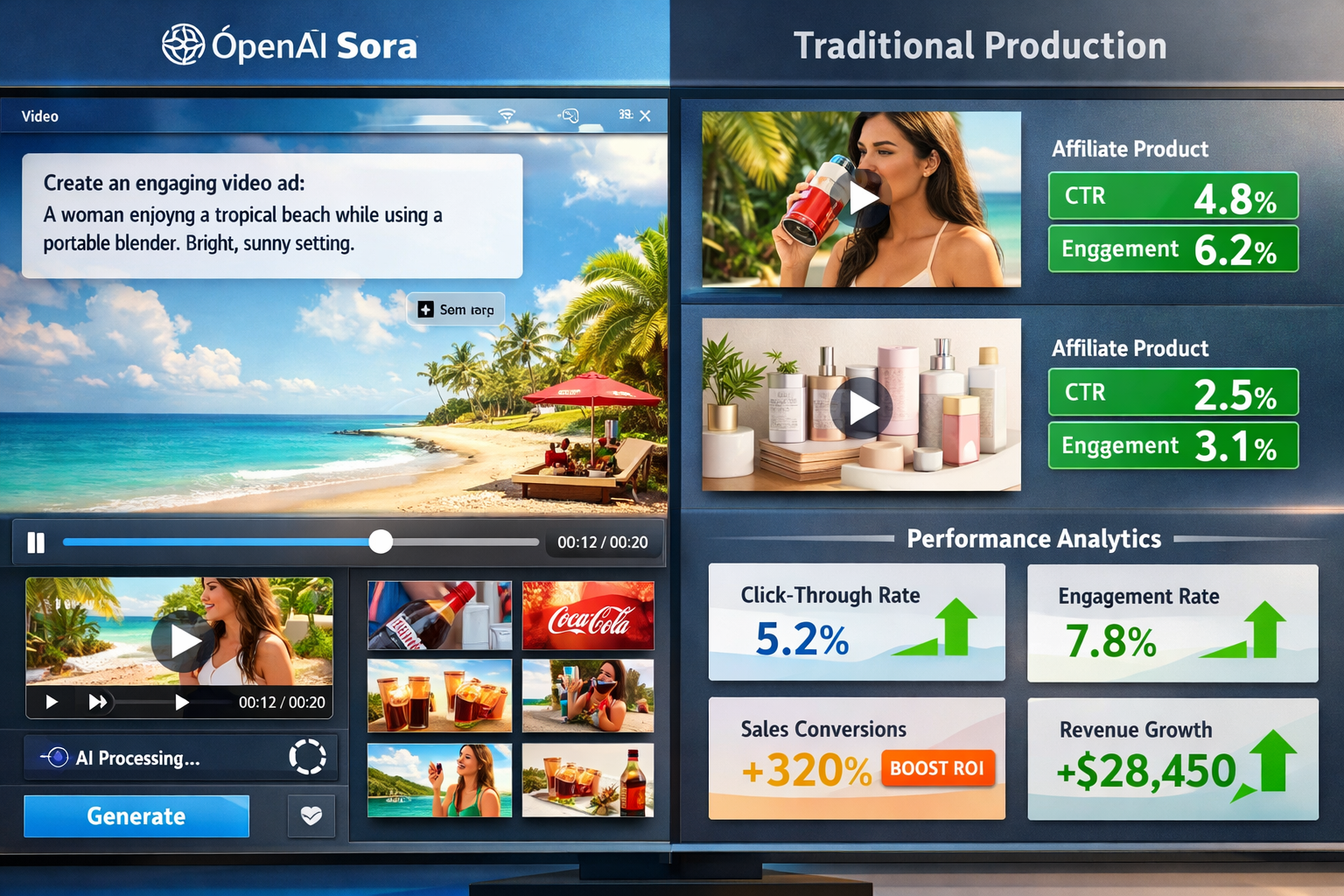
The AI Video Ads Revolution: Generating High-Converting Affiliate Creatives with Sora and Beyond in 2026 isn't just about faster production—it's about fundamentally reimagining the creative process. Traditional affiliate video production required substantial budgets, production teams, and weeks of turnaround time. Today's AI-powered workflows compress that timeline to hours while enabling exponentially more variations.
Creative production velocity has become the primary competitive differentiator in affiliate marketing[1]. Top-performing affiliates now generate 50-100 ad variations per campaign, testing different hooks, angles, and messaging approaches simultaneously. This volume-based testing methodology was economically impossible before AI video generation tools became commercially viable.
The shift toward high ticket affiliate marketing has accelerated this need. Higher commission products demand more sophisticated creative approaches, and AI enables the personalization required to convert premium buyers.
The Sora Advantage: From Experimental to Essential
OpenAI's Sora video generation model, launched in 2025, has rapidly evolved from experimental technology to production-ready tool. By February 2026, Sora is being actively deployed in commercial advertising campaigns, with Coca-Cola serving as a prominent early adopter[5]. This mainstream validation signals that generative video has crossed the reliability threshold necessary for affiliate applications.
Sora's capabilities particularly benefit affiliate marketers through:
- Text-to-video generation that transforms product descriptions into engaging visual narratives
- Style consistency across multiple video variations, maintaining brand coherence
- Rapid iteration cycles enabling same-day creative testing
- Cost efficiency that makes premium video production accessible to solo affiliates
For marketers exploring how to succeed in affiliate marketing, mastering AI video tools has become as fundamental as understanding SEO or paid traffic strategies.
Step-by-Step Workflow: Creating High-Converting AI Video Ads
Phase 1: AI-Powered Audience Research and Targeting
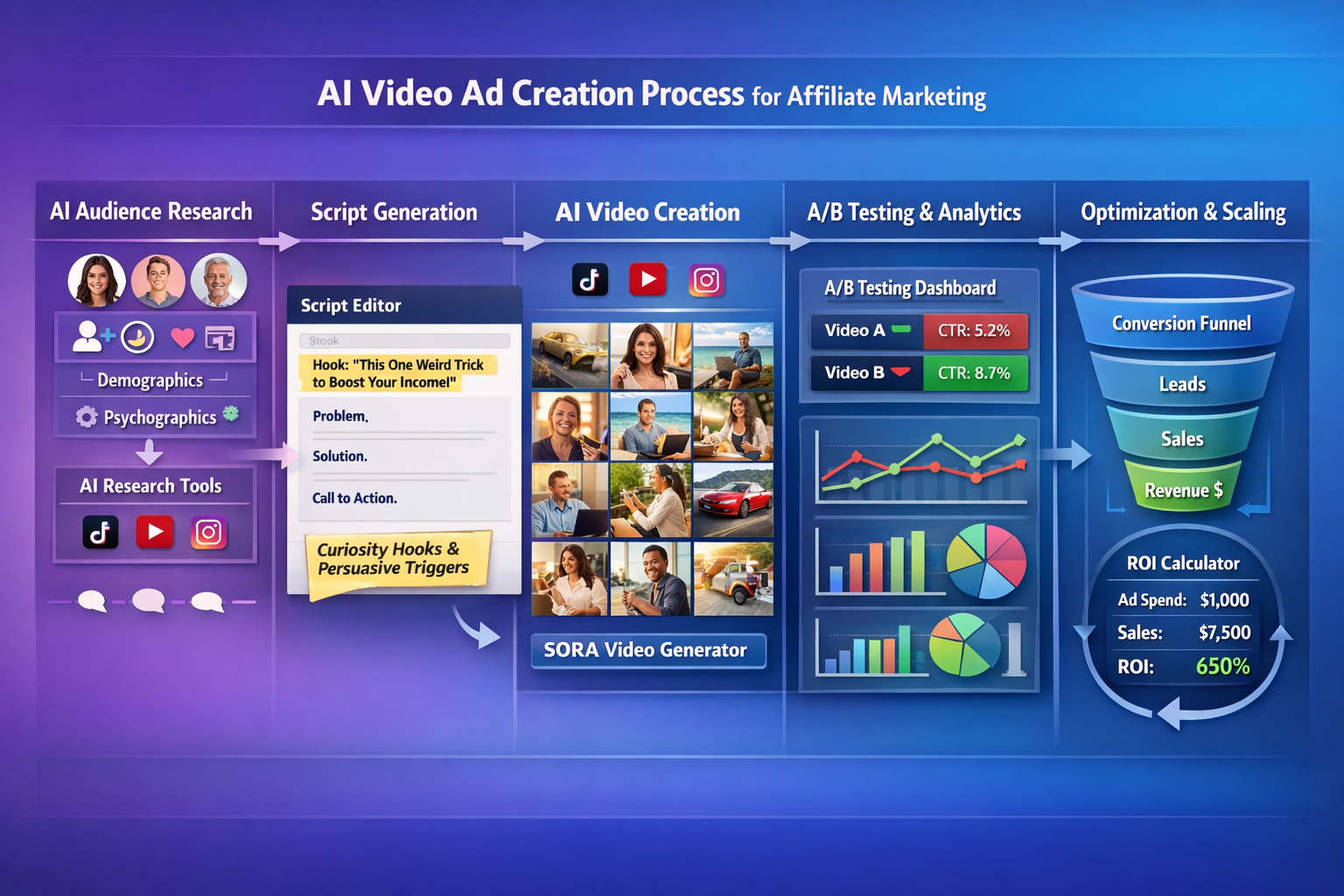
Before generating a single frame of video, successful 2026 affiliate campaigns begin with AI-driven audience intelligence. Current workflows use AI prompts to identify psychographic profiles, pain points, and behavioral patterns—compressing research timelines from weeks to minutes[1].
Practical implementation steps:
- Input product details into AI research tools (ChatGPT, Claude, or specialized affiliate platforms)
- Generate customer avatars with specific demographics, motivations, and objections
- Identify emotional triggers and curiosity hooks relevant to each segment
- Map content angles that align with platform-specific behaviors (TikTok vs. YouTube vs. Instagram)
This foundational research directly informs video creative decisions, ensuring that AI-generated content resonates with actual buyer psychology rather than generic messaging.
Phase 2: Script Development with Curiosity-Based Frameworks
Curiosity-based ad copy generation via AI is showing improved conversion metrics across affiliate campaigns[1]. The workflow combines AI efficiency with human strategic oversight:
Script generation process:
- Prompt AI tools with audience insights and product benefits
- Generate 10-15 script variations emphasizing different curiosity hooks
- Human review and refinement to maintain brand voice and add specific examples
- A/B test headlines and opening hooks before full video production
📌 Pro Tip: AI excels at drafting initial copy focused on pattern interrupts and curiosity gaps. Human editors should refine for authenticity, specificity, and brand alignment.
For affiliates working with best affiliate marketing programs for beginners, this script framework reduces the intimidation factor of video creation while maintaining quality standards.
Phase 3: Sora Video Generation and Creative Variations
With scripts finalized, the AI Video Ads Revolution: Generating High-Converting Affiliate Creatives with Sora and Beyond in 2026 truly accelerates. Sora and similar tools enable rapid visual production:
Video generation workflow:
- Input script and visual direction into Sora interface
- Generate multiple visual styles (documentary, lifestyle, animation, UGC-style)
- Create format variants (9:16 for TikTok/Reels, 16:9 for YouTube, 1:1 for feed posts)
- Add AI-generated captions and text overlays for sound-off viewing
- Produce localized versions with AI translation and voice cloning[3]
| Traditional Production | AI-Powered Production |
|---|---|
| 2-4 weeks timeline | 2-4 hours timeline |
| $2,000-$10,000 per video | $50-$200 per video |
| 1-3 variations | 20-50 variations |
| Single language | Multi-language simultaneously |
This efficiency enables the testing volume required for optimization while maintaining budget discipline—critical for affiliate marketing optimization techniques.
Phase 4: Platform-Specific Optimization
Short-form video on social platforms is now driving direct sales, not just awareness[2][4]. Each platform requires specific optimization:
TikTok & Instagram Reels:
- ⏱️ 7-15 second hook window
- 🎵 Trending audio integration
- 📱 Vertical 9:16 format
- 💬 Native caption styling
YouTube Shorts:
- 🎯 15-30 second optimal length
- 🔍 Keyword-optimized titles
- 👆 End-screen CTAs
- 🔗 Description link placement
Facebook & Instagram Feed:
- 📺 Square or landscape formats
- 🔇 Sound-off optimization
- 💰 Direct shopping integration
- 👥 Audience targeting precision
AI tools can automatically generate these platform-specific variations from a single master video, ensuring consistent messaging across channels while respecting platform conventions.
Case Studies: Early Adopters Leading the Revolution
Coca-Cola's AI-Generated Campaign Success
Coca-Cola's deployment of Sora for commercial advertising represents a watershed moment for AI video credibility[5]. While specific conversion metrics remain proprietary, the brand's continued investment in AI-generated content validates the technology's effectiveness for large-scale campaigns.
Key lessons for affiliates:
- ✅ Brand safety is achievable with proper AI oversight and human review
- ✅ Production costs decrease without sacrificing visual quality
- ✅ Testing velocity increases enabling data-driven creative optimization
- ✅ Audience reception remains positive when execution maintains authenticity
Meta's Manus Acquisition: Platform Integration
Meta's acquisition of Manus—an AI platform for affiliate marketing—signals that major platforms are integrating AI-driven affiliate tools directly into their infrastructure[1]. This consolidation suggests that AI-powered affiliate capabilities will become native features within Facebook's advertising ecosystem.
Implications for affiliate marketers:
- 🚀 Streamlined campaign creation within familiar platforms
- 📊 Enhanced attribution through platform-native tracking
- 🎯 Improved targeting via AI-powered audience insights
- 💡 Reduced technical barriers for new affiliates
This integration particularly benefits those exploring can you make money with affiliate marketing by lowering the technical expertise required for sophisticated campaigns.
UGC Creator Partnerships and AI Amplification
User-generated content creators are eclipsing traditional influencers as primary affiliate partners[2][3]. AI tools amplify this trend by enabling creators to produce more content without proportional time investment.
Successful UGC-AI hybrid workflows:
- 📹 Creators film authentic testimonials and product demonstrations
- 🤖 AI tools generate variations with different hooks and CTAs
- 🎨 Automated editing creates platform-specific versions
- 📈 Performance data informs next iteration
This approach combines the authenticity advantage of real creators with the scale benefits of AI production—a powerful combination for conversion optimization.
Beyond Sora: The Expanding AI Video Ecosystem in 2026
Multimodal Tools Reshaping Affiliate Workflows
While Sora captures headlines, the AI Video Ads Revolution: Generating High-Converting Affiliate Creatives with Sora and Beyond in 2026 encompasses a broader ecosystem of specialized tools:
Complementary AI video tools:
- 🎭 AI avatars and digital presenters (Synthesia, HeyGen) for spokesperson-style content
- 🗣️ Voice cloning and dubbing (ElevenLabs, Descript) for multilingual scaling
- ✂️ Automated editing suites (Runway, Descript) for post-production efficiency
- 📊 AI analytics platforms for performance prediction and optimization
These tools integrate into comprehensive workflows that handle everything from concept to deployment, with human oversight focused on strategic decisions rather than technical execution.
Personalization and Localization at Scale
AI enables personalization and localization at scale that was previously economically unfeasible[3]. Affiliates can now create segment-specific variations addressing:
- 🌍 Geographic differences (language, cultural references, local pain points)
- 👥 Demographic variations (age, gender, income level)
- 🎯 Behavioral segments (awareness stage, consideration phase, purchase intent)
- 📱 Device preferences (mobile-first vs. desktop viewers)
This granular targeting dramatically improves conversion rates by delivering precisely relevant messaging to each audience subset—a critical advantage in competitive affiliate niches.
Optimization Strategies: Testing and Iteration Frameworks
Data-Driven Creative Testing Methodology
The volume of AI-generated variations enables rigorous scientific testing approaches previously reserved for large-budget advertisers:
Structured testing framework:
- Generate 20-30 variations testing specific variables (hook, offer, CTA, visual style)
- Launch with equal budget allocation across all variants
- Measure performance metrics (CTR, view-through rate, conversion rate, CPA)
- Identify top performers (typically top 10-20% of variants)
- Generate second-generation variations based on winning elements
- Iterate weekly with continuous improvement cycles
This systematic approach, combined with affiliate marketing strategies focused on data-driven decision making, creates compounding performance improvements over time.
Attribution and ROI Measurement
Enhanced multi-touch attribution models are improving payout accuracy across affiliate networks[2]. AI-powered analytics tools now track:
- 📍 Customer journey touchpoints across multiple videos and platforms
- ⏰ Time-to-conversion patterns by creative type and audience segment
- 💰 Lifetime value predictions for different acquisition sources
- 🔄 Cross-device tracking for accurate conversion attribution
These insights enable affiliates to optimize not just for immediate conversions, but for long-term customer value—particularly important for high ticket affiliate marketing where customer relationships extend beyond initial purchase.
Practical Implementation: Getting Started in 2026
Essential Tools and Platform Recommendations
For affiliates ready to embrace the AI Video Ads Revolution: Generating High-Converting Affiliate Creatives with Sora and Beyond in 2026, here's a practical technology stack:
Beginner-friendly starting point:
- 🎬 Video generation: Sora (when available) or Runway Gen-2
- ✍️ Script writing: ChatGPT or Claude with custom prompts
- 🎙️ Voiceover: ElevenLabs for AI narration
- ✂️ Editing: Descript for automated editing and captions
- 📊 Analytics: Native platform analytics plus Google Analytics 4
Advanced affiliate stack:
- 🚀 All beginner tools plus specialized additions
- 🎭 AI avatars: Synthesia or HeyGen for presenter-style content
- 🌍 Translation: Descript or Papercup for multilingual versions
- 📈 Optimization: Metadata.io or Smartly.io for automated creative testing
- 🔗 Attribution: Voluum or RedTrack for advanced tracking
Budget Considerations and ROI Expectations
Investment requirements vary significantly based on scale and sophistication:
| Budget Level | Monthly Investment | Expected Output | ROI Timeline |
|---|---|---|---|
| Starter | $100-$300 | 10-20 video ads | 2-3 months |
| Growth | $500-$1,500 | 50-100 video ads | 1-2 months |
| Scale | $2,000-$5,000 | 200+ video ads | 2-4 weeks |
These costs represent dramatic reductions compared to traditional video production while enabling significantly higher testing volume—the combination that drives superior performance.
Skill Development Roadmap
Mastering AI video ads requires both technical and strategic capabilities:
Month 1-2: Foundations
- ✅ Learn AI tool interfaces and capabilities
- ✅ Study high-performing affiliate video ads
- ✅ Practice prompt engineering for video generation
- ✅ Understand platform-specific requirements
Month 3-4: Production
- ✅ Create first 20-30 video variations
- ✅ Launch initial campaigns across platforms
- ✅ Establish tracking and attribution systems
- ✅ Begin systematic testing methodology
Month 5-6: Optimization
- ✅ Analyze performance data and identify patterns
- ✅ Refine creative frameworks based on results
- ✅ Scale winning campaigns and audiences
- ✅ Develop repeatable production workflows
This progression aligns with comprehensive affiliate marketing optimization techniques that compound over time.
Future Outlook: Where AI Video Ads Are Heading
Emerging Trends and Capabilities
The AI Video Ads Revolution: Generating High-Converting Affiliate Creatives with Sora and Beyond in 2026 continues accelerating with several emerging developments:
Near-term advancements (2026-2027):
- 🎯 Real-time personalization generating unique videos for individual viewers
- 🤝 Interactive video experiences with branching narratives based on viewer choices
- 🧠 Predictive performance scoring estimating conversion rates before campaign launch
- 🔄 Automated optimization loops that generate, test, and refine without human intervention
Strategic implications:
These capabilities will further compress the advantage window for early adopters. Affiliates who master AI video workflows in 2026 will establish competitive moats through proprietary data, refined processes, and audience relationships that newcomers will struggle to replicate.
Regulatory and Ethical Considerations
As AI-generated content becomes ubiquitous, disclosure requirements and platform policies are evolving:
- ⚖️ FTC guidelines requiring clear disclosure of AI-generated content
- 🏢 Platform policies governing synthetic media and deepfakes
- 🎯 Audience expectations for transparency about AI involvement
- 🔒 Data privacy regulations affecting personalization capabilities
Responsible affiliates should proactively implement disclosure practices and maintain ethical standards to build long-term audience trust—particularly important for those building sustainable businesses around the ARM system affiliate results maximized.
Conclusion
The AI Video Ads Revolution: Generating High-Converting Affiliate Creatives with Sora and Beyond in 2026 represents the most significant transformation in affiliate marketing since the emergence of social media advertising. Tools like Sora have evolved from experimental curiosities to essential infrastructure, enabling affiliates to produce personalized video content at unprecedented scale and efficiency.
Key success factors for 2026 and beyond:
✅ Embrace AI tools early to develop expertise while competition remains manageable
✅ Maintain human strategic oversight for brand voice, authenticity, and ethical considerations
✅ Implement systematic testing frameworks to leverage AI's volume advantages
✅ Focus on platform-specific optimization as short-form video drives direct sales
✅ Invest in attribution and analytics to demonstrate ROI and guide optimization
Your Next Steps
Immediate actions to capitalize on this revolution:
- Experiment with accessible AI video tools like Runway or Descript to understand capabilities
- Analyze top-performing video ads in your niche to identify winning patterns
- Create your first 10 AI-generated video variations testing different hooks and angles
- Launch small-budget campaigns on TikTok or YouTube Shorts to gather performance data
- Establish tracking systems to measure attribution and conversion metrics accurately
The affiliates who will dominate in 2026 and beyond aren't necessarily those with the largest budgets—they're those who most effectively harness AI to test, learn, and optimize faster than their competition. With 57% of marketers increasing affiliate investments[8] and AI tools democratizing sophisticated video production, the opportunity window is wide open.
The question isn't whether to adopt AI video tools—it's how quickly you can integrate them into your workflow and begin the iterative learning process that compounds into sustainable competitive advantage.
References
[1] Watch – https://www.youtube.com/watch?v=D1CVu8KE2Xg
[2] Affiliate Marketing – https://www.imd.org/blog/marketing/affiliate-marketing/
[3] Video Marketing Trends For 2026 – https://www.visla.us/blog/listicles/video-marketing-trends-for-2026/
[4] Digital Marketing Trends 2026 Why Ai Systems Will Outperform Traditional Campaigns – https://jsmmtech.com/digital-marketing-trends-2026-why-ai-systems-will-outperform-traditional-campaigns/
[5] Marketing Trends 2026 – https://www.marketermilk.com/blog/marketing-trends-2026
[6] 10 Affiliate Trends Reshaping Affiliate Marketing In 2026 – https://www.affiversemedia.com/10-affiliate-trends-reshaping-affiliate-marketing-in-2026/
[7] Best Affiliate Marketing Niches 2026 – https://voluum.com/blog/best-affiliate-marketing-niches-2026/
[8] Affiliate Marketing Statistics – https://www.fintelconnect.com/blog/affiliate-marketing-statistics/