

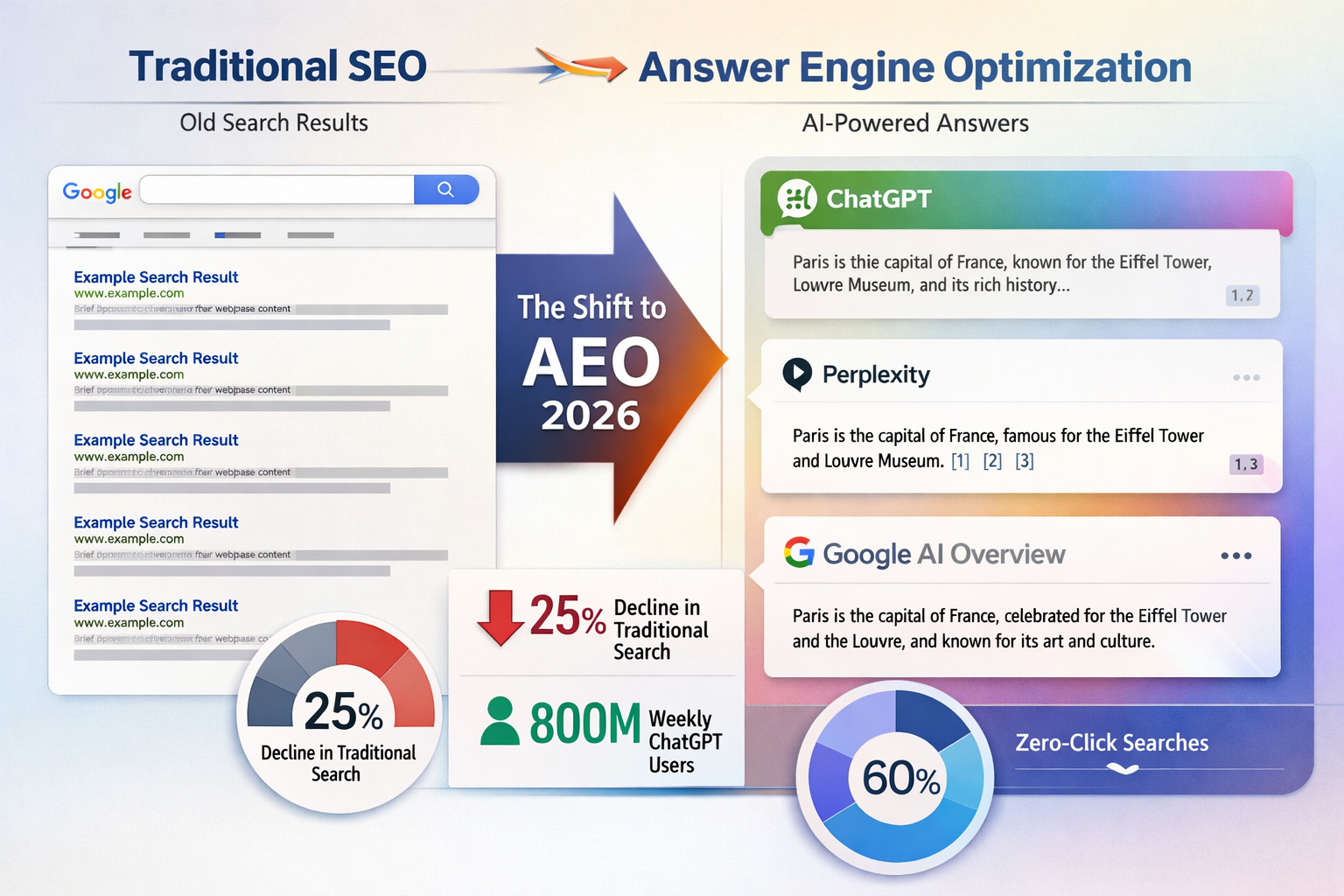
The digital landscape is experiencing a seismic shift. Traditional search engines that once dominated how users discovered information are rapidly giving way to AI-powered answer engines. As ChatGPT reaches 800 million weekly users and conversational AI platforms continue their explosive growth, brands face a critical question: How do you ensure visibility when users never click through to your website?[2]
Welcome to the era of Answer Engine Optimization (AEO): The New SEO for AI-Driven Discovery—a fundamental transformation in how content gets discovered, cited, and trusted in 2026. This isn’t just another marketing buzzword; it’s a survival strategy for affiliate marketers, content creators, and businesses watching their search referrals decline while AI chatbots absorb an increasing share of user queries.
The stakes couldn’t be higher. Gartner forecasts that traditional search engine volume will drop by 25% by 2026 as AI answer engines gain capability and adoption.[3] Media executives worldwide project search engine referrals will decline by 43% over just three years.[2] For affiliate marketers who’ve built their businesses on Google traffic, this represents both an existential threat and an unprecedented opportunity.
Key Takeaways
- 🎯 AI answer engines are replacing traditional search for millions of users, with ChatGPT alone serving 800 million weekly users and growing rapidly
- 📉 Zero-click searches dominate the future: Traditional search referrals are projected to decline 43% as AI chatbots provide direct answers without sending users to websites
- 🔄 AEO is SEO’s evolution, not replacement: The most effective strategy unifies both approaches to capture visibility across traditional rankings, AI Overviews, and conversational engines
- 📊 Citation tracking replaces click metrics: Success in 2026 means monitoring which AI models mention your brand and link back to your content
- ⚡ Answer-first content wins: AI engines prioritize cleanly structured content with core answers at the top, making formatting as important as substance
Understanding Answer Engine Optimization (AEO): The New SEO for AI-Driven Discovery
What Makes AEO Different from Traditional SEO?
Traditional search engine optimization focuses on ranking web pages in search engine results pages (SERPs) to drive clicks. Users type queries, scan blue links, and click through to websites. Success metrics center on rankings, impressions, and click-through rates.
Answer Engine Optimization operates in a fundamentally different paradigm. AI-powered platforms like ChatGPT, Perplexity AI, Google’s Gemini, and Claude don’t just rank content—they synthesize it. These systems extract information from multiple sources, combine insights, and present users with direct answers in conversational formats. Often, users never visit the original source websites.
This creates what industry experts call the “zero-click layer” of digital discovery.[1] Your content might be cited, summarized, or referenced by an AI model without generating a single click to your site. For affiliate marketers accustomed to conversion funnels that begin with website visits, this represents a complete reimagining of the customer journey.
The Six Core Pillars of AEO Strategy for 2026
According to leading AEO practitioners, successful implementation in 2026 focuses on six strategic areas:[1]
- Geographic Visibility Through Local Pages – Leveraging location-specific content to dominate local AI queries
- Answer-First Content Architecture – Structuring content to surface core answers immediately
- Entity Consistency Across Platforms – Maintaining uniform business information everywhere your brand appears
- AI Visibility Metrics and Citation Tracking – Monitoring mentions across multiple AI models
- Unified AEO-SEO Strategy – Blending both approaches for full-funnel visibility
- Multi-Format Content Optimization – Ensuring video, audio, and text content are all AI-discoverable
Each pillar addresses a specific aspect of how AI systems discover, evaluate, and cite content sources.
Why Answer Engine Optimization (AEO): The New SEO for AI-Driven Discovery Matters for Affiliate Marketers
The Affiliate Marketing Visibility Crisis
Affiliate marketers face a perfect storm of challenges in 2026. The business model depends on driving qualified traffic to merchant sites through affiliate links. Traditionally, this meant ranking product reviews, comparison articles, and buying guides in Google search results.
But what happens when users ask ChatGPT, “What’s the best noise-canceling headphone under $200?” instead of Googling it?
The AI provides a direct answer with product recommendations, key features, and even pricing information—all without the user ever visiting an affiliate site. No click means no commission, regardless of how valuable your content might be.
This isn’t a hypothetical scenario. It’s happening right now across every affiliate niche:
- Health and wellness queries go to AI chatbots that synthesize medical research
- Product comparisons get answered by AI models trained on thousands of reviews
- How-to questions receive step-by-step instructions without users visiting tutorial sites
- Software recommendations come directly from AI analysis of features and pricing
The Citation Opportunity: Becoming the Source AI Engines Trust
Here’s the counterintuitive truth: zero-click doesn’t mean zero-value. When an AI engine cites your content as a source, it confers authority, builds brand recognition, and creates trust signals that influence future purchasing decisions.
Consider this scenario: A user asks Perplexity AI about the best affiliate marketing strategies. The AI response includes: “According to AffiliateMarketingMK, the top strategy for beginners in 2026 is…” with a citation link to your site.
Even if the user doesn’t click immediately, you’ve achieved:
✅ Brand exposure to a qualified prospect
✅ Authority positioning as a trusted source
✅ Citation equity that reinforces your expertise
✅ Potential future traffic when users want deeper information
This is the new currency of digital visibility—citation influence rather than click volume.
Implementing Answer Engine Optimization (AEO): The New SEO for AI-Driven Discovery
Answer-First Content Structure: The Foundation of AEO
AI engines prioritize content that delivers immediate core answers. The traditional content structure—introduction, background, buildup, then answer—frustrates AI extraction algorithms and reduces the likelihood of citations.
The answer-first approach flips this structure:
Traditional Structure:
- Introduction (200 words)
- Background context (300 words)
- Detailed explanation (500 words)
- Finally, the answer (100 words)
Answer-First Structure:
- Direct answer (50-100 words)
- Supporting details (200 words)
- Comprehensive explanation (400 words)
- Additional context (300 words)
This format makes content “significantly easier for answer engines to summarize, cite, and reuse.”[1]
Practical Content Formatting for AI Processing
AI systems extract and process content more effectively when it follows specific structural patterns. According to AEO research, optimal formatting includes:[4]
| Element | Why It Matters | Implementation |
|---|---|---|
| Clear H2/H3 Headings | AI uses headings to understand content hierarchy and extract relevant sections | Use descriptive, question-based headings that match user queries |
| Bullet Points | Enables easy extraction of key facts and features | Break complex information into scannable lists |
| Numbered Steps | Perfect for how-to content and process explanations | Use for tutorials, guides, and sequential information |
| Short Paragraphs | Improves AI parsing and human readability | Keep paragraphs to 2-4 sentences maximum |
| Definition Boxes | Helps AI identify authoritative definitions | Use callouts or bold text for key terms |
Schema Markup: Speaking the Language of AI Engines
Schema markup provides structured data that helps AI systems understand your content’s context, entities, and relationships. For affiliate marketers, implementing schema is no longer optional—it’s essential for AEO visibility.
Priority Schema Types for 2026:
🏢 LocalBusiness Schema – Essential for location-based queries and local visibility
📍 PostalAddress Schema – Reinforces geographic entity consistency
🛍️ Product Schema – Enables AI engines to extract product details, pricing, and reviews
⭐ Review Schema – Helps AI cite your product evaluations and ratings
❓ FAQPage Schema – Directly feeds conversational AI question-answer pairs
📝 Article Schema – Identifies authoritative content and publication details
Adding these structured data elements “helps AI systems understand geographic relevance and entity-level details,” directly impacting citation likelihood.[1]
Entity Consistency: Building Trust Across the Digital Ecosystem
AI engines evaluate source credibility based on entity consistency—how consistently your business information appears across the web. Inconsistencies signal unreliability and reduce the likelihood of citations.
Critical Consistency Checkpoints:
- ✅ Business name (exact spelling, capitalization, punctuation)
- ✅ Address format (abbreviations, suite numbers, zip codes)
- ✅ Phone number (format, area code, extensions)
- ✅ Website URL (http vs https, www vs non-www)
- ✅ Business categories and descriptions
- ✅ Hours of operation
- ✅ Social media handles and profiles
Maintaining consistency across your website, Google Business Profile, social platforms, directory listings, and citation sources “directly impacts entity trust scores and citation likelihood.”[1]
Strategic AEO Implementation: The 90-Day Blueprint
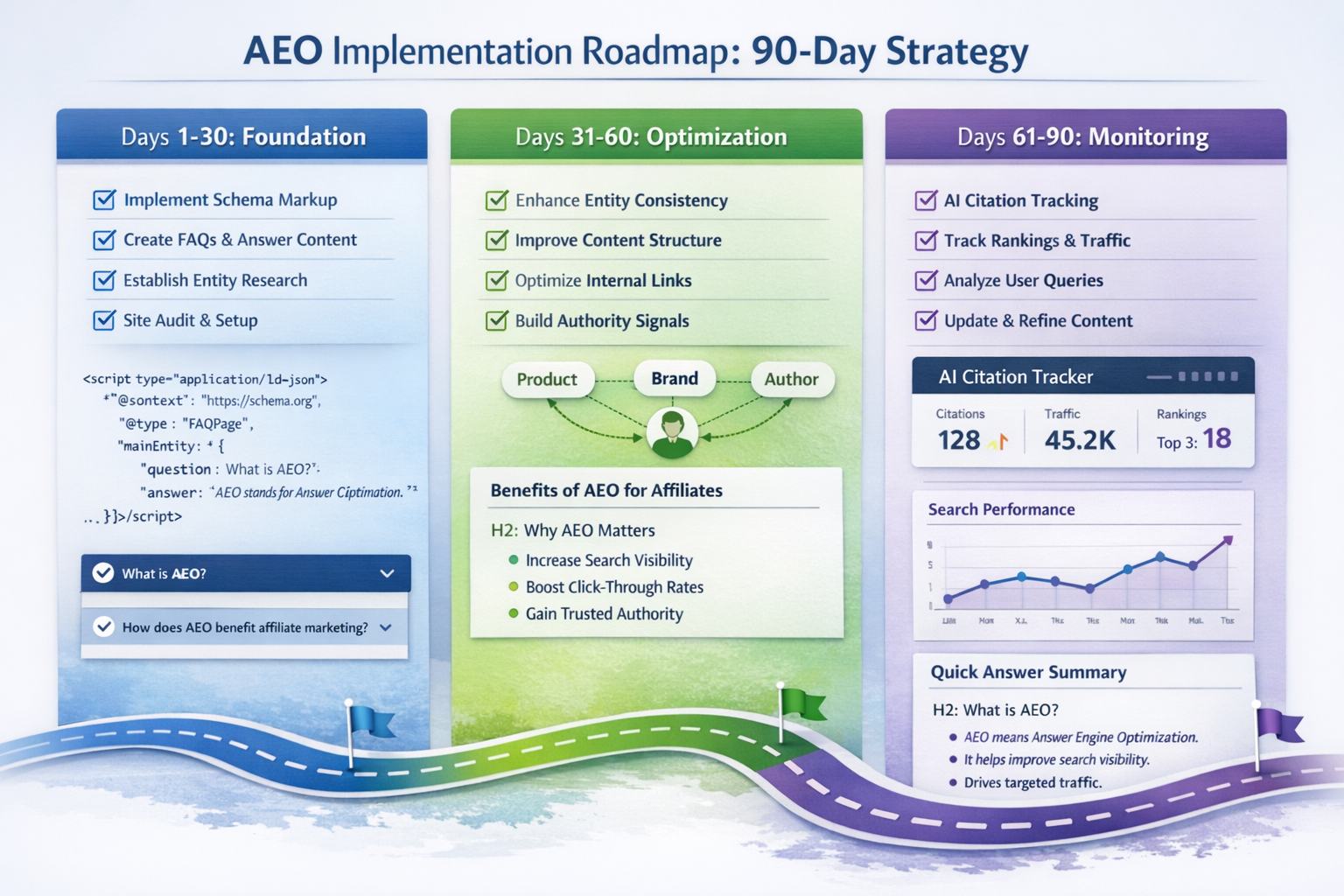
Days 1-30: Foundation and Entity Optimization
The first month focuses on technical infrastructure and entity establishment.
Week 1-2: Technical Audit and Schema Implementation
- Conduct a comprehensive schema audit of existing content
- Implement priority schema types (LocalBusiness, Product, FAQPage)
- Verify schema validation using Google’s Rich Results Test
- Fix any structured data errors or warnings
Week 3-4: Entity Consistency Optimization
- Audit all business listings and citations
- Standardize NAP (Name, Address, Phone) across platforms
- Update social media profiles for consistency
- Create entity reference document for future use
Days 31-60: Content Restructuring and Q&A Optimization
In month two, existing content is transformed into AEO-friendly formats.
Week 5-6: Answer-First Content Transformation
- Identify the top 20 performing pages by traffic
- Restructure each page with an answer-first format
- Add clear H2/H3 question headings
- Create concise summary sections at page tops
Week 7-8: FAQ and Schema Expansion
- Research common questions in your niche using AI tools
- Add comprehensive FAQ sections to priority pages
- Implement FAQPage schema markup
- Create standalone FAQ pages for major topics
This approach recognizes that “most effective AEO work involves restructuring existing website content rather than creating separate pages.”[1]
Days 61-90: Distribution, Monitoring, and Iteration
The final month establishes measurement systems and cross-platform presence.
Week 9-10: Multi-Platform Content Distribution
- Repurpose top content for video platforms (YouTube, TikTok)
- Create audio versions for podcast platforms
- Distribute content snippets across social channels
- Ensure all formats include proper attribution and links
Week 11-12: Citation Tracking and Performance Monitoring
- Set up AI citation monitoring across ChatGPT, Perplexity, Gemini
- Track which content gets cited most frequently
- Monitor brand mentions in AI responses
- Analyze patterns and optimize high-performing content types
This phased approach follows the recommended 90-day implementation timeline that balances technical optimization with content transformation.[3]
Advanced AEO Tactics for Dominating Zero-Click Searches
Leveraging Local Pages for Geographic Dominance
Local content represents one of the highest-opportunity AEO strategies for affiliate marketers in 2026. AI engines increasingly provide location-specific answers to user queries, creating opportunities for geographically targeted content.
Local AEO Strategy Components:
📍 City-Specific Landing Pages – Create dedicated pages for major cities in your target market
🗺️ Regional Buying Guides – Develop location-aware product recommendations
🏪 Local Business Partnerships – Feature local retailers and service providers
📊 Geographic Data Integration – Include local statistics, demographics, and trends
For example, instead of a generic “Best Coffee Makers 2026” article, create “Best Coffee Makers for Seattle Coffee Enthusiasts” with local retailer information, regional preferences, and climate-specific considerations.
Multi-Format Content: Meeting AI Engines Where They Search
AI engines don’t just process text—they increasingly analyze video, audio, images, and mixed-media content. Optimizing across formats expands your citation opportunities.
Video Optimization for AI Discovery:
- Use descriptive titles with question formats
- Include comprehensive video descriptions with timestamps
- Add accurate transcripts and closed captions
- Implement VideoObject schema markup
- Create chapter markers for key sections
Audio Content for Voice AI:
- Optimize podcast titles and descriptions for question queries
- Include detailed show notes with key points
- Transcribe episodes and publish transcripts
- Submit podcasts to major directories (Apple, Spotify, Google)
Image Optimization for Visual AI:
- Use descriptive, keyword-rich file names
- Write comprehensive alt text with context
- Implement ImageObject schema
- Include captions that explain image relevance
- Optimize image metadata and EXIF data
The Question-Headline Strategy
AI engines excel at matching user questions with content that directly answers them. Restructuring your content with question-based headings dramatically improves extraction and citation rates.
Before (Traditional Headlines):
- “Features to Consider”
- “Top Recommendations”
- “Pricing Information”
After (Question-Based Headlines):
- “What Features Matter Most in Noise-Canceling Headphones?”
- “Which Headphones Offer the Best Value Under $200?”
- “How Much Should You Expect to Pay for Quality Noise Cancellation?”
This simple transformation aligns your content structure with how users actually query AI engines, increasing the likelihood your content gets surfaced and cited.
Measuring AEO Success: Beyond Traditional Metrics
The New KPIs for Answer Engine Optimization
Traditional SEO metrics—rankings, impressions, clicks—tell an incomplete story in the AEO era. Success requires tracking an expanded set of indicators.
Essential AEO Metrics for 2026:
| Metric | What It Measures | Why It Matters |
|---|---|---|
| AI Citation Frequency | How often AI engines cite your content | Direct measure of source authority |
| Citation Quality Score | Which AI platforms cite you (ChatGPT, Perplexity, etc.) | Premium platforms indicate higher trust |
| Brand Mention Volume | Frequency of brand mentions in AI responses | Measures brand awareness in AI ecosystem |
| Citation-to-Click Ratio | Percentage of citations that generate clicks | Indicates content value beyond zero-click |
| Entity Recognition Rate | How consistently AI identifies your brand entity | Measures entity establishment success |
| Multi-Format Presence | Content citations across text, video, audio | Indicates comprehensive optimization |
“A significant portion of 2026 AEO strategy involves monitoring mentions and citations across multiple AI models rather than focusing solely on traditional click-through metrics.”[2]
Tools for Tracking AI Citations
Several specialized tools have emerged to help marketers monitor their presence in AI answer engines:
🔍 Perplexity Analytics – Tracks citations in Perplexity AI responses
🤖 ChatGPT Monitoring Tools – Monitors brand mentions in ChatGPT outputs
📊 AI Visibility Platforms – Comprehensive tracking across multiple AI engines
🔔 Brand Mention Alerts – Real-time notifications when AI engines cite your content
While these tools are still evolving, establishing baseline measurements now positions you to track progress as AEO becomes increasingly critical to digital marketing success.
Unifying AEO and SEO: The Integrated Approach
Why Separation Is a Strategic Mistake
Some marketers treat AEO as a completely separate discipline from traditional SEO, creating distinct content strategies, teams, and measurement frameworks. This separation is both inefficient and strategically flawed.
AEO is recognized as the natural evolution of SEO rather than a separate discipline.[1] The most successful brands in 2026 blend both approaches to capture full-funnel visibility across:
- 🔵 Traditional blue-link search results
- 🤖 Google AI Overviews
- 💬 Conversational engines (ChatGPT, Perplexity, Gemini)
- 🎯 Voice search and smart assistants
- 📱 Platform-specific AI (Instagram, TikTok, LinkedIn)
The Unified Content Strategy
Rather than creating separate “SEO content” and “AEO content,” develop content that serves both purposes simultaneously.
Unified Content Checklist:
✅ Optimized for traditional search – Target keywords, meta descriptions, title tags
✅ Structured for AI extraction – Answer-first format, clear headings, bullet points
✅ Schema-enhanced – Comprehensive structured data implementation
✅ Multi-format available – Text, video, audio, and visual versions
✅ Citation-worthy – Authoritative, well-researched, properly attributed
✅ Entity-consistent – Aligned with broader brand entity signals
This approach recognizes that “winning brands blend both approaches to capture full-funnel visibility.”[1]
Optimizing Existing Content vs. Creating New Pages
One of the most common AEO questions affiliate marketers ask: “Should I create separate AEO-optimized pages or optimize my existing content?”
The research is clear: “Most effective AEO work involves restructuring existing website content rather than creating separate pages.”[1]
Recommended Optimization Approach:
- Add answer-first summaries at the top of existing pages
- Standardize facts and product descriptions for consistency
- Improve schema markup on current high-performing content
- Add FAQ sections based on real user intent and AI queries
- Restructure headings to question-based formats
- Enhance internal linking to reinforce entity relationships
This strategy leverages your existing domain authority, backlink profile, and ranking signals while making content more AI-friendly—a more efficient path than building separate AEO content from scratch.
Common AEO Mistakes Affiliate Marketers Must Avoid
Mistake #1: Ignoring the Zero-Click Reality
Some marketers resist AEO because they think, “If users don’t click, how do I make money?” This mindset misses the fundamental shift happening in digital discovery.
The Reality: Zero-click doesn’t mean zero-value. Citations build authority, brand recognition, and trust that influences purchasing decisions across multiple touchpoints. Users who encounter your brand as a cited source in AI responses are more likely to:
- Remember your brand when ready to purchase
- Click through when they need deeper information
- Trust your recommendations over uncited competitors
- Share your content with others
Mistake #2: Keyword Stuffing for AI Engines
Some marketers assume AI engines work like primitive search algorithms, responding to keyword density and exact-match phrases. This leads to awkward, over-optimized content that actually reduces citation likelihood.
The Reality: Modern AI engines evaluate content quality, relevance, and authority using sophisticated language models. They prioritize natural, comprehensive, well-structured content over keyword-stuffed pages. Focus on answering questions thoroughly rather than hitting arbitrary keyword targets.
Mistake #3: Neglecting Entity Consistency
Many affiliate marketers optimize individual pages while ignoring broader entity signals. This creates confusion for AI systems trying to establish trust and authority.
The Reality: “Consistency across all local listings directly impacts entity trust scores and citation likelihood.”[1] A single inconsistent NAP citation can undermine months of optimization work.
Mistake #4: Treating AEO as a One-Time Project
Some marketers implement AEO tactics once and expect permanent results, failing to recognize that AI engines evolve rapidly.
The Reality: AEO requires ongoing monitoring, testing, and iteration. AI platforms update their algorithms, change citation preferences, and evolve their understanding of authority signals. Successful AEO demands continuous optimization based on performance data.
Mistake #5: Ignoring Multi-Format Optimization
Text-only optimization misses significant citation opportunities as AI engines increasingly process video, audio, and visual content.
The Reality: Comprehensive AEO strategy includes optimizing across all content formats where your audience consumes information. This expands citation opportunities and reinforces entity authority across platforms.
The Future of Answer Engine Optimization (AEO): The New SEO for AI-Driven Discovery
Emerging Trends Shaping AEO in 2026 and Beyond
The AEO landscape continues evolving rapidly. Several trends will define success in the coming years:
🎯 Hyper-Personalized AI Responses
AI engines increasingly provide personalized answers based on user history, preferences, and context. This creates opportunities for niche-specific optimization targeting particular user segments.
🔗 Direct AI-to-Commerce Integration
AI platforms are building native shopping capabilities, allowing users to purchase directly within conversational interfaces. Affiliate marketers must adapt to this shortened funnel.
📊 Real-Time Citation Analytics
Sophisticated tools will emerge to track AI citations in real-time, enabling rapid optimization based on what’s working across different AI platforms.
🌐 Cross-Platform Entity Graphs
AI systems will build comprehensive entity knowledge graphs that connect brand mentions across platforms, making entity consistency even more critical.
🎙️ Voice and Conversational Commerce
Voice-activated AI assistants will drive increasing purchase volume, requiring optimization for spoken queries and audio content.
Preparing for the Next Wave of AI Discovery
Forward-thinking affiliate marketers are already preparing for the next evolution of AI-driven discovery:
Invest in Brand Building: As zero-click searches dominate, brand recognition becomes the primary driver of eventual conversions. Citations that build brand awareness create long-term value even without immediate clicks.
Develop Proprietary Data: AI engines cite sources with unique insights and original research. Creating proprietary studies, surveys, and data sets positions you as an authoritative source.
Build Direct Relationships: Email lists, communities, and direct channels become increasingly valuable as third-party traffic becomes less predictable. Use AI citations to drive newsletter signups and community membership.
Embrace Multi-Platform Presence: Success requires presence across traditional search, AI engines, social platforms, and emerging discovery channels. Diversification protects against algorithm changes on any single platform.
Conclusion: Thriving in the Age of AI-Driven Discovery
The transformation from traditional search to AI-driven discovery represents the most significant shift in digital marketing since the emergence of search engines themselves. For affiliate marketers, this evolution demands fundamental changes in strategy, measurement, and content creation.
Answer Engine Optimization (AEO): The New SEO for AI-Driven Discovery isn’t a replacement for traditional SEO—it’s the natural evolution that recognizes how users increasingly discover and consume information in 2026. The decline in traditional search referrals and the explosive growth of AI answer engines create both challenges and unprecedented opportunities.
The affiliate marketers who thrive in this new landscape will be those who:
✅ Embrace zero-click as opportunity rather than threat
✅ Optimize for citations as the new currency of visibility
✅ Maintain entity consistency across all digital touchpoints
✅ Structure content for both human readers and AI extraction
✅ Monitor AI citations as rigorously as traditional rankings
✅ Unify AEO and SEO into integrated visibility strategies
Your Next Steps: Implementing AEO This Week
Don’t wait for traditional search traffic to disappear before adapting. Start your AEO journey today with these immediate actions:
This Week:
- Audit your top 10 pages for answer-first structure
- Add FAQ sections to your highest-traffic content
- Implement basic schema markup (FAQPage, Article, Product)
- Verify NAP consistency across major platforms
- Test your brand name in ChatGPT and Perplexity to establish baseline citation presence
This Month:
- Complete the Days 1-30 foundation work from the 90-day blueprint
- Restructure priority content with question-based headings
- Create video or audio versions of top-performing content
- Set up basic AI citation monitoring
- Review and optimize on-page SEO elements for a unified AEO-SEO approach
This Quarter:
- Execute the complete 90-day AEO implementation plan
- Establish comprehensive citation tracking across AI platforms
- Develop a multi-format content strategy
- Build entity consistency across all digital properties
- Create a measurement framework for ongoing optimization
The future of affiliate marketing visibility isn’t about choosing between traditional SEO and Answer Engine Optimization—it’s about mastering both to dominate discovery across every channel where your audience searches for information.
The question isn’t whether to adapt to AI-driven discovery. The question is whether you’ll lead the transformation or scramble to catch up when traditional search traffic has already declined. Start optimizing for answer engines today, and position yourself to capture visibility in the AI-first future that’s already here.
References
[1] Answer Engine Optimization Trends – https://blog.hubspot.com/marketing/answer-engine-optimization-trends
[2] Best Answer Engine Optimization Tools 2026 – https://visible.seranking.com/blog/best-answer-engine-optimization-tools-2026/
[3] What Is Answer Engine Optimization – https://www.tryprofound.com/resources/articles/what-is-answer-engine-optimization
[4] Ultimate Guide To Answer Engine Optimization Aeo – https://adsrole.com/blog/ultimate-guide-to-answer-engine-optimization-AEO
