

The affiliate marketing landscape is experiencing a seismic shift that most marketers aren’t prepared for. Traditional search engine optimization strategies that once guaranteed visibility are becoming obsolete as artificial intelligence reshapes how users discover information. Answer Engine Optimization for Affiliates: Ranking in AI Summaries Beyond Google Search has evolved from an experimental tactic to a mission-critical requirement in 2026, as AI-powered platforms like ChatGPT, Perplexity, and Microsoft Copilot increasingly answer user questions directly—without sending traffic to traditional search results.
For affiliate marketers, this transformation presents both an existential threat and an unprecedented opportunity. When AI systems cite your affiliate content as the authoritative source in their responses, you bypass traditional search engine results pages (SERPs) entirely and position yourself as the trusted expert. However, if your affiliate partnerships and recommended products aren’t appearing in Large Language Model (LLM) responses, you’re essentially invisible in the AI-driven discovery layer that’s rapidly becoming the primary gateway to online information.[6]
The stakes couldn’t be higher: Microsoft Copilot ads are already generating 73% higher click-through rates and 16% stronger conversion rates compared to traditional search advertising, with customer journeys 33% shorter.[4] This isn’t a future trend—it’s the current reality that forward-thinking affiliates are leveraging right now.
Key Takeaways
🎯 AEO is now mandatory, not optional: Answer Engine Optimization has become a core strategic requirement for affiliate visibility in 2026, integrating SEO, PR, and affiliate marketing into a unified discovery strategy.[1][2]
🔍 AI citation equals modern visibility: If your affiliate content and partner brands aren’t appearing in LLM responses from ChatGPT, Perplexity, and Copilot, you’re missing the primary discovery layer where users now find recommendations.[6]
📊 Structured data drives AI selection: Implementing LocalBusiness, PostalAddress, and Service schema markup directly increases your likelihood of being cited in AI answers, with entity consistency critical across all platforms.[1]
💡 Answer-first formatting is essential: Content must surface key information immediately in formats that AI systems can easily parse, cite, and trust—a fundamental departure from traditional SEO approaches.[1]
⚡ Measurable performance advantages: Early adopters are seeing dramatically higher engagement metrics, with Copilot ads demonstrating superior CTR, conversion rates, and shortened customer journeys compared to traditional search.[4]
Understanding the Shift from SEO to Answer Engine Optimization for Affiliates
The Zero-Click Reality Is Already Here
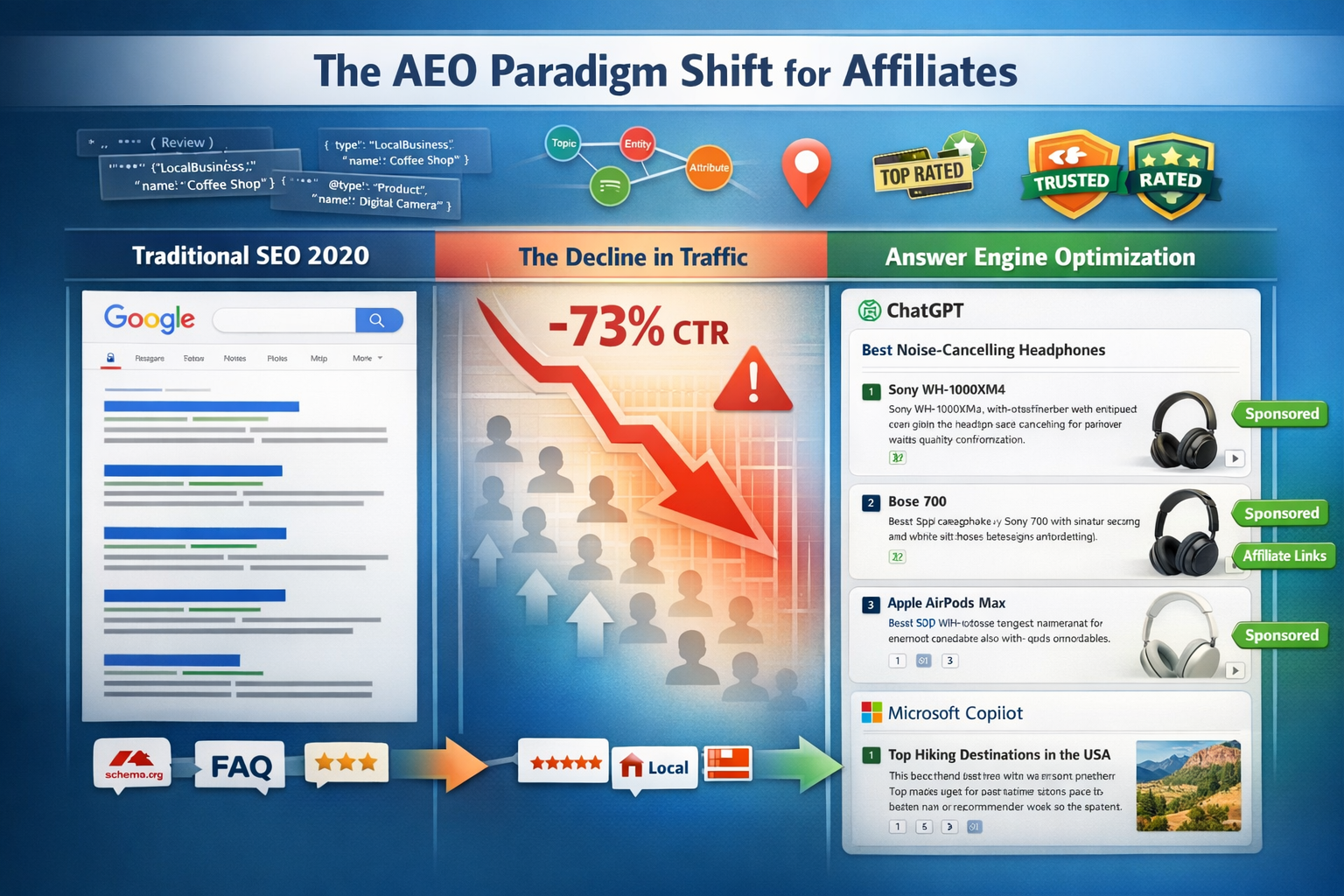
The prediction of a “zero-click future” isn’t a distant possibility—it’s the present reality that affiliate marketers must navigate today. AI-powered answer engines are fundamentally changing user behavior by providing comprehensive responses directly within conversational interfaces, eliminating the need for users to click through to multiple websites.[6]
This transformation affects affiliate marketing in several critical ways:
Traditional Search Journey:
- User enters query in Google
- Reviews 10 blue links
- Clicks multiple results
- Compares information across sites
- Eventually finds affiliate recommendation
AI-Powered Answer Journey:
- User asks question in ChatGPT/Perplexity
- Receives comprehensive answer with citations
- Trusts cited sources as authoritative
- Acts on recommendation immediately
The second journey is dramatically shorter, which explains why customer journeys are 33% shorter with AI-powered platforms.[4] For affiliates, this means you either become the cited source in step 2, or you don’t exist in the user’s decision-making process at all.
Why Traditional SEO Strategies Are Failing Affiliates
Traditional Google search engine optimization tactics were designed for a different era—one where users clicked through blue links and spent time on websites. These strategies focused on:
- Keyword density and placement for ranking algorithms
- Backlink quantity as primary authority signals
- Content length to satisfy perceived quality metrics
- Technical optimization for crawler accessibility
- Meta descriptions to improve click-through rates
While these elements still matter for traditional search, they’re insufficient for Answer Engine Optimization. AI systems evaluate content through fundamentally different criteria:
| Traditional SEO Focus | AEO Requirements |
|---|---|
| Keywords in titles/headers | Direct, concise answers to specific questions |
| Backlink quantity | Entity authority and consistency |
| Content length (2000+ words) | Answer-first formatting with key info upfront |
| Meta descriptions | Structured data markup (Schema.org) |
| PageRank signals | Multi-platform entity verification |
| Bounce rate optimization | Citation-worthy factual accuracy |
The shift requires affiliates to think beyond ranking for keywords and instead focus on becoming the authoritative source that AI systems trust and cite.[2]
The Six Pillars of Answer Engine Optimization for Affiliates
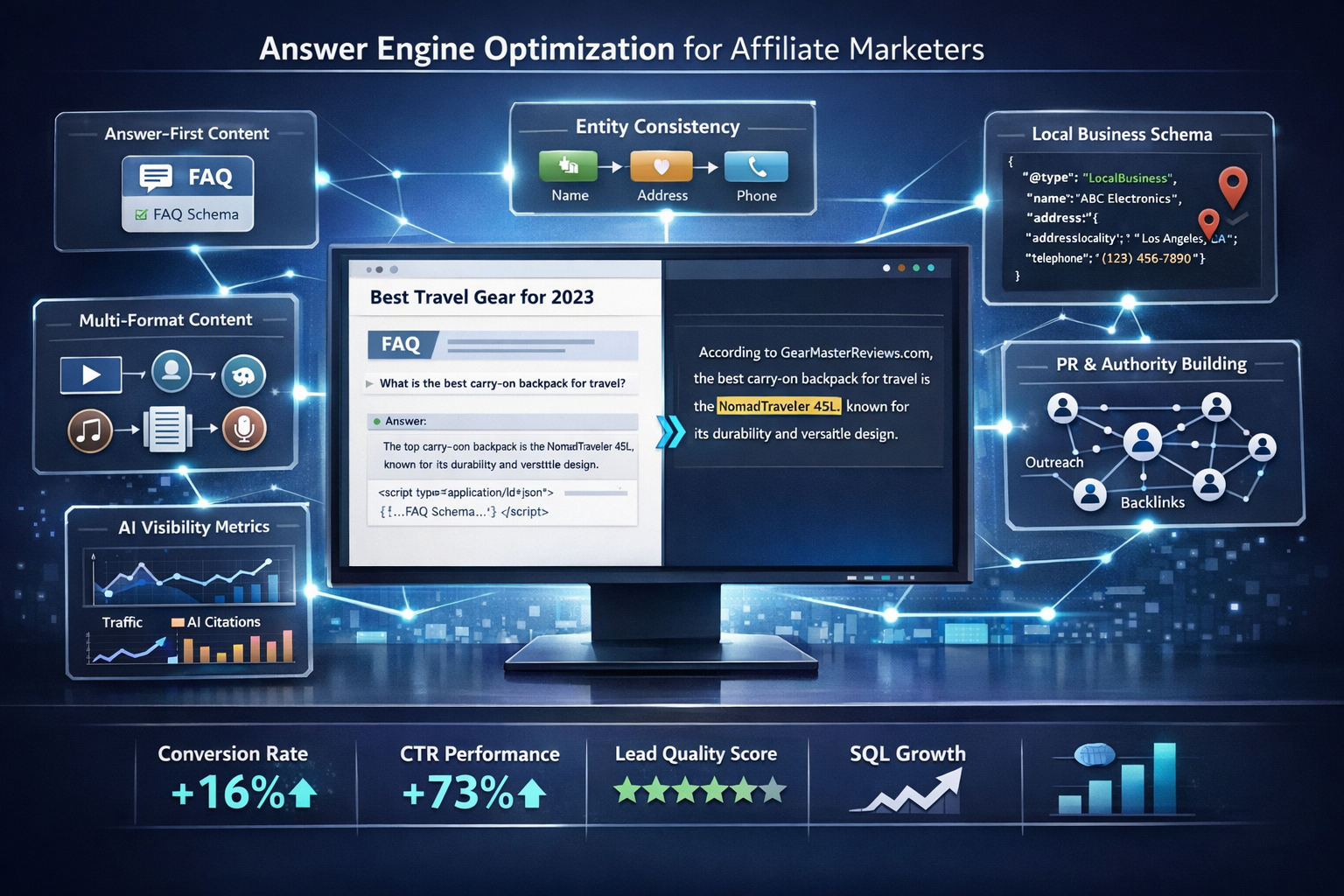
According to industry research, six primary optimization trends are reshaping how successful affiliates approach visibility in 2026:[1]
1. Geographic Visibility Through Local Pages 🌍
AI assistants increasingly personalize answers by region, drawing from pages that clearly communicate location, service availability, and entity-level details. Affiliates operating in multiple regions should create location-specific content variations.
2. Answer-First Content Formats 📝
Content must surface key information early and directly address user questions in formats that AI systems can parse, cite, and trust. This means restructuring content to lead with answers rather than building up to them.
3. Entity Consistency Across Platforms ✅
Mismatched information across local listings, social profiles, and directories reduces entity trust scores, directly impacting citation likelihood. Every platform must present identical NAP (Name, Address, Phone) data.
4. AI Visibility Metrics Tracking 📊
Success metrics now include monitoring how frequently your brand appears in LLM responses, which types of queries trigger citations, and the quality of leads from AI-influenced pages.
5. Unified AEO-SEO Strategy 🔗
Rather than treating AEO as separate from SEO, leading affiliates integrate both into a comprehensive discovery strategy that captures visibility across traditional search and AI platforms simultaneously.
6. Multi-Format Content Optimization 🎥
AI systems increasingly pull from video transcripts, podcast audio, and diverse content formats. Optimizing across formats expands citation opportunities.
Understanding affiliate marketing optimization techniques provides a foundation, but AEO requires additional specialized approaches that we’ll explore in the following sections.
Implementing Answer Engine Optimization for Affiliates: Ranking in AI Summaries
Structured Data: The Foundation of AI Citations
Schema markup is the technical foundation that enables AI systems to understand, categorize, and cite your affiliate content. While schema has existed for years as an SEO best practice, it’s now absolutely critical for AEO success.
The most impactful schema types for affiliates include:
LocalBusiness Schema 🏢
Defines your business entity with precise details that AI systems use to verify legitimacy and relevance:
{
  "@context": "https://schema.org",
  "@type": "LocalBusiness",
  "name": "Your Affiliate Business Name",
  "address": {
    "@type": "PostalAddress",
    "streetAddress": "123 Main Street",
    "addressLocality": "City",
    "addressRegion": "State",
    "postalCode": "12345"
  },
  "telephone": "+1-555-123-4567"
}
Product Schema 🛍️
Essential for affiliate product recommendations, helping AI understand what you’re recommending and why:
{
  "@context": "https://schema.org",
  "@type": "Product",
  "name": "Product Name",
  "aggregateRating": {
    "@type": "AggregateRating",
    "ratingValue": "4.8",
    "reviewCount": "127"
  },
  "offers": {
    "@type": "Offer",
    "price": "99.99",
    "priceCurrency": "USD"
  }
}
FAQPage Schema ❓
Directly targets the question-answer format that AI systems prefer:
{
  "@context": "https://schema.org",
  "@type": "FAQPage",
  "mainEntity": [{
    "@type": "Question",
    "name": "What is the best affiliate program for beginners?",
    "acceptedAnswer": {
      "@type": "Answer",
      "text": "The best affiliate programs for beginners include Amazon Associates, ShareASale, and CJ Affiliate due to their low barriers to entry and extensive product catalogs."
    }
  }]
}
Adding LocalBusiness, PostalAddress, and Service schema markup directly increases the likelihood of being selected for localized AI answers, with entity consistency supporting uniform citations across different AI engines.[1]
Creating Answer-First Content That AI Systems Cite
Traditional affiliate content often follows this structure:
- Introduction with background
- Problem explanation
- Solution exploration
- Product recommendations
- Conclusion
AI systems rarely cite content structured this way because the actual answer is buried deep in the article. Answer-first content inverts this approach:
AEO-Optimized Structure:
- Direct answer in first paragraph (what AI will cite)
- Supporting evidence and details (builds authority)
- Specific product recommendations (affiliate monetization)
- Additional context and alternatives (comprehensive coverage)
- Actionable next steps (user value)
Example Transformation:
❌ Traditional Approach:
“Affiliate marketing has become increasingly popular in recent years. Many people wonder about the best programs to join. There are several factors to consider when choosing an affiliate program. Let’s explore the landscape…”
✅ Answer-First Approach:
“The three best affiliate marketing programs for beginners in 2026 are Amazon Associates (4-10% commissions, millions of products), ShareASale (average 15% commissions, 4,500+ merchants), and CJ Affiliate (premium brands, higher payouts). These programs offer low barriers to entry, reliable tracking, and consistent payouts.”
The second approach gives AI systems exactly what they need: a clear, citeable answer that directly addresses the user’s question.[1]
Entity Consistency: Building Trust Across Platforms
AI systems don’t rely on a single source to determine authority—they cross-reference information across multiple platforms to verify entity legitimacy. Inconsistent information reduces trust scores, directly impacting citation likelihood.[1]
Critical Consistency Checkpoints:
✅ Business Name – Identical across all platforms (no variations)
✅ Address – Exact same format everywhere (including suite numbers)
✅ Phone Number – Same number on every listing
✅ Business Hours – Synchronized across all directories
✅ Service Descriptions – Consistent language and offerings
✅ Categories – Matching business classifications
Platforms to Audit:
- Google Business Profile
- Bing Places
- Facebook Business Page
- LinkedIn Company Page
- Industry-specific directories
- Local chamber listings
- Better Business Bureau
- Yelp and review platforms
Even minor discrepancies—like “123 Main St.” versus “123 Main Street”—can fragment your entity profile and reduce AI trust scores. Conduct quarterly audits to ensure perfect consistency.
Geographic Targeting for Localized AI Answers
AI assistants increasingly personalize answers based on user location, drawing from pages that clearly communicate geographic relevance and service availability.[1] This creates significant opportunities for affiliates serving specific regions.
Hyper-Local Content Strategies:
1. Region-Specific Landing Pages 📍
Create dedicated pages for each geographic area you serve:
- “Best Home Security Systems in Austin, Texas”
- “Top Solar Panel Installers in Phoenix, Arizona”
- “Miami Beach Vacation Rental Affiliate Guide”
2. Local Schema Implementation 🗺️
Add geographic coordinates and service area definitions:
{
  "@type": "LocalBusiness",
  "geo": {
    "@type": "GeoCoordinates",
    "latitude": "30.2672",
    "longitude": "-97.7431"
  },
  "areaServed": {
    "@type": "City",
    "name": "Austin"
  }
}
3. Location-Specific Content Elements 🏙️
- Reference local landmarks and neighborhoods
- Mention regional events and seasons
- Include local statistics and data
- Feature regional customer testimonials
- Address location-specific concerns
When users ask AI assistants location-based questions like “What’s the best affiliate program for my Austin-based blog?”, properly optimized geographic content significantly increases citation probability.
Measuring Success: Answer Engine Optimization for Affiliates Metrics
Traditional Metrics vs. AEO Performance Indicators
Success in Answer Engine Optimization requires tracking different metrics than traditional SEO. While organic traffic and keyword rankings remain relevant, they don’t capture AEO effectiveness.
New AEO Metrics to Track:
📊 AI Citation Frequency
How often does your brand appear in responses from ChatGPT, Perplexity, Copilot, and other AI platforms? Manual testing and specialized monitoring tools can track this.
🎯 Citation Context Quality
Are you cited for high-intent commercial queries or just informational questions? Quality of citations matters more than quantity.
💎 Lead Quality Scores
When affiliate content appears in AI answers, resulting leads are typically warmer and better aligned to ideal customer profiles compared to traditional search.[1] Track:
- Lead qualification rates from AI sources
- Sales Qualified Lead (SQL) conversion rates
- Average deal size from AI-influenced leads
- Customer Lifetime Value (CLV) by source
⚡ Engagement Metrics
Users arriving from AI citations demonstrate different behavior:
- Time on site (typically higher)
- Pages per session (often lower but more focused)
- Conversion rate (significantly higher)
- Bounce rate (varies by content type)
🔄 Multi-Platform Entity Verification
How many authoritative platforms recognize and verify your business entity? More verification sources increase AI trust.
Tools for Monitoring AI Visibility
Several emerging tools help affiliates track their Answer Engine Optimization performance:
AI-Specific Monitoring:
- Perplexity API – Track when your content is cited
- ChatGPT Plugin Analytics – Monitor plugin engagement
- Brand mention tracking – Specialized AEO monitoring services
Traditional Tools with AEO Applications:
- Google Search Console – Track featured snippets (AI training data)
- Schema markup validators – Ensure proper implementation
- Entity verification tools – Monitor knowledge graph presence
Manual Testing Protocol:
- Create list of target questions in your niche
- Query multiple AI platforms weekly
- Document citation frequency and context
- Track competitor citations
- Identify patterns in cited vs. non-cited content
This data reveals which content formats, topics, and approaches generate the most AI citations, allowing you to refine your strategy based on actual performance.
The Microsoft Copilot Advantage for Affiliates
Microsoft Copilot represents the most mature advertising platform within AI-powered search, offering affiliates measurable advantages that traditional search can’t match.[4]
Proven Performance Metrics:
✅ 73% Higher Click-Through Rates – Copilot ads dramatically outperform traditional search ads because they appear within contextually relevant AI conversations rather than alongside generic search results.[4]
✅ 16% Stronger Conversion Rates – The conversational context and AI-assisted qualification mean users clicking Copilot ads are further along the buying journey.[4]
✅ 33% Shorter Customer Journeys – AI-assisted discovery eliminates multiple research steps, accelerating the path to purchase.[4]
✅ $20 Billion Annual Revenue – Microsoft’s AI advertising revenue demonstrates market validation and platform sustainability.[4]
Why Copilot Ads Perform Better:
Unlike traditional search ads that respond to isolated queries, Copilot ads analyze the entire conversation history, enabling contextually relevant placement.[4] This means:
- Ads appear only when genuinely relevant to the conversation
- User intent is better understood through dialogue context
- Ad messaging can address specific concerns raised in conversation
- Timing aligns with user readiness to take action
For affiliates, this creates opportunities to promote partner products within AI conversations at precisely the moment users are most receptive.
Advanced Strategies: Answer Engine Optimization for Affiliates in Practice
PR and Authority Building as AEO Pillars
Traditional affiliate marketing often treated PR as a secondary tactic focused on brand awareness. In the AEO era, PR and affiliate marketing are core pillars that drive the trust signals answer engines evaluate when deciding which content to cite.[2]
Why PR Matters for AEO:
🏆 Authority Signals – Media mentions and press coverage create entity authority that AI systems recognize and weight heavily in citation decisions.
🔗 Diverse Backlink Profile – PR generates natural backlinks from high-authority news and media sites, strengthening your entity profile.
📰 Knowledge Graph Inclusion – Sufficient media coverage can trigger knowledge graph entries, dramatically improving AI recognition.
🌐 Multi-Platform Presence – PR creates mentions across diverse platforms, supporting entity consistency and verification.
Actionable PR Strategies for Affiliates:
HARO (Help A Reporter Out) – Respond to journalist queries in your niche, earning media mentions and authority backlinks
Expert Commentary – Offer expert opinions on industry trends to trade publications and news outlets
Data-Driven Studies – Conduct original research and publish findings that media outlets cite
Podcast Appearances – Guest appearances create audio content that AI systems increasingly index
Industry Awards – Apply for relevant awards to generate recognition and credibility signals
Strategic AEO makes PR efforts measurable in a new way—not just by impressions or share of voice, but by how frequently brands are cited across answer engines and the types of responses they appear in.[2]
Multi-Format Content Optimization
AI systems increasingly pull information from diverse content formats beyond traditional text articles. Optimizing across formats expands citation opportunities and captures different user preferences.[1]
Video Content Optimization 🎥
AI platforms can now analyze video transcripts and visual content:
- Upload transcripts to YouTube and video platforms
- Include structured chapters with timestamps
- Add comprehensive descriptions with key points
- Implement VideoObject schema markup
- Create short-form and long-form versions for different platforms
Audio Content Optimization 🎙️
Podcasts and audio content are becoming AI-indexable:
- Publish full transcripts alongside episodes
- Include detailed show notes with key takeaways
- Add episode-specific schema markup
- Create audiogram snippets for social sharing
- Optimize podcast descriptions with answer-first formatting
Visual Content Optimization 📊
Infographics, charts, and diagrams support AI understanding:
- Include alt text with detailed descriptions
- Add surrounding context explaining visual data
- Implement ImageObject schema markup
- Create text summaries of visual information
- Ensure accessibility for screen readers
Interactive Content 💻
Calculators, quizzes, and tools generate unique value:
- Provide text explanations of tool functionality
- Include example outputs in content
- Add FAQ schema addressing common questions
- Create video tutorials demonstrating usage
By diversifying content formats while maintaining consistent entity information and structured data across all formats, affiliates maximize their citation potential across different AI platforms and user preferences.
Avoiding Common Mistakes in Answer Engine Optimization
Many affiliates new to AEO make predictable mistakes that undermine their efforts. Understanding these pitfalls helps you avoid wasted time and resources, similar to learning about common affiliate marketing mistakes.
❌ Mistake 1: Keyword Stuffing for AI
Some affiliates assume AI systems respond to keyword density like traditional search algorithms. In reality, AI systems prioritize natural language and genuine answers over keyword repetition.
✅ Solution: Write for human readers first, ensuring answers are clear, accurate, and comprehensive. AI systems reward content that genuinely serves users.
❌ Mistake 2: Ignoring Entity Consistency
Affiliates often create content without ensuring their business entity is properly defined and consistent across platforms.
✅ Solution: Conduct a comprehensive entity audit before creating content. Establish consistent NAP data across all platforms and maintain it rigorously.
❌ Mistake 3: Burying Answers in Content
Traditional SEO taught affiliates to build up to answers gradually, keeping users on page longer. This approach fails with AI systems.
✅ Solution: Lead with direct answers in the first paragraph, then provide supporting details and context.
❌ Mistake 4: Neglecting Schema Markup
Many affiliates view schema as optional technical SEO rather than fundamental AEO infrastructure.
✅ Solution: Implement comprehensive schema markup on all content, particularly LocalBusiness, Product, FAQPage, and HowTo schemas.
❌ Mistake 5: Single-Platform Focus
Some affiliates optimize exclusively for one AI platform (usually ChatGPT) while ignoring others.
✅ Solution: Develop a multi-platform AEO strategy that targets ChatGPT, Perplexity, Copilot, Claude, and emerging AI platforms simultaneously.
❌ Mistake 6: Ignoring Mobile and Voice
AI-powered voice assistants represent a growing share of queries, with different optimization requirements.
✅ Solution: Optimize for conversational queries and voice search patterns, using natural question-and-answer formats.
The Future of Answer Engine Optimization for Affiliates
Emerging Trends Shaping AEO in 2026 and Beyond
The AEO landscape continues evolving rapidly, with several emerging trends that forward-thinking affiliates should monitor and prepare for:
1. Personalized AI Responses 🎯
AI platforms are increasingly personalizing answers based on user history, preferences, and context. This means the same question may generate different answers for different users, with citation selection influenced by individual user profiles.
Affiliate Implication: Building diverse content that appeals to different user segments and personas becomes more important than creating a single “perfect” answer.
2. Real-Time Information Integration ⚡
AI systems are improving their ability to access and cite real-time information, reducing reliance on static training data.
Affiliate Implication: Regularly updating content with current information, prices, and availability increases citation likelihood for time-sensitive queries.
3. Multi-Modal AI Understanding 🖼️
Advanced AI systems can now analyze images, videos, and audio alongside text, creating opportunities for visual and audio content to be cited.
Affiliate Implication: Investing in high-quality visual and video content with proper markup and descriptions expands citation opportunities.
4. Conversational Commerce Integration 🛒
AI platforms are integrating direct purchasing capabilities, allowing users to complete transactions within AI conversations.
Affiliate Implication: Early adoption of AI-native affiliate programs and commerce integrations positions affiliates for this emerging channel.
5. Regulatory and Disclosure Requirements ⚖️
As AI-driven recommendations influence purchasing decisions, regulatory bodies are developing disclosure requirements for AI-cited content.
Affiliate Implication: Implementing clear, AI-readable affiliate disclosures and maintaining transparent recommendation practices protects against future regulatory issues.
Integrating AEO with Traditional Affiliate Strategies
Answer Engine Optimization doesn’t replace traditional affiliate marketing strategies—it enhances and extends them. The most successful affiliates in 2026 are those who integrate AEO with proven affiliate tactics rather than treating them as separate approaches.
Unified Strategy Framework:
Content Creation 📝
- Traditional: Long-form product reviews and comparisons
- AEO Enhancement: Add answer-first summaries, FAQ schema, and direct product recommendations upfront
- Result: Content ranks in traditional search AND gets cited by AI platforms
Link Building 🔗
- Traditional: Internal linking strategies and backlink acquisition
- AEO Enhancement: Focus on authority backlinks from media and industry sources that strengthen entity profiles
- Result: Improved traditional rankings AND higher AI trust scores
Technical Optimization ⚙️
- Traditional: Page speed, mobile responsiveness, crawlability
- AEO Enhancement: Comprehensive schema markup, entity definition, multi-platform consistency
- Result: Better user experience AND AI-readable content structure
Performance Tracking 📊
- Traditional: Rankings, traffic, conversions, revenue
- AEO Enhancement: AI citation frequency, lead quality scores, multi-platform visibility
- Result: Comprehensive understanding of all discovery channels
This integrated approach ensures affiliates maintain visibility across traditional search while capturing the growing share of discovery happening through AI platforms.
Practical Implementation: Your Answer Engine Optimization Roadmap
30-Day AEO Implementation Plan for Affiliates
Implementing Answer Engine Optimization can feel overwhelming, but a structured 30-day plan makes it manageable:
Week 1: Foundation and Audit 🔍
Days 1-3: Entity Audit
- Document current NAP data across all platforms
- Identify inconsistencies and create standardization plan
- Claim and verify all business listings
Days 4-5: Schema Implementation
- Audit existing schema markup
- Identify gaps and prioritize implementation
- Install schema plugins or manual markup
Days 6-7: Competitor Analysis
- Test AI platforms with target queries
- Document which competitors get cited
- Analyze their content structure and approach
Week 2: Content Optimization ✍️
Days 8-10: Answer-First Restructuring
- Identify top 10 performing content pieces
- Restructure with answer-first approach
- Add FAQ sections with schema markup
Days 11-13: Question Research
- Use AI platforms to identify common questions
- Create question-answer content matrix
- Prioritize based on commercial intent
Days 14: Multi-Format Planning
- Identify content suitable for video/audio
- Plan transcript and description optimization
- Schedule multi-format content creation
Week 3: Authority Building 🏆
Days 15-17: PR Outreach
- Sign up for HARO and similar services
- Identify relevant podcast opportunities
- Draft expert commentary pitches
Days 18-20: Knowledge Graph Optimization
- Research knowledge graph requirements
- Build Wikipedia presence if applicable
- Secure mentions in authoritative sources
Day 21: Review and Adjust
- Assess progress against plan
- Identify obstacles and solutions
- Adjust timeline if needed
Week 4: Testing and Measurement 📊
Days 22-25: AI Platform Testing
- Create testing protocol for target queries
- Test across ChatGPT, Perplexity, Copilot, Claude
- Document citation frequency and context
Days 26-28: Analytics Setup
- Implement tracking for AI-influenced traffic
- Set up custom reports for AEO metrics
- Establish baseline measurements
Days 29-30: Strategy Refinement
- Analyze what’s working vs. not working
- Create ongoing optimization schedule
- Plan next 90 days of AEO activities
This structured approach ensures steady progress without overwhelming your existing affiliate marketing operations.
Tools and Resources for Ongoing AEO Success
Essential AEO Tools:
Schema Markup Tools 🛠️
- Schema.org validator
- Google Rich Results Test
- Schema markup generators
- WordPress schema plugins
Entity Management 🏢
- Google Business Profile
- Bing Places for Business
- Moz Local
- Yext (for multi-platform management)
Content Optimization 📝
- Answer The Public (question research)
- AlsoAsked (related questions)
- Clearscope (content optimization)
- Surfer SEO (on-page optimization)
AI Monitoring 👁️
- Manual testing protocols
- Brand mention tracking tools
- Custom Google Alerts for citations
- Emerging AEO-specific platforms
Analytics and Tracking 📈
- Google Analytics 4 (with custom events)
- Google Search Console
- Position tracking tools
- Custom AEO dashboards
Building proficiency with these tools enables ongoing optimization and measurement of Answer Engine Optimization efforts.
Conclusion: Embracing the AI-Powered Future of Affiliate Marketing
Answer Engine Optimization for Affiliates: Ranking in AI Summaries Beyond Google Search represents the most significant shift in affiliate marketing discovery since the rise of mobile search. The evidence is clear: AI platforms are not the future—they’re the present. With Microsoft Copilot ads already demonstrating 73% higher click-through rates and 16% stronger conversion rates compared to traditional search[4], affiliates who delay AEO implementation are conceding competitive advantage to early adopters.
The transition from traditional SEO to Answer Engine Optimization isn’t about abandoning proven strategies—it’s about evolving them for an AI-powered discovery landscape. Structured data, entity consistency, answer-first content formatting, and multi-platform authority building aren’t replacing traditional affiliate tactics; they’re enhancing them to capture visibility across both traditional search engines and AI platforms simultaneously.
Your Next Steps: Taking Action Today
The most successful affiliates in 2026 won’t be those with the largest budgets or the most technical expertise—they’ll be those who start implementing AEO strategies immediately while competitors remain focused exclusively on traditional search.
Immediate Actions to Take:
Audit your entity consistency across all platforms and fix discrepancies within 48 hours
Implement basic schema markup on your top 10 performing pages this week
Restructure your next piece of content using answer-first formatting
Test AI platforms with your target queries and document current citation landscape
Create a 30-day AEO implementation plan using the roadmap provided above
Join AEO-focused communities to stay current with emerging best practices
Allocate 20% of your content budget to AEO-optimized content creation
The affiliate marketers who will thrive in the coming years are those who recognize that visibility in AI summaries is now as important as ranking in Google search results. By implementing the strategies outlined in this guide—from structured data and entity consistency to answer-first content and multi-platform authority building—you position yourself to capture affiliate revenue from both traditional search and the rapidly growing AI-powered discovery channel.
The question isn’t whether Answer Engine Optimization will become important for affiliates. The question is whether you’ll implement it before or after your competitors. The data, the trends, and the early results all point to the same conclusion: the time to optimize for AI citations is now.
Start with one strategy from this guide today. Your future affiliate revenue depends on it.
References
[1] Answer Engine Optimization Trends – https://blog.hubspot.com/marketing/answer-engine-optimization-trends
[2] Why Aeo Answer Engine Optimization Is Critical To 2026 Marketing Planning – https://www.rygr.us/2026/02/04/why-aeo-answer-engine-optimization-is-critical-to-2026-marketing-planning
[3] The Top Answer Engine Optimization Aeo Companies – https://firstpagesage.com/seo-blog/the-top-answer-engine-optimization-aeo-companies/
[4] Ai Advertising – https://cpvlab.pro/blog/marketing-industry/ai-advertising/
[5] Why Aeo Answer Engine Optimization Is Critical To 2026 Marketing Planning – https://www.backbone.media/insights/why-aeo-answer-engine-optimization-is-critical-to-2026-marketing-planning
[6] Beyond The Prediction How The 2026 Zero Click Reality Is Already Here – https://partnerize.com/resources/blog/beyond-the-prediction-how-the-2026-zero-click-reality-is-already-here
[7] Answer Engine Optimization Agencies – https://respona.com/blog/answer-engine-optimization-agencies/
[8] Top 10 Seo Predictions For 2026 What Affiliate Marketers Need To Know – https://www.affiversemedia.com/top-10-seo-predictions-for-2026-what-affiliate-marketers-need-to-know/
[9] Affiliate Marketing Trends 2026 – https://www.awin.com/us/sector-insights/affiliate-marketing-trends-2026
