

The digital marketing landscape has shifted dramatically. When someone asks ChatGPT, Google Gemini, or Claude for product recommendations today, your affiliate content either appears as a trusted citation—or it doesn’t exist at all. Traditional search engine optimization alone no longer guarantees visibility in this new era of AI-powered answers. Answer Engine Optimization for Affiliates: Securing Citations in AI Summaries and GEO represents the critical evolution that determines whether affiliate marketers thrive or fade into obscurity in 2026.
Unlike traditional SEO, which focuses on ranking on search results pages, Answer Engine Optimization (AEO) ensures your content is selected, cited, and recommended by AI systems that now answer questions directly. For affiliate marketers, this means adapting strategies to secure citations in AI-generated summaries, voice assistant responses, and Google’s AI Overviews—the new battleground for commissions and conversions.
Key Takeaways
- AEO integrates SEO, PR, and affiliate marketing to ensure brands are trusted, cited, and recommended across AI interfaces, not just traditional search results[3]
- High-trust “seed set” domains like Wikipedia, Reddit, and major news outlets dominate AI citations—affiliates must prioritize appearing on these authoritative platforms[4]
- AI systems use mode switching between training data (GEO) for timeless questions and live search (AEO) for timely queries, requiring optimization for both scenarios[4]
- Entity consistency across platforms directly impacts citation likelihood—mismatched information reduces AI trust scores and citation frequency[1]
- Answer-first content formatting and schema markup enable AI systems to easily parse, understand, and cite affiliate content in generated responses[1]
Understanding Answer Engine Optimization for Affiliates in 2026
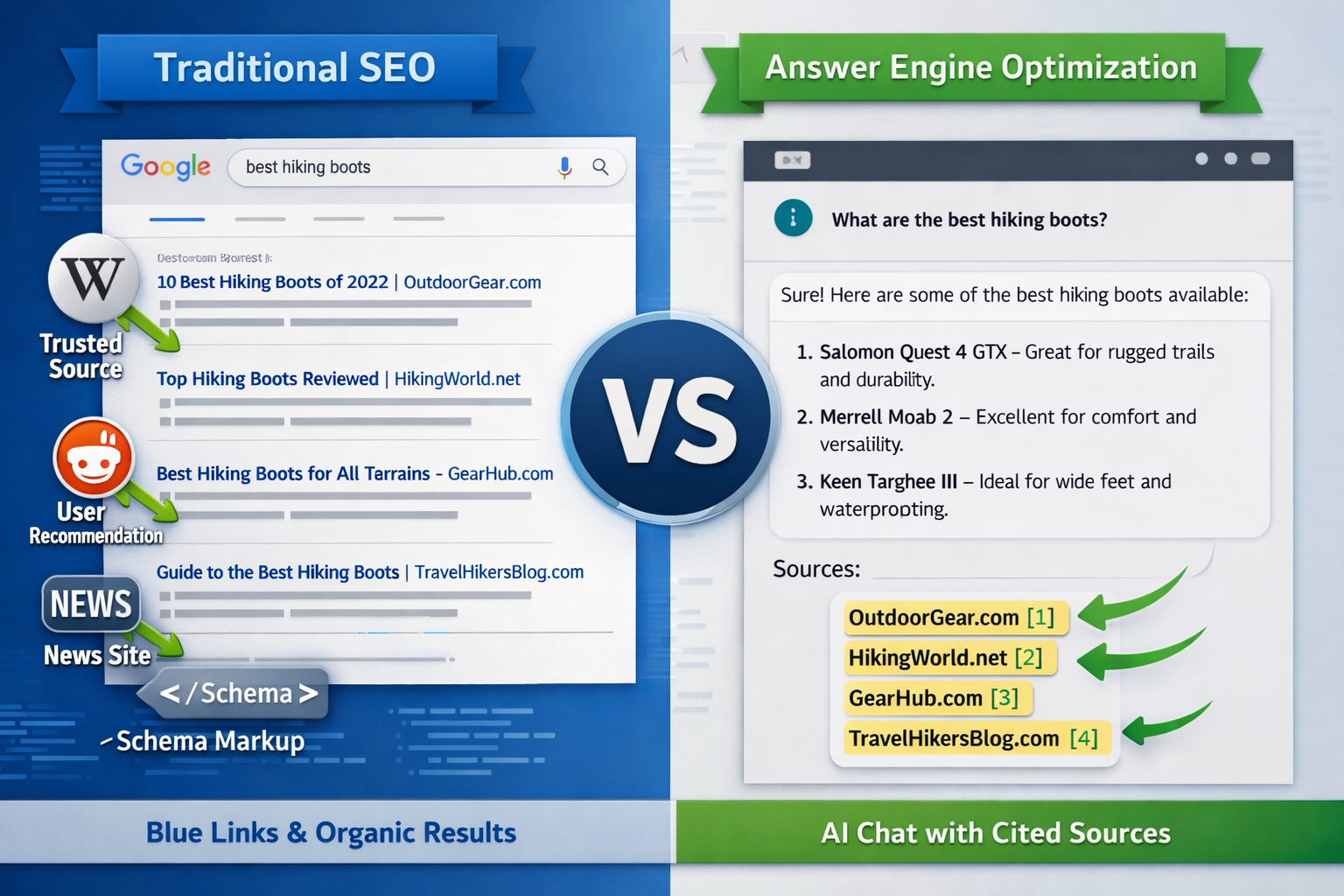
What Makes AEO Different from Traditional SEO?
Answer Engine Optimization for Affiliates: Securing Citations in AI Summaries and GEO represents a fundamental shift in how content gets discovered and monetized. While traditional search engine optimization focuses on ranking web pages in search results, AEO prioritizes getting your content selected as the authoritative source that AI systems cite when answering user questions.
The distinction matters enormously for affiliate marketers. Traditional SEO success means appearing in position 1-3 on a search results page. AEO success means your affiliate recommendation appears directly in the AI-generated answer—often with attribution that drives trust and clicks.
Consider this scenario: A user asks ChatGPT “What’s the best project management software for small teams?” If your affiliate review content has strong AEO optimization, ChatGPT might cite your comparison article directly, mentioning your site by name and potentially including key recommendations. Without AEO, your content remains invisible, even if it ranks #1 in traditional Google search.
The Three Pillars of AEO Strategy
Answer Engine Optimization combines three distinct disciplines into a unified approach[3]:
- Search Engine Optimization (SEO) – Provides the technical foundation, structured data, and content quality signals
- Public Relations (PR) – Generates earned media, third-party coverage, and expert mentions that AI systems prioritize
- Affiliate Marketing – Delivers authentic product expertise, comparison content, and user-focused recommendations
This integration is essential because AI systems prioritize external authority and relevance when selecting sources to cite[3]. Your own website’s SEO provides the foundation, but PR-driven mentions on high-authority sites and genuine affiliate expertise create the trust signals that secure AI citations.
Why AI Citations Matter More Than Rankings
The shift toward zero-click search results has accelerated dramatically. By 2026, a significant portion of searches end without a click to any website—users get their answers directly from AI summaries, voice assistants, or Google’s AI Overviews[6].
For affiliate marketers, this creates both challenge and opportunity:
The Challenge: Traditional affiliate strategies that rely on capturing search traffic to product comparison pages face declining click-through rates as AI answers questions directly.
The Opportunity: Affiliates who secure citations in AI responses gain enhanced credibility and trust. When ChatGPT cites your review site as a source, it carries more weight than a traditional search listing. Users perceive AI-cited sources as vetted and authoritative.
How AI Systems Select Sources for Citations
The “Seed Set” Sites That Dominate AI Recommendations
Research reveals that AI systems like ChatGPT rely heavily on high-trust “seed set” domains when generating responses[4]. These include:
- 📚 Knowledge bases: Wikipedia, Britannica, academic institutions
- 💬 Community platforms: Reddit, Quora, Stack Exchange
- 📰 News outlets: Major newspapers, industry publications, established media
- ⭐ Review platforms: Trustpilot, Consumer Reports, category-specific review sites
- 🏢 Government and institutional sources: .gov, .edu domains
For affiliates pursuing Answer Engine Optimization for Affiliates: Securing Citations in AI Summaries and GEO, this means your content strategy must extend beyond your own website. Securing mentions, guest posts, or citations on these seed set platforms dramatically increases the likelihood that AI systems will reference your expertise.
Mode Switching: Timeless vs. Timely Queries
ChatGPT and similar AI systems employ mode switching based on query type[4]:
Timeless Questions (GEO – Generative Engine Optimization):
- Answered from training data
- Examples: “How do I build customer loyalty?” or “What are the benefits of email marketing?”
- Optimization focus: Creating comprehensive, evergreen content that gets included in future training datasets
Timely Questions (AEO – Answer Engine Optimization):
- Trigger live search capabilities
- Examples: “Best affiliate programs in 2026” or “Current Amazon Associates commission rates”
- Optimization focus: Fresh, dated content with clear temporal signals and real-time accuracy
Smart affiliates optimize for both query types. Timeless content builds long-term authority that may influence future AI training. Timely content captures immediate citations for trending topics and current product recommendations.
| Query Type | AI Behavior | Content Strategy | Example |
|---|---|---|---|
| Timeless | Uses training data | Comprehensive guides, foundational tutorials | “How affiliate marketing works” |
| Timely | Triggers live search | Current reviews, 2026-specific comparisons | “Best affiliate networks 2026” |
| Hybrid | Combines both | Updated evergreen content with current data | “Affiliate marketing strategies” (updated annually) |
Entity Consistency and Trust Scores
AI systems evaluate entity consistency across the web when determining citation worthiness[1]. For affiliate marketers, this means:
- ✅ Consistent NAP (Name, Address, Phone) across all platforms if you’re a business
- ✅ Unified brand messaging and positioning statements
- ✅ Matching author bios and credentials across guest posts
- ✅ Aligned product information and specifications in reviews
- ✅ Synchronized schema markup across your content properties
Mismatched information reduces entity trust scores, which directly affects whether AI systems select and cite your content[1]. When ChatGPT encounters conflicting information about your brand or expertise across different sources, it may skip citing you entirely.
Six Core AEO Trends Dominating 2026 Strategy
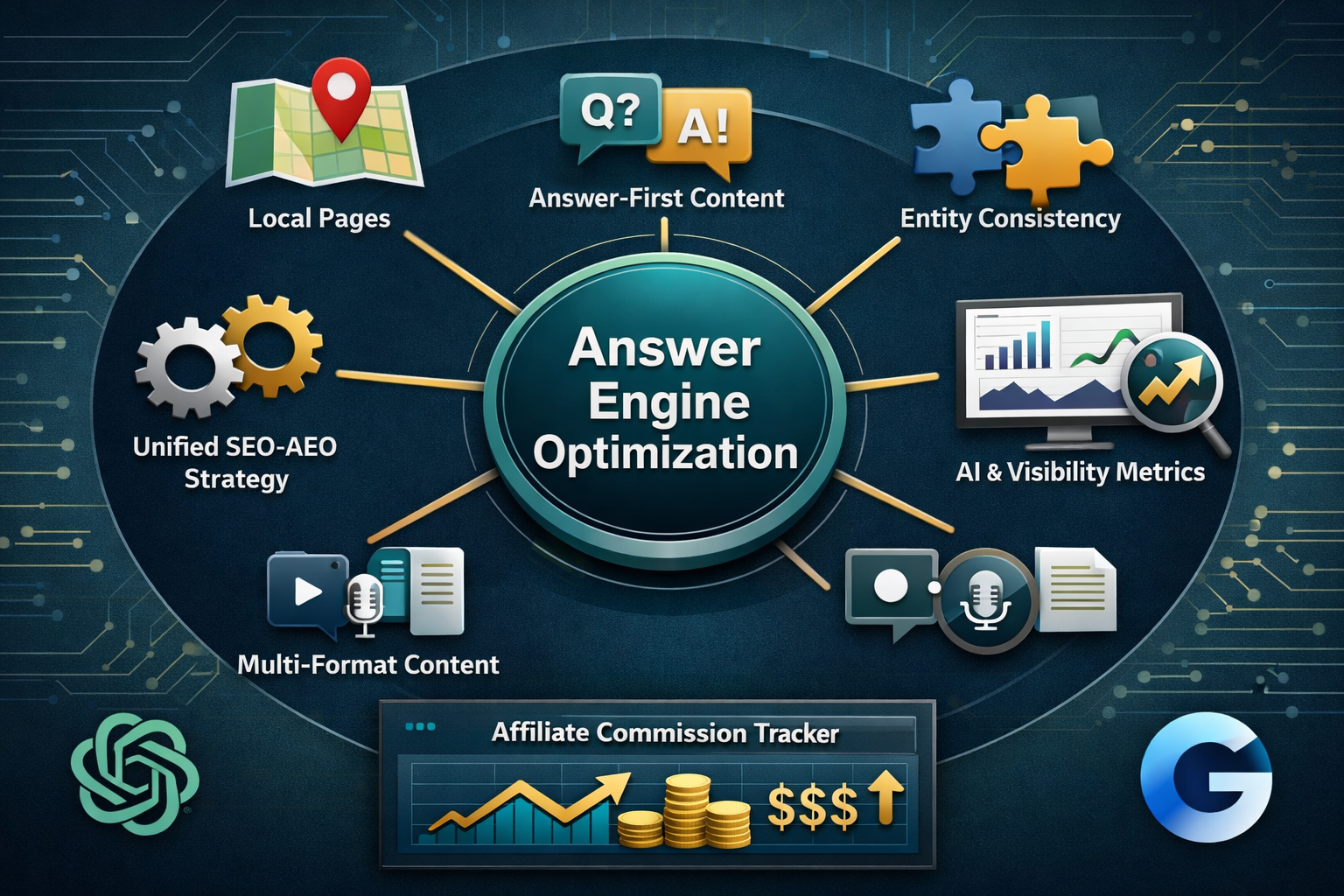
1. Leveraging Local Pages for Geographic Visibility
For affiliates in location-specific niches, local page optimization has become critical for Answer Engine Optimization for Affiliates: Securing Citations in AI Summaries and GEO[1]. AI systems increasingly provide geographically relevant answers, especially for queries like “best [product] in [city]” or “where to buy [item] near me.”
Implementation tactics:
- Create dedicated location pages with hyper-local content
- Implement LocalBusiness, PostalAddress, and Service schema markup
- Include specific details about local availability, regional pricing, and area-specific recommendations
- Add answer-first summaries addressing common local questions
- Ensure consistent geographic information across all citations and directories
This approach helps AI systems understand your geographic relevance and increases citation likelihood for location-based queries—particularly valuable for affiliates in industries like home services, local products, or regional marketplaces.
2. Implementing Answer-First Content Formats
Traditional content structures bury answers deep in articles. Answer-first formatting places the direct answer prominently at the beginning, making it easy for AI systems to parse and cite[1].
Answer-first structure:
Question: [Specific user question]
Quick Answer: [Concise 2-3 sentence response]
Detailed Explanation: [Comprehensive information]
Related Considerations: [Additional context]
This format serves both human readers (who appreciate quick answers) and AI systems (which can easily extract and cite the concise response). For affiliate marketing optimization, this means restructuring product reviews and comparison content to lead with clear, citation-worthy answers.
3. Maintaining Entity Consistency Across Platforms
As mentioned earlier, entity consistency directly impacts AI trust scores[1]. In 2026, successful affiliates implement:
- Centralized information management to ensure consistency
- Regular entity audits across major platforms
- Unified schema markup across all priority pages
- Consistent author profiles on guest posting platforms
- Aligned social media profiles with matching credentials
This standardization helps AI systems confidently cite your content, knowing the information is reliable and consistent across sources.
4. Tracking AI Visibility Metrics
AEO makes affiliate performance measurable beyond traditional metrics[3]. New tracking capabilities include:
Citation Frequency Metrics:
- Number of times your content appears in ChatGPT responses
- Citation rate in Google AI Overviews
- Mentions in Claude, Gemini, and other AI assistants
- Source attribution percentage across different query types
Lead Quality Improvements:
- Fit scores of leads from AEO-influenced pages
- SQL (Sales Qualified Lead) rates from AI sources
- Lead velocity from AI referrals
- Conversion rates of AI-attributed traffic[1]
These metrics reveal that leads from AI citations tend to be warmer and better aligned to ideal customer profiles[1], as users who trust AI recommendations are further along in their decision journey.
5. Unifying AEO with SEO Strategies
Answer Engine Optimization for Affiliates: Securing Citations in AI Summaries and GEO doesn’t replace traditional SEO—it integrates with it[3]. The most successful 2026 affiliate strategies combine:
- Technical SEO foundation: Fast loading, mobile optimization, clean code
- Traditional keyword targeting: Maintaining visibility in conventional search
- AEO-specific optimizations: Answer-first formatting, schema markup, entity consistency
- PR and authority building: Securing mentions on seed set domains
- Multi-platform presence: Extending beyond owned properties to authoritative third-party sites
This unified approach ensures visibility across both traditional search results and AI-generated answers. For those learning how to become an affiliate marketer, understanding this integration from the start provides a significant competitive advantage.
6. Optimizing Multi-Format Content
AI systems increasingly cite diverse content formats[1]:
- 📹 Video content: YouTube tutorials, product demonstrations, comparison videos
- 🎙️ Audio content: Podcast episodes, audio reviews, expert interviews
- 📄 Written content: Articles, guides, comparison tables
- 📊 Data visualizations: Infographics, charts, interactive tools
- 🖼️ Image content: Product photos, diagrams, visual guides
For maximum AI citation potential, affiliates should repurpose core content across multiple formats while maintaining consistent messaging and entity information. A comprehensive product review might exist as:
- A detailed written article with schema markup
- A YouTube video review
- A podcast episode discussing the product
- An infographic comparing features
- Social media posts highlighting key points
This multi-format approach increases the surface area for AI systems to discover and cite your expertise.
Practical Implementation: AEO Strategies for Affiliates
Building Your Seed Set Presence
Since high-trust domains dominate AI citations[4], affiliates must strategically build presence on seed set platforms:
Wikipedia Contributions:
- Contribute to relevant industry articles
- Add citations to authoritative sources (including your well-researched content)
- Maintain neutral, encyclopedic tone
- Focus on adding genuine value, not promotional content
Reddit Engagement:
- Participate authentically in relevant subreddits
- Provide helpful answers citing your detailed guides
- Build karma and community trust before sharing affiliate content
- Focus on niche-specific communities where your expertise adds value
Industry Publication Guest Posts:
- Pitch expert articles to established industry publications
- Include author bio with consistent credentials
- Link to your comprehensive resources when relevant
- Build relationships with editors for ongoing opportunities
Review Platform Optimization:
- Claim and optimize profiles on category-specific review sites
- Encourage authentic user reviews
- Respond professionally to all feedback
- Maintain accurate, up-to-date product information
Schema Markup for AI Understanding
Structured data helps AI systems understand and cite your content[1]. Priority schema types for affiliates include:
Product Schema:
{
  "@type": "Product",
  "name": "Product Name",
  "aggregateRating": {
    "@type": "AggregateRating",
    "ratingValue": "4.5",
    "reviewCount": "127"
  },
  "offers": {
    "@type": "Offer",
    "price": "99.99",
    "priceCurrency": "USD"
  }
}
Review Schema:
{
  "@type": "Review",
  "itemReviewed": {
    "@type": "Product",
    "name": "Product Name"
  },
  "author": {
    "@type": "Person",
    "name": "Your Name"
  },
  "reviewRating": {
    "@type": "Rating",
    "ratingValue": "5"
  }
}
FAQ Schema:
{
  "@type": "FAQPage",
  "mainEntity": [{
    "@type": "Question",
    "name": "Question text?",
    "acceptedAnswer": {
      "@type": "Answer",
      "text": "Answer text"
    }
  }]
}
Implementing these schema types makes your content machine-readable and citation-ready for AI systems.
Creating Citation-Worthy Affiliate Content
For Answer Engine Optimization for Affiliates: Securing Citations in AI Summaries and GEO, content quality matters more than ever. AI systems prioritize citing content that demonstrates:
🎯 Expertise Signals:
- Author credentials and experience
- Detailed product testing methodology
- Transparent disclosure of affiliate relationships
- Data-backed comparisons and analysis
- Original research and unique insights
📋 Comprehensive Coverage:
- Answer multiple related questions in single resources
- Include comparison tables with specific data points
- Address common objections and concerns
- Provide context for different use cases
- Update content regularly with current information
✨ User-Focused Value:
- Solve specific problems clearly
- Avoid promotional language in favor of objective analysis
- Include pros and cons for all recommendations
- Provide alternatives for different budgets and needs
- Focus on helping users make informed decisions
“When affiliate content appears in hyper-relevant AI answers, resulting leads are warmer and better aligned to ideal customer profiles.” – HubSpot Marketing Blog[1]
This quality-first approach aligns with both AI citation algorithms and user expectations, creating a virtuous cycle of trust and conversions.
Advanced AEO Tactics for Competitive Niches
Multi-Touch Attribution for AI-Influenced Conversions
As AI citations become more prevalent, attribution modeling must evolve[2]. Traditional last-click attribution fails to credit affiliate content that influences decisions through AI citations but doesn’t receive the final click.
Modern attribution approaches:
- Position-based attribution: Credits both first touch (AI citation) and last touch (conversion click)
- Time-decay attribution: Gives more credit to recent interactions while acknowledging earlier AI exposure
- Data-driven attribution: Uses machine learning to determine actual influence of each touchpoint
- Custom AI citation tracking: Implements unique parameters to track when users arrive after seeing AI citations
Improved attribution ensures affiliates receive fair compensation for their contributions across the full customer journey[2], not just final conversions.
AI-Powered Campaign Optimization
Artificial intelligence now plays a larger role in affiliate marketing strategies, helping optimize campaigns for both traditional search and answer engine visibility[2]:
AI Applications:
- Content generation: Creating answer-first summaries and FAQ sections
- Keyword research: Identifying questions AI systems commonly answer
- Competitor analysis: Tracking which affiliates get cited most frequently
- Performance prediction: Forecasting which content types will earn citations
- Real-time optimization: Adjusting content based on AI citation patterns
These automation tools help affiliates scale AEO efforts without increasing manual work in proportion.
Building Authority Through Expert Networks
AI systems increasingly value expert consensus and multiple authoritative mentions. Affiliates can leverage this by:
Creating Expert Roundups:
- Interview industry experts for comprehensive guides
- Include diverse perspectives from recognized authorities
- Cite multiple expert sources to demonstrate thorough research
- Build relationships that lead to reciprocal citations
Contributing to Expert Networks:
- Join industry associations and professional groups
- Participate in expert panels and webinars
- Provide quotes and insights for journalist requests (HARO, etc.).
- Build a personal brand as a recognized expert in your niche
Collaborating with Complementary Affiliates:
- Partner with non-competing affiliates for joint content
- Cross-cite each other’s authoritative resources
- Create comprehensive industry guides together
- Build citation networks that AI systems recognize as authoritative
This network approach amplifies your citation potential across multiple AI systems and query types.
Measuring AEO Success: Metrics That Matter
Citation Tracking and Monitoring
Unlike traditional SEO where rankings are easily tracked, AEO requires new monitoring approaches:
Manual Testing:
- Regularly query AI systems with target questions
- Document when and how your content gets cited
- Track citation frequency across different AI platforms
- Note the context and prominence of citations
Automated Monitoring Tools:
- Use emerging AEO tracking platforms
- Set up alerts for brand mentions in AI responses
- Monitor citation patterns across query variations
- Track competitor citation frequency
Referral Traffic Analysis:
- Identify traffic from AI-related sources
- Track engagement metrics for AI-referred visitors
- Monitor conversion rates from AI citations
- Analyze behavioral patterns of AI-influenced users
Lead Quality and Conversion Metrics
AEO success extends beyond visibility to lead quality improvements[1]:
Key Performance Indicators:
| Metric | What It Measures | Why It Matters |
|---|---|---|
| Lead Fit Score | How well AI-referred leads match ICP | Higher scores indicate better targeting |
| SQL Rate | Percentage becoming sales-qualified | Shows lead quality, not just quantity |
| Lead Velocity | Speed of progression through funnel | AI-influenced leads often convert faster |
| Customer LTV | Lifetime value of AI-attributed customers | Reveals long-term value of AEO efforts |
| Attribution Mix | Percentage of conversions with AI touchpoints | Shows growing influence of AEO |
These metrics demonstrate that Answer Engine Optimization for Affiliates: Securing Citations in AI Summaries and GEO delivers qualitative improvements, not just quantitative traffic increases.
Competitive Benchmarking
Understanding your relative AEO performance requires competitive analysis:
Benchmark Questions:
- Which competitors get cited most frequently?
- What content formats do AI systems prefer from competitors?
- Which seed set domains cite competitors but not you?
- What question types do competitors dominate?
- How has competitor citation frequency changed over time?
This competitive intelligence guides strategic priorities and reveals opportunities for differentiation.
Common AEO Mistakes Affiliates Must Avoid
❌ Neglecting Entity Consistency
The Mistake: Maintaining inconsistent information across platforms—different business descriptions, varying author bios, mismatched product details.
The Impact: AI systems lose confidence in your content’s reliability and skip citing you[1].
The Fix: Implement centralized information management and regular entity audits to ensure consistency.
❌ Focusing Only on Owned Properties
The Mistake: Optimizing only your own website while ignoring seed set domains and third-party platforms.
The Impact: Missing the high-trust citations that AI systems prioritize[4].
The Fix: Develop a comprehensive presence strategy that includes Wikipedia contributions, Reddit engagement, guest posts on authoritative sites, and review platform optimization.
❌ Using Promotional Language
The Mistake: Writing affiliate content with obvious promotional intent and sales-focused language.
The Impact: AI systems recognize and deprioritize promotional content in favor of objective, helpful resources.
The Fix: Adopt an educational, user-focused tone that prioritizes helping readers make informed decisions over driving immediate conversions.
❌ Ignoring Multi-Format Optimization
The Mistake: Creating only written content while neglecting video, audio, and visual formats.
The Impact: Reduced citation opportunities as AI systems increasingly reference diverse content types[1].
The Fix: Repurpose core content across multiple formats while maintaining consistent messaging and entity information.
❌ Failing to Update Content
The Mistake: Publishing comprehensive content once and never updating it.
The Impact: AI systems prioritize fresh, current information, especially for timely queries[4].
The Fix: Implement content refresh schedules, prominently add “Last Updated” dates, and regularly revise content with current data and examples.
The Future of Answer Engine Optimization for Affiliates
Emerging Trends for 2026 and Beyond
Conversational Commerce Integration:
AI assistants will increasingly facilitate direct purchases within conversations. Affiliates must optimize for transactional queries in which AI systems not only recommend products but also help complete purchases [7].
Voice-First Optimization:
As voice assistants become more sophisticated, audio-optimized content and natural language patterns will become critical for citations in voice responses[8].
Personalized AI Recommendations:
Future AI systems will provide hyper-personalized recommendations based on user history and preferences. Affiliates who create content addressing specific use cases and user profiles will secure more targeted citations[8].
Blockchain-Based Attribution:
Emerging technologies may enable transparent, immutable tracking of affiliate influence across AI citations, solving current attribution challenges[2].
AI-Generated Affiliate Content:
While AI will assist with content creation, human expertise and authentic testing will become even more valuable differentiators as AI-generated content proliferates [7].
Preparing for Continued Evolution
The most successful affiliates will:
- ✅ Stay platform-agnostic: Optimize for multiple AI systems, not just one
- ✅ Prioritize expertise: Build genuine authority that AI systems recognize and cite
- ✅ Embrace experimentation: Test new formats, platforms, and optimization tactics
- ✅ Monitor emerging platforms: Early adoption of new AI assistants provides competitive advantages
- ✅ Maintain flexibility: Adapt strategies as AI systems evolve their citation algorithms
For those exploring affiliate marketing opportunities, understanding AEO from the beginning provides a foundation for long-term success in an AI-dominated landscape.
Conclusion: Taking Action on AEO Today
Answer Engine Optimization for Affiliates: Securing Citations in AI Summaries and GEO represents the most significant shift in affiliate marketing since the rise of mobile search. AI systems now mediate the relationship between affiliates and potential customers, serving as trusted advisors that cite authoritative sources rather than simply displaying search results.
The affiliates who thrive in 2026 and beyond will be those who:
- Integrate AEO with traditional SEO rather than treating them as separate disciplines
- Build presence on seed set domains to gain the high-trust citations AI systems prioritize
- Optimize for both timeless and timely queries to capture citations across different AI modes
- Maintain rigorous entity consistency across all platforms and content properties
- Create answer-first content that AI systems can easily parse and cite
- Track AI-specific metrics to measure citation frequency and lead quality improvements
Your AEO Action Plan
This Week:
- Audit your entity consistency across major platforms
- Implement answer-first formatting on your top 5 performing pages
- Add comprehensive schema markup to priority content
- Test how AI systems currently respond to queries in your niche
This Month:
- Create a seed set presence strategy and begin implementation
- Develop multi-format versions of your best-performing content
- Set up AI citation tracking and monitoring systems
- Optimize 10-20 key pages with AEO best practices
This Quarter:
- Build relationships with editors at industry publications for guest posting
- Launch a comprehensive content refresh program with updated dates
- Implement advanced attribution modeling to track AI-influenced conversions
- Create original research or data that positions you as a citation-worthy authority
The shift to AI-mediated search isn’t coming—it’s already here. Affiliates who master Answer Engine Optimization for Affiliates: Securing Citations in AI Summaries and GEO today will secure the citations, commissions, and competitive advantages that define success in the AI era.
For more foundational knowledge, explore our guides on search engine optimization techniques and foundations of SEO for affiliate marketing. The integration of traditional SEO with Answer Engine Optimization creates the comprehensive visibility strategy that modern affiliate marketing demands.
References
[1] Answer Engine Optimization Trends – https://blog.hubspot.com/marketing/answer-engine-optimization-trends
[2] Affiliate Marketing – https://www.imd.org/blog/marketing/affiliate-marketing/
[3] Why Aeo Answer Engine Optimization Is Critical To 2026 Marketing Planning – https://www.rygr.us/2026/02/04/why-aeo-answer-engine-optimization-is-critical-to-2026-marketing-planning
[4] What Is Answer Engine Optimization – https://www.yotpo.com/blog/what-is-answer-engine-optimization/
[6] Beyond The Prediction How The 2026 Zero Click Reality Is Already Here – https://partnerize.com/resources/blog/beyond-the-prediction-how-the-2026-zero-click-reality-is-already-here
[7] Ai Advertising – https://cpvlab.pro/blog/marketing-industry/ai-advertising/
[8] Affiliate Marketing Trends 2026 – https://www.awin.com/us/sector-insights/affiliate-marketing-trends-2026
