

The digital landscape has shifted dramatically in 2026. Traditional search engine rankings no longer guarantee visibility when AI-powered answer engines like ChatGPT, Perplexity, and Google's AI Overviews deliver instant answers without requiring users to click through to websites. For affiliate marketers, this zero-click revolution poses a critical challenge: how do you capture traffic and commissions when users never leave the AI interface?
The solution lies in Answer Engine Optimization for Affiliates: Securing Citations in Perplexity, ChatGPT, and GEO Summaries—a strategic evolution beyond traditional SEO that focuses on getting your affiliate content cited as the authoritative source within AI-generated responses. This comprehensive guide reveals the structured data tweaks, authority signals, and content formats that transform affiliate sites from invisible to indispensable in the age of AI search.
Key Takeaways
- Technical implementation guides receive 3x more citations than general content, making specialized affiliate reviews and tutorials prime candidates for AI citations [2]
- Entity consistency across all platforms directly impacts citation likelihood, requiring unified NAP (Name, Address, Phone) data and service offerings [1]
- Answer-first content formatting—using concise definitions, lists, and punchy explanations—aligns with AI citation preferences [1]
- Six strategic AEO focus areas for 2026 include local page optimization, schema implementation, multi-format content, and unified SEO/AEO strategies [1]
- Relationship mapping content that explicitly connects entities, concepts, and implementation approaches gains priority in AI answer generation [2]
Understanding Answer Engine Optimization for Affiliates in 2026 🤖
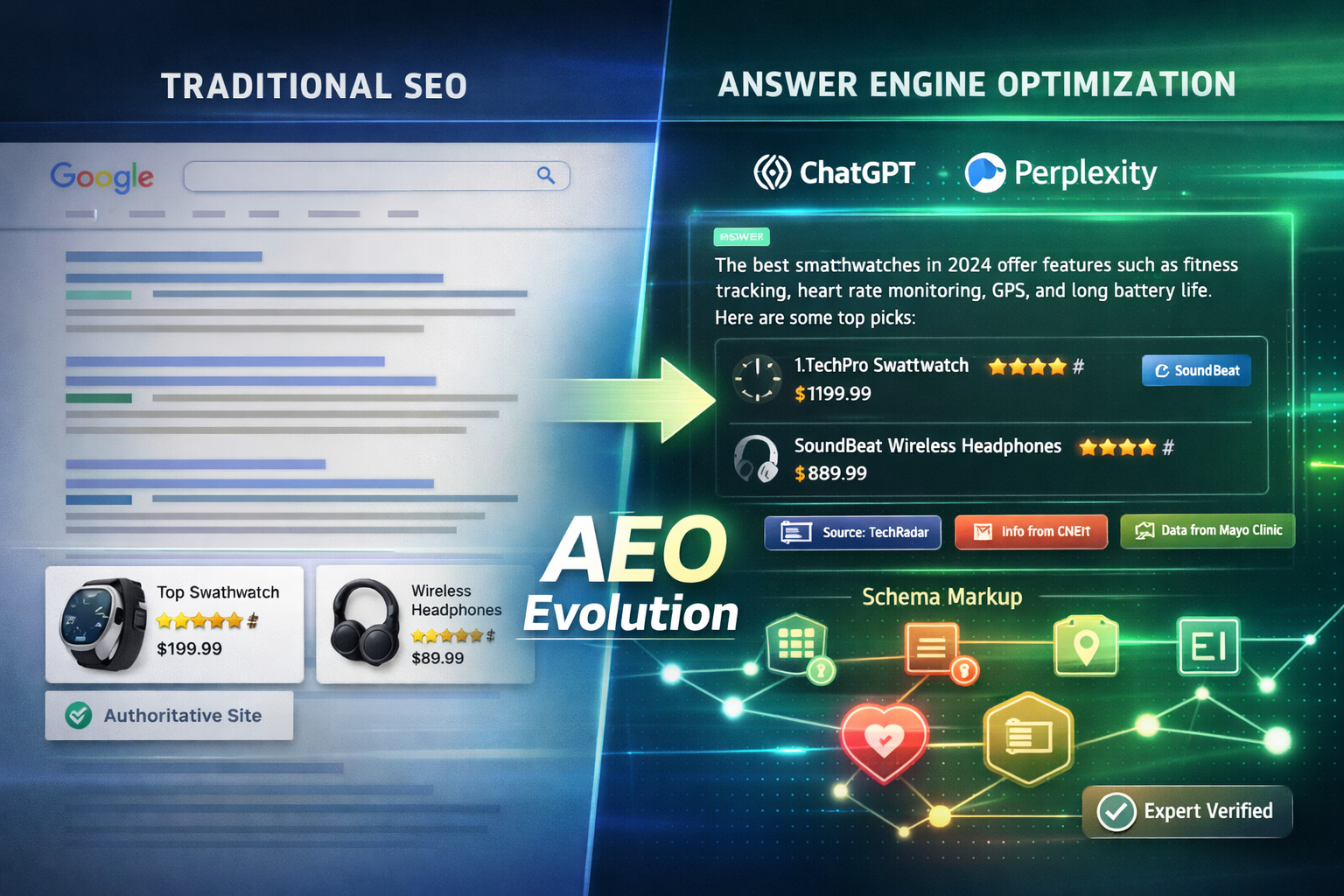
Answer Engine Optimization (AEO) represents a fundamental shift from optimizing for search engine result pages to optimizing for AI-generated answer citations. While traditional SEO techniques focus on ranking positions and click-through rates, AEO prioritizes becoming the cited source within conversational AI responses.
What Makes AEO Different from Traditional SEO?
Traditional SEO aims to rank your affiliate content on page one of Google search results. AEO, however, targets a different goal: getting your content referenced and cited when AI systems like ChatGPT, Perplexity, Claude, SearchGPT, and Google's Gemini generate answers to user queries [2].
This distinction matters enormously for affiliate marketers because:
- Zero-click searches now dominate user behavior, with AI providing direct answers
- Citation visibility builds brand authority even without immediate clicks
- Trust signals from AI citations can drive subsequent direct traffic
- Long-term positioning as a definitive source compounds over time
The shift requires rethinking content strategy from "rank and attract clicks" to "inform and earn citations."
The Six Strategic AEO Focus Areas for 2026
According to recent industry analysis, successful Answer Engine Optimization for Affiliates: Securing Citations in Perplexity, ChatGPT, and GEO Summaries requires attention to six critical areas [1]:
- Local page optimization for geographic visibility
- Answer-first content formats that AI systems prefer
- Entity consistency across all digital properties
- AI visibility metrics tracking and analysis
- Unified AEO-SEO strategies that complement rather than compete
- Multi-format content optimization including video and audio
Each area contributes to building the comprehensive authority profile that AI systems recognize and cite.
Technical Foundations: Schema and Structured Data for Citation Success 📊
The technical infrastructure supporting Answer Engine Optimization for Affiliates: Securing Citations in Perplexity, ChatGPT, and GEO Summaries begins with structured data implementation. AI systems rely heavily on schema markup to understand content relationships, entity attributes, and contextual relevance [2].
Essential Schema Types for Affiliate Marketers
Implementing the right schema markup dramatically increases citation probability. Focus on these schema types:
| Schema Type | Purpose | Citation Impact |
|---|---|---|
| Product Schema | Defines affiliate products with ratings, prices, availability | High – enables AI to cite specific product details |
| Review Schema | Structures review content with ratings and author credentials | Very High – AI prioritizes verified reviews |
| Organization Schema | Establishes entity identity and authority | Critical – builds trust signals |
| HowTo Schema | Formats implementation guides and tutorials | Very High – 3x citation rate [2] |
| FAQ Schema | Structures question-answer pairs | High – matches conversational queries |
| Article Schema | Defines content type, author, publish date | Medium – supports content freshness signals |
Building Entity Consistency Across Platforms
Entity consistency directly impacts citation likelihood [1]. AI systems cross-reference information across multiple sources to validate accuracy. Mismatched data—such as different business addresses, operating hours, or service descriptions—reduces entity trust scores and citation probability.
For affiliate marketers, this means:
- ✅ Maintain identical NAP data (Name, Address, Phone) across all platforms
- ✅ Synchronize service offerings and product categories everywhere
- ✅ Use consistent brand messaging and positioning statements
- ✅ Update all properties simultaneously when making changes
- ✅ Claim and verify all business profiles (Google Business, Bing Places, etc.)
This consistency signals to AI systems that your entity is reliable, established, and authoritative—key factors in citation selection.
Content Formats That Secure AI Citations 📝
The format and structure of your affiliate content significantly influences whether AI systems cite it. Analysis reveals that technical implementation guides receive citations three times more frequently than general best practices content [2], suggesting specialized, actionable content outperforms broad overviews.
Answer-First Content Architecture
AI systems prefer answer-first formatting—content that immediately provides concise, actionable information before expanding into details [1]. This structure aligns with how conversational AI generates responses.
Traditional content structure:
- Introduction and background
- Context and history
- Main points buried in paragraphs
- Conclusion
Answer-first structure for AEO:
- Direct answer in first 1-2 sentences
- Bulleted key points for scannability
- Detailed explanation with examples
- Implementation steps with specifics
- Related considerations and alternatives
For affiliate content, this means starting product reviews with the verdict, then supporting it with evidence—rather than building suspense toward a conclusion.
Content Types With Highest Citation Rates
Based on current AEO performance data, these content formats achieve superior citation rates [2]:
🏆 Technical Implementation Guides (3x citation rate)
- Step-by-step tutorials with screenshots
- Code snippets and configuration examples
- Troubleshooting sections
- Tool-specific instructions
🥈 Relationship Mapping Content
- Comparison tables showing product relationships
- "When to use X vs. Y" decision frameworks
- Integration compatibility guides
- Ecosystem explanations
🥉 Definitive Resource Pages
- Comprehensive glossaries with precise definitions
- Ultimate guides covering entire topics
- Research-backed data compilations
- Industry benchmark reports
For affiliate marketing strategies, this suggests creating detailed implementation guides for specific products rather than generic "top 10" listicles.
Optimizing for Multiple Answer Engines Simultaneously 🎯
Different AI platforms have varying citation preferences and algorithms. Dynamic AEO strategies analyze content performance across ChatGPT, Claude, Perplexity, SearchGPT, and Gemini to identify what drives citation success across platforms [2].
Platform-Specific Optimization Considerations
ChatGPT & GPT-4 Systems:
- Prioritize comprehensive, authoritative content
- Include clear attribution and source information
- Structure content with logical hierarchies
- Emphasize expertise signals and credentials
Perplexity:
- Focus on recent, up-to-date information
- Include specific data points and statistics
- Provide clear, concise answers
- Maintain strong topical relevance
Google AI Overviews (GEO):
- Leverage existing Google SEO optimization foundations
- Implement E-E-A-T signals (Experience, Expertise, Authoritativeness, Trust)
- Use structured data extensively
- Optimize for featured snippet formats
Tracking AI Visibility Metrics
Measuring Answer Engine Optimization for Affiliates: Securing Citations in Perplexity, ChatGPT, and GEO Summaries requires new metrics beyond traditional SEO analytics [1]:
- Citation frequency across different AI platforms
- Citation context (primary source vs. supporting reference)
- Query coverage (percentage of relevant queries generating citations)
- Attribution quality (direct links vs. indirect mentions)
- Competitive citation share within your niche
Tools are emerging in 2026 to track these metrics, but manual testing remains valuable—regularly querying AI systems with relevant questions to monitor citation presence.
Building Authority Through Citation Dominance 💪
AEO should support broader authority development and thought leadership by establishing citation dominance around strategic topics [2]. For affiliate marketers, this means systematically building comprehensive coverage that positions you as the definitive source in your niche.
Strategic Topic Clustering for Citation Authority
Rather than creating isolated content pieces, build topic clusters that demonstrate comprehensive expertise:
Core Pillar Content:
- Ultimate guides covering entire product categories
- Annual industry reports and benchmarks
- Comprehensive comparison resources
- Definitive glossaries and terminology guides
Supporting Cluster Content:
- Specific product reviews linking to pillar content
- Implementation tutorials for different use cases
- Troubleshooting guides for common issues
- Update articles tracking product changes
This architecture signals to AI systems that you're not just covering topics superficially—you're the authoritative source with depth across the entire subject area.
Leveraging Local Pages for Geographic Visibility
AI assistants increasingly personalize answers by region, drawing from pages that clearly communicate location, service availability, and geographic relevance [1]. For affiliate marketers targeting local niches or regional products, this creates significant opportunities.
Local optimization strategies:
- Create location-specific landing pages for regional products
- Include clear geographic markers in content
- Optimize for "near me" and location-based queries
- Maintain consistent local business citations
- Develop region-specific product recommendations
Even if you're an affiliate marketer without a physical location, creating content tailored to specific geographic markets can capture regional AI citations.
Integrating AEO With Your Existing Affiliate Marketing Strategy 🔗
Successful Answer Engine Optimization for Affiliates: Securing Citations in Perplexity, ChatGPT, and GEO Summaries requires systematic integration with broader marketing strategy [2]. AEO shouldn't replace traditional SEO and content marketing—it should enhance and complement these efforts.
Unified SEO-AEO Content Strategy
The most effective approach combines traditional SEO foundations with AEO-specific optimizations:
Content Creation Phase:
- Research keywords AND common AI queries in your niche
- Structure content answer-first while maintaining readability
- Implement comprehensive schema markup
- Include both human-friendly and AI-friendly formatting
Technical Implementation:
- Optimize page speed and Core Web Vitals
- Ensure mobile responsiveness
- Implement structured data across all content types
- Build internal linking architecture supporting both SEO and AEO
Promotion and Distribution:
- Build traditional backlinks for SEO authority
- Establish entity consistency across platforms
- Create multi-format content (text, video, audio)
- Monitor both search rankings AND AI citations
This unified approach ensures you're not sacrificing traditional search visibility while pursuing AI citations.
Multi-Format Content Optimization
AI systems increasingly reference video and audio content alongside traditional text [1]. For affiliate marketers, this means expanding beyond blog posts:
- Video reviews with detailed product demonstrations
- Podcast episodes discussing industry trends and recommendations
- Infographics visualizing comparison data
- Interactive tools helping users make decisions
Each format should include appropriate structured data and transcripts to maximize AI accessibility and citation potential.
Practical Implementation: Your AEO Action Plan 🚀
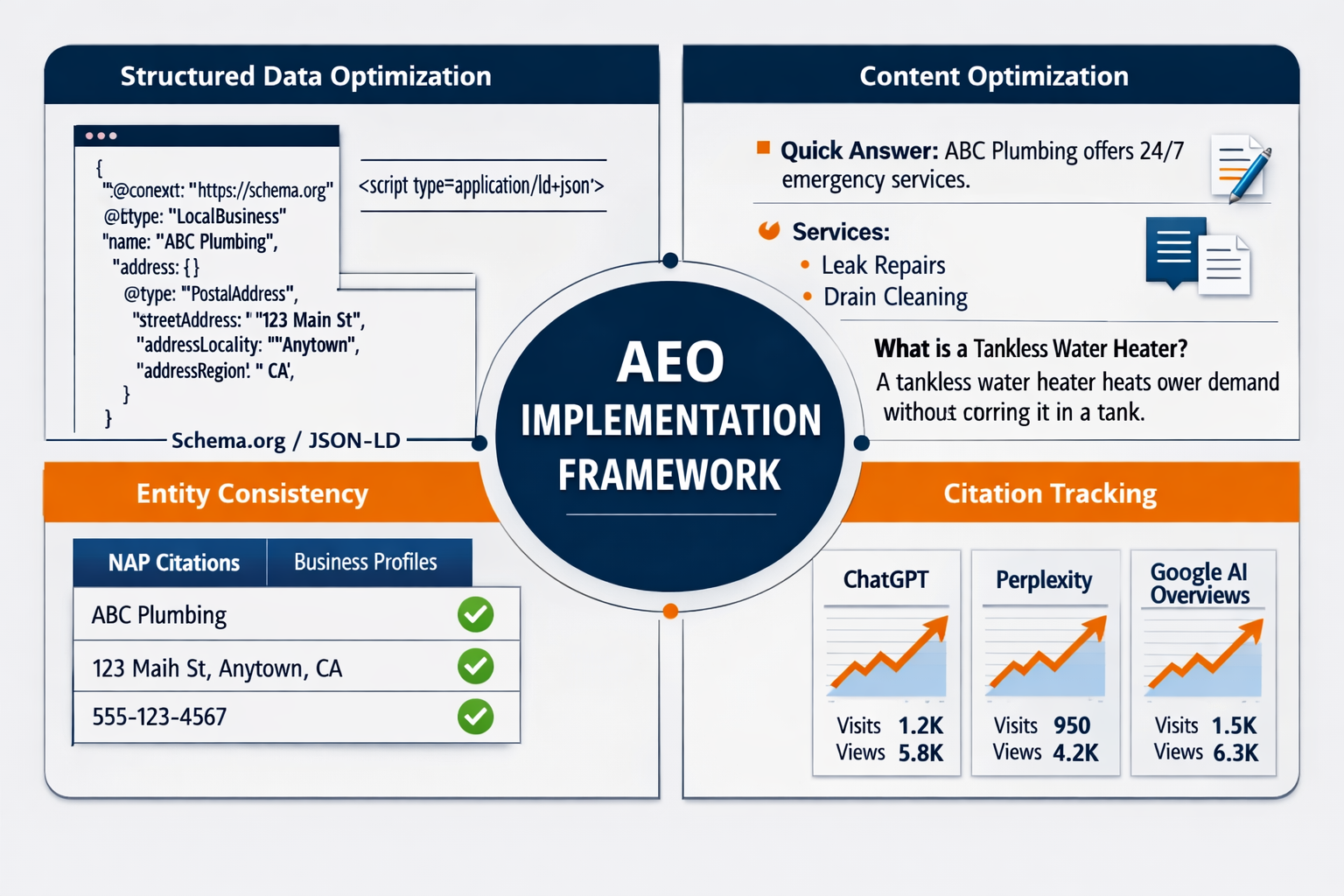
Implementing Answer Engine Optimization for Affiliates: Securing Citations in Perplexity, ChatGPT, and GEO Summaries doesn't require abandoning your current strategy—it requires strategic enhancements. Here's your practical action plan:
Phase 1: Foundation (Weeks 1-2)
✅ Audit current entity consistency
- Verify NAP data matches across all platforms
- Identify and correct inconsistencies
- Claim unclaimed business profiles
✅ Implement core schema markup
- Add Organization schema to homepage
- Implement Product schema on review pages
- Add Review schema to all product reviews
- Deploy Article schema across blog content
✅ Analyze current content structure
- Identify top-performing content
- Evaluate answer-first formatting opportunities
- Plan content restructuring priorities
Phase 2: Content Optimization (Weeks 3-6)
✅ Restructure priority content
- Convert top pages to answer-first format
- Add FAQ sections with schema markup
- Create comprehensive comparison tables
- Develop implementation guides for key products
✅ Expand topic cluster coverage
- Identify gaps in topic coverage
- Create supporting content linking to pillar pages
- Build comprehensive resource pages
- Develop relationship mapping content
✅ Implement multi-format strategy
- Create video versions of top reviews
- Develop podcast content discussing niche trends
- Build interactive comparison tools
- Design shareable infographics
Phase 3: Measurement and Refinement (Ongoing)
✅ Track AI citation metrics
- Manually test queries across AI platforms
- Document citation frequency and context
- Monitor competitive citation share
- Identify high-performing content patterns
✅ Refine based on performance
- Double down on content formats generating citations
- Update underperforming content with AEO optimizations
- Expand coverage in topics showing citation success
- Maintain entity consistency as business evolves
This phased approach allows you to implement AEO systematically while maintaining your existing affiliate marketing programs and revenue streams.
Common AEO Mistakes to Avoid ⚠️
As you implement Answer Engine Optimization for Affiliates: Securing Citations in Perplexity, ChatGPT, and GEO Summaries, avoid these common pitfalls:
❌ Sacrificing human readability for AI optimization
Content must remain valuable for human readers. AI systems recognize and penalize content written solely for algorithms.
❌ Neglecting entity consistency
Inconsistent information across platforms destroys trust signals and citation likelihood [1].
❌ Focusing exclusively on one AI platform
Different users rely on different AI systems. Optimize for multiple platforms simultaneously [2].
❌ Ignoring traditional SEO fundamentals
AEO enhances rather than replaces SEO best practices. Maintain strong traditional optimization.
❌ Creating shallow content for quick citations
Technical depth and comprehensive coverage drive sustainable citation success [2].
❌ Failing to track and measure results
Without measurement, you can't identify what's working or refine your approach.
Conclusion
Answer Engine Optimization for Affiliates: Securing Citations in Perplexity, ChatGPT, and GEO Summaries represents the evolution of digital marketing in an AI-dominated search landscape. As zero-click searches become the norm in 2026, affiliate marketers who adapt their strategies to secure AI citations will maintain visibility and authority while competitors fade into obscurity.
The path forward requires balancing technical implementation—schema markup, entity consistency, and structured data—with strategic content development that emphasizes answer-first formatting, technical depth, and comprehensive topic coverage. By implementing the six strategic focus areas, optimizing for multiple AI platforms simultaneously, and integrating AEO with existing SEO foundations, affiliate marketers can transform AI's disruption into opportunity.
Your next steps:
- Audit your entity consistency across all platforms this week
- Implement core schema markup on your highest-traffic pages
- Restructure one pillar page using answer-first formatting
- Test AI citations by querying your niche topics across platforms
- Track your results and refine based on citation performance
The affiliate marketers who master Answer Engine Optimization today will dominate the AI-powered search landscape of tomorrow. Start implementing these strategies now to secure your citations and maintain your competitive edge.
For more guidance on building a comprehensive affiliate strategy that integrates both traditional and AI-optimized approaches, explore our AI marketing tools guide and discover how to leverage internal links to strengthen your overall SEO-AEO architecture.
References
[1] Answer Engine Optimization Trends – https://blog.hubspot.com/marketing/answer-engine-optimization-trends
[2] Answer Engine Optimization Aeo Guide Dynamic Ai Seo – https://www.dojoai.com/blog/answer-engine-optimization-aeo-guide-dynamic-ai-seo