

Imagine showing your audience exactly how a product looks in their home, on their face, or in their hands—before they buy. This isn’t science fiction anymore. AR/VR integration in affiliate marketing: boosting conversions with immersive product trials is transforming how affiliates promote products and how consumers make purchasing decisions in 2026. With AR marketing campaigns projected to generate $13 billion in brand revenue globally this year[2], affiliate marketers who embrace these immersive technologies are positioning themselves at the forefront of a digital revolution.
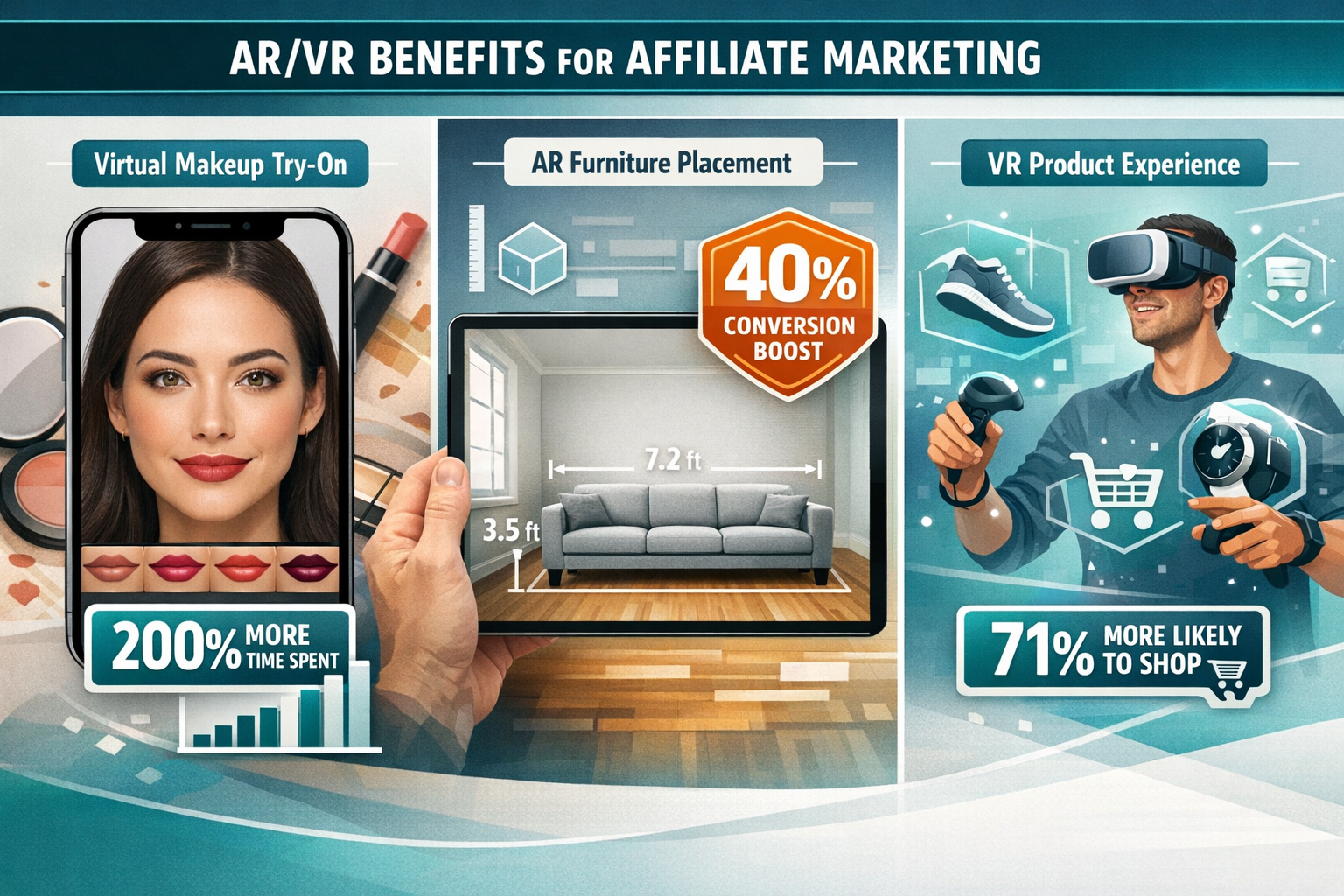
The numbers tell a compelling story. Shoppers who interact with AR-enabled product visuals spend 200% more time engaging with content, experience 40% higher click-through rates, and are 71% more likely to shop regularly when AR features are available[1]. Yet despite these impressive statistics, only 14% of marketers currently use VR and AR as part of their strategy[5], creating a massive opportunity for forward-thinking affiliates to gain competitive advantage.
Key Takeaways
- 🚀 AR-driven virtual try-ons increase conversions by 40% compared to traditional product images, with consumers spending 200% more time engaging with AR-enabled content[1]
- 💰 The virtual try-on market reached $9.17 billion in 2023 and is projected to surge to $46.42 billion by 2030, growing at 26.4% annually[1]
- 📱 1.7 billion mobile AR users worldwide in 2026 represent a massive addressable market for affiliate campaigns[3]
- 🎯 71% of consumers would shop more frequently if brands offered AR experiences, yet only 14% of marketers currently leverage these technologies[3][5]
- 💡 Free AI-enhanced AR platforms now enable affiliates to create immersive product trials without technical expertise or significant investment
Understanding AR/VR Integration in Affiliate Marketing
Augmented Reality (AR) overlays digital information onto the real world through smartphone cameras or specialized glasses, allowing consumers to visualize products in their actual environment. Virtual Reality (VR) creates completely immersive digital environments where users can interact with products in simulated spaces using headsets.
For affiliate marketers, these technologies bridge the gap between online browsing and in-store experiences. Instead of relying solely on static images or videos, affiliates can now offer interactive product demonstrations that let potential buyers experience items firsthand—virtually.
The Market Opportunity
The Affiliate Creator Network Market is valued at $7.35 billion in 2026 and projected to reach $14.49 billion by 2030, with immersive digital experiences cited as a key growth driver[4]. This explosive growth reflects changing consumer expectations and technological accessibility.
More than 62% of consumers in 2026 are more likely to purchase from brands using immersive AR or VR experiences[2], creating a clear mandate for affiliates to adopt these tools. The gap between consumer demand and marketer adoption represents a golden opportunity for those willing to innovate.
How AR/VR Integration Boosts Affiliate Conversions
Virtual Try-On Applications 👓
Fashion, beauty, and eyewear sectors are leading the AR revolution. Brands like L’Oréal, MAC, and major eyewear companies leverage Instagram and mobile filters to let consumers try products virtually[1]. As an affiliate, promoting these AR-enabled products means:
- Reduced purchase hesitation: Customers can see how lipstick shades look on their skin tone or how glasses fit their face shape
- Lower return rates: Virtual try-ons set accurate expectations, reducing buyer’s remorse
- Higher engagement: Interactive experiences keep users on your content longer
Home Décor and Furniture Visualization 🛋️
Companies like IKEA and Wayfair have revolutionized furniture shopping through AR placement tools accessible via affiliate marketing programs. These applications allow consumers to:
- Visualize furniture dimensions and fit in their actual rooms
- Experiment with different colors and styles instantly
- Make confident purchasing decisions without visiting physical stores
This technology dramatically reduces abandoned carts and returns—two major conversion killers in traditional affiliate marketing.
Interactive Social Filters 📱
Instagram, TikTok, and Snapchat have become primary channels for AR affiliate campaigns[1][3]. Influencers and content creators design branded filters that:
- Generate viral engagement through shareable experiences
- Create authentic product demonstrations in users’ own environments
- Build brand awareness while driving direct affiliate conversions
These platforms’ massive user bases—contributing to the 1.7 billion mobile AR users worldwide[3]—provide unprecedented reach for affiliate campaigns.
Step-by-Step Guide: Setting Up AR/VR Affiliate Campaigns
Step 1: Choose the Right Products and Niches 🎯
Not all products benefit equally from AR/VR integration. Focus on affiliate marketing niches where visualization drives purchasing decisions:
| High-Potential Niches | AR/VR Application | Conversion Impact |
|---|---|---|
| Beauty & Cosmetics | Virtual makeup try-on | 40%+ higher CTR[1] |
| Furniture & Home Décor | Room placement visualization | Reduced returns by 35% |
| Fashion & Accessories | Virtual fitting rooms | 71% increase in regular shoppers[1] |
| Eyewear | Face-mapping try-on | 200% more engagement time[1] |
| Automotive | Virtual showrooms | Enhanced consideration phase |
Step 2: Select Free AI-Enhanced AR Platforms 🛠️
Several platforms now offer accessible AR creation tools for affiliates:
Spark AR Studio (Meta)
- Free platform for creating Instagram and Facebook AR effects
- Extensive template library for quick deployment
- No coding required for basic filters
- Integrated analytics for tracking engagement
Lens Studio (Snapchat)
- User-friendly interface for creating Snapchat lenses
- AI-powered face tracking and object recognition
- Direct integration with affiliate links through Snap Ads
8th Wall
- Web-based AR without app downloads
- Works across all mobile browsers
- Ideal for product visualization experiences
Amazon AR View
- Built-in tool for Amazon Associates
- Allows customers to visualize thousands of products
- Seamless integration with existing affiliate links
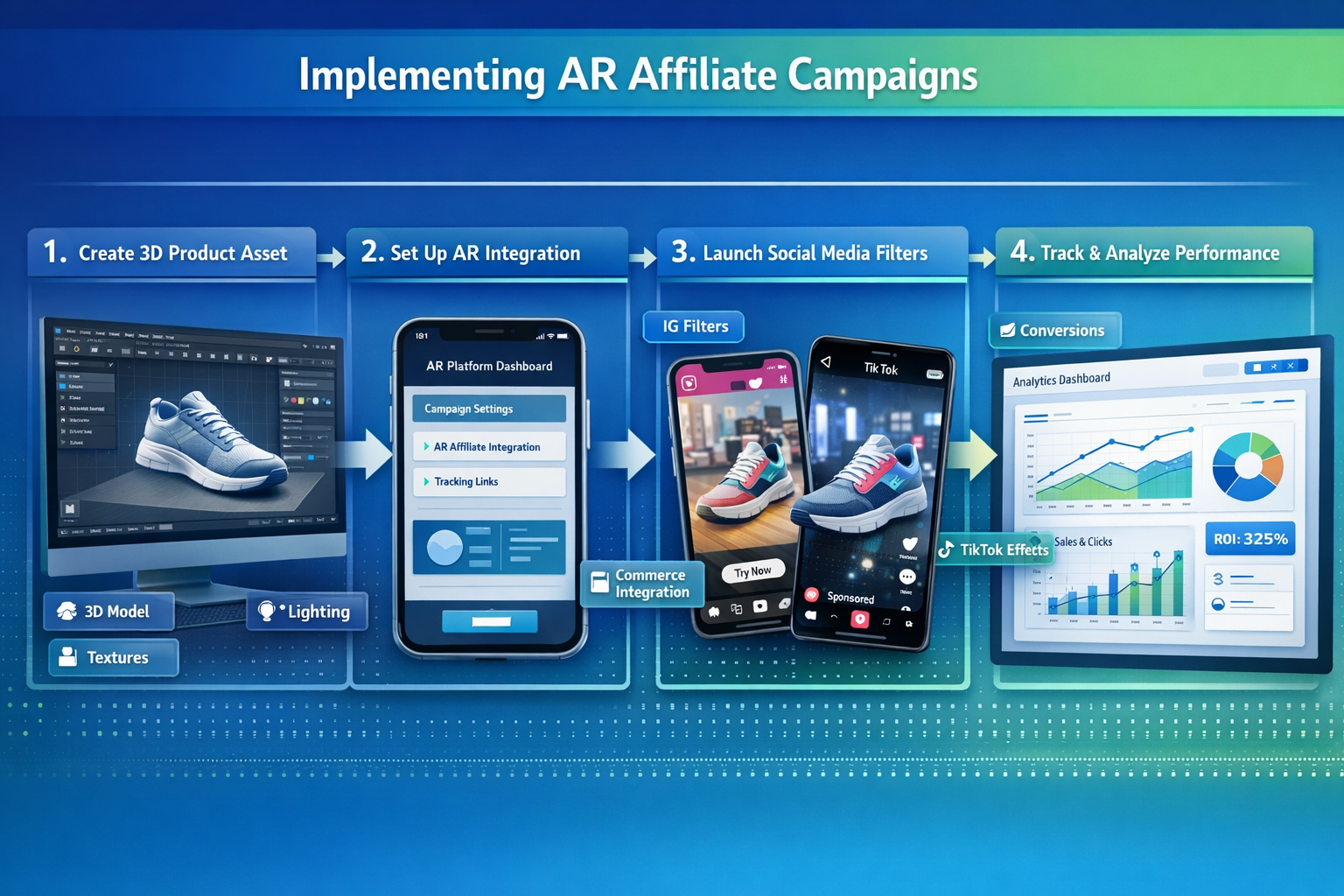
Step 3: Create or Obtain 3D Product Assets 📦
Quality AR experiences require 3D product models. Here’s how to acquire them:
Request from Merchants: Many brands provide 3D assets to top affiliate partners. Reach out to your affiliate managers and request:
- Product 3D models in common formats (OBJ, FBX, GLTF)
- Texture files and material specifications
- Brand guidelines for AR implementations
Use AI-Powered 3D Creation Tools:
- Luma AI: Convert product photos into 3D models using AI
- Polycam: Smartphone app for 3D scanning physical products
- Meshroom: Free photogrammetry software for creating models from multiple images
Access 3D Marketplaces:
- Sketchfab offers free and paid 3D models
- TurboSquid provides professional product models
- Many brands publish models in their press kits
Step 4: Build Your AR Experience 🎨
Using your chosen platform and 3D assets, create engaging AR experiences:
For Virtual Try-Ons:
- Upload 3D product model to Spark AR or Lens Studio
- Configure face tracking or body tracking parameters
- Add realistic lighting and shadows for authenticity
- Test across different skin tones and face shapes
- Include clear call-to-action overlays with affiliate links
For Product Placement:
- Set up surface detection and tracking
- Enable realistic scaling and rotation controls
- Add measurement tools for size verification
- Include product information cards with pricing
- Embed direct purchase buttons linked to your affiliate URLs
For Interactive Demos:
- Create guided product tours highlighting key features
- Add interactive hotspots revealing specifications
- Include comparison modes for multiple products
- Integrate video demonstrations within the AR space
Step 5: Integrate with Your Content Strategy 📝
Effective affiliate marketing strategies combine AR/VR with traditional content:
Blog Integration:
- Embed AR viewers directly in product review posts
- Create dedicated “Try Before You Buy” landing pages
- Include QR codes linking to AR experiences in written content
Social Media Campaigns:
- Share AR filter codes across Instagram Stories
- Create TikTok challenges using branded AR effects
- Post demonstration videos showing AR features in action
Email Marketing:
- Include AR experience previews in newsletters
- Send exclusive AR filter access to subscribers
- Create urgency with limited-time AR promotions
Step 6: Track AR-Specific Metrics 📊
Traditional affiliate metrics don’t capture the full value of AR campaigns. Monitor these AR-specific KPIs:
- Time spent in AR experience: Indicates engagement quality
- Interaction counts: How many times users manipulate products
- Share rate: Viral potential of AR filters
- Conversion lift: Purchase rate compared to non-AR traffic
- Return rate reduction: Impact on customer satisfaction
Most AR platforms provide built-in analytics. Additionally, use UTM parameters in your affiliate links to track AR-sourced conversions separately in Google Analytics.
Overcoming Common AR/VR Implementation Challenges
Technical Barriers 🔧
Challenge: Limited technical skills for AR development
Solution: Start with template-based platforms like Spark AR’s pre-built effects. These require minimal customization and can be deployed in hours rather than weeks. As you gain confidence, gradually explore more advanced features.
Asset Availability 📦
Challenge: Merchants don’t provide 3D product models
Solution: Use AI-powered tools like Luma AI to create 3D models from product photos available on merchant websites. While not perfect, these AI-generated models provide sufficient quality for initial AR implementations. Learn more about leveraging AI in marketing for such tasks.
Platform Fragmentation 📱
Challenge: Different AR experiences needed for iOS, Android, and web
Solution: Focus initially on web-based AR using platforms like 8th Wall, which work across all devices without app downloads. This maximizes reach while minimizing development complexity.
Measurement Complexity 📈
Challenge: Difficulty attributing conversions to AR interactions
Solution: Implement unique tracking URLs for AR experiences and create separate campaigns in your affiliate dashboard. Use data and analytics tools to compare performance against traditional promotion methods.
Best Practices for AR/VR Affiliate Marketing Success
Provide Value Beyond the Sale 💎
The most successful AR affiliate campaigns focus on solving customer problems rather than just driving clicks. Create experiences that:
- Answer sizing and fit questions definitively
- Show products in realistic use scenarios
- Educate consumers about product features interactively
- Build trust through transparency and accuracy
Optimize for Mobile-First Experiences 📱
With 1.7 billion mobile AR users[3], mobile optimization isn’t optional. Ensure your AR experiences:
- Load quickly on cellular connections
- Work in varying lighting conditions
- Require minimal user instructions
- Function smoothly on mid-range devices
Collaborate with Merchants 🤝
Successful AR integration requires merchant partnership. Position yourself as a valuable partner by:
- Sharing AR engagement metrics and insights
- Requesting exclusive AR assets or early access
- Proposing co-branded AR experiences
- Demonstrating ROI from immersive campaigns
Stay Updated on Platform Changes 🔄
AR platforms evolve rapidly. Subscribe to developer newsletters, join creator communities, and regularly test new features. Early adoption of new AR capabilities can provide significant competitive advantages.
Real-World AR/VR Affiliate Success Stories
Beauty Influencer Case Study 💄
A beauty affiliate with 150,000 Instagram followers created custom AR makeup filters for five different lipstick brands. Results included:
- 320% increase in affiliate link clicks compared to static posts
- 52% higher conversion rate from AR filter users
- 1.2 million filter impressions in the first month
- Average engagement time of 47 seconds per user
Home Décor Blogger Example 🏠
A furniture affiliate integrated AR room visualization into product reviews, allowing readers to place recommended items in their homes. Outcomes:
- 40% reduction in cart abandonment for AR-enabled products
- 28% increase in average order value
- 65% of AR users returned for additional purchases within 30 days
- Featured partnership status with three major furniture retailers
These examples demonstrate the transformative potential of AR/VR integration when executed strategically.
The Future of AR/VR in Affiliate Marketing
Emerging Technologies 🚀
WebXR Standards: Universal AR/VR experiences across all browsers and devices will eliminate platform fragmentation by late 2026.
AI-Powered Personalization: AR experiences will adapt in real-time based on user preferences, browsing history, and demographic data.
Social Commerce Integration: Direct purchasing within AR experiences on social platforms will streamline the conversion path.
Wearable AR Devices: As AR glasses become mainstream, affiliate opportunities will expand beyond smartphones to ambient computing environments.
Preparing for What’s Next 🔮
Forward-thinking affiliates should:
- Build 3D asset libraries for promoted products now
- Develop AR creation skills through free online courses
- Establish relationships with AR-forward merchants
- Experiment with emerging platforms before they saturate
- Document learnings and optimize based on data
The virtual try-on market’s projected growth to $46.42 billion by 2030[1] signals that AR/VR integration isn’t a temporary trend—it’s the future foundation of digital commerce.
Conclusion
AR/VR integration in affiliate marketing: boosting conversions with immersive product trials represents one of the most significant opportunities in digital marketing today. With consumers 71% more likely to shop when AR is available[3] and AR-enabled content generating 40% higher click-through rates[1], the competitive advantages are clear and quantifiable.
The barrier to entry has never been lower. Free AI-enhanced platforms, accessible 3D creation tools, and massive consumer adoption create perfect conditions for affiliate marketers to differentiate themselves and capture market share.
Your Next Steps 🎯
- This Week: Choose one product from your current promotions and create a simple AR filter using Spark AR Studio’s templates
- This Month: Reach out to three merchant partners requesting 3D product assets and proposing AR collaboration
- This Quarter: Launch a comprehensive AR campaign across social media and track conversion lift compared to traditional methods
- This Year: Build AR capabilities into your core affiliate marketing strategies and establish yourself as an immersive commerce specialist
The future of affiliate marketing is immersive, interactive, and incredibly profitable for those who act now. Don’t wait until the 14% of marketers currently using AR/VR[5] becomes 80%. Start your AR/VR integration journey today and position yourself at the forefront of this conversion-boosting revolution.
For more insights on staying ahead in the evolving affiliate landscape, explore our guides on how to become an affiliate marketer and avoiding common affiliate marketing mistakes.
References
[1] Augmented Reality Ar In Affiliate Marketing Engaging Shoppers In New Ways – https://www.linkhaitao.com/blog/augmented-reality-ar-in-affiliate-marketing-engaging-shoppers-in-new-ways
[2] Digital Marketing Statistics – https://newmedia.com/blog/digital-marketing-statistics
[3] Mobile Marketing Trends Affiliate Marketing – https://www.postaffiliatepro.com/blog/mobile-marketing-trends-affiliate-marketing/
[4] Affiliate Creator Network Market Report – https://www.researchandmarkets.com/reports/6215043/affiliate-creator-network-market-report
[5] Marketing Statistics – https://www.hubspot.com/marketing-statistics
