

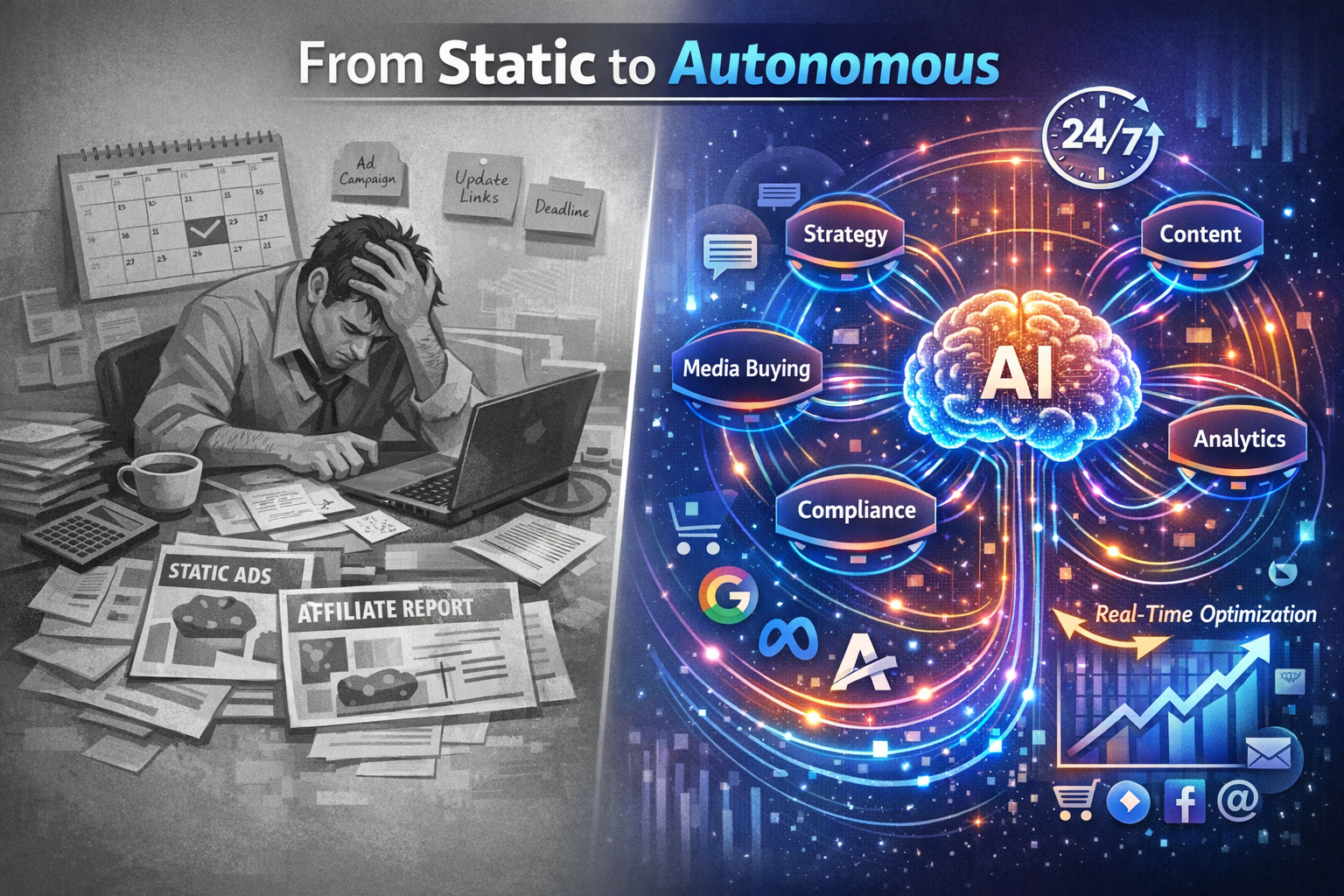
The affiliate marketing landscape has fundamentally transformed. Gone are the days when marketers manually adjusted bids at 9 AM and hoped their campaigns performed well overnight. In 2026, Autonomous Orchestration: AI-Powered Always-On Campaigns for Affiliate Revenue Growth represents a paradigm shift from static, human-dependent campaigns to intelligent, self-optimizing systems that work around the clock. These AI-driven “living” systems continuously test, adapt, and scale affiliate promotions in real-time across multiple channels—delivering performance gains that human marketers simply cannot match due to operational constraints.
The transition from traditional campaign management to autonomous orchestration isn’t just about automation—it’s about creating digital employees that think strategically, execute flawlessly, and optimize continuously without sleep, vacation, or human error. For affiliate marketers seeking competitive advantage, understanding and implementing these autonomous systems has become essential for survival and growth.
Key Takeaways
✅ Autonomous AI agents function as 24/7 digital employees that manage, optimize, and scale affiliate campaigns continuously without human intervention, delivering measurable performance improvements.
✅ Multi-agent systems enable specialized AI agents to collaborate across marketing functions—eliminating departmental silos and ensuring perfect alignment between strategy, content creation, compliance, and media execution.
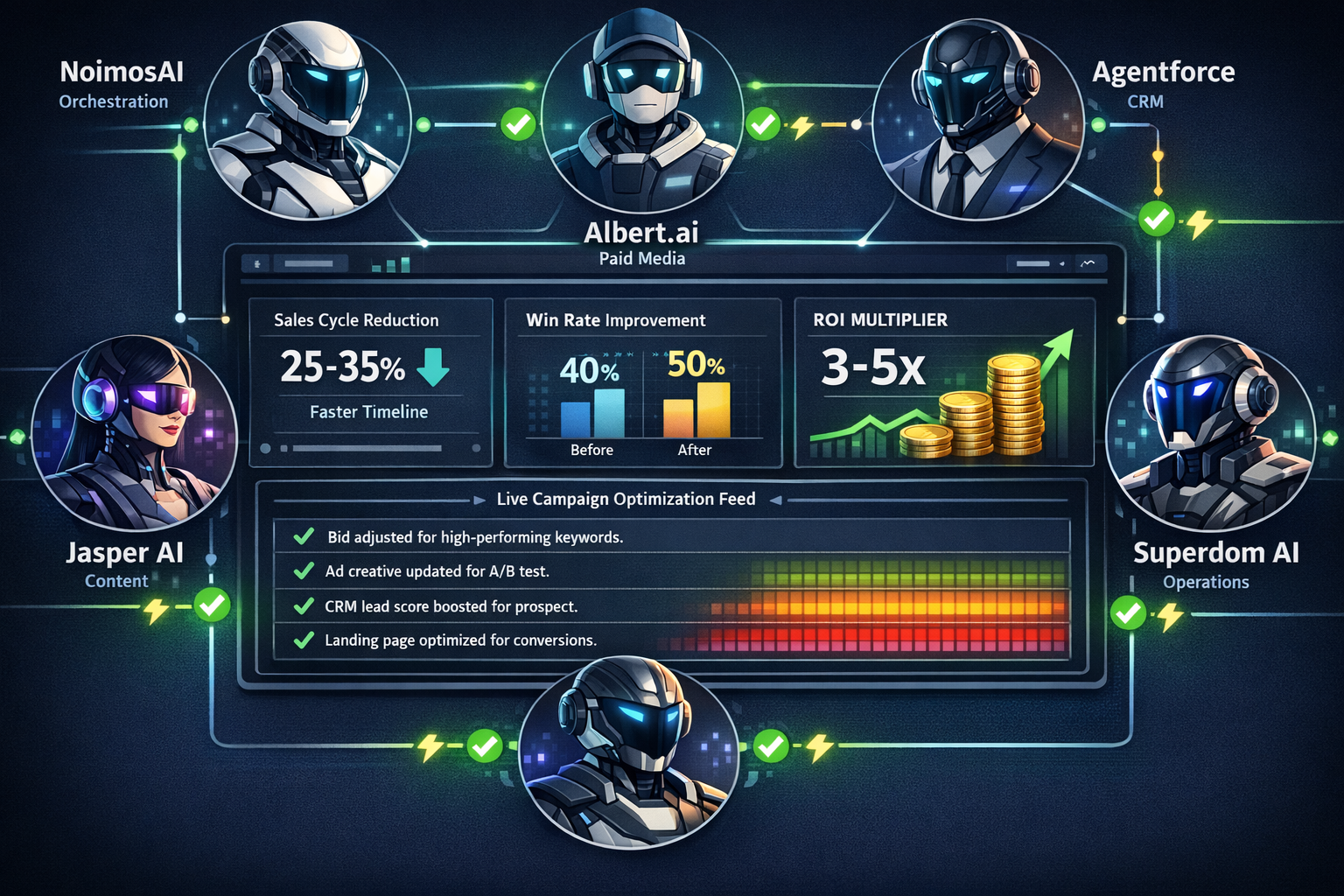
✅ Quantified performance gains from autonomous orchestration include 25-35% reduction in sales cycle length, 40-50% improvement in win rates, and 3-5X higher ROI compared to traditional approaches.[2]
✅ Five platform leaders have emerged in 2026—NoimosAI, Albert.ai, Agentforce, Jasper AI, and Superdom AI—each serving distinct strategic roles in the autonomous marketing ecosystem.[1]
✅ Agentic attribution represents a critical new measurement layer designed to map how autonomous AI systems influence discovery and conversions, requiring brands to optimize specifically for AI agent consumption.[3]
Understanding Autonomous Orchestration in Affiliate Marketing
What Makes Autonomous Orchestration Different?
Traditional affiliate marketing relies on marketers creating campaigns, setting parameters, and manually adjusting performance based on periodic reviews. Autonomous orchestration fundamentally reimagines this process by deploying AI-powered agents that function as specialized digital employees, each with distinct responsibilities and decision-making capabilities.[1]
These autonomous systems operate on three core principles:
Continuous Operation: Unlike human marketers who work 8-10 hours daily, autonomous agents monitor and optimize campaigns 24/7, identifying opportunities and addressing issues in real-time regardless of time zones or holidays.
Multi-Agent Collaboration: Specialized agents work together seamlessly—strategy agents analyze market trends, content agents draft compelling copy, compliance agents ensure brand safety, and media buying agents execute optimized ad spend across platforms.[1]
Self-Learning Optimization: Rather than following static rules, these systems learn from every interaction, continuously improving their decision-making capabilities and adapting to changing market conditions without human reprogramming.
For those just starting their journey, understanding how to do affiliate marketing with these advanced tools provides a significant competitive advantage from day one.
The Shift from Supporting Tools to Agentic Systems
The marketing industry has moved beyond simple AI-powered tools that assist human decision-making. In 2026, we’ve entered the era of autonomous agentic systems—AI entities capable of independent strategic thinking and execution.[1] This represents a fundamental restructuring of how marketing operations function.
Traditional AI Tools (Pre-2024):
- Required constant human oversight
- Provided recommendations for human approval
- Operated within narrow, predefined parameters
- Functioned as assistants to human marketers
Autonomous Agentic Systems (2026):
- Make independent decisions within strategic frameworks
- Execute actions automatically without approval workflows
- Adapt parameters based on real-time performance data
- Function as digital employees with specialized expertise
This evolution has profound implications for affiliate marketers. Those who embrace autonomous orchestration gain access to capabilities that were previously available only to enterprise organizations with large marketing teams. For insights on how to succeed in affiliate marketing in this new environment, understanding these systems is critical.
The Architecture of Autonomous Orchestration: AI-Powered Always-On Campaigns for Affiliate Revenue Growth
Multi-Agent Systems: The Foundation of Always-On Campaigns
The power of Autonomous Orchestration: AI-Powered Always-On Campaigns for Affiliate Revenue Growth lies in Multi-Agent Systems (MAS)—networks of specialized AI agents that collaborate to manage complex marketing operations.[1] Each agent possesses domain-specific expertise and operates semi-independently while coordinating with other agents to achieve unified business objectives.
Core Agent Types in Affiliate Campaign Orchestration:
| Agent Type | Primary Function | Key Capabilities | Business Impact |
|---|---|---|---|
| Strategy Agent | Market analysis and planning | Trend identification, competitor monitoring, opportunity detection | Identifies high-potential affiliate offers before market saturation |
| Content Agent | Creative development | Copy generation, A/B test creation, multi-variant production | Produces hundreds of ad variations for continuous testing |
| Compliance Agent | Brand safety and regulatory review | Policy checking, brand guideline enforcement, legal compliance | Prevents costly violations and brand damage |
| Media Buying Agent | Campaign execution and optimization | Bid management, budget allocation, platform coordination | Maximizes ROI through real-time optimization across channels |
| Analytics Agent | Performance measurement | Attribution modeling, conversion tracking, ROI calculation | Provides actionable insights for strategic refinement |
This collaborative architecture eliminates the traditional silos that plague marketing departments. When a strategy agent identifies a trending product category, it immediately communicates with content agents to generate relevant promotional materials, while media buying agents prepare optimized campaigns across Google Ads, Meta, and affiliate networks—all without human coordination delays.
Platform Consolidation: The Five Leaders of 2026
The autonomous marketing landscape has consolidated around five key platform leaders, each serving distinct strategic roles in the ecosystem:[1]
🔷 NoimosAI – Overall orchestration and multi-agent coordination
🔷 Albert.ai – Paid media optimization across Google Ads, Meta, and Bing
🔷 Agentforce – CRM integration and customer journey automation
🔷 Jasper AI – Content creation and creative asset generation
🔷 Superdom AI – Marketing operations and workflow automation
For affiliate marketers, this consolidation simplifies technology selection. Rather than evaluating hundreds of point solutions, successful marketers now build integrated stacks around these core platforms, ensuring seamless data flow and coordinated optimization across all campaign elements.
Those exploring affiliate marketing programs should prioritize networks that integrate with these autonomous platforms, ensuring compatibility with cutting-edge optimization capabilities.
Measurable Performance Gains from Autonomous Orchestration
Quantified ROI Improvements in AI-Powered Campaigns
The shift to Autonomous Orchestration: AI-Powered Always-On Campaigns for Affiliate Revenue Growth delivers concrete, measurable performance improvements that justify investment and strategic commitment. Data from 2026 implementations reveals significant gains across key performance indicators:[2]
📊 Sales Cycle Reduction: 25-35%
Autonomous agents compress sales timelines by identifying high-intent prospects earlier, delivering personalized content at optimal moments, and automating follow-up sequences. For high-ticket affiliate offers, this translates to shortening 6+ month sales cycles to 4-5 months—dramatically improving cash flow and conversion velocity.
📊 Win Rate Improvement: 40-50%
By continuously optimizing targeting, messaging, and offer presentation based on real-time performance data, autonomous systems achieve substantially higher conversion rates than static campaigns. This improvement stems from the system’s ability to test thousands of variations and instantly allocate budget to winning combinations.
📊 ROI Multiplication: 3-5X Higher Returns
Compared to traditional broad-based lead generation, autonomous account-based marketing (ABM) approaches deliver three to five times higher return on investment. This gain results from precision targeting, continuous optimization, and elimination of wasted spend on low-probability prospects.
For those interested in high ticket affiliate marketing, these performance improvements are particularly impactful, as even modest conversion rate increases translate to substantial revenue gains on high-value offers.
Real-Time Optimization: The 24/7 Advantage
One of the most significant advantages of autonomous orchestration is continuous optimization—the ability to monitor, analyze, and adjust campaigns every minute of every day.[1] This capability delivers advantages that human marketers cannot match:
⚡ Immediate Response to Performance Shifts
When an ad creative begins underperforming, autonomous agents detect the decline within minutes and automatically pause the asset, reallocate budget to better-performing variations, and generate new test creatives—all before a human marketer would even notice the problem.
⚡ Cross-Channel Coordination
Albert.ai, for example, simultaneously optimizes campaigns across Google Ads, Meta, and Bing accounts, ensuring consistent messaging while adapting to each platform’s unique performance characteristics.[1] This coordination happens in real time, with budget automatically flowing to the highest-performing channels based on current conditions.
⚡ Timezone-Independent Operation
Global affiliate campaigns require attention across all time zones. Autonomous agents optimize campaigns for Australian audiences at 2 AM Eastern Time just as effectively as they optimize for New York audiences at 2 PM—ensuring no opportunity is missed due to human sleep schedules.
Understanding affiliate marketing strategies in this context means recognizing that competitive advantage increasingly depends on operational capabilities rather than strategic insights alone.
Emerging Trends: The Future of Autonomous Affiliate Marketing
Agentic Attribution: Measuring AI-Influenced Conversions
A critical new measurement layer emerged in February 2026: agentic attribution—designed to map how autonomous AI systems influence discovery and conversions.[3] This represents a fundamental departure from traditional analytics focused on human user behavior.
Why Traditional Metrics Fall Short:
- Page views and click-through rates measure human interaction, but miss AI agent queries
- Conversion paths designed for human decision-making don’t capture AI-mediated purchases
- Attribution models assume human browsing patterns that don’t apply to autonomous agents
The Agentic Attribution Framework:
Modern attribution systems now track:
- AI Agent Queries: How autonomous shopping agents discover and evaluate products
- Machine-Readable Content Consumption: Which structured data and API endpoints do agents access
- Agent-to-Agent Recommendations: How AI systems share product information within networks
- Autonomous Transaction Patterns: Purchase behaviors of AI agents acting on behalf of users
This shift requires affiliate marketers to optimize content, SEO, and product positioning specifically for AI agents—not just for human readers. Structured data, API accessibility, and machine-readable specifications become as important as compelling copy and visual design.
For those building foundational knowledge, exploring the foundations of SEO for affiliate marketing now includes understanding how to optimize for AI agent discovery and evaluation.
Brand Twins: Persistent Autonomous Brand Representation
One of the most innovative developments in early 2026 is the emergence of “Brand Twins”—persistent AI agents that autonomously represent brands in digital marketplaces.[3] Unlike traditional campaign-based marketing that operates in discrete time periods, Brand Twins function continuously as digital representatives of the brand.
Core Capabilities of Brand Twins:
- Autonomous Negotiation: Engage with customer AI agents to negotiate pricing, terms, and package configurations
- Dynamic Pricing Optimization: Adjust offers in real-time based on market conditions, inventory levels, and competitive positioning
- Proactive Customer Engagement: Initiate conversations with potential customers based on behavioral signals and intent data
- Transaction Execution: Complete purchases autonomously when parameters align with strategic objectives
This model represents a structural shift from episodic campaigns to continuous autonomous brand presence. For affiliate marketers, this means partnering with merchants who deploy Brand Twins and understanding how to position affiliate offers within this new ecosystem.
Outcome-Based Pricing: Aligning Costs with Results
The affiliate and performance marketing space is shifting from fixed licensing models to outcome-based pricing structures, where autonomous agents’ performance directly determines pricing obligations.[3] This evolution aligns perfectly with affiliate marketing’s core principle of paying for results rather than exposure.
Traditional Martech Pricing:
- Fixed monthly or annual licensing fees
- Costs are independent of performance outcomes
- Budget allocated regardless of ROI
Outcome-Based Autonomous Agent Pricing:
- Fees tied directly to conversions, revenue, or other KPIs
- Costs scale proportionally with results
- Investment automatically justified by performance
This pricing evolution reduces risk for affiliate marketers, particularly those just starting. Rather than committing large upfront investments in tools that may or may not deliver results, outcome-based models ensure technology costs align with actual business value generated.
Those exploring whether affiliate marketing is legit will find outcome-based pricing particularly reassuring, as it demonstrates vendors’ confidence in their autonomous systems’ ability to deliver measurable results.
Implementation Strategy: Building Your Autonomous Affiliate System
Selecting the Right Platform Stack
Implementing Autonomous Orchestration: AI-Powered Always-On Campaigns for Affiliate Revenue Growth requires strategic platform selection. Rather than attempting to build comprehensive capabilities from scratch, successful affiliate marketers in 2026 assemble integrated stacks around specialized best-in-class solutions.
Recommended Platform Selection Framework:
1. Orchestration Layer (Choose One)
- NoimosAI: Comprehensive multi-agent coordination for complex campaigns
- Superdom AI: Marketing operations focus with strong workflow automation
2. Media Execution Layer (Choose One or More)
- Albert.ai: Cross-platform paid media optimization (Google, Meta, Bing)
- Platform-native automation for specialized channels
3. Content Creation Layer (Choose One)
- Jasper AI: AI-powered copywriting and creative asset generation
- Specialized tools for video, graphics, or other specific content types
4. CRM and Customer Journey Layer (Choose One)
- Agentforce: Salesforce-integrated customer journey automation
- Alternative CRM platforms with strong AI agent capabilities
5. Analytics and Attribution Layer (Essential)
- Agentic attribution platform supporting AI-influenced conversion tracking
- Traditional analytics for human user behavior (Google Analytics, etc.)
For those seeking structured learning, an affiliate marketing course online that covers autonomous system implementation provides valuable guidance through the selection and integration process.
Integration with Existing Affiliate Programs
The most successful autonomous orchestration implementations don’t replace existing affiliate relationships—they enhance them. Here’s how to integrate autonomous systems with current affiliate programs:
Step 1: Audit Current Performance
- Document baseline metrics for all active affiliate programs
- Identify highest-performing offers and channels
- Map current manual optimization processes
Step 2: Start with High-Impact Opportunities
- Deploy autonomous agents first on highest-volume campaigns
- Focus initial implementation on channels with clear optimization opportunities
- Maintain manual control on experimental or brand-sensitive campaigns
Step 3: Establish Performance Benchmarks
- Set clear KPIs for autonomous agent performance
- Define acceptable ranges for key metrics (CPA, ROAS, conversion rate)
- Create alert systems for significant deviations
Step 4: Gradual Expansion
- Expand autonomous control as confidence and performance data accumulate
- Integrate additional platforms and channels systematically
- Document learnings and refine strategic parameters
Step 5: Continuous Refinement
- Review agent performance weekly initially, and monthly once stable
- Adjust strategic parameters based on business objectives
- Stay current with platform updates and new capabilities
Those wondering how to become an affiliate marketer in 2026 should recognize that understanding autonomous systems is now a core competency, not an advanced specialty.
Overcoming Common Challenges in Autonomous Campaign Management
Maintaining Brand Voice and Compliance
One concern many marketers express about autonomous systems is the loss of brand control. How do you ensure AI agents maintain an appropriate brand voice, comply with regulatory requirements, and avoid potentially damaging content?
Solution: Compliance Agent Architecture
Modern multi-agent systems include specialized compliance agents that review all content and campaign decisions before execution.[1] These agents:
- Enforce brand guideline adherence across all generated content
- Check regulatory compliance for specific industries (finance, health, etc.)
- Flag potentially controversial or sensitive content for human review
- Maintain approved messaging frameworks and prohibited term lists
Implementation Best Practices:
- Define clear brand guidelines in machine-readable formats
- Establish approval workflows for new content categories
- Implement graduated autonomy (more restrictions initially, expanding as confidence grows)
- Conduct regular audits of agent-generated content
Understanding common problems in affiliate marketing PPC helps identify where compliance agents provide particular value, such as preventing policy violations that could result in account suspensions.
Balancing Automation with Strategic Oversight
Autonomous orchestration doesn’t mean “set it and forget it.” Successful implementations balance automation with appropriate strategic oversight:
What to Automate:
✅ Bid adjustments and budget allocation
✅ A/B test creation and winner selection
✅ Routine performance monitoring and reporting
✅ Cross-channel optimization and coordination
✅ Creative variation generation within approved frameworks
What Requires Human Strategic Input:
🎯 Overall campaign strategy and positioning
🎯 New market or product category entry decisions
🎯 Brand partnership and affiliate program selection
🎯 Major budget allocation across business units
🎯 Crisis response and reputation management
The key is establishing clear decision boundaries—defining which decisions autonomous agents can make independently and which require human approval or input.
Advanced Tactics for Maximizing Autonomous Campaign Performance
Leveraging AI-Powered Account-Based Marketing (ABM)
For affiliate marketers promoting high-ticket offers, AI-powered Account-Based Marketing delivers exceptional results through autonomous orchestration.[2] This approach focuses autonomous agents on specific high-value prospects rather than broad audience targeting.
Autonomous ABM Implementation:
1. Account Identification
- Strategy agents analyze firmographic and behavioral data to identify ideal prospects
- Predictive scoring models rank accounts by conversion probability and lifetime value
- Dynamic account lists update continuously based on intent signals
2. Personalized Engagement
- Content agents generate account-specific messaging and creative assets
- Media buying agents coordinate multi-channel touchpoints (display, social, search, email)
- Timing optimization ensures messages reach decision-makers at optimal moments
3. Journey Orchestration
- Agents map each account’s position in the buyer journey
- Content and offers adapt automatically to the journey stage
- Cross-channel coordination ensures consistent, progressive engagement
4. Performance Optimization
- Analytics agents track account-level engagement and conversion signals
- Budget flows automatically to the highest-performing account segments
- Underperforming accounts receive reduced investment or alternative strategies
This sophisticated approach, previously available only to enterprise B2B organizations, is now accessible to individual affiliate marketers through autonomous orchestration platforms.
Multi-Channel Synchronization for Maximum Impact
One of the most powerful capabilities of autonomous orchestration is perfect synchronization across marketing channels.[1] Rather than managing Google Ads, Meta campaigns, and email marketing as separate initiatives, autonomous agents coordinate these channels as unified customer experiences.
Synchronization Strategies:
Sequential Messaging:
- Initial awareness through display advertising
- Retargeting via social media with complementary messaging
- Email follow-up reinforcing key value propositions
- Search ads capturing active intent signals
Consistent Creative Evolution:
- When A/B tests identify winning creative elements on one channel, agents automatically incorporate those elements into creatives across all channels
- Brand messaging stays synchronized even as individual channel tactics evolve
- Seasonal or promotional campaigns launch simultaneously across all touchpoints
Cross-Channel Attribution:
- Agents track customer journeys across all touchpoints
- Budget allocation reflects true multi-touch attribution
- Channel investment optimizes for overall customer acquisition cost, not channel-specific metrics
This level of coordination is virtually impossible to achieve through manual campaign management but becomes standard operating procedure with autonomous orchestration.
The Competitive Landscape: Enterprise Adoption and Market Growth
Rapid Enterprise Adoption of Autonomous Agents
The autonomous orchestration market is experiencing explosive growth. 80% of enterprise applications are expected to embed AI agents by 2026, with the agentic AI sector experiencing 46%+ compound annual growth rate (CAGR).[6] This rapid adoption reflects measurable business value across multiple dimensions:
Documented Enterprise Benefits:
- Productivity Gains: Autonomous agents handle routine tasks, freeing human marketers for strategic work
- Cost Reduction: 24/7 optimization reduces wasted ad spend and improves overall campaign efficiency
- Decision Speed: Real-time optimization enables faster response to market opportunities and threats
- Scalability: Autonomous systems manage campaign complexity that would overwhelm human teams
For individual affiliate marketers, this enterprise adoption trend creates both opportunities and challenges. The opportunity lies in accessing enterprise-grade capabilities through affordable platforms. The challenge comes from competing against increasingly sophisticated automated competitors.
Democratization of Advanced Marketing Technology
Historically, sophisticated marketing automation required significant investment and technical expertise, limiting access to large organizations. Autonomous orchestration platforms are democratizing these capabilities, making them accessible to individual marketers and small businesses.
Accessibility Factors:
- Outcome-Based Pricing: Pay for results rather than large upfront licensing fees
- No-Code Interfaces: Configure sophisticated automation without programming expertise
- Pre-Built Templates: Launch proven campaign structures rather than building from scratch
- Integrated Ecosystems: Connect platforms through standard integrations rather than custom development
This democratization means affiliate marketers who embrace autonomous orchestration can compete effectively against much larger competitors, leveling the playing field through technology rather than team size.
For those exploring AI marketing tools, understanding which platforms support autonomous orchestration capabilities helps prioritize technology investments for maximum competitive advantage.
Ethical Considerations and Responsible AI Implementation
Transparency and Consumer Trust
As autonomous agents increasingly mediate customer interactions, maintaining transparency and building trust becomes critical. Consumers deserve to know when they’re interacting with AI systems rather than human representatives.
Best Practices for Transparent Autonomous Marketing:
🔹 Clear AI Disclosure: Identify AI-generated content and automated interactions appropriately
🔹 Human Escalation Paths: Provide easy access to human support when needed
🔹 Data Privacy Protection: Ensure autonomous agents respect privacy regulations and consumer preferences
🔹 Ethical Targeting: Avoid manipulative tactics even when technically possible
🔹 Honest Performance Claims: Represent products and services accurately in AI-generated content
Responsible implementation of autonomous orchestration builds long-term customer relationships rather than optimizing for short-term conversions at the expense of trust.
Bias Mitigation and Fairness
AI systems can inadvertently perpetuate or amplify biases present in training data. Affiliate marketers implementing autonomous orchestration should actively work to identify and mitigate potential biases:
Bias Prevention Strategies:
- Regularly audit agent decisions for demographic or geographic bias
- Ensure training data represents diverse customer populations
- Monitor for discriminatory patterns in targeting or offer presentation
- Implement fairness constraints in optimization algorithms
Building fair, unbiased autonomous systems isn’t just ethically correct—it’s good business, ensuring campaigns reach all potential customers rather than systematically excluding valuable segments.
Conclusion: Embracing the Autonomous Future of Affiliate Marketing
The transition to Autonomous Orchestration: AI-Powered Always-On Campaigns for Affiliate Revenue Growth represents more than incremental improvement—it’s a fundamental reimagining of how affiliate marketing operates. The shift from static, human-dependent campaigns to intelligent, self-optimizing systems working 24/7 delivers measurable performance gains that justify strategic commitment and investment.
The data is compelling: 25-35% reduction in sales cycle length, 40-50% improvement in win rates, and 3-5X higher ROI compared to traditional approaches.[2] These aren’t theoretical benefits—they’re documented results from 2026 implementations across the industry.
Actionable Next Steps
Ready to implement autonomous orchestration in your affiliate marketing business? Follow this strategic roadmap:
Immediate Actions (This Week):
- Audit Current Performance: Document baseline metrics across all active campaigns
- Identify High-Impact Opportunities: Determine which campaigns would benefit most from autonomous optimization
- Research Platform Options: Evaluate NoimosAI, Albert.ai, Jasper AI, and other leading platforms for your specific needs
Short-Term Implementation (Next 30 Days):
4. Start Small: Deploy autonomous agents on one high-volume campaign as a pilot
5. Establish Benchmarks: Define success metrics and monitoring processes
6. Configure Compliance Guardrails: Set brand guidelines and approval workflows
Long-Term Strategy (Next 90 Days):
7. Expand Systematically: Add additional campaigns and channels based on pilot results
8. Optimize Integration: Refine platform connections and data flows
9. Scale Successful Patterns: Replicate winning approaches across your affiliate portfolio
The competitive landscape is evolving rapidly. 80% of enterprise applications will embed AI agents by 2026 [6], and affiliate marketers who delay adoption risk falling behind competitors who embrace these capabilities today.
The future of affiliate marketing isn’t about replacing human creativity and strategic thinking—it’s about augmenting human capabilities with autonomous systems that handle optimization, execution, and continuous improvement at scales and speeds humans cannot match. Those who successfully integrate autonomous orchestration into their affiliate businesses will thrive in this new landscape, while those who resist will struggle to compete.
The question isn’t whether autonomous orchestration will reshape affiliate marketing—it already has. The only question is whether you’ll lead this transformation or be left behind.
References
[1] Best Autonomous Ai Agents For Marketing In 2026 The Ultimate Guide – https://noimosai.com/en/blog/best-autonomous-ai-agents-for-marketing-in-2026-the-ultimate-guide
[2] Best Ai Tools Marketing 2026 – https://thesmarketers.com/blogs/best-ai-tools-marketing-2026/
[3] Weekly AI Marketing Roundup February 1, February 7, 2026 – https://marketingagent.blog/2026/02/07/weekly-ai-marketing-roundup-february-1-february-7-2026/
[6] Future Of Ai Agents – https://www.salesmate.io/blog/future-of-ai-agents/
