

The affiliate marketing landscape is experiencing a seismic shift in 2026. Consumers are no longer clicking through affiliate links to brand websites—they're completing purchases directly inside AI chatbot interfaces. ChatGPT, Perplexity, and other autonomous purchasing agents are fundamentally changing how people discover, evaluate, and buy products. For affiliate marketers who built their businesses on traditional search traffic and click-through commissions, understanding autonomous purchasing agents: how AI chatbots are bypassing brand websites and what affiliates must do is no longer optional—it's essential for survival.
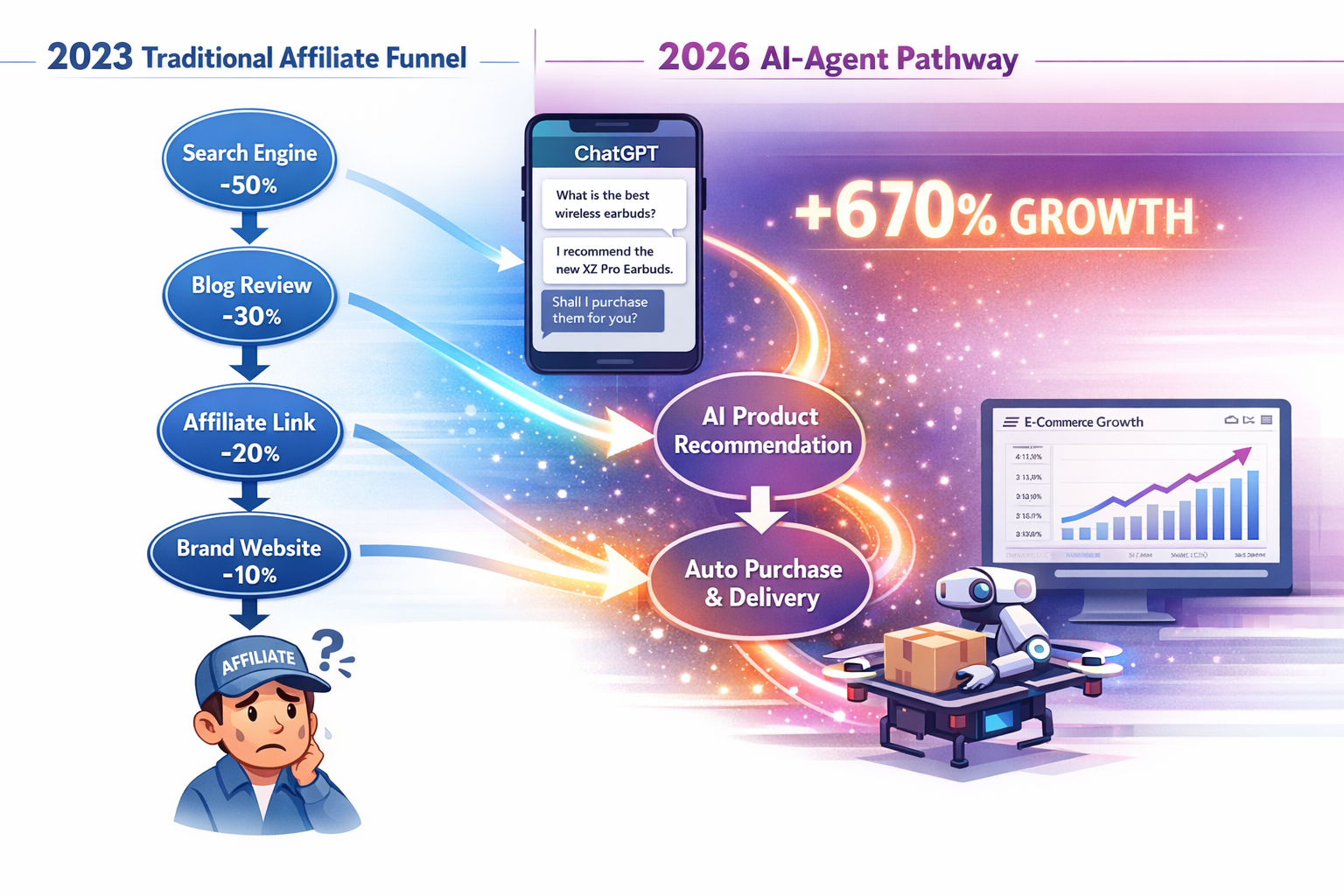
The numbers tell a stark story: nearly 8 out of 10 mobile searches now result in zero clicks to the open web, with AI systems synthesizing answers directly in their interfaces. During Cyber Week 2025, 20% of global orders were influenced by AI agents, and Adobe reported a staggering 670% year-over-year increase in AI traffic to retail sites. Traditional affiliate funnels—built on driving traffic from content to merchant sites—are being disrupted by AI systems that complete the entire purchase journey without ever sending users to your carefully crafted landing pages.
Key Takeaways
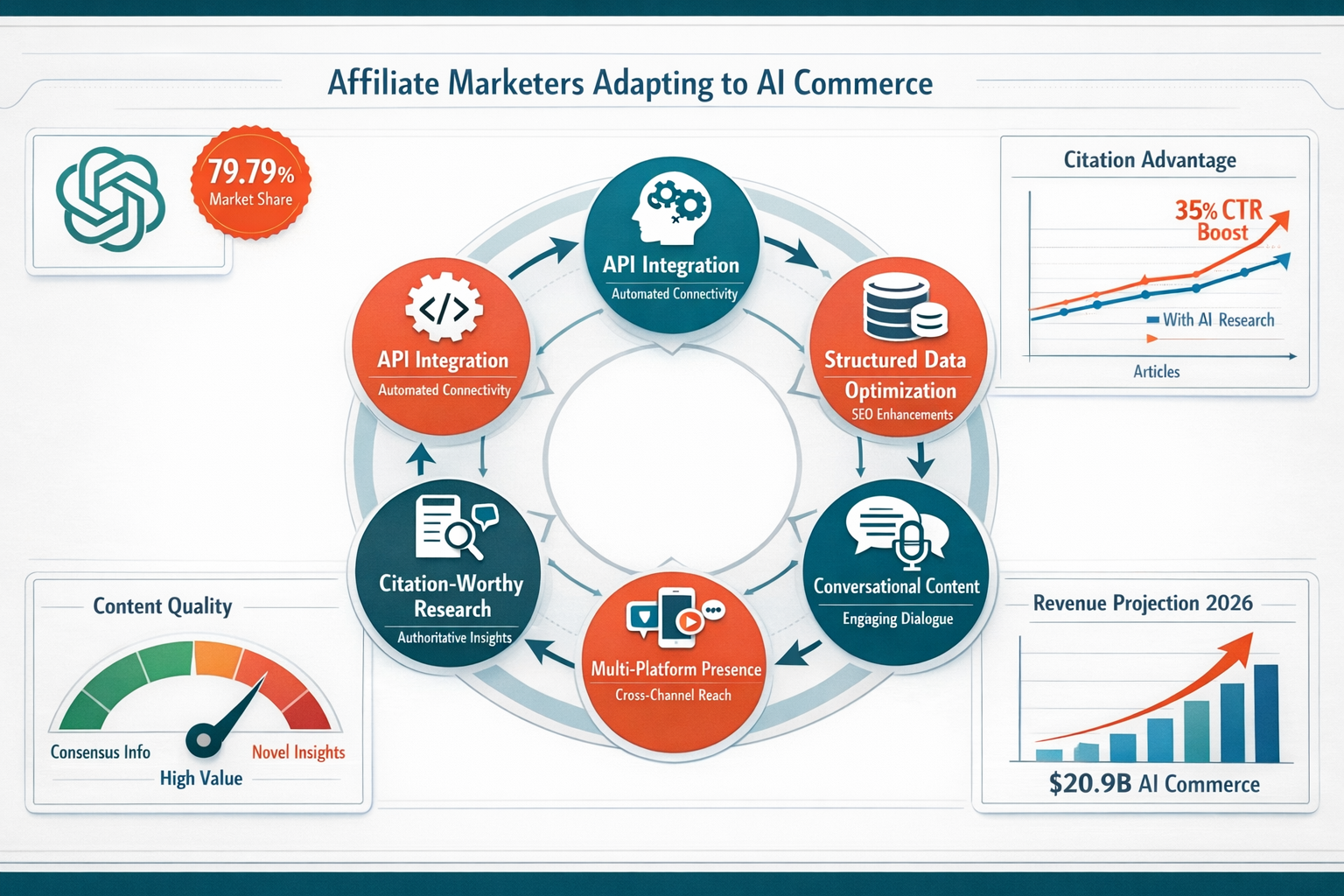
- AI chatbots now drive purchases directly: 20% of Cyber Week 2025 orders were influenced by autonomous AI agents, with ChatGPT holding 79.79% of the AI chatbot market share
- Zero-click searches dominate: 77.1% of mobile searches result in no traffic to traditional websites, collapsing organic click-through rates by 61% for informational queries
- Citation is the new ranking: Brands cited in AI Overviews see 35% higher CTR, but 62% of brands remain invisible to AI models
- Novel content wins: Consensus-based SEO strategies from 2015 no longer work; AI models require additive, unique information to generate citations
- Affiliates must adapt or perish: Success requires API partnerships, structured data optimization, conversational content formats, and multi-platform AI presence strategies
The Rise of Autonomous Purchasing Agents in 2026 🤖
Autonomous purchasing agents represent a fundamental evolution in consumer behavior. These AI-powered systems—led by ChatGPT with its 800 million weekly active users—don't just answer questions. They research products, compare options, provide recommendations, and increasingly facilitate direct purchases without requiring users to leave the chat interface.
The growth trajectory is exponential. AI chatbot traffic increased 81% year-over-year in 2025, reaching 55.2 billion visits across the top 10 platforms. More importantly, 52% of global AI chatbot users engage in information searches, with 38% using them specifically for shopping. This isn't a future trend—it's the present reality reshaping commerce.
Why Traditional Affiliate Funnels Are Breaking Down
The traditional affiliate marketing model relied on a predictable sequence:
- Consumer searches Google for product information
- Clicks on affiliate content (blog post, review, comparison)
- Reads content and clicks affiliate link
- Lands on merchant website
- Completes purchase (affiliate earns commission)
This funnel is collapsing at multiple points. Organic CTR for informational queries declined 61% since AI Overviews launched. For every 100 clicks a #1 ranking previously generated, brands now earn only 35 clicks—with the majority absorbed by AI-generated answer containers that never send traffic downstream.
Even more concerning for affiliates: 62% of brands are "technically invisible" to generative AI models, meaning AI systems fail to cite them in 81% of test cases when asked direct, unbranded questions about their core services. If your affiliate partners aren't being recommended by AI agents, your commission potential evaporates regardless of your content quality.
"AI platforms are expected to account for 1.5% of total retail e-commerce sales in 2026, or $20.9 billion, nearly quadrupling 2025 figures."
How AI Chatbots Are Bypassing Brand Websites
The mechanics of how autonomous purchasing agents bypass traditional websites reveal both the challenge and the opportunity for affiliate marketers. Understanding these mechanisms is critical to developing effective strategies for AI marketing in 2026.
The Zero-Click Commerce Phenomenon
Zero-click searches occur when users receive complete answers within the AI interface without clicking through to external websites. In 2026, this affects:
- 77.1% of mobile searches (up from 65.2% in 2024)
- 58.5% of desktop searches (up from 46.5% in 2022)
AI Overviews synthesize information from multiple sources, presenting consolidated answers with minimal attribution. When users ask ChatGPT "What's the best wireless headphone under $200?" the system provides recommendations, specifications, and even price comparisons—all without requiring users to visit affiliate review sites or brand pages.
Platform-Specific Citation Disparities
Not all AI platforms treat brands equally, creating strategic implications for affiliates:
| Platform | DTC Brand Citation Rate | Implication for Affiliates |
|---|---|---|
| Google AI Overviews | 4.2% | Heavily favors established retailers and aggregators |
| ChatGPT | 36.8% | More open to citing diverse sources including niche brands |
| Perplexity | ~25% (estimated) | Prioritizes recent, authoritative content |
This disparity means affiliates promoting direct-to-consumer brands should prioritize optimization for ChatGPT and Perplexity rather than over-investing in Google-specific SEO tactics. The open web platforms offer nearly 9x better citation rates for emerging brands compared to Google's AI features.
Direct Purchase Integration
The most disruptive development is direct purchase capability. While still emerging, several platforms are testing or implementing:
- In-chat checkout processes that complete transactions without external navigation
- API integrations with e-commerce platforms enabling real-time inventory and pricing
- Saved payment methods that reduce friction for repeat purchases
- Conversational commerce interfaces that guide users through product selection
When purchases happen inside the AI interface, traditional affiliate tracking pixels and cookies become obsolete. This necessitates entirely new attribution and commission models.
What Affiliates Must Do: Strategic Adaptations for Autonomous Purchasing Agents
Surviving and thriving in the era of autonomous purchasing agents requires fundamental strategy shifts. Here's what successful affiliates are implementing in 2026:
1. Develop API Partnerships and Platform Integrations
The future of affiliate marketing involves direct integration with AI platforms rather than relying solely on content discovery. Forward-thinking affiliates are:
- Negotiating API access with ChatGPT, Perplexity, and emerging platforms
- Creating structured product feeds optimized for AI consumption
- Implementing conversational commerce protocols that work within chat interfaces
- Establishing attribution frameworks that track AI-initiated purchases
This mirrors the evolution of affiliate marketing programs from simple link-sharing to sophisticated platform partnerships.
2. Optimize for Citation, Not Just Ranking 📊
The battleground has shifted from "ranking #1 on Google" to "earning the citation in AI responses." Brands cited in AI Overviews see 35% higher CTR than those not cited. To achieve citation:
Create Novel, Additive Content
- AI models trained on the entire internet no longer reward consensus content
- Provide unique data, original research, or proprietary insights
- Develop expertise-driven perspectives that add new information to the conversation
Implement Structured Data Markup
- Use Schema.org markup extensively for products, reviews, and FAQs
- Create machine-readable content that AI systems can easily parse
- Structure information in clear, hierarchical formats
Build Authoritative Topical Depth
- Cover topics comprehensively rather than superficially
- Link related content to establish topical authority
- Demonstrate expertise through depth and breadth of coverage
These strategies align with best affiliate marketing tips for 2026, emphasizing quality and authority over volume.
3. Adopt Conversational Content Formats
AI chatbots consume and generate conversational content differently than traditional search engines. Adapt your content strategy:
Question-Answer Formats
- Structure content as natural Q&A pairs
- Address specific user questions comprehensively
- Use conversational language that AI can easily reformulate
Comparison Frameworks
- Create detailed product comparisons with clear criteria
- Use tables and structured formats for specifications
- Provide context-specific recommendations (best for X use case)
Step-by-Step Guides
- Break complex topics into sequential steps
- Use clear headings and numbered lists
- Provide actionable, implementable advice
This approach works whether users find your content through traditional search or whether AI systems reference it when generating responses. For those new to this evolution, understanding how to do affiliate marketing in this new landscape is essential.
4. Diversify Across Multiple AI Platforms
ChatGPT's 79.79% market share is dominant but not permanent. Smart affiliates are building presence across:
- ChatGPT (800M+ weekly users) – Largest reach, consumer-focused
- Perplexity (39.4M monthly visits) – Research-oriented, citation-friendly
- Google Gemini (70.1M monthly visits) – Integration with Google ecosystem
- Claude – Growing enterprise and professional user base
- Emerging platforms – Stay alert for new entrants
Each platform has different citation algorithms, user demographics, and commercial features. Diversification protects against algorithm changes and platform-specific volatility.
5. Invest in Brand Building and Direct Relationships
As intermediary traffic sources become less reliable, direct audience relationships become more valuable:
Build Email Lists
- Capture contact information before AI agents do
- Maintain direct communication channels
- Reduce dependence on algorithmic discovery
Develop Community Platforms
- Create Discord, Slack, or forum communities
- Foster direct engagement with your audience
- Build loyalty that transcends platform changes
Establish Brand Authority
- Become the recognized expert in your niche
- Get cited by AI through brand-specific queries
- Develop thought leadership that AI systems reference
This aligns with proven affiliate marketing strategies that emphasize sustainable audience relationships.
6. Leverage AI Tools for Content Creation and Optimization
Fight fire with fire by using AI tools to enhance your affiliate operations:
Content Generation at Scale
- Use AI to create product descriptions and comparisons
- Stitch Fix reported AI-generated descriptions outperforming human-written versions in tests
- Maintain human oversight for quality and accuracy
SEO and Citation Optimization
- Use AI-powered tools to analyze what content gets cited
- Identify gaps in AI knowledge that you can fill
- Optimize existing content for AI consumption
Competitive Analysis
- Monitor which competitors get cited by AI platforms
- Analyze their content strategies and citation patterns
- Adapt successful approaches to your niche
7. Prepare for New Attribution and Commission Models
Traditional cookie-based tracking is becoming obsolete. Prepare for:
AI-Native Attribution
- Track conversions initiated through AI platforms
- Implement server-side tracking that works without cookies
- Develop relationships with merchants using AI-aware attribution
Value-Based Commissions
- Shift from click-based to influence-based compensation
- Negotiate commissions for AI citations and recommendations
- Demonstrate value through brand awareness and consideration metrics
Hybrid Monetization
- Combine affiliate commissions with sponsorships
- Develop consulting services for brands entering AI commerce
- Create information products that complement affiliate offers
The Future of Affiliate Marketing in an AI-First World 🚀
The transformation driven by autonomous purchasing agents isn't temporary—it's the new foundation of digital commerce. By 2027, analysts predict AI platforms will account for 3-5% of total e-commerce sales, representing over $50 billion in transactions.
Successful affiliates in this environment will be those who:
- Embrace platform partnerships rather than fighting platform changes
- Create genuinely valuable content that AI systems want to cite
- Build direct audience relationships that transcend algorithmic discovery
- Adapt monetization models to AI-native attribution frameworks
- Maintain agility as the landscape continues evolving rapidly
The skills that made affiliates successful in the 2010s—SEO optimization, content marketing, conversion optimization—remain relevant but must be applied through an AI-first lens. Those who view autonomous purchasing agents as partners rather than threats will find new opportunities in this transformed landscape.
For affiliates willing to adapt, the AI revolution offers opportunities to reach audiences at unprecedented scale. ChatGPT's 800 million weekly users represent a massive, engaged audience actively seeking product recommendations and purchase guidance. The question isn't whether to engage with AI platforms—it's how quickly you can adapt your strategies to serve this new consumer behavior.
Conclusion
Autonomous purchasing agents: how AI chatbots are bypassing brand websites and what affiliates must do isn't just a trend to monitor—it's an existential challenge requiring immediate strategic response. With 77.1% of mobile searches resulting in zero clicks, 62% of brands invisible to AI models, and $20.9 billion in AI-driven e-commerce projected for 2026, the traditional affiliate playbook has become obsolete.
The path forward requires bold adaptation: develop API partnerships with AI platforms, optimize for citation rather than ranking, create novel content that adds genuine value, diversify across multiple AI ecosystems, build direct audience relationships, and prepare for AI-native attribution models. Those who act decisively will discover that while the mechanisms have changed, the fundamental value proposition of affiliate marketing—connecting consumers with products that solve their problems—remains more relevant than ever.
Take action today: Audit your current affiliate strategies against AI-first criteria, identify which of your merchant partners are visible to major AI platforms, and begin experimenting with conversational content formats optimized for AI consumption. The affiliates who thrive in 2026 and beyond will be those who transformed their businesses before the shift became complete.
Start by exploring comprehensive affiliate marketing courses that address AI-era strategies, or dive into beginner-friendly guides if you're just entering this transformed landscape. The opportunity remains enormous—but only for those willing to evolve.