


Blog Ideas Brainstorming and Clustering by Local Service Areas: A Complete n8n Automation Guide
Imagine generating hundreds of targeted blog ideas for every service area your business covers, then automatically organizing them into content clusters that boost your local SEO rankings—all while you sleep. Blog ideas brainstorming and clustering by local service areas represents one of the most powerful yet underutilized strategies for local service businesses looking to dominate their markets through strategic content automation.
In 2025, the convergence of AI-powered content generation and workflow automation platforms like n8n has revolutionized how local businesses approach content marketing. Rather than manually brainstorming blog topics for each service location, smart business owners are building automated systems that generate, organize, and even publish location-specific content at scale.
Key Takeaways
• Automated clustering reduces manual content planning from weeks to hours by organizing blog ideas around geographic service areas and topic themes
• n8n workflows can generate hundreds of location-specific blog ideas by combining service keywords with local area data automatically
• Topic cluster architecture improves local SEO by creating interconnected content hubs that demonstrate topical authority to search engines
• Geographic content organization helps businesses target multiple service areas without duplicate content penalties
• AI-powered brainstorming produces more comprehensive topic coverage than manual methods while maintaining local relevance
Understanding Blog Ideas Brainstorming and Clustering by Local Service Areas
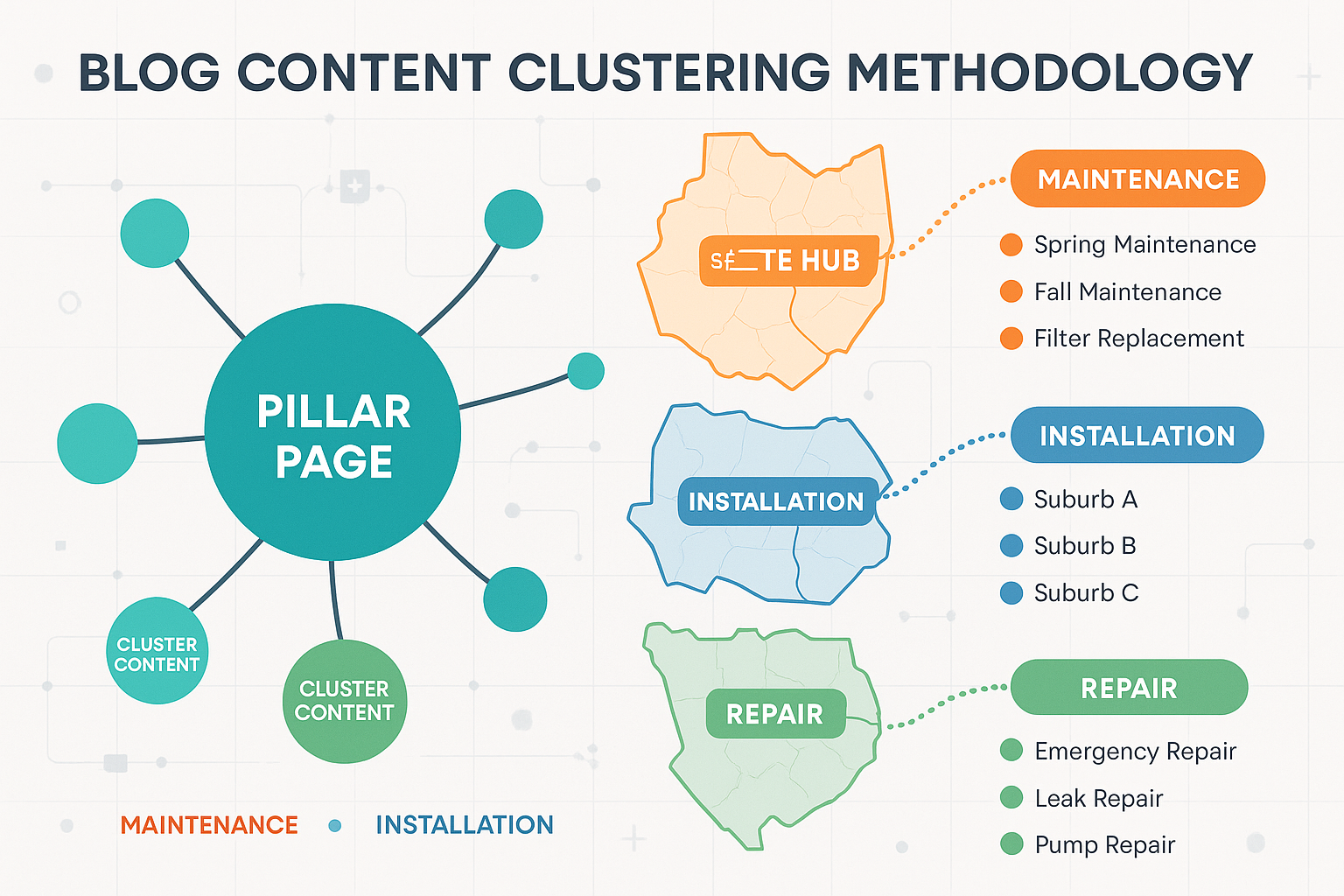
Blog ideas brainstorming and clustering by local service areas involves systematically generating content topics that combine your core services with specific geographic locations, then organizing these ideas into logical content groups that support each other through strategic internal linking.
The Foundation of Local Content Clustering
Topic clusters consist of a central pillar page linked to multiple related cluster pages, organizing content around specific themes to help search engines understand content depth [1]. For local service businesses, this means creating comprehensive content hubs that cover both service expertise and geographic relevance.
Core Components of Local Content Clusters:
- Pillar Pages: Broad service overviews (e.g., “Pool Maintenance Services”)
- Geographic Clusters: Location-specific variations (e.g., “Pool Maintenance in Riverside”)
- Service-Specific Pages: Detailed topic coverage (e.g., “Saltwater Pool Maintenance”)
- Supporting Content: How-to guides, FAQs, and educational resources
Why Geographic Clustering Matters in 2025
Building topical authority in 2025 requires showing search engines you cover subjects in depth, extending beyond simple keyword targeting to interconnected content [2]. Local service businesses must demonstrate expertise across multiple dimensions:
- Service Expertise 🔧
- Geographic Coverage 📍
- Customer Education 📚
- Problem-Solving Capability 💡
Local service businesses should create service area pages targeting specific towns combined with services, clustering approximately 10 towns per batch for larger service areas [3]. This approach prevents content overwhelm while ensuring comprehensive coverage.
Automated Blog Ideas Brainstorming and Clustering by Local Service Areas with n8n
n8n’s workflow automation capabilities transform the traditionally manual process of content ideation into a systematic, scalable operation. By connecting AI language models with data sources and content management systems, businesses can generate thousands of targeted blog ideas automatically.
Setting Up Your n8n Content Ideation Workflow
Workflow Trigger Options:
- Scheduled execution (weekly/monthly content planning)
- Google Sheets updates (new service areas or keywords)
- Manual execution (on-demand brainstorming sessions)
- Webhook triggers (integration with CRM or lead data)
The Content Generation Process
Step 1: Data Collection and Preparation
Trigger → Google Sheets (Service Areas + Keywords) → HTTP Request (Competitor Research) → Data Processing
Your n8n workflow begins by collecting:
- Service keywords (pool cleaning, HVAC repair, plumbing services)
- Geographic locations (cities, neighborhoods, zip codes)
- Seasonal factors (winter maintenance, summer installations)
- Customer pain points (emergency repairs, routine maintenance)
Step 2: AI-Powered Topic Generation
Topic cluster generators can produce in-depth lists with search volume data by entering broad topics and target locations, reducing manual research time significantly [4]. Your n8n workflow leverages this by:
- Combining service + location keywords systematically
- Generating topic variations using AI language models
- Creating content hierarchies automatically
- Identifying content gaps in existing coverage
Step 3: Intelligent Clustering and Organization
The workflow automatically groups related topics into logical clusters:
| Cluster Type | Example Topics | Target Keywords |
|---|---|---|
| Maintenance | Weekly pool cleaning in Downtown LA | pool cleaning + location |
| Emergency Services | 24/7 plumber near USC | emergency plumber + area |
| Seasonal Content | Winter pool closing in Pasadena | seasonal service + city |
| Equipment Focus | Salt system installation in Beverly Hills | equipment + installation + location |
Advanced Clustering Strategies
Multi-Dimensional Organization:
Local service area pages should use location-specific keywords like ‘plumber in German Village’ or ‘electrician near Ohio State’ to attract appropriate audiences [5]. Your n8n workflow can generate content ideas across multiple dimensions:
Geographic Specificity
- City-level targeting
- Neighborhood focus
- Landmark-based references
- ZIP code optimization
Service Depth
- Basic maintenance topics
- Advanced repair procedures
- Equipment installation guides
- Troubleshooting resources
Customer Journey Stages
- Awareness stage (educational content)
- Consideration stage (comparison guides)
- Decision stage (service-specific pages)
- Retention stage (maintenance tips)
Implementing Content Clusters for Maximum Local SEO Impact
Once your blog ideas brainstorming and clustering by local service areas workflow generates comprehensive topic lists, the next phase involves strategic implementation that maximizes search engine visibility and user engagement.
Content Architecture Best Practices
Pillar Page Structure:
Pillar pages provide broad overviews of particular topics with internal links connecting to all relevant supporting cluster pages [6]. For local service businesses, effective pillar pages include:
- Service overview with local relevance
- Geographic coverage area clearly defined
- Internal links to all related cluster content
- Local trust signals (testimonials, certifications)
- Contact information and service area maps
Supporting Cluster Development:
Supporting cluster pages focused on service-specific needs like measurements, material estimates, replacement, and maintenance create additional topical clusters for local services [7]. Your n8n workflow can automatically generate ideas for:
- How-to guides for each service area
- Cost estimation content by location
- Maintenance schedules for different climates
- Emergency procedures with local contact information
Technical Implementation with n8n
Automated Content Creation Pipeline:
Topic Generation → Content Outline Creation → Draft Generation → WordPress Publishing → Internal Linking → Performance Tracking
Workflow Components:
Content Brief Generation
- AI creates detailed outlines
- Includes target keywords and internal links
- Specifies local relevance requirements
- Suggests related topics for clustering
Draft Creation and Optimization
- Multi-location businesses should create unique content for each location page with a minimum of 300-500 words to avoid content duplication [8]
- AI generates location-specific content variations
- Includes local keywords naturally
- Maintains consistent brand voice across locations
Automated Publishing and Organization
- WordPress integration for direct publishing
- Automatic category and tag assignment
- Internal link insertion based on cluster relationships
- Meta description and title optimization
Avoiding Common Clustering Pitfalls
Content Duplication Prevention:
Multi-location businesses should use subdirectories for location pages (e.g., /locations/manchester/) to maintain proper site structure and organization [9]. Your n8n workflow should:
- Generate unique angles for each location
- Include location-specific details (local regulations, climate factors)
- Vary content structure while maintaining quality
- Monitor for duplicate content using automated checks
Quality Control Measures:
Blog post templates including ‘How-to,’ ‘What is,’ and Listicle formats provide effective structures for creating topic cluster content [10]. Implement quality gates in your workflow:
- Content length validation (minimum word counts)
- Keyword density checks (avoiding over-optimization)
- Readability scoring (grade 7-8 target level)
- Local relevance verification (location-specific information included)
Optimizing and Scaling Your Local Content Strategy
Performance Monitoring and Iteration
Google Search Console data identifies existing topic coverage and reveals gaps where new cluster pages are needed within the strategy [11]. Your n8n workflow can automate performance tracking by:
Automated Reporting:
- Traffic analysis by location and topic cluster
- Ranking position tracking for target keywords
- Conversion rate monitoring from content to leads
- Engagement metrics (time on page, bounce rate)
Content Gap Identification:
- Competitor content analysis using automated scraping
- Search volume trends for new location combinations
- Seasonal opportunity detection (heating repairs in winter)
- Customer question mining from support tickets and reviews
Scaling Across Multiple Markets
Location pages should be refreshed every two months or when expanding service areas to maintain accuracy in local search results [12]. Your n8n automation can handle scaling through:
Market Expansion Workflows:
- New location detection (CRM integration)
- Automatic content generation for new service areas
- Cluster expansion (adding new topics to existing locations)
- Cross-location content optimization (maintaining consistency)
Resource Allocation Optimization:
| Priority Level | Content Type | Automation Level | Manual Review |
|---|---|---|---|
| High | Core service pages | Full automation | Quality check only |
| Medium | Educational content | Semi-automated | Editorial review |
| Low | Seasonal content | Template-based | Full review |
Advanced n8n Integration Strategies
Multi-Platform Content Distribution:
Your workflow can extend beyond blog creation to include:
- Social media post generation from blog content
- Email newsletter content featuring local topics
- Google My Business post automation with local angles
- Video script creation for location-specific content
Customer Feedback Integration:
- Review mining for content ideas (positive experiences become case studies)
- FAQ generation from customer support tickets
- Service improvement content based on common issues
- Testimonial integration into location-specific pages
Measuring Success and ROI
Key Performance Indicators
Traffic Metrics:
- Organic traffic growth by service area
- Local keyword rankings improvement
- Featured snippet captures for location-based queries
- Voice search optimization results
Business Impact Metrics:
- Lead generation from content by location
- Cost per acquisition reduction through organic traffic
- Customer lifetime value from content-driven leads
- Market share expansion in target service areas
Continuous Improvement Process
Monthly Optimization Cycle:
- Performance Review (automated reporting)
- Content Gap Analysis (competitor and search data)
- Topic Refresh (new ideas generation)
- Quality Assessment (content audit and updates)
- Strategy Refinement (workflow optimization)
Quarterly Strategic Assessment:
- Market expansion opportunities evaluation
- Content cluster performance analysis
- Competitor strategy assessment
- Technology stack optimization review
Conclusion
Blog ideas brainstorming and clustering by local service areas represents a fundamental shift from reactive content creation to strategic, automated content marketing that scales with your business growth. By implementing n8n workflows that systematically generate, organize, and optimize location-specific content, local service businesses can achieve unprecedented efficiency in their content marketing efforts while dramatically improving their local search visibility.
The key to success lies in building workflows that balance automation efficiency with content quality, ensuring that every piece of content serves both search engines and real customers in your service areas. As AI capabilities continue to advance and local search becomes increasingly competitive, businesses that master automated content clustering will gain significant advantages in market share and customer acquisition.
Immediate Action Steps:
- Audit your current content to identify existing clusters and gaps
- Set up basic n8n workflows for topic generation and content organization
- Create pillar pages for your core services with local relevance
- Implement automated performance tracking to measure ROI and optimization opportunities
- Scale systematically by adding new service areas and content clusters based on performance data
The future of local service marketing belongs to businesses that can combine human expertise with automated efficiency, creating content ecosystems that serve customers while driving sustainable business growth.
References
[1] Local service businesses should create service area pages targeting specific towns combined with services, clustering approximately 10 towns per batch for larger service areas
[2] Building topical authority in 2025 requires showing search engines you cover subjects in depth, extending beyond simple keyword targeting to interconnected content
[3] Local service area pages should use location-specific keywords like ‘plumber in German Village’ or ‘electrician near Ohio State’ to attract appropriate audiences
[4] Topic cluster generators can produce in-depth lists with search volume data by entering broad topics and target locations, reducing manual research time significantly
[5] Local service area pages should use location-specific keywords like ‘plumber in German Village’ or ‘electrician near Ohio State’ to attract appropriate audiences
[6] Pillar pages provide broad overviews of particular topics with internal links connecting to all relevant supporting cluster pages
[7] Supporting cluster pages focused on service-specific needs like measurements, material estimates, replacement, and maintenance create additional topical clusters for local services
[8] Multi-location businesses should create unique content for each location page with a minimum of 300-500 words to avoid content duplication
[9] Multi-location businesses should use subdirectories for location pages (e.g., /locations/manchester/) to maintain proper site structure and organization
[10] Blog post templates including ‘How-to,’ ‘What is,’ and Listicle formats provide effective structures for creating topic cluster content
[11] Google Search Console data identifies existing topic coverage and reveals gaps where new cluster pages are needed within the strategy
[12] Location pages should be refreshed every two months or when expanding service areas to maintain accuracy in local search results
