

The affiliate marketing landscape has transformed dramatically. Gone are the days when success meant juggling a dozen disconnected tools while manually copying data between platforms. Building an AI Marketing Stack for Affiliates in 2026: From Disconnected Tools to Fully Orchestrated Revenue Systems represents the evolution from chaotic workflows to intelligent, automated revenue engines that work together seamlessly.
Today's top-performing affiliates aren't just using AI—they're orchestrating entire ecosystems where data flows automatically, content generates at scale, and optimization happens in real-time. The difference between struggling affiliates and those generating consistent six-figure revenues often comes down to one factor: stack architecture.
Key Takeaways
- 🏗️ Modern affiliate success requires layered architecture: Data layer, content generation, testing automation, analytics, and AI agents must work as an integrated system, not isolated tools
- 📊 Multi-tool workflows are now standard: Most successful affiliates deploy 5-10 specialized AI solutions across different workflow stages rather than relying on single platforms [2]
- 🚀 Testing velocity creates competitive advantage: AI-powered angle generation and rapid creative variation enable affiliates to test 20+ approaches simultaneously, dramatically accelerating optimization [4]
- 🎯 Attribution clarity drives revenue: Enhanced multi-touch attribution models now provide accurate insights across customer journeys, ensuring proper commission tracking [1]
- 🤝 Hybrid human-AI approach wins: Research confirms that combining AI automation with human strategic oversight delivers superior results compared to either approach alone [4]
Understanding the Modern Affiliate AI Stack Architecture
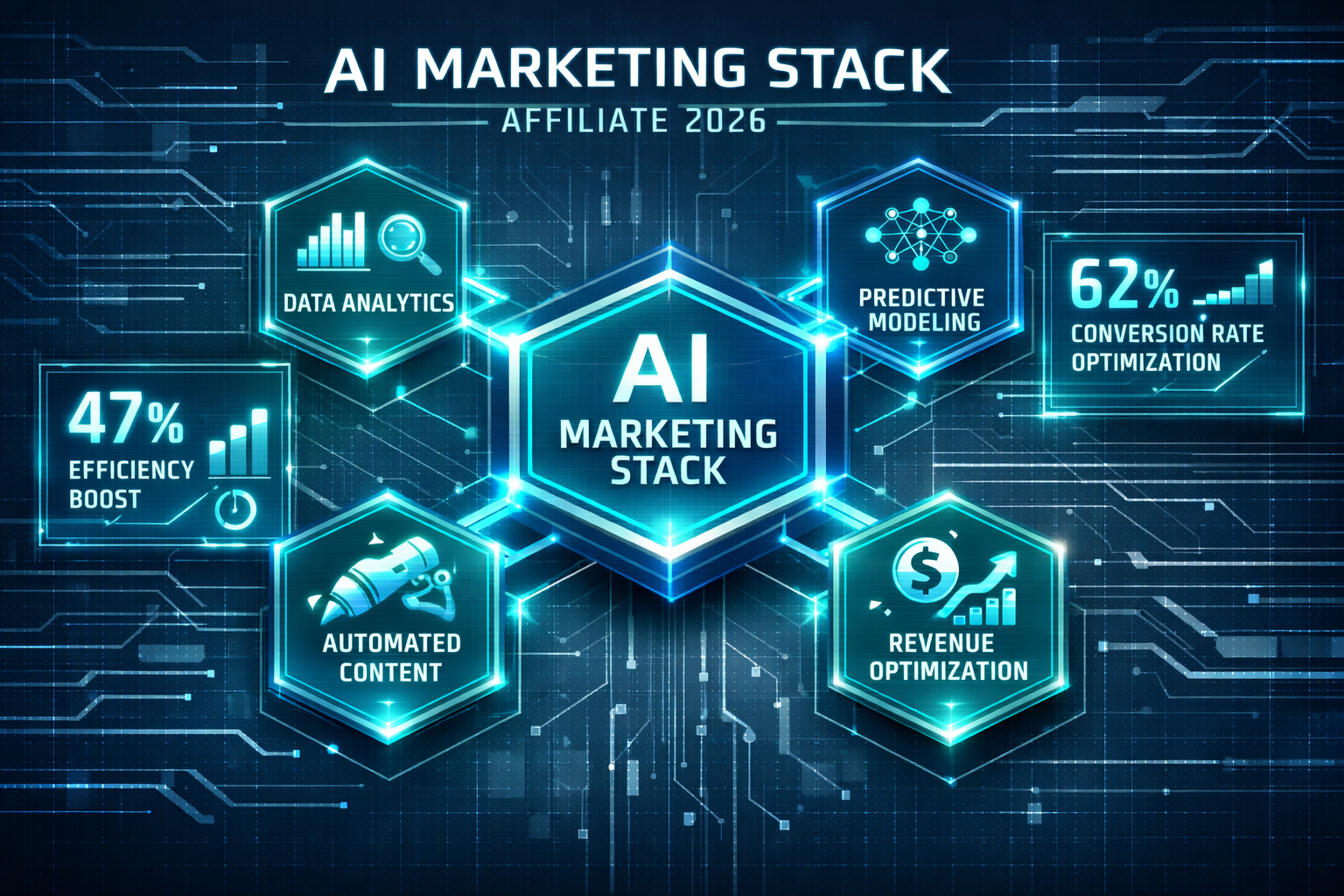
Building an AI Marketing Stack for Affiliates in 2026 requires understanding the five core layers that comprise a fully orchestrated revenue system. Each layer serves a distinct purpose while feeding data and insights to the others.
The Five-Layer Reference Architecture
Layer 1: Data Foundation & Integration
The foundation layer consolidates tracking, attribution, and data collection across all traffic sources. This includes:
- Unified tracking platforms like RedTrack and Voluum that consolidate multi-source data [3][4]
- Attribution systems that accurately track customer journeys across touchpoints [1]
- API integrations connecting affiliate networks, ad platforms, and CRM systems
- Data warehousing for historical analysis and pattern recognition
Without a solid data foundation, every other layer operates blindly. The most common mistake affiliates make is skipping this layer and jumping straight to content generation tools.
Layer 2: Content Generation & Creative Production
This layer handles the creation of all marketing assets at scale:
- ChatGPT and language models for ad copy, landing pages, email sequences, and advertorials [3][4]
- AdCreative.ai for automated banner generation and visual creative testing [2]
- AI video generators for short-form content and video ads
- Template systems that maintain brand consistency while enabling rapid variation
The key innovation in 2026 is volume through variation. Top affiliates now generate 50+ creative variations weekly, testing different angles simultaneously [4].
Layer 3: Testing & Optimization Automation
Automation at this layer accelerates the optimization cycle:
- Auto-pause systems that kill losing placements based on statistical significance [4]
- Budget allocation algorithms that shift spend toward winners automatically
- A/B testing frameworks for landing pages, offers, and creative elements
- Angle generation tools that brainstorm and test multiple advertising approaches [4]
This layer transforms testing from a manual monthly process into a continuous, automated system that runs 24/7.
Layer 4: Analytics & Intelligence
Intelligence systems process data to generate actionable insights:
- Predictive analytics forecasting campaign performance and seasonal trends
- Sentiment analysis scoring lead quality and creative effectiveness [3]
- Competitor monitoring tracking market shifts and competitor strategies
- Performance dashboards providing real-time visibility across all campaigns
Modern analytics go beyond reporting what happened to predicting what will happen and recommending specific actions.
Layer 5: AI Agents & Workflow Orchestration
The top layer coordinates everything below it:
- Workflow automation connecting tools through APIs and webhooks
- AI agents that execute multi-step processes autonomously
- Decision engines that apply business rules across the stack
- Alert systems notifying humans only when strategic decisions are needed
This orchestration layer is what transforms disconnected tools into a cohesive revenue system. For those just starting their journey, understanding best affiliate marketing programs for beginners provides essential context before building complex stacks.
From Disconnected Tools to Orchestrated Systems: The Implementation Roadmap
Phase 1: Audit Your Current Tool Chaos (Week 1-2)
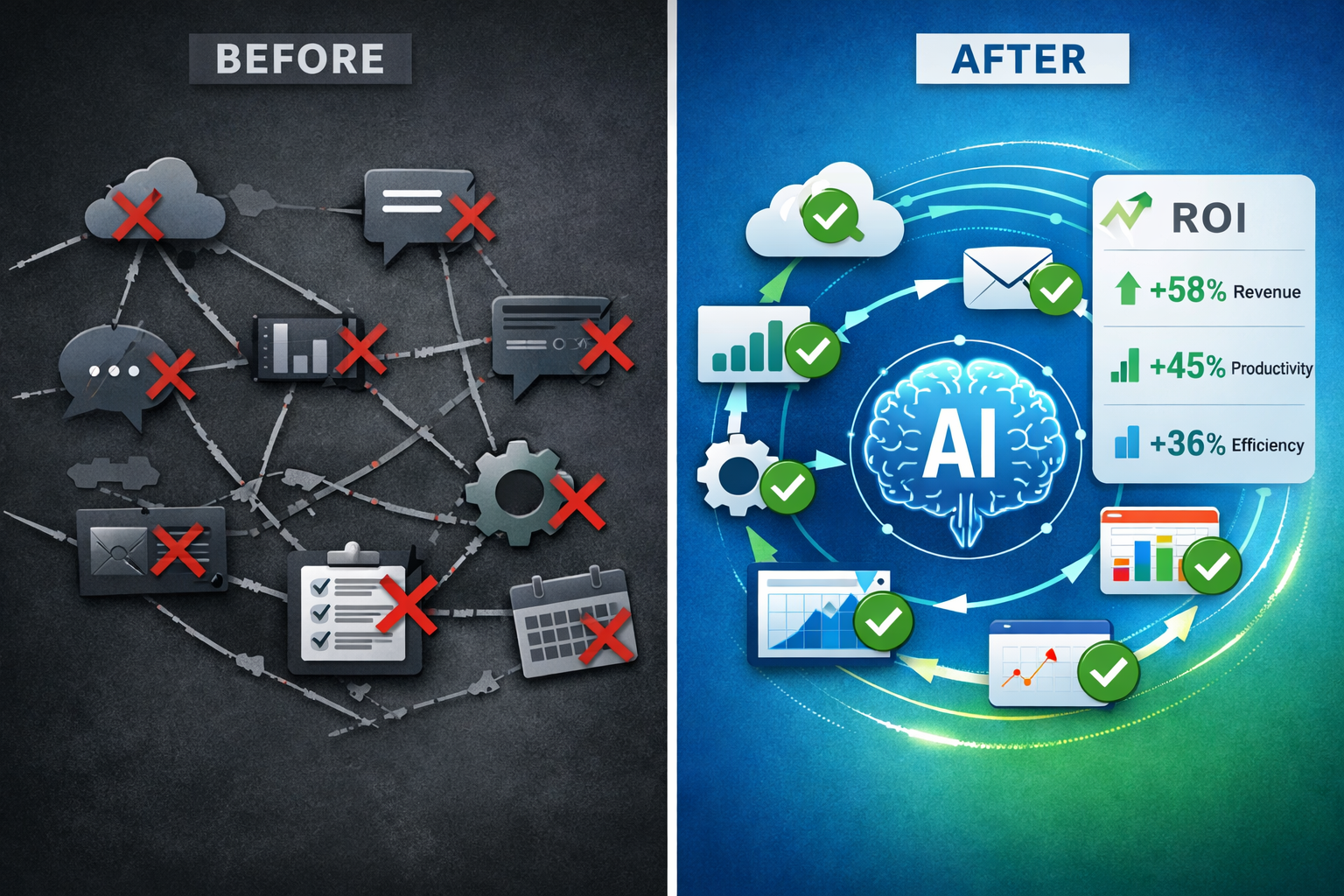
Most affiliates discover they're using 8-12 tools with zero integration between them. Start by documenting:
- Every platform currently in use
- Manual data transfers happening daily
- Duplicate functionality across tools
- Gaps where no tool exists
Create a workflow map showing how data moves (or doesn't move) between systems. This visual representation often reveals shocking inefficiencies—like copying conversion data from affiliate networks into spreadsheets, then manually uploading to ad platforms.
Phase 2: Establish Your Data Foundation (Week 3-4)
Before adding more AI tools, fix the foundation:
- Implement unified tracking: Deploy RedTrack or Voluum to consolidate all traffic sources [3][4]
- Set up proper attribution: Configure multi-touch attribution models that credit all touchpoints [1]
- Create data pipelines: Use Zapier or Make to connect affiliate networks with tracking platforms
- Build your data warehouse: Set up Google BigQuery or similar for historical analysis
This foundation work isn't glamorous, but it's essential. Without it, AI tools operate on incomplete or inaccurate data, producing flawed recommendations. Understanding how to succeed in affiliate marketing requires this foundational discipline.
Phase 3: Deploy AI Content Systems (Week 5-6)
With data flowing properly, add content generation capacity:
- Start with ChatGPT for ad copy, landing page content, and email sequences [3][4]
- Add AdCreative.ai for visual banner generation and ad creative testing [2]
- Implement template systems ensuring brand consistency across variations
- Create prompt libraries documenting successful prompts for reuse
The goal is testing velocity. AI enables affiliates to generate dozens of creative variations and angles rapidly, identifying the most effective approaches faster than manual creation ever could [2].
Many affiliates struggle with creative depletion when manually writing 20+ ad angles. AI solves this by generating multiple advertising angles before testing, spinning ad copy for native and display traffic, and brainstorming creative approaches continuously [4].
Phase 4: Automate Testing & Optimization (Week 7-8)
Transform manual optimization into automated systems:
- Configure auto-pause rules in Voluum or similar platforms to kill losing placements automatically [4]
- Set up budget allocation algorithms that shift spend toward winners
- Implement statistical significance testing ensuring decisions are data-driven
- Create optimization playbooks that AI agents can execute autonomously
Voluum's AI-powered automation tracks, attributes, auto-pauses losing placements, and scales winners faster across multiple traffic sources with real-time data consolidation [4]. This is particularly essential for large-volume campaigns with mixed ad formats.
Phase 5: Build Intelligence & Orchestration (Week 9-12)
The final phase connects everything into a cohesive system:
- Deploy predictive analytics forecasting performance trends
- Set up AI agents that execute multi-step workflows automatically
- Create decision frameworks defining when human intervention is needed
- Build performance dashboards providing real-time visibility
This orchestration transforms your stack from a collection of tools into an intelligent revenue system that operates largely autonomously, alerting you only for strategic decisions.
For affiliates concerned about legitimacy and best practices, reviewing whether affiliate marketing is legitimate provides important context before investing in sophisticated tooling.
Essential Tool Categories and Selection Criteria
Content Generation Layer
Primary Tools:
- ChatGPT: Industry standard for ad copies, landing pages, social media, email marketing, and advertorials [3][4]
- AdCreative.ai: Automated banner and visual creative generation optimized for CTR [2]
- Jasper/Copy.ai: Alternative content generators with team collaboration features
Selection Criteria:
- API availability for automation
- Output quality and consistency
- Template and brand guideline support
- Cost per generated asset
Tracking & Attribution Layer
Primary Tools:
- RedTrack: Combines tracking, content generation, visual creation, and lead scoring [3][4]
- Voluum: Pro-level multi-source optimization with AI-powered automation [4]
- ClickMagick: Budget-friendly option with solid tracking capabilities
Selection Criteria:
- Multi-source consolidation capability
- Attribution model flexibility
- Real-time data processing
- Integration ecosystem
Testing & Optimization Layer
Primary Tools:
- Optimizely: Enterprise A/B testing with statistical rigor
- Google Optimize: Free option for landing page testing
- VWO: Conversion optimization platform with heatmaps and session recording
Selection Criteria:
- Statistical significance calculation
- Multi-variant testing support
- Integration with tracking platforms
- Automation capabilities
Those exploring affiliate marketing opportunities should prioritize tools that scale with growth rather than requiring replacement as volume increases.
Measuring ROI and Stack Performance
Key Performance Indicators for Stack Effectiveness
Velocity Metrics:
- Creative production rate: Variations generated per week
- Testing cycle time: Days from concept to statistical significance
- Optimization frequency: How often winning/losing decisions are made
Efficiency Metrics:
- Manual hours saved: Time previously spent on routine tasks
- Cost per conversion: Improvement after AI implementation
- Attribution accuracy: Percentage of conversions properly tracked
Revenue Metrics:
- Revenue per traffic source: Improvement from better attribution
- Scaling speed: Time to profitably scale winning campaigns
- Portfolio diversity: Number of profitable campaigns running simultaneously
The Hybrid Human-AI Model
Current research and real-world evidence clearly favor a hybrid approach where AI handles scale, pattern-spotting, and repetitive work while humans retain control over strategy, brand decisions, and final output [4].
Using no AI at all creates speed and cost disadvantages versus competitors who do use it. However, fully automated systems without human oversight often make strategic errors that damage brand reputation or violate platform policies.
The winning formula in 2026:
- AI handles: Content generation, data processing, routine optimization, pattern recognition
- Humans handle: Strategic direction, brand voice, final approval, relationship management
This approach enables affiliates to produce more angles, hooks, headlines, and variations, leading to faster optimization and higher ROI [5]. Understanding common challenges in affiliate marketing helps contextualize where AI provides the greatest leverage.
Common Pitfalls and How to Avoid Them
Pitfall 1: Tool Hoarding Without Integration
Collecting AI tools without connecting them creates data silos worse than having fewer tools. Each disconnected tool requires manual data entry, creating bottlenecks that negate automation benefits.
Solution: Prioritize integration over features. Choose tools with robust APIs and native integrations with your core platforms.
Pitfall 2: Skipping the Data Foundation
Jumping straight to content generation without proper tracking produces garbage in, garbage out scenarios. AI optimizes based on the data it receives—if that data is incomplete or inaccurate, optimization moves in the wrong direction.
Solution: Invest 30-40% of your initial implementation time on tracking, attribution, and data infrastructure before adding AI layers.
Pitfall 3: Over-Automation Without Human Oversight
Fully automated systems occasionally make catastrophic decisions—like spending entire budgets on statistically insignificant winners or generating content that violates platform policies.
Solution: Implement approval gates for high-stakes decisions and alert thresholds that trigger human review when metrics deviate significantly from norms.
Pitfall 4: Ignoring Platform Policy Changes
Meta's acquisition of AI platforms and ongoing policy changes directly affect how affiliates approach targeting research and creative deployment [5]. Automated systems may continue using tactics that worked yesterday but violate today's policies.
Solution: Subscribe to platform policy updates and implement monthly compliance reviews of automated workflows.
For affiliates working with specific platforms, understanding problems in affiliate marketing PPC helps anticipate integration challenges before they impact revenue.
Future-Proofing Your AI Marketing Stack
Emerging Trends for 2026-2027
Agentic AI Systems: The next evolution involves AI agents that execute complex multi-step workflows autonomously, making tactical decisions within strategic parameters set by humans.
Cross-Platform Intelligence: Future stacks will automatically adjust strategies across platforms based on performance data—if Facebook CPMs rise, budgets automatically shift to Google while creative is adapted for the new platform.
Predictive Offer Matching: AI will analyze audience data to predict which offers will convert best for specific segments, automatically rotating offers based on real-time performance forecasting.
Voice and Video Dominance: As short-form video continues dominating social platforms, AI video generation and voice synthesis will become essential stack components rather than optional additions.
Building for Adaptability
The most successful stacks in 2026 share one characteristic: modularity. Rather than monolithic platforms, they comprise specialized tools connected through APIs, enabling quick replacement of underperforming components without rebuilding the entire system.
Design principles for future-proof stacks:
- Prioritize tools with open APIs over closed ecosystems
- Build data warehouses that outlive individual tools
- Document workflows so they're transferable between platforms
- Create abstraction layers that separate business logic from tool implementation
This modular approach ensures that when better tools emerge—and they will—you can swap components without disrupting the entire revenue system.
Conclusion
Building an AI Marketing Stack for Affiliates in 2026: From Disconnected Tools to Fully Orchestrated Revenue Systems represents a fundamental shift from manual, fragmented workflows to intelligent, automated ecosystems. The competitive advantage no longer comes from access to AI tools—everyone has that. It comes from orchestration: how effectively you connect data flow, content generation, testing automation, analytics, and AI agents into a cohesive revenue engine.
The five-layer architecture—data foundation, content generation, testing automation, analytics intelligence, and workflow orchestration—provides a proven framework for building systems that scale. Success requires resisting the temptation to collect tools without integration, instead focusing on creating seamless data flows between specialized components.
Your Next Steps
- Week 1: Audit your current tools and map existing workflows to identify integration gaps
- Week 2-4: Establish proper tracking and attribution infrastructure before adding more AI tools
- Week 5-8: Deploy content generation and testing automation systems
- Week 9-12: Build intelligence layers and orchestration connecting everything into a unified system
- Ongoing: Measure velocity, efficiency, and revenue metrics to continuously optimize your stack
The affiliates who master this orchestration—combining AI's speed and scale with human strategic oversight—will dominate the increasingly competitive landscape of 2026 and beyond. Those who continue operating with disconnected tools will find themselves unable to compete on testing velocity, creative volume, or optimization speed.
Start with the foundation, build systematically, and remember: the goal isn't collecting the most AI tools. It's creating the most intelligent revenue system. For additional strategies and tactics, explore our comprehensive guides on proven affiliate marketing strategies and essential tools for affiliate marketers.
References
[1] Affiliate Marketing – https://www.imd.org/blog/marketing/affiliate-marketing/
[2] 10 Best Ai Tools For Affiliate Marketing – https://blog.octobrowser.net/10-best-ai-tools-for-affiliate-marketing
[3] Best Ai Tools For Affiliate Marketing – https://www.vibelets.ai/blog/best-ai-tools-for-affiliate-marketing
[4] Adv Ai Tools For Affiliate Marketing – https://propellerads.com/blog/adv-ai-tools-for-affiliate-marketing/
[5] Watch – https://www.youtube.com/watch?v=D1CVu8KE2Xg
 dfyadmin