

The affiliate marketing landscape is experiencing a seismic shift in 2026. Imagine launching a complete affiliate campaign—from keyword research to ad creative optimization—simply by speaking to your AI assistant. Conversational AI Agents for Affiliate Campaign Orchestration: From Voice Commands to Autonomous Execution in 2026 represents the cutting edge of marketing automation, where natural language instructions transform into fully executed campaigns without manual intervention. 🚀
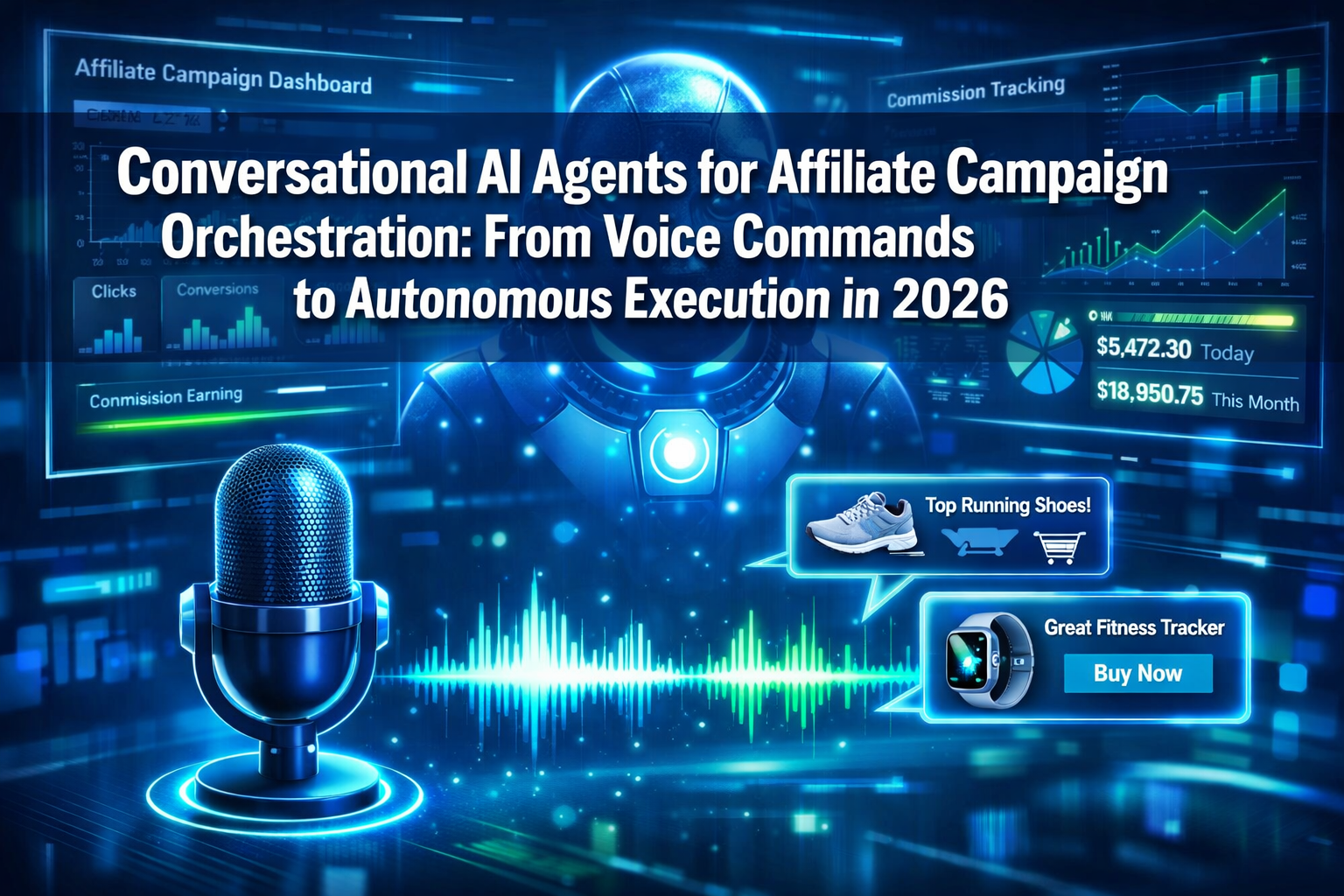
This revolutionary approach combines voice-activated commands with agentic AI systems that independently plan, execute, and optimize affiliate strategies. According to recent industry predictions, by the end of 2026, agentic AI systems will be able to plan, execute, and optimize full marketing campaigns without constant human input[1]. This shift from reactive to proactive AI fundamentally changes how affiliate marketers operate, enabling unprecedented scale and efficiency.
Key Takeaways
- Voice-to-execution workflows enable affiliate marketers to launch campaigns through natural language commands, reducing setup time from hours to minutes
- Agentic AI systems autonomously handle media buying, creative optimization, and budget allocation across multiple affiliate networks with minimal human intervention
- Gartner predicts 10% of agent interactions will be automated by 2026, up from just 1.6% today, reflecting rapid adoption in business workflows[3]
- Strategic human oversight remains critical for maximizing commissions while mitigating automation risks through approval gates and performance thresholds
- API-based affiliate aggregators like ChatAds enable real-time optimization across multiple networks through single integrations with sub-500ms response times[2]
Understanding Conversational AI Agents for Affiliate Campaign Orchestration in 2026
What Are Conversational AI Agents?
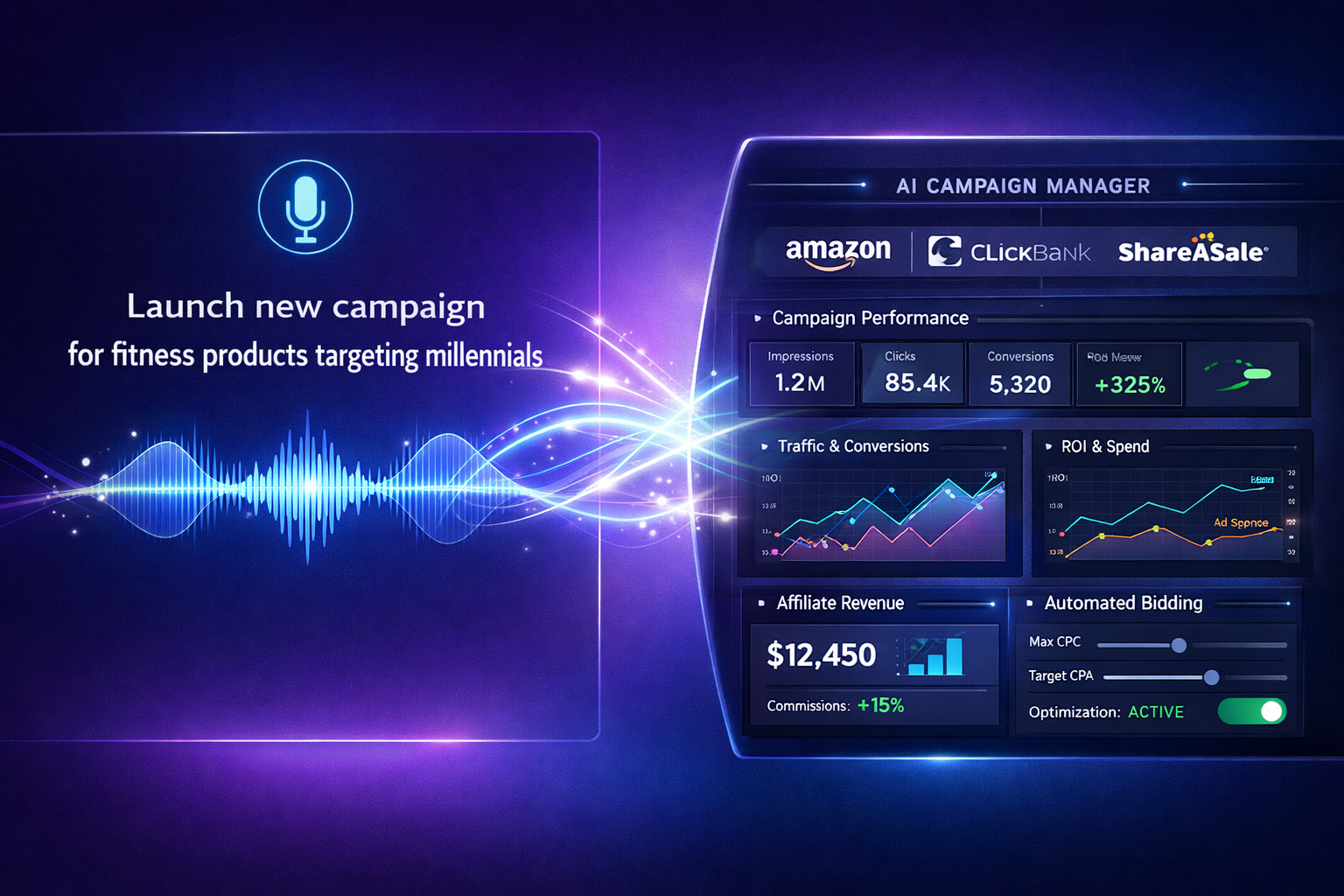
Conversational AI agents represent a quantum leap beyond traditional chatbots. These sophisticated systems understand context, maintain conversation history, and most importantly, take autonomous action based on natural language instructions. In the affiliate marketing opportunities space, this means transforming a simple voice command like "Launch a campaign for fitness supplements targeting millennials" into a fully executed strategy.
The technology powering these agents combines:
- Natural Language Processing (NLP) for understanding complex instructions
- Machine Learning models that learn from past campaign performance
- API integrations connecting to affiliate networks, ad platforms, and analytics tools
- Decision-making algorithms that optimize in real-time without human input
The Shift from Manual to Autonomous Execution
Traditional affiliate campaign management requires dozens of manual steps: researching products, selecting affiliate networks, creating ad copy, setting budgets, monitoring performance, and adjusting bids. Conversational AI Agents for Affiliate Campaign Orchestration: From Voice Commands to Autonomous Execution in 2026 eliminates this friction.
Consider this workflow comparison:
| Traditional Method | AI Agent Method |
|---|---|
| 4-6 hours setup time | 5-10 minutes voice commands |
| Manual network logins | Single API integration |
| Static targeting rules | Dynamic real-time optimization |
| Weekly performance reviews | Continuous autonomous adjustments |
| Limited to 2-3 campaigns simultaneously | Manage 20+ campaigns in parallel |
The autonomous nature of these systems is particularly powerful. Rather than waiting for marketers to spot trends and make adjustments, AI agents proactively identify opportunities and execute changes. This capability has driven impressive results—74% of small contact centers report positive feedback on AI's role in revenue growth, not merely from cost savings but from improved customer experiences and faster response times[3].
Real-World Applications in Affiliate Marketing
Modern conversational AI agents excel at several critical affiliate marketing tasks:
Product Recommendation Optimization: AI systems analyze real-time behavioral signals including page views, review duration, and click history to dynamically serve uniquely relevant product recommendations to individual visitors[4]. This hyper-personalization dramatically increases conversion rates compared to static affiliate links.
Multi-Network Campaign Management: Platforms like ChatAds operate as affiliate aggregators, connecting chatbots to multiple affiliate networks through a single API with sub-500ms response times[2]. This enables marketers to test products across Amazon Associates, ClickBank, ShareASale, and CJ Affiliate simultaneously without managing separate integrations.
Conversation Intelligence for Optimization: Marketing teams can transform sales call data into actionable signals through conversation intelligence agents that identify objections, competitor mentions, and messaging gaps—feeding insights directly into affiliate campaign optimization[5]. This creates a feedback loop where customer conversations directly improve campaign performance.
For those exploring how to do affiliate marketing effectively in 2026, understanding these AI capabilities is no longer optional—it's foundational.
How Voice Commands Transform into Autonomous Campaign Execution
The Natural Language to Action Pipeline
The magic of Conversational AI Agents for Affiliate Campaign Orchestration: From Voice Commands to Autonomous Execution in 2026 lies in the sophisticated pipeline that translates casual speech into precise marketing actions. Here's how the process unfolds:
Step 1: Intent Recognition
When a marketer says, "Create a campaign promoting kitchen appliances for home cooks with a $500 daily budget," the AI agent parses multiple elements:
- Campaign objective (promotion)
- Product category (kitchen appliances)
- Target audience (home cooks)
- Budget constraint ($500/day)
Step 2: Strategy Formulation
The agent autonomously determines:
- Which affiliate networks offer the best commission rates for kitchen products
- Optimal ad platforms based on audience demographics
- Creative angles most likely to convert (recipe inspiration vs. product reviews)
- Bidding strategies to maximize ROI within budget constraints
Step 3: Execution Across Platforms
Without further input, the system:
- Generates ad creative variations using AI copywriting
- Sets up tracking pixels and affiliate links with proper attribution
- Launches campaigns across selected platforms
- Implements A/B testing protocols
Step 4: Autonomous Optimization
As data flows in, the agent continuously:
- Adjusts bids based on performance
- Pauses underperforming creative variants
- Scales winning combinations
- Reallocates budget to highest-converting segments
API Integrations Powering Seamless Orchestration
The backbone of autonomous execution is robust API connectivity. ChatAds, for example, specifically targets multi-tenant chat platforms requiring universal monetization, handling B2C chatbots with 100+ daily conversations that lack direct brand partnerships[2]. This approach solves a critical challenge: enabling affiliate monetization at scale without manual network management.
Key API capabilities include:
✅ Real-time product data: Amazon's Product Advertising API enables AI chatbots to pull live pricing, availability, ratings, and imagery while maintaining affiliate tracking through deep-linking with unique tracking IDs[2]
✅ Commission passthrough: Advanced platforms retain user affiliate accounts with 100% commission passthrough, charging only for API usage rather than taking a percentage of earnings[2]
✅ Performance analytics: Unified reporting across networks provides the data foundation for autonomous optimization decisions
For marketers interested in affiliate marketing course online options, understanding API-first architectures is increasingly essential.
Case Study: Voice-Activated Campaign Launch
A practical example demonstrates the power of this technology. An affiliate marketer working in the B2B SaaS space issues this voice command:
"Launch a campaign for project management software targeting small business owners, focus on productivity benefits, use my top three performing landing pages, allocate $1,000 weekly budget, and notify me if cost-per-acquisition exceeds $150."
Within minutes, the AI agent:
- Identifies relevant B2B affiliate programs (offering 20-30% recurring commissions—significantly higher than consumer programs)[2]
- Creates targeted ad copy emphasizing productivity ROI
- Sets up campaigns across LinkedIn and Google Ads
- Implements the specified CPA threshold as an automatic pause trigger
- Schedules weekly performance reports
This level of automation was science fiction just two years ago. Today, it's becoming standard practice for sophisticated affiliate operations leveraging AI marketing strategies.
Balancing Automation with Human Oversight for Maximum Commissions
The Critical Role of Strategic Human Intervention
While autonomous execution offers tremendous efficiency, Conversational AI Agents for Affiliate Campaign Orchestration: From Voice Commands to Autonomous Execution in 2026 must be balanced with strategic human oversight to maximize commissions and minimize risks. Complete automation without guardrails can lead to budget overruns, brand misalignment, or missed strategic opportunities.
The optimal approach implements tiered automation with human approval gates:
Tier 1: Full Autonomy (70-80% of decisions)
- Bid adjustments within predefined ranges
- Creative variant testing
- Budget reallocation among proven channels
- Pause/resume decisions based on performance metrics
Tier 2: Notification + Override Window (15-20% of decisions)
- New channel expansion
- Budget increases beyond thresholds
- Significant strategy pivots
- Partnership opportunities requiring negotiation
Tier 3: Required Human Approval (5-10% of decisions)
- Brand partnership agreements
- Major budget commitments
- Strategic direction changes
- Legal/compliance considerations
This framework ensures AI agents handle routine optimization while humans focus on high-value strategic decisions that require judgment, creativity, and relationship management.
Implementing Performance Guardrails
Successful affiliate marketers using conversational AI agents establish clear performance boundaries:
Budget Controls
- Daily spending caps per campaign
- Automatic pause triggers when CPA exceeds targets
- Alerts for unusual spending patterns
Quality Thresholds
- Minimum conversion rate requirements
- Brand safety filters preventing inappropriate placements
- Compliance checks for regulated industries
ROI Monitoring
- Real-time commission tracking
- Profitability alerts when margins compress
- Automatic scaling of high-performing campaigns
Platforms like Verloop demonstrate this balance effectively, featuring smooth agent-to-human handoff systems with campaign automation that automatically reaches out to customers with personalized, behavior-triggered messages while maintaining human oversight for complex scenarios[3].
Maximizing Commissions Through Hybrid Intelligence
The highest-earning affiliate marketers in 2026 don't choose between AI and human expertise—they strategically combine both. Here's how:
AI Handles: Data analysis, pattern recognition, routine optimization, multi-variate testing, real-time bidding, performance monitoring
Humans Handle: Strategic positioning, creative direction, relationship building, negotiation, brand alignment, emerging opportunity identification
This division of labor allows marketers to manage significantly larger campaign portfolios. Where a skilled affiliate marketer might manually optimize 3-5 campaigns effectively, AI-augmented marketers successfully orchestrate 20-30 campaigns simultaneously while maintaining or improving performance.
For those exploring 5 must-have tools for affiliate marketers, conversational AI agents increasingly top the list alongside traditional analytics and tracking platforms.
Risk Mitigation Strategies
To avoid common pitfalls of over-automation:
🛡️ Start with limited autonomy: Begin with AI handling 40-50% of decisions, gradually increasing as you build confidence in system performance
🛡️ Implement anomaly detection: Set up alerts for unusual patterns that might indicate technical issues or market changes
🛡️ Maintain manual override capability: Ensure you can instantly pause or redirect campaigns regardless of AI recommendations
🛡️ Regular strategy reviews: Schedule weekly human-led reviews of overall campaign direction, even when daily optimization is automated
🛡️ Diversification requirements: Program agents to maintain portfolio diversity rather than over-concentrating in single products or channels
Advanced Strategies for Conversational AI Campaign Orchestration
Multi-Modal Command Interfaces
The most sophisticated implementations of Conversational AI Agents for Affiliate Campaign Orchestration: From Voice Commands to Autonomous Execution in 2026 support multiple interaction methods:
- Voice commands for quick adjustments and strategy changes
- Text-based chat for detailed instructions and documentation
- Visual dashboards for performance monitoring and approval workflows
- Email integration for automated reporting and exception handling
This multi-modal approach accommodates different working styles and contexts. A marketer might use voice commands while commuting, switch to text chat for detailed campaign specifications at their desk, and review visual dashboards during team meetings.
Competitive Intelligence Integration
Advanced conversational AI agents now incorporate LLM-powered competitor analysis capabilities, automatically monitoring:
- Competitor affiliate offers and commission structures
- Market positioning and messaging strategies
- Pricing changes and promotional patterns
- New product launches in your niche
This intelligence feeds directly into campaign optimization, enabling your AI agent to proactively adjust strategies in response to competitive moves without waiting for human analysis.
Seasonal and Trend-Based Autonomous Scaling
Recent AI affiliate marketing resources demonstrate practical models using tools including Claude, ChatGPT, and specialized keyword research platforms for content production, claiming viability for six-figure affiliate earnings without paid advertising[6]. These approaches leverage AI's ability to:
- Predict seasonal demand fluctuations
- Automatically scale budgets ahead of high-conversion periods
- Identify emerging trends before they peak
- Adjust messaging to align with current events and cultural moments
For instance, an AI agent managing kitchen appliance promotions might autonomously increase budget allocation for air fryers in January (New Year's resolution season) and slow cookers in October (holiday preparation), all without explicit instructions.
Cross-Channel Attribution and Optimization
Modern conversational AI agents excel at solving attribution challenges that plague affiliate marketing. By tracking user journeys across multiple touchpoints—social media, search ads, content sites, email—these systems:
- Properly credit assist conversions, not just last-click
- Optimize budget allocation based on true contribution to conversions
- Identify synergies between channels that amplify overall performance
This holistic view enables more sophisticated strategies than single-channel optimization ever could, particularly valuable for content that converts across multiple distribution channels.
Conclusion: Embracing the Future of Affiliate Campaign Management
Conversational AI Agents for Affiliate Campaign Orchestration: From Voice Commands to Autonomous Execution in 2026 represents more than incremental improvement—it's a fundamental transformation of how affiliate marketing operates. The ability to translate natural language instructions into fully executed, continuously optimized campaigns eliminates traditional bottlenecks and enables unprecedented scale.
The data supports this transformation: with Gartner predicting 10% of agent interactions automated by 2026[3] and 74% of businesses reporting positive revenue impact from AI implementation[3], early adopters gain significant competitive advantages. The commission passthrough models and API-first architectures now available make this technology accessible to marketers at all levels, not just enterprise operations.
Actionable Next Steps
Ready to implement conversational AI agents in your affiliate marketing? Follow these steps:
- Audit your current workflow: Identify repetitive tasks consuming 2+ hours weekly that AI could automate
- Start with one campaign: Test conversational AI on a single, well-understood campaign before scaling
- Establish clear guardrails: Define budget limits, performance thresholds, and approval requirements before granting autonomy
- Choose the right platform: Evaluate API capabilities, commission structures, and network coverage for your niche
- Implement gradual autonomy: Begin with 40-50% automation, increasing as you build confidence and optimize prompts
- Monitor and refine: Review AI decisions weekly, identifying patterns where human judgment adds value
- Scale systematically: Once proven on one campaign, expand to additional products and channels methodically
The affiliate marketers thriving in 2026 aren't those who resist AI automation—they're the ones who strategically harness it while maintaining human oversight where judgment, creativity, and relationships matter most. The technology exists today. The question is whether you'll lead or follow this transformation.
For those ready to dive deeper, explore our comprehensive guides on affiliate marketing opportunities and digital marketing strategies to build the foundational knowledge that complements AI-powered execution.
The future of affiliate marketing isn't fully human or fully automated—it's the strategic partnership between human creativity and AI execution that unlocks exponential growth. 🎯
References
[1] Ai Predictions Marketing – https://blog.hubspot.com/marketing/ai-predictions-marketing
[2] Best Affiliate Networks Ai Chatbots – https://www.getchatads.com/blog/best-affiliate-networks-ai-chatbots/
[3] Best Conversational Ai Agents – https://sintra.ai/blog/best-conversational-ai-agents
[4] Ai Affiliate Marketing – https://www.linkjolt.io/blog/ai-affiliate-marketing
[5] Complete Ai Agents Guide For Marketing – https://www.vellum.ai/blog/complete-ai-agents-guide-for-marketing
[6] Watch – https://www.youtube.com/watch?v=NtQyiquUioA