

{"cover":"Professional landscape format (1536x1024) editorial hero image featuring bold text overlay 'Conversational Commerce in Voice AI: Optimizing Affiliate Offers for Twilio and Intercom Agents' in extra large 72pt white sans-serif font with dark gradient shadow, centered in upper third. Background shows futuristic AI interface with voice waveforms, chat bubbles, and holographic affiliate conversion funnels overlaying a modern tech workspace. Visual elements include Twilio and Intercom branded interface mockups, intent detection graphs, and commission tracking dashboards. Color scheme: deep purple, electric blue, white, and neon green accents. High contrast, magazine cover quality, cutting-edge technology aesthetic with professional polish and dynamic composition showing voice AI agents processing customer conversations","content":["Detailed landscape format (1536x1024) illustration showing voice-first affiliate funnel architecture with Twilio Voice AI integration. Visual includes flowchart diagram with voice call entry points, intent detection nodes highlighted in blue, branching conversation paths with decision trees, and affiliate offer presentation moments marked with dollar signs. Interface mockups show Twilio Studio canvas with connected nodes, real-time transcription panels, and sentiment analysis meters. Background features code snippets for webhook configurations and API integrations. Color palette: Twilio red accents, professional navy blue, white backgrounds, green conversion indicators. Clean technical diagram aesthetic with annotations and callout boxes explaining upsell trigger points","Comprehensive landscape format (1536x1024) dashboard visualization displaying conversion tracking metrics for voice and chat commerce journeys. Split-screen composition showing Intercom Fin chat interface on left with highlighted affiliate product recommendations and customer intent signals, Twilio voice analytics dashboard on right with call duration graphs, conversion rate percentages, and revenue attribution charts. Central section displays unified funnel visualization with drop-off points, A/B test results comparing voice versus chat conversion rates, and ROI metrics showing 3.7x returns. Visual includes heat maps of successful conversation patterns, commission payout timelines, and performance benchmarks. Modern analytics aesthetic with data visualization best practices, purple and teal gradient accents, professional business intelligence styling"]}
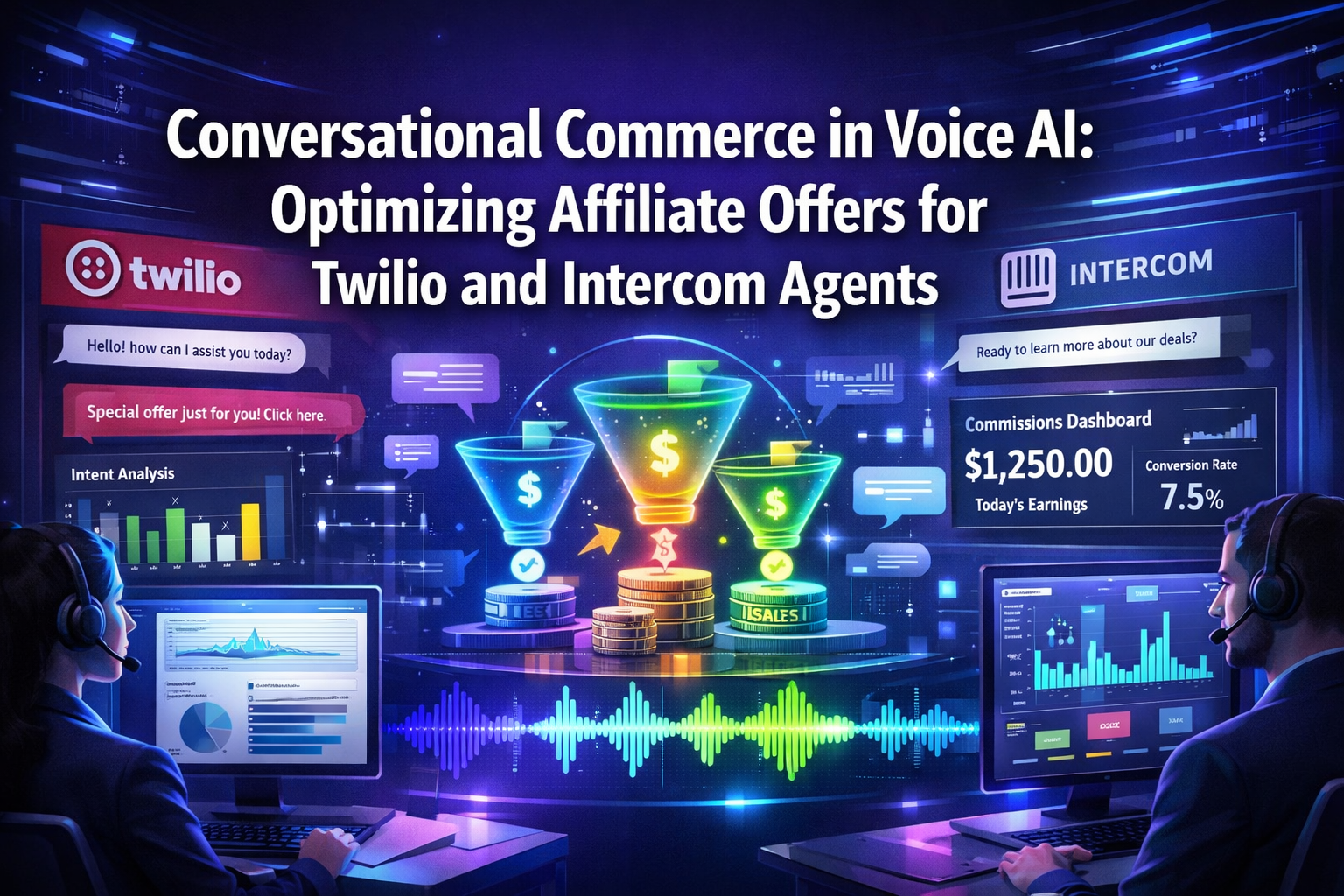
Voice technology is transforming how businesses sell products and services in 2026. Conversational Commerce in Voice AI: Optimizing Affiliate Offers for Twilio and Intercom Agents represents the cutting edge of automated sales—where intelligent systems handle customer conversations and recommend products without human intervention. This revolution combines the power of platforms like Twilio Voice AI and Intercom Fin with affiliate marketing strategies to create seamless, revenue-generating customer experiences.
The numbers tell a compelling story. One in ten customer service interactions will be fully automated by agentic voice AI by 2026, with organizations reporting 3.7x return on investment for every dollar invested in voice AI solutions [1]. For affiliate marketers and businesses alike, this presents an unprecedented opportunity to scale conversions through intelligent, voice-first sales funnels.
Key Takeaways
- 🎯 Voice AI systems can detect customer intent in real-time, enabling perfectly timed affiliate product recommendations during natural conversations
- 💰 ROI metrics show 3.7x returns on voice AI investments, making conversational commerce a profitable channel for affiliate offers [1]
- 🔧 Twilio and Intercom platforms provide robust tools for building voice-first affiliate funnels with intent detection, upsell prompts, and conversion tracking
- 📊 Enterprise adoption is accelerating, with 23% of organizations already scaling agentic AI systems and 39% actively experimenting [1]
- 🌍 Multi-language support across 20+ languages enables global affiliate campaigns with sophisticated dialect recognition [1]
Understanding Voice-First Affiliate Funnels
What Makes Voice Commerce Different
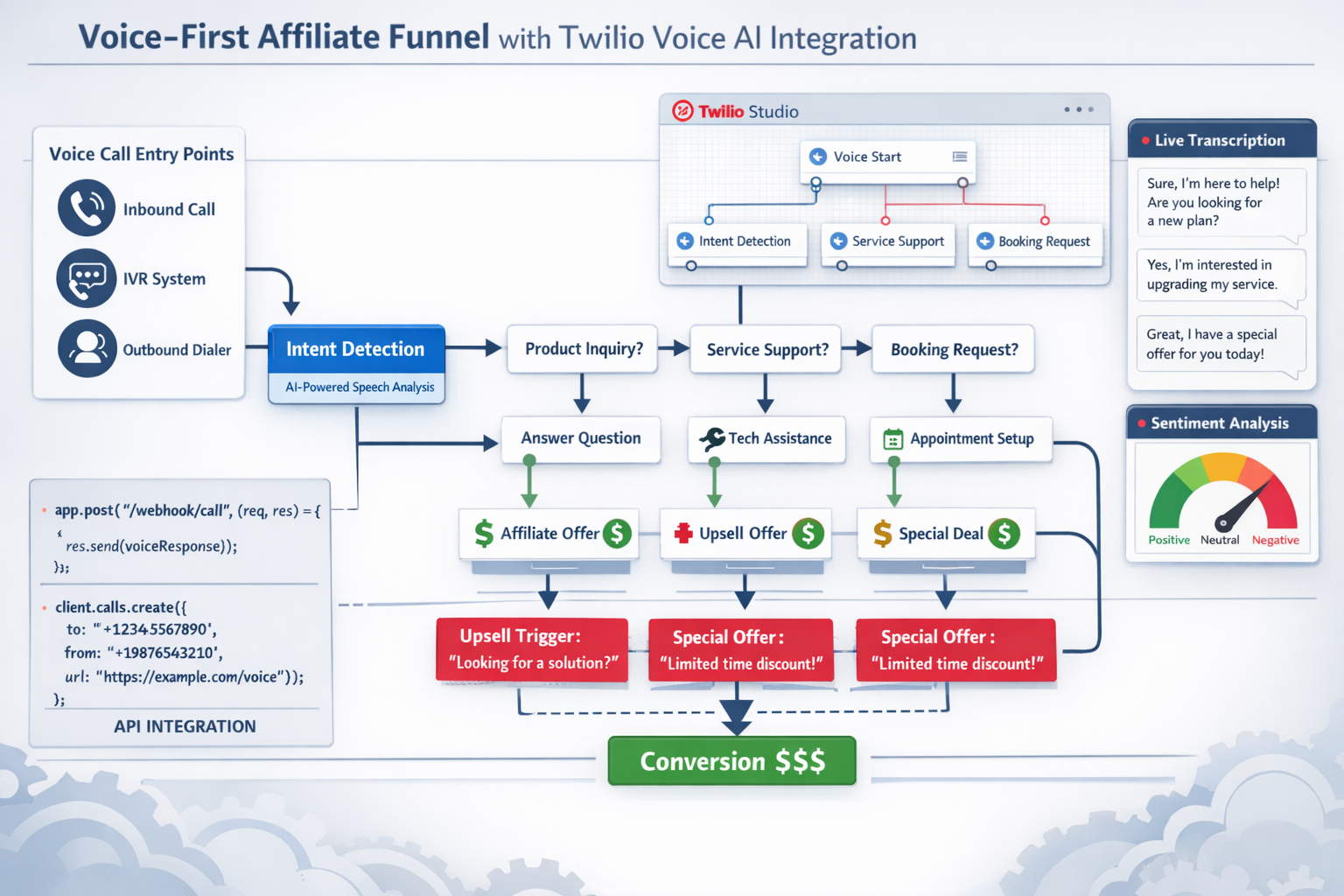
Traditional affiliate marketing relies on clicks, banners, and written content. Voice commerce flips this model entirely. Instead of customers reading product descriptions and clicking links, they engage in natural conversations where AI agents understand needs, answer questions, and recommend solutions—all while seamlessly integrating affiliate offers.
Voice-first affiliate funnels leverage conversational AI to:
- Detect customer intent through natural language processing
- Identify buying signals in real-time conversations
- Present relevant affiliate offers at optimal moments
- Track conversions through voice and chat interactions
- Optimize recommendations based on conversation patterns
The intelligent contact center market is expanding at a compound annual growth rate of 18.66% from 2025 to 2030, signaling massive opportunity for affiliate marketers who adapt to this channel [2].
The Technology Stack: Twilio and Intercom
Twilio Voice AI provides the infrastructure for building intelligent voice agents that can:
- Handle inbound and outbound calls at scale
- Process natural language with advanced speech recognition
- Route conversations based on detected intent
- Integrate with affiliate tracking systems via webhooks
Intercom Fin specializes in chat-based conversational AI that:
- Engages customers across messaging channels
- Provides instant answers using knowledge base integration
- Recommends products based on conversation context
- Tracks customer journeys from first message to conversion
Together, these platforms create a comprehensive conversational commerce ecosystem where affiliate offers can be optimized across both voice and text channels.
Building Intent Detection Systems for Affiliate Offers
Identifying Buying Signals in Conversations
The foundation of successful Conversational Commerce in Voice AI: Optimizing Affiliate Offers for Twilio and Intercom Agents lies in accurate intent detection. Modern voice AI systems can detect frustration, urgency, and satisfaction, reducing agent escalations by 25% [1]. This same emotional intelligence applies to identifying purchase intent.
Key buying signals to detect:
| Signal Type | Voice Indicators | Chat Indicators | Affiliate Action |
|---|---|---|---|
| Problem Statement | "I'm struggling with…" | "Need help with…" | Present solution-based offer |
| Comparison Shopping | "What's better than…" | "X vs Y?" | Recommend premium affiliate product |
| Price Inquiry | "How much does…" | "Cost of…" | Introduce tiered pricing options |
| Urgency | Stressed tone, fast speech | "ASAP", "urgent" | Limited-time affiliate offers |
| Research Phase | Multiple questions | Detailed inquiries | Educational content with soft sell |
Enterprise-grade voice AI is approaching 85% accuracy rates when properly implemented, making intent detection reliable enough for automated affiliate recommendations [1].
Configuring Twilio Studio for Intent-Driven Routing
Twilio Studio provides a visual workflow builder where you can design conversation paths that respond to detected intent:
- Create intent classification webhooks that analyze customer speech in real-time
- Build branching logic that routes to different affiliate offer presentations
- Set up dynamic content variables that personalize product recommendations
- Configure fallback paths for low-confidence intent detection
- Implement A/B testing splits to optimize conversion rates
For those getting started with affiliate marketing, Twilio's free tier allows testing these concepts before scaling to production.
Training Intercom Fin for Product Recommendations
Intercom Fin uses machine learning to understand customer needs through chat conversations. To optimize for affiliate offers:
- Build comprehensive knowledge bases that include affiliate product information
- Tag conversations with intent labels to improve recommendation accuracy
- Create custom bot workflows that present offers at natural conversation breaks
- Set up qualification questions that gather information before recommendations
- Monitor conversation analytics to identify successful recommendation patterns
The system learns from each interaction, continuously improving its ability to match customers with relevant affiliate products.
Designing Upsell Prompts That Convert
The Psychology of Voice-Based Selling
Voice conversations create different psychological dynamics than text-based interactions. The human-like quality of modern AI voices (even when customers know they're speaking with AI) triggers social responses that can increase receptivity to offers.
Effective voice upsell principles:
✅ Timing is everything – Present offers after solving a problem or answering a question
✅ Frame as recommendations – "Based on what you've shared, customers also find value in…"
✅ Use social proof – "Our most popular solution for this is…"
✅ Keep it conversational – Avoid sounding scripted or pushy
✅ Provide clear value – Explain benefits before mentioning price
"Average conversations with AI agents now last 11 minutes, resolving issues that previously required multiple human touchpoints." [1]
This extended engagement time provides multiple opportunities for natural affiliate offer integration.
Crafting Multi-Touch Upsell Sequences
Rather than single-shot pitches, design conversation journeys with multiple touchpoints:
Early conversation (Awareness):
- Mention solutions casually while addressing primary need
- Build credibility through helpful information
- Avoid direct selling
Mid-conversation (Consideration):
- Present specific product recommendations
- Highlight features relevant to stated needs
- Offer comparison information if requested
Late conversation (Decision):
- Provide special offers or limited-time incentives
- Address objections with additional information
- Facilitate easy purchase or follow-up
Post-conversation (Retention):
- Send follow-up messages with additional resources
- Provide complementary product recommendations
- Track engagement for future conversations
This approach aligns with how affiliate marketing actually works—building trust before asking for conversions.
Personalization Variables and Dynamic Content
Both Twilio and Intercom support dynamic content insertion based on:
- Customer data – Name, location, previous purchases, browsing history
- Conversation context – Problems mentioned, questions asked, sentiment detected
- Behavioral signals – Time of day, device type, engagement level
- Segmentation tags – Customer tier, industry, company size
Example personalized upsell script:
"Hi [Name], since you're looking for [stated need], many [customer segment] professionals in [location] have found success with [affiliate product]. It specifically addresses [mentioned problem] and typically delivers results within [timeframe]. Would you like me to share more details?"
Conversion Tracking in Voice and Chat Journeys
Setting Up Attribution Systems
Tracking conversions from conversational commerce requires different approaches than traditional affiliate marketing. The customer journey spans multiple channels and touchpoints, making attribution complex.
Essential tracking components:
🔹 Unique conversation IDs – Assign each interaction a trackable identifier
🔹 Webhook integrations – Send conversion events to affiliate networks in real-time
🔹 Custom parameters – Pass conversation metadata to affiliate tracking URLs
🔹 Multi-touch attribution – Credit conversions across voice, chat, and follow-up channels
🔹 Session recording – Store conversation transcripts for quality analysis
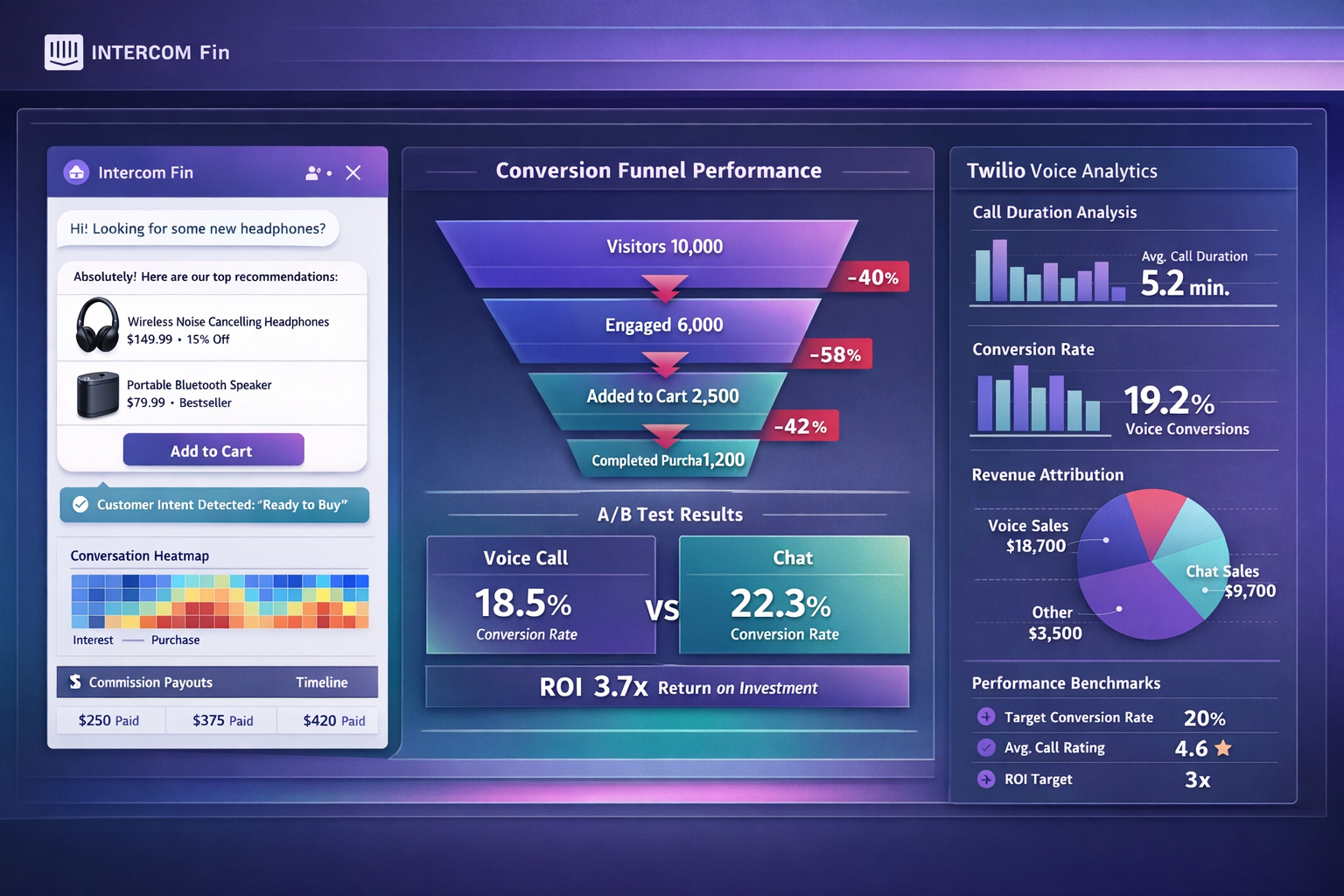
Twilio provides comprehensive APIs for capturing call data, while Intercom's event tracking enables detailed chat analytics. Connecting these to affiliate networks requires middleware that translates conversation events into trackable conversions.
Key Performance Metrics for Voice Affiliate Campaigns
Monitor these metrics to optimize Conversational Commerce in Voice AI: Optimizing Affiliate Offers for Twilio and Intercom Agents:
| Metric | Definition | Target Benchmark | Optimization Strategy |
|---|---|---|---|
| Intent Detection Accuracy | % of correctly identified customer needs | >80% | Improve training data, refine NLP models |
| Offer Presentation Rate | % of conversations including affiliate offers | 40-60% | Adjust triggering logic, reduce false positives |
| Conversion Rate | % of presented offers resulting in sales | 5-15% | Test offer timing, improve personalization |
| Average Order Value | Revenue per converted conversation | Varies by niche | Introduce higher-tier products, bundle offers |
| Cost Per Conversion | AI costs + infrastructure / conversions | <30% of commission | Optimize conversation length, reduce API calls |
| Customer Satisfaction | Post-conversation rating | >4.2/5 | Balance selling with helpfulness |
Organizations implementing voice AI solutions are reporting 3.7x return on investment for every dollar invested [1], but individual campaign performance varies based on implementation quality.
A/B Testing Conversation Flows
Continuous optimization requires systematic testing of conversation elements:
Test variables:
- Offer presentation timing (early vs. late in conversation)
- Language formality (casual vs. professional tone)
- Recommendation quantity (single product vs. multiple options)
- Price disclosure timing (upfront vs. after benefits)
- Call-to-action phrasing (direct vs. consultative)
Twilio Studio and Intercom both support traffic splitting for A/B tests. Run tests for at least 100 conversations per variant to achieve statistical significance, then implement winning variations while continuing to test new hypotheses.
Advanced Strategies for Conversational Commerce in Voice AI
Emotional Intelligence and Sentiment-Based Offers
Modern voice systems can detect frustration, urgency, and satisfaction in real-time [1]. This emotional intelligence enables sophisticated offer optimization:
High satisfaction detected:
- Present premium affiliate products
- Introduce complementary solutions
- Request referrals or reviews
Frustration detected:
- Focus on problem-solving before selling
- Offer money-back guarantees
- Provide exceptional value propositions
Urgency detected:
- Highlight immediate availability
- Emphasize fast implementation
- Offer expedited support options
This emotional responsiveness increases conversion rates while maintaining positive customer experiences.
Multi-Language Affiliate Campaigns
Leading voice AI platforms now support 20+ languages natively with sophisticated dialect recognition, and 73% of consumers prioritize AI that correctly understands their accents [1]. This enables global affiliate campaigns with localized offers.
Implementation considerations:
- Partner with affiliate programs offering international products
- Adapt conversation scripts for cultural norms
- Test intent detection accuracy across languages
- Localize pricing and payment options
- Comply with regional advertising regulations
The job market reflects this expansion—42% of organizations are expected to hire for AI-focused customer experience roles, including conversational AI designers, by 2026 [2].
Integration with Existing Marketing Funnels
Voice AI agents shouldn't operate in isolation. Connect conversational commerce to broader affiliate marketing strategies:
Pre-conversation touchpoints:
- Retarget website visitors with voice callback offers
- Use email campaigns to drive chat conversations
- Promote voice consultation services through social media
Post-conversation nurturing:
- Send conversation summaries with affiliate links
- Trigger email sequences based on detected intent
- Schedule follow-up calls for high-value prospects
Cross-channel consistency:
- Maintain unified messaging across voice, chat, and traditional channels
- Sync customer data between platforms
- Track customer journeys across all touchpoints
This integrated approach maximizes the value of each conversation while building long-term customer relationships.
Implementation Roadmap: Getting Started
Phase 1: Foundation (Weeks 1-4)
Technical setup:
- Create Twilio account and configure Voice API
- Set up Intercom workspace and install Fin
- Select affiliate programs with API-friendly tracking
- Build initial conversation scripts for one product category
Learning objectives:
- Understand platform capabilities and limitations
- Test basic intent detection with simple scenarios
- Establish baseline conversion metrics
- Identify technical integration requirements
For those wondering if you can make money with affiliate marketing, this phase provides early validation of the conversational commerce model.
Phase 2: Optimization (Weeks 5-12)
Refinement activities:
- Analyze conversation transcripts for improvement opportunities
- Implement A/B tests on offer presentation
- Expand to additional product categories
- Improve intent detection accuracy with training data
- Build custom reporting dashboards
Scaling considerations:
- Increase conversation volume gradually
- Monitor infrastructure costs vs. revenue
- Refine targeting to highest-converting customer segments
- Document successful conversation patterns
Phase 3: Scale (Month 4+)
Growth initiatives:
- Launch multi-language campaigns
- Integrate advanced emotional intelligence features
- Expand to additional affiliate verticals
- Implement predictive analytics for proactive outreach
- Build team processes for ongoing optimization
Advanced capabilities:
- Custom AI model training for niche industries
- Omnichannel conversation orchestration
- Predictive lifetime value modeling
- Automated conversation quality assurance
Compliance and Ethical Considerations
Disclosure Requirements
Affiliate relationships must be disclosed even in voice and chat conversations. Implement disclosures that are:
- Clear and conspicuous – Stated before or during offer presentation
- Easily understood – Use plain language appropriate for voice
- Consistently applied – Include in every conversation with affiliate offers
- Compliant with FTC guidelines – Follow current regulations for automated systems
Example disclosure: "Just so you know, if you choose this solution, we may receive a commission from the provider. This doesn't affect your price, and we only recommend products we believe will help you."
Data Privacy and Customer Consent
Voice and chat conversations collect significant customer data. Ensure compliance with:
- GDPR (European customers) – Obtain explicit consent, provide data access/deletion
- CCPA (California customers) – Disclose data collection, honor opt-out requests
- Industry-specific regulations – HIPAA for healthcare, FINRA for finance, etc.
Both Twilio and Intercom provide compliance tools, but implementation responsibility rests with the affiliate marketer.
Balancing Automation with Human Touch
While AI agents handle most conversations, maintain human oversight:
- Monitor conversation quality regularly
- Provide escalation paths for complex situations
- Review edge cases where AI performed poorly
- Update conversation flows based on customer feedback
- Ensure AI represents your brand values accurately
This balance maintains the efficiency benefits of automation while preserving customer trust and satisfaction.
Conclusion
Conversational Commerce in Voice AI: Optimizing Affiliate Offers for Twilio and Intercom Agents represents a fundamental shift in how affiliate marketing operates in 2026. The technology has matured beyond experimental stages—with 23% of organizations already scaling agentic AI systems and proven 3.7x ROI metrics [1]—making this the ideal time to implement voice-first affiliate funnels.
The key to success lies in thoughtful implementation that prioritizes customer value over aggressive selling. When AI agents genuinely help solve problems and recommend relevant solutions, conversions follow naturally. The platforms exist, the market is growing at 18.66% annually [2], and early adopters are establishing competitive advantages that will compound over time.
Next Steps to Get Started:
- Choose your niche – Select affiliate products that solve clear problems suitable for conversational recommendations
- Start with one platform – Begin with either Twilio (for voice-first) or Intercom (for chat-first) before expanding
- Build a simple prototype – Create one conversation flow for one product to test the concept
- Measure everything – Establish tracking before launching to understand what works
- Iterate based on data – Use conversation analytics to continuously improve performance
- Scale what works – Expand successful patterns to additional products and channels
The future of affiliate marketing is conversational, intelligent, and increasingly automated. Those who master Conversational Commerce in Voice AI today will lead the industry tomorrow. Whether you're just starting in affiliate marketing or scaling existing operations, voice AI offers unprecedented opportunities to increase conversions while delivering better customer experiences.
The question isn't whether to adopt conversational commerce—it's how quickly you can implement it effectively. With platforms like Twilio and Intercom providing accessible tools and proven ROI metrics demonstrating viability, the path forward is clear. Start small, test thoroughly, and scale systematically to build a voice-first affiliate business that thrives in 2026 and beyond.
References
[1] Voice Ai Trends Enterprise Adoption Roi – https://nextlevel.ai/voice-ai-trends-enterprise-adoption-roi/
[2] Conversational Ai Statistics – https://www.nextiva.com/blog/conversational-ai-statistics.html