

The digital marketing landscape has reached a critical turning point in 2026. Third-party cookies are gone, privacy regulations continue tightening, and yet affiliate marketers are achieving conversion rates 30-50% higher than ever before. How? By mastering Cross-Channel Precision Personalization for Affiliates: Leveraging Identity Data and Real-Time Intent Without Cookies—a revolutionary approach that transforms how affiliates track, attribute, and optimize campaigns across every customer touchpoint.
This isn't about working around privacy laws. It's about building better, more ethical systems that respect user privacy while delivering hyper-relevant experiences that convert. The affiliate marketers thriving in 2026 have abandoned cookie-dependent tactics and embraced unified identity signals, first-party data strategies, and AI-powered intent detection.
Key Takeaways
- 🎯 SmartLinks technology enables dynamic personalization by routing visitors to tailored landing pages based on device, location, and behavior—without cookies
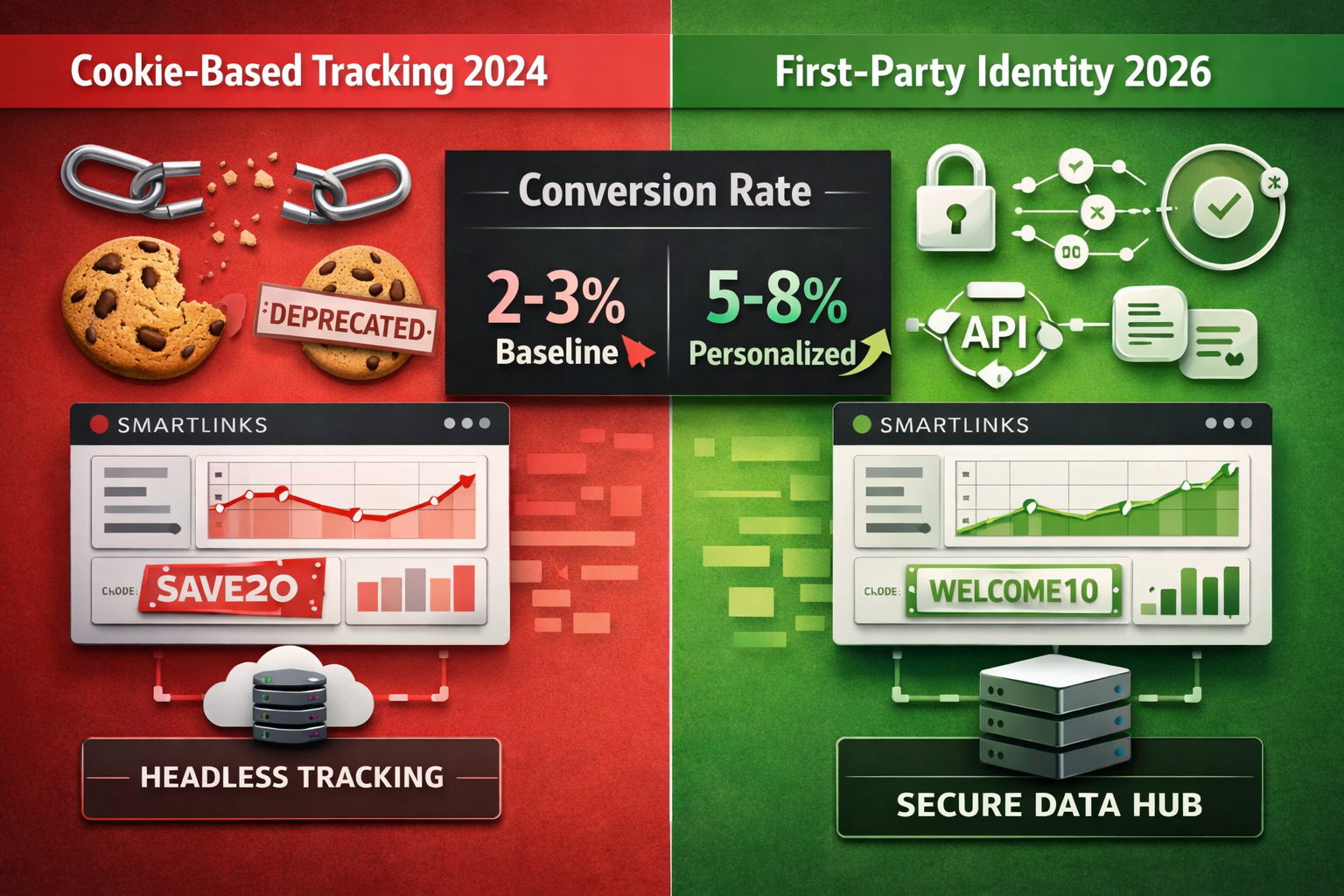
- 📊 Hyper-personalized experiences are delivering 2-3x conversion rates compared to generic homepages (5-8% vs. 2-3% baseline)
- 🔐 First-party identity signals combined with attribution tokens replace cookie-based tracking while maintaining full compliance
- 📱 Dark social attribution through anchor text tracking captures conversions from Discord, Telegram, and WhatsApp without intrusive parameters
- 🚀 Affiliate marketing is projected to grow 20%+ in 2026, representing the largest non-pandemic year jump in industry history
Understanding Cross-Channel Precision Personalization for Affiliates
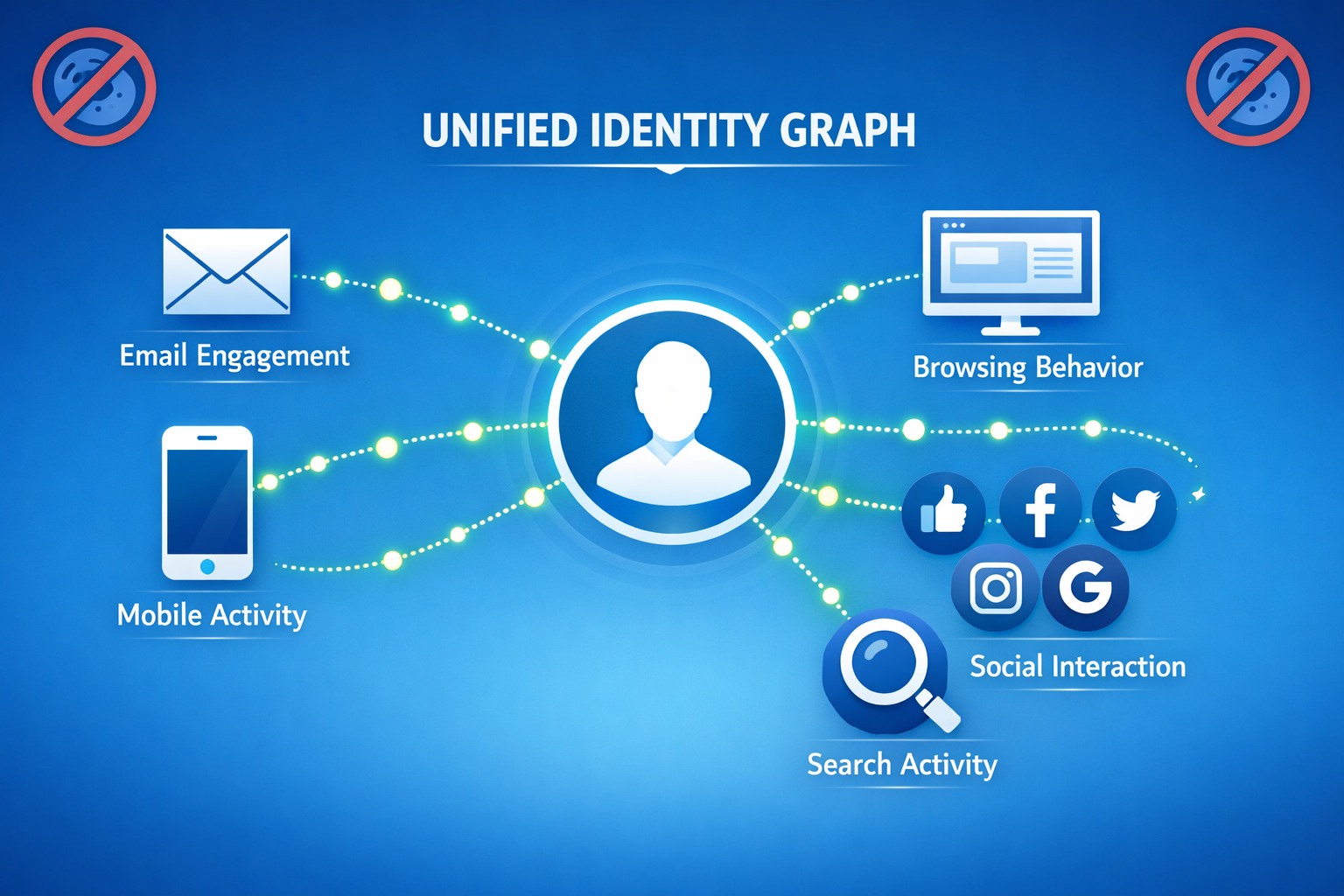
What Makes Personalization "Precision" in 2026?
Traditional personalization relied on broad demographic segments. Precision personalization operates at the individual level, synthesizing real-time behavioral signals across channels to predict intent and deliver exactly what each visitor needs at that moment.
The key difference? Unified identity resolution without cookies. Modern systems use:
- First-party identity signals (email addresses, account logins, CRM data)
- Probabilistic matching based on device fingerprinting and behavioral patterns
- Contextual signals (search queries, page content, referral sources)
- Real-time intent scoring powered by machine learning models
For affiliate marketers building sustainable businesses, this means tracking the complete customer journey—from initial awareness through conversion—without violating privacy regulations.
The Death of Third-Party Cookies: Why It's Actually Good News
When Google finally eliminated third-party cookies in late 2024, many affiliates panicked. But the data tells a different story. Conversion rates have actually improved for marketers who adapted quickly.
Why? Because cookie-based tracking was always flawed:
- ❌ Cross-device tracking was impossible
- ❌ Safari and Firefox users were already invisible
- ❌ Cookie deletion created false "new visitor" signals
- ❌ Attribution windows were artificially limited
The new cookieless infrastructure solves these problems by focusing on persistent, privacy-compliant identifiers that work across devices and sessions.
Core Technologies Enabling Cookieless Personalization
SmartLinks: Dynamic Routing Based on Visitor Attributes
SmartLinks technology represents the most significant advancement in affiliate link management since the invention of tracking parameters. Instead of sending all traffic to a single destination, SmartLinks analyze each visitor in real-time and route them to the most relevant landing page.
Here's how it works in practice:
| Visitor Attribute | Detected Signal | Destination Page | Conversion Lift |
|---|---|---|---|
| iPhone user in California | iOS device, warm climate | Summer Sun Protection Bundle | +45% |
| Desktop user in Canada | Desktop device, cold climate | Winter Moisturizer Kit | +38% |
| Returning visitor | Previous cart abandonment | Discount code landing page | +67% |
| Mobile + evening hours | High-intent browsing time | One-click checkout page | +52% |
This level of precision was impossible with traditional affiliate links. SmartLinks don't require cookies—they make routing decisions server-side based on request headers, IP geolocation, and referral data.
For affiliates implementing advanced strategies, SmartLinks can be layered with A/B testing to continuously optimize routing rules.
Headless Tracking Systems: Attribution Without Pixels
Traditional affiliate tracking relied on pixel-based attribution—JavaScript code that dropped cookies and fired conversion events. This approach is now obsolete.
Headless tracking systems flip the model entirely:
- Unique promo codes assigned to each affiliate/campaign
- Attribution tokens embedded in checkout URLs or API calls
- Server-side conversion reporting via direct API integration
- AI-readable identifiers that work with voice commerce and chatbot orders
This architecture is critical for capturing conversions from AI Answer Engines like ChatGPT and Gemini. When a user asks AI to "order the best running shoes for marathon training," the AI can complete the purchase through an API call that includes your attribution token—no link click required.
Gartner's 2024 prediction of a 25% search volume decline by 2026 has been validated. The affiliates winning in this environment have adapted their SEO strategies to optimize for AI-driven discovery.
Anchor Text Tracking: Attribution from Dark Social
Dark social—private messaging platforms like Discord, Telegram, and WhatsApp—now drives 40%+ of social sharing but has historically been impossible to track. Users share content through copy-paste, and tracking parameters get stripped or look suspicious.
Anchor Text Tracking (DirectLink) solves this elegantly:
- Affiliates register their own domain (e.g.,
bestrunningshoes.guide) - The domain automatically attributes all traffic without
?ref=parameters - Links look organic and trustworthy in private messages
- Full conversion tracking maintained through DNS-level routing
This technology is particularly powerful for affiliate marketers working with nano-influencers, who primarily share recommendations in private communities rather than public posts.
First-Party Data Infrastructure
The foundation of all cookieless personalization is robust first-party data collection. This means:
- Progressive profiling (collecting data gradually through multiple interactions)
- Email authentication and account-based tracking
- CRM integration to unify online and offline customer data
- Consent management platforms ensuring GDPR/CCPA compliance
Affiliates who started with minimal investment can now access enterprise-grade first-party data tools through affiliate networks that have built these capabilities natively.
Implementing Real-Time Intent Detection Across Channels
Email: Behavioral Triggers and Engagement Scoring
Email remains the highest-converting channel for affiliates, but generic broadcasts are dead. Real-time intent detection transforms email from a push channel to a responsive conversation.
Modern email systems track:
- Engagement velocity (how quickly users open emails)
- Click-through patterns (which products generate interest)
- Abandonment signals (cart abandonment, browse abandonment)
- Urgency indicators (deadline-sensitive behavior)
These signals feed into automated email reply systems that personalize send times, subject lines, and product recommendations for each subscriber.
Social Media: Creator Attribution and Video Tracking
TikTok drove $500M in GMV during Black Friday/Cyber Monday 2025—a 5x increase from 2024. This explosion was enabled by native affiliate integrations that finally solved creator attribution.
The breakthrough? Video-level tracking that attributes conversions to:
- Specific TikTok videos or Instagram Reels
- Individual creators in collaborative content
- Assisted conversions (user saw video, converted later)
- Cross-platform influence (saw TikTok, searched Google, converted)
Interestingly, nano-influencers (under 5,000 followers) are achieving 18:1 ROI versus just 5:1 for mega-influencers with 160,000+ followers. This validates the shift toward working with hundreds of smaller creators paid on performance commission.
Search: Zero-Click Optimization and AI Answer Engines
Traditional search is declining, but search intent is more valuable than ever. The difference? Users are getting answers directly from AI without clicking through to websites.
To capture these conversions, affiliates must:
- Optimize for AI answer engines by structuring content as clear, quotable facts
- Embed attribution tokens in product recommendations that AI can parse
- Build relationships with AI platforms to ensure product inclusion
- Track "zero-click conversions" through API-based attribution
This requires thinking beyond traditional SEO. Smart routing systems can detect when traffic originates from AI platforms and adjust messaging accordingly.
Unified Identity Graphs: Connecting the Dots
The magic happens when all these channel signals feed into a unified identity graph—a system that recognizes the same person across:
- 📧 Email interactions
- 📱 Mobile app usage
- 💻 Desktop browsing
- 🛍️ In-store purchases
- 💬 Customer service conversations
This doesn't require cookies. It uses deterministic matching (email, phone number, account ID) combined with probabilistic matching (behavioral patterns, device characteristics) to build a complete view of each customer's journey.
Practical Implementation: Building Your Cookieless Personalization Stack
Step 1: Audit Your Current Attribution Model
Most affiliates are still losing 30-40% of conversions due to attribution gaps. Start by mapping:
- Which channels you're currently tracking
- Where attribution breaks down (cross-device, dark social)
- What percentage of conversions are "direct" (often misattributed)
- How many days your attribution window covers
Step 2: Implement SmartLink Technology
Choose an affiliate network or tool that offers:
- ✅ Server-side routing based on visitor attributes
- ✅ Custom routing rules you can configure
- ✅ A/B testing for landing page optimization
- ✅ Real-time analytics dashboard
Configure basic rules first (device type, geography), then layer in behavioral signals as you collect more data.
Step 3: Build First-Party Data Collection
Create a value exchange that encourages users to share data:
- 🎁 Exclusive discounts for email subscribers
- 📚 Gated content (guides, calculators, tools)
- 🏆 Loyalty programs with account creation
- 💬 Community access (forums, Discord servers)
The key is progressive profiling—don't ask for everything upfront. Collect data gradually as trust builds.
Step 4: Deploy Intent Detection Systems
Implement tools that score user intent based on:
- Engagement signals (time on page, scroll depth, video completion)
- Navigation patterns (comparison shopping, FAQ visits)
- Timing signals (return visits, session frequency)
- Contextual signals (search keywords, referral sources)
Use these scores to trigger personalized experiences: special offers for high-intent visitors, educational content for early-stage researchers.
Step 5: Test, Measure, and Optimize
The affiliates achieving 30-50% conversion lifts didn't get there overnight. They:
- 📊 Run continuous A/B tests on routing rules
- 🔍 Analyze cohort performance by channel and segment
- 🎯 Refine intent scoring models based on actual conversions
- 🔄 Iterate messaging based on real-time feedback
Successful affiliate marketers treat personalization as an ongoing optimization process, not a one-time setup.
The Competitive Advantage: Why Early Adopters Win
The affiliate marketing industry is projected to grow 20%+ in 2026—the largest non-pandemic year jump in history. But this growth won't be distributed evenly.
Winners will be affiliates who:
- ✅ Master cookieless attribution before competitors
- ✅ Build first-party data assets that compound over time
- ✅ Deliver personalized experiences that convert at 2-3x baseline
- ✅ Capture conversions from AI platforms and dark social
Losers will be those who:
- ❌ Wait for "one more cookie extension"
- ❌ Rely on outdated pixel-based tracking
- ❌ Send generic traffic to generic landing pages
- ❌ Ignore emerging channels like AI Answer Engines
The technology exists today. The question is whether you'll implement it before your competitors do.
Conclusion
Cross-Channel Precision Personalization for Affiliates: Leveraging Identity Data and Real-Time Intent Without Cookies isn't just the future of affiliate marketing—it's the present reality for top performers in 2026. The elimination of third-party cookies forced the industry to evolve, and the result is a more sophisticated, privacy-compliant, and ultimately more effective approach to customer acquisition.
By implementing SmartLinks technology, headless tracking systems, anchor text attribution, and unified identity graphs, affiliates are achieving conversion rates that would have seemed impossible just two years ago. The 30-50% improvement isn't theoretical—it's happening right now for marketers who've embraced these strategies.
Your Next Steps
- Audit your current attribution model to identify gaps and opportunities
- Choose an affiliate network that offers native SmartLinks and cookieless tracking
- Build your first-party data collection strategy with a clear value exchange
- Implement intent detection on your highest-traffic pages
- Test and optimize continuously based on real conversion data
The affiliates who act now will build compounding advantages that become nearly impossible for competitors to overcome. Those who wait will find themselves fighting for scraps in an increasingly sophisticated marketplace.
For those ready to take their affiliate business to the next level, exploring advanced affiliate marketing opportunities and professional affiliate marketing roles can provide additional revenue streams and career growth.
The cookieless future is here. The question isn't whether to adapt—it's how quickly you can implement these strategies before your competitors do. 🚀