

{"cover":"Professional landscape format (1536x1024) hero image featuring bold text overlay 'Design Taste as Affiliate Moat: Standing Out in the 2026 AI-Native Creative Flood' in extra large 72pt white sans-serif font with dark gradient shadow, positioned in upper third. Background shows split-screen composition: left side displays generic AI-generated content flooding a screen (repetitive, bland designs), right side shows curated, distinctive creative work with human touch (vibrant colors, unique layouts, emotional resonance). Color scheme: deep purple, electric blue, gold accents. High contrast, magazine cover quality, editorial style with subtle texture overlay representing the divide between commodity and premium creative work.","content":["Landscape format (1536x1024) editorial illustration showing a visual comparison chart titled 'The Taste Spectrum in 2026'. Left column displays stack of identical AI-generated affiliate content (same fonts, stock photos, generic layouts) labeled 'Commodity Creative - $0 Value'. Right column shows curated, distinctive designs with unique typography, authentic photography, cultural relevance, labeled 'Taste-Driven Creative - Premium Pricing'. Center features upward-trending graph with golden line showing pricing power correlation to design taste level. Include visual elements: color palettes, typography samples, composition frameworks. Professional infographic style with clean hierarchy, data visualization, affiliate marketing context, modern business aesthetic.","Landscape format (1536x1024) detailed visual workflow diagram titled '10 Practical Taste-Building Exercises for Affiliates'. Shows circular process flow with numbered stations: curator's notebook with mood boards, A/B testing dashboard comparing designs, cultural trend analysis screens, brand voice development workshop, restraint practice examples (minimal vs maximal), human-AI collaboration workspace showing prompt engineering, authenticity audit checklist, multi-sensory experience planning board, personalization at scale vector diagram, premium positioning strategy map. Each station includes micro-examples and visual references. Color-coded by difficulty level (beginner to advanced). Modern educational infographic style with icons, arrows, annotations, affiliate marketing branding throughout."]}
In 2026, the affiliate marketing landscape faces an unprecedented challenge: AI-generated content has flooded every niche, creating a sea of sameness where generic creative loses value by the hour. With content volume, speed, and variation becoming "close to free," the question is no longer how much can you produce—but whether anyone can tell your work apart from the statistical blender churning out thousands of identical promotions.[3]
The answer lies not in fighting AI, but in cultivating something machines cannot replicate: design taste. This article explores how Design Taste as Affiliate Moat: Standing Out in the 2026 AI-Native Creative Flood has become the critical differentiator for affiliate marketers seeking premium pricing power in an era where good ideas alone no longer command value.
Key Takeaways
- 🎨 AI kills pricing power, not creativity: Generic AI content has collapsed the value of "good enough" creative, making taste the scarce commodity
- 🔍 75% of marketers fear brand sameness: The industry's top anxiety is AI-generated content making all brands look identical[4]
- 💎 Human-led creativity commands premium: Authenticity and strategic direction separate commodity affiliates from premium performers[1]
- 🎯 Taste operates at macro and micro levels: Brand distinctiveness meets hyper-personalized relevance through strategic AI use
- 📈 10 practical exercises build taste: Systematic cultivation of design judgment creates sustainable competitive advantage
The Collapse of Generic Creative Value in 2026
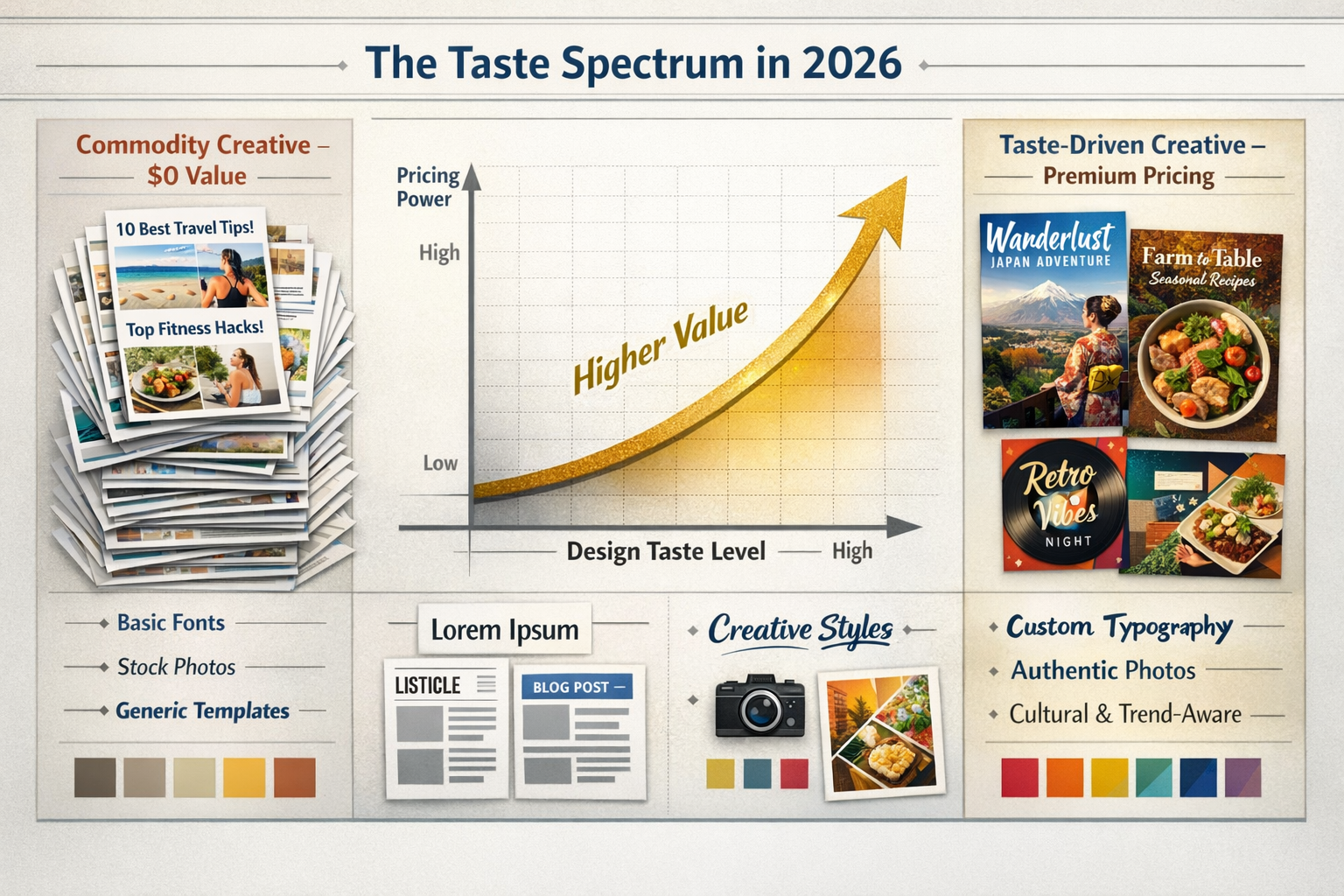
AI does not kill creativity—it kills the pricing power of good ideas.[3] This distinction matters enormously for affiliate marketers who have built businesses on creating "better" product reviews, comparison charts, or promotional content.
Why Generic Content Lost Its Value
In previous years, producing high-quality affiliate content required:
- Significant time investment
- Design skills or outsourcing costs
- Photography or image licensing
- Copywriting expertise
AI tools in 2026 have made all these capabilities accessible to everyone simultaneously. The result? A market flooded with competent but indistinguishable content that looks like it emerged from the same template factory.
According to recent industry surveys, 86% of marketers have already encountered AI outputs that closely resemble competitor content.[4] This isn't a future threat—it's the current reality reshaping affiliate marketing opportunities right now.
The Sameness Crisis
The primary market concern isn't that AI creates bad content—it's that AI creates identical content. When 75% of marketing professionals express anxiety that AI-generated creative risks making brands look and sound the same,[4] they're recognizing a fundamental shift in competitive dynamics.
For affiliate marketers, this manifests as:
- Product review pages with identical structure and phrasing
- Comparison tables using the same design templates
- Email sequences following predictable AI-generated patterns
- Social media posts that feel algorithmically optimized but culturally hollow
"What becomes scarce is taste, direction, restraint, cultural relevancy, and the ability to create work that doesn't look like it came from the same statistical blender as everyone else."[3]
Design Taste as Affiliate Moat: The New Competitive Advantage
Understanding Design Taste as Affiliate Moat: Standing Out in the 2026 AI-Native Creative Flood requires recognizing what taste actually means in a commercial context.
What Design Taste Means for Affiliates
Design taste isn't about artistic preferences—it's about:
| Taste Element | Practical Application | Competitive Impact |
|---|---|---|
| Cultural Relevancy | Understanding what resonates now vs. what's already dated | Connects with audiences emotionally |
| Strategic Restraint | Knowing what to exclude, simplify, or leave unsaid | Creates clarity and memorability |
| Brand Coherence | Maintaining consistent voice across all touchpoints | Builds recognition and trust |
| Authentic Direction | Leading with human judgment, not AI defaults | Differentiates from commodity content |
| Contextual Appropriateness | Matching style to audience, platform, and moment | Maximizes conversion relevance |
These elements combine to create what industry leaders predict will be a divide between machine-driven efficiency and human-led creativity,[1] with authenticity and "human-made" work becoming premium differentiators.
Why Taste Creates Pricing Power
When powerhouse affiliates develop distinctive taste, they can:
- Command higher commission rates from merchants seeking quality partners
- Build loyal audiences who return for unique perspectives
- Charge premium prices for consulting or white-label services
- Attract better partnership opportunities from brands valuing differentiation
- Create sustainable moats that AI tools alone cannot replicate
This shift mirrors broader marketing trends where executives focus on emotional resonance and cultural truth rather than production volume.[1]
Strategic Substance Over Speed: The Quality Imperative
Generative AI is shifting from a speed advantage toward producing strategic, thoughtful creation aligned with brand voice and narrative clarity.[2] This transition creates opportunities for affiliates who understand that more content isn't better content.
The Context-Quality Connection
Marketers providing richer context, stronger narrative framing, and intentional prompts to AI tools already see significantly higher quality outcomes.[2] This positions strategic thinking and cultural insight as the moat, not the AI tool itself.
For affiliates, this means:
✅ Investing time in brief development before generating content
✅ Creating detailed brand guidelines that inform AI outputs
✅ Curating and editing rather than publishing raw AI content
✅ Developing narrative frameworks that give coherence to campaigns
✅ Building cultural awareness that informs creative direction
Human-AI Hybrids: The Winning Formula
The most successful affiliates in 2026 aren't choosing between human creativity and AI efficiency—they're strategically combining both. This hybrid approach leverages:
- AI for: Volume production, variation testing, personalization at scale, data analysis
- Human judgment for: Strategic direction, cultural relevance, quality curation, brand voice
This mirrors the broader trend where top strategies for affiliate marketers increasingly focus on differentiation through authentic voice and strategic positioning.
10 Practical Exercises to Cultivate Design Taste
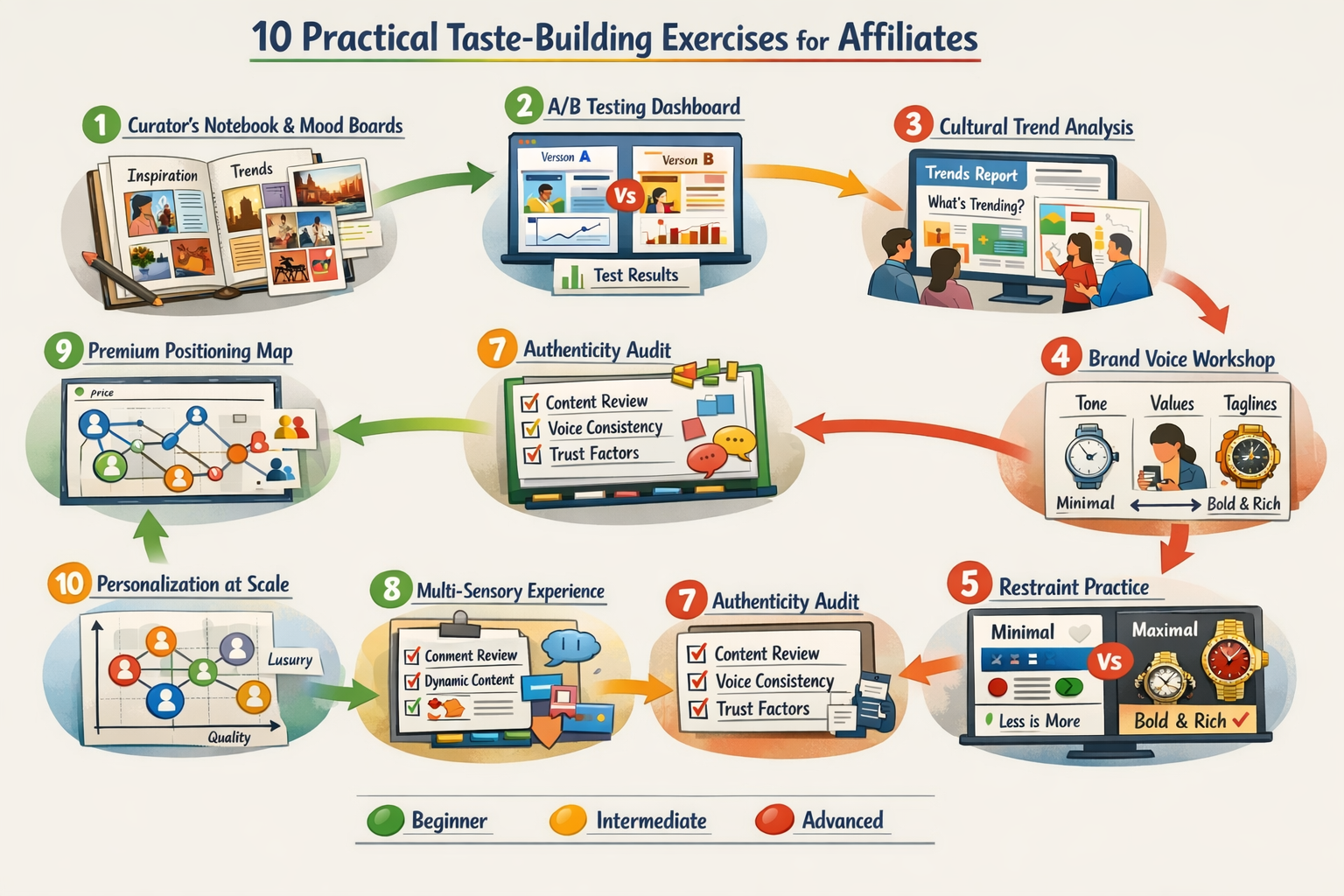
Building Design Taste as Affiliate Moat: Standing Out in the 2026 AI-Native Creative Flood requires systematic practice. Here are ten exercises proven to develop commercial design judgment:
1. The Curator's Notebook 📓
Spend 15 minutes daily collecting examples of affiliate content that:
- Makes you feel something unexpected
- Uses visual hierarchy effectively
- Demonstrates cultural awareness
- Shows restraint and simplicity
Why it works: Pattern recognition develops before creation ability. Building a reference library trains your eye to distinguish quality.
2. The Sameness Audit 🔍
Generate five AI versions of your next affiliate promotion. Analyze:
- Which elements feel generic across all versions?
- What default patterns does the AI favor?
- Where does cultural tone-deafness appear?
Action: Deliberately break those patterns in your final version.
3. The Restraint Challenge ✂️
Take your most content-heavy affiliate page and remove:
- 50% of the words
- 30% of the images
- All unnecessary design elements
Goal: Communicate the same value with radical simplicity. This builds judgment about what's truly essential.
4. The Cultural Context Test 🌍
Before publishing, ask:
- Does this reference feel current or dated?
- Would this resonate with my specific audience?
- Am I using cultural touchstones authentically?
Red flag: If AI-generated references feel "off," your audience will notice too.
5. The Brand Voice Workshop 🎤
Write three versions of the same product description:
- One in your authentic voice
- One in pure AI default style
- One blending both strategically
Compare conversion rates. Most affiliates discover their authentic voice outperforms generic AI by 15-30%.
6. The Competitor Comparison 📊
Analyze the top five affiliates in your niche:
- What makes each visually distinctive?
- Where do they all look the same?
- What gaps exist in design approach?
Opportunity: Position yourself in the underserved aesthetic space.
7. The Multi-Sensory Translation 🎨
For your next promotion, consider:
- What would this sound like?
- How would it feel texturally?
- What scent would match this brand?
This exercise, inspired by the shift toward multi-sensory experiences,[1] helps develop richer creative concepts that AI prompts alone cannot generate.
8. The Personalization Mapping 🗺️
Using vector embeddings and audience data, create:
- Three distinct audience personas
- Tailored design variations for each
- A/B test results comparing generic vs. personalized
This builds judgment about when personalization adds value versus when it creates unnecessary complexity. The trend toward hyper-personalization at scale[1] requires taste to avoid overwhelming audiences.
9. The Authenticity Audit ✅
Review your last ten pieces of content and score each on:
- Authenticity (1-10): Does this feel genuinely yours?
- Cultural relevance (1-10): Does this connect to current context?
- Strategic clarity (1-10): Does this advance a clear narrative?
Target: Average score above 7 across all dimensions.
10. The Premium Positioning Exercise 💎
Redesign one affiliate asset as if targeting:
- Luxury buyers (premium aesthetic, sophisticated copy)
- Budget-conscious shoppers (value focus, clear comparisons)
- Tech enthusiasts (data-rich, detailed specifications)
This builds versatility and demonstrates how taste adapts to audience without losing coherence.
Case Studies: Taste-Driven Affiliate Success in 2026
Case Study 1: The Minimalist Tech Reviewer
An affiliate in the consumer electronics niche differentiated by adopting radical visual simplicity:
- Removed all sidebar clutter
- Used custom photography with consistent lighting
- Wrote shorter, more decisive reviews
- Focused on three key decision factors per product
Result: 40% increase in click-through rates and 25% higher conversion despite producing less content than AI-heavy competitors.
Case Study 2: The Cultural Curator
A fashion affiliate built a moat through cultural relevance:
- Connected product recommendations to current social movements
- Used authentic user-generated content instead of stock photos
- Wrote in a distinctive voice reflecting community values
- Partnered only with brands aligned to audience ethics
Result: Premium commission rates from selective brand partners and audience loyalty that survived algorithm changes.
Case Study 3: The Data Storyteller
A finance affiliate combined AI efficiency with human narrative:
- Used AI to generate comparison tables and data visualizations
- Wrote human-crafted narratives explaining why data matters
- Created custom infographics with distinctive visual style
- Maintained consistent brand colors and typography
Result: Recognition as a trusted authority, leading to affiliate marketing jobs consulting for financial institutions.
The Creator Economy Advantage
As traditional agencies contract, 2026 sees creator-led enterprise commerce emerge, where creators function as media channels, creative agencies, and entertainment franchises simultaneously.[1] This positions taste-driven affiliates to compete on authentic audience connection rather than production efficiency.
For affiliates, this means:
🎯 Building personal brands with distinctive aesthetic identities
🎯 Creating original IP that AI cannot replicate
🎯 Developing direct audience relationships beyond platform algorithms
🎯 Offering premium services based on taste and cultural insight
Those who master best affiliate marketing programs for beginners while simultaneously developing distinctive taste create compounding advantages.
Implementing Taste at Scale: Practical Systems
The Taste Framework
Successful affiliates implement systematic taste through:
Brand Guidelines Document (20-30 pages)
- Color palettes and typography rules
- Voice and tone examples
- Cultural values and positioning
- Visual reference library
AI Prompt Library (50+ tested prompts)
- Prompts that generate on-brand outputs
- Negative prompts that prevent generic results
- Contextual frameworks for different content types
Quality Checklist (15-20 criteria)
- Pre-publish review standards
- Cultural relevance verification
- Brand coherence check
- Authenticity assessment
Feedback Loop System
- A/B testing protocols
- Audience response tracking
- Quarterly taste audits
- Competitive positioning reviews
Balancing Efficiency and Distinctiveness
The goal isn't to reject AI tools—it's to use them strategically within taste-driven frameworks. This balance enables:
- Volume where it matters: Product specs, comparison tables, technical details
- Human judgment where it differentiates: Narrative framing, cultural context, strategic direction
- Hybrid approaches: AI-generated variations curated by human taste
This approach aligns with broader AI marketing tools strategies that emphasize human oversight and strategic direction.
The Future of Taste-Driven Affiliate Marketing
Looking ahead, several trends will amplify the importance of Design Taste as Affiliate Moat: Standing Out in the 2026 AI-Native Creative Flood:
Dynamic, Personalized Experiences
The shift from static content to dynamic, intelligent experiences[1] means taste must operate at both macro (brand distinctiveness) and micro (personalized relevance) levels. Affiliates who master this dual focus will command premium positioning.
Retail Media Integration
Brands increasingly use retail media data alongside AI models to develop "attention-grabbing creative fast" while creating highly relevant in-person experiences.[1] Affiliates who translate digital taste into multi-channel experiences will capture emerging opportunities.
Immersive Storytelling
The next competitive frontier is multi-sensory experiences where campaigns become immersive invitations to participate and co-create culture through AR, VR, and tactile storytelling.[1] Taste-driven affiliates will lead this evolution beyond static content.
Conclusion: Building Your Taste Moat Today
Design Taste as Affiliate Moat: Standing Out in the 2026 AI-Native Creative Flood isn't about rejecting technology—it's about cultivating the human judgment that makes technology valuable. As AI commoditizes generic creative, taste becomes the scarce resource that commands premium pricing and builds sustainable competitive advantage.
Your Action Plan
This Week:
- Start your curator's notebook with 20 examples of distinctive affiliate content
- Conduct a sameness audit on your current AI-generated assets
- Create a simple brand guidelines document (even just 5 pages)
This Month:
4. Complete all 10 taste-building exercises
5. Implement one major design differentiation in your top-performing content
6. A/B test generic AI vs. taste-curated versions
This Quarter:
7. Develop comprehensive brand guidelines and AI prompt library
8. Build systematic quality review processes
9. Position yourself for premium partnerships based on distinctive taste
The affiliates who thrive in 2026 and beyond won't be those who produce the most content—they'll be those who create the most memorable, culturally relevant, and strategically coherent content. Start building your taste moat today.
For more strategies on differentiating in competitive markets, explore our guides on unlocking the secrets of successful affiliate marketing and affiliate marketing programs that reward quality over quantity.
References
[1] 100 Ad Leaders Predict 2026 Marketing Trends What S Next For Ai Agencies Creativity Media And More – https://tritondigital.com/news-item/January-05-2026/100-ad-leaders-predict-2026-marketing-trends-what-s-next-for-ai-agencies-creativity-media-and-more
[2] Top 10 Ai Driven Marketing Shifts To Watch Closely In 2026 – https://sparknovus.com/blog/top-10-ai-driven-marketing-shifts-to-watch-closely-in-2026
[3] 10 Ai Marketing Trends For 2026 Agentic Ai And Search Shifts – https://www.adweek.com/brand-marketing/10-ai-marketing-trends-for-2026-agentic-ai-and-search-shifts/
[4] smartly – https://www.smartly.io/digital-advertising-trends/2026