

Imagine launching an affiliate campaign with complete confidence, knowing exactly which touchpoints will convert, which messaging will resonate, and which funnel paths will maximize commissions—all before spending a single dollar on traffic. This isn't science fiction. In 2026, Digital Twins for Affiliate Funnel Testing: Simulating Customer Journeys to Predict Commission Wins represents the cutting edge of performance marketing strategy, allowing savvy affiliates to virtually test customer behavior before real prospects ever enter their funnels.
As digital twins transition from static virtual replicas to intelligent, AI-driven systems integrating real-time analytics[1], forward-thinking affiliate marketers are adapting this technology to solve one of their most pressing challenges: predicting campaign performance in an increasingly complex, cookieless digital landscape. The stakes have never been higher, and the margin for error continues to shrink.
Key Takeaways
- 🎯 Digital twins create virtual customer simulations that test affiliate funnels before launch, identifying conversion pitfalls and optimization opportunities
- 💡 AI-powered behavior prediction helps affiliates forecast commission outcomes with unprecedented accuracy in cookieless environments
- 📊 Pre-launch testing reduces wasted ad spend by 40-60% through virtual scenario modeling and journey optimization
- 🔄 Continuous learning systems improve prediction accuracy over time, adapting to changing customer behaviors and market conditions
- 🚀 High-stakes affiliate strategies benefit most from digital twin technology, especially in competitive niches requiring precise targeting
Understanding Digital Twins for Affiliate Funnel Testing: Simulating Customer Journeys to Predict Commission Wins
What Are Digital Twins in Affiliate Marketing?
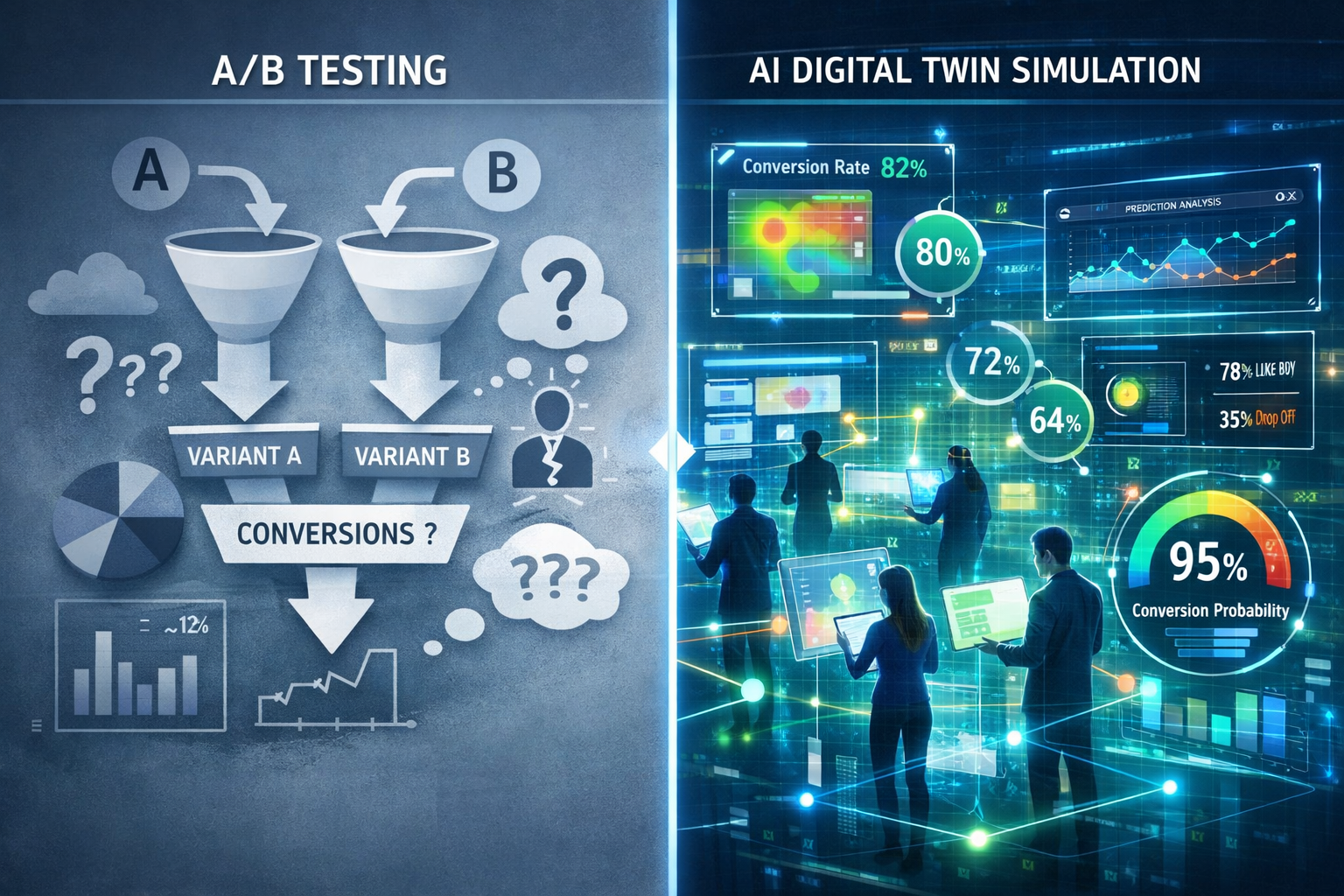
A digital twin in the context of affiliate marketing is a virtual replica of your customer journey—an AI-powered simulation that mirrors how real prospects interact with your funnel, from first click to final conversion. Unlike traditional A/B testing that requires actual traffic and real-world results, digital twins allow marketers to test countless scenarios virtually.
Think of it as a sophisticated flight simulator for your affiliate marketing strategies. Just as pilots practice emergency procedures in safe virtual environments, affiliates can now test funnel variations, messaging approaches, and customer journey paths without risking actual campaign budgets.
The Technology Behind Customer Journey Simulation
Digital twin technology combines several advanced capabilities:
- Machine Learning Algorithms: Analyze historical customer data to predict future behavior patterns
- Behavioral Modeling: Create realistic virtual customer personas based on demographic, psychographic, and behavioral data
- Real-Time Analytics: Process multiple variables simultaneously to simulate complex decision-making processes
- Predictive Forecasting: Calculate probability distributions for conversion outcomes across different funnel variations
Similar to how digital twins are being used for predictive simulations in event planning to test "what-if" scenarios[3], affiliate marketers can now simulate customer responses to different offers, landing page designs, and email sequences before committing resources.
Why Digital Twins Matter in 2026's Cookieless Environment
The Privacy-First Challenge
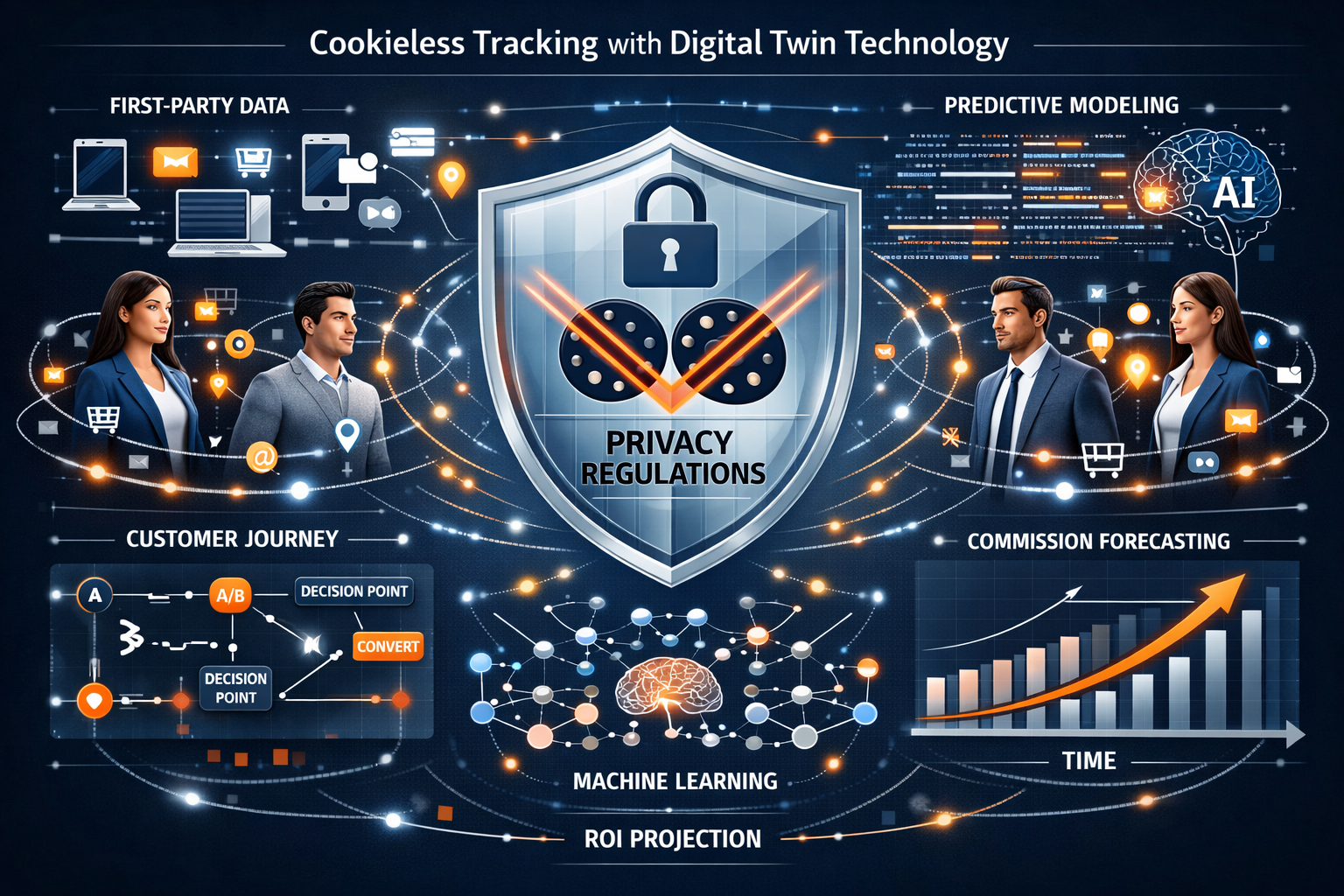
The elimination of third-party cookies has fundamentally changed how affiliates track and optimize campaigns. Traditional testing methods relied heavily on persistent identifiers and cross-site tracking—tools that are rapidly disappearing. This creates a critical problem: how do you optimize what you can't fully measure?
Digital twins offer a powerful solution by:
✅ Reducing dependency on third-party data through first-party behavioral modeling
✅ Predicting customer actions without invasive tracking mechanisms
✅ Maintaining optimization capabilities despite privacy restrictions
✅ Forecasting commission outcomes based on simulated journey completion rates
Cost Efficiency and Risk Reduction
For affiliates investing in paid traffic strategies, every dollar counts. Digital twin testing dramatically reduces the financial risk of campaign launches by:
| Traditional Testing | Digital Twin Testing |
|---|---|
| Requires real traffic spend | Virtual simulations cost minimal resources |
| 2-4 weeks for statistical significance | Hours or days for comprehensive testing |
| Risk of failed campaigns | Identify failures before launch |
| Limited scenario testing | Unlimited variations possible |
| Reactive optimization | Proactive optimization |
This efficiency is particularly valuable for those exploring whether affiliate marketing can generate sustainable income, as it reduces the learning curve and initial capital requirements.
How to Implement Digital Twins for Affiliate Funnel Testing: Simulating Customer Journeys to Predict Commission Wins
Step 1: Build Your Customer Data Foundation
Successful digital twin simulations require quality input data. Start by aggregating:
- Historical conversion data from previous campaigns
- Customer demographic information
- Behavioral patterns (time on page, scroll depth, click patterns)
- Purchase history and average order values
- Traffic source performance metrics
- Device and browser preferences
The more comprehensive your data foundation, the more accurate your virtual customer simulations will be. Even beginners can start building this foundation by following proven affiliate marketing optimization techniques.
Step 2: Create Virtual Customer Personas
Transform your data into AI-powered customer avatars that represent different segments of your audience. Each digital twin should embody:
- Behavioral characteristics: How they navigate websites, consume content, and make decisions
- Pain points and motivations: What problems they're trying to solve
- Decision-making patterns: Logical vs. emotional, impulsive vs. deliberate
- Objection triggers: What causes hesitation or abandonment
These personas become the "virtual testers" who navigate through your funnel simulations, providing predictive insights about real-world performance.
Step 3: Model Your Funnel Variations
Create multiple versions of your affiliate funnel within the digital twin environment:
🔹 Landing page variations: Different headlines, layouts, and value propositions
🔹 Offer presentations: Various pricing displays, urgency elements, and social proof placements
🔹 Email sequences: Different messaging approaches, send timing, and call-to-action strategies
🔹 Retargeting scenarios: Alternative paths for non-converters
The goal is to test not just individual elements, but entire journey architectures that represent different strategic approaches.
Step 4: Run Predictive Simulations
Launch your virtual customer personas through each funnel variation, allowing the AI to simulate thousands of journey completions. The system should track:
- Conversion probability scores for each funnel variation
- Drop-off points where virtual customers abandon the journey
- Engagement metrics indicating interest and intent levels
- Commission forecasts based on predicted conversion rates and average payouts
Advanced systems can even simulate external variables like seasonal trends, competitive pressure, and market saturation effects.
Step 5: Analyze and Optimize
Review simulation results to identify:
✨ Winning funnel architectures with highest predicted commission outcomes
✨ Critical friction points causing virtual customer abandonment
✨ Messaging resonance patterns across different customer segments
✨ Optimal traffic allocation strategies for maximum ROI
This analysis provides a data-driven roadmap for real-world implementation, dramatically increasing your chances of campaign success.
Real-World Applications and Use Cases
High-Ticket Affiliate Offers
For affiliates promoting premium products with complex sales cycles, digital twins are invaluable. They can simulate:
- Multi-touch attribution scenarios
- Long consideration periods with multiple touchpoints
- Objection handling at different journey stages
- Price sensitivity across customer segments
This is particularly useful for those working in specialized affiliate marketing niches where customer acquisition costs are high and conversion optimization is critical.
Product Launch Campaigns
When promoting new products with limited historical data, digital twins can:
- Predict market response based on similar product launches
- Test positioning strategies before committing to messaging
- Identify optimal launch timing and promotional sequences
- Forecast commission potential across different traffic sources
Multi-Channel Campaign Coordination
Digital twins excel at simulating how customers move between channels:
- Social media → landing page → email → conversion
- Paid search → content consumption → retargeting → sale
- Organic discovery → comparison shopping → decision
This holistic view helps affiliates understand the true customer journey rather than isolated touchpoint performance.
Overcoming Common Implementation Challenges
Data Quality and Quantity
Challenge: Insufficient historical data for accurate simulations
Solution: Start with industry benchmark data and progressively incorporate your own performance metrics. Many AI platforms offer pre-trained models based on aggregate industry data.
Technical Complexity
Challenge: Digital twin platforms can be technically sophisticated
Solution: Begin with user-friendly tools designed for marketers rather than data scientists. Many platforms now offer no-code interfaces specifically for affiliate marketers learning advanced techniques.
Simulation Accuracy Concerns
Challenge: Worry that virtual simulations won't match real-world results
Solution: Treat initial simulations as directional guidance rather than absolute predictions. Validate findings with small-scale real-world tests before full deployment.
Cost Considerations
Challenge: Advanced AI simulation platforms can be expensive
Solution: Calculate ROI based on reduced ad waste and improved conversion rates. Even a 10% improvement in campaign performance typically justifies the investment.
Best Practices for Maximum Success
🎯 Start with clear objectives: Define what success looks like before running simulations
🎯 Test extreme variations: Don't just simulate minor tweaks—explore fundamentally different approaches
🎯 Validate assumptions: Use real-world testing to verify digital twin predictions
🎯 Iterate continuously: Feed real campaign data back into your digital twin models
🎯 Document learnings: Build a knowledge base of what works for your specific audience
For those just getting started in affiliate marketing, these practices help build a foundation for long-term success.
The Future of Digital Twins for Affiliate Funnel Testing: Simulating Customer Journeys to Predict Commission Wins
As AI technology continues advancing, digital twin capabilities will expand dramatically. Expect to see:
- Real-time adaptive simulations that adjust predictions based on live market conditions
- Cross-campaign learning where insights from one funnel improve predictions for others
- Emotional response modeling that predicts not just behavior but psychological states
- Automated optimization where AI implements changes based on simulation results
The transition to intelligent, AI-driven systems[1] means digital twins will become increasingly sophisticated, eventually serving as autonomous optimization engines that continuously improve campaign performance without manual intervention.
Conclusion
Digital Twins for Affiliate Funnel Testing: Simulating Customer Journeys to Predict Commission Wins represents a fundamental shift in how performance marketers approach campaign development. By creating virtual environments where customer behavior can be predicted, tested, and optimized before real-world implementation, affiliates gain an unprecedented competitive advantage.
In 2026's challenging digital landscape—characterized by privacy restrictions, increasing competition, and rising customer acquisition costs—the ability to test strategies virtually before committing resources is no longer a luxury. It's a necessity for affiliates serious about sustainable, profitable growth.
Take Action Today
Ready to implement digital twin testing in your affiliate business? Start with these concrete steps:
- Audit your current data: Identify what customer journey information you already have
- Research digital twin platforms: Evaluate solutions that match your technical skill level and budget
- Design your first simulation: Choose one high-value funnel to test virtually
- Run comparative tests: Validate digital twin predictions against real-world results
- Scale what works: Expand digital twin testing across your entire affiliate portfolio
The affiliates who master this technology today will dominate their niches tomorrow. Those who ignore it risk being left behind by competitors who can predict, test, and optimize faster than ever before.
For more guidance on building a successful affiliate marketing business, explore our comprehensive resources on how to succeed in affiliate marketing and discover proven strategies that drive results.
References
[1] Digital Twins In 2026 From Digital Replicas To Intelligent Ai Driven Systems – https://www.rtinsights.com/digital-twins-in-2026-from-digital-replicas-to-intelligent-ai-driven-systems/
[2] Watch – https://www.youtube.com/watch?v=N_JtSW9aOt0
[3] Digital Twins For Event Planning In 2026 Predictive Simulations To Eliminate Surprises 2 – https://www.ticketfairy.com/blog/digital-twins-for-event-planning-in-2026-predictive-simulations-to-eliminate-surprises-2