

In 2026, affiliate marketers face an unprecedented challenge: capturing attention in an oversaturated digital landscape. While traditional video content has long been a staple of successful campaigns, Dynamic Video Personalization for Affiliate Campaigns: AI-Generated Product Demos That Boost CTR by 40% represents a revolutionary shift. AI video production now enables affiliates to create thousands of personalized video variations with different messaging and calls-to-action per audience segment—delivering the 40% revenue uplift that industry research promises. This transformation isn't just about automation; it's about creating meaningful connections at scale.
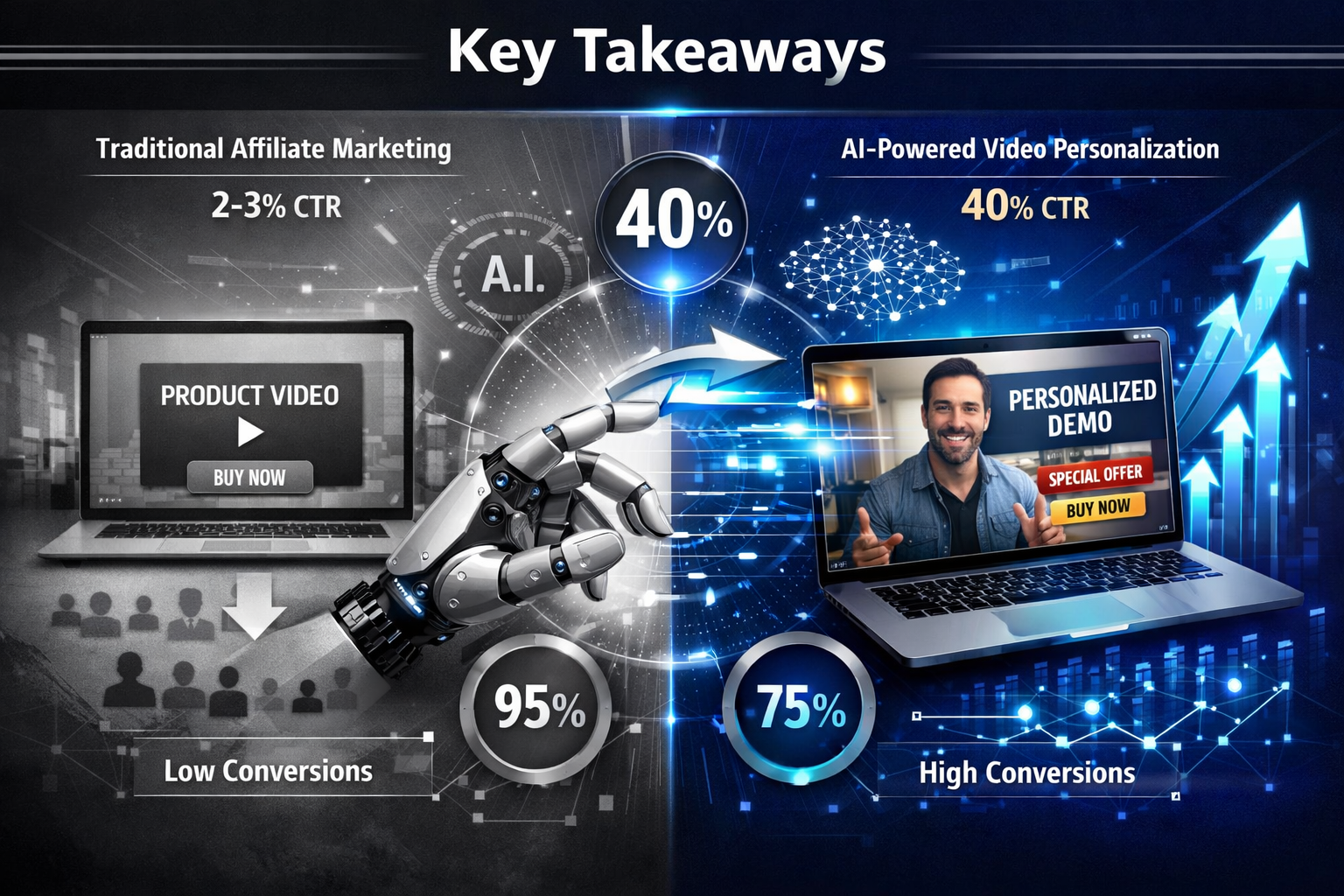
Key Takeaways
- AI-generated product demos boost conversion rates by 40% compared to traditional video methods, with 96% of marketers believing AI-driven personalization will transform video marketing[1]
- Video content increases affiliate marketing conversion rates by 49%, making it essential for competitive campaigns in 2026[2]
- Over 55% of consumers prefer personalized AI-generated videos over generic content, while 81% favor brands that customize experiences[1][3]
- 79% of affiliate marketers now use AI tools for content creation, with 75% specifically using AI for video production and editing[4]
- Dynamic personalization enables thousands of video variations tailored to specific audience segments, demographics, and behavioral patterns
Understanding Dynamic Video Personalization for Affiliate Campaigns
Dynamic video personalization represents a fundamental shift in how affiliate marketers approach product demonstrations. Unlike static videos that deliver the same message to every viewer, personalized AI-generated product demos adapt content, messaging, and calls-to-action based on viewer characteristics, behavior, and preferences.
What Makes Video Personalization "Dynamic"?
Dynamic personalization goes beyond simply inserting a viewer's name into a video. It involves:
- Audience segmentation based on demographics, interests, and purchase history
- Real-time content adaptation that changes product features highlighted
- Customized messaging that speaks directly to specific pain points
- Tailored calls-to-action optimized for different conversion stages
- Behavioral triggers that adjust video content based on user interactions
The technology behind this transformation has matured significantly. 41% of businesses now use AI to create videos, representing a 128% increase from just 18% in 2023[1]. This explosive growth reflects both improved AI capabilities and proven ROI results.
The 40% CTR Boost: What the Data Shows
The promise of a 40% click-through rate improvement isn't marketing hyperbole—it's grounded in measurable performance data. AI-generated product demonstration videos boost conversion rates by 40% compared to traditional video creation methods[1]. More broadly, businesses using AI-driven video marketing see an 82% increase in ROI compared to conventional approaches[1].
This performance advantage stems from several factors:
✅ Relevance: Personalized videos address specific viewer needs
✅ Engagement: Customized content holds attention longer
✅ Trust: Tailored messaging builds stronger connections
✅ Timing: Dynamic videos reach viewers at optimal moments
✅ Testing: AI enables rapid A/B testing of thousands of variations
For those new to affiliate marketing programs, understanding these performance metrics provides crucial context for campaign planning.
How AI-Generated Product Demos Transform Affiliate Marketing
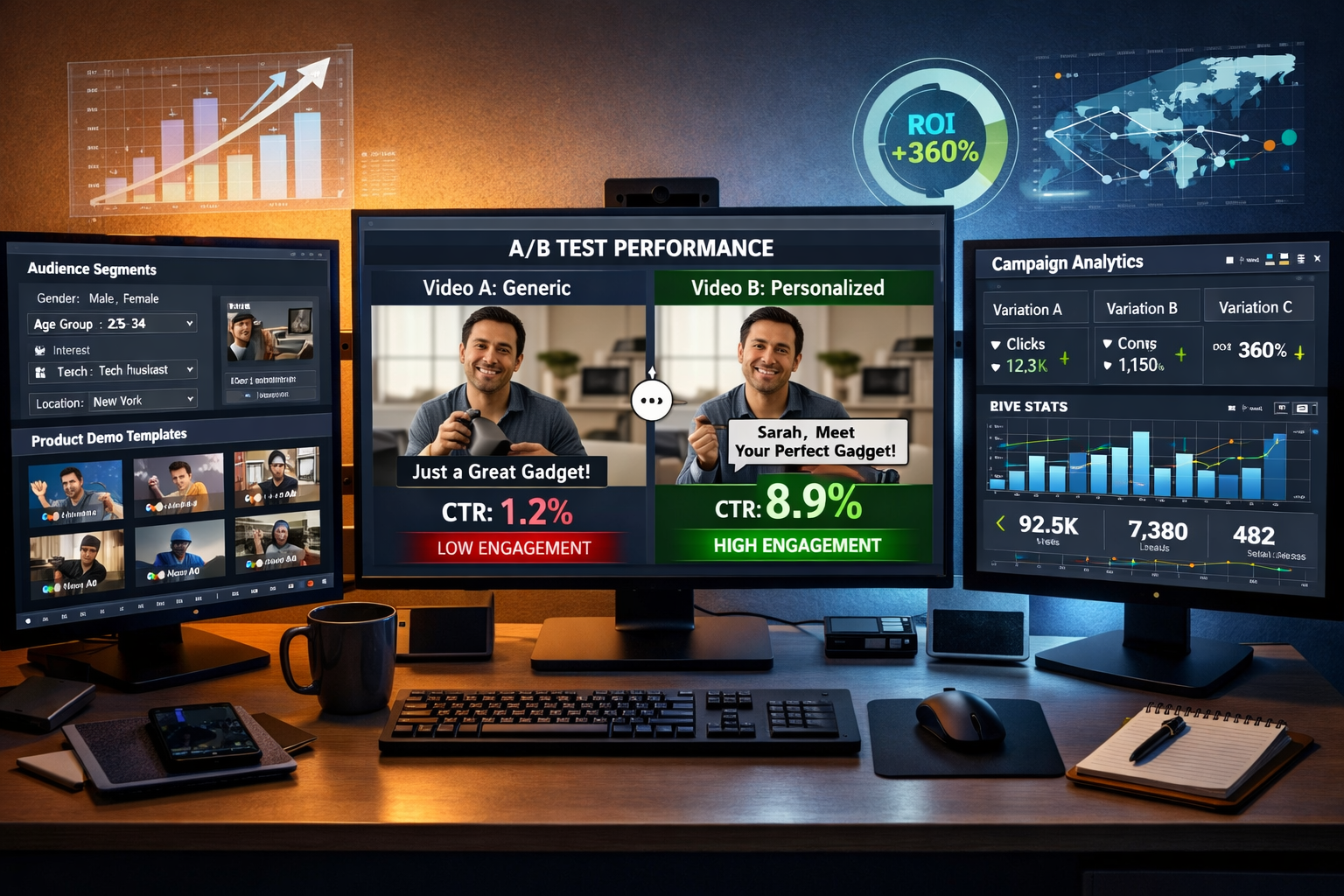
The integration of AI into video production has democratized sophisticated marketing techniques previously available only to enterprises with massive budgets. Today's affiliate marketers can leverage these tools to compete effectively in any niche.
The AI Video Production Workflow
Creating personalized product demos with AI follows a streamlined process:
- Input Product Information: Upload product details, features, benefits, and images
- Define Audience Segments: Specify demographics, interests, and behavioral characteristics
- Create Personalization Rules: Set parameters for how content adapts per segment
- Generate Video Variations: Let AI produce thousands of customized versions
- Deploy and Test: Launch campaigns and monitor performance metrics
- Optimize Continuously: Refine based on real-time data and results
58% of marketing videos now use AI-generated voiceovers, achieving near-human quality that makes scaled production practical[1]. This technological maturity means affiliates can create professional-quality demos without expensive voice talent or recording equipment.
Key Features of Effective AI Product Demos
The most successful AI-generated product demonstrations share common characteristics:
| Feature | Impact | Implementation |
|---|---|---|
| Personalized Messaging | Addresses specific pain points | Segment-based scripting |
| Dynamic Product Focus | Highlights relevant features | Conditional content blocks |
| Customized CTAs | Matches viewer journey stage | Behavioral targeting |
| AI-Generated Subtitles | Boosts retention by 65%[1] | Automatic transcription |
| Adaptive Length | Optimizes for platform/audience | Smart editing algorithms |
Those exploring affiliate marketing products to sell can apply these principles across virtually any product category, from physical goods to digital services.
Audience Segmentation Strategies
Effective personalization requires thoughtful audience segmentation. The most impactful approaches include:
Demographic Segmentation 🎯
- Age groups with different communication styles
- Geographic locations with regional preferences
- Income levels affecting purchase considerations
- Professional backgrounds influencing product needs
Behavioral Segmentation 📊
- Previous purchase history and patterns
- Website interaction and engagement levels
- Email response rates and preferences
- Social media activity and interests
Psychographic Segmentation 💭
- Values and lifestyle choices
- Pain points and challenges
- Goals and aspirations
- Brand affinities and preferences
The data supports this approach: 81% of consumers favor brands that customize their experiences to individual preferences[3], creating strong incentive for implementing sophisticated segmentation strategies.
Implementing Dynamic Video Personalization in Your Affiliate Campaigns
Moving from theory to practice requires understanding both the technical tools and strategic frameworks that drive success.
Choosing the Right AI Video Platform
The AI video production landscape in 2026 offers numerous options, each with distinct capabilities:
Enterprise Solutions provide comprehensive features including:
- Advanced personalization engines
- Multi-platform distribution
- Detailed analytics dashboards
- Team collaboration tools
- API integrations
Mid-Market Tools balance capability and affordability:
- Template-based production
- Standard personalization options
- Basic analytics
- Limited integrations
Entry-Level Platforms offer accessibility:
- Simple drag-and-drop interfaces
- Pre-built templates
- Basic customization
- Affordable pricing
For affiliates implementing best affiliate marketing tips, starting with entry-level tools and scaling up as campaigns grow often provides the best risk-reward balance.
Creating Your First Personalized Product Demo
A practical step-by-step approach ensures successful implementation:
Step 1: Define Your Core Message 📝
Identify the primary value proposition that resonates across all audience segments. This becomes your foundation.
Step 2: Map Audience Segments 🗺️
Create detailed profiles for 3-5 primary audience segments, documenting their unique characteristics, needs, and preferences.
Step 3: Develop Personalization Variables 🔄
Determine which elements will change per segment:
- Opening hooks
- Feature emphasis
- Benefit framing
- Social proof examples
- Call-to-action language
Step 4: Produce Base Assets 🎬
Create or gather core visual assets including product footage, screenshots, graphics, and brand elements.
Step 5: Configure AI Personalization ⚙️
Set up rules and parameters that govern how content adapts for each segment.
Step 6: Generate Video Variations 🚀
Let AI produce personalized versions for each audience segment.
Step 7: Test and Refine 🔬
Deploy videos in controlled tests, measure performance, and optimize based on results.
Measuring Success: Key Metrics to Track
"96% of marketers believe AI-driven personalization will be a game-changer for video marketing" – Industry Research[1]
To validate this belief in your campaigns, track these critical metrics:
Engagement Metrics 📈
- Click-through rate (CTR)
- View completion rate
- Average watch time
- Interaction rate (clicks, shares, comments)
Conversion Metrics 💰
- Conversion rate per video variation
- Cost per acquisition (CPA)
- Return on ad spend (ROAS)
- Revenue per view
Personalization Performance 🎯
- Segment-specific CTR differences
- Personalization lift over control
- Variation performance rankings
- Optimization velocity
Understanding what is affiliate marketing at a fundamental level helps contextualize these metrics within broader campaign objectives.
Advanced Strategies for Maximizing CTR with AI Video Personalization
Once basic implementation succeeds, advanced techniques can push performance even higher.
Multi-Variant Testing at Scale
Traditional A/B testing compares two versions. AI-powered personalization enables multi-variant testing across hundreds or thousands of combinations simultaneously:
- Test different opening hooks per segment
- Experiment with various feature sequences
- Compare multiple CTA approaches
- Evaluate diverse visual styles
- Assess different video lengths
This massive testing capability identifies winning combinations that human intuition might miss. 75% of video marketers use AI tools to help create or edit marketing videos[4], reflecting widespread adoption of these testing capabilities.
Sequential Video Journeys
Rather than treating each video as isolated, create personalized video sequences that guide viewers through multi-stage journeys:
- Awareness Stage: Problem identification and education
- Consideration Stage: Solution comparison and evaluation
- Decision Stage: Specific product demonstration and offer
- Retention Stage: Usage tips and complementary products
Each stage uses dynamic personalization to maintain relevance as viewers progress through their decision journey.
Cross-Platform Personalization
Extend personalization across multiple touchpoints:
- Email campaigns: Embedded personalized video thumbnails
- Landing pages: Dynamic video content matching traffic source
- Social media: Platform-optimized variations
- Retargeting ads: Behavior-triggered personalized demos
This omnichannel approach ensures consistent, personalized experiences regardless of where prospects encounter your content. Those working with affiliate marketing niches can adapt these strategies to their specific market characteristics.
Leveraging AI-Generated Subtitles
The data is compelling: AI-generated subtitles boost viewer retention by 65%[1]. This dramatic improvement stems from:
- Accessibility: Reaching hearing-impaired audiences
- Sound-off viewing: Accommodating mobile and public viewing
- Comprehension: Reinforcing spoken messages visually
- SEO benefits: Providing searchable text content
Modern AI subtitle generation achieves near-perfect accuracy while automatically translating into multiple languages, exponentially expanding reach.
Overcoming Common Challenges in AI Video Personalization
While the benefits are substantial, implementation isn't without obstacles. Understanding common challenges helps avoid costly mistakes.
Quality Control at Scale
Challenge: Ensuring thousands of AI-generated variations maintain brand standards and message accuracy.
Solutions:
- Establish clear brand guidelines and templates
- Implement automated quality checks
- Use staged review processes for high-value segments
- Monitor performance metrics for quality indicators
- Maintain human oversight for strategic decisions
Balancing Personalization and Privacy
Challenge: Leveraging personal data for customization while respecting privacy regulations and consumer concerns.
Solutions:
- Use aggregate demographic data rather than individual tracking
- Implement transparent data practices
- Offer opt-out mechanisms
- Focus on behavioral signals over personal identifiers
- Comply with GDPR, CCPA, and relevant regulations
Technical Integration Complexity
Challenge: Connecting AI video platforms with existing marketing technology stacks.
Solutions:
- Choose platforms with robust API capabilities
- Work with integration specialists when needed
- Start with standalone implementations before full integration
- Document workflows and data flows clearly
- Plan for scalability from the beginning
For those pursuing affiliate marketing jobs or building agencies, mastering these integration challenges creates competitive advantages.
Content Fatigue and Refresh Cycles
Challenge: Preventing audience fatigue as the same viewers encounter multiple personalized variations.
Solutions:
- Implement frequency caps per viewer
- Rotate creative elements regularly
- Monitor engagement metrics for fatigue signals
- Create seasonal or event-based variations
- Continuously test new approaches
The Future of Dynamic Video Personalization in Affiliate Marketing
Looking ahead, several trends will shape how AI-generated product demos evolve:
Real-Time Personalization
Next-generation systems will adapt video content during playback based on viewer reactions, creating truly dynamic experiences that respond to engagement signals in real-time.
Voice and Accent Personalization
Beyond subtitles, AI will generate voiceovers in regional accents and languages that match viewer preferences, creating deeper connections through linguistic familiarity.
Interactive Video Elements
Personalized demos will incorporate clickable hotspots, branching narratives, and interactive product explorers that let viewers control their experience while maintaining personalization.
Predictive Personalization
Machine learning will predict optimal personalization strategies based on similar audience segments, automatically optimizing new campaigns from launch rather than requiring extensive testing periods.
Integration with Emerging Platforms
As new social and commerce platforms emerge, AI personalization will adapt content for platform-specific formats, audiences, and engagement patterns automatically.
Those staying current with AI marketing trends will be best positioned to capitalize on these developments.
Conclusion: Taking Action on Dynamic Video Personalization
Dynamic Video Personalization for Affiliate Campaigns: AI-Generated Product Demos That Boost CTR by 40% isn't a future possibility—it's a present reality transforming how successful affiliates compete in 2026. The data demonstrates clear advantages: conversion rate improvements of 40%, ROI increases of 82%, and consumer preference for personalized experiences over generic content[1][2][3].
Your Next Steps
Immediate Actions (This Week):
- Audit your current video content and identify personalization opportunities
- Research AI video platforms that match your budget and technical capabilities
- Define 3-5 primary audience segments for your top-performing products
- Create a test campaign plan for one product with personalized variations
Short-Term Goals (This Month):
- Implement your first AI-generated personalized product demo campaign
- Establish baseline metrics and tracking systems
- Run controlled tests comparing personalized versus generic videos
- Document learnings and optimization opportunities
Long-Term Strategy (This Quarter):
- Scale successful personalization approaches across your product portfolio
- Develop sophisticated multi-stage video journeys
- Integrate personalization across multiple marketing channels
- Build systematic testing and optimization processes
The competitive advantage goes to affiliates who embrace these technologies early and master their implementation. With 79% of affiliate marketers already using AI tools for content creation[4], those who delay risk falling behind in an increasingly sophisticated marketplace.
The 40% CTR boost isn't guaranteed for every campaign—it requires thoughtful implementation, continuous testing, and strategic optimization. But for affiliates willing to invest in learning and applying these powerful tools, the potential rewards are substantial.
Start small, test rigorously, and scale what works. The future of affiliate marketing is personalized, dynamic, and AI-powered. Your competitive advantage depends on how quickly you adapt to this new reality.
References
[1] Video Marketing Statistics – https://www.sellerscommerce.com/blog/video-marketing-statistics/
[2] Affiliate Marketing Statistics – https://www.wix.com/blog/affiliate-marketing-statistics
[3] Affiliate Marketing Statistics – https://www.publift.com/blog/affiliate-marketing-statistics
[4] Top Affiliate Marketing Statistics – https://www.postaffiliatepro.com/blog/top-affiliate-marketing-statistics/