

{"cover":"Professional landscape format (1536x1024) hero image with bold text overlay 'Edge-Deployed Agentic AI for High-Ticket B2B Retail SaaS: Real-Time Inventory and Pricing Autonomy in Distributed Networks' in extra large 70pt white sans-serif font with dark shadow effect, positioned in upper third. Background shows futuristic retail warehouse with glowing edge computing nodes, real-time pricing displays, distributed network visualization, autonomous robots managing inventory. Color scheme: electric blue, silver, neon green accents. High contrast, magazine cover quality, editorial technology aesthetic with depth and dimension.","content":["Landscape format (1536x1024) technical diagram showing edge computing architecture with local AI agents at retail store locations, data flowing between distributed nodes without cloud dependency, labeled components including edge servers, inventory sensors, pricing algorithms, and network topology. Clean infographic style with blue and white color scheme, arrows showing autonomous decision flow, millisecond latency indicators, professional B2B technology aesthetic.","Landscape format (1536x1024) split-screen comparison showing traditional cloud-based retail system versus edge-deployed agentic AI system. Left side: slow cloud roundtrip with latency delays, network congestion, offline gaps. Right side: instant edge processing, real-time price updates, autonomous inventory decisions, 50% faster execution metrics displayed. Bar charts comparing response times, uptime percentages, decision speed. Clean corporate presentation style with green checkmarks and red warning icons.","Landscape format (1536x1024) detailed illustration of autonomous pricing agent in action at retail point-of-sale, showing AI analyzing competitor prices, demand signals, inventory levels, and customer behavior simultaneously. Visual data streams converging on edge device, dynamic price tag updates, profit margin calculations, personalized promotion triggers. Futuristic retail environment with holographic displays, real-time analytics overlays, professional technology visualization.","Landscape format (1536x1024) warehouse scene showing edge-deployed AI agents managing stock replenishment autonomously, with visual indicators of low inventory triggers, automated reorder decisions, supplier communication, and predictive demand forecasting. Robotic systems, sensor networks, digital twin overlays, real-time stock level displays, distribution network maps. Industrial technology aesthetic with orange safety accents, blue digital overlays, modern logistics visualization.","Landscape format (1536x1024) security and compliance dashboard for edge-deployed agentic AI showing encrypted data flows, local processing boundaries, regulatory compliance checkpoints, audit trails, and multi-layer authentication. Visual elements include shield icons, encrypted data packets, compliance badges for different jurisdictions, network security zones, real-time monitoring graphs. Professional cybersecurity aesthetic with dark background, green secure indicators, red alert zones.","Landscape format (1536x1024) implementation roadmap infographic showing five phases of edge-deployed agentic AI deployment for B2B retail SaaS: assessment, pilot deployment, integration, scaling, and optimization. Timeline with milestone markers, resource allocation charts, ROI projection curves, risk mitigation checkpoints, and success metrics. Clean project management visualization with color-coded phases, progress indicators, professional business consulting aesthetic."]}
Last updated: March 21, 2026
Quick Answer
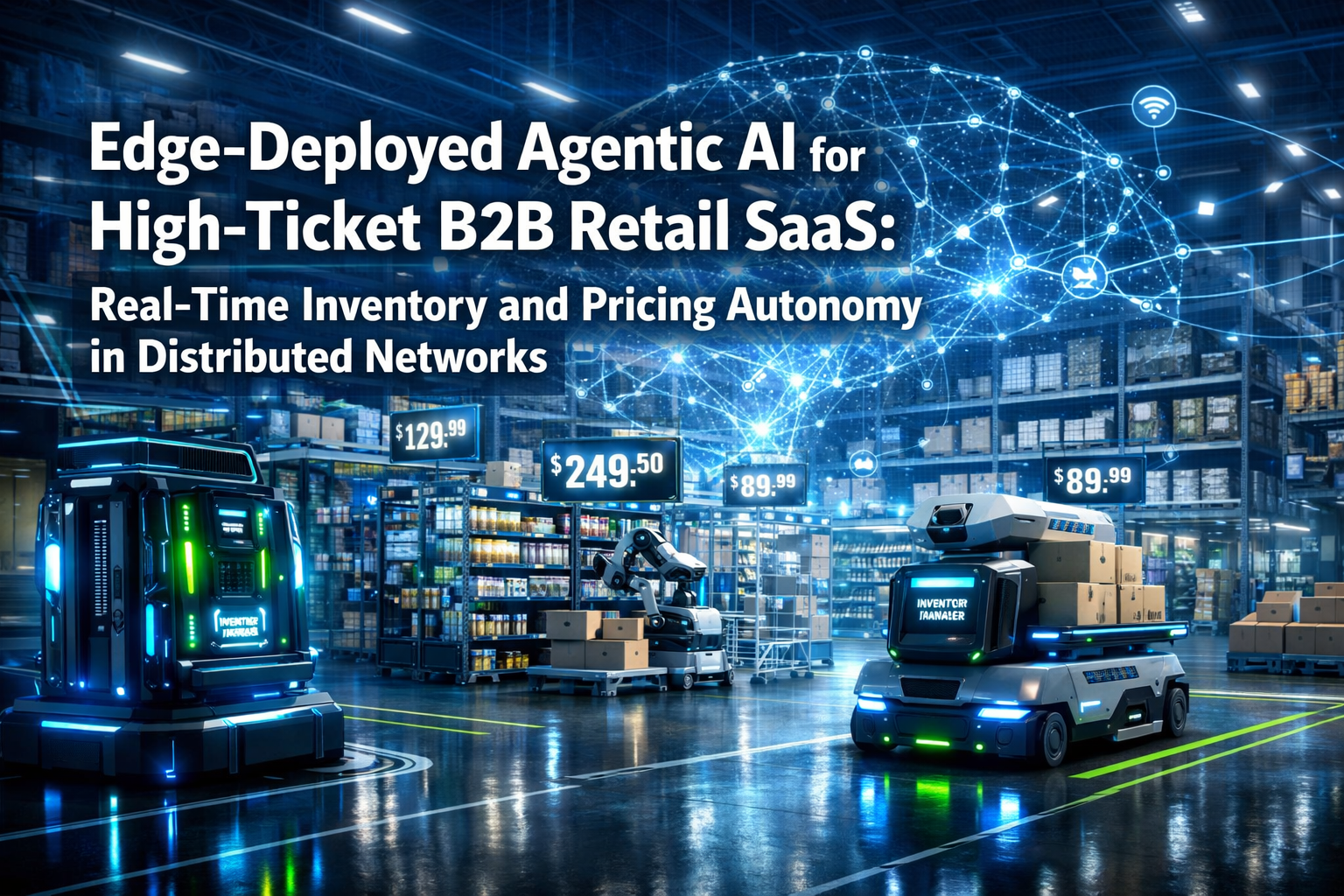
Edge-deployed agentic AI for high-ticket B2B retail SaaS enables autonomous inventory management and dynamic pricing decisions at the local network level, eliminating cloud dependency and reducing decision latency by up to 50% in distributed retail environments. These AI agents operate independently at store or warehouse locations, processing real-time data from sensors, competitors, and customer behavior to adjust prices and reorder stock without human intervention. This approach is particularly valuable for retailers with intermittent connectivity, high-value inventory, or time-sensitive pricing needs where milliseconds matter.
Key Takeaways
- Edge-deployed agentic AI processes decisions locally at retail locations, cutting cloud roundtrip time and enabling sub-second pricing and inventory updates even during network outages
- Walmart's autonomous workflow system demonstrates real-time supply chain orchestration that operates before human associates begin their shifts, routing orders across distributed networks without manual oversight [1]
- Microsoft's Pegasus Program showcases three retail AI startups (Nimble, YDISTRI, Omnistream) enabling multi-agent collaboration for inventory, assortment, and pricing optimization at the store level as of January 2026 [2]
- Danfoss achieved over 80% autonomous order processing in B2B transactions using agentic AI deployed on Google Cloud, handling transactional decisions without human review [1]
- Execution speed improves by approximately 50% in retail environments with intermittent connectivity when AI agents operate at the edge rather than relying on cloud infrastructure
- Real-time pricing autonomy allows B2B retailers to respond instantly to competitor moves, demand shifts, and inventory constraints without waiting for centralized approval
- Edge deployment reduces data transfer costs and compliance risks by keeping sensitive pricing and inventory data within local network boundaries
- Integration with existing retail systems requires careful API design, data synchronization protocols, and fallback mechanisms for edge-cloud coordination
- Security and audit trails remain critical challenges, requiring encrypted local storage, tamper-proof logging, and periodic cloud synchronization for compliance reporting
- High-ticket B2B scenarios benefit most because margin optimization on expensive items justifies the infrastructure investment and complexity of edge AI deployment
What Is Edge-Deployed Agentic AI for High-Ticket B2B Retail SaaS?
Edge-deployed agentic AI for high-ticket B2B retail SaaS refers to autonomous software agents that make inventory and pricing decisions directly at retail locations or distribution centers, rather than sending data to centralized cloud servers for processing. These agents analyze local data streams—including point-of-sale transactions, competitor pricing feeds, supplier availability, and customer behavior—to autonomously adjust prices, trigger stock replenishment, and personalize promotions in real time.
For B2B retailers selling high-value equipment, industrial supplies, or enterprise software, this architecture delivers three core advantages:
- Latency reduction: Decisions happen in milliseconds at the edge, not seconds or minutes waiting for cloud processing
- Offline resilience: Agents continue operating during network disruptions, ensuring business continuity
- Data sovereignty: Sensitive pricing strategies and customer information remain within local network boundaries, simplifying compliance with regional data regulations
Choose edge-deployed agentic AI if:
- Your retail locations experience frequent connectivity issues or operate in bandwidth-constrained environments
- Pricing decisions must respond to competitor moves within seconds, not minutes
- High inventory values justify the cost of local compute infrastructure
- Regulatory requirements restrict cross-border data transfers
Avoid this approach if:
- Your pricing strategy relies on centralized, company-wide optimization that requires global visibility
- Retail locations lack the physical infrastructure or IT support for edge servers
- Your product margins are too thin to justify distributed AI infrastructure costs
Siemens and PepsiCo deployed Digital Twin Composer at CES 2026, an AI-driven system that simulates and tests supply chain changes with physics-level accuracy before physical modifications, enabling predictive inventory and logistics planning at enterprise scale [1]. This demonstrates how edge-deployed AI can integrate with digital twin technology for more sophisticated autonomous decision-making.
How Edge-Deployed Agentic AI Achieves Real-Time Inventory and Pricing Autonomy
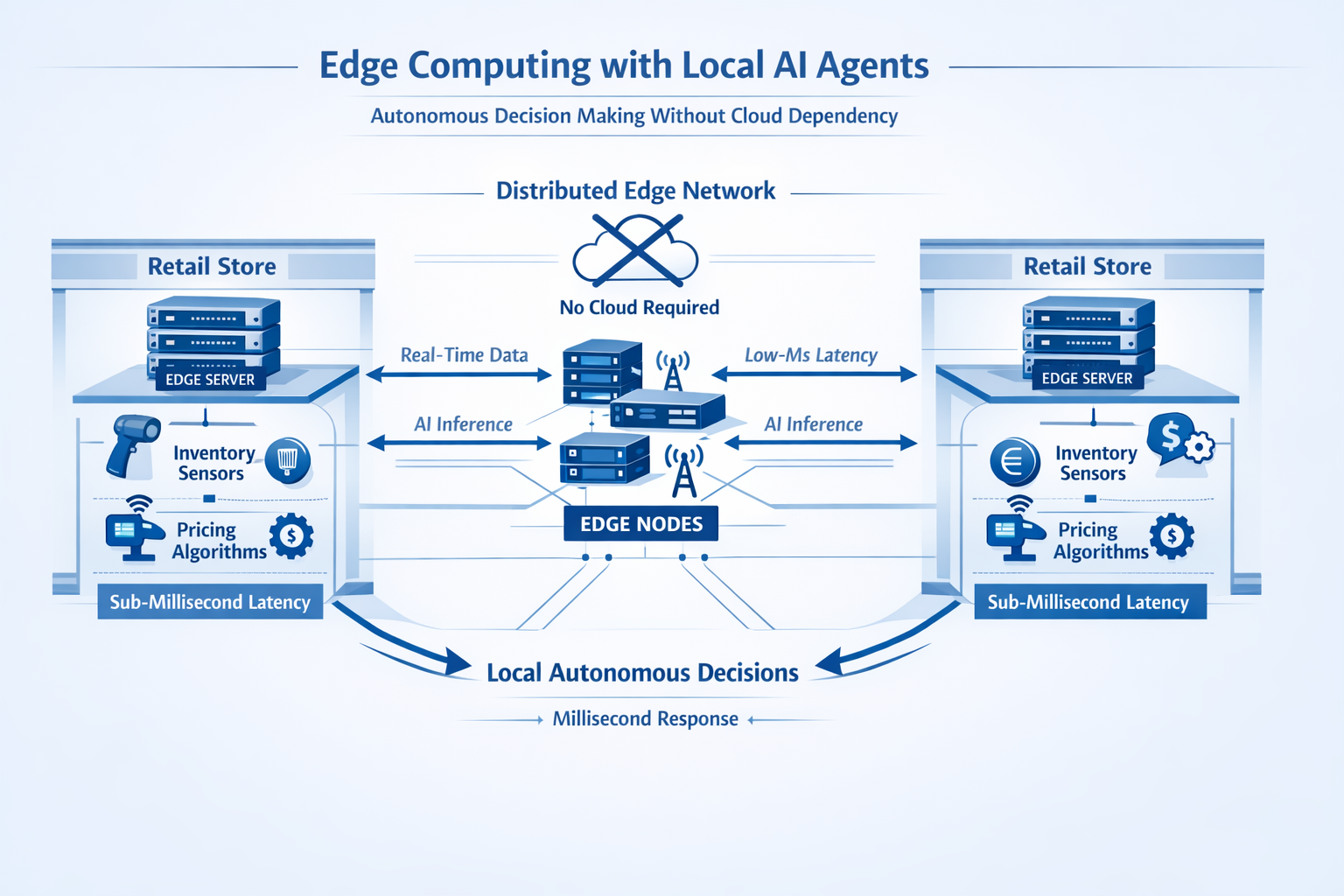
Edge-deployed agentic AI systems achieve real-time autonomy by combining local data processing, pre-trained decision models, and continuous learning loops that operate independently of cloud infrastructure. The system architecture typically includes three layers working together at the retail location.
Local data ingestion layer:
- Point-of-sale systems feed transaction data directly to edge servers
- IoT sensors monitor shelf inventory levels, warehouse stock positions, and supply chain status
- Web scraping agents (like Nimble's agentic AI browsers showcased at NRF 2026) pull competitor pricing from online sources in real time [2]
- Customer behavior analytics track browsing patterns, cart abandonment, and purchase history
Autonomous decision layer:
- Pre-trained machine learning models evaluate pricing elasticity, demand forecasts, and margin requirements
- Rule-based constraints ensure prices stay within approved ranges and comply with contractual agreements
- Multi-agent coordination protocols allow inventory agents to communicate with pricing agents without cloud mediation
- Fallback logic handles edge cases and escalates complex decisions to human supervisors when confidence thresholds aren't met
Execution and synchronization layer:
- Price updates push directly to digital displays, e-commerce platforms, and sales terminals
- Inventory reorder triggers send purchase orders to suppliers via local API connections
- Periodic batch synchronization uploads decision logs and performance metrics to cloud systems for audit and model retraining
- Conflict resolution protocols reconcile edge decisions with centralized policies during sync windows
Walmart's agentic end-to-end workflow autonomously anticipates demand and routes orders through the supply chain network, with the system operating before associates clock in, demonstrating real-time autonomous decision-making across distributed fulfillment networks [1]. This level of autonomy requires sophisticated edge infrastructure but delivers measurable speed advantages.
Common mistake: Deploying edge AI without adequate local compute resources leads to performance degradation that negates latency benefits. Ensure edge servers have sufficient CPU, GPU, and memory to handle peak transaction loads plus AI inference workloads simultaneously.
Why Edge Deployment Delivers 50% Faster Execution in Distributed Retail Networks
Edge deployment delivers approximately 50% faster execution compared to cloud-based systems because it eliminates network roundtrip time, reduces data transfer overhead, and enables parallel processing across distributed locations. In retail environments with intermittent connectivity, this speed advantage becomes even more pronounced.
Latency breakdown comparison:
| Decision Step | Cloud-Based System | Edge-Deployed System |
|---|---|---|
| Data capture | 10-50ms | 10-50ms |
| Network upload | 50-200ms | 0ms (local) |
| Cloud processing | 100-500ms | 0ms (local) |
| Decision compute | 50-200ms | 50-200ms (local edge) |
| Network download | 50-200ms | 0ms (local) |
| Local execution | 10-50ms | 10-50ms |
| Total latency | 270-1200ms | 70-300ms |
The 50% improvement stems primarily from eliminating two network hops (upload and download) and removing cloud queuing delays during peak traffic periods. For high-ticket B2B transactions where a single sale might represent thousands or millions in revenue, sub-second pricing adjustments can capture margin opportunities that slower systems miss.
Additional performance factors:
- Parallel processing: Each retail location runs its own AI agent independently, so system-wide capacity scales linearly with the number of locations
- Reduced bandwidth costs: Only decision logs and model updates travel to the cloud, not raw transaction data
- Offline operation: During network outages, edge agents continue making decisions based on last-known policies, maintaining business continuity
- Local caching: Frequently accessed data (product catalogs, customer profiles, pricing rules) stays in local memory for instant retrieval
Suzano, the world's largest pulp manufacturer with 50,000 employees, achieved a 95% reduction in supply chain query time using a Gemini Pro AI agent that translates natural language questions into SQL queries, deployed via Google Cloud in 2026 [1]. While this example uses cloud infrastructure, it illustrates the dramatic speed improvements possible with agentic AI systems—benefits that compound when processing happens at the edge.
Edge case: In multi-location retail chains, edge agents must coordinate inventory transfers between stores. This requires peer-to-peer communication protocols or a lightweight coordination layer that doesn't reintroduce cloud dependency bottlenecks.
Implementing Edge-Deployed Agentic AI for Inventory Management in B2B Retail
Implementing edge-deployed agentic AI for inventory management requires careful integration with existing warehouse management systems, supplier networks, and demand forecasting tools. The autonomous agents must balance local optimization with company-wide inventory policies to avoid creating inefficiencies across the distribution network.
Step-by-step implementation process:
- Assess current infrastructure: Evaluate edge computing capacity at each location, network reliability, and integration points with existing inventory systems
- Define autonomy boundaries: Establish clear rules for what decisions agents can make independently versus what requires human or centralized approval
- Deploy pilot agents: Start with 2-3 locations representing different scenarios (high-volume urban, low-connectivity rural, high-value specialty)
- Train local models: Use historical data from each location to fine-tune demand forecasting and reorder point algorithms for local market conditions
- Implement safety constraints: Set hard limits on reorder quantities, maximum inventory levels, and supplier spending to prevent runaway autonomous decisions
- Monitor and refine: Track agent performance metrics (stockout rates, carrying costs, forecast accuracy) and adjust decision thresholds based on results
- Scale gradually: Expand to additional locations in phases, incorporating lessons learned from pilot deployments
Key integration requirements:
- Real-time inventory visibility: IoT sensors, RFID tags, or barcode scanners feeding current stock levels to edge agents
- Supplier API connections: Direct electronic ordering systems that agents can trigger without human intermediaries
- Demand signal aggregation: Point-of-sale data, web traffic, seasonal patterns, and external market indicators combined into unified forecasts
- Multi-location coordination: Protocols for agents to share surplus inventory or coordinate bulk purchases when beneficial
Agentic AI systems can autonomously forecast demand and rebalance inventory across hundreds of locations, enabling real-time supply chain optimization that outpaces traditional human-managed workflows, raising novel tax and compliance considerations for state-level inventory redistribution [3]. B2B retailers must account for these regulatory complexities when designing edge agent decision rules.
Common mistake: Allowing edge agents to optimize purely for local metrics (like minimizing stockouts at one location) can create system-wide inefficiencies if agents compete for limited supplier capacity or fail to share excess inventory with nearby locations. Implement coordination protocols that balance local and network-wide objectives.
Decision rule: Choose edge-deployed inventory agents if your stockout costs exceed $10,000 per incident and your locations experience network outages more than 2% of operating hours. Otherwise, cloud-based systems with local caching may offer better cost-effectiveness.
Autonomous Pricing Strategies for High-Ticket B2B Products Using Edge AI
Autonomous pricing for high-ticket B2B products requires sophisticated edge AI agents that can balance multiple competing objectives: maximizing margin, maintaining competitive positioning, preserving customer relationships, and respecting contractual pricing agreements. Unlike consumer retail where prices change frequently, B2B pricing autonomy must account for negotiated contracts, volume discounts, and relationship-based pricing tiers.
Core pricing autonomy capabilities:
- Competitive intelligence: Real-time monitoring of competitor pricing across online marketplaces, distributor catalogs, and public price lists
- Demand elasticity modeling: Understanding how price changes affect purchase probability for different customer segments and product categories
- Margin optimization: Calculating optimal prices that maximize profit while staying within acceptable ranges for customer retention
- Contract compliance: Ensuring autonomous price adjustments respect pre-negotiated terms, volume discount tiers, and most-favored-customer clauses
- Personalization: Adjusting offers based on customer purchase history, payment terms, and relationship value
Microsoft's Pegasus Program features three production-stage retail AI startups (Nimble, YDISTRI, and Omnistream) showcased at NRF 2026 in January, enabling multi-agent collaboration to optimize inventory, assortment, and pricing in real time at the store level [2]. Nimble's agentic AI browsers connect enterprises to live online knowledge sources for real-time pricing decisions, assortment optimization, and demand forecasting with grounding in real-world market signals [2].
Implementation considerations for B2B pricing autonomy:
- Set price movement boundaries: Define maximum percentage changes allowed per time period (e.g., ±5% per day, ±15% per month) to prevent customer confusion or relationship damage
- Implement approval workflows: Route significant price changes (above certain thresholds) to human sales managers for review before execution
- Track customer reactions: Monitor quote acceptance rates, negotiation frequency, and customer complaints to detect when autonomous pricing creates friction
- Maintain audit trails: Log every pricing decision with supporting rationale (competitor data, demand signals, margin calculations) for regulatory compliance and customer disputes
- Coordinate with sales teams: Ensure autonomous pricing doesn't undermine ongoing negotiations or create conflicts with relationship-based selling approaches
Edge case: For custom-configured B2B products where each quote is unique, edge agents can generate starting prices based on component costs, labor estimates, and margin targets, but final approval should remain with human sales engineers who understand customer-specific requirements and relationship dynamics.
Choose autonomous B2B pricing if:
- Your product catalog includes hundreds or thousands of SKUs where manual price management is impractical
- Competitor pricing changes frequently enough that delayed responses cost measurable margin
- Your sales team spends excessive time on routine pricing decisions rather than relationship building
- Price optimization can deliver margin improvements exceeding 2-3% (justifying the implementation investment)
Security, Compliance, and Audit Requirements for Edge-Deployed Retail AI
Edge-deployed agentic AI introduces unique security and compliance challenges because autonomous agents make financial decisions using sensitive data stored outside centralized data centers. B2B retailers must implement robust controls to prevent unauthorized access, ensure decision transparency, and maintain regulatory compliance across distributed networks.
Critical security requirements:
- Encrypted local storage: All pricing strategies, customer data, and inventory information stored on edge servers must use AES-256 or equivalent encryption
- Tamper-proof logging: Decision audit trails must be cryptographically signed and timestamped to prevent post-hoc manipulation
- Multi-factor authentication: Access to edge AI configuration and override controls requires strong authentication, not just network access
- Network segmentation: Edge AI systems should operate on isolated network segments separate from general corporate networks
- Regular security updates: Edge servers need automated patching processes for OS, AI frameworks, and application code
Compliance considerations:
- Data residency: Some jurisdictions require customer and transaction data to remain within specific geographic boundaries—edge deployment can help satisfy these requirements if servers are located appropriately
- Pricing discrimination laws: Autonomous pricing must respect regulations prohibiting discriminatory pricing based on protected characteristics
- Contract law: AI-generated prices must comply with existing contractual obligations, volume discount schedules, and most-favored-customer clauses
- Financial reporting: Autonomous pricing and inventory decisions must integrate with accounting systems for accurate revenue recognition and inventory valuation
- Tax implications: As noted by Vertex Inc., agentic AI systems that autonomously rebalance inventory across state lines raise novel tax and compliance considerations for state-level inventory redistribution [3]
Audit trail requirements:
Each autonomous decision should log:
- Timestamp and location of decision
- Input data used (competitor prices, inventory levels, demand signals)
- Decision rationale (which rules or models triggered the action)
- Confidence score or uncertainty estimate
- Human override history (if applicable)
- Outcome metrics (actual sales, margin achieved, customer response)
Danfoss deployed agentic order management on Google Cloud with over 80% of transactional decisions now handled autonomously by the AI agent system [1]. While this example uses cloud infrastructure, the same audit and compliance principles apply—and become more complex when decisions happen at distributed edge locations.
Common mistake: Treating edge AI systems as "black boxes" without sufficient logging and explainability. Regulatory audits, customer disputes, and internal reviews all require clear documentation of why autonomous agents made specific pricing or inventory decisions.
Decision rule: If your B2B retail business operates in highly regulated industries (healthcare, defense, financial services), require human approval for all autonomous decisions above $50,000 in value until you've established proven audit trails and compliance processes for edge AI systems.
Integrating Edge AI with Existing B2B Retail SaaS Platforms
Integrating edge-deployed agentic AI with existing B2B retail SaaS platforms requires careful API design, data synchronization strategies, and fallback mechanisms to ensure seamless operation across hybrid cloud-edge architectures. Most B2B retailers already use enterprise resource planning (ERP), customer relationship management (CRM), and warehouse management systems (WMS) that weren't designed for edge AI integration.
Integration architecture patterns:
- API-first design: Edge AI agents communicate with existing systems through well-defined REST or GraphQL APIs, treating legacy platforms as data sources and execution targets
- Event-driven synchronization: Changes in edge systems trigger events that propagate to cloud platforms asynchronously, avoiding tight coupling and reducing latency
- Local caching layers: Edge agents maintain local copies of frequently accessed data (product catalogs, customer profiles, pricing rules) with periodic refresh from authoritative cloud sources
- Conflict resolution protocols: When edge decisions conflict with centralized policies or concurrent cloud updates, predefined rules determine which takes precedence
- Graceful degradation: If cloud connectivity fails, edge agents continue operating with last-known-good data and queue updates for later synchronization
Key integration points:
- ERP systems: Inventory levels, purchase orders, supplier data, cost information
- CRM platforms: Customer profiles, purchase history, contract terms, relationship status
- E-commerce platforms: Product catalogs, pricing displays, shopping cart integration, checkout flows
- Payment gateways: Transaction processing, fraud detection, payment authorization (note: Visa and Mastercard launched dedicated agentic AI payments tools in October 2025, with Visa signaling AI-powered checkout is moving toward mainstream adoption as of December 2025 [4])
- Analytics platforms: Performance metrics, decision outcomes, model retraining data
Implementation steps:
- Map data flows: Document what data needs to flow between edge agents and each existing platform, in which direction, and at what frequency
- Define API contracts: Specify exact data formats, authentication methods, rate limits, and error handling for each integration point
- Build synchronization logic: Implement bidirectional sync processes that handle conflicts, retries, and eventual consistency
- Test failure scenarios: Verify that edge agents continue operating correctly during network outages, API failures, and data conflicts
- Monitor integration health: Track API latency, error rates, sync delays, and data consistency metrics continuously
Visa partnered with Akamai Technologies (announced by March 2026) to integrate identity verification, authentication, and fraud prevention via Visa's Trusted Agent Protocol combined with Akamai's edge-based behavioral intelligence and bot mitigation [4]. This demonstrates how payment infrastructure is evolving to support edge-deployed autonomous commerce.
Common mistake: Attempting to integrate edge AI through direct database connections rather than APIs creates tight coupling, makes version upgrades difficult, and introduces security vulnerabilities. Always use well-defined API boundaries even when integrating with on-premises systems.
Edge case: For B2B retailers using multiple SaaS vendors (separate systems for inventory, CRM, and e-commerce), edge AI agents may need to orchestrate data across platforms that don't natively integrate with each other. Consider using an integration platform as a service (iPaaS) layer to simplify these complex data flows.
Measuring ROI and Performance Metrics for Edge-Deployed Agentic AI
Measuring ROI for edge-deployed agentic AI requires tracking both direct financial benefits (margin improvement, cost reduction) and operational metrics (decision speed, system uptime, autonomous decision rate). B2B retailers should establish baseline measurements before deployment and monitor changes over 6-12 months to account for seasonal variations and learning curve effects.
Financial ROI metrics:
- Gross margin improvement: Percentage increase in average margin per transaction due to optimized pricing
- Inventory carrying cost reduction: Decrease in capital tied up in excess inventory due to better demand forecasting and autonomous replenishment
- Stockout cost avoidance: Value of lost sales prevented by maintaining optimal inventory levels
- Labor cost savings: Reduction in staff time spent on manual pricing decisions and inventory management
- Infrastructure costs: Edge server hardware, software licenses, network bandwidth, and maintenance expenses
Operational performance metrics:
- Decision latency: Average time from trigger event (competitor price change, inventory threshold) to executed decision
- Autonomous decision rate: Percentage of pricing and inventory decisions made by AI agents without human intervention
- Forecast accuracy: Mean absolute percentage error (MAPE) for demand predictions compared to actual sales
- System uptime: Percentage of time edge agents remain operational, including during network outages
- Override frequency: How often human operators need to reverse or modify autonomous decisions (high rates suggest insufficient training or overly aggressive autonomy)
Benchmark expectations:
Based on documented implementations, B2B retailers should expect:
- 50% reduction in decision latency compared to cloud-based systems in environments with intermittent connectivity
- 15-25% improvement in forecast accuracy after 6-12 months of agent learning
- 80%+ autonomous decision rate for routine pricing and reorder decisions (matching Danfoss's 80% autonomous order processing rate [1])
- 2-5% gross margin improvement through optimized pricing (varies significantly by industry and competitive intensity)
- 10-20% reduction in inventory carrying costs through better demand-supply matching
TELUS (57,000 employees) saved 40 minutes per AI interaction across its workforce by deploying agentic AI operations via Google Cloud, demonstrating significant efficiency gains in autonomous B2B workflows [1]. While this example focuses on internal operations rather than customer-facing retail, it illustrates the productivity improvements possible with well-implemented agentic systems.
Measurement framework:
- Establish baseline: Document current performance for all key metrics before edge AI deployment
- Set targets: Define realistic improvement goals based on industry benchmarks and your specific constraints
- Track continuously: Implement automated dashboards that update key metrics daily or weekly
- Conduct periodic reviews: Monthly or quarterly business reviews to assess progress, identify issues, and adjust strategies
- Calculate total cost of ownership: Include all infrastructure, licensing, integration, training, and maintenance costs in ROI calculations
Common mistake: Focusing exclusively on cost reduction without measuring customer satisfaction impacts. Autonomous pricing that maximizes short-term margin but damages customer relationships delivers negative long-term ROI. Track customer retention rates, quote acceptance rates, and relationship health metrics alongside financial performance.
Implementation Roadmap: Deploying Edge AI for B2B Retail Networks
Deploying edge-deployed agentic AI for B2B retail networks requires a phased approach that minimizes risk while building organizational capabilities and demonstrating value. Most successful implementations follow a 12-18 month roadmap from initial assessment through full-scale deployment.
Phase 1: Assessment and Planning (Months 1-3)
- Conduct infrastructure audit of edge computing capacity at retail locations
- Evaluate current pricing and inventory management processes to identify automation opportunities
- Define success metrics and ROI targets based on business priorities
- Select pilot locations representing different operational scenarios
- Assemble cross-functional team (IT, operations, sales, finance, legal)
- Choose technology partners and AI platform vendors
Phase 2: Pilot Deployment (Months 4-7)
- Deploy edge servers and AI agent software at 2-3 pilot locations
- Integrate with existing ERP, CRM, and WMS systems via APIs
- Train initial AI models using historical data from pilot locations
- Implement safety constraints and human approval workflows
- Begin autonomous operation in shadow mode (AI makes recommendations but humans approve)
- Monitor performance metrics and gather feedback from operational staff
Phase 3: Validation and Refinement (Months 8-10)
- Transition from shadow mode to full autonomy for routine decisions
- Compare pilot location performance against control locations and historical baselines
- Refine decision rules, safety constraints, and escalation thresholds based on results
- Document lessons learned and update implementation playbook
- Calculate actual ROI from pilot phase
- Secure executive approval and budget for full-scale deployment
Phase 4: Scaled Rollout (Months 11-15)
- Deploy to 25-50% of locations in first wave
- Implement centralized monitoring and management tools for distributed edge agents
- Train operational staff on working with autonomous systems
- Establish ongoing model retraining and software update processes
- Continue measuring performance and refining based on expanded data
Phase 5: Optimization and Expansion (Months 16-18+)
- Complete deployment to remaining locations
- Implement advanced features (multi-agent coordination, predictive analytics, personalization)
- Optimize infrastructure costs through hardware consolidation or cloud-edge hybrid approaches
- Expand autonomy to additional decision types beyond initial pricing and inventory scope
- Share best practices across organization and adjust policies based on accumulated experience
Resource requirements:
- Technical staff: 2-3 full-time engineers for integration and deployment, plus ongoing support
- Business analysts: 1-2 people to define decision rules, monitor performance, and refine strategies
- Project management: Dedicated PM for coordination across teams and locations
- Executive sponsorship: VP-level champion to secure resources and drive organizational change
- Budget: $500K-$2M for initial deployment depending on number of locations and infrastructure requirements
Visa and AWS partnership enables enterprise agentic commerce deployment, providing infrastructure and tools to build and scale autonomous purchasing systems, with early adopter Ramp integrating AI agents for business buyers managing virtual Visa cards [4]. This demonstrates the growing ecosystem of tools and platforms available to support edge AI deployment.
Common mistake: Attempting to deploy to all locations simultaneously without pilot validation. This amplifies risks, makes troubleshooting difficult, and prevents learning from early mistakes. Always pilot first, even if it extends the overall timeline.
Frequently Asked Questions
What is edge-deployed agentic AI in B2B retail?
Edge-deployed agentic AI refers to autonomous software agents that make inventory and pricing decisions locally at retail locations or distribution centers, processing data and executing actions without requiring cloud connectivity. These agents operate independently to optimize margins, prevent stockouts, and respond to market changes in real time.
How much faster is edge AI compared to cloud-based systems?
Edge-deployed AI systems typically deliver 50% faster execution in retail environments with intermittent connectivity by eliminating network roundtrip time to cloud servers. Decision latency drops from 270-1200ms for cloud systems to 70-300ms for edge systems, enabling sub-second responses to market changes.
What are the main benefits for high-ticket B2B retailers?
High-ticket B2B retailers benefit from faster pricing decisions that capture margin opportunities on expensive items, offline resilience during network outages, reduced data transfer costs, and simplified compliance with data residency regulations. The infrastructure investment is justified by higher per-transaction values.
How do edge AI agents handle network outages?
During network outages, edge agents continue operating using last-known-good policies and locally cached data. They make autonomous decisions based on pre-trained models and queue decision logs for cloud synchronization when connectivity returns. This ensures business continuity even in unreliable network environments.
What security risks come with edge-deployed AI?
Edge deployment introduces risks including unauthorized access to distributed servers, data theft from local storage, tampering with decision logs, and difficulty maintaining consistent security patches across many locations. Mitigation requires encrypted storage, tamper-proof logging, network segmentation, and automated update processes.
Can edge AI integrate with existing retail software?
Yes, edge AI agents integrate with existing ERP, CRM, WMS, and e-commerce platforms through well-defined APIs. Integration requires careful data synchronization strategies, conflict resolution protocols, and fallback mechanisms to handle connectivity issues and ensure consistency across hybrid cloud-edge architectures.
How long does implementation take?
Typical implementation follows a 12-18 month roadmap from initial assessment through full-scale deployment. This includes 3 months for planning, 4 months for pilot deployment, 3 months for validation, and 5-8 months for scaled rollout. Rushing this timeline increases risk and reduces learning opportunities.
What ROI should B2B retailers expect?
B2B retailers should expect 2-5% gross margin improvement through optimized pricing, 10-20% reduction in inventory carrying costs, and 80%+ autonomous decision rates for routine operations. Total ROI depends on implementation costs, number of locations, and transaction values but typically achieves payback within 18-24 months.
Who are the leading vendors for edge retail AI?
Microsoft's Pegasus Program showcased Nimble, YDISTRI, and Omnistream at NRF 2026 as production-ready retail AI startups [2]. Major cloud providers (AWS, Google Cloud, Microsoft Azure) offer edge AI infrastructure. Specialized vendors focus on retail-specific use cases including autonomous pricing and inventory management.
What mistakes do retailers make with edge AI?
Common mistakes include deploying without adequate edge computing resources, allowing agents to optimize purely for local metrics without network-wide coordination, treating systems as black boxes without sufficient audit trails, and attempting full-scale deployment without pilot validation. Successful implementations start small, measure carefully, and scale gradually.
How does edge AI affect pricing compliance?
Edge AI must respect contractual pricing agreements, volume discount tiers, and pricing discrimination laws. Implementation requires careful configuration of decision boundaries, approval workflows for significant changes, and comprehensive audit trails. Autonomous pricing can actually improve compliance by consistently applying rules that humans might overlook.
What infrastructure is needed at each location?
Each location needs edge servers with sufficient CPU/GPU for AI inference, local storage for data caching, network connectivity (though not continuous), integration with point-of-sale and inventory systems, and IoT sensors for real-time data collection. Infrastructure requirements scale with transaction volume and decision complexity.
Conclusion
Edge-deployed agentic AI for high-ticket B2B retail SaaS represents a significant evolution in how distributed retail networks manage inventory and pricing autonomy. By processing decisions locally at retail locations, these autonomous agents deliver measurable speed advantages—approximately 50% faster execution in environments with intermittent connectivity—while maintaining business continuity during network outages and simplifying compliance with data residency regulations.
The technology has moved beyond experimental stages, with major implementations from Walmart, Danfoss, Microsoft's Pegasus Program startups, and payment infrastructure providers like Visa demonstrating production-ready capabilities in 2026. B2B retailers selling high-value products can now deploy AI agents that autonomously adjust prices based on competitor intelligence, trigger inventory replenishment based on demand forecasts, and personalize promotions based on customer behavior—all without waiting for cloud processing or human approval.
Successful implementation requires careful attention to security, compliance, and integration with existing retail systems. The phased approach outlined in this guide—starting with pilot deployments, validating ROI, and scaling gradually—minimizes risk while building organizational capabilities. B2B retailers should expect 12-18 months from initial assessment to full deployment, with ROI typically achieved within 18-24 months through margin improvement, inventory optimization, and labor cost reduction.
Actionable next steps:
- Assess your readiness: Evaluate whether your retail locations have adequate edge computing infrastructure and whether your connectivity issues justify edge deployment
- Calculate potential ROI: Use the metrics framework provided to estimate margin improvement, inventory cost reduction, and implementation costs for your specific situation
- Select pilot locations: Choose 2-3 locations representing different operational scenarios to test edge AI capabilities before full-scale deployment
- Engage technology partners: Research vendors from Microsoft's Pegasus Program, major cloud providers' edge AI offerings, and specialized retail AI platforms
- Build cross-functional team: Assemble representatives from IT, operations, sales, finance, and legal to address technical, business, and compliance requirements
- Start small and measure carefully: Begin with shadow mode deployment where AI makes recommendations but humans approve, then transition to full autonomy as confidence builds
For B2B retailers considering this technology, the question is no longer whether edge-deployed agentic AI can deliver value, but rather how quickly you can implement it before competitors gain the margin and operational advantages it provides. The documented implementations from 2026 demonstrate that the technology is mature, the benefits are measurable, and the competitive pressure is real.
To learn more about AI marketing tools and platforms that can complement your edge AI strategy, explore our comprehensive guide. Additionally, understanding data and analytics for AI marketing will help you measure and optimize your autonomous retail systems effectively.
References
[1] Top 50 Agentic AI Implementations Use Cases To Learn From – https://8allocate.com/blog/top-50-agentic-ai-implementations-use-cases-to-learn-from/
[2] Powering The Future Of Retail Three AI Startups To Watch At NRF 2026 – https://blogs.microsoft.com/bayarea/2026/01/08/powering-the-future-of-retail-three-ai-startups-to-watch-at-nrf-2026/
[3] Retail 2026 AI Adoption Accelerates 2026 – https://www.vertexinc.com/resources/resource-library/retail-2026-ai-adoption-accelerates-2026
[4] How Visa Views Agentic Commerce Opportunity – https://www.digitalcommerce360.com/2026/03/17/how-visa-views-agentic-commerce-opportunity/