

The relay race is over. In 2026, affiliate marketers who still pass campaigns from tool to tool—manually analyzing data, adjusting bids, and optimizing content in disconnected platforms—are watching their competitors pull ahead with connected AI systems that orchestrate entire campaigns autonomously. From discrete tools to agentic workflows: building connected AI systems for affiliate campaign orchestration represents the fundamental shift separating industry leaders from those struggling to keep pace. Rather than optimizing individual touchpoints, winning brands now deploy intelligent ecosystems where AI agents plan, execute, and optimize campaigns with minimal human intervention—transforming marketing operations from relay-race chaos into precision control-room orchestration.
This transformation isn’t theoretical. Systems integration has emerged as the competitive advantage in 2026, with AI systems outperforming traditional campaigns by adapting during prospect journey execution rather than analyzing results weeks after the fact[4]. The siloed approach where momentum breaks down is giving way to coordinated workflows that respond to behavioral changes, intent signals, and demand fluctuations in real time.
Key Takeaways
- 🚀 Agentic AI workflows coordinate multiple marketing functions autonomously, eliminating the manual handoffs that create delays and lost opportunities in traditional discrete tool approaches
- 💰 Connected systems deliver measurable ROI gains: 40-50% improvement in win rates, 25-35% reduction in sales cycles, and 3-5X higher ROI compared to siloed campaign management[2]
- 🎯 Real-time adaptation replaces post-campaign analysis as AI systems adjust bidding, content, and targeting during prospect journeys rather than weeks later[4]
- 🔗 Affiliate infrastructure provides the essential foundation for scaling creator-driven campaigns across influencer relationships, commissions, payments, and multi-channel advertising[1]
- 📊 Privacy-resilient attribution through affiliate systems addresses ongoing signal loss and fragmented data challenges facing marketers in 2026[1]
The Evolution from Isolated Tools to Intelligent Orchestration
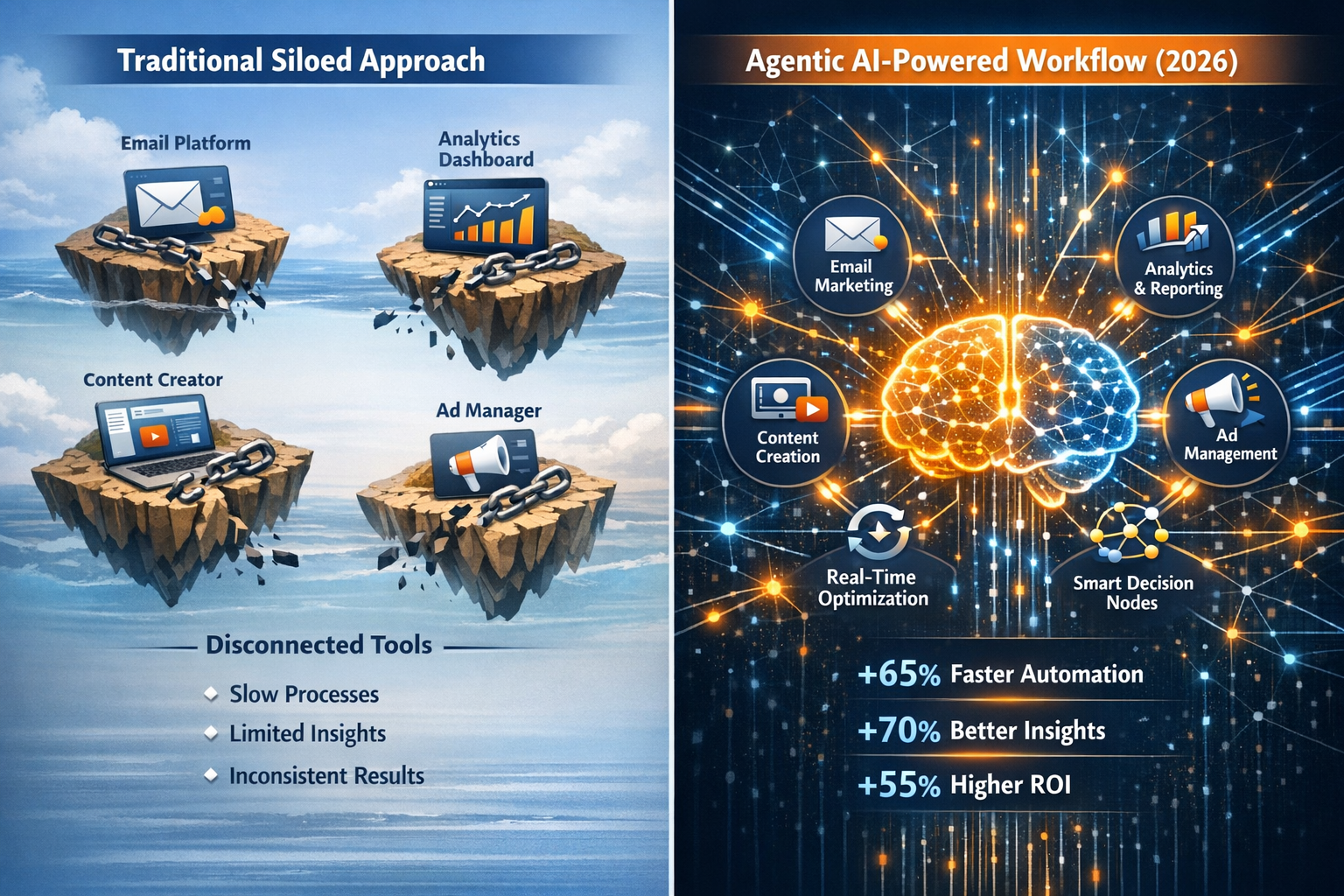
Understanding the Discrete Tool Problem
Most marketing teams in 2026 still operate with disconnected technology stacks that create operational friction at every turn. The typical affiliate marketer juggles separate platforms for:
- Email marketing automation
- Social media scheduling and monitoring
- Content creation and optimization
- Analytics and reporting dashboards
- Affiliate network management
- Paid advertising campaigns
- Customer relationship management
Each tool excels at its specific function but operates in isolation. Data doesn’t flow automatically between systems. Insights discovered in one platform require manual implementation in another. Campaign adjustments happen in sequential steps rather than coordinated responses. This fragmented approach is precisely where momentum breaks down[4].
The consequences are significant:
- Delayed response times to market changes and competitor moves
- Inconsistent customer experiences across touchpoints
- Duplicated effort entering data and configuring rules across multiple platforms
- Lost attribution when customer journeys span disconnected systems
- Missed optimization opportunities that require cross-platform data analysis
For those exploring affiliate marketing programs, understanding this evolution is critical to building competitive advantage from the start.
What Makes Workflows “Agentic”
Agentic workflows represent a fundamental departure from traditional automation. While basic automation follows predetermined “if-then” rules, agentic systems employ AI that can:
✅ Plan multi-step campaigns based on objectives and constraints
✅ Execute coordinated actions across multiple platforms simultaneously
✅ Monitor performance indicators and environmental changes in real time
✅ Adapt strategies dynamically based on emerging patterns and outcomes
✅ Learn from results to improve future decision-making
These AI agents don’t simply execute tasks—they orchestrate complex workflows with minimal human oversight. When a prospect’s behavior signals increased purchase intent, the agentic system doesn’t wait for a marketer to notice and respond. It immediately adjusts bidding strategies, personalizes content delivery, triggers appropriate email sequences, and reallocates budget across channels to capitalize on the opportunity.
The global influencer market’s projected growth to approximately $33 billion by the end of 2025 reflects this shift toward creator-driven campaigns that demand sophisticated orchestration[1]. Managing dozens or hundreds of influencer partnerships manually becomes impossible at scale—precisely where agentic workflows deliver competitive advantage.
Core Components of Connected AI Systems for Affiliate Campaign Orchestration
Data Integration Layer: The Foundation
Connected AI systems begin with unified data infrastructure that eliminates silos. This integration layer serves as the nervous system connecting every touchpoint:
| Data Source | Critical Information | Integration Purpose |
|---|---|---|
| Affiliate Networks | Click data, conversion rates, commission structures | Performance tracking and partner evaluation |
| CRM Systems | Customer profiles, purchase history, lifetime value | Personalization and segmentation |
| Analytics Platforms | Traffic sources, behavior patterns, funnel metrics | Attribution and optimization insights |
| Ad Platforms | Impression data, CPCs, audience performance | Budget allocation and targeting refinement |
| Content Systems | Engagement metrics, topic performance, SEO rankings | Content strategy and production priorities |
| Email Platforms | Open rates, click patterns, subscriber segments | Communication timing and messaging |
The integration layer doesn’t just collect this data—it normalizes, enriches, and makes it accessible to AI agents in real time. When properly implemented, marketers gain a single source of truth that powers intelligent decision-making across all campaign elements.
For marketers implementing AI tools for competitive analysis, this integrated data foundation enables sophisticated market intelligence that informs campaign strategy.
AI Agent Architecture: The Decision Engine
At the heart of connected systems sit specialized AI agents that handle distinct orchestration functions:
🎯 Campaign Planning Agent
Analyzes objectives, budgets, and market conditions to generate comprehensive campaign strategies. This agent identifies optimal channel mix, content themes, targeting parameters, and timeline structures based on historical performance and predictive modeling.
📊 Performance Monitoring Agent
Continuously tracks campaign metrics across all channels, identifying anomalies, opportunities, and threats. Rather than generating static reports, this agent provides real-time alerts and recommendations when intervention opportunities arise.
💰 Budget Optimization Agent
Dynamically reallocates spending across channels, partners, and campaigns based on performance signals. This agent doesn’t wait for monthly reviews—it shifts resources hourly or even minute-by-minute to maximize ROI.
✍️ Content Personalization Agent
Tailors messaging, creative assets, and offers to individual prospects based on behavioral data, demographic information, and predicted preferences. This goes far beyond basic segmentation to deliver truly individualized experiences.
🔗 Attribution Analysis Agent
Maps customer journeys across touchpoints to accurately credit conversions and inform strategic decisions. With privacy-resilient attribution becoming essential in 2026[1], this agent navigates signal loss and fragmented data to maintain visibility.
These agents don’t operate independently—they communicate, coordinate, and collaborate to orchestrate cohesive campaigns. When the performance monitoring agent detects declining engagement in a specific segment, it alerts the content personalization agent to test new messaging approaches while the budget optimization agent reduces spend until performance recovers.
Workflow Automation Infrastructure
The third critical component connects AI decision-making to execution across platforms. Modern workflow automation infrastructure enables:
- API-based integrations that trigger actions across dozens of platforms simultaneously
- Conditional logic trees that handle complex multi-step processes
- Error handling and fallback protocols ensuring reliability at scale
- Audit trails and compliance monitoring for regulatory requirements
- Human-in-the-loop checkpoints for high-stakes decisions requiring oversight
AI marketing automation capabilities now include behavioral trigger workflows, dynamic content personalization, predictive lead scoring, multi-touch attribution, and real-time data capabilities[2]—all orchestrated through this infrastructure layer.
For those building affiliate marketing strategies from the ground up, understanding workflow automation prevents the technical debt that comes from bolting together incompatible systems.
Building Your Connected AI System: From Discrete Tools to Agentic Workflows
Step 1: Audit Your Current Technology Stack
Begin by mapping every tool and platform currently in use for affiliate campaign management. Document:
- Primary function of each tool
- Data it generates or requires
- Current integration status with other systems
- Manual processes required to move data or trigger actions
- Cost and contract terms
- User satisfaction and adoption rates
This audit reveals integration gaps, redundant capabilities, and opportunities for consolidation. Many marketers discover they’re paying for overlapping functionality across multiple platforms while critical connections remain manual.
Step 2: Define Your Orchestration Priorities
Not every campaign element requires immediate AI orchestration. Prioritize based on impact and feasibility:
High Impact, High Feasibility (Start Here)
- Email sequence triggering based on affiliate link clicks
- Bid adjustments for paid campaigns based on conversion data
- Budget reallocation between top-performing affiliate partners
High Impact, Medium Feasibility (Phase 2)
- Dynamic content personalization across landing pages
- Predictive lead scoring for affiliate traffic quality
- Cross-channel attribution modeling
High Impact, Lower Feasibility (Long-term Goals)
- Fully autonomous campaign creation and launch
- AI-generated creative asset production
- Predictive inventory management for affiliate products
This phased approach prevents overwhelming teams while delivering quick wins that build momentum and demonstrate ROI.
Step 3: Select Your Integration Platform
The foundation of connected systems is the integration platform that enables communication between tools. Options include:
Enterprise Integration Platforms
Robust solutions like MuleSoft, Zapier for Teams, or Workato that handle complex workflows at scale. Best for organizations managing hundreds of integrations across multiple departments.
Marketing-Specific Platforms
Solutions like HubSpot Operations Hub or Marketo’s integration tools designed specifically for marketing technology stacks. These offer pre-built connectors for common marketing platforms.
Custom API Development
Building proprietary integration infrastructure provides maximum flexibility but requires significant technical resources and ongoing maintenance.
For most affiliate marketers, hybrid approaches work best—using integration platforms for standard connections while developing custom solutions for unique requirements or competitive advantages.
Step 4: Implement AI Agents Progressively
Rather than attempting to deploy fully autonomous systems immediately, introduce AI agents incrementally:
Month 1-2: Monitoring and Recommendations
Deploy AI agents in advisory mode, generating insights and recommendations that humans review before implementation. This builds trust and allows teams to understand agent decision-making logic.
Month 3-4: Semi-Autonomous Execution
Enable agents to execute low-risk decisions automatically (like bid adjustments within predefined ranges) while requiring approval for significant changes.
Month 5-6: Autonomous Orchestration
Transition to fully autonomous operation for proven workflows, maintaining human oversight through exception reporting and periodic audits.
This progressive approach minimizes risk while accelerating learning and adoption. Account-Based Marketing powered by AI shows measurable results including 25-35% reduction in sales cycle length and 40-50% improvement in win rates[2]—outcomes that justify the implementation investment.
Step 5: Establish Feedback Loops and Continuous Improvement
Connected AI systems improve through continuous learning. Establish mechanisms for:
- Regular performance reviews comparing AI decisions to human judgment
- A/B testing of agent strategies against control groups
- Feedback collection from sales teams on lead quality
- Customer satisfaction monitoring across AI-personalized experiences
- Competitive benchmarking to identify improvement opportunities
The most successful implementations treat AI orchestration as an evolving capability rather than a one-time project. As agents accumulate data and refine their models, performance compounds over time.
Real-World Applications: From Discrete Tools to Agentic Workflows in Affiliate Campaign Orchestration
Influencer Partnership Orchestration
Managing creator partnerships manually becomes impossible at scale. Agentic workflows transform influencer campaign management:
- Automated partner discovery using AI to identify creators whose audiences match target demographics and psychographics
- Performance-based budget allocation that shifts spending toward top-performing partnerships in real time
- Content approval workflows that route creator submissions through brand safety checks and optimization recommendations
- Commission optimization that adjusts payout structures based on traffic quality and conversion performance
- Relationship management that triggers personalized outreach based on partnership lifecycle stage
Affiliate programs provide essential infrastructure for scaling these creator-driven campaigns, allowing brands to manage relationships, commissions, payments, display ads, and search advertising in one consolidated platform[1].
Multi-Channel Attribution and Budget Optimization
Privacy changes and signal loss make attribution increasingly challenging. Connected AI systems navigate this complexity:
The attribution analysis agent combines:
- First-party data from affiliate networks and CRM systems
- Behavioral signals from website analytics
- Conversion data across multiple touchpoints
- Probabilistic modeling to fill gaps from lost third-party cookies
This comprehensive view enables the budget optimization agent to allocate spending based on true incremental impact rather than last-click attribution that overvalues bottom-funnel channels.
For marketers exploring proven strategies to boost affiliate income, sophisticated attribution represents the difference between scaling profitably and wasting budget on vanity metrics.
Dynamic Content Personalization at Scale
Agentic content systems move beyond basic segmentation to deliver individualized experiences:
When a prospect clicks an affiliate link, the content personalization agent instantly:
- Analyzes their behavioral history and inferred preferences
- Selects optimal landing page layout and messaging framework
- Personalizes product recommendations based on predicted interest
- Adjusts offer presentation (discount vs. value proposition vs. urgency)
- Customizes follow-up email sequences based on on-page behavior
This happens in milliseconds, creating experiences that feel hand-crafted while operating at unlimited scale. The system continuously learns which personalization strategies drive conversions for different audience segments.
Predictive Campaign Planning
Rather than relying solely on historical performance, planning agents incorporate predictive modeling:
- Seasonal demand forecasting that anticipates traffic and conversion fluctuations
- Competitive landscape analysis identifying opportunities when competitors reduce spending
- Content trend prediction highlighting emerging topics before they peak
- Partner performance forecasting predicting which affiliates will deliver best results for specific campaigns
- Budget requirement modeling that accurately estimates spending needed to achieve objectives
These predictive capabilities enable proactive strategy rather than reactive adjustments—a fundamental advantage in competitive markets.
Overcoming Common Implementation Challenges

Technical Integration Complexity
Challenge: Legacy systems with limited API access or incompatible data formats create integration bottlenecks.
Solution: Implement middleware layers that translate between systems, use web scraping for platforms without APIs, and prioritize replacing tools that resist integration during contract renewals. Sometimes the “best” individual tool becomes the wrong choice when it can’t participate in connected workflows.
Data Quality and Consistency
Challenge: AI agents make poor decisions when trained on incomplete, inaccurate, or inconsistent data.
Solution: Establish data governance protocols including validation rules, standardized naming conventions, regular audits, and cleansing processes. Invest in data quality before deploying autonomous agents—garbage in guarantees garbage out.
Team Skill Gaps
Challenge: Marketing teams lack technical expertise to implement and manage AI orchestration systems.
Solution: Combine training programs with strategic hiring and partnerships. Upskill existing team members in marketing technology fundamentals while bringing in specialists for complex implementations. Consider marketing automation agencies for initial deployment support.
Change Management Resistance
Challenge: Team members fear AI will replace their roles or distrust autonomous decision-making.
Solution: Frame AI agents as capability amplifiers rather than replacements. Involve teams in agent training and decision logic development. Start with transparency—showing why agents make specific recommendations builds trust before transitioning to autonomous execution.
Measuring ROI During Transition
Challenge: Quantifying returns while systems are partially implemented and learning.
Solution: Establish baseline metrics before implementation, track leading indicators (response time improvements, process efficiency gains) alongside lagging indicators (revenue, conversion rates), and use controlled experiments comparing AI-orchestrated campaigns to traditional approaches.
The Future of Affiliate Campaign Orchestration in 2026 and Beyond
Emerging Capabilities on the Horizon
The evolution from discrete tools to agentic workflows continues accelerating. Emerging capabilities reshaping affiliate orchestration include:
🤖 Autonomous Campaign Creation
AI agents that generate complete campaign strategies, create content assets, configure targeting, and launch campaigns with minimal human input beyond objective-setting.
🎨 AI-Generated Creative at Scale
Systems that produce unlimited variations of ad creative, landing pages, and email content tailored to micro-segments while maintaining brand consistency.
🔮 Predictive Lifetime Value Optimization
Agents that optimize not for immediate conversions but for predicted customer lifetime value, dramatically improving long-term profitability.
🌐 Cross-Platform Identity Resolution
Advanced matching algorithms that connect customer touchpoints across devices and platforms despite privacy restrictions, enabling accurate attribution.
💬 Conversational Commerce Integration
AI agents that orchestrate affiliate campaigns across emerging conversational interfaces including voice assistants, messaging apps, and AI-powered search results.
The shift toward creator partners whose content drives visibility in LLMs and AI-powered search environments[1] represents a fundamental change in how discovery happens—requiring orchestration systems that span traditional channels and emerging AI-mediated experiences.
Preparing for the Agentic Future
Forward-thinking affiliate marketers position themselves for this future by:
- Building data infrastructure that captures comprehensive customer journey information across all touchpoints
- Developing AI literacy across marketing teams through training and hands-on experimentation
- Establishing ethical guidelines for AI decision-making that balance performance with customer experience and privacy
- Creating flexible technology architectures that accommodate rapid integration of emerging capabilities
- Cultivating strategic partnerships with technology providers, agencies, and platforms at the forefront of AI innovation
The organizations that thrive won’t be those with the most sophisticated individual tools—they’ll be those that build the most intelligent, connected, and adaptive orchestration systems.
Conclusion: Embracing the Orchestration Revolution
The transformation from discrete tools to agentic workflows represents more than incremental improvement—it’s a fundamental reimagining of how affiliate campaigns operate. In 2026, the competitive advantage belongs to marketers who’ve moved beyond optimizing individual touchpoints to orchestrating intelligent ecosystems where AI agents coordinate complex workflows with minimal human intervention.
The evidence is compelling: AI systems outperform traditional campaigns by adapting during prospect journey execution[4], delivering 40-50% improvement in win rates and 3-5X higher ROI[2]. These aren’t marginal gains—they’re the difference between leading markets and struggling to compete.
Building connected AI systems for affiliate campaign orchestration requires investment in integration infrastructure, AI capabilities, and organizational change. The path forward involves auditing current technology stacks, prioritizing high-impact orchestration opportunities, implementing AI agents progressively, and establishing continuous improvement mechanisms.
Your Next Steps
Ready to begin your transformation? Start here:
- Conduct a technology audit mapping your current tools, integrations, and manual processes
- Identify your highest-impact orchestration opportunity—the workflow where automation would deliver immediate ROI
- Select an integration platform that connects your existing tools and scales with future needs
- Deploy your first AI agent in advisory mode, learning from its recommendations before enabling autonomous execution
- Measure, learn, and expand based on results, progressively building toward comprehensive orchestration
For those just beginning their affiliate journey, exploring best affiliate marketing programs for beginners provides the foundation upon which connected systems can be built.
The relay race is over. The control room awaits. The question isn’t whether to embrace agentic workflows—it’s how quickly you can build the connected AI systems that will define affiliate marketing success in 2026 and beyond.
References
[1] How Affiliate Marketing Powers Ai Search And Creator Commerce – https://martech.org/how-affiliate-marketing-powers-ai-search-and-creator-commerce/
[2] Best Ai Tools Marketing 2026 – https://thesmarketers.com/blogs/best-ai-tools-marketing-2026/
[3] Marketing Automation Agencies Top Tools 2026 – https://www.slicktext.com/blog/2026/01/marketing-automation-agencies-top-tools-2026/
[4] Digital Marketing Trends 2026 Why Ai Systems Will Outperform Traditional Campaigns – https://jsmmtech.com/digital-marketing-trends-2026-why-ai-systems-will-outperform-traditional-campaigns/
[5] Ai Marketing Tools – https://www.pushwoosh.com/blog/ai-marketing-tools/
[6] B2b Affiliate Campaign Ideas To Run In 2026 – https://partnerstack.com/articles/b2b-affiliate-campaign-ideas-to-run-in-2026
[7] Watch – https://www.youtube.com/watch?v=B2oJ2E1q6yY
[8] Affiliate Marketing Tools 2026 – https://voluum.com/blog/affiliate-marketing-tools-2026/
