

The search landscape has fundamentally shifted. In 2026, 900 million weekly ChatGPT users are getting answers without clicking through to websites—and affiliate marketers who rely on traditional SEO are watching their traffic evaporate. Welcome to the era of Generative Engine Optimization (GEO), where success isn't measured in clicks but in AI citations. When ChatGPT, Perplexity, or Google's AI Overviews recommend your content as the authoritative source, you win—even in zero-visit answers that include your affiliate links.
This comprehensive guide reveals GEO for Affiliates: 12 Strategies to Dominate Citations in ChatGPT Search, Perplexity, and AI Overviews, helping you transform your content strategy to capture AI-driven traffic that converts 4.4× higher than traditional organic search.[1]
Key Takeaways
- AI citations drive superior conversions: AI-referred traffic converts 4.4× higher and bounces 27% less than traditional organic search[1]
- Commercial intent dominates AI queries: 53.5% of ChatGPT-triggering prompts carry commercial intent, creating massive opportunities for affiliates[1]
- Structured data is non-negotiable: FAQPage schema provides a 2.7× citation boost, while comparison tables earn 2.5× more citations than text-only content[1]
- Freshness signals matter critically: 76.4% of cited pages were updated within 30 days, with visible "Last Updated" dates lifting citation rates by 47%[1]
- Third-party mentions multiply visibility: Brands are 6.5× more likely to be cited through external mentions than their own websites alone[1]
Understanding GEO for Affiliates in the AI Search Era
What Makes AI Citations Different from Traditional SEO
Traditional SEO focuses on ranking positions and click-through rates. Generative Engine Optimization targets something entirely different: getting your content sourced and cited when AI engines generate answers. When ChatGPT recommends "the best budget laptops for students" and cites your affiliate review as the authoritative source, you've achieved AI visibility—regardless of whether users click through.
The data proves this shift matters. AI-referred traffic converts 4.4× higher than organic search because visitors arrive with fundamentally different intent signals.[1] They're not browsing—they're acting on AI-specific recommendations that pre-qualify your content as trustworthy.
The Commercial Intent Opportunity
Here's the game-changer for affiliate marketers: 53.5% of ChatGPT-triggering prompts carry commercial intent, according to analysis of three million ChatGPT responses and 18,000 verified citations.[1] Users asking "best wireless earbuds under $100" or "most reliable web hosting for small business" are ready to buy—and AI engines are actively looking for authoritative product recommendations to cite.
Understanding affiliate marketing strategies in this new context means optimizing for citation-worthy content, not just clickable headlines.
Strategy 1: Structure Content for AI Extraction 📊
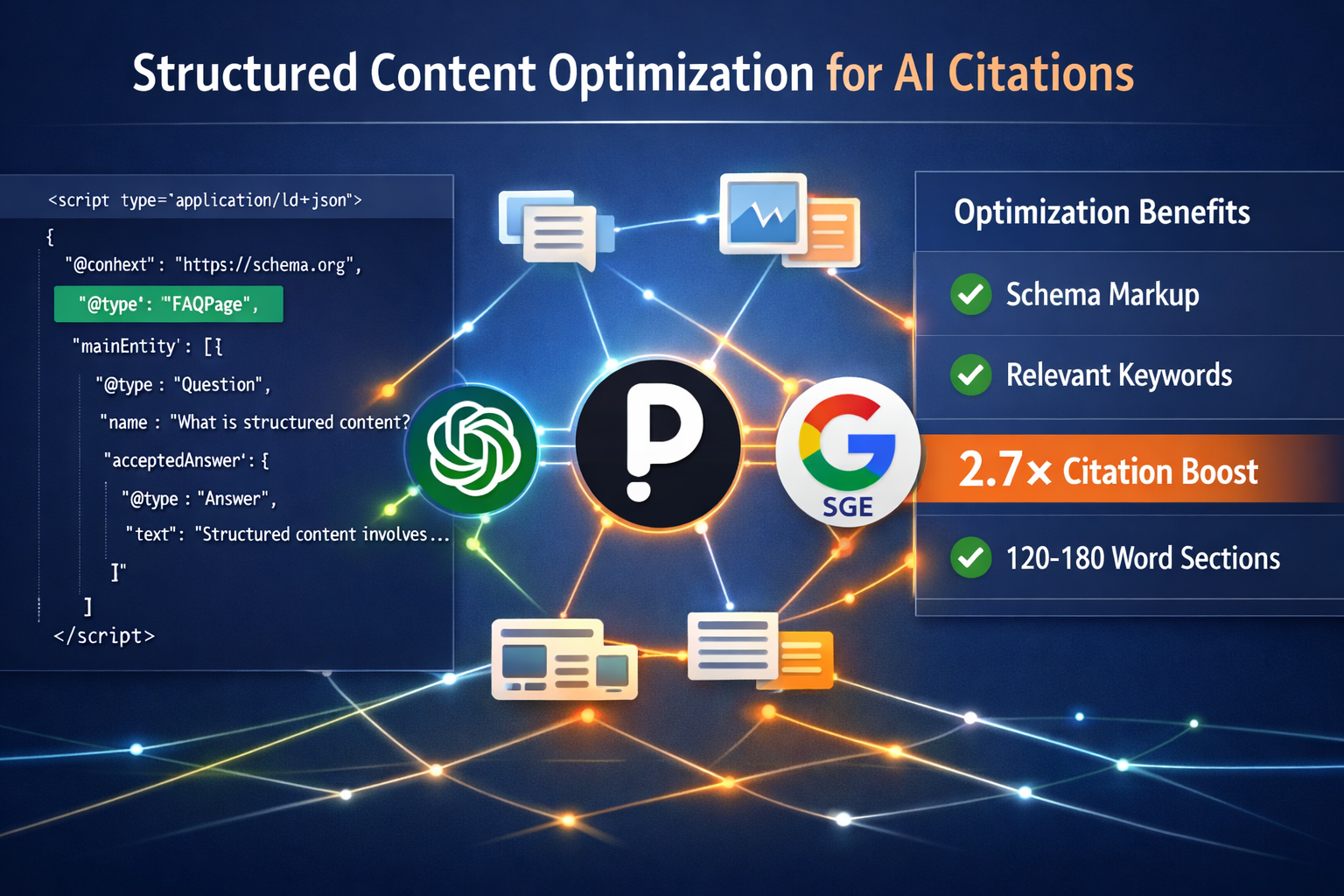
AI engines extract clean, complete answers from well-structured content. AI-cited content sections typically run 120–180 words—long enough for comprehensive answers but short enough for clean extraction.[1]
Implementation checklist:
- Break content into discrete, self-contained sections
- Use descriptive H2/H3 headings that answer specific questions
- Keep answer blocks between 120-180 words
- Front-load key information in the first 2-3 sentences
- End sections with clear conclusions or recommendations
For affiliate content, this means structuring product comparisons, feature analyses, and buying guides as modular answer blocks that AI can extract and cite independently.
Strategy 2: Deploy FAQPage Schema Markup
FAQPage schema provides a 2.7× citation boost when properly implemented.[1] This structured data format explicitly tells AI engines which content blocks answer specific questions—making citation extraction effortless.
Schema implementation example:
{
  "@context": "https://schema.org",
  "@type": "FAQPage",
  "mainEntity": [{
    "@type": "Question",
    "name": "What's the best budget laptop for students in 2026?",
    "acceptedAnswer": {
      "@type": "Answer",
      "text": "The Acer Aspire 5 offers the best value for students..."
    }
  }]
}
Every affiliate review or comparison guide should include FAQPage schema for Q&A sections. This single technical optimization can dramatically increase your AI citation rate.
Strategy 3: Leverage Comparison Tables for 2.5× Citation Lift
Comparison tables earn 2.5× more citations than text-only equivalents[1] because they present structured, scannable data that AI engines can easily parse and reference.
| Feature | Product A | Product B | Product C |
|---|---|---|---|
| Price | $299 | $399 | $249 |
| Battery Life | 12 hours | 15 hours | 10 hours |
| Weight | 3.2 lbs | 2.8 lbs | 3.5 lbs |
| Best For | Budget buyers | Power users | Basic tasks |
Include comparison tables in every product roundup, service review, and feature analysis. Add table markup schema when possible to further enhance AI readability.
Strategy 4: Embed Verifiable Statistics with Citations
Verifiable statistics with source citations boost AI citation rates by up to 40%, according to Princeton's GEO research.[1] AI engines prioritize factual accuracy and reward content that demonstrates credibility through proper sourcing.
Best practices:
- Include specific numbers and percentages
- Cite original research sources
- Link to authoritative studies and reports
- Use inline citations [like this]
- Update statistics regularly to maintain freshness
For affiliate content, this means backing product claims with manufacturer specs, third-party test results, and verified user statistics—not vague marketing language.
Strategy 5: Maintain Content Freshness with Visible Update Signals ⏰
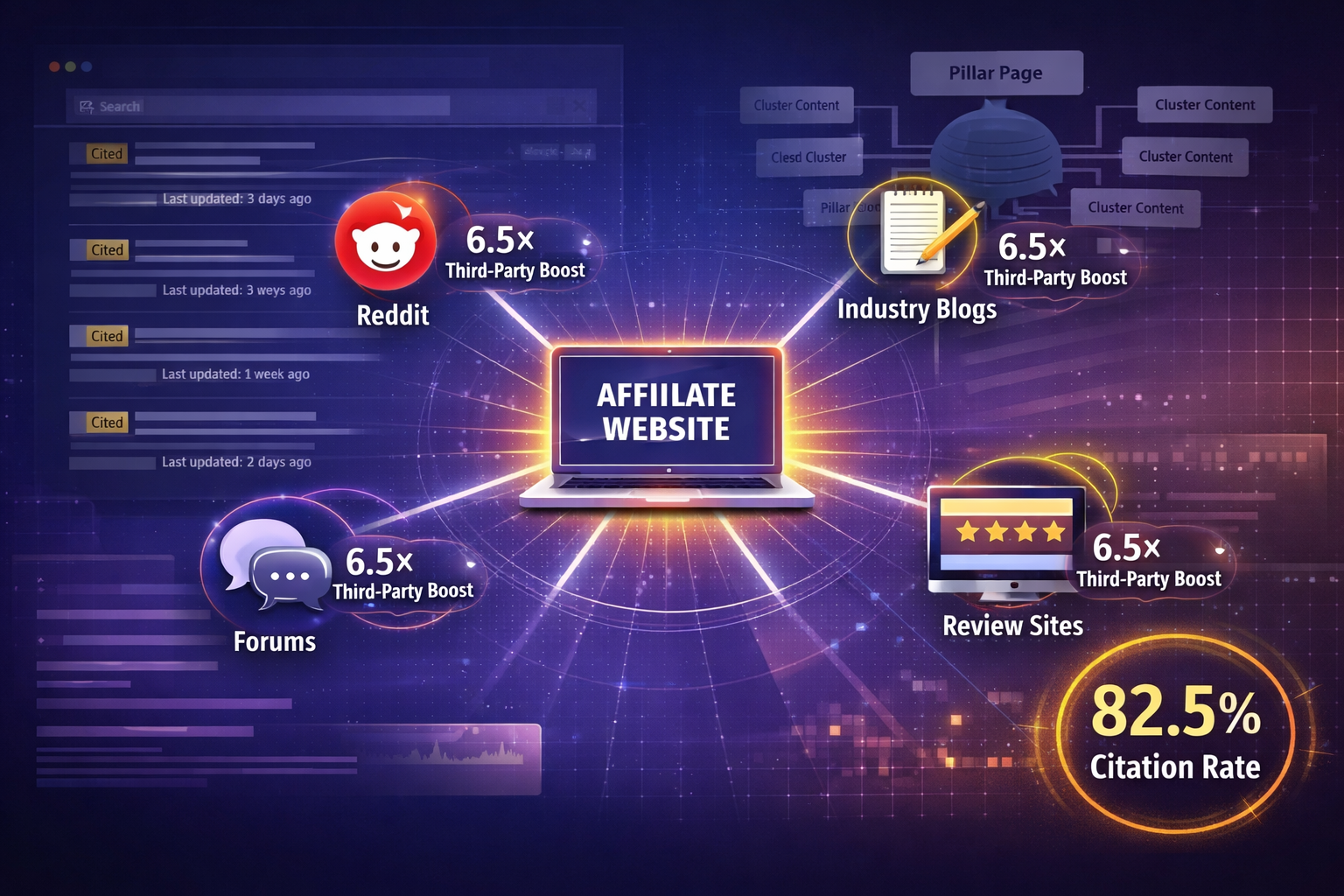
76.4% of cited pages were updated within 30 days, and adding a visible "Last Updated" date lifted citation rates by 47%.[1] AI engines heavily weight content freshness when determining citation-worthiness.
Freshness optimization tactics:
- Display prominent "Last Updated: [Date]" timestamps
- Perform substantive updates (not just timestamp changes)
- Refresh statistics, pricing, and product availability
- Update product recommendations quarterly
- Archive or redirect outdated content
Substantive updates earn 3.8× more citations than timestamp-only refreshes, so focus on meaningful content improvements.[1]
Strategy 6: Build Pillar-Cluster Content Architectures
82.5% of ChatGPT citations link to nested pages within established topic hierarchies rather than isolated articles.[1] This pillar-cluster architecture multiplies citation potential by 2.7× compared to standalone content.
Architecture example:
- Pillar Page: "Complete Guide to Wireless Earbuds 2026"
- Cluster 1: "Best Budget Wireless Earbuds Under $50"
- Cluster 2: "Wireless Earbuds for Running and Exercise"
- Cluster 3: "Noise-Canceling Earbuds Comparison"
- Cluster 4: "How to Choose Wireless Earbuds: Buyer's Guide"
Internal linking between pillar and cluster pages signals topical authority to AI engines, increasing the likelihood that any page in your hierarchy gets cited. Learn more about building effective search engine optimization techniques for your content structure.
Strategy 7: Optimize for Multi-Platform AI Testing
Different AI platforms have different citation preferences. GEO for Affiliates: 12 Strategies to Dominate Citations in ChatGPT Search, Perplexity, and AI Overviews requires testing content performance across multiple engines.
Platform-specific considerations:
- ChatGPT: Favors conversational, comprehensive answers with clear sourcing
- Perplexity: Prioritizes recent content with strong citation networks
- Google AI Overviews: Weights domain authority and existing search rankings
- Claude: Values nuanced analysis and balanced perspectives
Test your target keywords across all platforms monthly and track which pages get cited where. Adjust content structure based on platform-specific performance patterns.
Strategy 8: Cultivate Third-Party Citations and Mentions
Brands are 6.5× more likely to be cited through third-party mentions than through their own websites alone.[1] This multiplier effect makes external visibility crucial for AI citation dominance.
Third-party citation strategies:
- Contribute expert quotes to industry publications
- Participate actively in Reddit discussions related to your niche
- Guest post on authoritative sites in your vertical
- Get featured in product roundups and comparison guides
- Build relationships with journalists and content creators
When third-party sites mention your brand, product recommendations, or content, AI engines view you as an established authority worth citing.
Strategy 9: Create Answer-Focused Product Reviews
Traditional affiliate reviews optimize for clicks. GEO-optimized reviews answer specific buyer questions with citation-worthy precision.
Answer-focused review structure:
- Direct answer to main question (120-180 words)
- Detailed feature analysis (modular sections)
- Comparison with alternatives (table format)
- Specific use case recommendations (Q&A format)
- Pricing and availability (current, verified data)
Each section should stand alone as a complete answer AI engines can extract and cite. For more insights on creating effective content, explore our guide on how to succeed in affiliate marketing.
Strategy 10: Implement Product Schema Markup
Beyond FAQPage schema, Product schema helps AI engines understand your affiliate recommendations at a granular level.
Essential Product schema properties:
- name
- image
- description
- brand
- aggregateRating
- offers (price, availability, url)
- review
This structured data makes your product recommendations machine-readable, increasing citation probability when AI engines answer product-specific queries.
Strategy 11: Monitor AI Share of Voice
Citation consistency across repeat queries remains below 1%, but overall brand visibility percentage stays stable, allowing reliable measurement of AI Share of Voice.[1]
Tracking methodology:
- Identify 20-30 core commercial keywords in your niche
- Query each across ChatGPT, Perplexity, and Google AI monthly
- Record when your content gets cited
- Calculate citation percentage per platform
- Track trends over time
This metric reveals your AI visibility trajectory and helps identify which content types and topics earn the most citations. Understanding whether you can make money with affiliate marketing in this new landscape requires measuring these new metrics.
Strategy 12: Exceed the 1,900-Word Threshold 📈
Pages exceeding approximately 1,900 words significantly outperform shorter pieces in AI citation rates.[1] Comprehensive content provides AI engines with more citation opportunities across multiple query types.
Long-form content advantages:
- Multiple answer blocks for different queries
- Greater topical depth and authority signals
- More opportunities for structured data markup
- Higher likelihood of addressing long-tail questions
- Better performance in pillar-cluster architectures
Focus on comprehensive guides, detailed comparisons, and in-depth analyses that thoroughly cover topics from multiple angles. Quality and depth matter more than ever in the AI citation economy.
Measuring Success in the GEO Era
Traditional metrics like organic traffic and bounce rate still matter, but GEO for Affiliates: 12 Strategies to Dominate Citations in ChatGPT Search, Perplexity, and AI Overviews requires new success indicators:
✅ Citation rate: Percentage of target queries where your content gets cited
✅ AI referral traffic: Direct traffic from AI platform citations
✅ AI referral conversion rate: 4.4× higher than organic is the benchmark[1]
✅ Third-party mention volume: External citations that multiply visibility
✅ Schema implementation coverage: Percentage of content with proper markup
✅ Content freshness score: Average days since last substantive update
Track these metrics monthly to understand your AI visibility trajectory and identify optimization opportunities.
Common GEO Mistakes Affiliates Make ⚠️
Mistake #1: Optimizing for fluency alone
Fluency optimization shows negligible citation improvement. Focus on verifiable facts and structured data instead.[1]
Mistake #2: Neglecting content freshness
Outdated content rarely gets cited. Maintain regular update cycles.
Mistake #3: Ignoring third-party visibility
Relying solely on owned content limits citation potential by 6.5×.[1]
Mistake #4: Creating isolated content
Standalone articles miss the 2.7× citation multiplier from pillar-cluster architectures.[1]
Mistake #5: Skipping schema markup
Missing the 2.7× FAQPage schema boost is leaving citations on the table.[1]
Conclusion
GEO for Affiliates: 12 Strategies to Dominate Citations in ChatGPT Search, Perplexity, and AI Overviews represents the future of affiliate marketing visibility. As AI search platforms continue capturing market share from traditional search engines, affiliate marketers who optimize for citations—not just clicks—will dominate their niches.
The data is clear: AI-referred traffic converts 4.4× higher, 53.5% of ChatGPT queries carry commercial intent, and proper optimization techniques can boost citation rates by 40% or more.[1] The opportunity is massive, but the window to establish AI citation dominance is closing as more marketers adopt GEO strategies.
Your Next Steps
- Audit your top 10 affiliate pages for schema markup, content structure, and freshness signals
- Implement FAQPage schema on all review and comparison content this week
- Create comparison tables for your highest-traffic product roundups
- Build a pillar-cluster architecture around your most profitable niche
- Test your target keywords across ChatGPT, Perplexity, and Google AI monthly
- Establish a content freshness schedule with substantive quarterly updates
- Develop third-party citation relationships through guest posting and expert contributions
The shift from traditional SEO to Generative Engine Optimization isn't coming—it's here. Affiliates who adapt now will capture the AI citation advantage while competitors scramble to understand why their traffic is declining. Start implementing these 12 strategies today to secure your position in the AI-driven affiliate marketing landscape of 2026 and beyond.
For additional strategies to enhance your overall approach, explore our comprehensive resources on affiliate marketing programs and high ticket affiliate marketing.
References
[1] Ai Content Strategy Chatgpt Citations – https://whitehat-seo.co.uk/blog/ai-content-strategy-chatgpt-citations