

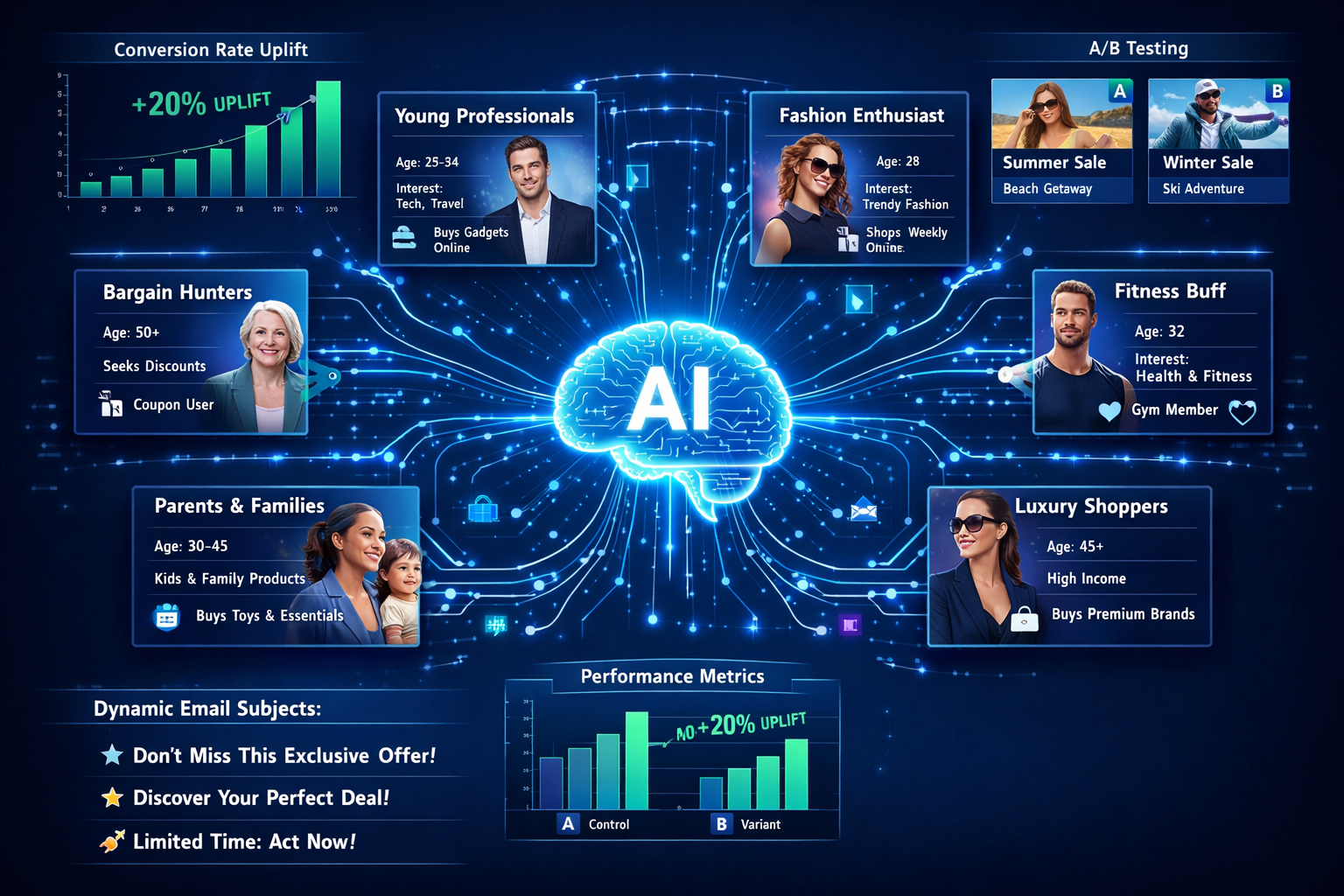
In 2026, generic affiliate marketing messages are dead. Today's consumers expect content that speaks directly to their needs, preferences, and behaviors—and they expect it across every touchpoint. The difference between personalization leaders and laggards? A staggering 40% revenue uplift, according to McKinsey research. The secret lies in hyper-personalization at scale: building dynamic content variations for every affiliate customer segment using predictive AI that generates thousands of tailored messages automatically.
Gone are the days when affiliates could send the same email blast to their entire list or display identical landing pages to every visitor. Modern consumers have been trained by Netflix, Amazon, and Spotify to expect experiences crafted specifically for them. For affiliate marketers, this means moving beyond basic segmentation to embrace AI-driven content creation that adapts in real-time to individual behaviors, contexts, and preferences.
Key Takeaways
- Personalized campaigns boost conversions by over 20%, making hyper-personalization essential rather than optional for competitive affiliate marketing in 2026 [1]
- AI-powered tools enable real-time content adaptation across email, web, social media, and PPC channels, reducing manual intervention while maintaining authentic personalization
- Privacy-first data strategies using zero- and first-party collection across 5-7 customer touchpoints provide the foundation for effective segmentation without relying on third-party cookies [2]
- Context-based personalization focusing on role, industry, location, and device creates respectful experiences that feel helpful rather than intrusive [3]
- Micro-influencer partnerships and behavioral predictive analytics enable more authentic, targeted affiliate campaigns within specific customer segments [4][5]
Understanding Hyper-Personalization at Scale: Building Dynamic Content Variations for Every Affiliate Customer Segment
What Makes Hyper-Personalization Different from Traditional Segmentation?
Traditional affiliate marketing segmentation divides audiences into broad categories—perhaps by age, gender, or purchase history. Hyper-personalization at scale takes this concept exponentially further by creating individualized experiences for each customer based on real-time behavioral data, contextual signals, and predictive analytics.
The key distinction lies in granularity and automation. While traditional segmentation might create 5-10 audience groups, hyper-personalization generates thousands of content variations tailored to micro-segments or even individual users. This level of customization was impossible manually, but AI-powered tools now make it achievable at scale.
Consider these core differences:
| Traditional Segmentation | Hyper-Personalization at Scale |
|---|---|
| 5-10 broad audience groups | Thousands of micro-segments or individual profiles |
| Manual content creation for each segment | AI-generated dynamic content variations |
| Static messaging across channels | Real-time adaptive content based on behavior |
| Historical data analysis | Predictive analytics and behavioral forecasting |
| One-size-fits-most approach | Individualized experiences for each customer |
The Revenue Impact of Dynamic Content Variations
The business case for hyper-personalization at scale is compelling. Research shows that personalized campaigns increase conversion rates by over 20% compared to generic approaches [1]. For affiliate marketers operating on commission-based models, this translates directly to revenue growth.
Beyond conversion improvements, hyper-personalization delivers:
- 📈 Higher average order values through contextually relevant product recommendations
- 💰 Improved customer lifetime value via stronger engagement and loyalty
- 🎯 Better affiliate attribution through enhanced multi-touch tracking across personalized journeys
- ⚡ Reduced customer acquisition costs as personalized content performs better across paid channels
Leading affiliate marketing programs now prioritize partners who can demonstrate sophisticated personalization capabilities, recognizing that tailored content drives superior performance for both affiliates and merchants.
The Technology Foundation: AI-Powered Content Generation and Segmentation
Behavioral Segmentation Through Predictive Analytics
Modern AI tools analyze customer behavior patterns to identify distinct segments and predict future actions. These systems can:
- Identify loyal customers likely to purchase complementary products based on browsing patterns and purchase history
- Detect disengaged segments showing signs of churn, triggering personalized re-engagement campaigns
- Forecast product-segment fit by analyzing which offers resonate with specific audience clusters [1]
This predictive capability transforms affiliate marketing from reactive to proactive. Instead of waiting for customers to take action, affiliates can anticipate needs and deliver relevant content before customers even realize they're searching for solutions.
For those exploring how to do affiliate marketing effectively in 2026, mastering behavioral segmentation tools represents a fundamental competitive advantage.
Dynamic Content Creation Across Multiple Channels
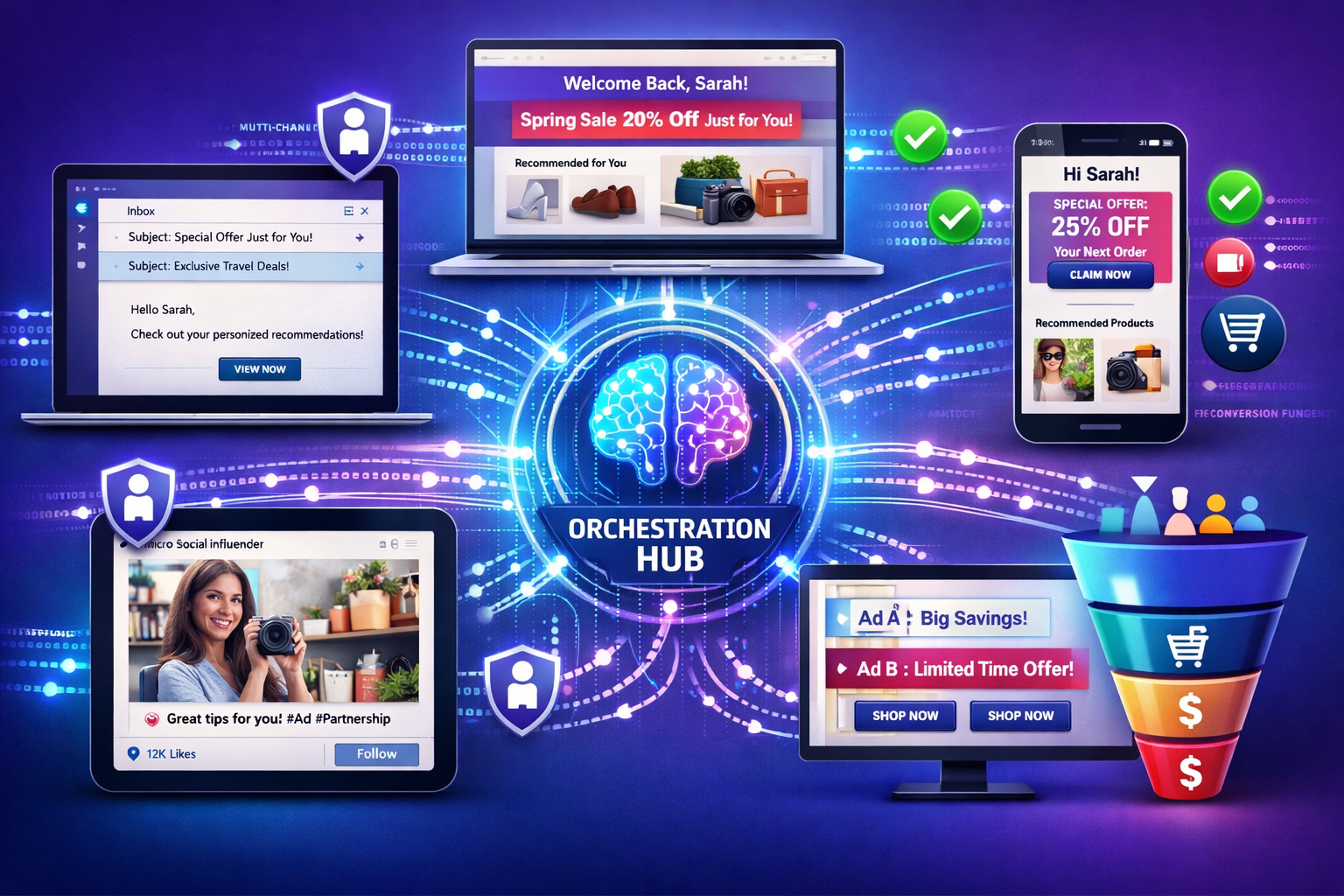
AI-driven content creation now enables real-time adaptation across every customer touchpoint:
Email Marketing:
- Dynamic subject lines tailored to individual behavior patterns
- Personalized copy that references specific browsing history
- Automated send-time optimization based on individual engagement patterns [1]
Website and Landing Pages:
- Real-time content adjustments based on referral source, device, and location
- Personalized product recommendations that evolve with each visit
- Context-aware calls-to-action that match customer journey stage [1]
Social Media and Influencer Content:
- Micro-influencer partnerships targeting specific niche segments
- Platform-specific content variations (Instagram Reels vs. Stories vs. feed posts)
- Authentic, engagement-focused messaging over follower count [4][5]
PPC and Paid Advertising:
- Dynamic ad copy variations matched to search intent and demographics
- Personalized landing page experiences that maintain message continuity
- Budget allocation optimized toward highest-performing segment variations
Building Your Privacy-First Data Foundation
The Shift to Zero- and First-Party Data Collection
With stricter EU regulations and Apple's privacy initiatives reshaping the digital landscape, privacy-compliant personalization has become a competitive advantage rather than a compliance burden [2].
Successful affiliate marketers in 2026 implement 5-7 data collection points across the customer lifecycle, compared to the typical 1-2 touchpoints used by less sophisticated competitors [2]. These collection points use value exchanges that respect customer privacy:
✅ Discount codes in exchange for preference surveys
✅ Early access to new products for sharing interests and needs
✅ Exclusive content for email subscription and profile completion
✅ Loyalty rewards for behavioral data sharing and engagement
✅ Interactive quizzes that gather preferences while providing value
Owned Identification as the Cornerstone
Owned identification—the ability to recognize customers across devices and channels using first-party data—serves as "the cornerstone of cross-channel personalization" in 2026 [2]. This approach enables dynamic personalized journeys without reliance on third-party cookies.
Building owned identification requires:
- Progressive profiling that gathers data incrementally across multiple interactions
- Unified customer data platforms that consolidate information from all touchpoints
- Transparent value exchanges that clearly communicate benefits of data sharing
- Consent management systems that respect customer preferences and regulatory requirements
Those working in high ticket affiliate marketing particularly benefit from owned identification, as the longer sales cycles and higher consideration purchases require sophisticated multi-touch attribution.
Implementing Context-Based Personalization That Feels Respectful
Moving Beyond Intrusive Tracking
The most effective hyper-personalization at scale in 2026 focuses on context rather than detailed background tracking [3]. This approach creates experiences that feel helpful rather than creepy.
Context-based personalization considers:
- 🏢 Professional role and industry (B2B affiliates)
- 📍 Geographic location and local preferences
- 📱 Device type and usage patterns
- ⏰ Time of day and seasonal factors
- 🎯 Current intent signals from search queries and browsing behavior
This contextual approach respects privacy while still delivering relevant experiences. A business professional browsing on mobile during commute hours receives different content than the same person browsing on desktop during work hours—without requiring invasive tracking.
Multichannel Coordination at Scale
AI ensures all communication across social media, email, PPC, and web channels is perfectly synchronized, creating seamless customer journeys at scale while maintaining personalization [1].
This coordination prevents common pitfalls like:
- Sending promotional emails about products customers already purchased
- Displaying ads for beginner content to advanced users
- Presenting conflicting messages across different channels
- Overwhelming customers with excessive communication
For affiliates building comprehensive strategies, understanding foundations of SEO for affiliate marketing helps ensure organic content aligns with personalized paid campaigns.
Practical Implementation: Getting Started with Dynamic Content Variations
Step 1: Audit Your Current Segmentation
Before implementing advanced hyper-personalization, assess your current state:
- How many distinct customer segments do you currently target?
- What data points inform your segmentation decisions?
- How many content variations do you create for each campaign?
- Which channels receive personalized versus generic content?
Most affiliates discover they're operating with 3-5 segments and minimal content variation—revealing significant opportunity for improvement.
Step 2: Establish Data Collection Infrastructure
Implement multiple touchpoints for gathering zero- and first-party data:
- Website behavioral tracking (privacy-compliant)
- Email engagement metrics (opens, clicks, conversions)
- Preference centers allowing customers to self-identify interests
- Survey and quiz tools offering value in exchange for insights
- Purchase history and product interaction data
- Social media engagement patterns
- Customer service interaction records
Step 3: Choose AI-Powered Personalization Tools
Select platforms that enable automated content variation creation:
- Email marketing platforms with AI-driven subject line optimization and dynamic content blocks
- Website personalization engines that adapt landing pages in real-time
- Content generation tools that create multiple variations from templates
- Predictive analytics platforms that identify high-value segments and forecast behavior
Many best affiliate marketing programs for beginners now provide integrated personalization tools, reducing the technical barrier to entry.
Step 4: Start Small and Scale Systematically
Begin with high-impact, manageable implementations:
- Test dynamic email subject lines for your top-performing campaigns
- Create 3-5 landing page variations based on traffic source
- Implement basic product recommendations using collaborative filtering
- Develop micro-influencer partnerships for 2-3 niche segments
Measure results rigorously and expand successful approaches before adding complexity.
Step 5: Monitor, Measure, and Optimize Continuously
Track key performance indicators across segments:
- Conversion rate improvements by segment and content variation
- Engagement metrics (time on page, email open rates, click-through rates)
- Revenue per customer across personalized versus generic experiences
- Customer lifetime value trends as personalization matures
- Attribution accuracy across multi-touch personalized journeys
Use these insights to refine segmentation, improve content variations, and identify new personalization opportunities.
Common Pitfalls and How to Avoid Them
Over-Personalization and the Creepiness Factor
While personalization drives results, excessive customization can backfire. Avoid:
- Referencing information customers don't remember sharing
- Creating content that feels surveillance-based rather than helpful
- Personalizing elements that don't add value (e.g., using names excessively)
Focus on context-based personalization [3] that feels natural and respectful.
Technology Without Strategy
AI tools enable sophisticated personalization, but technology alone doesn't guarantee success. Many affiliates fall into the trap of implementing complex systems without clear strategic objectives.
Ensure you:
- Define specific business goals for personalization initiatives
- Map personalization efforts to customer journey stages
- Align content variations with segment-specific needs and preferences
- Maintain brand consistency across all variations
Those looking to avoid common missteps should review 10 common affiliate marketing mistakes for broader strategic guidance.
Neglecting Mobile and Cross-Device Experiences
With mobile traffic dominating affiliate channels, personalization must work seamlessly across devices. Ensure:
- Content variations render properly on all screen sizes
- Personalization engines recognize users across devices
- Mobile-specific contexts (location, time constraints) inform content adaptation
- Load times remain fast despite dynamic content generation
The Future of Hyper-Personalization in Affiliate Marketing
Emerging Trends for 2026 and Beyond
Several developments will shape the evolution of hyper-personalization at scale:
Voice and Conversational Interfaces: As voice search and AI assistants grow, personalization will extend to conversational content that adapts to spoken queries and dialogue context.
Enhanced Multi-Touch Attribution: Advanced AI models will provide unprecedented insights into customer journeys, enabling more accurate affiliate payouts and better understanding of which personalized touchpoints drive conversions [4].
Nano-Influencer Ecosystems: The trend toward micro-influencers will continue fragmenting into nano-influencers (under 10,000 followers) who deliver hyper-targeted content to extremely specific segments [5].
Predictive Content Generation: AI will move from adapting existing content to generating entirely new variations based on predicted segment preferences and emerging trends.
For those building long-term careers, exploring affiliate marketing jobs reveals how employers increasingly value personalization expertise.
Balancing Automation with Authenticity
The most successful affiliates in 2026 balance AI-powered automation with genuine human connection. While technology enables scale, authenticity drives trust and long-term relationships.
Maintain this balance by:
- Using AI for efficiency and optimization, not replacing human creativity
- Ensuring content variations reflect genuine understanding of segment needs
- Incorporating real customer stories and testimonials across variations
- Maintaining consistent brand voice even as messaging adapts
Conclusion
Hyper-personalization at scale: building dynamic content variations for every affiliate customer segment has evolved from competitive advantage to business necessity in 2026. With personalized campaigns delivering 20%+ conversion improvements [1] and personalization leaders achieving 40% revenue uplifts, affiliates can no longer afford generic, one-size-fits-all approaches.
The path forward requires three foundational elements:
- Privacy-first data infrastructure using zero- and first-party collection across multiple customer touchpoints [2]
- AI-powered content generation that creates thousands of variations automatically while maintaining brand consistency [1]
- Context-based personalization that feels respectful and helpful rather than intrusive [3]
Actionable Next Steps
Start your hyper-personalization journey today:
✅ Audit your current segmentation to identify expansion opportunities
✅ Implement 2-3 additional data collection points using value exchanges
✅ Test dynamic content variations in your highest-performing channel
✅ Explore AI-powered tools that automate personalization at scale
✅ Measure rigorously and optimize based on segment-specific performance data
The affiliates who master hyper-personalization at scale in 2026 will dominate their niches, delivering superior customer experiences while achieving exceptional business results. The technology exists, the data is available, and the revenue opportunity is proven. The only question remaining: will you lead the personalization revolution or watch competitors capture the advantage?
For those ready to dive deeper into advanced affiliate strategies, explore our comprehensive guides on best affiliate marketing tips and discover how personalization integrates with broader marketing excellence.
References
[1] Hyper Personalization 2026 – https://azariangrowthagency.com/hyper-personalization-2026/
[2] Marketing Automation Trends – https://www.klaviyo.com/blog/marketing-automation-trends
[3] Whats Next 6 Marketing Trends For 2026 – https://www.adtaxi.com/blog/whats-next-6-marketing-trends-for-2026/
[4] Affiliate Marketing – https://www.imd.org/blog/marketing/affiliate-marketing/
[5] Affiliate Marketing Trends – https://easyaffiliate.com/blog/affiliate-marketing-trends/