

The affiliate marketing landscape is undergoing a dramatic transformation in 2026. Gone are the days when affiliate teams operated in isolation, simply distributing links and waiting for commissions. Today's most successful organizations are reimagining their marketers as internal influencers—trusted voices who leverage AI-powered insights to drive collaborative campaigns and measurable results. This shift toward "Marketers as Internal Influencers: AI Strategies for Affiliate Team Collaboration" represents more than just a trend; it's a fundamental restructuring of how affiliate teams operate, communicate, and win in an increasingly competitive marketplace.
Key Takeaways
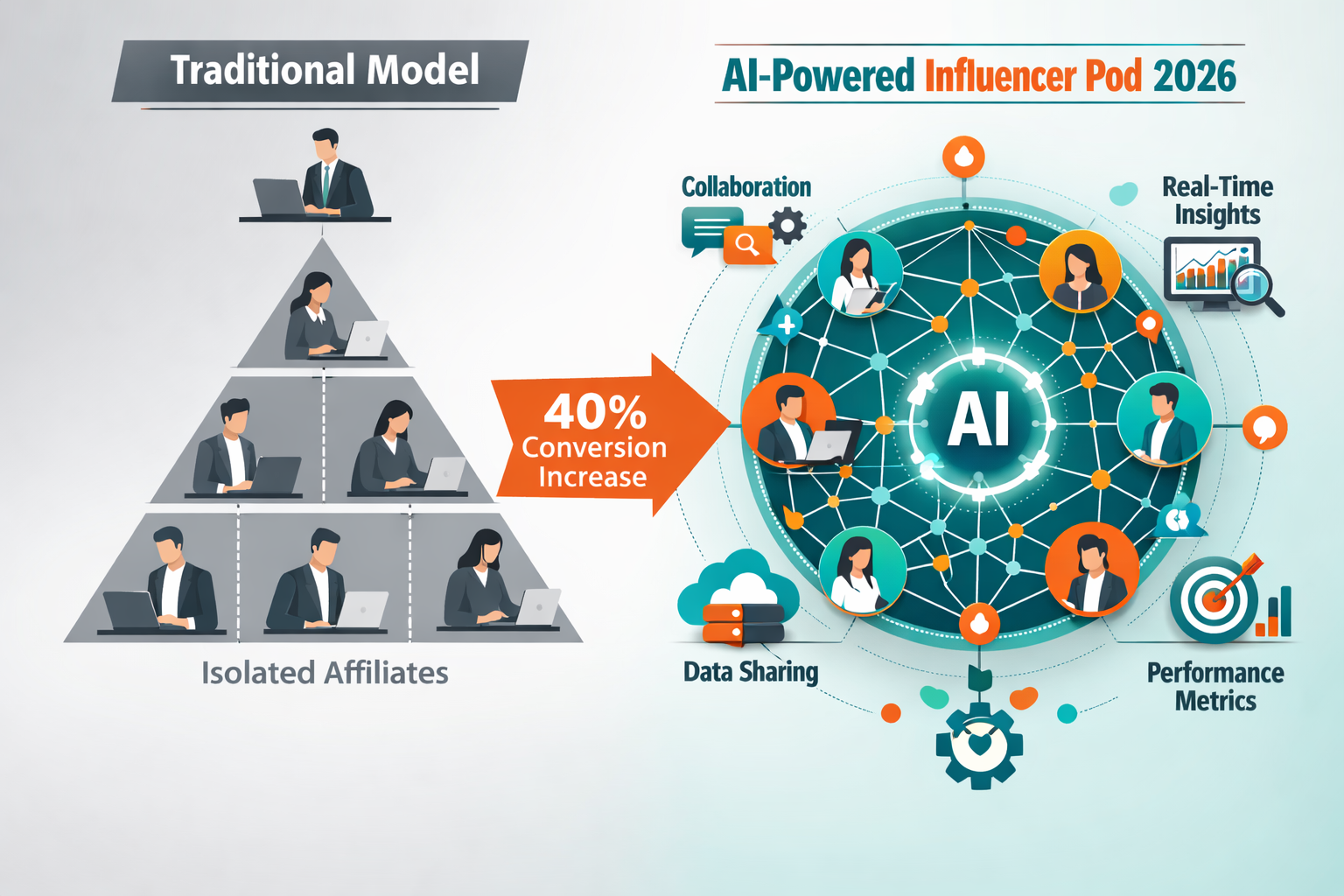
✅ AI-powered personalization enables affiliate teams to segment audiences into micro-segments and deliver targeted recommendations, increasing conversions by up to 40% [1]
✅ Internal influencer pods transform isolated affiliate marketers into collaborative teams that share insights, strategies, and AI-driven intelligence in real-time
✅ Authentic content creation combined with AI automation creates a competitive advantage that resonates with both consumers and AI-powered search platforms
✅ Performance-based partnerships are replacing traditional affiliate relationships, positioning marketers as strategic growth partners rather than link distributors
✅ Streamlined workflows through AI tools reduce manual tasks, allowing teams to focus on relationship-building and creative strategy development
Understanding the Internal Influencer Model for Affiliate Teams
What Makes Marketers Internal Influencers?
The concept of marketers as internal influencers fundamentally changes how affiliate teams function. Rather than working as individual contributors focused solely on their own performance metrics, team members become collaborative thought leaders who influence strategy, share winning tactics, and collectively elevate campaign performance.
This model draws inspiration from the influencer-affiliate hybrid approach that brands are increasingly adopting. According to recent research, brands are moving beyond traditional affiliate relationships toward partnerships based on real trust and shared goals [1]. When applied internally, this same philosophy creates teams where marketers influence each other's strategies, share AI-driven insights, and collectively optimize for better results.
The Shift from Isolation to Collaboration
Traditional affiliate marketing often suffered from knowledge silos. Individual marketers discovered winning strategies but rarely shared them systematically. The internal influencer model breaks down these barriers by:
- Creating structured knowledge-sharing sessions where top performers demonstrate their AI-powered techniques
- Establishing collaborative testing frameworks that allow teams to validate strategies across multiple campaigns simultaneously
- Building internal content libraries where marketers document and share their most effective approaches
- Implementing peer mentorship programs that pair experienced marketers with newer team members
This collaborative approach aligns perfectly with broader affiliate marketing strategies that emphasize partnership and shared growth.
AI Strategies Transforming Affiliate Team Collaboration
AI-Driven Personalization at Scale
One of the most powerful applications of AI in affiliate team collaboration is hyper-personalization. Modern AI platforms enable marketers to segment audiences into detailed micro-segments such as "price-conscious researchers" versus "brand-loyal buyers" and serve personalized affiliate recommendations in real-time [1].
When teams collaborate around these AI insights, they can:
| AI Capability | Team Collaboration Benefit | Expected Impact |
|---|---|---|
| Micro-segmentation | Share audience insights across campaigns | 40% conversion increase [1] |
| Real-time personalization | Coordinate messaging across channels | Higher engagement rates |
| Predictive analytics | Forecast trends collaboratively | Better resource allocation |
| Content performance prediction | Test and validate together | Faster optimization cycles |
Teams implementing these AI strategies report significant improvements in both efficiency and results, making them valuable resources for those exploring what affiliate marketing can achieve in 2026.
Automated Content Creation and Testing
AI writing assistants like Jasper, Copy.ai, and ChatGPT have revolutionized how affiliate teams approach content creation. Marketers can now generate 10+ versions of affiliate ad copy in minutes, then collaborate to test which versions convert best for different audience segments [1].
The internal influencer model enhances this capability by:
🎯 Creating shared testing protocols where all team members contribute variations and track results centrally
🎯 Establishing quality standards for AI-generated content that maintains brand voice and authenticity
🎯 Building collaborative review processes where team members provide feedback on each other's AI-assisted content
🎯 Developing collective learning from A/B test results across all campaigns
This approach ensures that AI serves as an amplifier of human creativity rather than a replacement, maintaining the authenticity that consumers and algorithms increasingly prioritize [2].
Enhanced Attribution and Performance Tracking
Modern affiliate platforms in 2026 incorporate improved multi-touch attribution models that provide better insights into customer journeys [5]. When teams collaborate around this data, they gain a comprehensive understanding of what's working across the entire organization.
Internal influencer teams leverage attribution data to:
- Identify which touchpoints contribute most to conversions
- Understand how different team members' efforts complement each other
- Optimize the customer journey collaboratively
- Ensure fair recognition for contributions across complex sales cycles
For marketers concerned about whether affiliate marketing is legitimate, these transparent attribution systems provide clear evidence of value creation.
Building Your AI-Powered Influencer Pod: Training Paths and Tool Stacks
Essential Training for Internal Influencers
Transforming affiliate teams into internal influencer pods requires structured training that combines AI literacy with collaborative skills. Here's a comprehensive training path:
Phase 1: AI Fundamentals (Weeks 1-2)
- Understanding AI capabilities and limitations in affiliate marketing
- Hands-on practice with AI writing tools, personalization engines, and analytics platforms
- Learning to interpret AI-generated insights and recommendations
Phase 2: Collaborative Frameworks (Weeks 3-4)
- Establishing team communication protocols
- Creating shared documentation systems
- Building collaborative testing methodologies
- Developing peer feedback mechanisms
Phase 3: Advanced AI Applications (Weeks 5-6)
- Implementing micro-segmentation strategies
- Automating creator discovery and outreach [4]
- Leveraging AI for content performance prediction
- Integrating AI insights into decision-making processes
Phase 4: Leadership and Influence (Weeks 7-8)
- Presenting data-driven insights to stakeholders
- Mentoring team members on AI tools
- Leading collaborative campaign planning sessions
- Driving continuous improvement through shared learnings
This training approach ensures teams can effectively implement best affiliate marketing practices while maintaining the human touch that drives authentic connections.
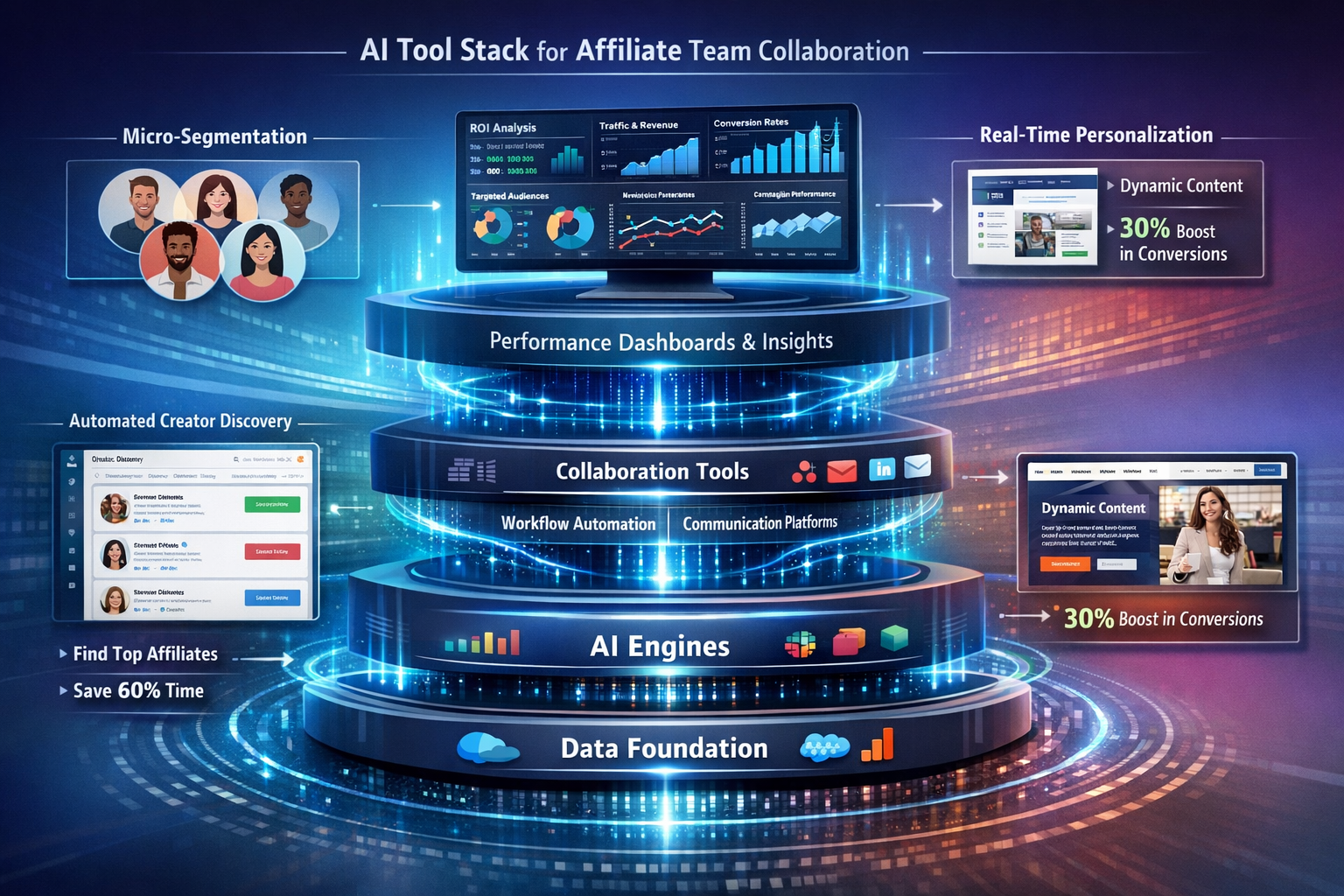
The 2026 AI Tool Stack for Collaborative Affiliate Teams
Building an effective internal influencer pod requires the right technology foundation. Here's the recommended tool stack:
Data Foundation Layer:
- CRM platforms with affiliate tracking capabilities
- Analytics dashboards that consolidate multi-channel performance
- Attribution software for accurate contribution measurement
AI Engine Layer:
- Personalization platforms for micro-segmentation and real-time recommendations
- AI writing assistants (ChatGPT, Jasper, Copy.ai) for content generation
- Predictive analytics tools for forecasting and trend identification
- Creator discovery platforms with AI-powered filtering [4]
Collaboration Layer:
- Project management systems (Asana, Monday.com) for campaign coordination
- Knowledge bases (Notion, Confluence) for documentation and sharing
- Communication platforms (Slack, Teams) with AI integration
- Workflow automation tools (Zapier, n8n) for process streamlining
Performance Dashboard Layer:
- Real-time reporting with customizable views for different team roles
- Competitive intelligence tracking affiliate landscape changes
- ROI calculators demonstrating campaign value
- Insight sharing mechanisms for collaborative learning
Teams exploring different affiliate niches can adapt this stack to their specific requirements while maintaining core collaborative capabilities.
Implementing Marketers as Internal Influencers: AI Strategies for Affiliate Team Collaboration
Creating Performance-Based Internal Partnerships
The shift toward performance-based partnerships extends beyond external relationships. Within affiliate teams, marketers can establish internal partnership agreements where:
- Senior marketers mentor newer team members, sharing AI strategies and earning recognition for their mentees' growth
- Specialists in different channels collaborate on cross-channel campaigns, sharing credit for results
- Teams establish shared KPIs that reward collaborative success over individual achievement
- Recognition systems highlight both individual performance and contribution to team learning
This approach mirrors how brands are actively recruiting "true growth partners" rather than affiliates who simply "blast out links" [1], creating opportunities for marketers to prove measurable value through collaboration.
Leveraging Authentic Content as Competitive Advantage
In an era where over 80% of citations used by AI search platforms originate from ad-funded websites rather than brand-owned content [2], affiliate and creator material has unprecedented influence. Internal influencer teams capitalize on this by:
✨ Co-creating authentic content that combines multiple team members' expertise and perspectives
✨ Developing collaborative content calendars that ensure consistent, high-quality output across channels
✨ Establishing authenticity standards that maintain genuine voice even when using AI assistance
✨ Building content partnerships with external affiliates based on shared values and audience trust
This emphasis on authenticity differentiates successful teams in an increasingly automated landscape, as genuine experience and opinion provide the trust and credibility that both consumers and algorithms prioritize [2].
Shortening Planning Cycles Through AI Collaboration
AI-powered workflow automation enables teams to move faster from creator discovery to campaign execution [4]. Internal influencer pods maximize this speed advantage by:
- Conducting rapid collaborative brainstorming sessions enhanced by AI suggestion tools
- Implementing parallel testing where multiple team members simultaneously validate different approaches
- Automating routine communications while maintaining personalized relationship-building
- Creating shared templates for common tasks that incorporate best practices
These efficiencies allow teams to maintain strong relationships without added complexity, essential for those managing multiple affiliate programs.
Measuring Collaborative Success
Effective internal influencer pods require new metrics that capture collaborative value:
Individual Contribution Metrics:
- Personal conversion rates and revenue generation
- Content quality and engagement scores
- AI tool proficiency and optimization improvements
Collaborative Impact Metrics:
- Knowledge shared through documentation and presentations
- Mentorship effectiveness measured by mentee growth
- Cross-team campaign performance improvements
- Innovation contributions (new strategies, tools, approaches)
Team Performance Metrics:
- Overall revenue growth and conversion improvements
- Speed of campaign deployment and optimization
- Customer lifetime value across collaborative touchpoints
- Team satisfaction and retention rates
By tracking both individual and collaborative metrics, organizations avoid the common affiliate marketing mistakes that come from misaligned incentives.
Advanced Strategies for Marketers as Internal Influencers: AI Strategies for Affiliate Team Collaboration
Building Co-Authored Content and Collaborative Campaigns
Partner-led webinars and co-authored content transform affiliate partners "from external promoters into integrated extensions of your marketing team" [3]. Internal influencer pods apply this same principle by:
- Creating collaborative whitepapers that combine multiple team members' research and insights
- Hosting internal webinars where top performers share their AI-powered strategies
- Developing joint case studies that demonstrate the power of collaborative approaches
- Building shared research repositories that benefit the entire organization
These collaborative content initiatives improve both team capabilities and external positioning, similar to successful powerhouse affiliate approaches.
Implementing AI-Powered Creator Discovery and Relationship Management
AI enables marketers to filter creator databases using plain language search and predict content performance in real-time [4]. Internal influencer teams leverage these capabilities by:
- Sharing creator databases with collaborative notes and performance histories
- Coordinating outreach strategies to avoid duplicate contacts and present unified brand messaging
- Pooling relationship intelligence about creator preferences, communication styles, and partnership opportunities
- Automating personalization while maintaining authentic relationship-building
This systematic approach to creator relationships ensures teams maximize partnership value while minimizing inefficiencies.
Scaling Through Structured Knowledge Transfer
The internal influencer model's greatest long-term value comes from systematic knowledge transfer. Successful teams implement:
Weekly Insight Sessions:
- 30-minute meetings where team members share one significant learning from the week
- Rotating presentation responsibilities to develop communication skills
- Documented takeaways added to shared knowledge base
Monthly Strategy Reviews:
- Deep dives into AI tool performance and optimization opportunities
- Collaborative analysis of market trends and competitive movements
- Strategic planning for upcoming campaigns with input from all team members
Quarterly Innovation Workshops:
- Dedicated time for experimenting with new AI tools and approaches
- Cross-functional collaboration with product, sales, and customer success teams
- External speaker sessions with industry experts and successful affiliates
Annual Skill Development:
- Formal training on emerging AI capabilities and marketing techniques
- Certification programs for advanced tools and methodologies
- Team-building activities that strengthen collaborative relationships
Conclusion
The transformation of marketers into internal influencers through AI-powered collaboration represents a fundamental shift in how affiliate teams operate and succeed. By combining the personalization capabilities of AI with the authentic relationships and insights that only human marketers can provide, organizations create competitive advantages that drive measurable results.
The evidence is compelling: teams implementing AI-driven micro-segmentation see conversion increases of 40% [1], while collaborative content approaches position affiliates as integrated marketing partners rather than external promoters [3]. As AI search platforms increasingly rely on affiliate and creator content for their citations [2], the internal influencer model ensures teams stay at the forefront of this evolving landscape.
Actionable Next Steps
Ready to transform your affiliate team into an internal influencer pod? Start with these concrete actions:
1️⃣ Assess your current state: Evaluate existing collaboration levels, AI tool adoption, and knowledge-sharing practices
2️⃣ Select your pilot group: Choose 3-5 motivated marketers to form your initial influencer pod
3️⃣ Implement the core tool stack: Deploy essential AI personalization, content creation, and collaboration platforms
4️⃣ Launch your training program: Begin with Phase 1 AI fundamentals and build from there
5️⃣ Establish collaborative metrics: Define and track both individual and team success indicators
6️⃣ Create your first co-authored content: Develop a collaborative case study or whitepaper demonstrating your approach
7️⃣ Schedule regular insight sessions: Commit to weekly knowledge-sharing meetings
8️⃣ Measure and iterate: Track results, gather feedback, and continuously refine your approach
The future of affiliate marketing belongs to teams that successfully blend AI capabilities with human creativity, authenticity, and collaboration. By implementing these strategies for "Marketers as Internal Influencers: AI Strategies for Affiliate Team Collaboration," you position your organization to thrive in 2026 and beyond.
References
[1] Affiliate Campaign Strategies – https://easyaffiliate.com/blog/affiliate-campaign-strategies/
[2] Ai Affiliate Marketing – https://www.accelerationpartners.com/resources/ai-affiliate-marketing/
[3] B2b Affiliate Campaign Ideas To Run In 2026 – https://partnerstack.com/articles/b2b-affiliate-campaign-ideas-to-run-in-2026
[4] Ai In Influencer Marketing How Brands Creators Are Scaling 2026 Partnerships – https://www.aspire.io/blog/ai-in-influencer-marketing-how-brands-creators-are-scaling-2026-partnerships
[5] Affiliate Marketing – https://www.imd.org/blog/marketing/affiliate-marketing/