

Mobile AI shopping agents are revolutionizing how consumers make purchasing decisions in 2026. These intelligent assistants now handle millions of transactions without users ever opening a browser, fundamentally changing the affiliate marketing landscape. As voice-activated, context-aware agents become consumers’ primary shopping companions, Mobile AI Shopping Agents: 9 Tactics for Affiliate Marketers to Capture On-Device Conversions in 2026 represents the essential playbook for staying competitive in this delegated decision economy.
With over 65% of affiliate clicks now originating from mobile devices and 79.3% of affiliate marketers already using AI tools, the convergence of mobile dominance and artificial intelligence has created unprecedented opportunities—and challenges—for performance marketers.
Key Takeaways
- 📱 Mobile AI agents now handle purchases autonomously, requiring affiliates to optimize for voice-activated, context-aware systems rather than traditional browser-based conversions
- 🎯 First-party data integration enables real-time personalization that wins delegated purchasing decisions from AI shopping assistants
- 🔄 Structured data markup and API connectivity are essential for ensuring affiliate offers appear in AI agent product recommendations
- 💡 Voice optimization and contextual triggers increase visibility when consumers delegate shopping tasks to on-device AI companions
- 📊 81% of consumers prefer personalized experiences, making AI-driven customization critical for capturing on-device conversions
Understanding the Mobile AI Shopping Revolution
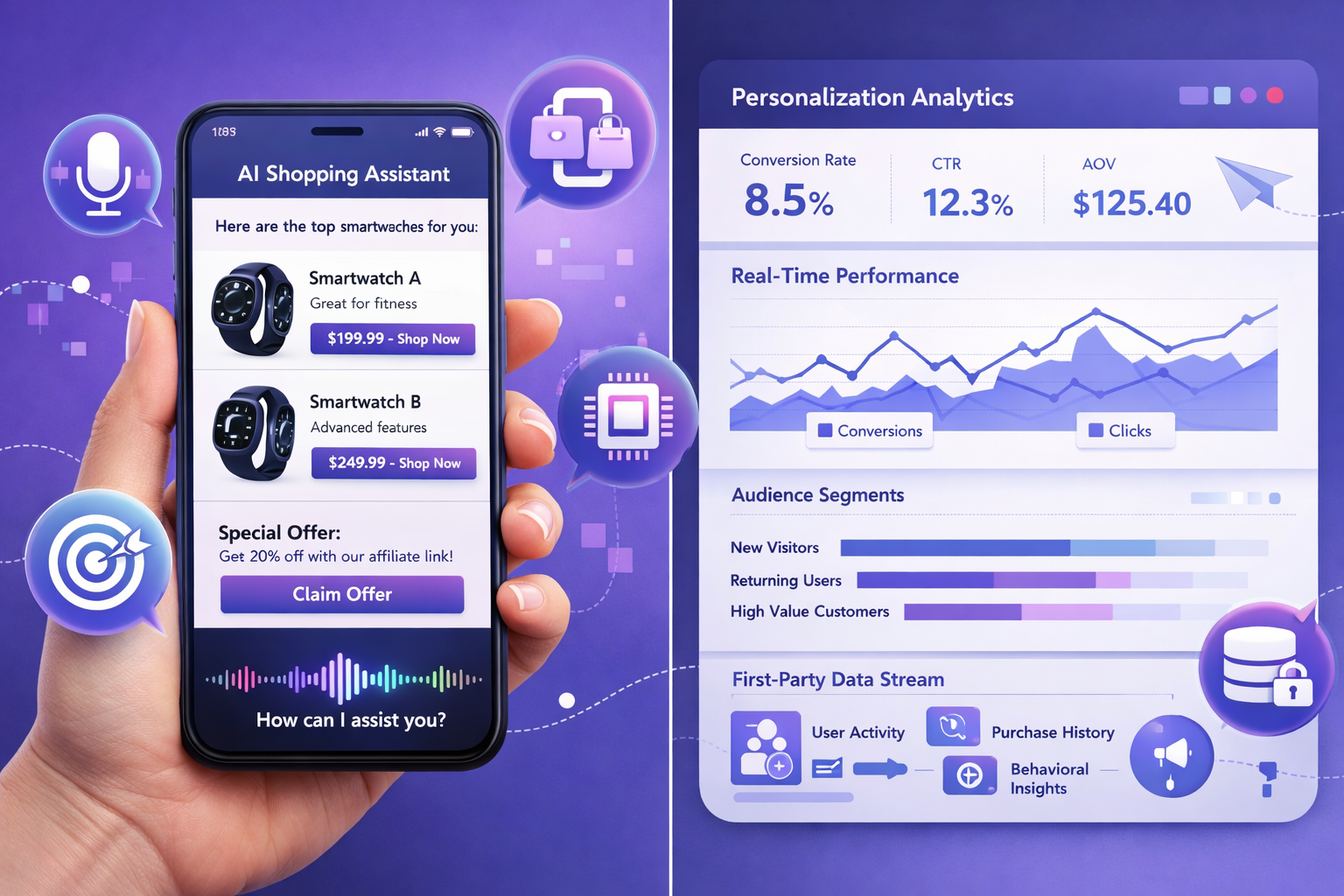
The shopping experience has fundamentally transformed. Today’s consumers increasingly rely on AI-powered assistants embedded directly in their smartphones to research products, compare prices, and complete purchases—all without visiting traditional websites.
These mobile AI shopping agents analyze user behavior, preferences, and contextual signals to make autonomous purchasing recommendations. For affiliate marketers, this shift means that traditional click-through models are being supplemented (and sometimes replaced) by AI-mediated transactions in which the agent itself evaluates and selects affiliate offers.
“Mobile AI agents are becoming the new gatekeepers of consumer purchasing decisions, requiring affiliates to optimize for machine-readable signals rather than human-readable content alone.”
The statistics paint a clear picture: mobile devices now generate 50-62% of all affiliate-driven traffic, with projections reaching 65%+ by 2027. Affiliate sites that haven’t optimized for mobile AI interactions are losing more than half their potential conversions.
The 9 Essential Tactics for Mobile AI Shopping Agents
Tactic 1: Implement Comprehensive Structured Data Markup 🏷️
Mobile AI shopping agents rely heavily on structured data to understand product information, pricing, availability, and affiliate relationships. Implementing schema.org markup for products, offers, reviews, and organizations ensures your affiliate content is machine-readable.
Key implementation steps:
- Add Product schema with affiliate pricing and availability
- Include AggregateRating markup to showcase social proof
- Implement Offer schema with clear affiliate disclosure
- Use the Organization schema to establish authority
AI agents prioritize content with clear, structured information when making recommendations to users. Without proper markup, your affiliate offers become invisible to these automated decision-makers.
Tactic 2: Optimize for Voice-Activated Shopping Queries 🎤
Voice commerce continues its explosive growth, with millions of consumers now delegating shopping tasks to voice-activated AI assistants. Top strategies for affiliate marketers must now include voice optimization as a core component.
Voice optimization essentials:
- Target conversational long-tail keywords (“best wireless headphones under $100”)
- Create FAQ-style content that answers specific shopping questions
- Optimize for local intent when relevant (“near me” queries)
- Structure content for featured snippet capture
Voice queries typically generate longer, more specific search phrases. Affiliates who optimize for these natural language patterns capture higher-intent traffic from AI shopping agents.
Tactic 3: Build First-Party Data Integration Systems 📊
AI shopping agents excel at personalization when they have access to rich user data. Creating systems that collect and utilize first-party data enables real-time customization that wins delegated purchasing decisions.
First-party data strategies:
| Data Type | Collection Method | AI Agent Application |
|---|---|---|
| Purchase History | Email integration | Product recommendations |
| Browsing Behavior | Cookie-free tracking | Contextual offers |
| Preference Signals | Interactive quizzes | Personalized filtering |
| Engagement Metrics | On-site analytics | Timing optimization |
By building permission-based data relationships with your audience, you provide AI agents with the signals needed to present your affiliate offers at precisely the right moment. This approach aligns perfectly with proven strategies to boost affiliate marketing income.
Tactic 4: Create API-Ready Affiliate Product Feeds 🔌
Mobile AI shopping agents are increasingly pulling product information directly via APIs rather than scraping websites. Making your affiliate content API-accessible dramatically increases visibility in AI-mediated shopping experiences.
API implementation priorities:
- Develop RESTful endpoints for product catalogs
- Include real-time pricing and availability updates
- Provide affiliate attribution parameters in API responses
- Ensure fast response times (under 200ms)
AI agents favor sources that provide clean, fast, programmatic access to product information. Investing in API infrastructure positions your affiliate business for the future of automated commerce.
Tactic 5: Deploy Contextual Trigger Optimization ⚡
Context is everything for mobile AI shopping agents. These systems analyze dozens of signals—location, time of day, recent searches, calendar events, weather—to determine optimal moments for product recommendations.
Contextual trigger examples:
- Location-based: Recommending travel gear when the user arrives at the airport
- Time-sensitive: Promoting meal kits during typical dinner planning hours
- Event-triggered: Suggesting gifts when the calendar shows upcoming birthdays
- Weather-responsive: Featuring seasonal products based on local conditions
Understanding how to become an effective affiliate marketer in 2026 requires mastering these contextual optimization techniques. AI agents that detect relevant contextual triggers are 3-4x more likely to present your affiliate offers.
Tactic 6: Leverage Video Content with AI Enhancement 📹
Video content enhanced with AI editing and scripting tools achieves 49% higher conversion rates than traditional formats. Mobile AI shopping agents increasingly incorporate video demonstrations into product recommendations.
AI-enhanced video tactics:
- Create short-form product comparison videos (30-60 seconds)
- Use AI tools to generate multiple versions for A/B testing
- Include clear verbal calls-to-action for voice-activated purchases
- Optimize video metadata for AI agent indexing
Video provides rich signals that AI shopping agents use to assess product quality, use cases, and user satisfaction. Affiliates who master AI-enhanced video creation gain significant competitive advantages.
Tactic 7: Establish Real-Time Personalization Engines 🎯
With 81% of consumers preferring personalized experiences, real-time customization has become essential for capturing on-device conversions. AI shopping agents expect dynamic content that adapts instantly to user signals.
Personalization engine components:
- Behavioral tracking without third-party cookies
- Machine learning models for preference prediction
- Dynamic content assembly based on user profiles
- A/B testing frameworks for continuous optimization
Real-time personalization requires technical infrastructure, but the conversion improvements justify the investment. Those looking to succeed in affiliate marketing must prioritize personalization capabilities.
Tactic 8: Optimize for On-Device Processing 🔒
Privacy concerns and processing speed improvements have led many AI functions to be moved directly to mobile devices. This “edge computing” approach means AI shopping agents can make recommendations without cloud connectivity.
On-device optimization strategies:
- Minimize data payload sizes for faster local processing
- Create lightweight product catalogs optimized for mobile storage
- Implement progressive web app (PWA) architecture
- Cache affiliate content for offline availability
On-device AI agents favor content that loads quickly and functions without constant internet connectivity. Optimizing for edge processing ensures your affiliate offers remain accessible even in low-connectivity situations.
Tactic 9: Integrate with Affiliate Program APIs 🤝
Modern affiliate marketing programs increasingly offer direct API integration for tracking, attribution, and commission management. Connecting your systems directly to affiliate networks enables seamless AI agent transactions.
API integration benefits:
- Automatic commission tracking for AI-mediated sales
- Real-time inventory synchronization
- Dynamic pricing updates
- Automated compliance and disclosure management
Direct API integration eliminates friction in the conversion process, allowing AI shopping agents to complete transactions while maintaining proper affiliate attribution. This technical capability becomes increasingly important as delegated purchasing grows.
Implementing Mobile AI Shopping Agent Tactics Successfully
Implementing these nine tactics requires a strategic, phased approach. Start by auditing your current mobile optimization and AI readiness, then prioritize tactics based on your specific niche and audience.
Implementation roadmap:
- Foundation Phase (Weeks 1-4): Implement structured data markup and voice optimization
- Data Phase (Weeks 5-8): Build first-party data collection systems and API infrastructure
- Personalization Phase (Weeks 9-12): Deploy contextual triggers and real-time personalization
- Enhancement Phase (Ongoing): Optimize video content and refine based on performance data
Those pursuing affiliate marketing courses should seek programs that specifically address mobile AI optimization and API integration, as these skills are becoming fundamental to affiliate success.
Measuring Success with Mobile AI Shopping Agents
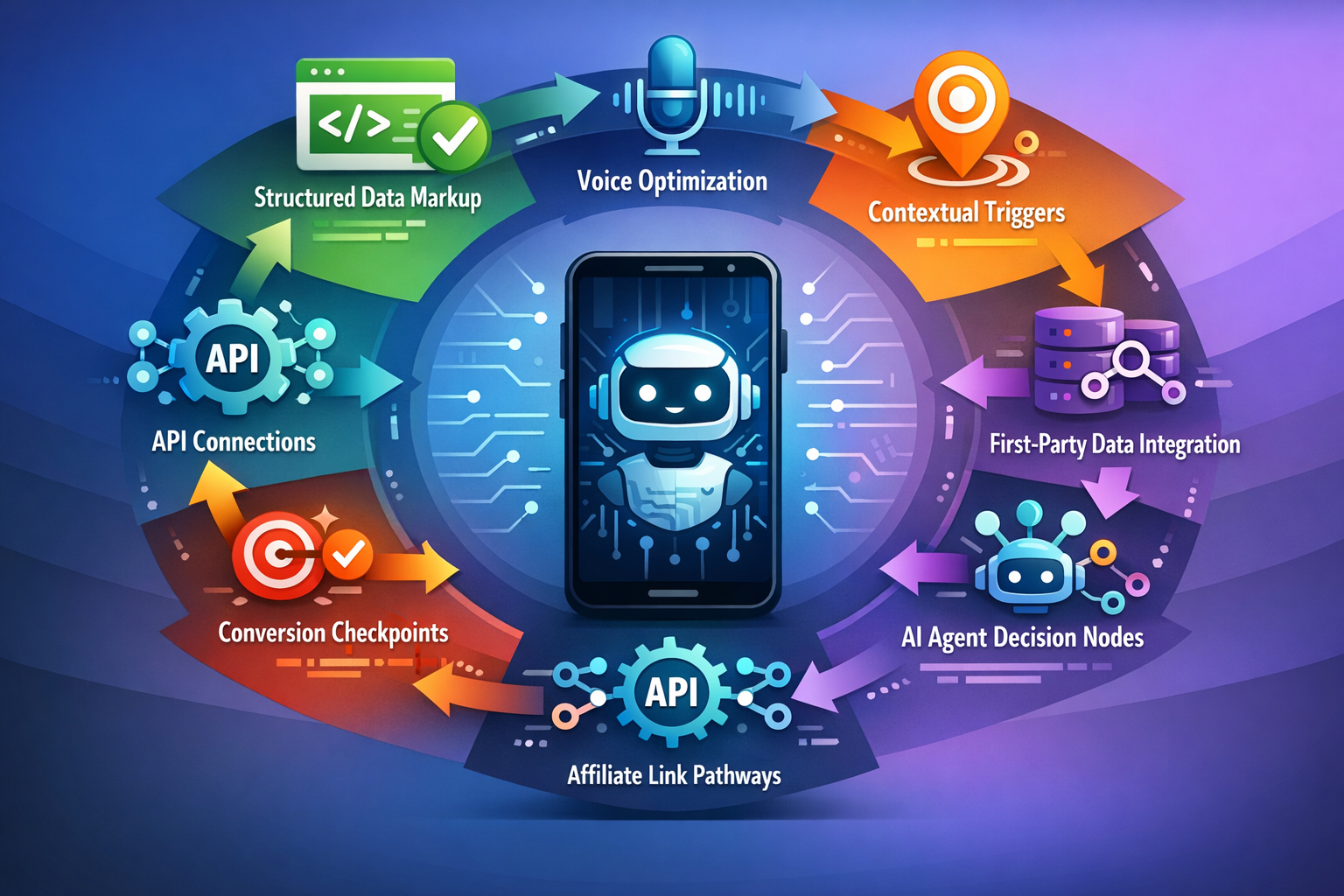
Traditional affiliate metrics like click-through rates remain important, but mobile AI shopping agents require additional measurement frameworks:
Key performance indicators for AI-mediated conversions:
- 📈 Agent recommendation rate: How often AI agents present your offers
- 🎯 Delegated conversion rate: Percentage of AI-initiated purchases completed
- ⏱️ Time-to-recommendation: Speed at which AI agents surface your content
- 💰 Average order value: Transaction size for AI-mediated sales
- 🔄 Repeat recommendation rate: Frequency of ongoing AI agent selections
These metrics provide insight into how effectively your optimization efforts are capturing AI-mediated shopping decisions. Regular monitoring and adjustment ensure continued success as AI agent capabilities evolve.
Conclusion: Embracing the Mobile AI Shopping Future
Mobile AI Shopping Agents: 9 Tactics for Affiliate Marketers to Capture On-Device Conversions in 2026 represents more than just technical optimization—it’s a fundamental shift in how affiliate marketing operates. As consumers increasingly delegate purchasing decisions to intelligent assistants, affiliates must evolve from creating human-focused content to building machine-readable, API-accessible, contextually-aware systems.
The nine tactics outlined in this guide provide a comprehensive framework for success:
✅ Structured data markup for machine readability
✅ Voice optimization for conversational commerce
✅ First-party data integration for personalization
✅ API-ready product feeds for programmatic access
✅ Contextual trigger optimization for relevance
✅ AI-enhanced video content for engagement
✅ Real-time personalization engines for customization
✅ On-device processing optimization for speed
✅ Direct affiliate program API integration for seamless transactions
Your next steps:
- Audit your current mobile AI readiness across all nine tactical areas
- Prioritize implementation based on your niche, audience, and technical capabilities
- Implement foundation tactics (structured data, voice optimization) immediately
- Test and measure performance using AI-specific metrics
- Iterate continuously as AI agent capabilities evolve
The affiliate marketers who thrive in 2026 and beyond will be those who embrace mobile AI shopping agents as partners rather than obstacles. By optimizing for machine-readable signals, contextual relevance, and seamless API integration, you position your affiliate business to capture conversions in this new delegated decision economy.
The future of affiliate marketing isn’t about choosing between human and AI audiences—it’s about serving both simultaneously through intelligent, adaptive systems that deliver value regardless of who (or what) is making the purchasing decision.
