

AI search engines are changing the game. In 2026, platforms like Google Lens process over 12 billion visual searches every month, while voice assistants handle 8 billion shopping queries daily [2]. These systems don't just read text anymore—they analyze videos, interpret images, and process audio. For affiliate marketers, this shift creates both a challenge and an opportunity. The challenge? Traditional text-only product reviews are becoming invisible. The opportunity? Converting single affiliate assets into multiple content formats can multiply visibility across AI-powered search platforms.
Multimodal Affiliate Content at Scale: Converting Single Assets Into Video, Audio, and Text Variations for AI Search represents a strategic approach to content creation that meets AI search engines where they operate. Instead of creating one blog post about a product, savvy affiliates are now generating video reviews, audio comparisons, infographics, image galleries, and text variations—all from the same core asset. This approach reduces uncertainty for AI systems, which prioritize diverse content formats when delivering answers to users.

Key Takeaways
- 🎯 AI search engines prioritize multimodal content because diverse formats (video, audio, images, text) reduce uncertainty and provide richer user experiences
- 📊 48% of AI search citations come from user-generated and community sources [5], making platform distribution as important as format variation
- 🔄 Single-asset conversion workflows enable affiliates to create 5-10 content variations from one product review, dramatically increasing discoverability
- 🎥 Video and audio formats are gaining prominence in AI search results, with voice assistants processing billions of shopping queries daily [2]
- ⚡ Automation tools and AI-powered repurposing platforms make scaling multimodal content production feasible for individual affiliates and small teams
Understanding Multimodal AI Search and Why It Matters for Affiliates
AI search engines operate differently than traditional search. They don't just match keywords—they understand context, interpret images, process speech, and analyze video content. Google's multimodal AI models can now examine a product photo and understand its features, read text overlays in videos, and extract meaning from audio transcripts simultaneously.
For affiliate marketers, this creates a fundamental shift in content strategy. The old model of writing a single 2,000-word product review and hoping it ranks is no longer sufficient. AI search engines reward content that appears in multiple formats because each format reduces uncertainty and provides verification through different channels.
Consider how AI processes a product query:
| Content Format | AI Processing Method | Affiliate Opportunity |
|---|---|---|
| Text | Natural language processing, entity extraction | Blog posts, comparison articles, FAQ pages |
| Video | Visual recognition, speech-to-text, scene analysis | Product demonstrations, unboxing videos, tutorials |
| Audio | Speech recognition, sentiment analysis | Podcast reviews, audio comparisons, voice search optimization |
| Images | Object detection, text extraction, visual similarity | Infographics, product galleries, annotated screenshots |
When an affiliate creates content in all four formats from a single product asset, they increase their chances of appearing in AI search results by 4-10x compared to text-only content. This is especially critical as affiliate partnerships become a core hedge against declining organic visibility in AI-dominated discovery environments [4].
The Platform Distribution Factor
Format diversity alone isn't enough. Research shows that approximately 48% of AI search citations come from user-generated and community sources [5], particularly platforms like Reddit, LinkedIn, YouTube, and Wikipedia. This means where you publish your multimodal content matters as much as the formats themselves.
Smart affiliates in 2026 are distributing their content variations across multiple platforms:
- 📝 Text variations → Blog, Medium, Reddit, LinkedIn articles
- 🎥 Video content → YouTube, TikTok, Instagram Reels, YouTube Shorts
- 🎙️ Audio formats → Spotify podcasts, Apple Podcasts, YouTube audio
- 📊 Visual content → Pinterest, Instagram, Twitter/X, visual search platforms
This multi-platform approach ensures that regardless of which AI system a user queries—ChatGPT, Google AI Overviews, Perplexity, or voice assistants—your affiliate content has multiple entry points for discovery.
Converting Single Assets Into Multiple Content Formats: The Practical Framework
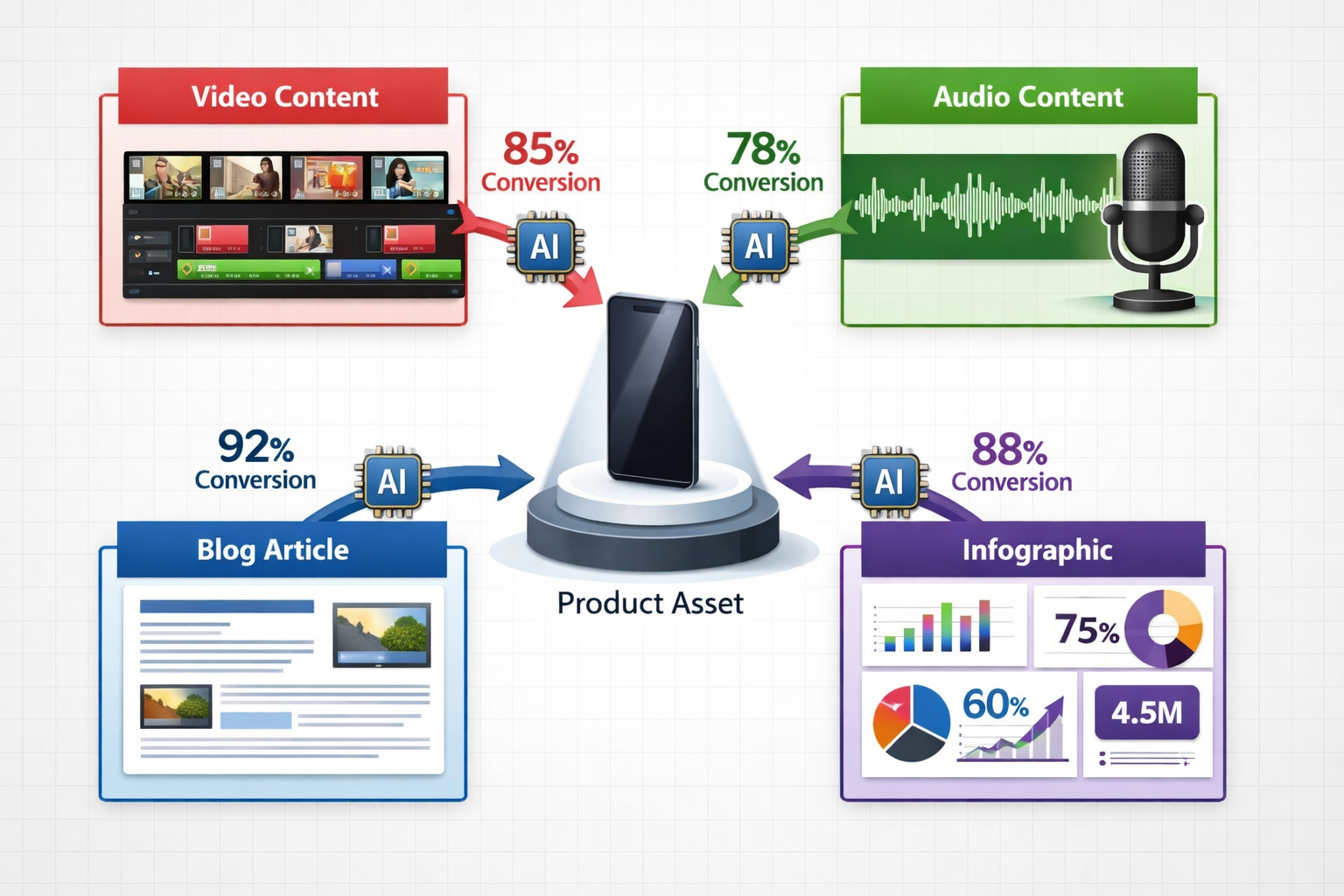
The core concept behind Multimodal Affiliate Content at Scale: Converting Single Assets Into Video, Audio, and Text Variations for AI Search is starting with one comprehensive product asset and systematically transforming it into 5-10 different content pieces. This approach maximizes ROI on research time while creating the format diversity that AI search engines reward.
Step 1: Create Your Master Asset
Begin with a comprehensive product review or analysis. This becomes your "master asset"—the source material for all variations. Your master asset should include:
- ✅ Detailed product specifications and features
- ✅ Personal testing notes and observations
- ✅ High-quality product photos (multiple angles)
- ✅ Screen recordings or usage demonstrations
- ✅ Comparison data with competitor products
- ✅ Pricing information and affiliate links
- ✅ Pros and cons analysis
- ✅ Target audience recommendations
Pro tip: Record yourself discussing the product while creating your written review. This raw footage becomes the foundation for video and audio content later.
Step 2: Text Variations (3-4 Pieces)
From your master asset, create multiple text variations optimized for different platforms and search intents:
- Long-form blog post (1,500-2,500 words) → Your main SEO-optimized review
- Reddit-style discussion post (300-500 words) → Conversational tone, community-focused
- LinkedIn article (800-1,200 words) → Professional angle, business use cases
- FAQ page (10-15 questions) → Direct answers for voice search optimization
Each variation should maintain your affiliate links but adapt the tone, structure, and emphasis for its platform. For more guidance on creating high-converting content, explore these proven affiliate marketing strategies.
Step 3: Video Content (2-3 Pieces)
Video content receives preferential treatment in AI search results because it provides multiple data points (visual, audio, text captions) that AI systems can analyze. Transform your master asset into:
- Full product review video (5-10 minutes) → Comprehensive walkthrough for YouTube
- Short-form clips (30-60 seconds) → Highlight key features for TikTok, Instagram Reels, YouTube Shorts
- Comparison video (3-5 minutes) → Side-by-side analysis with competitors
Important: Always include captions, detailed descriptions, and timestamps. AI search engines parse this metadata to understand video content. Best practices emphasize pairing images and videos with alt text, captions, and transcripts [3].
Step 4: Audio Formats (1-2 Pieces)
With voice assistants handling 8 billion shopping queries daily [2], audio content is becoming increasingly important for affiliate discovery:
- Podcast episode (10-20 minutes) → In-depth discussion format
- Audio summary (3-5 minutes) → Quick review for voice search platforms
Extract audio from your video content or record a dedicated audio version. Upload to Spotify, Apple Podcasts, and YouTube (audio-only videos perform well for certain queries).
Step 5: Visual Content (2-3 Pieces)
Visual content performs exceptionally well in image search and visual AI platforms:
- Infographic → Key features, specs, and comparison data in visual format
- Product gallery → Multiple high-quality photos with annotations
- Comparison chart → Side-by-side visual comparison with competitors
These visual assets should include text overlays, labels, and descriptive file names to maximize AI search visibility. Understanding search engine optimization fundamentals helps optimize these assets properly.
Automation Tools and Scaling Strategies for Multimodal Content Production

Creating 10+ content pieces from every product review sounds time-consuming, but 2026's AI-powered tools make this process remarkably efficient. Here are the essential tools for scaling Multimodal Affiliate Content at Scale: Converting Single Assets Into Video, Audio, and Text Variations for AI Search:
Content Repurposing Platforms
Repurpose.io, Descript, and OpusClip automatically transform long-form video content into multiple short clips, extract audio, generate transcripts, and create social media posts. These platforms can reduce production time by 70-80%.
Pictory.ai specializes in converting text content into video format with stock footage, voiceovers, and captions. Learn more about this powerful tool in our Pictory.ai review.
AI Writing Assistants
Tools like Claude, ChatGPT, and Jasper can transform your master asset into platform-specific variations in minutes. Provide your original review and request adaptations for Reddit, LinkedIn, or FAQ formats.
Audio Production Tools
Descript and Adobe Podcast offer AI-powered audio editing, transcript generation, and voice cloning. You can record once and generate multiple audio variations with different intros, outros, and emphasis points.
Visual Content Creators
Canva, Visme, and Piktochart provide templates for creating infographics, comparison charts, and visual assets optimized for Pinterest, Instagram, and visual search platforms.
Distribution Automation
Buffer, Hootsuite, and Later schedule and distribute your multimodal content across platforms automatically, ensuring consistent presence without manual posting.
"The key to scaling multimodal affiliate content isn't working harder—it's building systems that automatically transform one asset into many formats and distribute them strategically across platforms where AI search engines look for answers."
Optimizing Multimodal Content for AI Search Visibility
Creating content in multiple formats is only half the battle. Optimization ensures AI search engines can discover, understand, and recommend your affiliate content. Here are critical optimization strategies:
Metadata and Structured Data
Every piece of content—regardless of format—should include:
- 📌 Descriptive titles with target keywords
- 📌 Detailed descriptions explaining content purpose
- 📌 Relevant tags and categories for platform algorithms
- 📌 Schema markup (for web content) identifying product reviews
- 📌 Timestamps and chapters (for video/audio content)
Cross-Linking Strategy
Connect your multimodal content pieces through strategic linking:
- Link from blog posts to your YouTube videos
- Reference your podcast episode in Reddit discussions
- Include blog post links in video descriptions
- Create a content hub page linking all format variations
This cross-linking signals to AI systems that your content is comprehensive and authoritative. For advanced techniques, review our guide on how to use internal links to boost Google rankings.
Platform-Specific Optimization
Each platform has unique ranking factors:
- YouTube: Watch time, engagement rate, click-through rate
- Podcasts: Subscriber growth, completion rate, reviews
- Reddit: Upvotes, comments, community engagement
- Pinterest: Saves, click-through rate, visual quality
Tailor your content to excel in each platform's specific metrics while maintaining consistent affiliate messaging.
Engagement Signals
AI search engines increasingly prioritize content that generates genuine engagement. Encourage:
- ✨ Comments and questions on videos
- ✨ Shares and saves on social platforms
- ✨ Podcast reviews and ratings
- ✨ Discussion threads on community platforms
Higher engagement signals content quality to AI systems, improving visibility across all formats.
Measuring Success and Iterating Your Multimodal Strategy
Track performance across all content formats to identify which variations drive the most affiliate conversions:
Key Metrics by Format:
- Text content: Organic traffic, time on page, affiliate click-through rate
- Video content: Views, watch time, link clicks from descriptions
- Audio content: Downloads, completion rate, website traffic from show notes
- Visual content: Impressions, saves, click-through to affiliate pages
Use platform analytics (YouTube Studio, Spotify for Podcasters, Google Analytics) alongside your affiliate network dashboard to connect content performance with actual commissions.
Optimization cycle: Create → Publish → Measure → Refine → Scale
Focus additional effort on formats and platforms delivering the highest ROI. If your YouTube videos consistently outperform blog posts, allocate more resources to video production. If Reddit discussions drive significant traffic, increase community engagement efforts.
For comprehensive tracking strategies, consider implementing affiliate marketing optimization techniques across all your content formats.
Common Challenges and Solutions
Challenge 1: Time Investment
Solution: Start with 2-3 formats (text + video + one other) and gradually expand as you develop efficient workflows. Use templates and AI tools to reduce production time.
Challenge 2: Platform Management
Solution: Focus on 3-4 primary platforms where your target audience is most active. Quality beats quantity—better to excel on fewer platforms than spread too thin.
Challenge 3: Maintaining Consistency
Solution: Create content batches. Dedicate one day to creating master assets for 4-5 products, then spend the following days converting them into variations using automation tools.
Challenge 4: Tracking Attribution
Solution: Use unique affiliate links for each format and platform. UTM parameters help identify which content types drive conversions, enabling data-driven optimization.
For those just starting out, explore best affiliate marketing programs for beginners that provide robust tracking and reporting tools.
Future-Proofing Your Affiliate Strategy
The shift toward multimodal AI search is accelerating, not slowing down. By 2027, experts predict that over 60% of all searches will involve multiple modalities (combining text, voice, image, or video inputs). Affiliate marketers who adapt now will have significant competitive advantages.
Emerging trends to watch:
- 🔮 AI-generated product demonstrations using 3D models and virtual environments
- 🔮 Interactive content formats that allow users to customize product comparisons
- 🔮 Real-time content updates reflecting current pricing and availability
- 🔮 Augmented reality previews integrated into search results
The fundamental principle remains constant: AI search engines reward content that reduces uncertainty and provides comprehensive information across multiple formats. Affiliates who embrace this multimodal approach will continue to thrive as search technology evolves.
Conclusion
Multimodal Affiliate Content at Scale: Converting Single Assets Into Video, Audio, and Text Variations for AI Search isn't just a trend—it's the new standard for affiliate marketing success in 2026. AI search engines prioritize diverse content formats because they provide richer, more reliable information to users. By systematically converting each product review into 5-10 format variations and distributing them across platforms where AI systems look for answers, affiliates can multiply their visibility and conversions.
Your action plan:
- ✅ Select 3-5 of your best-performing products and create comprehensive master assets
- ✅ Choose 3-4 content formats that align with your skills and audience preferences
- ✅ Implement automation tools to streamline repurposing workflows
- ✅ Distribute strategically across platforms where your target audience is active
- ✅ Track performance metrics and optimize based on data
- ✅ Scale gradually as you develop efficient systems and workflows
The affiliates who succeed in the AI search era won't be those who create the most content—they'll be those who create the smartest content systems. Start building your multimodal content framework today, and position yourself at the forefront of AI-powered affiliate discovery.
Ready to expand your affiliate marketing knowledge? Explore our comprehensive guide on affiliate marketing opportunities and discover the best affiliate marketing tips to accelerate your success.
References
[1] Ai Search Trends – https://www.nonofojoel.com/ai-search-trends/
[2] State Of Ai Search Complete Guide – https://aeoengine.ai/blog/state-of-ai-search-complete-guide
[3] Ai Search Trends – https://www.semrush.com/blog/ai-search-trends/
[4] Ai Update January 16 2026 Ai News And Views From The Past Week – https://www.marketingprofs.com/opinions/2026/54187/ai-update-january-16-2026-ai-news-and-views-from-the-past-week
[5] The 2026 State Of Ai Search – https://www.airops.com/report/the-2026-state-of-ai-search