

The affiliate marketing landscape has transformed dramatically in 2026. What once required teams of copywriters, graphic designers, and video editors can now be accomplished by a single marketer armed with the right AI tools. Multimodal AI workflows for affiliate content have revolutionized how campaigns are created, enabling marketers to generate complete promotional packages—including headlines, product images, and demo videos—from a single brief or prompt.
This technological leap represents more than simple automation. Unified AI platforms now produce comprehensive affiliate campaigns that cut production time by up to 80% while enabling faster A/B testing cycles and significantly reducing costs. The ability to generate copy, visuals, and video simultaneously from one input has become a game-changer for affiliate marketers looking to scale their operations without proportionally scaling their budgets.
Key Takeaways
- 🚀 Multimodal AI platforms can generate complete affiliate campaigns—including blog posts, product images, social media content, and videos—from a single prompt, dramatically reducing production time and costs
- 💡 Integrated workflows enable marketers to create platform-optimized content variations for TikTok, YouTube, Instagram, email, and paid ads simultaneously, eliminating repetitive manual work
- 📊 AI-powered distribution systems automatically adapt and schedule content across multiple channels, optimizing posting times and personalizing messaging for different audience segments
- 🎬 Avatar-based video creation tools like Synthesia and HeyGen produce professional spokesperson videos in minutes, making video marketing accessible to all affiliate marketers
- ⚡ Faster testing cycles mean affiliate marketers can now run dozens of campaign variations in the time it previously took to create a single campaign, accelerating optimization and revenue growth
Understanding Multimodal AI Workflows for Affiliate Content
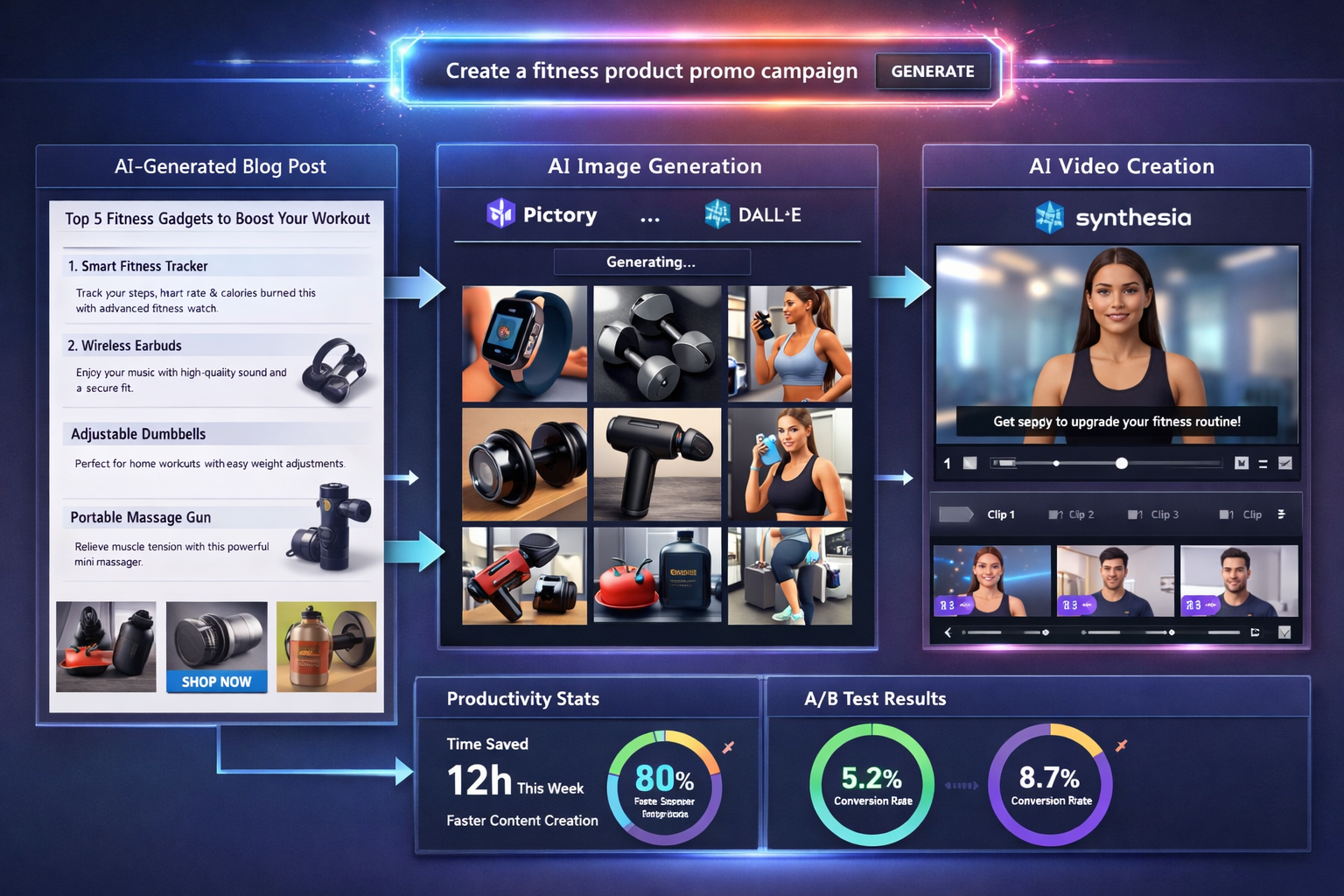
Multi-modal AI content creation has emerged as a core trend in 2026, enabling AI tools to handle text, images, video, and audio simultaneously from a single prompt.[1] This represents a fundamental shift from earlier AI tools that focused on individual content types in isolation.
What makes these workflows "multimodal"? The term refers to AI systems capable of processing and generating multiple types of media formats within a unified framework. Rather than using separate tools for writing product descriptions, creating banner images, and producing video reviews, marketers can now input campaign parameters once and receive coordinated assets across all formats.
The Technology Behind Unified Campaign Generation
At the heart of these capabilities are advanced AI models like Gemini, which represents a family of multimodal AI models capable of processing and generating text, images, audio, and code.[6] These models understand context across different media types, ensuring visual elements align with written copy and video scripts complement both.
The practical implications for affiliate marketing are substantial:
- Consistency: Brand voice and messaging remain uniform across all campaign elements
- Speed: What took days or weeks now happens in hours or minutes
- Cost efficiency: Reduced need for multiple specialized contractors or software subscriptions
- Scalability: Marketers can test more variations and target more niches simultaneously
Components of a Complete Affiliate Campaign
Modern affiliate marketing campaigns generated through multimodal AI workflows can include:[2]
| Campaign Element | AI-Generated Output | Platform Application |
|---|---|---|
| Blog Content | Long-form articles with sourced research and hero images | Website, SEO traffic |
| Paid Ads | Multiple headline and image variations for testing | Google Ads, Facebook, Instagram |
| Email Sequences | Subject lines, body copy, and inline graphics | Email marketing platforms |
| Landing Pages | Complete page copy with CTAs and conversion-optimized layouts | Dedicated campaign URLs |
| Social Media | Platform-specific posts, carousels, thumbnails, and short videos | Instagram, TikTok, YouTube, LinkedIn |
| SEO Assets | Topic clusters, keyword-optimized content, and meta descriptions | Organic search strategy |
This comprehensive approach ensures every touchpoint in the customer journey receives professional, coordinated content that guides prospects toward affiliate conversions.
How Multimodal AI Workflows Transform Affiliate Campaign Creation
The practical application of multimodal AI workflows begins with understanding how these systems accept input and deliver coordinated output. Unlike traditional content creation processes that require separate briefs for each asset type, unified AI platforms work from consolidated campaign parameters.
Single-Prompt Campaign Generation Process
The workflow typically follows this streamlined pattern:
Step 1: Campaign Brief Input
Marketers provide essential information in one comprehensive prompt:
- Product or service being promoted
- Target audience demographics and pain points
- Key benefits and unique selling propositions
- Desired tone and brand voice
- Campaign objectives (awareness, consideration, conversion)
- Platform requirements (blog, social, email, video)
Step 2: AI Processing and Asset Generation
The platform's multimodal AI simultaneously creates:
- Written content optimized for each channel
- Visual assets aligned with copy themes
- Video scripts and generated footage
- Platform-specific formatting and sizing
Step 3: Review and Refinement
Marketers review coordinated assets and make adjustments through conversational prompts rather than manual editing.
Step 4: Distribution and Optimization
Content deploys across channels with built-in performance tracking for ongoing refinement.
Platform-Specific Tools for Different Content Types
While unified platforms handle multiple formats, specialized tools excel in particular areas:
Video Creation Platforms
Pictory AI auto-generates platform-optimized clips for TikTok, YouTube, and Instagram from longer video content, enabling rapid social media content creation from webinars or extended videos.[1] This proves particularly valuable for affiliate marketers who conduct product reviews or tutorials, as a single long-form video can be automatically segmented into dozens of short-form clips optimized for YouTube Shorts and other platforms.
Synthesia creates avatar/spokesperson videos with AI avatars and multi-language dubbing, applicable for demo videos, training content, and explainer videos.[1] Affiliate marketers can generate professional product demonstrations without appearing on camera themselves or hiring actors.
HeyGen provides avatar-based video creation where users input scripts, choose avatars, and receive polished presentation videos in minutes.[2] This democratizes video marketing for affiliates who previously lacked video production skills or budgets.
LTX Studio offers hybrid editing with AI for precise narrative control and storyboarding, supporting professional video production and marketing applications.[1] For affiliates promoting high-ticket products requiring sophisticated storytelling, this tool bridges the gap between automation and creative control.
Template-Driven Content Solutions
InVideo offers template-driven solutions with pre-built frameworks and extensive template libraries covering different industries, accelerating video production for social media and ads.[2] These templates ensure brand consistency while dramatically reducing production time.
For those just starting out, understanding how to do affiliate marketing with these modern tools provides a significant competitive advantage over marketers still using manual processes.
The Power of Integrated Content Platforms
Beyond specialized tools, comprehensive platforms now generate blog articles, social media posts, email campaigns, landing pages, and ad copy within single interfaces, addressing the full affiliate funnel.[2] This integration eliminates the friction of moving between different tools and manually ensuring consistency.
These platforms understand the relationship between different content types. For example:
- Blog post key points automatically become social media captions
- Email subject lines derive from high-performing ad headlines
- Video scripts incorporate language from converting landing pages
- Visual themes remain consistent across all touchpoints
Implementing Multimodal AI Workflows: Practical Strategies for Affiliate Marketers
Successfully implementing these workflows requires more than simply adopting new tools. Affiliate marketers must develop strategic approaches that maximize the unique advantages of multimodal AI while maintaining quality and authenticity.
Building Effective Campaign Prompts
The quality of AI-generated content depends heavily on prompt engineering. Effective campaign prompts should include:
Product Context
- Specific product features and benefits
- Price points and value propositions
- Target customer demographics
- Competitive differentiators
Brand Voice Guidelines
- Tone preferences (professional, casual, enthusiastic, educational)
- Words or phrases to include or avoid
- Existing brand messaging to reference
- Desired emotional response
Content Specifications
- Required content lengths for each format
- Platform-specific requirements
- SEO keywords for organic content
- Compliance and disclosure requirements for affiliate content
Campaign Objectives
- Primary conversion goals
- Secondary engagement metrics
- Testing hypotheses to explore
- Timeline and urgency factors
"The most successful affiliate marketers in 2026 aren't those who simply use AI tools—they're those who've mastered the art of communicating campaign vision through comprehensive prompts that guide AI toward strategic outcomes."
Multi-Channel Distribution Automation
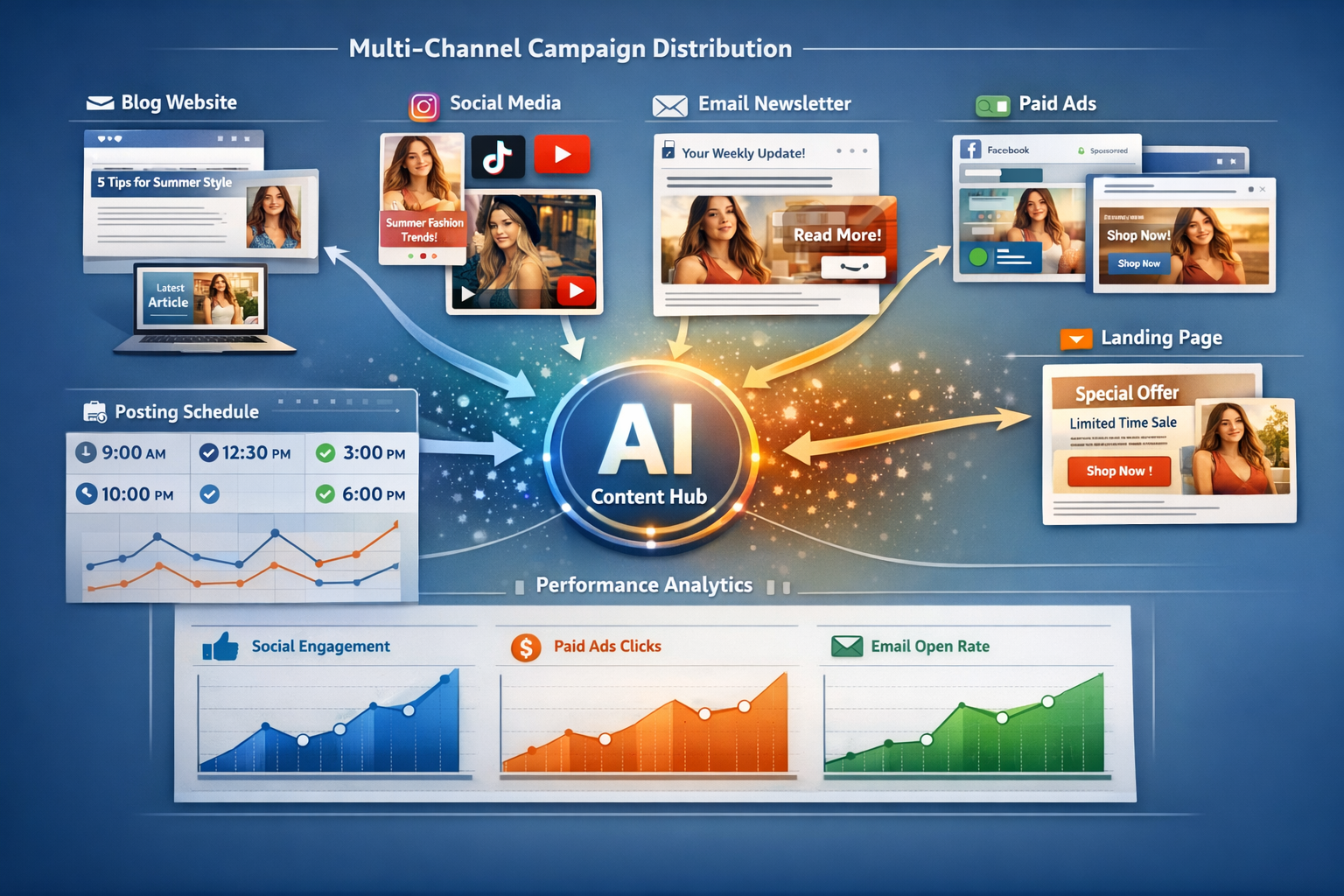
Creating content is only half the battle. StoryChief and Distribution AI enable multi-channel distribution, allowing content created once to be adapted and posted across blogs, social media accounts, and newsletters simultaneously.[2]
These distribution systems offer several sophisticated capabilities:
Scheduled Social Sharing uses AI to analyze when target audiences are most active and automatically post content at optimal times.[2] Rather than manually scheduling posts or using generic "best time to post" guidelines, these systems learn from your specific audience's engagement patterns.
Dynamic Content Personalization adapts messaging based on platform requirements and user preferences across different channels.[2] The same campaign might emphasize different product benefits on LinkedIn versus Instagram, or adjust language formality based on audience demographics.
Performance-Based Optimization tracks which content variations generate the most engagement and conversions, automatically allocating more distribution resources to high-performers while pausing underperforming variations.
For marketers exploring best affiliate marketing tips, understanding distribution automation represents a critical competitive advantage in 2026.
A/B Testing at Scale
One of the most transformative aspects of multimodal AI workflows is the ability to test exponentially more campaign variations than previously possible. Traditional A/B testing might compare two email subject lines or two ad images. Multimodal AI enables testing:
- 20+ headline variations simultaneously
- Different visual styles across audience segments
- Multiple video scripts with different emotional appeals
- Various landing page layouts and copy approaches
- Diverse social media content formats
This testing velocity accelerates learning and optimization. Affiliate marketers can identify winning combinations in days rather than months, then reinvest savings into scaling successful campaigns.
Voice and Audio Integration
An emerging frontier in multimodal workflows involves voice cloning technology, which creates digital voice replicas from audio samples with emotional speech synthesis, generating voices with natural inflections for brand storytelling across campaigns.[2]
Applications for affiliate marketing include:
- Podcast-style product reviews
- Audio versions of blog content for accessibility
- Voice-over for video content without recording equipment
- Personalized audio messages in email campaigns
- Multi-language content expansion without hiring translators
This audio dimension completes the truly multimodal approach, ensuring affiliate campaigns reach audiences across every preferred content consumption format.
Advanced Techniques for Maximizing Campaign Performance
As affiliate marketers become comfortable with basic multimodal workflows, advanced techniques unlock even greater performance gains and competitive advantages.
Competitive Intelligence Integration
Sophisticated marketers combine multimodal AI workflows with LLM-powered competitor analysis to inform campaign creation. By analyzing what messaging, visuals, and formats competitors use successfully, AI can generate campaigns that differentiate strategically while capitalizing on proven approaches.
This integration might involve:
- Scraping competitor landing pages to identify messaging patterns
- Analyzing top-performing competitor videos for structural insights
- Identifying content gaps competitors haven't addressed
- Testing contrarian approaches to saturated messaging themes
Niche-Specific Customization
While multimodal AI excels at generating general marketing content, the most successful affiliate campaigns incorporate niche-specific knowledge and terminology. Marketers should:
Build Custom Knowledge Bases
Feed AI systems with niche-specific information:
- Industry terminology and jargon
- Common customer questions and objections
- Product category comparisons and specifications
- Regulatory requirements and compliance language
Develop Niche Prompt Libraries
Create reusable prompt templates optimized for specific verticals:
- Health and wellness product reviews
- Software and SaaS comparisons
- Financial services and investment products
- Consumer electronics and tech gadgets
Incorporate Expert Perspectives
Even AI-generated content benefits from human expertise. Consider:
- Interviewing niche experts and incorporating insights
- Adding personal experience and testing results
- Including unique data or research not available to competitors
- Providing authentic recommendations based on actual product use
For those exploring how to become an affiliate marketer in specialized niches, this customization separates successful campaigns from generic AI-generated content that fails to resonate.
Seasonal and Trend-Responsive Campaigns
Multimodal AI workflows enable rapid response to trending topics, seasonal opportunities, and current events. The speed advantage becomes particularly valuable during:
Holiday Shopping Seasons
Generate complete holiday-themed campaigns across all formats in hours:
- Gift guide blog posts with product images
- Holiday-specific email sequences
- Festive social media content and videos
- Limited-time offer landing pages
Trending Topics
Capitalize on viral moments or trending conversations:
- News-jacking content that connects products to current events
- Trend-aligned social media content
- Timely video responses to popular topics
- SEO content targeting trending search queries
Product Launches
When promoted products release new versions or features:
- Updated comparison content highlighting new features
- Launch announcement videos and social content
- Refreshed landing pages with current information
- Email campaigns to existing audiences about updates
Quality Control and Human Oversight
Despite AI's impressive capabilities, successful affiliate marketers maintain quality control processes:
Content Review Protocols
- Fact-checking product claims and specifications
- Ensuring affiliate disclosures meet FTC requirements
- Verifying links and tracking codes function correctly
- Confirming visual assets don't contain copyright issues
Brand Consistency Checks
- Reviewing tone and voice across all generated assets
- Ensuring visual branding remains cohesive
- Confirming messaging aligns with brand values
- Testing user experience across different devices
Performance Monitoring
- Tracking conversion rates by content type and platform
- Identifying which AI-generated variations perform best
- Gathering audience feedback and sentiment
- Adjusting prompts based on performance data
Those pursuing affiliate marketing jobs should recognize that AI augments rather than replaces human judgment, creativity, and strategic thinking.
Cost-Benefit Analysis: ROI of Multimodal AI Workflows
Understanding the financial implications of adopting multimodal AI workflows helps marketers make informed investment decisions and measure success accurately.
Traditional Campaign Costs vs. AI-Powered Workflows
Traditional Approach (Pre-AI):
- Copywriter: $500-2,000 per campaign
- Graphic designer: $300-1,500 for multiple assets
- Video production: $1,000-5,000+ for professional content
- Total per campaign: $1,800-8,500+
- Time requirement: 1-4 weeks
- Campaigns feasible per month: 1-3
Multimodal AI Workflow Approach:
- Platform subscription: $50-300/month (unlimited campaigns)
- Marketer time investment: 2-8 hours per campaign
- Minor editing/refinement costs: $0-200
- Total per campaign: $50-500
- Time requirement: 1-3 days
- Campaigns feasible per month: 10-30+
Calculating Time Savings
Beyond direct costs, time savings represent significant value:
| Task | Traditional Time | AI-Assisted Time | Time Saved |
|---|---|---|---|
| Blog post (1,500 words) | 4-6 hours | 30-60 minutes | 75-90% |
| Social media content (10 posts) | 2-3 hours | 15-30 minutes | 80-90% |
| Product images (5 variations) | 3-5 hours | 10-20 minutes | 90-95% |
| Demo video (2-3 minutes) | 8-12 hours | 30-90 minutes | 85-95% |
| Email sequence (5 emails) | 3-4 hours | 20-40 minutes | 80-90% |
| Total campaign | 20-30 hours | 2-4 hours | 85-90% |
This time efficiency allows affiliate marketers to either scale operations dramatically or maintain current volume while reclaiming time for strategy, relationship building, and optimization.
Testing Velocity and Revenue Impact
The ability to test more variations directly impacts revenue. Consider:
Scenario A: Traditional Approach
- 1 campaign per month
- 2-3 variations tested
- 3-6 months to identify winning approach
- Opportunity cost of slow learning
Scenario B: Multimodal AI Approach
- 10-15 campaigns per month
- 5-10 variations per campaign
- 2-4 weeks to identify winning approach
- Rapid scaling of successful campaigns
The revenue difference compounds over time as AI-powered marketers iterate faster, learn quicker, and scale winners more aggressively.
For those interested in best affiliate marketing programs for beginners, these tools level the playing field, allowing newcomers to compete with established marketers who have larger teams and budgets.
Common Challenges and Solutions
Despite their advantages, multimodal AI workflows present challenges that marketers must navigate effectively.
Challenge 1: Generic or Inauthentic Content
Problem: AI-generated content can feel generic, lacking the authentic voice and personal experience that builds trust with audiences.
Solutions:
- Incorporate personal testing experiences and results into prompts
- Add unique data, screenshots, or case studies AI cannot generate
- Edit AI content to include specific examples and anecdotes
- Use AI for structure and first drafts, then humanize with personal touches
- Develop detailed brand voice guidelines that inform AI generation
Challenge 2: Platform Policy Compliance
Problem: Different platforms have varying policies regarding AI-generated content, affiliate disclosures, and advertising standards.
Solutions:
- Build compliance requirements directly into prompts
- Create platform-specific prompt templates with policy considerations
- Implement review checklists before publishing across channels
- Stay updated on FTC affiliate disclosure requirements
- Use AI to generate disclosure language but verify accuracy
Challenge 3: Technical Learning Curve
Problem: Mastering multiple AI tools and understanding effective prompt engineering requires time investment.
Solutions:
- Start with one comprehensive platform rather than multiple specialized tools
- Follow AI marketing tools guides to accelerate learning
- Join communities of affiliate marketers using similar tools
- Document successful prompts and workflows for reuse
- Invest in training or courses specific to AI marketing tools
Challenge 4: Content Saturation
Problem: As more marketers adopt AI tools, markets risk becoming saturated with similar content.
Solutions:
- Differentiate through unique research and data
- Focus on underserved niches with less competition
- Combine AI efficiency with human creativity and insight
- Develop distinctive brand personalities and perspectives
- Use AI for production while maintaining strategic human direction
Challenge 5: Quality Consistency
Problem: AI outputs can vary in quality, requiring review and refinement.
Solutions:
- Develop detailed prompt templates that consistently produce quality results
- Implement multi-stage review processes before publication
- Use AI to generate multiple variations, then select the best
- Refine prompts based on output quality patterns
- Maintain human oversight for final approval
Future Trends in Multimodal AI for Affiliate Marketing
The multimodal AI landscape continues evolving rapidly. Understanding emerging trends helps marketers prepare for upcoming opportunities and challenges.
Increased Personalization at Scale
Future AI systems will generate not just campaign variations, but individually personalized content for specific audience segments or even individual users. Imagine AI creating:
- Product recommendations tailored to browsing history
- Video content addressing specific customer objections
- Email sequences adapting to engagement patterns
- Landing pages that dynamically adjust based on traffic source
Real-Time Content Optimization
Rather than creating campaigns and monitoring performance separately, emerging systems will continuously optimize content in real-time based on performance data:
- Automatically adjusting ad copy based on conversion rates
- Swapping underperforming images for new AI-generated alternatives
- Modifying video thumbnails and titles based on click-through rates
- Personalizing landing page elements based on visitor behavior
Enhanced Integration with Affiliate Networks
Expect tighter integration between multimodal AI platforms and affiliate networks, enabling:
- Automatic campaign generation when new products become available
- Real-time product data integration into content
- Performance tracking directly within content creation platforms
- Automated commission optimization based on conversion data
Voice and Conversational Commerce
As voice assistants and conversational AI become more prevalent:
- Voice-optimized affiliate content for smart speakers
- Conversational product recommendations through chatbots
- Audio-first content strategies for podcast and voice platforms
- Multi-language expansion through AI translation and voice cloning
Regulatory and Ethical Considerations
As AI-generated content becomes ubiquitous, expect:
- Clearer regulations regarding AI content disclosure
- Platform policies specifically addressing AI-generated marketing
- Industry standards for ethical AI use in affiliate marketing
- Consumer expectations for transparency about AI involvement
Staying ahead of these affiliate marketing trends positions marketers for long-term success in an AI-augmented landscape.
Building Your Multimodal AI Workflow: Step-by-Step Implementation
For affiliate marketers ready to implement these workflows, a systematic approach ensures successful adoption.
Phase 1: Assessment and Planning (Week 1)
Audit Current Processes
- Document time spent on different content creation tasks
- Calculate current campaign costs and production timelines
- Identify bottlenecks and inefficiencies
- Determine which content types consume most resources
Define Objectives
- Set specific goals (e.g., "reduce campaign production time by 70%")
- Identify which content types to prioritize for AI adoption
- Establish quality standards and success metrics
- Determine budget for tools and training
Research Platform Options
- Evaluate comprehensive platforms versus specialized tools
- Consider integration with existing marketing stack
- Review pricing models and scalability
- Test free trials of leading platforms
Phase 2: Tool Selection and Setup (Week 2-3)
Choose Primary Platform
Select based on:
- Content types most critical to your affiliate strategy
- Budget and pricing structure
- Learning curve and available support
- Integration capabilities with current tools
Configure and Customize
- Set up brand voice guidelines and preferences
- Create custom templates for common campaign types
- Integrate with distribution channels and analytics
- Develop initial prompt libraries
Training and Skill Development
- Complete platform tutorials and training resources
- Experiment with different prompt approaches
- Study successful examples from other users
- Join user communities for tips and support
Phase 3: Pilot Campaign (Week 4-5)
Select Test Campaign
Choose a campaign that:
- Represents typical content needs
- Has clear success metrics for comparison
- Isn't mission-critical (allows for learning)
- Covers multiple content types (blog, social, video)
Generate and Refine
- Create initial content using AI workflows
- Review and refine outputs
- Document what prompts work well
- Identify areas needing human enhancement
Deploy and Monitor
- Publish across selected channels
- Track performance against traditional campaigns
- Gather team feedback on process
- Note time and cost savings achieved
Phase 4: Optimization and Scaling (Week 6+)
Analyze Results
- Compare performance metrics to traditional campaigns
- Calculate actual time and cost savings
- Identify which content types benefited most
- Document lessons learned and best practices
Refine Workflows
- Update prompt templates based on results
- Streamline review and approval processes
- Expand to additional content types or channels
- Train team members on successful approaches
Scale Implementation
- Gradually increase AI-generated campaign volume
- Maintain quality control as you scale
- Continue testing and optimizing
- Share successes and case studies with stakeholders
Those exploring how to start affiliate marketing with no money will find that many AI platforms offer free tiers or trials, making this technology accessible even with limited budgets.
Conclusion: Embracing the Multimodal AI Revolution in Affiliate Marketing
Multimodal AI workflows for affiliate content represent more than incremental improvement—they constitute a fundamental transformation in how affiliate marketing campaigns are conceived, created, and deployed. The ability to generate comprehensive campaigns including copy, visuals, and video from single prompts has democratized professional-quality content creation, making sophisticated marketing accessible to solo entrepreneurs while multiplying the productivity of established teams.
The evidence is clear: affiliate marketers who embrace these workflows gain significant competitive advantages through reduced costs, accelerated testing cycles, and the ability to maintain presence across multiple channels simultaneously. The 85-90% time savings documented throughout this article translate directly to either dramatic business scaling or reclaimed time for strategic activities that AI cannot yet replicate—relationship building, creative strategy, and deep market understanding.
However, success requires more than simply adopting new tools. The most effective practitioners combine AI efficiency with human creativity, strategic thinking, and authentic expertise. They use AI to handle production and variation generation while maintaining editorial oversight, brand consistency, and genuine value creation for their audiences.
Actionable Next Steps
For Beginners:
- Start with one comprehensive multimodal platform rather than multiple specialized tools
- Focus on mastering prompt engineering for your specific niche
- Begin with blog content and social media before expanding to video
- Invest time in understanding content that converts before automating production
- Join communities of AI-powered affiliate marketers to accelerate learning
For Experienced Marketers:
- Audit current workflows to identify highest-impact automation opportunities
- Run parallel campaigns comparing AI-generated versus traditional content
- Develop comprehensive prompt libraries for your best-performing campaigns
- Integrate AI workflows with existing analytics and optimization processes
- Train team members on AI tools to multiply organizational capabilities
For All Marketers:
- Stay informed about emerging AI capabilities and platform updates
- Maintain ethical standards and transparency about AI-generated content
- Balance automation with authentic human insight and expertise
- Continuously test and optimize based on performance data
- Remember that AI augments rather than replaces strategic marketing thinking
The multimodal AI revolution in affiliate marketing is not coming—it's already here. The question is not whether to adopt these workflows, but how quickly you can implement them effectively to capture the substantial advantages they offer. Those who master these tools in 2026 will define the competitive landscape for years to come, while those who delay risk being left behind by more agile, AI-empowered competitors.
The future of affiliate marketing belongs to marketers who combine technological leverage with strategic insight, using AI to amplify their unique perspectives and expertise rather than replace them. Start small, learn continuously, and scale systematically. The tools are ready—the opportunity is now.
References
[1] Best Ai Tools Marketing 2026 – https://thesmarketers.com/blogs/best-ai-tools-marketing-2026/
[2] Ai Content Marketing Tools – https://www.digitalfirst.ai/blog/ai-content-marketing-tools
[6] 35 Ai Content Generators To Explore In 2026 – https://www.techtarget.com/searchenterpriseai/feature/35-AI-content-generators-to-explore-in-2026