

The landscape of AI-powered marketing shifted dramatically on February 9, 2026, when OpenAI officially launched advertising within ChatGPT. For affiliate marketers who have built their strategies around AI recommendations and conversational commerce, this rollout represents both an unprecedented opportunity and a minefield of compliance challenges. The OpenAI ChatGPT Ads Post-Launch: Affiliate Compliance Checklist for February 2026 has become essential reading for anyone navigating this new terrain where sponsored AI content meets affiliate disclosure requirements.
With approximately 95% of ChatGPT’s 800 million weekly users now exposed to sponsored content[3], affiliate marketers must immediately reassess their promotional strategies, disclosure practices, and trust-building frameworks. The integration of ads into the world’s most popular AI chatbot creates complex questions about transparency, user consent, and regulatory compliance that demand immediate attention.
Key Takeaways
- 🎯 Limited Rollout Scope: ChatGPT ads currently target only Free and Go tier users in the US, leaving all paid subscription levels (Plus, Pro, Business, Enterprise) completely ad-free[1][2]
- ✅ Transparency Controls: Users can dismiss ads, opt out of personalization, delete ad history, and view explanations for why specific ads were shown[2]
- 🔒 Privacy Protections: User conversations are never shared with advertisers; only aggregate performance data (views, clicks) is provided[1][2]
- 🚫 Sensitive Topic Exclusions: Ads are prohibited near health, mental health, politics, and other regulated content, with strict age-gating preventing exposure to users under 18[2][4]
- 📋 Affiliate Compliance Imperative: Marketers must now layer FTC disclosure requirements on top of OpenAI’s ad labeling system to maintain legal compliance and user trust
Understanding the ChatGPT Advertising Rollout: What Changed in February 2026
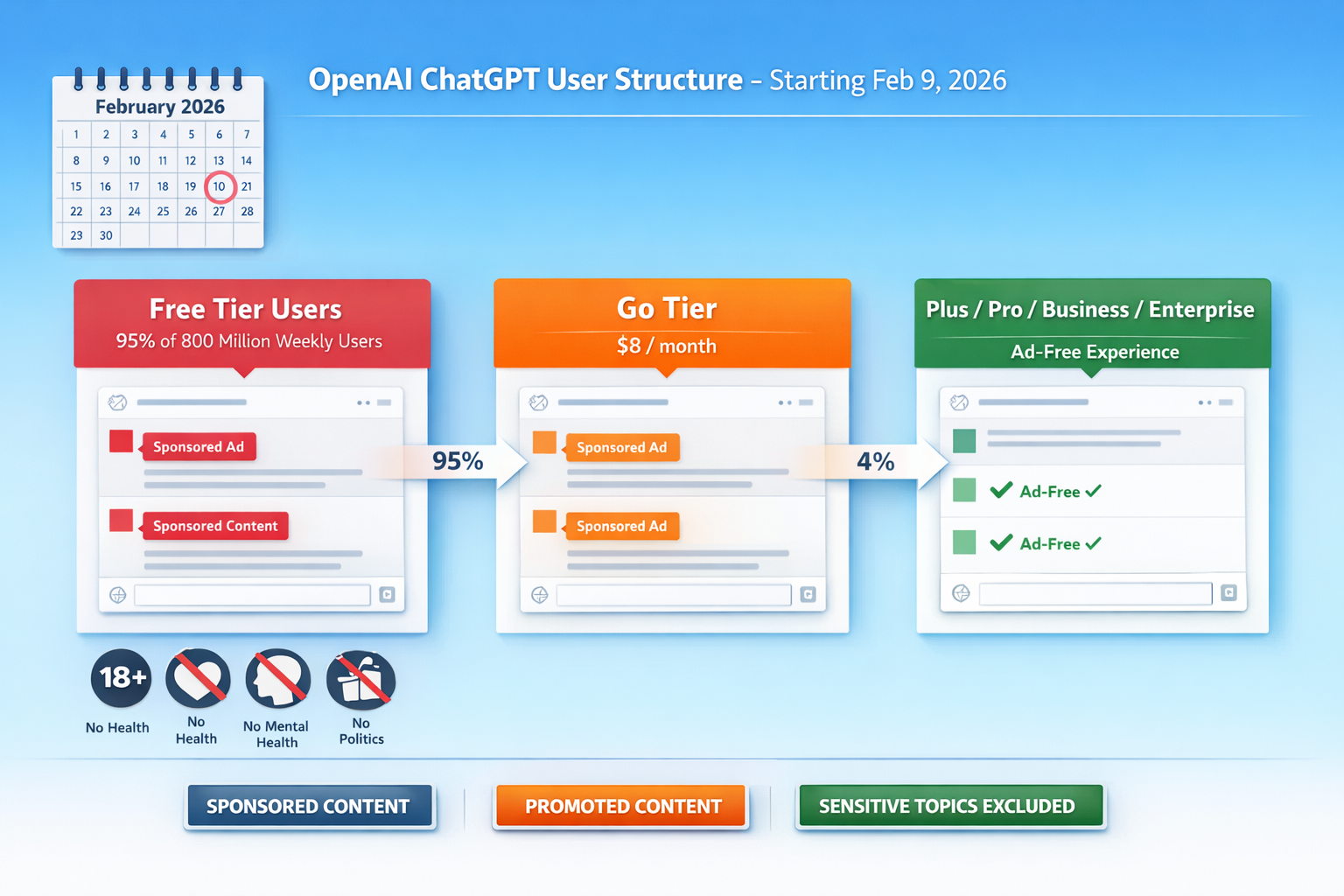
The February 9, 2026 launch marked OpenAI’s first venture into advertising after years of subscription-only revenue models. This strategic pivot reflects the company’s need to diversify income streams while maintaining accessibility for the massive free-tier user base that has driven ChatGPT’s explosive growth.
Who Sees ChatGPT Ads?
The current ad implementation follows a carefully segmented approach:
| User Tier | Monthly Cost | Ad Exposure | Status |
|---|---|---|---|
| Free | $0 | ✅ Yes | Testing in US only |
| Go | $8 | ✅ Yes | Testing in US only |
| Plus | $20 | ❌ No | Completely ad-free |
| Pro | $200 | ❌ No | Completely ad-free |
| Business | Varies | ❌ No | Completely ad-free |
| Enterprise | Varies | ❌ No | Completely ad-free |
| Education | Varies | ❌ No | Completely ad-free |
The Go plan, introduced globally in mid-January 2026, specifically targets users who want enhanced features without the full Plus subscription cost[2]. Its inclusion in the ad-supported tier creates an interesting middle ground that affiliate marketers should understand when targeting different audience segments.
How ChatGPT Ads Appear
OpenAI has implemented several critical safeguards to maintain user experience quality:
- Placement: Ads appear outside ChatGPT’s responses, never embedded within the AI’s answers[1][2][4]
- Labeling: All sponsored content is clearly marked as such, separated visually from organic responses[1][2]
- Influence: OpenAI explicitly guarantees that ads do not affect how ChatGPT answers questions[1][2]
- Dismissal: Users can close ads and provide feedback about why specific ads aren’t relevant[2]
This separation is crucial for affiliate marketers to understand. Unlike traditional search ads that might influence organic results, ChatGPT’s architecture maintains a firewall between sponsored content and AI-generated answers.
The Immediate Implications for Affiliate Marketing Strategies
The introduction of ChatGPT ads fundamentally alters how affiliate marketers should approach AI-powered promotional strategies. For those building affiliate marketing businesses around conversational AI, understanding these changes is non-negotiable.
Three Critical Shifts Affiliate Marketers Must Address
1. Competitive Ad Landscape
Affiliate marketers who previously relied on ChatGPT’s organic recommendations now face direct competition from paid advertisers. If you’ve been promoting products through ChatGPT-optimized content strategies, expect your organic visibility to compete with clearly labeled sponsored placements.
2. User Trust Recalibration
The presence of ads may change how users perceive ChatGPT recommendations. Savvy marketers must double down on transparency and authentic value delivery to maintain credibility in an increasingly commercialized AI environment.
3. Disclosure Complexity
When affiliate content appears alongside ChatGPT ads, the disclosure requirements become layered. Marketers must now navigate both OpenAI’s ad labeling system AND Federal Trade Commission (FTC) affiliate disclosure mandates simultaneously.
“The convergence of AI-generated content and traditional advertising creates unprecedented compliance challenges. Affiliate marketers who fail to adapt their disclosure practices risk regulatory action and permanent trust damage.” – Industry Compliance Expert
OpenAI ChatGPT Ads Post-Launch: Affiliate Compliance Checklist for February 2026 – Core Requirements
Building a compliant affiliate strategy in the post-ChatGPT-ads era requires systematic attention to multiple regulatory frameworks. This comprehensive checklist addresses the most critical compliance areas that successful affiliate marketers must master.
✅ Section 1: FTC Disclosure Compliance
The Federal Trade Commission’s endorsement and disclosure guidelines apply regardless of platform. When promoting affiliate products in or around ChatGPT environments, marketers must:
Mandatory Disclosure Elements:
- Clear and Conspicuous: Disclosures must be impossible to miss, positioned before affiliate links, and written in plain language
- Platform-Appropriate: If promoting through ChatGPT-generated content, disclosures must appear in the same format and medium
- Proximity: Place disclosures immediately adjacent to affiliate claims, not buried in footers or separate pages
- Specificity: Use explicit language like “I earn a commission if you purchase through this link” rather than vague terms like “affiliate relationship”
Action Items:
- Audit all ChatGPT-related promotional content for disclosure placement
- Update disclosure templates to address AI-generated recommendation contexts
- Create platform-specific disclosure variations for different content types
- Document disclosure practices for regulatory compliance records
✅ Section 2: OpenAI Platform-Specific Guidelines
OpenAI’s advertising policies create additional compliance layers beyond general FTC requirements. Affiliate marketers must understand and respect these platform-specific rules:
Prohibited Practices:
- No Conversation Manipulation: Do not attempt to influence ChatGPT’s organic responses to favor affiliate products
- Respect Age-Gating: Never target affiliate content to users under 18 through ChatGPT interfaces[2][4]
- Avoid Sensitive Topics: Do not promote affiliate products related to health, mental health, or political content where ads are prohibited[1][2][4]
- Honor Opt-Outs: Respect users who have opted out of ad personalization when targeting ChatGPT audiences
Compliance Verification:
- Review OpenAI’s official advertising approach documentation[4]
- Monitor updates to OpenAI’s privacy policy regarding advertising[6]
- Establish internal review processes for ChatGPT-adjacent promotional content
✅ Section 3: Data Privacy and User Consent
The intersection of affiliate tracking and ChatGPT’s privacy protections requires careful navigation. OpenAI has implemented strong privacy safeguards that affiliate marketers must respect:
Key Privacy Principles:
- Conversation Confidentiality: User conversations are never shared with advertisers[1][2]
- Aggregate Data Only: Advertisers receive only views and clicks, not individual user data[1][2]
- User Control: Individuals can opt out of personalization and delete ad history[1]
- No Cross-Contamination: Affiliate tracking must not attempt to access ChatGPT conversation data
Implementation Steps:
- Ensure affiliate tracking pixels comply with OpenAI’s data sharing restrictions
- Implement cookie consent mechanisms that respect ChatGPT user privacy preferences
- Create clear privacy policies explaining how affiliate tracking works separately from ChatGPT interactions
- Establish data retention policies that align with user deletion rights
✅ Section 4: Content Authenticity and Transparency
Maintaining authentic, trustworthy content becomes even more critical when ads enter the ChatGPT ecosystem. Affiliate marketers should follow these best practices for affiliate marketing:
Transparency Standards:
- Separate Sponsored from Organic: Clearly distinguish between paid placements and genuine recommendations
- Honest Performance Claims: Never exaggerate product benefits or create false urgency
- Source Attribution: When using ChatGPT to generate affiliate content, consider disclosing AI assistance
- Update Frequency: Regularly review and update affiliate content to ensure accuracy
Trust-Building Tactics:
- Provide genuine value beyond affiliate commissions
- Include both pros and cons in product reviews
- Disclose personal experience (or lack thereof) with promoted products
- Offer non-affiliate alternatives when appropriate
✅ Section 5: Age-Appropriate Content Targeting
OpenAI’s strict age-gating policies prohibit ads to users under 18[2][4]. Affiliate marketers must implement corresponding safeguards:
Age Verification Requirements:
- Content Classification: Tag affiliate content appropriately for age restrictions
- Targeting Restrictions: Avoid promoting age-restricted products through ChatGPT-adjacent channels
- Verification Mechanisms: Implement age gates on landing pages for restricted categories
- Compliance Documentation: Maintain records of age-appropriate targeting practices
Restricted Product Categories:
- Alcohol and tobacco products
- Gambling and betting services
- Adult content and services
- Financial products requiring legal age (credit cards, loans)
- Dietary supplements with age restrictions
✅ Section 6: Sensitive Topic Exclusions
OpenAI prohibits ads near health, mental health, politics, and other sensitive topics[1][2][4]. Affiliate marketers must navigate these restrictions carefully:
Excluded Content Areas:
- Health Products: Medical devices, pharmaceuticals, health supplements
- Mental Health Services: Therapy, counseling, psychiatric services
- Political Content: Campaign materials, political advocacy, partisan content
- Financial Advice: Investment recommendations, financial planning services
- Legal Services: Attorney services, legal representation
Compliant Alternatives:
For marketers in these niches, consider:
- Focusing on educational content rather than direct product promotion
- Building email lists outside ChatGPT for compliant follow-up marketing
- Utilizing alternative affiliate marketing strategies that don’t rely on ChatGPT placement
- Creating comprehensive resource guides that provide value beyond product sales
✅ Section 7: Ongoing Monitoring and Adaptation
The ChatGPT advertising landscape will evolve rapidly throughout 2026. Successful affiliate marketers must commit to continuous compliance monitoring:
Monthly Review Checklist:
- ☑️ Review OpenAI policy updates and announcements
- ☑️ Audit affiliate content for disclosure compliance
- ☑️ Monitor FTC guidance on AI-generated content
- ☑️ Track user feedback and trust signals
- ☑️ Analyze performance data for compliance issues
- ☑️ Update internal compliance documentation
- ☑️ Train team members on new requirements
Quarterly Strategic Assessment:
- Evaluate overall compliance posture
- Review competitor compliance approaches
- Assess emerging regulatory trends
- Update compliance checklists and procedures
- Conduct third-party compliance audits if necessary
Advanced Compliance Strategies for ChatGPT Affiliate Marketing
Beyond the baseline checklist, sophisticated affiliate marketers should implement advanced compliance frameworks that anticipate future regulatory developments.
Building a Compliance-First Content Strategy
Rather than treating compliance as an afterthought, leading marketers are embedding it into their content creation processes:
Pre-Publication Compliance Review:
- Legal Review: Have high-value content reviewed by legal counsel familiar with FTC guidelines
- Disclosure Audit: Verify disclosure placement, language, and prominence
- Privacy Check: Confirm data collection practices align with stated policies
- Platform Compliance: Ensure content respects OpenAI’s advertising policies
- User Experience Test: Verify disclosures are visible across devices and platforms
Leveraging Technology for Compliance Automation
Smart marketers are using technology to scale compliance efforts:
- Automated Disclosure Insertion: Tools that automatically add compliant disclosures to affiliate links
- Compliance Monitoring Software: Systems that flag potential compliance issues before publication
- Privacy Management Platforms: Solutions that handle cookie consent and data deletion requests
- Content Review Workflows: Approval processes that require compliance sign-off before publishing
Those interested in AI marketing automation should explore how these technologies can strengthen compliance while improving efficiency.
Creating a Compliance Documentation System
Regulatory agencies increasingly expect documented compliance efforts. Establish systems to:
- Record Disclosure Decisions: Document why specific disclosure language was chosen
- Track Policy Changes: Maintain a log of OpenAI and FTC policy updates and corresponding adaptations
- Archive Content Versions: Preserve historical versions of affiliate content showing compliance evolution
- Document Training: Keep records of team compliance training and certifications
- Maintain Vendor Agreements: Store contracts with affiliate networks confirming their compliance commitments
Common Compliance Mistakes to Avoid in the ChatGPT Ads Era
Even experienced affiliate marketers are making critical errors as they adapt to ChatGPT’s advertising rollout. Avoid these common affiliate marketing mistakes:
❌ Mistake 1: Assuming ChatGPT’s Ad Labels Replace FTC Disclosures
The Problem: Some marketers believe that because ChatGPT labels ads as “sponsored,” they don’t need separate affiliate disclosures.
The Reality: OpenAI’s ad labels apply to paid placements within ChatGPT. Your affiliate relationship with product vendors requires separate, independent disclosure under FTC guidelines.
The Fix: Always include clear affiliate disclosures regardless of platform ad labeling.
❌ Mistake 2: Using Vague or Buried Disclosures
The Problem: Disclosures hidden in footers, using unclear language like “affiliate partner,” or requiring users to click “more info” links.
The Reality: FTC requires disclosures to be “clear and conspicuous” – immediately visible without additional user action.
The Fix: Place disclosures before affiliate links, use explicit language, and ensure visibility across all devices.
❌ Mistake 3: Ignoring Age-Gating Requirements
The Problem: Promoting age-restricted products without verifying user age or implementing appropriate safeguards.
The Reality: OpenAI prohibits ads to users under 18[2][4], and many affiliate products have legal age restrictions.
The Fix: Implement age verification on landing pages and avoid promoting restricted products through ChatGPT-adjacent channels.
❌ Mistake 4: Attempting to Manipulate ChatGPT Responses
The Problem: Using prompt engineering or other tactics to make ChatGPT recommend specific affiliate products.
The Reality: This violates OpenAI’s policies and potentially constitutes deceptive marketing under FTC guidelines.
The Fix: Focus on creating valuable content that earns organic recommendations rather than attempting to game the system.
❌ Mistake 5: Neglecting Privacy Policy Updates
The Problem: Failing to update privacy policies to reflect affiliate tracking practices in ChatGPT-adjacent contexts.
The Reality: Privacy regulations require clear disclosure of data collection and sharing practices.
The Fix: Review and update privacy policies to address affiliate tracking, cookie usage, and data sharing with affiliate networks.
Industry-Specific Compliance Considerations
Different affiliate niches face unique compliance challenges in the ChatGPT advertising era:
Technology and Software Affiliates
- Disclosure Timing: Reveal affiliate relationships before users click download or purchase links
- Feature Accuracy: Ensure ChatGPT-adjacent content accurately represents software capabilities
- Pricing Transparency: Clearly disclose if affiliate links lead to special pricing or if commissions affect recommendations
E-Commerce and Physical Products
- Product Claims: Verify all performance claims can be substantiated
- Return Policies: Clearly communicate vendor return policies and affiliate commission implications
- Shipping Disclosures: Inform users about shipping costs and delivery timeframes
Digital Products and Courses
- Income Claims: Follow FTC guidelines on earnings representations (avoid “get rich quick” language)
- Refund Policies: Clearly communicate refund terms and how they affect affiliate commissions
- Course Content: Accurately represent what’s included in promoted educational products
For those exploring high-ticket affiliate marketing, compliance becomes even more critical due to higher transaction values and increased regulatory scrutiny.
Building Long-Term Trust in an Ad-Supported AI Environment
The ultimate compliance strategy is building genuine trust that transcends regulatory requirements. As ChatGPT becomes increasingly commercialized, users will gravitate toward marketers who demonstrate authentic value and transparency.
Trust-Building Principles
1. Value-First Mindset: Prioritize helping users solve problems over maximizing commission revenue
2. Radical Transparency: Disclose not just what’s required, but what users would want to know
3. Authentic Experience: Only promote products you’ve genuinely used or thoroughly researched
4. Balanced Recommendations: Include non-affiliate alternatives and competitor comparisons
5. Responsive Communication: Address user questions and concerns promptly and honestly
Measuring Trust and Compliance Health
Track these metrics to assess your compliance and trust-building effectiveness:
- Disclosure Visibility Rate: Percentage of users who view disclosures before clicking affiliate links
- Return Visitor Rate: Users who return after initial affiliate interactions (trust indicator)
- Complaint Volume: User complaints about disclosure clarity or product misrepresentation
- Conversion Quality: Refund rates and customer satisfaction scores for affiliate sales
- Engagement Metrics: Time on page, scroll depth, and content interaction rates
Preparing for Future Regulatory Developments
The ChatGPT advertising rollout is just the beginning. Affiliate marketers should anticipate several regulatory developments throughout 2026 and beyond:
Likely Regulatory Trends
1. AI-Specific Disclosure Requirements: Regulators may mandate specific disclosures when AI tools are used to generate affiliate content
2. Enhanced Privacy Protections: Expect stricter data privacy regulations affecting affiliate tracking and personalization
3. Platform Accountability: Platforms like ChatGPT may face increased responsibility for third-party advertising compliance
4. International Harmonization: Global regulatory frameworks may converge around common AI advertising standards
5. Algorithmic Transparency: Potential requirements to disclose how AI algorithms select or prioritize affiliate recommendations
Staying Ahead of Compliance Curves
Position your affiliate business to adapt quickly:
- Join Industry Associations: Participate in affiliate marketing organizations that track regulatory developments
- Engage Legal Counsel: Establish relationships with attorneys specializing in advertising and AI law
- Monitor Regulatory Agencies: Follow FTC, state attorney general, and international regulator announcements
- Implement Flexible Systems: Build compliance frameworks that can quickly adapt to new requirements
- Document Everything: Maintain thorough records demonstrating good-faith compliance efforts
Practical Implementation: Your 30-Day Compliance Action Plan
Transform this checklist into action with a structured 30-day implementation plan:
Week 1: Assessment and Audit
- Days 1-2: Review all current affiliate content for disclosure compliance
- Days 3-4: Audit privacy policies and data collection practices
- Days 5-7: Assess current ChatGPT-related marketing strategies and identify compliance gaps
Week 2: Policy and Procedure Development
- Days 8-10: Create or update disclosure templates for different content types
- Days 11-12: Develop internal compliance review procedures
- Days 13-14: Update privacy policies to address affiliate tracking and ChatGPT interactions
Week 3: Content Updates and Training
- Days 15-18: Update existing content with compliant disclosures
- Days 19-20: Train team members on new compliance requirements
- Day 21: Implement compliance review workflows for new content
Week 4: Monitoring and Optimization
- Days 22-24: Set up compliance monitoring systems and metrics
- Days 25-27: Test disclosure visibility across devices and platforms
- Days 28-30: Review implementation results and refine procedures
Resources and Tools for Ongoing Compliance
Equip yourself with the right resources to maintain compliance:
Essential Reading
- FTC Endorsement Guides: Official guidelines on affiliate disclosures
- OpenAI Advertising Approach: Platform-specific policies[4]
- OpenAI Privacy Policy: Data handling and user rights[6]
- State-specific advertising regulations for your jurisdiction
Recommended Tools
- Disclosure Management: Automated disclosure insertion plugins
- Privacy Compliance: Cookie consent and privacy management platforms
- Content Review: Workflow tools with compliance checkpoints
- Monitoring: Compliance tracking and alerting systems
Professional Support
- Legal Counsel: Attorneys specializing in advertising and affiliate marketing law
- Compliance Consultants: Experts who can audit and improve compliance programs
- Industry Associations: Organizations providing compliance training and updates
- Peer Networks: Communities of affiliate marketers sharing compliance best practices
Those seeking comprehensive training should explore affiliate marketing courses that incorporate compliance education.
Conclusion: Thriving Through Compliance in the ChatGPT Advertising Era
The OpenAI ChatGPT Ads Post-Launch: Affiliate Compliance Checklist for February 2026 represents more than a regulatory burden—it’s an opportunity to differentiate through trust and transparency. As ChatGPT’s advertising ecosystem matures throughout 2026, affiliate marketers who embrace compliance as a competitive advantage will build sustainable, profitable businesses while others struggle with regulatory challenges and user trust erosion.
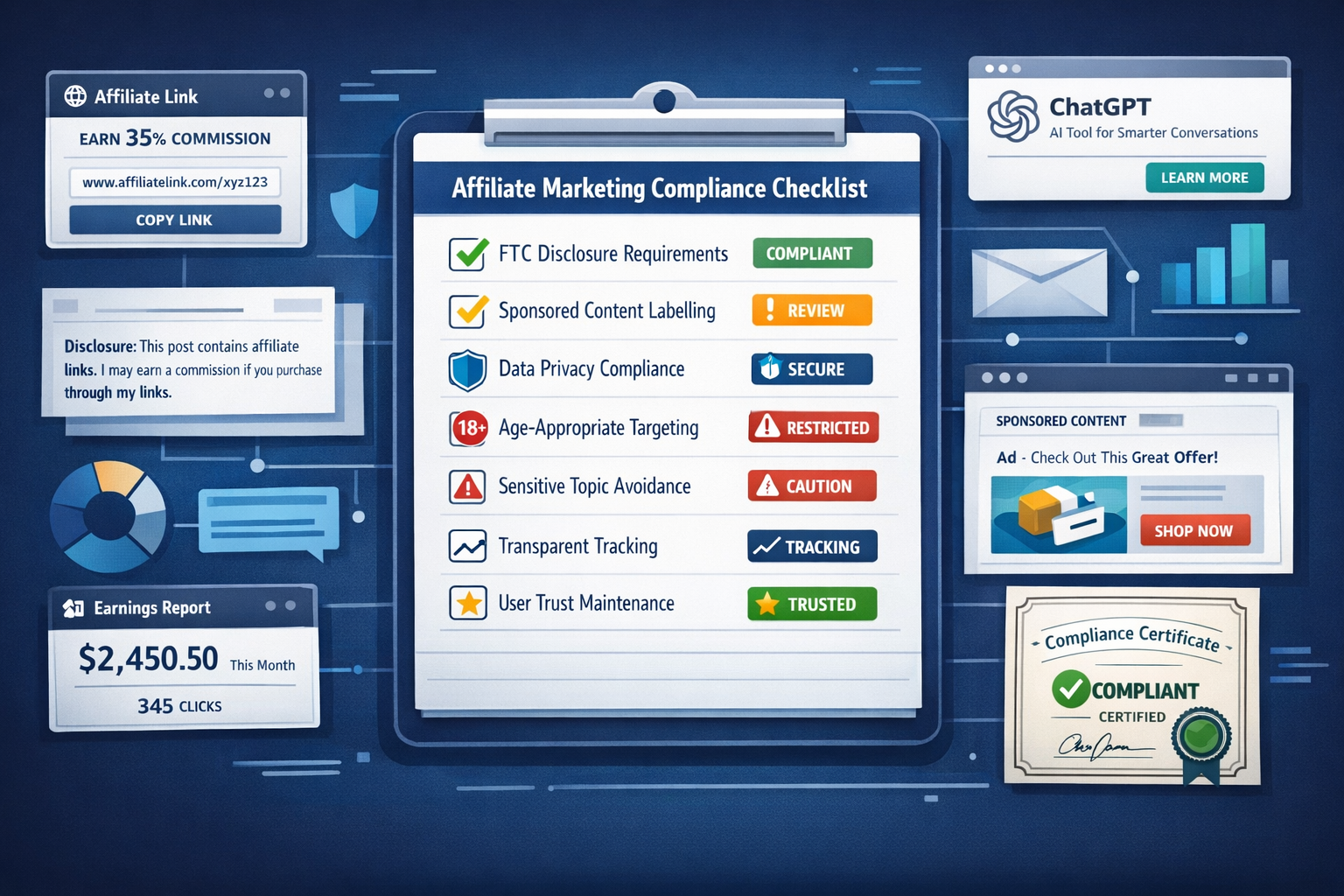
The seven core compliance areas—FTC disclosures, OpenAI platform guidelines, data privacy, content authenticity, age-appropriate targeting, sensitive topic exclusions, and ongoing monitoring—create a comprehensive framework for navigating this new landscape. By implementing systematic compliance processes, leveraging automation technology, and prioritizing genuine user value, affiliate marketers can capitalize on ChatGPT’s massive reach while maintaining regulatory compliance and user trust.
Your Next Steps
Take action today to secure your affiliate business in the ChatGPT advertising era:
- Complete the 30-day compliance action plan outlined above
- Audit your current content using the seven-section checklist
- Update your disclosure templates to meet current FTC and OpenAI requirements
- Implement monitoring systems to track compliance health metrics
- Join professional communities to stay informed about regulatory developments
- Consider legal review of high-value affiliate campaigns
- Document your compliance efforts to demonstrate good-faith practices
The convergence of AI and advertising creates unprecedented opportunities for affiliate marketers willing to navigate compliance complexities with diligence and integrity. By treating compliance as a foundational business practice rather than an afterthought, you’ll build an affiliate marketing operation positioned for long-term success regardless of how the ChatGPT advertising landscape evolves.
The future of affiliate marketing in the AI era belongs to those who can balance innovation with responsibility, automation with authenticity, and profit with principle. Start implementing your compliance framework today, and transform regulatory requirements into your competitive advantage.
References
[1] Openai Launches Ads In Chatgpt Amid Industry Shift 528610 – https://evrimagaci.org/gpt/openai-launches-ads-in-chatgpt-amid-industry-shift-528610
[2] Chatgpt Rolls Out Ads – https://techcrunch.com/2026/02/09/chatgpt-rolls-out-ads/
[3] Openai Chatgpt Advertising Strategy 2026 – https://almcorp.com/blog/openai-chatgpt-advertising-strategy-2026/
[4] Our Approach To Advertising And Expanding Access – https://openai.com/index/our-approach-to-advertising-and-expanding-access/
[5] akronlegalnews – https://www.akronlegalnews.com/editorial/37794
[6] Us Privacy Policy – https://openai.com/policies/us-privacy-policy/
[7] Watch – https://www.youtube.com/watch?v=H7NJ1M1Udds
[8] Chatgpt Ads – https://proton.me/blog/chatgpt-ads
[9] Openai Joins The Ad Race What Chatgpts Monetisation Shift Means For Affiliate Marketing – https://www.affiversemedia.com/openai-joins-the-ad-race-what-chatgpts-monetisation-shift-means-for-affiliate-marketing/
