

The landscape of affiliate marketing transformed overnight when OpenAI began testing advertisements in ChatGPT during February 2026. For affiliate marketers who built their strategies around trust and transparency, this shift raises critical questions: How do you maintain ethical standards when AI platforms mediate your recommendations? What happens to disclosure requirements when sponsored content appears in conversational AI responses? The Post-ChatGPT Ads Era: Affiliate Compliance Strategies After OpenAI’s February 2026 Rollout demands a complete rethinking of how affiliates approach transparency, trust, and regulatory compliance.
This seismic shift isn’t just about new advertising opportunities—it’s about preserving the foundation of affiliate marketing while adapting to AI-mediated recommendations. With OpenAI testing ads specifically for free tier and ChatGPT Go plan users[9], affiliate marketers must navigate uncharted territory where traditional disclosure methods may no longer suffice.
Key Takeaways
- 🎯 OpenAI launched ChatGPT ads testing in February 2026 for free and Go tier users aged 18+, using clearly labeled “sponsored” messages[9]
- ✅ Affiliate compliance now requires dual-layer transparency: traditional FTC disclosures plus AI-specific trust indicators
- 📋 New disclosure frameworks must account for conversational AI contexts where traditional banner disclaimers don’t translate
- 🔍 Trust implications extend beyond legal compliance to maintaining audience confidence in AI-mediated affiliate recommendations
- 🚀 Proactive compliance strategies separate successful affiliates from those facing regulatory scrutiny and audience backlash
Understanding the February 2026 ChatGPT Ads Rollout
What Changed in OpenAI’s Advertising Approach
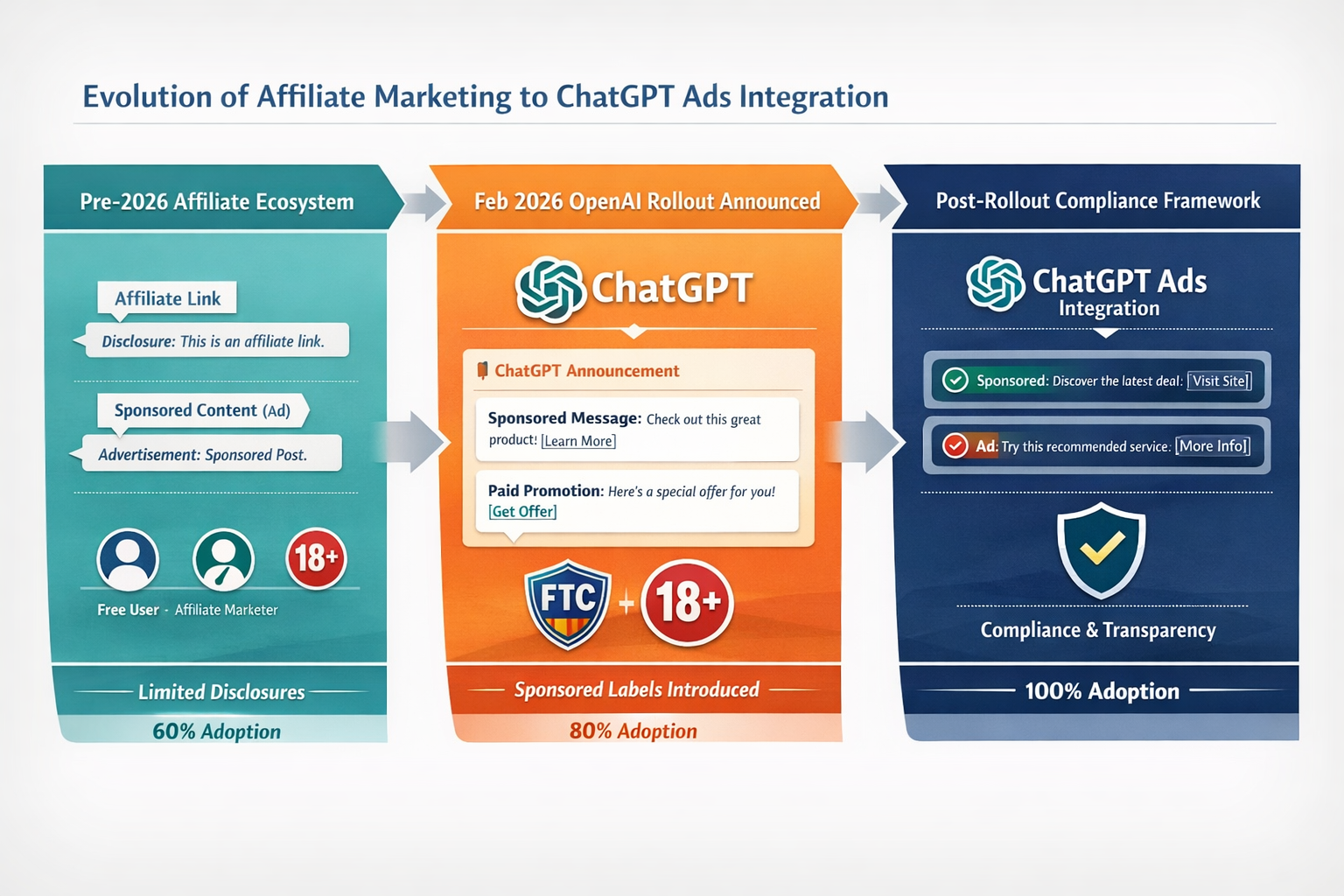
OpenAI’s February 2026 rollout marked a pivotal moment in AI monetization. The company began testing advertisements within ChatGPT conversations, targeting specific user segments with labeled sponsored content[9]. Unlike traditional display advertising, these ads integrate directly into AI-generated responses, creating a fundamentally different user experience.
The rollout specifically targets:
- Free tier users who access ChatGPT without paid subscriptions
- ChatGPT Go plan subscribers in the United States
- Users aged 18 and older exclusively[9]
This age restriction demonstrates OpenAI’s awareness of regulatory sensitivities around advertising to younger audiences. The company employs clearly labeled “sponsored” messages rather than attempting to blend advertisements seamlessly into organic responses[3].
The Revenue Model Behind ChatGPT Ads
OpenAI’s strategic pivot toward advertising reflects broader industry trends. The company seeks to establish “a Meta-style revenue engine”[5], diversifying beyond subscription-based income. This approach mirrors how social media platforms evolved from purely user-supported models to advertising-driven ecosystems.
For affiliate marketers, this creates both opportunities and challenges. The conversational nature of ChatGPT means affiliate recommendations could appear more natural and contextually relevant than traditional banner ads. However, this same naturalness raises ethical questions about the adequacy of disclosure and user awareness.
Understanding what affiliate marketing truly means becomes even more critical in this AI-mediated environment, where the lines between organic recommendations and paid promotions can blur.
Trust Implications for Affiliate Marketers in the Post-ChatGPT Ads Era
How AI-Mediated Recommendations Affect Credibility
The introduction of ads into ChatGPT fundamentally alters the trust equation for affiliate marketers. When users interact with AI assistants, they often perceive responses as objective, algorithm-driven suggestions rather than commercially motivated recommendations. This perception creates a trust paradox: AI recommendations may carry more weight than traditional affiliate content, but sponsored AI responses risk greater backlash if users feel deceived.
Consider these trust implications:
| Traditional Affiliate Marketing | AI-Mediated Affiliate Marketing |
|---|---|
| Clear visual separation between content and ads | Integrated conversational responses |
| Established disclosure conventions | Emerging disclosure standards |
| User expects commercial intent | User may assume objectivity |
| Trust built through consistent transparency | Trust depends on platform credibility |
The Post-ChatGPT Ads Era: Affiliate Compliance Strategies After OpenAI’s February 2026 Rollout must address this fundamental shift. Affiliates can no longer rely solely on traditional disclosure methods designed for blog posts and social media.
Regulatory Scrutiny and Policymaker Expectations
Policymakers are closely monitoring OpenAI’s advertising approach, with expectations for clearer guidance as testing expands[3]. This regulatory attention signals that compliance frameworks will likely tighten rather than relax.
The Federal Trade Commission (FTC) has long required clear and conspicuous disclosures for affiliate relationships. In AI contexts, “clear and conspicuous” takes on new meaning:
- Proximity: Disclosures must appear within the AI response itself, not buried in platform’s terms of service
- Clarity: Language must be immediately understandable in conversational contexts
- Prominence: Sponsored labels must be visually distinct from organic content
Affiliate marketers who understand proven strategies know that compliance isn’t just about avoiding penalties—it’s about building sustainable businesses on foundations of trust.
Compliance Frameworks for the Post-ChatGPT Ads Era: Affiliate Compliance Strategies After OpenAI’s February 2026 Rollout
FTC Disclosure Standards in AI Contexts
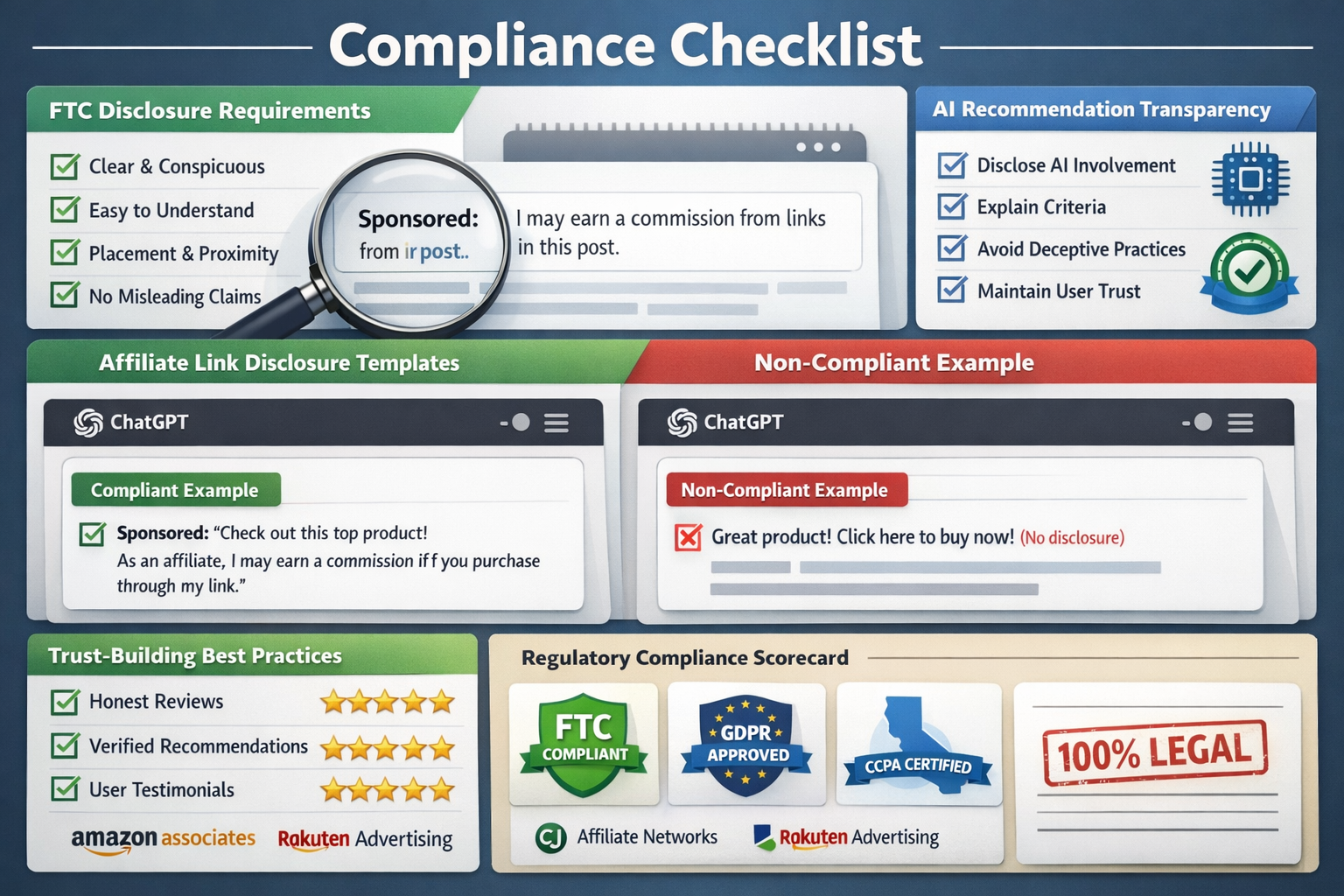
The FTC’s Endorsement Guides apply to AI-mediated recommendations just as they do to traditional content. However, implementation requires adaptation to conversational interfaces. Key requirements include:
✅ Material Connection Disclosure
Affiliates must disclose any material connection between themselves and recommended products. In ChatGPT contexts, this means:
- Explicitly stating affiliate relationships within AI responses
- Using clear language like “This recommendation includes affiliate links” rather than vague terms
- Ensuring disclosures appear before users click through to products
✅ Proximity and Placement
Disclosures must be impossible to miss. In conversational AI:
- Place disclosures at the beginning of product recommendations
- Repeat disclosures if conversations span multiple messages
- Don’t rely on users reading platform-wide disclosure policies
✅ Clear and Unambiguous Language
Avoid industry jargon or technical terms. Instead of “This content may be monetized through affiliate partnerships,” use “I earn commissions from purchases made through these links.”
For those exploring how to do affiliate marketing in 2026, these disclosure standards represent the baseline, not the ceiling.
Platform-Specific Compliance Considerations
OpenAI’s use of labeled “sponsored” messages[3] provides a foundation, but affiliates must go further. Platform-specific considerations include:
For ChatGPT Free Tier Ads:
- Understand that users may be less familiar with advertising in AI contexts
- Provide additional context about how recommendations are generated
- Clearly distinguish between organic AI responses and sponsored content
For ChatGPT Go Plan Ads:
- Recognize that paying users may have higher expectations for transparency
- Ensure premium positioning doesn’t obscure commercial relationships
- Maintain consistent disclosure standards across all user tiers
Cross-Platform Consistency:
If you’re promoting affiliate products across multiple AI platforms, maintain consistent disclosure language. This builds recognition and reinforces transparency.
Actionable Compliance Checklists for Affiliate Marketers
Pre-Launch Compliance Checklist
Before launching any affiliate campaign in the Post-ChatGPT Ads Era, complete this comprehensive checklist:
📋 Legal Foundation
- Review current FTC Endorsement Guides for affiliate marketing
- Consult with legal counsel familiar with AI advertising regulations
- Document your compliance procedures for audit purposes
- Create standardized disclosure templates for AI contexts
📋 Disclosure Preparation
- Draft clear, conversational disclosure language
- Test disclosure visibility across different devices and interfaces
- Ensure disclosures appear in all relevant AI responses
- Create backup disclosure methods if primary methods fail
📋 Partner Verification
- Verify that affiliate programs allow AI-mediated promotions
- Review partner terms of service for AI-specific restrictions
- Confirm commission tracking works with AI-generated links
- Establish communication channels with affiliate managers
📋 Transparency Documentation
- Create public-facing transparency statements
- Document all affiliate relationships in accessible locations
- Prepare responses to user questions about commercial relationships
- Establish processes for updating disclosures as relationships change
Those working in affiliate marketing programs should treat this checklist as a living document, updating it as regulations and platform policies evolve.
Ongoing Monitoring and Adjustment Checklist
Compliance isn’t a one-time effort. Implement these ongoing practices:
🔍 Monthly Compliance Audits
- Review all active affiliate promotions for proper disclosures
- Check that disclosure language remains current with regulations
- Verify that affiliate links function correctly and track properly
- Document any compliance issues and remediation steps
🔍 Quarterly Regulatory Reviews
- Monitor FTC guidance updates related to AI advertising
- Review platform policy changes from OpenAI and other AI providers
- Assess industry best practices from compliance leaders
- Update disclosure templates based on new guidance
🔍 Continuous User Feedback
- Monitor user questions about affiliate relationships
- Track user sentiment regarding disclosure adequacy
- Collect feedback on disclosure clarity and visibility
- Adjust disclosure approaches based on user comprehension
🔍 Performance vs. Compliance Balance
- Track conversion rates before and after disclosure implementations
- Measure trust indicators (repeat engagement, referrals)
- Identify compliance approaches that maintain or improve performance
- Share successful compliance strategies with industry peers
Professionals exploring affiliate marketing opportunities in the AI era must recognize that compliance excellence becomes a competitive advantage, not merely a legal obligation.
Building Trust Through Transparency in AI-Mediated Recommendations
Disclosure Best Practices That Maintain Performance
Many affiliates fear that prominent disclosures will tank conversion rates. Research and experience suggest the opposite: transparent affiliates build more sustainable, profitable businesses. Here’s how to implement disclosures that strengthen rather than weaken your affiliate performance:
💡 Front-Load Transparency
Begin product recommendations with clear affiliate disclosures. Example:
“Full disclosure: I earn commissions from purchases made through these links. That said, I only recommend products I’ve personally vetted and believe will genuinely help you.”
This approach:
- Establishes trust immediately
- Frames the commercial relationship positively
- Emphasizes genuine value over pure profit motive
💡 Explain Your Selection Criteria
Help users understand how you choose affiliate products:
“I evaluate affiliate products based on three criteria: proven results, ethical business practices, and value for money. I turn down partnerships that don’t meet these standards, even when commissions are high.”
💡 Provide Non-Affiliate Alternatives
Demonstrate objectivity by including non-monetized options:
“While I have affiliate relationships with Options A and B, Option C is also excellent—though I don’t earn commissions from it. Choose based on your specific needs, not my compensation structure.”
This level of transparency, while seemingly counterintuitive, builds the kind of trust that generates long-term revenue. Those learning how to become an affiliate marketer should internalize this principle from day one.
Trust Indicators Beyond Legal Compliance
Legal compliance represents the minimum standard. Trust leaders go further by implementing these advanced transparency practices:
🌟 Transparency Reports
Publish regular reports detailing:
- Total affiliate revenue earned
- Percentage of recommendations that are monetized
- Affiliate partnerships you’ve declined and why
- Changes to your affiliate relationships
🌟 Independent Product Testing
Document your product evaluation process:
- Share testing methodologies
- Publish both positive and negative findings
- Update recommendations when products change
- Acknowledge when competitors offer superior solutions
🌟 User-First Policies
Implement and publicize policies that prioritize users:
- Money-back guarantees for recommended products
- Assistance with refunds if products underperform
- Regular check-ins with users who purchase through your links
- Willingness to recommend against purchases when inappropriate
🌟 AI-Specific Trust Signals
In ChatGPT and similar platforms:
- Clearly label AI-generated vs. human-curated recommendations
- Explain how AI systems select affiliate products
- Provide transparency about data used in recommendations
- Offer human override options for AI suggestions
Navigating Specific Compliance Challenges in the Post-ChatGPT Ads Era
Challenge 1: Disclosure Visibility in Conversational Interfaces
Traditional affiliate disclosures rely on visual hierarchy—bold text, prominent placement, contrasting colors. Conversational AI interfaces present different challenges:
The Problem:
In text-based conversations, users may skim responses, missing disclosures buried mid-paragraph or at the end of lengthy explanations.
The Solution:
- Lead with disclosures: Place affiliate disclaimers in the first sentence of product recommendations
- Use formatting strategically: Even in text interfaces, formatting like bold text or CAPITALIZATION can draw attention
- Repeat when necessary: If a conversation involves multiple product mentions, repeat disclosures for each
- Provide visual breaks: Use line breaks or separators to make disclosures stand out
Example Implementation:
❌ Poor disclosure: “Here are three great productivity tools for your business… [lengthy descriptions]… By the way, I may earn commissions from these recommendations.”
✅ Strong disclosure: “AFFILIATE DISCLOSURE: I earn commissions from the following recommendations.
Here are three productivity tools I’ve personally tested…”
Challenge 2: Multi-Turn Conversation Disclosure Requirements
ChatGPT conversations often span multiple exchanges. Users may enter mid-conversation or forget earlier context. This creates disclosure challenges:
The Problem:
A user asks for product recommendations in message 1, receives disclosures in message 2, then asks follow-up questions in messages 5-10. Do you need to repeat disclosures?
The Solution:
- Initial disclosure: Provide comprehensive disclosure with the first product recommendation
- Reminder disclosures: Include brief reminders in subsequent messages (“As mentioned, these are affiliate recommendations”)
- Context-aware repetition: Repeat full disclosures if conversation topic shifts significantly
- Session-based approach: Treat each conversation session as requiring fresh disclosures
Best Practice Framework:
- Message 1 (user): “What’s the best email marketing tool?”
- Message 2 (affiliate): [FULL DISCLOSURE] + recommendation
- Message 3 (user): “How does it compare to [competitor]?”
- Message 4 (affiliate): [BRIEF REMINDER] + comparison
- Message 10 (user): “What about project management tools?”
- Message 11 (affiliate): [FULL DISCLOSURE] + new category recommendations
Challenge 3: Balancing Compliance with User Experience
Over-disclosure can frustrate users and diminish the value of AI assistance. Finding the balance requires nuance:
The Problem:
Users engage with ChatGPT for quick, helpful answers. Lengthy legal disclaimers may feel like obstacles rather than transparency.
The Solution:
- Concise core disclosures: Keep primary disclosures to 1-2 sentences
- Layered transparency: Provide brief disclosures inline, with links to detailed transparency policies
- Value-first framing: Position disclosures as part of providing honest, valuable recommendations
- User control: Allow users to request more or less disclosure detail based on preferences
Disclosure Hierarchy:
- Level 1 (Always present): “I earn commissions from these recommendations.”
- Level 2 (Available on request): Detailed explanation of affiliate relationships, selection criteria, and alternatives
- Level 3 (Comprehensive): Full transparency report, testing methodologies, and partnership details
Those exploring affiliate marketing niches will find that some niches (finance, health) require more extensive disclosures than others due to regulatory requirements and user expectations.
Industry-Specific Compliance Considerations
High-Stakes Niches: Finance, Health, and Legal
Certain affiliate niches face heightened regulatory scrutiny. In the Post-ChatGPT Ads Era: Affiliate Compliance Strategies After OpenAI’s February 2026 Rollout, these sectors require additional precautions:
💰 Financial Products
- Disclose material connections AND provide risk warnings
- Include disclaimers about investment risks and potential losses
- Verify that you’re legally permitted to provide financial recommendations
- Consider whether AI-mediated financial advice triggers additional licensing requirements
🏥 Health and Wellness
- Clearly state that recommendations don’t constitute medical advice
- Disclose affiliate relationships before health product recommendations
- Provide scientific backing for product claims
- Include warnings about consulting healthcare professionals
⚖️ Legal Services
- Clarify that affiliate content isn’t legal advice
- Disclose jurisdictional limitations
- Recommend professional consultation for specific situations
- Verify bar association rules regarding legal service advertising
E-commerce and Physical Products
Standard e-commerce affiliate marketing faces fewer regulatory hurdles but still requires robust compliance:
📦 Product Reviews and Comparisons
- Disclose whether you’ve personally used or reviewed products
- Distinguish between hands-on testing and research-based reviews
- Update reviews when products change significantly
- Acknowledge both strengths and weaknesses
🛍️ Seasonal and Promotional Content
- Ensure disclosures remain visible during high-traffic periods
- Verify that promotional urgency doesn’t obscure affiliate relationships
- Maintain disclosure standards even in time-sensitive recommendations
Technology and Tools for Compliance Management
Automated Disclosure Systems
As AI advertising scales, manual compliance management becomes impractical. Consider these technological solutions:
🤖 Disclosure Automation Tools
- Systems that automatically append disclosures to affiliate content
- Template libraries with pre-approved disclosure language
- Version control for tracking disclosure updates
- Multi-platform deployment for consistent disclosures
🤖 Compliance Monitoring Software
- Automated audits of affiliate content for disclosure presence
- Link tracking systems that verify disclosure proximity
- Alert systems for missing or inadequate disclosures
- Compliance reporting for regulatory documentation
🤖 AI-Powered Compliance Assistants
Ironically, AI can help manage AI advertising compliance:
- Natural language processing to assess disclosure clarity
- Automated regulatory update monitoring
- Compliance gap identification in existing content
- Recommendation engines for disclosure optimization
Documentation and Record-Keeping Systems
Robust documentation protects against regulatory challenges:
📁 Essential Records to Maintain
- Complete history of all affiliate partnerships
- Timestamped copies of all disclosures used
- Communication logs with affiliate partners
- Compliance audit results and remediation actions
- User feedback regarding disclosure adequacy
- Legal consultations and compliance reviews
📁 Retention Policies
- Maintain records for a minimum 5 years (longer for high-stakes niches)
- Implement secure, searchable storage systems
- Create redundant backups of compliance documentation
- Establish clear access controls for sensitive records
Future-Proofing Your Affiliate Compliance Strategy
Anticipating Regulatory Evolution
The regulatory landscape for AI advertising will evolve rapidly. Position yourself ahead of changes:
🔮 Likely Regulatory Developments
- Platform-specific disclosure requirements: Different AI platforms may mandate specific disclosure formats
- Enhanced transparency reporting: Regulators may require detailed affiliate relationship disclosures
- AI-specific endorsement guides: FTC may issue guidance specifically for AI-mediated recommendations
- International harmonization: Global standards may emerge for AI advertising compliance
🔮 Proactive Preparation Strategies
- Exceed current requirements to build compliance buffers
- Participate in industry associations shaping best practices
- Monitor regulatory proceedings related to AI advertising
- Build relationships with compliance-focused legal counsel
Building a Compliance-First Culture
Long-term success requires embedding compliance into organizational DNA:
🏆 Leadership Commitment
- Make compliance a core business value, not an afterthought
- Allocate adequate resources for compliance infrastructure
- Celebrate compliance excellence, not just revenue metrics
- Hold team members accountable for compliance standards
🏆 Training and Education
- Provide regular compliance training for all team members
- Create accessible compliance resources and guidelines
- Encourage questions and proactive compliance discussions
- Share compliance success stories and lessons learned
🏆 Stakeholder Transparency
- Communicate compliance commitments to users
- Share compliance challenges and solutions publicly
- Engage with regulatory bodies constructively
- Contribute to industry-wide compliance improvements
Those considering affiliate marketing jobs should prioritize employers who demonstrate genuine compliance commitments, as this indicates business sustainability and ethical operations.
Case Studies: Compliance Approaches in Early ChatGPT Ads Testing
Early Adopter Lessons
While specific case studies from the February 2026 rollout are still emerging, early patterns reveal instructive approaches:
📊 Approach 1: Maximum Transparency
Some affiliates implemented extensive disclosures, including:
- Detailed affiliate relationship explanations
- Transparent commission structure sharing
- Non-affiliate alternative recommendations
- Regular transparency report publishing
Results: Higher trust metrics, strong user retention, slightly lower initial conversion rates that improved over time as trust compounded.
📊 Approach 2: Minimum Compliance
Other affiliates met legal requirements but avoided additional transparency:
- Brief, legally sufficient disclosures
- Focus on conversion optimization
- Limited explanation of selection criteria
Results: Higher initial conversion rates, increased user complaints, regulatory inquiries, and declining long-term performance.
📊 Approach 3: Hybrid Model
The most successful early adopters balanced compliance with user experience:
- Clear, concise primary disclosures
- Layered transparency for interested users
- Value-focused framing of affiliate relationships
- Continuous compliance improvement based on feedback
Results: Strong conversion rates, high trust scores, minimal regulatory concerns, sustainable growth trajectory.
Strategic Recommendations for Different Affiliate Business Models
Content Publishers and Bloggers
For affiliates who create long-form content, now integrating with AI platforms:
✅ Adaptation Strategies
- Repurpose existing content with AI-appropriate disclosures
- Create AI-specific content versions with conversational disclosures
- Implement consistent disclosure language across all platforms
- Monitor how AI platforms surface your affiliate content
✅ Disclosure Integration
- Add structured data markup for AI platforms to recognize disclosures
- Create disclosure templates optimized for AI extraction
- Test how various AI platforms display your content and disclosures
- Adjust disclosure placement based on AI rendering
Social Media Affiliates
Social media affiliates face unique challenges as AI platforms integrate social content:
✅ Platform-Specific Approaches
- Adapt hashtag-based disclosures (#ad, #affiliate) for AI contexts
- Ensure disclosures remain visible when AI platforms summarize social posts
- Create AI-readable disclosure formats that complement visual disclosures
- Monitor how AI assistants reference your social affiliate content
Email Marketers
Email affiliates must consider how AI assistants interact with email content:
✅ Email-AI Integration
- Include disclosures in email subject lines when appropriate
- Ensure disclosures appear in email preview text
- Test how AI email assistants summarize your affiliate messages
- Create plain-text disclosure versions for AI parsing
📚 Related Reading
For a comprehensive overview, see our authoritative guide: AI answer engines vs traditional search.
Conclusion: Thriving in the Post-ChatGPT Ads Era Through Compliance Excellence
The Post-ChatGPT Ads Era: Affiliate Compliance Strategies After OpenAI’s February 2026 Rollout represents both a challenge and an opportunity for affiliate marketers. OpenAI’s introduction of labeled sponsored messages[3][9] signals the beginning of a fundamental transformation in how affiliate recommendations reach audiences.
Success in this new landscape requires moving beyond viewing compliance as a legal obligation and embracing it as a competitive advantage. Affiliates who build trust through exceptional transparency will capture the most valuable asset in AI-mediated marketing: user confidence in an environment where skepticism is the default.
Actionable Next Steps
Immediate Actions (This Week):
- Audit all current affiliate content for AI-appropriate disclosures
- Create disclosure templates optimized for conversational interfaces
- Document all affiliate relationships for compliance records
- Review FTC guidelines and platform policies for AI advertising
Short-Term Actions (This Month):
- Implement automated disclosure systems for scalable compliance
- Establish compliance monitoring and audit procedures
- Consult with legal counsel on AI-specific compliance requirements
- Develop transparency reports for public disclosure
Long-Term Actions (This Quarter):
- Build a compliance-first culture within your organization
- Participate in industry discussions shaping AI advertising standards
- Develop advanced trust indicators beyond minimum compliance
- Create systems for continuous compliance improvement
The affiliates who will thrive in the Post-ChatGPT Ads Era are those who recognize that transparency isn’t a barrier to success—it’s the foundation. As AI platforms like ChatGPT become primary information sources, users will gravitate toward affiliates who demonstrate an unwavering commitment to honest, compliant, user-first recommendations.
The February 2026 rollout marks just the beginning. The strategies you implement today will determine whether you’re positioned as a trust leader or struggling to catch up as regulations tighten and user expectations rise. Choose transparency, embrace compliance excellence, and build the sustainable affiliate business that thrives regardless of platform changes or regulatory evolution.
For those ready to implement these strategies, exploring comprehensive affiliate marketing strategies provides additional frameworks for building compliant, profitable affiliate businesses in the AI era.
References
[1] Openai – https://releasebot.io/updates/openai
[2] 6825453 Chatgpt Release Notes – https://help.openai.com/en/articles/6825453-chatgpt-release-notes
[3] Chatgpt 2026 Latest Features – https://www.gend.co/blog/chatgpt-2026-latest-features
[4] Retiring Gpt 4o And Older Models – https://openai.com/index/retiring-gpt-4o-and-older-models/
[5] Ai Update February 6 2026 Ai News And Views From The Past Week – https://www.marketingprofs.com/opinions/2026/54257/ai-update-february-6-2026-ai-news-and-views-from-the-past-week
[6] 20001051 Retiring Gpt 4o And Other Chatgpt Models – https://help.openai.com/ko-kr/articles/20001051-retiring-gpt-4o-and-other-chatgpt-models
[7] community.openai – https://community.openai.com/t/feedback-on-deprecation-of-chatgpt-4o-feb-17-2026-api-endpoint/1372477
[8] community.openai – https://community.openai.com/t/working-with-gtp-4o-after-february-13-2026/1373987
[9] Ai Education Weekly Update Feb162026 – https://www.aiforeducation.io/blog/ai-education-weekly-update-feb162026