

One month into OpenAI's advertising experiment, the affiliate marketing landscape has shifted beneath our feet. When ChatGPT began testing labeled sponsored messages for free-tier users in early February 2026, it marked a watershed moment—not just for AI monetization, but for every affiliate marketer who had built traffic strategies around conversational AI platforms. The Post-ChatGPT Ads Era: Affiliate Revenue Strategies After OpenAI's February 2026 Rollout now demands a fundamental rethinking of trust, disclosure, and revenue diversification.
With 900 million weekly active users as of late February 2026[3], ChatGPT has become the world's largest AI platform—and its transition to a Meta-style advertising revenue engine has created both challenges and opportunities for affiliate marketers navigating this new terrain.
Key Takeaways
- 🎯 OpenAI's February 2026 ad rollout introduced sponsored messages to free-tier ChatGPT users, fundamentally changing how affiliates must approach AI-generated traffic and trust signals
- 📊 New disclosure requirements mandate clear documentation of sponsored content handling for organizations using free-tier ChatGPT in research workflows
- 🔄 Revenue diversification across alternative AI platforms (Claude, Gemini) and traditional channels has become essential as ChatGPT's organic recommendations face credibility questions
- ⚡ Tiered model strategy (ChatGPT Go, Plus, Enterprise) creates distinct audience segments with different monetization potential for affiliate marketers
- 🛡️ Regulatory scrutiny is intensifying around AI advertising practices, requiring proactive compliance strategies from affiliate marketers
Understanding the Post-ChatGPT Ads Era Landscape
The February 2026 Advertising Rollout
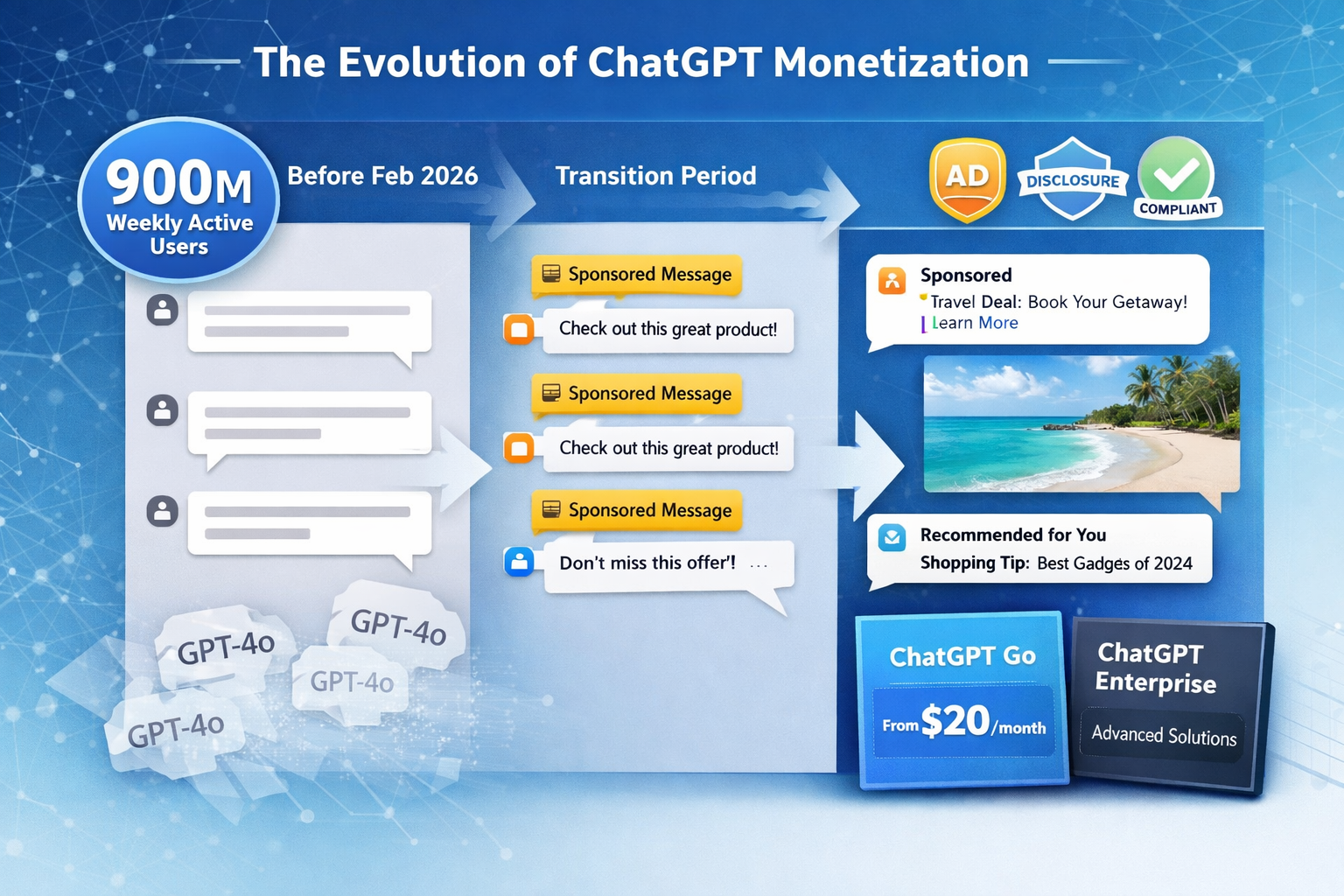
OpenAI's decision to monetize its massive free-tier user base through advertising represents a calculated pivot toward sustainable revenue[1]. The labeled sponsored messages appear within ChatGPT conversations, clearly marked to distinguish them from organic responses—a transparency measure designed to maintain user trust while generating ad revenue.
For affiliate marketers who have relied on ChatGPT recommendations to drive product discovery and purchase decisions, this shift introduces credibility friction. When users can't be certain whether a product suggestion stems from genuine AI analysis or paid placement, conversion rates may suffer.
The rollout coincided with several other strategic moves:
- ChatGPT Go pricing tier launched to expand the addressable market with GPT-5.2 Instant for high-volume, budget-conscious users[2]
- Retirement of GPT-4o and older models on February 13, 2026, forcing users toward newer tiers[5][6]
- Enterprise expansion at institutions like UCSF (9,000+ users on February 17, 2026)[4], establishing B2B adoption momentum
The Trust Equation Has Changed
Before February 2026, ChatGPT operated as a seemingly neutral information source. Affiliate marketers could craft content strategies knowing that AI recommendations carried implicit authority. The Post-ChatGPT Ads Era: Affiliate Revenue Strategies After OpenAI's February 2026 Rollout must account for diminished organic credibility.
"Companies using free-tier ChatGPT must now document how sponsored content is handled and verified during research tasks."[2]
This documentation requirement signals that regulatory scrutiny is active[2]. Policymakers are examining OpenAI's advertising approach, and clearer guidance will emerge as testing expands. For affiliate marketers, this means proactive compliance—not reactive scrambling when regulations formalize.
Strategic Affiliate Revenue Adaptations
1. Disclosure-First Content Strategy
The new advertising landscape demands radical transparency. Affiliate marketers must:
- Clearly label all affiliate relationships in AI-optimized content
- Document which AI platforms were used in product research and recommendation development
- Distinguish between organic AI analysis and sponsored placements in your own content
- Build trust signals through independent verification of AI-generated product comparisons
For those just starting their affiliate journey, understanding what is affiliate marketing and its foundational principles becomes even more critical when AI platforms introduce sponsored elements.
2. Multi-Platform AI Diversification
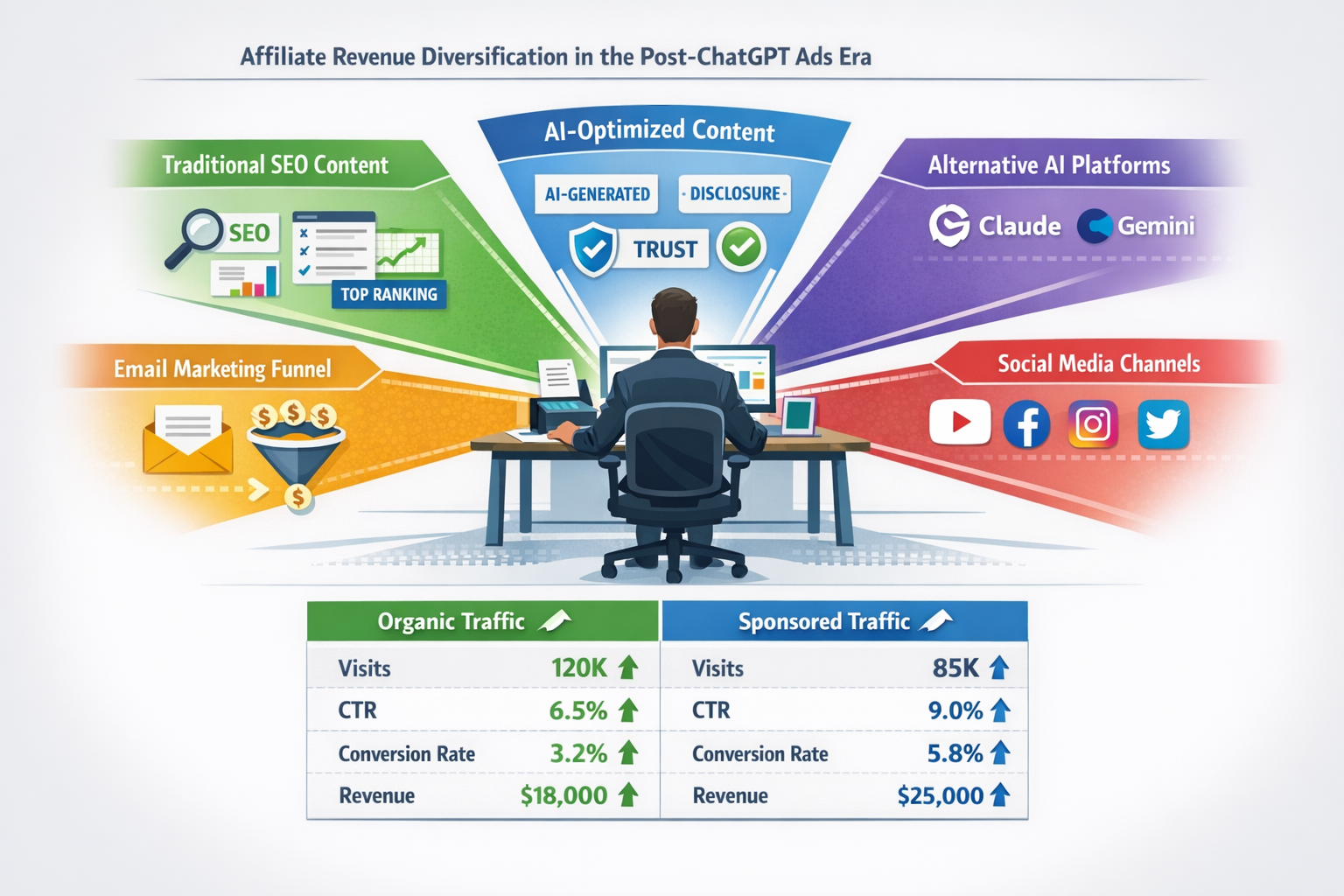
Relying exclusively on ChatGPT for traffic and product discovery now carries concentration risk. Smart affiliates are diversifying across:
| AI Platform | Advertising Status | Affiliate Opportunity |
|---|---|---|
| ChatGPT | Sponsored messages active | High volume, lower trust |
| Claude (Anthropic) | No ads (as of March 2026) | Premium positioning |
| Google Gemini | Search-integrated ads | SEO synergy potential |
| Perplexity AI | Citation-based model | Authority building |
By distributing content and optimization efforts across multiple AI platforms, affiliates reduce dependence on any single channel's monetization decisions. Those exploring top strategies for affiliate marketers should prioritize platform diversification as a core 2026 tactic.
3. Tiered Audience Segmentation
OpenAI's new pricing structure creates distinct user segments with different commercial intent:
Free Tier Users (with ads)
- High volume, lower intent
- Sponsored message exposure
- Best for awareness-stage content
- Lower conversion rates expected
ChatGPT Go Users ($20/month)
- Budget-conscious, high-volume users
- GPT-5.2 Instant access
- Mid-funnel opportunities
- Price-sensitive product recommendations
Plus/Business/Enterprise Users ($20-$60/month)
- Premium positioning
- GPT-5.2 Thinking for deeper analysis
- High-intent, higher-value conversions
- Best for premium affiliate offers
Tailoring content and offers to these segments maximizes revenue per user. For instance, affiliate marketing opportunities in the Enterprise segment might focus on B2B SaaS tools, while free-tier content emphasizes accessible entry-level products.
4. Voice and Search Integration Optimization
OpenAI's voice improvements (January 26, 2026) expanded search response quality, including better shopping result integration[7]. This creates opportunities for:
- Voice-optimized product descriptions that align with conversational queries
- Featured snippet positioning to capture voice search recommendations
- Shopping integration SEO that ensures your affiliate products appear in ChatGPT's enhanced search results
Understanding foundations of SEO for affiliate marketing becomes crucial as voice search and AI-powered shopping converge.
5. Alternative Traffic Channel Reinforcement
The Post-ChatGPT Ads Era: Affiliate Revenue Strategies After OpenAI's February 2026 Rollout must include traditional channel strengthening:
- Email marketing remains unaffected by AI advertising shifts and provides direct audience access
- YouTube and video content offers visual product demonstrations that AI text platforms can't replicate
- Social media communities build trust through human interaction rather than algorithmic recommendations
- SEO-optimized blog content continues driving organic traffic independent of AI platform changes
Those learning how to do affiliate marketing should view AI platforms as one channel among many, not the entire strategy.
Emerging Opportunities in the Post-ChatGPT Ads Era
Prism Research Workspace Monetization
OpenAI's Prism research workspace[2] launched as an AI-native interface specifically for research tasks. This creates a dedicated environment where:
- Research-intent users actively seek product comparisons and recommendations
- Premium features can be promoted to focused, high-value audiences
- Sponsored content may be more acceptable in a commercial research context
- Affiliate content positioned as "research resources" gains credibility
Memory-Powered Personalization
Memory expansion across tiers[2] (stronger for Plus/Business, lighter for free users) enables personalization that affiliate marketers can leverage:
- ChatGPT remembers user preferences and past interactions
- Personalized product recommendations become more relevant
- Cross-sell opportunities emerge from conversation history
- Retargeting strategies can align with AI-remembered user interests
Institutional and Enterprise Channels
The UCSF ChatGPT Enterprise launch (9,000+ users on February 17, 2026)[4] demonstrates institutional adoption momentum. Affiliate marketers can:
- Target B2B and educational affiliate programs
- Position premium tools for organizational use
- Develop enterprise-focused content strategies
- Build partnerships with institutional buyers
For those exploring affiliate marketing niches, the enterprise and institutional segment represents a growing opportunity.
Regulatory Compliance and Future-Proofing
Documentation Best Practices
Organizations using free-tier ChatGPT must document sponsored content handling[2]. Affiliate marketers should:
- Maintain records of which AI platforms were consulted for product research
- Screenshot AI recommendations to verify they weren't sponsored
- Disclose AI usage in content creation processes
- Implement review workflows to catch sponsored placements in AI-generated drafts
Anticipating Regulatory Evolution
As policymakers examine OpenAI's advertising approach[2], affiliate marketers should:
- Monitor FTC guidance on AI-generated affiliate content
- Join industry associations tracking AI advertising regulation
- Consult legal counsel on disclosure requirements
- Build compliance into content workflows rather than retrofitting later
Those interested in best affiliate marketing tips should prioritize compliance and transparency as competitive advantages.
Practical Implementation Roadmap
Immediate Actions (Next 30 Days)
✅ Audit current content for AI-generated product recommendations
✅ Add disclosure statements clarifying AI platform usage
✅ Test alternative AI platforms (Claude, Gemini, Perplexity)
✅ Document your AI research and recommendation processes
✅ Review affiliate partnerships for sponsored AI placement conflicts
Medium-Term Strategy (90 Days)
📈 Diversify traffic sources beyond ChatGPT
📈 Segment content by user tier (free vs. paid ChatGPT users)
📈 Optimize for voice search and shopping integration
📈 Build email list to reduce platform dependency
📈 Develop compliance workflows for AI content review
Long-Term Positioning (6-12 Months)
🎯 Establish authority in alternative AI platforms
🎯 Create enterprise-focused affiliate content
🎯 Invest in video and multimedia to differentiate from AI text
🎯 Partner with brands on transparent AI recommendation programs
🎯 Monitor regulatory developments and adapt proactively
Conclusion
The Post-ChatGPT Ads Era: Affiliate Revenue Strategies After OpenAI's February 2026 Rollout represents both disruption and opportunity. While sponsored messages introduce credibility challenges for AI-generated recommendations, the platform's 900 million weekly active users[3] still represent an enormous addressable market—if approached strategically.
Success in this new landscape requires radical transparency, platform diversification, and proactive compliance. Affiliate marketers who document their processes, disclose AI usage, and build trust through independent verification will differentiate themselves as sponsored content proliferates.
The tiered pricing structure (Go, Plus, Business, Enterprise) creates distinct audience segments with different monetization potential. Voice search integration and the Prism research workspace offer new channels for product discovery. And alternative AI platforms without advertising (for now) provide credibility havens for trust-focused affiliate strategies.
Next Steps
- Assess your current ChatGPT dependency and traffic concentration risk
- Implement disclosure statements across all AI-optimized content
- Test at least two alternative AI platforms this month
- Strengthen traditional channels (email, SEO, social) as hedges against AI platform changes
- Join affiliate marketing communities tracking AI advertising developments
For those ready to adapt their strategies to this new reality, explore our comprehensive guide on how to become an affiliate marketer and discover AI marketing automation strategies that complement your affiliate efforts in 2026.
The Post-ChatGPT Ads Era isn't the end of AI-powered affiliate marketing—it's the beginning of a more transparent, diversified, and strategically sophisticated approach. Those who adapt quickly will thrive; those who ignore the shift risk obsolescence.
References
[1] Ai Update February 6 2026 Ai News And Views From The Past Week – https://www.marketingprofs.com/opinions/2026/54257/ai-update-february-6-2026-ai-news-and-views-from-the-past-week
[2] Chatgpt 2026 Latest Features – https://www.gend.co/blog/chatgpt-2026-latest-features
[3] Chatgpt Reaches 900m Weekly Active Users – https://techcrunch.com/2026/02/27/chatgpt-reaches-900m-weekly-active-users/
[4] Open Ais Chatgpt Enterprise February 2026 Launch – https://chancellor.ucsf.edu/news/open-ais-chatgpt-enterprise-february-2026-launch
[5] Retiring Gpt 4o And Older Models – https://openai.com/index/retiring-gpt-4o-and-older-models/
[6] community.openai – https://community.openai.com/t/working-with-gtp-4o-after-february-13-2026/1373987
[7] 6825453 Chatgpt Release Notes – https://help.openai.com/en/articles/6825453-chatgpt-release-notes