

The affiliate marketing landscape has fundamentally shifted. In 2026, success no longer depends on reacting to what customers did yesterday—it's about predicting what they'll buy tomorrow. With 50% of consumers now using AI-powered search like ChatGPT and Gemini to guide purchase decisions, and these high-intent visitors converting at nearly 4× the rate of traditional search traffic [3], mastering Predictive Consumer Behavior AI for Affiliate Offers: 8 Tactics to Anticipate Purchases in 2026 has become essential for affiliate marketers who want to stay ahead of the competition.
This comprehensive guide reveals how to leverage AI predictive analytics to forecast buyer actions, tailor affiliate promotions with digital twin simulations, and achieve higher conversions before products even launch. Whether you're just starting with affiliate marketing for beginners or optimizing advanced campaigns, these tactics will transform your approach.
Key Takeaways
- AI-powered predictive analytics enable affiliates to anticipate customer purchases before they happen, increasing conversion rates by up to 4× compared to traditional methods
- Digital twin simulations allow marketers to test affiliate campaigns virtually before launch, reducing risk and optimizing ROI
- Behavioral pattern recognition shifts marketing from reactive to proactive, automatically adjusting offers based on real-time intent signals
- Multi-channel AI integration across email, chatbots, and dynamic content creates seamless personalized experiences that drive higher affiliate commissions
- Enhanced attribution models ensure fair compensation for affiliates throughout the entire customer journey, not just last-click conversions
Understanding Predictive Consumer Behavior AI in 2026
Predictive consumer behavior AI represents a fundamental shift in how affiliate marketers approach their campaigns. Rather than analyzing past purchases and hoping patterns repeat, modern AI systems identify behavioral signals that indicate future buying intent [2].
What Makes 2026 Different?
Marketing success in 2026 is increasingly defined by a brand's ability to anticipate customer intent rather than react to past behavior [2]. AI identifies patterns in behavior and predicts outcomes at scale, processing millions of data points that would be impossible for humans to analyze manually.
The key advantages include:
- 🎯 Precision targeting based on predictive intent scores
- ⚡ Real-time optimization without manual intervention
- 📊 Behavioral forecasting that spots trends months ahead
- 🔄 Adaptive personalization that evolves with each interaction
From Static Segments to Dynamic Predictions
Traditional affiliate marketing relied on static demographic segments—age groups, geographic locations, or broad interest categories. Predictive AI moves beyond these limitations by analyzing:
| Traditional Approach | Predictive AI Approach |
|---|---|
| Demographics (age, location) | Behavioral patterns (browsing depth, engagement frequency) |
| Past purchase history | Future purchase probability scores |
| Static audience segments | Dynamic intent-based grouping |
| Manual campaign adjustments | Automated real-time optimization |
Changes in browsing depth, content sequence, or engagement frequency can signal shifts in customer intent, prompting AI systems to adjust messaging and offers automatically without requiring static attribute-based segmentation [2]. This represents a move from rule-based to adaptive personalization experiences.
Tactic #1: Leverage AI-Powered Audience Segmentation for Predictive Targeting
The first essential tactic in Predictive Consumer Behavior AI for Affiliate Offers: 8 Tactics to Anticipate Purchases in 2026 involves using AI to discover which affiliate offers perform best for different audience segments [1].
How It Works
Modern AI platforms analyze hundreds of behavioral signals simultaneously:
- Time spent on specific product pages
- Scroll depth and content engagement patterns
- Cross-device browsing behavior
- Social media interaction history
- Email open and click-through patterns
These signals combine to create predictive intent scores that indicate which visitors are most likely to convert on specific affiliate offers. Rather than showing the same promotion to everyone, AI automatically matches the right offer to the right person at the right moment.
Implementation Strategy
To implement predictive audience segmentation:
- Integrate behavioral tracking across all touchpoints (website, email, social media)
- Feed data into AI platforms that calculate purchase probability scores
- Create dynamic offer rotations based on predicted intent levels
- Monitor performance and allow AI to refine predictions over time
This approach enables targeting different demographics with precision rather than broad-based campaigns [1], dramatically improving conversion rates while reducing wasted ad spend. For those looking to boost affiliate marketing income, this precision targeting delivers measurable results.
Tactic #2: Deploy Digital Twin Simulations for Pre-Launch Campaign Testing
Digital twin technology represents one of the most powerful innovations in predictive marketing. These AI-powered simulations create virtual replicas of your target audience, allowing you to test affiliate campaigns before spending a single dollar on real traffic [2].
What Are Digital Twins?
A digital twin is a virtual representation of your customer base that mirrors real-world behavioral patterns. By feeding historical data into AI models, these simulations predict how different audience segments will respond to specific:
- Affiliate offer positioning
- Pricing strategies
- Messaging angles
- Visual creative elements
- Call-to-action placements
Benefits for Affiliate Marketers
Digital twin simulations provide:
✅ Risk reduction – Test campaigns virtually before launch
✅ Cost efficiency – Identify winning strategies without wasting ad budget
✅ Speed to market – Optimize campaigns in days instead of weeks
✅ Scenario planning – Model different market conditions and seasonal trends
By running hundreds of virtual campaign variations, AI identifies the highest-performing combinations before you commit resources. This predictive approach helps avoid common affiliate marketing mistakes that drain budgets without delivering results.
Tactic #3: Implement Behavioral Pattern Recognition for Intent Prediction
The third tactic in Predictive Consumer Behavior AI for Affiliate Offers: 8 Tactics to Anticipate Purchases in 2026 focuses on recognizing subtle behavioral changes that signal shifting purchase intent.
Reading the Digital Body Language
Just as salespeople read body language in physical stores, AI systems now interpret digital body language through behavioral pattern analysis [2]:
- Increased browsing depth – Viewing more product pages signals growing interest
- Content sequence changes – Moving from general to specific content indicates decision-making progression
- Engagement frequency shifts – More frequent visits suggest approaching purchase decision
- Comparison behavior – Viewing competitor products indicates active evaluation phase
Automated Response Triggers
When AI detects these intent signals, it automatically adjusts the affiliate marketing approach:
🔔 High intent detected → Present premium affiliate offers with urgency messaging
⏰ Medium intent detected → Share educational content with embedded affiliate links
📧 Low intent detected → Nurture with value-driven content without hard selling
⚠️ Churn risk detected → Deploy retention offers or alternative product suggestions
This adaptive approach ensures you're always presenting the most relevant affiliate offers based on where customers are in their buying journey, maximizing conversion opportunities while maintaining trust.
Tactic #4: Optimize Email Campaigns With AI-Powered Send-Time Prediction
Email remains one of the highest-performing channels for affiliate marketers when enhanced with AI [1]. The fourth tactic leverages predictive algorithms to optimize every aspect of email campaigns.
Beyond Basic Email Marketing
Traditional email marketing sends messages at predetermined times—Tuesday at 10 AM, for example. Predictive AI analyzes individual user habits to determine the optimal send time for each subscriber [1]:
- When they typically check email
- Which days they're most responsive
- How time of day affects their conversion likelihood
- Seasonal patterns in their engagement
Multi-Dimensional Email Optimization
AI enhances email affiliate campaigns through:
1. Personalized Product Recommendations
AI tailors product suggestions based on browsing behavior, ensuring each email features affiliate offers aligned with individual interests [1].
2. Subject Line Optimization
AI automatically tests multiple subject lines in real-time and selects top performers, continuously improving open rates [1].
3. Content Sequence Prediction
AI determines the optimal order of information presentation based on what drives conversions for similar audience segments.
4. Re-engagement Timing
AI predicts when inactive subscribers are most likely to re-engage, timing reactivation campaigns for maximum impact.
For marketers exploring best affiliate marketing programs for beginners, AI-powered email optimization provides a competitive advantage even with limited experience.
Tactic #5: Utilize AI Chatbots for Conversational Affiliate Recommendations
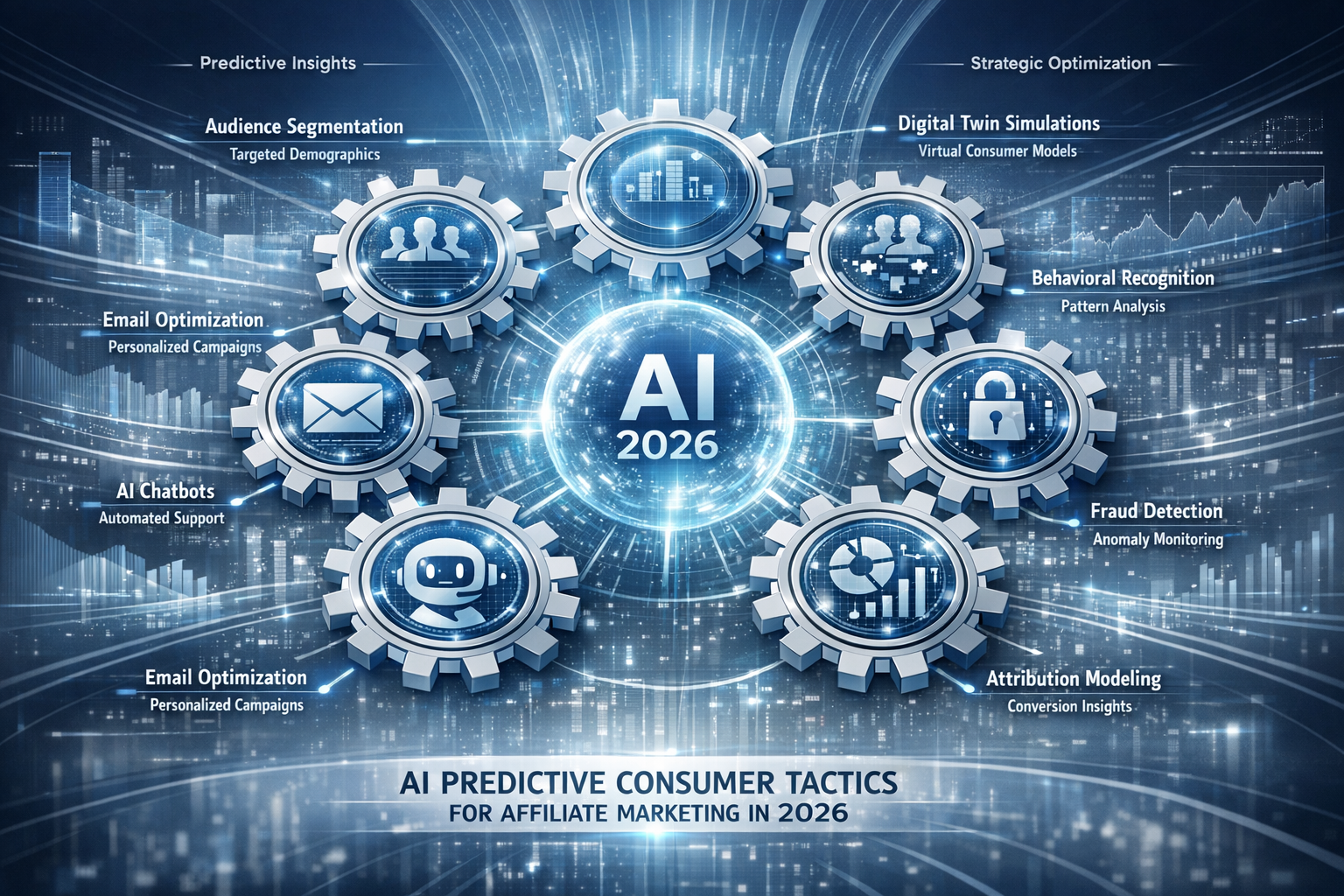
The fifth tactic in Predictive Consumer Behavior AI for Affiliate Offers: 8 Tactics to Anticipate Purchases in 2026 harnesses conversational AI to deliver affiliate recommendations naturally within customer interactions.
The Power of Conversational Commerce
AI chatbots answer customer queries while subtly pushing affiliate products during conversations [1]. For example:
- Someone mentions marathon training → Bot recommends "top-rated running shoes" with affiliate links
- User asks about productivity tips → Bot suggests specific software tools with affiliate codes
- Visitor browses vacation content → Bot offers hotel booking platforms with commission tracking
Advanced Chatbot Strategies
Messenger Bot Follow-Ups
AI-powered Messenger bots follow up with abandoned-cart visitors using discount nudges and personalized affiliate offers [1], recovering sales that would otherwise be lost.
Predictive Question Anticipation
Modern chatbots predict what questions visitors will ask next based on their browsing history, proactively offering relevant affiliate solutions before customers even ask.
Sentiment Analysis Integration
AI analyzes conversation tone and adjusts recommendations accordingly—enthusiastic users receive premium offers, while hesitant visitors get more educational content with softer affiliate positioning.
Implementation Tips
- Keep recommendations contextual – Only suggest products relevant to the conversation
- Maintain transparency – Disclose affiliate relationships when appropriate
- Test conversation flows – Use A/B testing to optimize chatbot scripts
- Monitor conversion rates – Track which conversation patterns drive affiliate sales
Tactic #6: Deploy AI-Driven Contextual Commerce for Real-Time Product Matching
In 2026, AI-driven contextual commerce matches products to editorial content in real-time based on reader intent and publishers' first-party data, replacing the decade-old static link affiliate model [3].
How Contextual Commerce Works
Traditional affiliate marketing embedded fixed product links in content. Predictive contextual commerce dynamically adjusts which products appear based on:
- Current reader behavior and intent signals
- Real-time inventory and pricing data
- Seasonal trends and demand fluctuations
- Individual purchase probability scores
Real-World Applications
Content-Aware Product Insertion
AI scans article content and automatically inserts the most relevant affiliate offers without manual link placement. A fitness article might feature running shoes for one reader and yoga mats for another, based on their behavioral history.
Dynamic Pricing Integration
AI monitors affiliate program pricing across networks and automatically promotes offers with the best commission rates and customer value, maximizing earnings per click.
Trend-Responsive Recommendations
When AI detects emerging product trends, it automatically adjusts affiliate promotions to capitalize on demand before markets become saturated [6].
This approach significantly outperforms static affiliate links because it adapts to each visitor's unique context rather than showing identical promotions to everyone.
Tactic #7: Implement Enhanced Attribution Models for Multi-Touch Affiliate Journeys
The seventh tactic addresses a critical challenge in affiliate marketing: fair attribution across complex customer journeys.
Beyond Last-Click Attribution
Traditional affiliate models credit only the final touchpoint before purchase. Enhanced attribution models moving beyond "last-click" provide better insights into customer journeys [1], ensuring affiliates receive fair credit for contributions at earlier stages.
Modern Attribution Approaches
Multi-Touch Attribution
AI tracks all touchpoints in the customer journey and assigns proportional credit:
- First touch (awareness)
- Mid-journey touches (consideration)
- Last touch (conversion)
Lifetime Value Attribution
Some innovative programs now tie payouts to customer lifetime value rather than individual conversions [1], rewarding affiliates who attract high-quality customers who make repeat purchases.
Benefits for Affiliate Marketers
✅ Fair compensation for upper-funnel content that drives awareness
✅ Better ROI insights showing which content truly influences purchases
✅ Strategic optimization based on full-journey performance data
✅ Reduced waste by identifying which touchpoints actually matter
This approach particularly benefits content creators and influencers who build awareness but may not capture the final click, ensuring their contribution is recognized and compensated appropriately.
Tactic #8: Leverage AI for Fraud Detection and Campaign Protection
The final tactic in Predictive Consumer Behavior AI for Affiliate Offers: 8 Tactics to Anticipate Purchases in 2026 focuses on protecting your revenue and reputation through AI-powered fraud detection.
The Fraud Challenge in Affiliate Marketing
Invalid traffic, click fraud, and commission theft drain affiliate budgets and damage program integrity. AI tools like FraudGuard and TrafficGuard detect invalid traffic and anomalies swiftly [1], protecting affiliate revenue before fraudulent clicks drain budgets.
How AI Detects Fraud
Predictive fraud detection analyzes:
- Click patterns – Identifying bot-like behavior and suspicious timing
- Traffic sources – Flagging known fraud networks and suspicious referrers
- Conversion patterns – Detecting unrealistic conversion rates that signal manipulation
- Device fingerprinting – Tracking devices used for multiple fraudulent transactions
Proactive Protection Strategies
Real-Time Blocking
AI identifies and blocks fraudulent traffic instantly, preventing wasted ad spend before it occurs.
Predictive Risk Scoring
Each traffic source receives a fraud risk score, allowing marketers to allocate budget toward legitimate channels with higher ROI potential.
Anomaly Detection
AI establishes baseline performance patterns and alerts marketers to unusual activity that may indicate fraud or technical issues requiring investigation.
By implementing AI-powered fraud protection, affiliate marketers ensure their predictive campaigns deliver genuine results rather than inflated metrics from invalid traffic.
Integrating All 8 Tactics: A Holistic Approach to Predictive Affiliate Marketing
The true power of Predictive Consumer Behavior AI for Affiliate Offers: 8 Tactics to Anticipate Purchases in 2026 emerges when these tactics work together as an integrated system.
The Predictive Marketing Ecosystem
Step 1: Data Collection
Behavioral tracking captures signals across all touchpoints (website, email, chatbots, social media).
Step 2: AI Analysis
Predictive algorithms process data to calculate purchase probability scores and identify intent patterns.
Step 3: Dynamic Optimization
AI automatically adjusts offers, messaging, timing, and placement based on predictions.
Step 4: Multi-Channel Execution
Optimized campaigns deploy across email, chatbots, contextual commerce, and advertising platforms simultaneously.
Step 5: Attribution & Learning
Enhanced attribution models track results while AI continuously refines predictions based on outcomes.
Step 6: Fraud Protection
AI monitors all traffic and conversions, blocking fraudulent activity in real-time.
Measuring Success
Track these key metrics to evaluate your predictive affiliate marketing performance:
📊 Conversion Rate Improvement – Compare pre-AI vs. post-AI conversion rates
💰 Revenue Per Visitor – Measure earnings efficiency across traffic sources
⏱️ Time to Conversion – Track how quickly visitors convert after first touch
🎯 Prediction Accuracy – Monitor how well AI forecasts align with actual outcomes
🛡️ Fraud Reduction – Quantify savings from blocked invalid traffic
For those implementing these advanced strategies, combining them with fundamental affiliate marketing strategies creates a powerful foundation for sustainable growth.
Overcoming Implementation Challenges
While the benefits of predictive AI are clear, implementation comes with challenges that affiliate marketers must address.
Common Obstacles
Data Privacy Concerns
With increasing privacy regulations, collecting behavioral data requires transparent consent and compliance with GDPR, CCPA, and similar frameworks.
Technical Complexity
Integrating AI platforms with existing marketing stacks can be technically demanding, especially for solo affiliates or small teams.
Initial Investment
AI tools and platforms require upfront investment in software, training, and potentially hiring specialists with AI expertise.
Learning Curve
Understanding how to interpret AI predictions and optimize based on insights requires new skills and knowledge.
Solutions and Best Practices
✅ Start small – Implement one or two tactics initially, then expand as you gain experience
✅ Choose user-friendly platforms – Many AI tools now offer no-code interfaces designed for marketers
✅ Prioritize data compliance – Build privacy protection into your strategy from day one
✅ Invest in education – Take courses on AI marketing and predictive analytics
✅ Join communities – Connect with other affiliates implementing AI strategies to share insights
The affiliate marketers who overcome these challenges early will capture disproportionate market share as AI adoption accelerates throughout 2026 and beyond.
The Future of Predictive Affiliate Marketing Beyond 2026
As we look beyond 2026, several emerging trends will further transform how Predictive Consumer Behavior AI for Affiliate Offers operates:
Emerging Technologies
Quantum Computing for Prediction
Quantum computers will process exponentially more data, enabling predictions with unprecedented accuracy across millions of variables simultaneously.
Emotion AI Integration
AI systems will analyze emotional responses through facial recognition, voice analysis, and biometric data to predict purchase likelihood based on emotional states.
Blockchain Attribution
Decentralized attribution systems will provide transparent, tamper-proof tracking of affiliate contributions across the entire customer journey.
Voice Commerce Optimization
As voice shopping grows, AI will optimize affiliate recommendations for voice-based interactions with smart speakers and virtual assistants.
Preparing for What's Next
Forward-thinking affiliate marketers should:
🔮 Stay informed about emerging AI technologies and their marketing applications
🧪 Experiment early with new platforms and approaches before they become mainstream
🤝 Build relationships with AI vendors and technology partners
📚 Invest in continuous learning to maintain competitive advantage
The pace of AI innovation shows no signs of slowing, making adaptability and continuous learning essential skills for long-term affiliate marketing success.
Conclusion: Embracing Predictive AI for Affiliate Success in 2026
Predictive Consumer Behavior AI for Affiliate Offers: 8 Tactics to Anticipate Purchases in 2026 represents more than just a technological upgrade—it's a fundamental shift in how successful affiliate marketers operate. By anticipating customer needs before they're explicitly expressed, AI-powered affiliates deliver superior value to both merchants and consumers while maximizing their own earnings.
The eight tactics covered in this guide—from AI-powered audience segmentation and digital twin simulations to enhanced attribution and fraud protection—work together to create a comprehensive predictive marketing ecosystem that outperforms traditional reactive approaches by significant margins.
Your Next Steps
To implement these strategies effectively:
- Audit your current data collection – Identify gaps in behavioral tracking across touchpoints
- Choose one tactic to pilot – Start with the tactic that addresses your biggest current challenge
- Select appropriate AI tools – Research platforms that align with your budget and technical capabilities
- Set clear success metrics – Define how you'll measure improvement from AI implementation
- Test, learn, and scale – Begin with small campaigns, optimize based on results, then expand
The affiliate marketers who master predictive AI in 2026 will not only survive but thrive in an increasingly competitive landscape. By anticipating purchases before they happen, you position yourself as an invaluable partner to merchants and a trusted guide to consumers—the foundation of sustainable affiliate marketing success.
Start implementing these tactics today, and you'll be well-positioned to capitalize on the predictive AI revolution transforming affiliate marketing throughout 2026 and beyond.
References
[1] Ai For Affiliate Marketing Growth – https://interviewkickstart.com/ai-for-all/ai-for-affiliate-marketing-growth
[2] Predictive Analytics In Marketing 2026 – https://awebdigital.co/predictive-analytics-in-marketing-2026/
[3] 2026 Affiliate Marketing Predictions Industry Experts Sound Off On Winning With Ai Discovery – https://www.everflow.io/post/2026-affiliate-marketing-predictions-industry-experts-sound-off-on-winning-with-ai-discovery
[4] Affiliate Marketing – https://www.imd.org/blog/marketing/affiliate-marketing/
[6] 10 Affiliate Trends Reshaping Affiliate Marketing In 2026 – https://www.affiversemedia.com/10-affiliate-trends-reshaping-affiliate-marketing-in-2026/