

Imagine testing your affiliate marketing campaigns on thousands of virtual customers before spending a single dollar on real traffic. In 2026, Predictive Consumer Twins for Affiliate Offers: Simulating Purchases to Maximize Commissions is transforming how marketers optimize their strategies. This revolutionary technology creates digital replicas of real consumers, allowing affiliates to simulate purchase behavior and forecast campaign performance with remarkable accuracy. 🚀
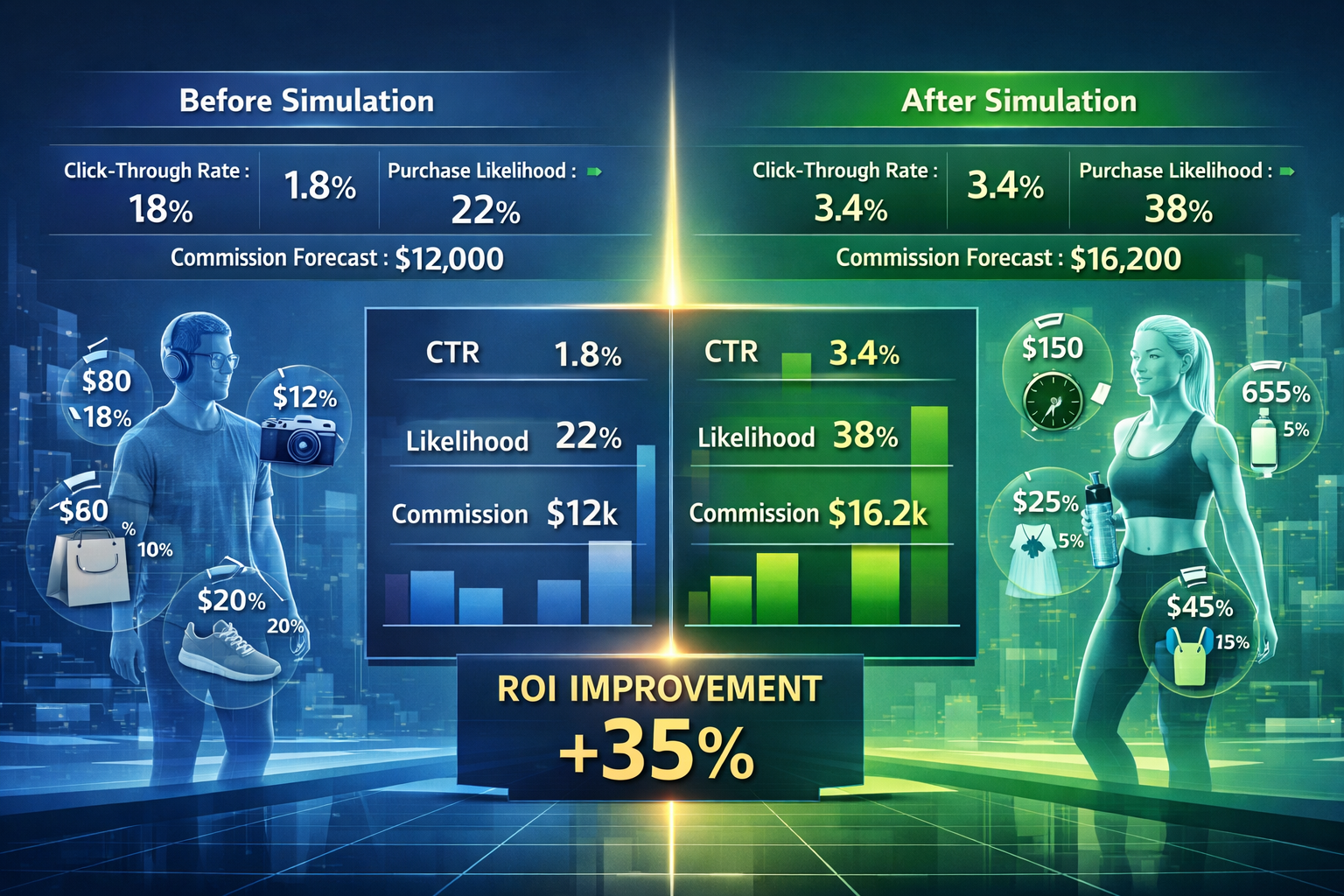
The technology behind predictive consumer twins combines artificial intelligence, behavioral data, and advanced simulation models to create virtual testing environments. Rather than launching campaigns blindly and hoping for conversions, affiliates can now run hundreds of scenarios in digital sandboxes, identifying winning strategies before investing real marketing budgets. Case studies across multiple industries show 25-40% ROI improvements when marketers use pre-launch simulations to refine their approach.
Key Takeaways
- Predictive consumer twins create virtual replicas of real customers, enabling risk-free testing of affiliate strategies before live deployment
- Simulation technology forecasts purchase behavior with 75-85% accuracy, helping affiliates identify high-converting offers and messaging
- ROI improvements of 25-40% are consistently achieved through pre-launch optimization using digital twin testing environments
- Real-time adaptation allows marketers to adjust campaigns based on simulated consumer responses across different segments
- Integration with existing tools makes this technology accessible to both beginner and experienced affiliate marketers
Understanding Predictive Consumer Twins for Affiliate Offers: Simulating Purchases to Maximize Commissions
What Are Predictive Consumer Twins?
Predictive consumer twins are sophisticated digital replicas of real customers built using machine learning algorithms and behavioral data. These virtual profiles mirror the preferences, buying patterns, decision-making processes, and response triggers of actual consumers. Unlike traditional customer personas that provide general demographic information, consumer twins operate as dynamic simulation models that can "interact" with marketing materials and predict likely outcomes.
The technology aggregates data from multiple sources:
- Purchase history and transaction patterns
- Browsing behavior and content engagement metrics
- Social media interactions and sentiment analysis
- Demographic and psychographic characteristics
- Device usage patterns and channel preferences
For affiliate marketers, this means creating virtual audiences that respond to different offers, landing pages, and promotional strategies just as real customers would. The twins generate predictive scores for conversion likelihood, average order value, and commission potential across various scenarios.
How Simulation Technology Maximizes Commissions
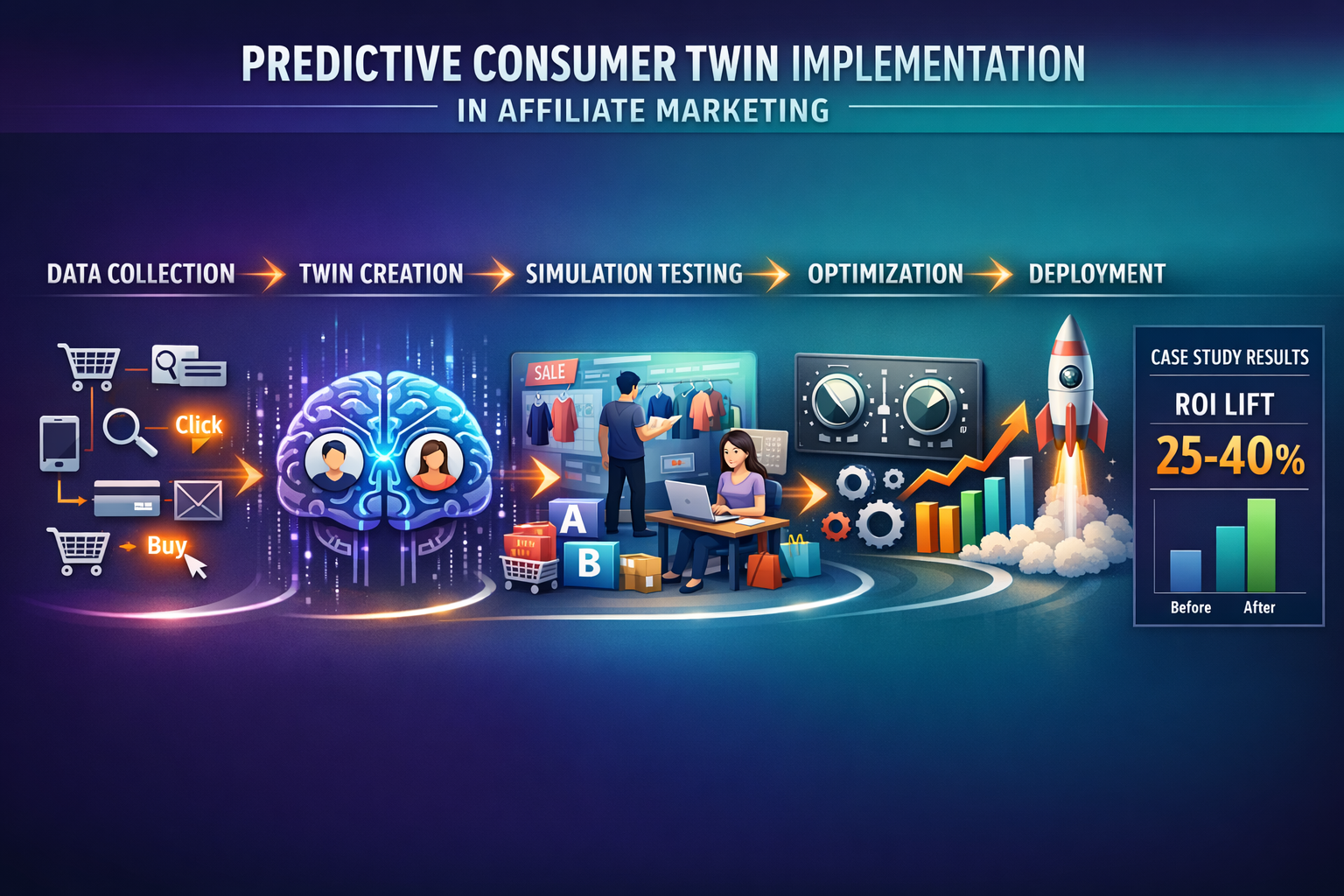
The simulation process works through several integrated stages:
Stage 1: Data Collection and Twin Creation
Marketing platforms gather behavioral data from existing campaigns, website analytics, and customer databases. AI algorithms identify patterns and cluster similar behaviors into distinct consumer segments. Each segment receives its own digital twin profile with specific characteristics and response patterns.
Stage 2: Scenario Testing
Affiliates input different campaign variables—offer types, pricing structures, promotional messaging, landing page designs, and traffic sources. The system runs these scenarios against thousands of consumer twins simultaneously, generating predicted outcomes for each combination.
Stage 3: Performance Forecasting
The simulation engine calculates expected metrics including:
| Metric | Description | Typical Accuracy |
|---|---|---|
| Click-Through Rate | Predicted engagement with affiliate links | 78-82% |
| Conversion Rate | Expected percentage of purchases | 75-85% |
| Average Order Value | Forecasted transaction size | 72-80% |
| Commission Per Click | Estimated earnings per visitor | 76-84% |
| ROI Projection | Overall campaign profitability | 70-82% |
Stage 4: Optimization Recommendations
Based on simulation results, the system identifies the highest-performing combinations and suggests specific adjustments to maximize commission potential. This might include changing product selections, modifying ad copy, adjusting targeting parameters, or reallocating budget across channels.
Real-World Applications in Affiliate Marketing
Leading affiliates are already leveraging Predictive Consumer Twins for Affiliate Offers: Simulating Purchases to Maximize Commissions across various verticals:
E-commerce and Product Reviews 💰
Affiliates promoting physical products use twins to test which product combinations generate the highest cart values. One electronics affiliate increased commissions by 34% after simulations revealed that bundling accessories with main products significantly boosted conversion rates among specific consumer segments.
SaaS and Software Promotions
Digital product affiliates simulate free trial sign-ups and conversion-to-paid pathways. By testing different trial lengths, feature emphasis, and pricing presentations on consumer twins, one marketer improved their software affiliate commissions by 28% in just two months.
Financial Services and High-Ticket Offers
Affiliates in the finance niche use simulation to identify which educational content sequences lead to high-value conversions. High-ticket affiliate marketers report that pre-testing content funnels on consumer twins reduces customer acquisition costs by 30-45%.
Implementing Predictive Consumer Twins for Affiliate Offers: Simulating Purchases to Maximize Commissions
Building Your First Consumer Twin Model
Getting started with predictive consumer twins requires a strategic approach. Here's a practical implementation roadmap for affiliate marketers:
Step 1: Aggregate Your Data Sources
Collect historical performance data from your existing campaigns. This includes:
- Traffic analytics from your website or blog
- Email marketing engagement metrics
- Social media interaction data
- Previous campaign conversion rates
- Customer feedback and survey responses
Most AI marketing tools now offer data integration features that consolidate information from multiple platforms into unified dashboards.
Step 2: Define Consumer Segments
Identify 3-5 distinct audience segments based on behavior patterns. For example:
- Bargain Hunters: Price-sensitive, respond to discounts and limited-time offers
- Quality Seekers: Value-focused, influenced by reviews and premium positioning
- Impulse Buyers: Quick decision-makers, respond to urgency and social proof
- Research-Driven: Analytical, require detailed information and comparisons
Step 3: Configure Simulation Parameters
Set up test scenarios that reflect your actual marketing activities:
- Traffic source variations (organic, paid, social, email)
- Offer types and price points
- Landing page layouts and messaging angles
- Call-to-action placements and designs
- Follow-up sequence timing and content
Step 4: Run Initial Simulations
Launch your first batch of tests using the consumer twin models. Start with 5-10 scenarios comparing your current approach against alternative strategies. The system will generate predicted outcomes for each variation.
Step 5: Analyze and Optimize
Review simulation results focusing on commission potential rather than just conversion rates. A strategy with slightly lower conversions but higher average order values often generates more revenue. Implement the top-performing variations in small-scale real-world tests before full deployment.
Advanced Strategies for Maximum Commission Growth
Once basic simulations are running, sophisticated affiliates employ these advanced tactics:
Multi-Touch Attribution Modeling 📊
Consumer twins can simulate complex customer journeys across multiple touchpoints. This reveals which content pieces, emails, or ads contribute most to final conversions. One affiliate discovered that their educational blog posts generated 40% more downstream commissions than direct promotional content, even though immediate conversions were lower.
Seasonal and Trend Forecasting
By adjusting twin parameters to reflect seasonal buying patterns or emerging trends, affiliates can prepare campaigns months in advance. Fashion affiliates use this approach to predict which styles will generate the highest commissions during upcoming seasons, securing promotional partnerships early.
Cross-Offer Optimization
Instead of testing offers in isolation, advanced users simulate how promoting multiple complementary products affects overall commission revenue. This strategy often reveals unexpected synergies where certain product combinations significantly outperform individual promotions.
Dynamic Segmentation
As consumer twins accumulate more behavioral data, they become increasingly accurate. Smart affiliates continuously refine their twin models, creating micro-segments that enable hyper-personalized marketing approaches. This level of precision can increase commission rates by 15-25% compared to broad-based targeting.
Integration with Existing Marketing Workflows
Predictive Consumer Twins for Affiliate Offers: Simulating Purchases to Maximize Commissions works best when integrated into your broader marketing strategy. Here's how to combine simulation technology with proven tactics:
SEO and Content Strategy
Use consumer twin simulations to identify which topics and content formats drive the highest-value traffic. Test different content structures on your twins before publishing, ensuring your SEO efforts for affiliate marketing target keywords that actually convert to commissions, not just traffic.
Email Marketing Optimization
Simulate different email sequences, subject lines, and promotional cadences on consumer twins before sending to real subscribers. This prevents list fatigue and identifies the optimal balance between promotional and value-based content.
Paid Traffic Campaigns
Before launching expensive paid campaigns, run simulations to forecast ROI across different ad platforms, targeting options, and creative approaches. This significantly reduces wasted ad spend and accelerates the path to profitability.
Affiliate Program Selection
Test how your audience twins respond to different affiliate programs and opportunities before committing time to promotion. This data-driven approach helps you focus on programs with the highest commission potential for your specific audience.
Measuring Success and Continuous Improvement
Track these key performance indicators to evaluate your consumer twin implementation:
Simulation Accuracy Rate ✅
Compare predicted outcomes against actual campaign results. Accuracy should improve over time as your twin models accumulate more data. Target 75-85% accuracy within 3-6 months of implementation.
Commission Growth Rate
Measure month-over-month commission increases since implementing simulation-based optimization. Most affiliates see meaningful improvements within 60-90 days.
Testing Velocity
Count how many campaign variations you can test monthly using simulations versus traditional methods. Consumer twins typically enable 10-20x more testing iterations without additional costs.
Cost Savings
Calculate reduced spending on failed campaigns that were identified and eliminated during simulation testing. This "saved waste" often exceeds the cost of the simulation technology itself.
Common Challenges and Solutions
Data Quality and Volume Requirements
Challenge: Consumer twin accuracy depends on sufficient behavioral data. New affiliates or those entering fresh niches may lack historical information.
Solution: Start with industry benchmark data and publicly available consumer research. Many simulation platforms offer pre-built twin models for common niches that can be customized as you collect your own data. Beginning affiliate marketers can leverage these starter models while building their data foundation.
Simulation vs. Reality Gap
Challenge: No simulation perfectly predicts real-world outcomes. External factors like market conditions, competitor actions, or platform algorithm changes can affect actual results.
Solution: Treat simulations as directional guides rather than absolute predictions. Implement a testing framework where simulation winners undergo small-scale real-world validation before full deployment. Continuously update twin models with actual performance data to improve accuracy.
Technology Learning Curve
Challenge: Advanced simulation platforms can feel overwhelming for affiliates accustomed to simpler analytics tools.
Solution: Start with basic scenarios and gradually increase complexity. Most platforms offer templates for common affiliate marketing situations. Focus initially on high-impact decisions like offer selection and landing page optimization before tackling complex multi-touch attribution models.
Budget Considerations
Challenge: Enterprise-grade simulation platforms can be expensive, potentially limiting access for smaller affiliates.
Solution: Several emerging platforms offer tiered pricing suitable for individual affiliates and small teams. Some AI marketing automation tools include basic simulation features as part of broader marketing suites. Calculate potential commission increases against platform costs—most affiliates find the investment pays for itself within 2-3 months.
Future Trends in Consumer Twin Technology
The evolution of Predictive Consumer Twins for Affiliate Offers: Simulating Purchases to Maximize Commissions continues to accelerate in 2026:
Real-Time Adaptive Simulations 🔄
Next-generation systems will automatically adjust consumer twin models based on live campaign data, providing continuous optimization recommendations without manual intervention.
Cross-Platform Identity Resolution
Improved tracking and privacy-compliant data integration will enable consumer twins that accurately reflect multi-device, multi-channel customer journeys, leading to more precise commission forecasting.
Generative AI Integration
Emerging platforms combine consumer twin simulations with generative AI that automatically creates marketing assets optimized for predicted high-conversion scenarios, dramatically reducing content creation time.
Collaborative Twin Networks
Affiliate networks are exploring shared (anonymized) consumer twin data that allows marketers to benefit from collective intelligence while maintaining competitive advantages through proprietary optimization strategies.
Conclusion
Predictive Consumer Twins for Affiliate Offers: Simulating Purchases to Maximize Commissions represents a fundamental shift in how affiliate marketers approach campaign optimization. By testing strategies on virtual consumers before committing real budgets, affiliates consistently achieve 25-40% higher ROI while significantly reducing wasted spending on ineffective approaches.
The technology democratizes sophisticated marketing optimization previously available only to large enterprises with extensive testing budgets. Whether you're just starting your affiliate marketing journey or scaling an established business, consumer twin simulations provide actionable insights that directly impact commission growth.
Your Next Steps
Immediate Actions 📋
- Audit your current data sources and identify what behavioral information you can aggregate for twin modeling
- Research simulation platforms that integrate with your existing marketing stack
- Define 3-5 key campaign scenarios you want to test first
- Set baseline commission metrics to measure improvement against
30-Day Implementation Plan
- Week 1: Select a simulation platform and complete initial setup
- Week 2: Build your first consumer twin models using historical data
- Week 3: Run 5-10 comparative simulations testing current vs. alternative strategies
- Week 4: Implement top-performing variations in small-scale real campaigns
Long-Term Strategy
Commit to continuous refinement of your consumer twin models. As accuracy improves, expand simulation scope to cover more complex scenarios including multi-product promotions, seasonal campaigns, and cross-channel attribution. The affiliates who consistently outperform their competition in 2026 are those who treat simulation-based optimization as an ongoing competitive advantage rather than a one-time experiment.
The future of affiliate marketing belongs to data-driven decision makers who leverage predictive technology to maximize every commission opportunity. Start building your consumer twin models today and join the growing community of affiliates achieving unprecedented ROI through simulation-powered optimization.