

The affiliate marketing landscape in 2026 has transformed dramatically. Successful affiliates no longer wait for trends to emerge—they anticipate them. Predictive Content Forecasting for Affiliates: AI Tools to Publish Before Trends Spike and Boost Commissions represents the shift from reactive content creation to proactive strategy, where artificial intelligence analyzes market signals and forecasts winning opportunities before competitors even notice them. This approach enables affiliates to capture early traffic, establish authority, and maximize commissions by being first to market.
The difference between thriving and struggling in affiliate marketing now hinges on timing. When content goes live before a trend spikes, it gains momentum organically, ranks higher in search results, and captures audiences at the perfect moment of interest. This article explores the AI-powered tools and workflows that make preemptive content creation possible, delivering higher ROI without the exhausting cycle of chasing yesterday's trends.
Key Takeaways
- Predictive analytics identifies winning products and trending topics before they spike, allowing affiliates to publish content ahead of demand curves
- AI content automation reduces production timelines by 60-80%, enabling rapid deployment across multiple products and platforms
- Real-time optimization through AI agents autonomously manages bidding, targeting, and creative elements without manual intervention
- Behavioral trigger workflows respond instantly to prospect actions, delivering personalized content at precisely the right moment
- The US affiliate marketing industry is projected to reach $15 billion in 2026, with AI-powered strategies driving the majority of growth [3]
Understanding Predictive Content Forecasting for Affiliates
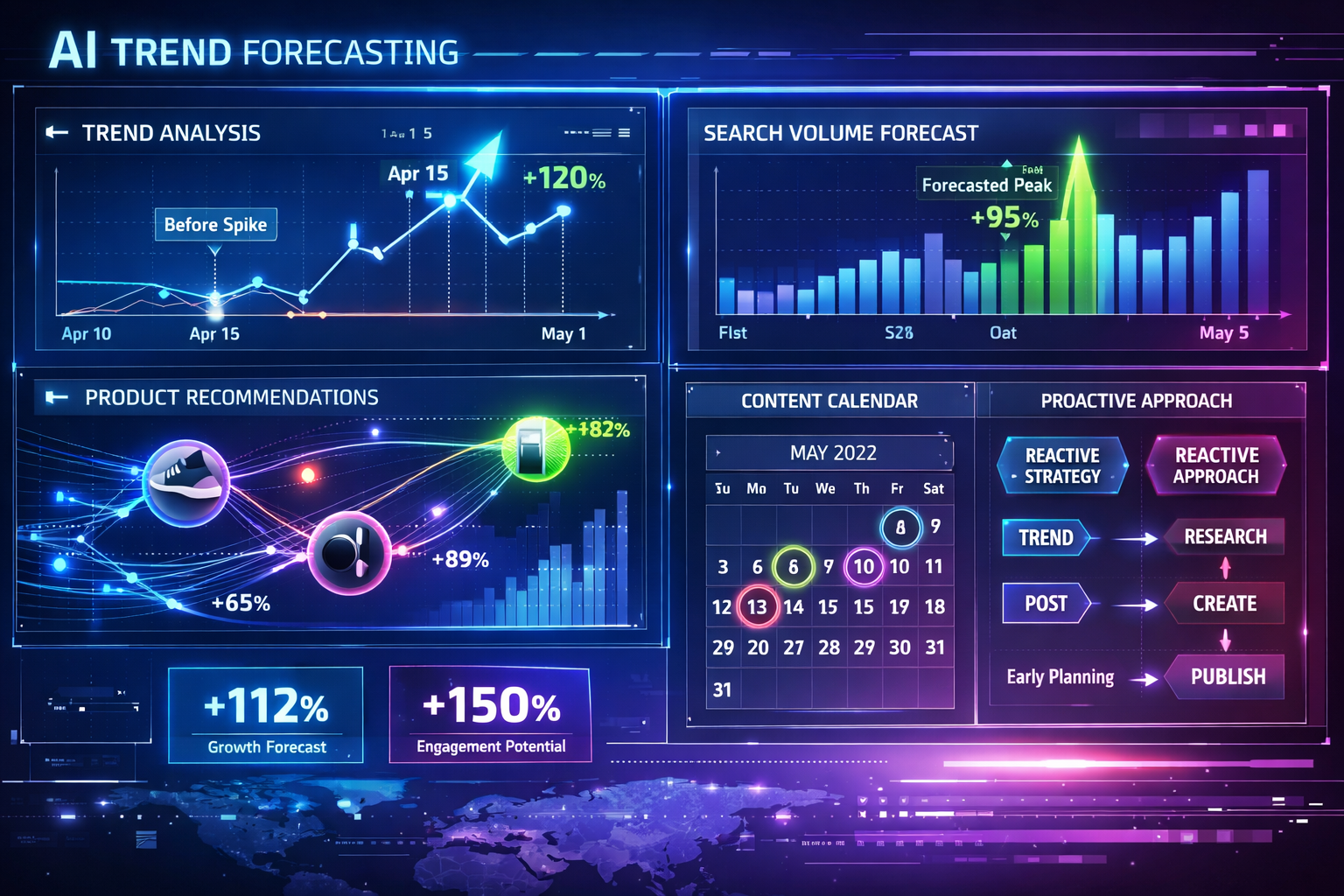
Predictive content forecasting represents a fundamental shift in how affiliates approach content strategy. Instead of analyzing what performed well last month or reacting to current trends, predictive models use machine learning algorithms to forecast which topics, products, and keywords will gain traction in the coming weeks and months.
How Predictive Analytics Works for Affiliates
AI models analyze multiple data streams simultaneously: historical sales patterns, competitor performance metrics, search volume trends, social media sentiment, seasonal fluctuations, and market indicators. These systems identify patterns invisible to human analysis, detecting early signals that precede trend spikes [1].
For example, when search interest for a product category begins rising gradually, predictive models calculate the trajectory and forecast when it will reach peak demand. Affiliates can then create and publish content 2-4 weeks before the spike, allowing time for search engines to index pages and build authority.
The Competitive Advantage of Being First
Publishing before trends spike delivers several compounding advantages:
- Early ranking positions in search results before competition intensifies
- Organic backlink accumulation as later content creators reference early authorities
- Audience trust building through demonstrated expertise ahead of mainstream awareness
- Higher conversion rates from visitors actively seeking information on emerging topics
Those who master affiliate marketing strategies understand that timing multiplies the effectiveness of every other optimization.
AI Tools That Power Predictive Content Forecasting for Affiliates
The technology enabling predictive forecasting has matured significantly in 2026. Several categories of AI tools now work together to create comprehensive forecasting systems.
Trend Prediction Platforms
These specialized tools analyze billions of data points across search engines, social platforms, e-commerce sites, and news sources to identify emerging trends:
- Search volume forecasting tools predict keyword demand 30-90 days ahead
- Product opportunity scanners identify high-potential affiliate products before launch
- Seasonal pattern analyzers forecast cyclical trends with precision timing
- Competitor monitoring systems alert affiliates when rivals shift focus to new niches
AI models can now predict which products will succeed by analyzing market trends, competitor performance, and historical sales data, allowing affiliates to allocate resources to high-potential opportunities rather than relying on trial-and-error [1].
Content Generation and Automation
Once opportunities are identified, AI content generators dramatically reduce production timelines. These tools brainstorm blog post ideas, draft social media updates, and generate ad copy, substantially cutting down the time required to create content for multiple products and campaigns [1].
Modern AI assistants in 2026 produce multimodal content across text, image, audio, and video formats at scale, enabling rapid adaptation for different platforms, audiences, and languages [2]. This capability is essential for affiliates managing multiple affiliate marketing programs simultaneously.
Autonomous Campaign Management
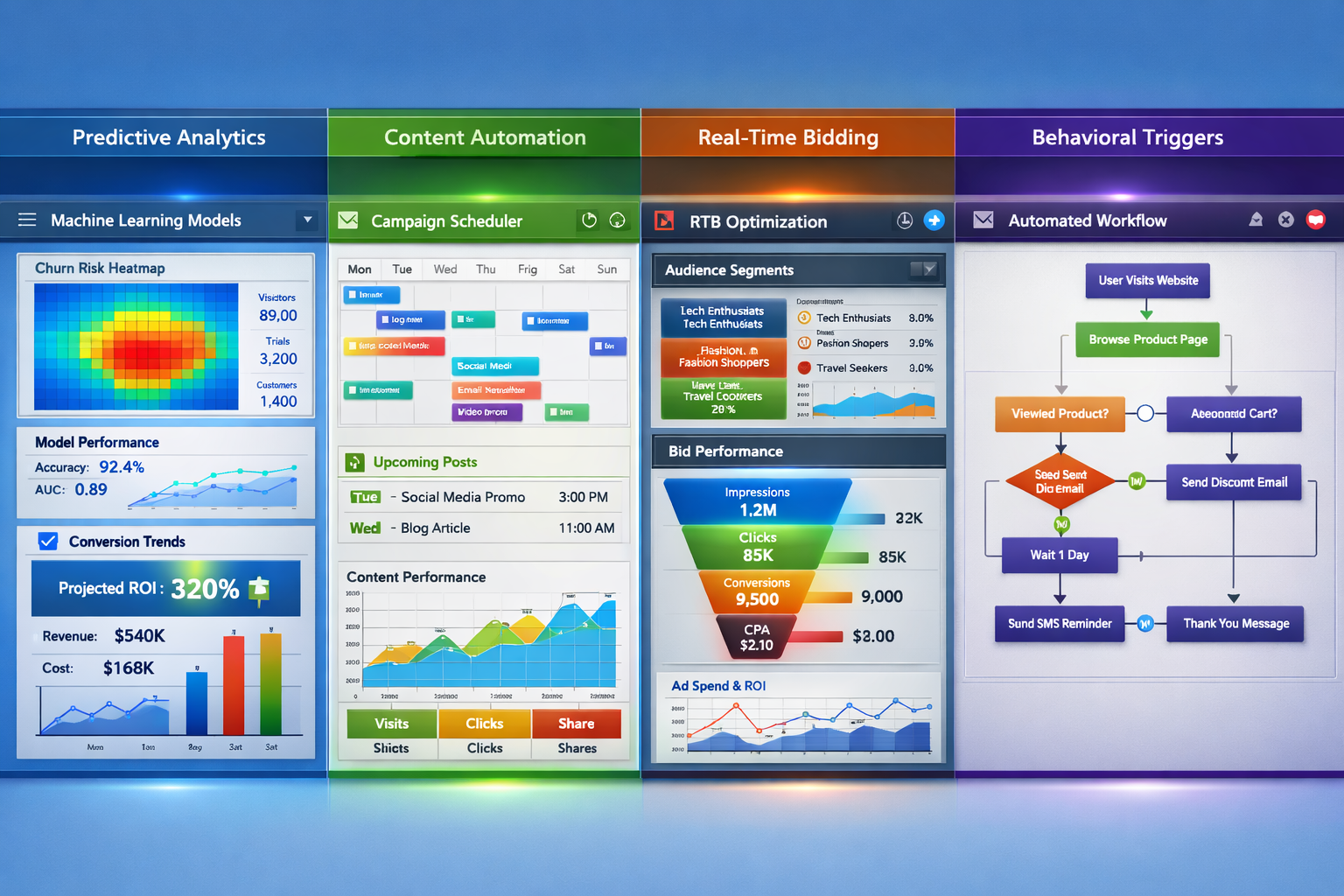
Perhaps the most transformative development is the emergence of AI agents that autonomously manage entire affiliate campaigns end-to-end. By 2026, these agents have become mainstream in marketing workflows, capable of thinking, acting, and optimizing independently without manual intervention for routine tasks [2].
These systems handle:
- Real-time bidding optimization adjusting bids based on conversion probability
- Audience segmentation and targeting refinement across platforms
- Creative testing and automatic rotation of top-performing variations
- Budget allocation shifting resources to highest-ROI channels
Google's agentic AI system "Your Google Ads Expert" now proactively identifies performance anomalies—such as conversion rate drops from broken landing pages—and can resolve issues or alert marketers instantly without manual intervention [5].
Implementing Predictive Workflows to Boost Commissions
Understanding the tools is only the first step. Successful implementation requires structured workflows that integrate predictive insights into daily operations.
Building Your Predictive Content Calendar
Start by connecting trend forecasting tools to your content calendar. Set up automated alerts for:
- Rising search trends in your niche with projected spike dates
- Product launch announcements from merchant partners
- Seasonal opportunity windows based on historical patterns
- Competitor content gaps where demand exceeds supply
Schedule content creation to complete 2-4 weeks before predicted spike dates, allowing time for indexing and initial promotion. Those exploring how to become an affiliate marketer should build this forecasting discipline from day one.
Hyper-Personalization Through Behavioral Triggers
AI-driven personalization using behavioral signals, context, and intent data tailors content and product offers for each individual visitor. Predictive analytics can surface offers before customers consciously realize they want them [2].
Implement behavioral trigger workflows that automatically respond to user actions:
- Website visits trigger personalized email sequences
- Product page views activate retargeting with relevant content
- Email opens initiate follow-up with complementary offers
- Cart abandonment triggers urgency-based promotions
These automated workflows respond to prospect actions in real time, delivering personalized content and offers based on demonstrated interest [6].
Multi-Touch Attribution and Performance Tracking
Enhanced multi-touch attribution models now track affiliate contributions accurately across multiple touchpoints, providing better insights into customer journeys and ensuring affiliates receive fair compensation for their role in conversions [4].
Modern attribution systems reveal:
- Which content pieces initiate customer journeys
- How predictive content performs versus reactive content
- The true ROI of publishing before versus after trend spikes
- Optimal content mix across awareness, consideration, and decision stages
This data feeds back into predictive models, continuously improving forecast accuracy.
Maximizing ROI Without Reactive Chasing
The traditional affiliate approach—monitoring trends, creating content after spikes begin, and competing in saturated markets—leads to diminishing returns. Predictive forecasting eliminates this reactive cycle.
Resource Allocation Based on Predictions
Predictive lead scoring identifies high-conversion prospects automatically by analyzing historical performance data to score leads, predict win probability, and forecast revenue [2]. This enables affiliates to prioritize outreach to the most promising prospects rather than spreading efforts equally.
Allocate your content creation budget based on:
- Predicted trend magnitude (larger spikes justify more content investment)
- Competition level (first-mover advantage is highest in less competitive niches)
- Conversion probability (focus on products with strong purchase intent signals)
- Commission rates (balance opportunity size with payout potential)
Understanding whether you can make money with affiliate marketing depends largely on this strategic resource allocation.
Avoiding Common Pitfalls
Even with powerful AI tools, several mistakes can undermine predictive strategies:
❌ Over-reliance on automation without strategic oversight
❌ Ignoring data quality leading to inaccurate predictions
❌ Publishing too early before any search demand exists
❌ Neglecting content quality in favor of speed
❌ Failing to validate predictions with multiple data sources
Learn from common affiliate marketing mistakes to avoid these pitfalls.
The 2026 Affiliate Marketing Landscape
The affiliate industry continues rapid evolution. The US market is projected to reach $15 billion in 2026, representing a 20% year-over-year increase [3]. This growth is driven primarily by AI-powered strategies that improve targeting precision and operational efficiency [4].
Key trends shaping the industry:
- AI-driven automation embedded across content creation, campaign optimization, and predictive analytics
- Enhanced attribution models providing clearer ROI visibility
- Voice and visual search creating new content opportunities
- Privacy-first tracking requiring more sophisticated attribution methods
Affiliates who adopt AI marketing automation position themselves at the forefront of these industry shifts.
Practical Tools and Platforms for 2026
Several specific platforms have emerged as leaders in predictive affiliate marketing:
| Tool Category | Key Features | Best For |
|---|---|---|
| Trend Forecasters | Search volume prediction, seasonal analysis, competitor monitoring | Identifying opportunities early |
| Content Automation | AI writing, multimodal generation, localization | Scaling content production |
| Campaign Management | Autonomous optimization, real-time bidding, creative testing | Hands-off campaign scaling |
| Attribution Platforms | Multi-touch tracking, ROI analysis, journey mapping | Understanding true performance |
| Behavioral Automation | Trigger workflows, personalization, dynamic content | Converting prospects efficiently |
When evaluating affiliate marketing opportunities, prioritize those that integrate well with these AI-powered systems.
Integration Strategies
The most effective approach combines multiple tools into cohesive workflows:
- Trend forecaster identifies opportunity →
- Content automation creates optimized articles →
- Campaign management distributes across channels →
- Behavioral automation nurtures visitors →
- Attribution platform measures results →
- Feedback loop refines predictions
This integrated approach delivers exponentially better results than isolated tool usage.
Conclusion
Predictive Content Forecasting for Affiliates: AI Tools to Publish Before Trends Spike and Boost Commissions represents the future of affiliate marketing—a future that has already arrived in 2026. The competitive advantage now belongs to those who anticipate rather than react, who leverage AI to identify opportunities before they become obvious, and who publish content at precisely the right moment to capture rising demand.
The tools and workflows outlined in this guide provide a roadmap for transforming your affiliate strategy from reactive to predictive. By implementing trend forecasting platforms, content automation systems, autonomous campaign management, and behavioral trigger workflows, affiliates can dramatically increase ROI while reducing the exhausting cycle of chasing trends.
Next Steps to Implement Predictive Forecasting
Ready to transform your affiliate approach? Take these immediate actions:
✅ Audit your current workflow to identify reactive versus proactive content
✅ Select one trend forecasting tool and test it for 30 days
✅ Set up automated alerts for rising trends in your top niches
✅ Create a predictive content calendar for the next quarter
✅ Implement one behavioral trigger workflow to test personalization
✅ Establish attribution tracking to measure predictive content ROI
The affiliate marketing landscape continues evolving rapidly, but the fundamental principle remains constant: those who see opportunities first and act decisively capture the greatest rewards. With AI-powered predictive forecasting, that first-mover advantage is now accessible to affiliates at every level.
Start small, test systematically, and scale what works. The commission-boosting power of publishing before trends spike awaits those willing to embrace these transformative tools and strategies.
References
[1] Ai Affiliate Marketing – https://www.linkjolt.io/blog/ai-affiliate-marketing
[2] Ai Predictions Marketing – https://blog.hubspot.com/marketing/ai-predictions-marketing
[3] The Future Of Affiliate Marketing 2026 Edition – https://www.mattmcwilliams.com/the-future-of-affiliate-marketing-2026-edition/
[4] Affiliate Marketing – https://www.imd.org/blog/marketing/affiliate-marketing/
[5] Ai Marketing Guide – https://www.yotpo.com/blog/ai-marketing-guide/
[6] Best Ai Tools Marketing 2026 – https://thesmarketers.com/blogs/best-ai-tools-marketing-2026/