

The shopping landscape has fundamentally transformed. In 2026, AI agents are no longer just helpful assistants—they’ve become primary decision-makers handling nearly a quarter of all shopping intents. When consumers ask their AI assistant to “find the best wireless headphones under $200,” they’re delegating the entire research, comparison, and recommendation process to a non-human buyer. This seismic shift in Predisposing AI Purchasing Agents: Affiliate Strategies for Delegated Consumer Decisions in 2026 requires affiliate marketers to completely rethink how they position products, structure content, and capture commissions in an era where machines make purchases before humans even see the options.
The traditional affiliate playbook—crafted for human readers scrolling through blog posts and clicking colorful buttons—is becoming obsolete. AI purchasing agents don’t respond to emotional appeals, persuasive copywriting, or attractive banner ads. They evaluate structured data, machine-readable optimization tactics specifications, and verified trust signals at computational speed. For affiliate marketers, this means the game has changed from influencing human psychology to predisposing algorithmic decision-making systems.
Key Takeaways
The evolution of AI purchasing agents in 2026 demands integration with zero-click monetization frameworks aligned with post-ChatGPT ads compliance to ensure affiliate strategies remain effective in consent-based advertising environments.

- 🤖 AI agents now handle 24% of shopping decisions, requiring affiliates to optimize for machine-readable content rather than human persuasion
- 📊 Structured data and schema markup are essential for making affiliate content discoverable to AI purchasing agents
- ⚡ Agent-to-agent commerce is compressing traditional multi-day purchase journeys into instant transactions through real-time API communication
- 🔗 Multi-touch attribution models and first-party data strategies are replacing cookie-based tracking in AI-mediated purchases
- 💰 Crypto-integrated affiliate links and blockchain verification provide transparent commission tracking in automated transactions
Understanding AI Purchasing Agents and Delegated Consumer Decisions
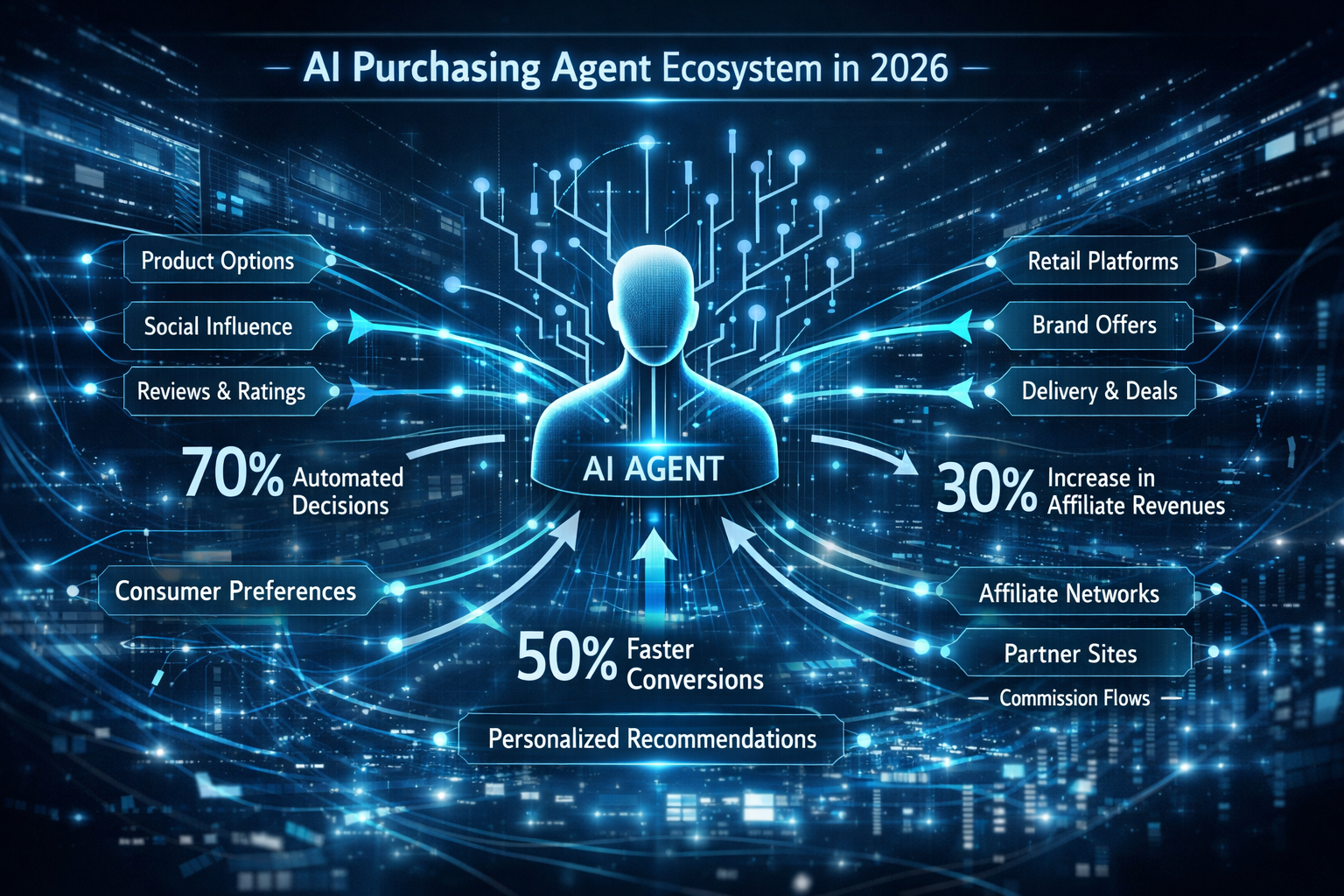
What Are AI Purchasing Agents?
AI purchasing agents are autonomous software systems that make shopping decisions on behalf of consumers. Unlike simple product recommendation engines, these agents actively research options, compare specifications, verify credibility, check inventory, negotiate terms, and execute purchases—all without direct human intervention at each step.
In 2026, these agents operate across multiple platforms:
- Voice assistants (Alexa, Google Assistant, Siri) that complete purchases through conversational commands
- ChatGPT and Perplexity offering comparative shopping research with instant checkout capabilities
- Specialized procurement bots for B2B environments that negotiate with hundreds of suppliers simultaneously
- Personal AI assistants integrated into smartphones and smart home devices
The critical distinction is delegation versus assistance. Consumers increasingly trust AI agents to make final decisions rather than simply providing options for human review. According to industry research, “a meaningful share of customer interactions will happen agent-to-agent” in 2026, with shoppers using AI assistants to verify stock, delivery times, and returns policies while brands deploy their own AI agents to respond instantly [3].
How AI Agents Evaluate Products
AI purchasing agents prioritize high-friction task elimination—they rapidly assume responsibility for price comparisons, credibility checks, return policy scanning, and review validation [2][3]. Their evaluation process follows a fundamentally different logic than human shopping behavior:
| Human Shopping Behavior | AI Agent Decision Process |
|---|---|
| Emotional response to imagery | Structured data parsing |
| Persuasive copywriting influence | Specification matching algorithms |
| Brand loyalty and recognition | Objective credibility scoring |
| Subjective review interpretation | Sentiment analysis aggregation |
| Multi-day research process | Millisecond comparison execution |
For affiliate marketing strategies to remain effective, marketers must understand that AI agents evaluate products through machine-readable trust signals rather than human-persuasive content.
The Rise of Agent-to-Agent Commerce in 2026
Real-Time Data Exchange Between AI Systems
The most transformative development in Predisposing AI Purchasing Agents: Affiliate Strategies for Delegated Consumer Decisions in 2026 is the emergence of agent-to-agent commerce. This represents a fundamental shift from consumer-to-business transactions to AI-to-AI negotiations.
Here’s how it works in practice:
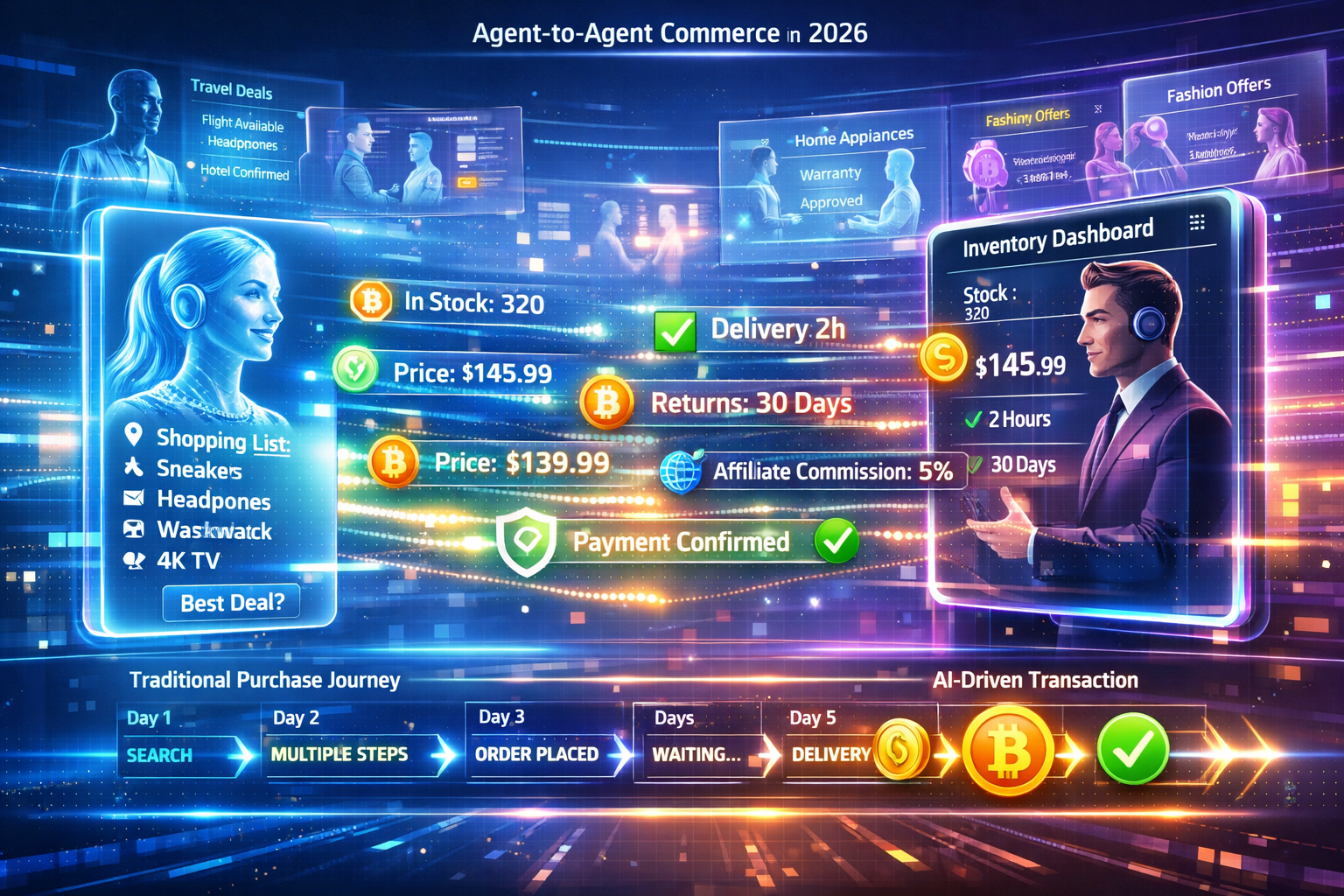
- Consumer’s AI agent receives a purchase request (“Buy organic coffee beans”)
- Agent queries multiple brand AI systems simultaneously through APIs
- Brand agents respond with real-time inventory, pricing, delivery windows, and return policies
- Consumer’s agent evaluates responses against predefined preferences and constraints
- Transaction executes automatically with the optimal supplier
- Affiliate attribution occurs through blockchain-verified referral tracking
This compression of transaction timelines requires real-time data availability through APIs [3]. Traditional affiliate content that takes hours or days to reach consumers becomes irrelevant when AI agents complete entire purchase cycles in seconds.
GenAI Platforms as Retail Channels
Major GenAI platforms have transitioned from information providers to direct retail channels. In 2026, these platforms compete as affiliate distribution networks:
- Perplexity launched a free shopping experience with conversational product discovery and instant checkout
- OpenAI introduced comparative shopping research directly in ChatGPT
- Google enabled “Buy for me” functionality across Search and Gemini [5]
For affiliate marketers, this creates both opportunity and competition. These platforms can drive significant affiliate revenue, but they also control the entire customer experience and may prioritize their own commercial relationships over independent affiliate recommendations.
Affiliate Strategies for Predisposing AI Purchasing Agents
Optimizing Product Feeds for Machine Readability
The foundation of successful Predisposing AI Purchasing Agents: Affiliate Strategies for Delegated Consumer Decisions in 2026 is creating machine-readable product information. AI agents cannot be persuaded by clever copywriting—they require structured, standardized data formats.
Essential optimization tactics include:
✅ Implement Schema.org markup for products, reviews, pricing, and availability
✅ Create comprehensive JSON-LD structured data with all product specifications
✅ Maintain real-time inventory feeds accessible through APIs
✅ Standardize attribute naming (use industry-standard taxonomies)
✅ Include machine-readable trust signals (return policies, warranties, certifications)
✅ Provide structured review data with sentiment scores and verification status
✅ Enable API access for agent-to-agent queries
For those learning how to succeed in affiliate marketing, understanding structured data implementation is now as critical as traditional SEO skills.
Creating Agent-Friendly Content Schemas
Traditional affiliate content focuses on human engagement metrics—time on page, scroll depth, click-through rates. AI agents don’t scroll or engage emotionally. They parse, extract, and evaluate.
Agent-friendly content architecture includes:
Specification Tables
Present product specifications in clean HTML tables with consistent attribute names. AI agents can extract and compare this data across multiple sources instantly.
FAQ Schema Markup
Structure common questions and answers using FAQ schema. When AI agents research “best wireless headphones for running,” they prioritize content with structured Q&A data.
Comparison Matrices
Create standardized comparison tables with identical attributes across competing products. This enables AI agents to perform objective evaluations without interpretation.
Trust Signal Documentation
Clearly document return policies, warranty terms, shipping options, and customer service availability in machine-readable formats. AI agents prioritize vendors with transparent, easily verifiable policies.
“AI agents rapidly assume responsibility for price comparisons, credibility checks, return policy scanning, and review validation—tasks traditionally handled by affiliate content.” [2]
Blockchain and Crypto-Integrated Affiliate Links
Traditional cookie-based affiliate tracking faces two critical challenges in AI-mediated commerce:
- Privacy regulations and the third-party cookie phase-out eliminate traditional tracking methods [1]
- Agent-to-agent transactions bypass browser environments where cookies operate
The solution emerging in 2026 is blockchain-verified affiliate attribution with crypto-integrated commission payments:
How Blockchain Affiliate Tracking Works:
- Each affiliate link contains a unique blockchain identifier
- When an AI agent executes a purchase, the transaction is recorded on-chain
- Attribution is cryptographically verified and immutable
- Commissions are automatically distributed through smart contracts
- Multi-touch attribution is transparently tracked across the entire customer journey
This approach solves the attribution problem while providing instant commission payments and eliminating disputes about referral credit. For top strategies for affiliate marketers in 2024 and beyond, understanding crypto-integrated tracking is becoming essential.
Multi-Touch Attribution in AI-Driven Purchases
AI purchasing agents often consult multiple information sources before making decisions. A single purchase might involve:
- Initial research on a comparison website
- Specification verification on manufacturer sites
- Review validation across multiple platforms
- Price checking on aggregator services
- Final purchase through a GenAI platform
Improved tracking and attribution models provide better insights into customer journeys, ensuring affiliates receive fair payouts in a landscape where traditional conversion tracking becomes obsolete [1]. Without updated attribution frameworks, affiliates risk losing revenue visibility in agent-driven transactions.
Modern multi-touch attribution for AI commerce includes:
🔹 First-party data collection replacing third-party cookies
🔹 Server-side tracking that captures agent API requests
🔹 Blockchain transaction logs providing immutable attribution records
🔹 Weighted attribution models that credit multiple touchpoints
🔹 Real-time commission calculation through smart contracts
The Human Element: Creator Networks and Micro-Influencers
Why Human Recommendations Still Matter
Despite AI agents handling increasing transaction volume, human influence remains powerful in 2026. Industry observers note that “AI and its poor recommendations will inadvertently spur” preference to “buy from people, not robots” [4].
Three in every 10 US advertisers worked with creators via affiliate networks in 2025, with this number expected to climb “significantly” in 2026 [4]. This expansion reflects growing recognition that authentic human recommendations provide value AI agents cannot replicate.
The strategic opportunity lies in hybrid approaches where:
- Human creators build trust and provide authentic product experiences
- AI agents verify creator recommendations against objective criteria
- Affiliate commissions reward both human influence and AI-mediated transactions
Social Media as AI-Accessible Affiliate Channels
TikTok, YouTube, and Instagram are reshaping affiliate marketing strategies despite platform discouragement of external links. Platform operators increasingly recognize that facilitating transactions aligns with their business models [1][4].
In 2026, social platforms are becoming AI-accessible through:
- API access allowing AI agents to query creator content and recommendations
- Structured product tags that AI agents can parse and evaluate
- Creator credibility scores that AI agents factor into decision-making
- Integrated checkout that enables agent-mediated purchases without leaving platforms
For creators and affiliates, this means optimizing social content for both human engagement and AI discoverability.
B2B Procurement: The Frontier of AI Agent Commerce
Enterprise AI Agents Reshaping B2B Affiliate Programs
While consumer AI agents capture attention, B2B procurement agents represent the fastest-growing segment of AI-mediated commerce. Forrester predicts buyers’ procurement teams will deploy agents capable of “scaling negotiation across hundreds of suppliers simultaneously” by 2026, with 80% of B2B sales interactions already occurring digitally [6].
For B2B affiliate programs, this creates unprecedented opportunities:
Volume Multiplication
A single procurement agent can evaluate and purchase from dozens of suppliers in the time a human buyer completes one transaction. Affiliates who position themselves as trusted intermediaries can capture commissions across massive transaction volumes.
Specification-Driven Matching
B2B purchases prioritize objective specifications over brand loyalty. Affiliates who maintain comprehensive, machine-readable specification databases become essential resources for procurement agents.
Automated Negotiation
AI procurement agents negotiate terms, volume discounts, and delivery schedules automatically. Affiliate programs must support dynamic commission structures that adapt to negotiated terms.
Adapting Commission Structures for AI Commerce
Companies are adjusting commission rates and payout models to balance profitability with attracting high-performing affiliates, requiring program managers to actively renegotiate terms in a competitive environment [1].
Emerging commission models for AI agent commerce include:
| Traditional Model | AI-Optimized Model |
|---|---|
| Fixed percentage per sale | Dynamic rates based on transaction complexity |
| Cookie-based attribution | Blockchain-verified multi-touch |
| Monthly payouts | Instant smart contract settlements |
| Manual fraud review | Algorithmic verification |
| Single-touch credit | Weighted multi-source attribution |
For those exploring how to become an affiliate marketer, understanding these evolving commission structures is critical for long-term success.
AI-Powered Content Creation and Campaign Optimization
Leveraging AI Tools for Affiliate Content
Artificial intelligence now plays a larger role in affiliate content creation, campaign optimization, and predictive analytics, helping affiliates improve targeting and efficiency [1]. In 2026, successful affiliates use AI tools to:
Generate Structured Product Descriptions
AI writing tools create specification-rich product descriptions with proper schema markup, ensuring content is optimized for both human readers and AI purchasing agents.
Automate Comparison Content
AI systems continuously monitor competitor products, pricing, and specifications, automatically updating comparison tables and recommendation algorithms.
Predict Purchase Intent
Machine learning models analyze user behavior patterns to predict when AI agents are likely to research specific product categories, enabling proactive content optimization.
Optimize for Agent Queries
Natural language processing tools analyze how AI agents phrase product queries, allowing affiliates to optimize content for machine search patterns rather than human keywords.
For comprehensive guidance on integrating these technologies, explore resources on foundations of SEO for affiliate marketing adapted for AI-driven search.
Predictive Analytics for Agent Behavior
Understanding how AI agents make decisions requires analyzing their behavior patterns. In 2026, sophisticated affiliates deploy analytics systems that:
- Track which data fields AI agents prioritize in product evaluations
- Identify trust signals that most influence agent recommendations
- Monitor response times to API queries and optimize data delivery speed
- Analyze attribution patterns across multi-touch agent journeys
- Predict seasonal demand based on agent query volume trends
This data-driven approach transforms affiliate marketing from creative persuasion to systematic optimization.
Practical Implementation: Getting Started in 2026
Step-by-Step Guide to AI-Ready Affiliate Content
For affiliates ready to adapt to Predisposing AI Purchasing Agents: Affiliate Strategies for Delegated Consumer Decisions in 2026, here’s a practical implementation roadmap:
Phase 1: Audit Current Content (Week 1-2)
- Evaluate existing content for structured data implementation
- Identify product pages lacking schema markup
- Review specification completeness and standardization
- Assess API accessibility of product information
Phase 2: Implement Structured Data (Week 3-6)
- Add schema.org Product markup to all product pages
- Implement Review schema with aggregated ratings
- Create FAQ schema for common product questions
- Develop JSON-LD structured data for key attributes
Phase 3: Enable API Access (Week 7-10)
- Create API endpoints for real-time product data
- Implement authentication for agent-to-agent queries
- Ensure sub-second response times for agent requests
- Document API specifications for AI agent integration
Phase 4: Optimize Attribution (Week 11-14)
- Transition to first-party data collection methods
- Implement server-side tracking for agent transactions
- Explore blockchain-based attribution solutions
- Configure multi-touch attribution models
Phase 5: Test and Refine (Ongoing)
- Monitor AI agent traffic and behavior patterns
- Analyze which structured data elements drive conversions
- Optimize response times and data completeness
- Continuously update schemas as standards evolve
Tools and Resources for AI Agent Optimization
Structured Data Tools:
- Google’s Structured Data Testing Tool
- Schema.org markup generators
- JSON-LD validators
- Rich results testing platforms
API Development:
- RESTful API frameworks
- GraphQL for flexible data queries
- API documentation generators
- Performance monitoring tools
Attribution and Tracking:
- First-party data platforms
- Server-side tracking solutions
- Blockchain attribution services
- Multi-touch attribution software
Content Optimization:
- AI-powered content generators
- Specification extraction tools
- Automated comparison builders
- Sentiment analysis platforms
For those just starting their journey, reviewing what is affiliate marketing provides essential foundational knowledge before diving into advanced AI optimization.
Challenges and Ethical Considerations
Transparency in AI-Mediated Affiliate Relationships
As AI agents make purchasing decisions on behalf of consumers, transparency becomes critical. Consumers deserve to know:
- When AI agents are receiving affiliate commissions
- How those commissions might influence recommendations
- What data AI agents use to make decisions
- Whether AI agents prioritize affiliate revenue over consumer value
Ethical affiliate marketers in 2026 implement disclosure mechanisms that inform consumers when AI agents are making commission-influenced recommendations, even if the consumer never directly sees the affiliate content.
Balancing Automation with Consumer Protection
The speed and autonomy of AI purchasing agents create consumer protection challenges:
⚠️ Unwanted purchases made by overly autonomous agents
⚠️ Biased recommendations based on affiliate commission rates
⚠️ Privacy concerns about AI agents sharing consumer data
⚠️ Quality issues when agents prioritize price over value
Responsible affiliate programs implement safeguards including:
- Mandatory human approval for purchases above threshold amounts
- Transparent disclosure of commission relationships
- Quality guarantees and easy return processes
- Consumer control over AI agent decision parameters
Regulatory Landscape and Compliance
Privacy regulations and evolving affiliate marketing laws require constant attention. In 2026, affiliates must navigate:
- GDPR and CCPA compliance for first-party data collection
- FTC disclosure requirements adapted for AI-mediated transactions
- Platform-specific rules for social media affiliate content
- Industry standards for AI agent transparency
Staying informed about regulatory developments is essential for long-term success in AI-driven affiliate marketing.
Future Outlook: Beyond 2026
Emerging Trends in AI Agent Commerce
The evolution of Predisposing AI Purchasing Agents: Affiliate Strategies for Delegated Consumer Decisions in 2026 continues accelerating. Emerging trends include:
Fully Autonomous Household Agents
AI systems that manage all household purchasing without human intervention, from groceries to appliances, based on usage patterns and preferences.
Collaborative Agent Networks
Consumer AI agents that share information and recommendations with trusted peer agents, creating social networks of AI decision-makers.
Predictive Procurement
Agents that anticipate needs before consumers recognize them, purchasing products proactively based on behavioral patterns and life events.
Augmented Reality Integration
AI agents that evaluate products in physical retail environments through AR interfaces, combining online information access with in-store shopping.
Preparing for Continuous Evolution
The only constant in AI-driven commerce is continuous change. Successful affiliates in 2026 and beyond will:
✨ Maintain learning mindsets and continuously update skills
✨ Invest in technology infrastructure that supports rapid adaptation
✨ Build flexible content systems that accommodate new AI platforms
✨ Develop diverse revenue streams across multiple AI channels
✨ Prioritize relationships with both human creators and AI platform operators
The affiliate marketers who thrive will be those who view AI agents not as threats to traditional methods, but as new audiences requiring different optimization approaches.
📚 Related Reading
For a comprehensive overview, see our authoritative guide: AI answer engines vs traditional search.
Conclusion
The transformation of shopping through Predisposing AI Purchasing Agents: Affiliate Strategies for Delegated Consumer Decisions in 2026 represents the most significant shift in affiliate marketing since the commercialization of the internet. With AI agents now handling nearly a quarter of shopping decisions, the traditional playbook of persuasive content and emotional appeals has given way to structured data, machine-readable specifications, and algorithmic optimization.
Success in this new landscape requires fundamental strategic shifts:
- Prioritizing machine-readable content over human-persuasive copy
- Implementing structured data and schema markup as foundational requirements
- Enabling real-time API access for agent-to-agent commerce
- Adopting blockchain-verified attribution to replace cookie-based tracking
- Balancing AI optimization with authentic human creator relationships
- Maintaining ethical transparency in AI-mediated transactions
The affiliate marketers who adapt quickly—implementing agent-friendly content schemas, crypto-integrated affiliate links, and multi-touch attribution models—will capture disproportionate value as AI commerce accelerates. Those who cling to traditional methods risk irrelevance as AI agents bypass human-focused content entirely.
Actionable Next Steps
This Week:
- Audit your top-performing affiliate content for structured data implementation
- Research schema.org markup requirements for your product categories
- Identify which AI platforms (ChatGPT, Perplexity, Google Gemini) your target audience uses
This Month:
- Implement basic Product and Review schema on your highest-traffic pages
- Create specification comparison tables with standardized attributes
- Test your content accessibility to AI agents through platform searches
This Quarter:
- Develop API endpoints for real-time product data access
- Transition to first-party data collection and server-side tracking
- Explore blockchain-based attribution solutions for your affiliate program
- Build relationships with micro-influencers in your niche for hybrid human-AI strategies
The future of affiliate marketing isn’t about choosing between human creativity and AI optimization—it’s about strategically combining both to influence decisions at every stage of the customer journey, whether those decisions are made by humans or the AI agents they trust. Start implementing these strategies today to position yourself for success in the AI-driven commerce ecosystem of 2026 and beyond.
References
[1] Affiliate Marketing – https://www.imd.org/blog/marketing/affiliate-marketing/
[2] How Agentic Ai Will Reshape Shopping 2026 – https://www.emarketer.com/content/how-agentic-ai-will-reshape-shopping-2026
[3] How Ai Agents Will Reshape Every Part Of Marketing In 2026 – https://martech.org/how-ai-agents-will-reshape-every-part-of-marketing-in-2026/
[4] Affiliate Marketing Trends 2026 – https://www.awin.com/us/sector-insights/affiliate-marketing-trends-2026
[5] Ai Trends Shaping Agentic Commerce – https://commercetools.com/blog/ai-trends-shaping-agentic-commerce
[6] Top 5 Ai Trends In B2b Reshaping Commerce In 2026 – https://www.mirakl.com/blog/top-5-ai-trends-in-b2b-reshaping-commerce-in-2026
