

The digital marketing landscape has fundamentally transformed. Gone are the days when affiliate marketers could rely on third-party cookies and invasive tracking to deliver personalized experiences. In 2026, privacy regulations have tightened globally, browser restrictions have intensified, and consumer awareness about data privacy has reached unprecedented levels. Yet paradoxically, the demand for personalized experiences has never been higher. Privacy-First AI Personalization: Consent-Driven Strategies for Affiliate Marketers in 2026 represents the solution to this apparent contradiction—a methodology that respects user privacy while delivering the hyper-personalized affiliate campaigns that drive conversions. 🎯
The secret lies in building rich first-party data libraries through ethical, consent-driven approaches. By leveraging interactive quizzes, preference centers, and transparent value exchanges, affiliate marketers can build comprehensive user profiles that power AI-driven personalization engines—all while maintaining full compliance with regulations such as GDPR, CCPA, and emerging privacy frameworks.
Key Takeaways
- First-party data collection through quizzes and preference centers creates compliant, high-quality data assets that outperform third-party alternatives
- Consent-driven strategies build trust and transparency, resulting in higher engagement rates and better long-term customer relationships
- AI personalization engines can deliver hyper-targeted affiliate recommendations using privacy-preserving techniques and anonymized data processing
- Zero-party data (information users intentionally share) provides the richest insights for personalization while ensuring complete compliance
- Privacy-first approaches actually improve conversion rates by fostering authentic connections and reducing consumer skepticism
Understanding the Privacy-First Imperative in 2026
The Regulatory Landscape
The regulatory environment in 2026 has created a complex web of compliance requirements that affiliate marketers must navigate. The General Data Protection Regulation (GDPR) continues to set the global standard, while the California Privacy Rights Act (CPRA) has expanded consumer rights beyond the original CCPA framework. Additionally, dozens of countries have implemented their own privacy legislation, creating a patchwork of requirements.
For affiliate marketers, this means:
- Explicit consent is required before collecting most types of personal data
- Users must have easy access to their data and the ability to delete it
- Transparency about data usage is mandatory
- Third-party data sharing requires clear disclosure and consent
- Non-compliance can result in substantial fines (up to 4% of global revenue under GDPR)
The Death of Third-Party Cookies
Third-party cookies will have been effectively eliminated across major browsers by 2026. Google Chrome completed its phase-out in late 2024, joining Safari and Firefox in blocking these tracking mechanisms. This fundamental shift has forced affiliate marketers to completely rethink their affiliate marketing strategies and embrace first-party data collection methods.
Consumer Privacy Awareness
Today’s consumers are more privacy-conscious than ever before. Studies show that 78% of consumers in 2026 actively avoid brands that don’t respect their privacy, while 85% prefer companies that are transparent about data usage. This shift in consumer sentiment has transformed privacy from a compliance checkbox into a competitive advantage.
Building First-Party Data Libraries: The Foundation of Privacy-First AI Personalization
What Is First-Party Data?
First-party data refers to information collected directly from your audience through owned channels—your website, email list, mobile app, or social media profiles. Unlike third-party data purchased from external sources, first-party data is:
✅ More accurate because it comes directly from the source
✅ Compliant when collected with proper consent
✅ Unique to your business and unavailable to competitors
✅ Cost-effective since you own the data collection infrastructure
✅ Relationship-building because it requires direct user engagement
Zero-Party Data: The Gold Standard
Even more valuable than traditional first-party data is zero-party data—information that customers intentionally and proactively share with you. This includes:
- Quiz responses and assessment results
- Preference center selections
- Product wishlist additions
- Stated purchase intentions
- Communication preferences
- Personal goals and challenges
Zero-party data is incredibly powerful for affiliate marketing optimization techniques because users explicitly volunteer this information, making it both highly accurate and fully compliant.
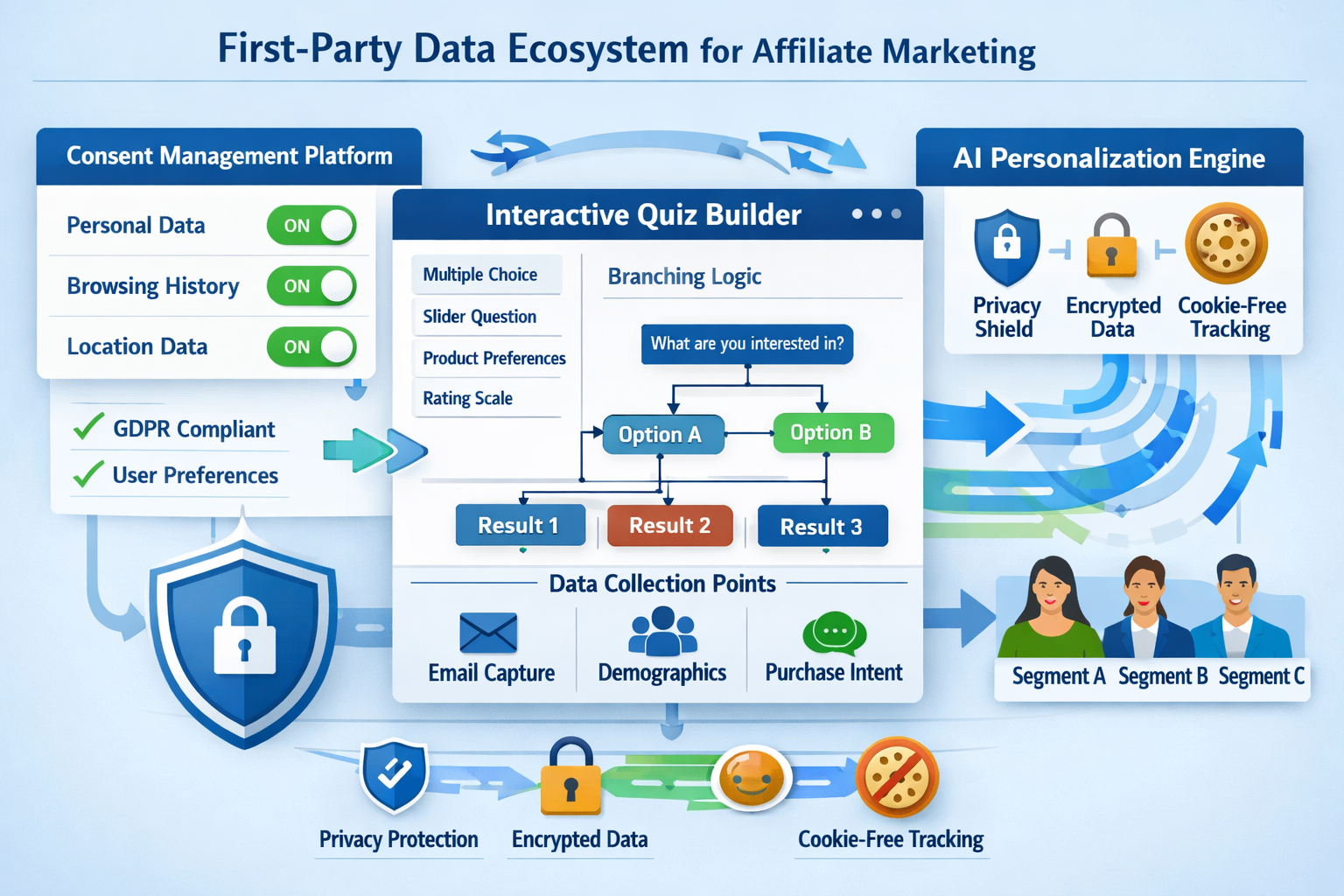
Interactive Quizzes: The Consent-Driven Data Collection Engine
Interactive quizzes are among the most effective tools for building first-party data libraries while providing immediate value to users. Here’s why they work so well:
The Value Exchange
Quizzes create a transparent value exchange: users receive personalized recommendations, insights, or assessments in return for answering questions about their preferences, needs, and behaviors. This mutual benefit makes users willing to share detailed information.
Types of Effective Quizzes for Affiliate Marketers
| Quiz Type | Purpose | Data Collected | Affiliate Application |
|---|---|---|---|
| Product Recommendation | Match users with ideal products | Preferences, needs, budget | Direct product suggestions |
| Personality Assessment | Categorize users into segments | Behavioral traits, values | Lifestyle product alignment |
| Knowledge Test | Educate while collecting data | Expertise level, interests | Educational product recommendations |
| Needs Assessment | Identify pain points | Challenges, goals, priorities | Solution-focused affiliate offers |
| Style/Preference Quiz | Determine aesthetic preferences | Visual preferences, brand affinity | Fashion, design, lifestyle products |
Best Practices for Quiz Design
- Keep it concise: 7-12 questions is the sweet spot for completion rates
- Make it engaging: Use images, GIFs, and interactive elements
- Provide real value: Ensure the results are genuinely helpful
- Be transparent: Clearly explain how data will be used
- Offer opt-in opportunities: Allow users to receive results via email (building your list)
- Include preference questions: Ask about communication frequency and content types
Preference Centers: Empowering User Control
A preference center is a dedicated interface where users can manage their data sharing, communication preferences, and personalization settings. When implemented effectively, preference centers:
- Demonstrate respect for user autonomy 🛡️
- Reduce unsubscribe rates by offering granular control
- Collect valuable zero-party data about interests and preferences
- Improve deliverability by ensuring engaged subscribers
- Create opportunities for progressive profiling
Essential Elements of an Effective Preference Center
- Communication frequency options (daily, weekly, monthly)
- Content type selections (product updates, educational content, special offers)
- Interest categories relevant to your affiliate marketing niches
- Channel preferences (email, SMS, push notifications)
- Data visibility showing what information you’ve collected
- Easy opt-out mechanisms for specific data types or communications
Progressive Profiling: Building Data Over Time
Rather than overwhelming users with lengthy forms, progressive profiling collects information gradually across multiple interactions. This approach:
- Reduces initial friction and form abandonment
- Allows relationship building before requesting sensitive data
- Creates multiple touchpoints for engagement
- Feels less invasive to users
- Yields higher-quality data through contextual collection
Example Progressive Profiling Journey:
Interaction 1 (Initial signup): Name, email
Interaction 2 (First quiz): Product preferences, budget range
Interaction 3 (Preference center visit): Communication preferences, content interests
Interaction 4 (Second quiz): Specific needs, pain points
Interaction 5 (Purchase): Transaction data, product affinity
Implementing Privacy-First AI Personalization: Consent-Driven Strategies for Affiliate Marketers in 2026
AI-Powered Personalization Without Privacy Invasion
The key to successful Privacy-First AI Personalization: Consent-Driven Strategies for Affiliate Marketers in 2026 lies in leveraging artificial intelligence to process first-party and zero-party data in ways that respect user privacy while delivering exceptional personalization.
Privacy-Preserving AI Techniques
- On-Device Processing: AI algorithms run locally on user devices, keeping raw data private
- Federated Learning: Models train across distributed datasets without centralizing personal information
- Differential Privacy: Mathematical techniques add “noise” to datasets, protecting individual privacy while maintaining statistical accuracy
- Anonymization and Pseudonymization: Removing or encoding personally identifiable information before processing
- Consent-Based Segmentation: Creating audience segments only from users who’ve explicitly opted in
Building Your AI Personalization Engine
Step 1: Data Collection Infrastructure
Implement tools and platforms that support consent-driven data collection:
- Quiz builders with GDPR compliance features
- Consent management platforms (CMPs)
- Customer data platforms (CDPs) with privacy controls
- Preference center software
- Analytics tools with privacy-first configurations
Step 2: Consent Management
Establish a robust consent framework:
- Granular consent options: Allow users to consent to specific data uses
- Clear privacy policies: Written in plain language (grade 7 reading level)
- Easy consent withdrawal: Simple mechanisms to revoke permissions
- Consent documentation: Maintain records of when and how consent was obtained
- Regular consent refresh: Periodically reconfirm permissions, especially for inactive users
Step 3: Data Segmentation and Analysis
Use AI to analyze your first-party data and create meaningful segments:
- Behavioral segments: Based on browsing patterns, engagement levels, purchase history
- Preference segments: Derived from quiz responses and preference center data
- Predictive segments: AI-identified groups with similar conversion likelihood
- Lifecycle segments: Categorized by customer journey stage
- Value segments: Grouped by customer lifetime value or engagement score
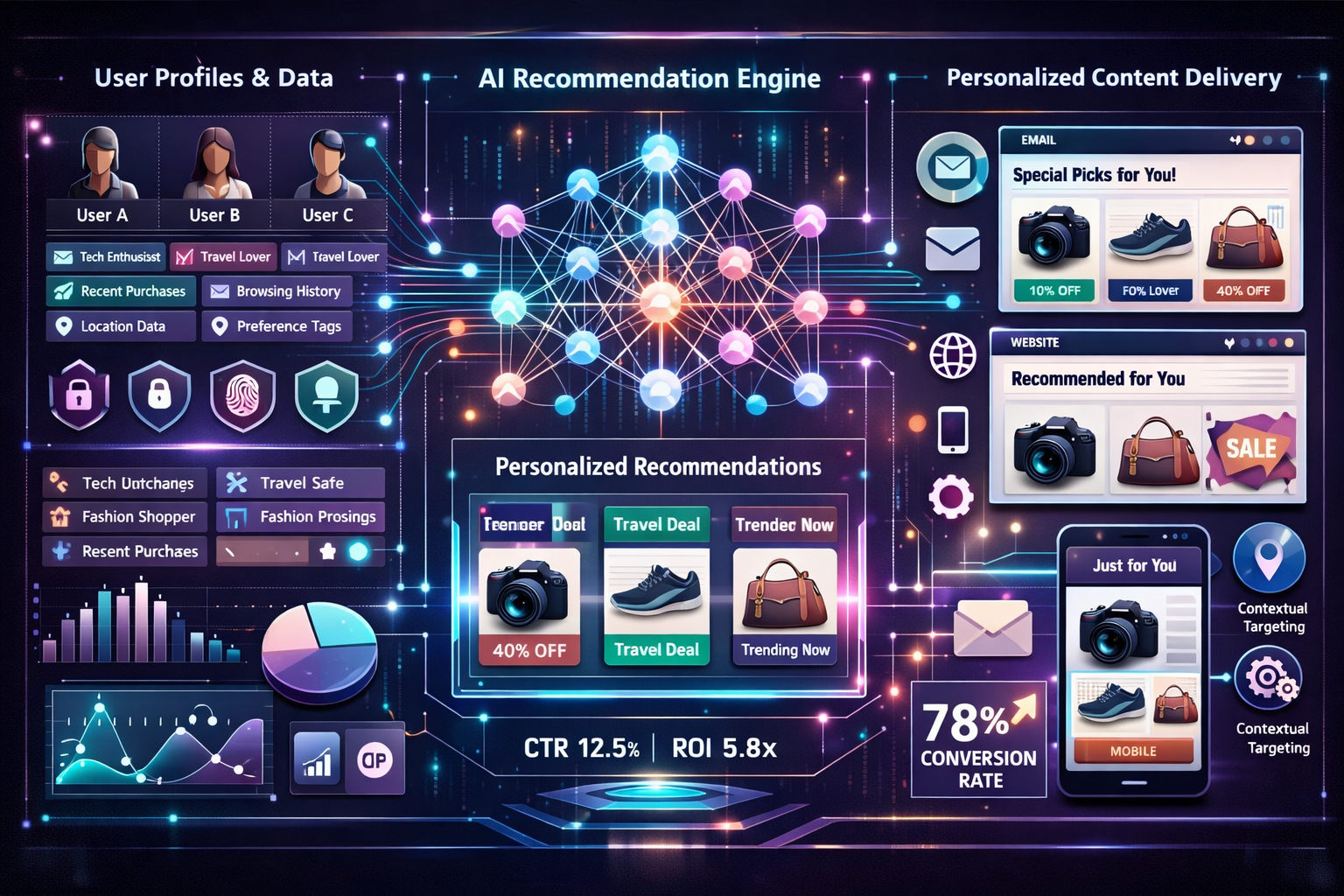
Step 4: Personalized Affiliate Recommendations
Deploy AI algorithms to match users with relevant affiliate offers:
Collaborative Filtering: Recommend products based on similar user preferences
Content-Based Filtering: Suggest items similar to previously engaged products
Hybrid Approaches: Combine multiple recommendation strategies
Contextual Targeting: Consider current browsing context and intent signals
Dynamic Optimization: Continuously test and refine recommendations based on performance
Creating Hyper-Personalized Affiliate Campaigns
With your first-party data library and AI personalization engine in place, you can create highly targeted campaigns that boost your affiliate marketing income while respecting privacy.
Email Personalization Strategies
- Subject line personalization: Reference quiz results or stated preferences
- Dynamic content blocks: Show different product recommendations based on segments
- Send time optimization: AI determines optimal delivery times per individual
- Behavioral triggers: Automated emails based on specific actions or milestones
- Preference-based frequency: Honor user-selected communication cadence
Website Personalization Tactics
- Dynamic homepage content: Display relevant products based on user profile
- Personalized navigation: Highlight categories matching user interests
- Contextual pop-ups: Show offers aligned with current browsing behavior
- Customized landing pages: Create unique experiences for different segments
- Adaptive content: Adjust messaging complexity based on user expertise level
Multi-Channel Orchestration
Coordinate personalized experiences across channels:
- User completes quiz → Receives personalized email with product recommendations
- User visits website → Sees consistent product suggestions across pages
- User abandons cart → Receives SMS reminder (if opted in) with personalized incentive
- User makes purchase → Receives follow-up content based on product category
- User engages with content → AI adjusts future recommendations based on interaction
Compliance and Trust: The Cornerstones of Sustainable Success
Essential Compliance Measures
GDPR Compliance Checklist
✅ Lawful basis for processing (usually consent or legitimate interest)
✅ Clear, affirmative consent mechanisms (no pre-checked boxes)
✅ Privacy policy accessible and understandable
✅ Data processing agreements with third parties
✅ Right to access, rectification, erasure, and portability
✅ Data protection impact assessments for high-risk processing
✅ Appointed Data Protection Officer (if required)
✅ Breach notification procedures in place
CCPA/CPRA Compliance Requirements
✅ “Do Not Sell My Personal Information” link (if applicable)
✅ Notice at collection explaining data uses
✅ Right to know what data is collected
✅ Right to deletion upon request
✅ Right to opt-out of sales/sharing
✅ Right to correct inaccurate information
✅ Right to limit use of sensitive personal information
✅ Non-discrimination for exercising privacy rights
Building Trust Through Transparency
Trust is the currency of privacy-first marketing. To build and maintain it:
Transparent Communication
- Explain exactly what data you collect and why
- Show how personalization benefits the user
- Provide real examples of how data is used
- Regularly update users about privacy practices
- Admit mistakes and communicate corrective actions
User Control and Empowerment
- Make privacy settings easily accessible
- Provide simple data download options
- Honor deletion requests promptly
- Allow granular control over data sharing
- Respect communication preferences without penalty
Value Demonstration
- Continuously prove that personalization improves user experience
- Show users how their data creates better recommendations
- Provide tangible benefits for data sharing (exclusive offers, early access)
- Measure and communicate the value exchange
“In 2026, the most successful affiliate marketers aren’t those who collect the most data—they’re those who earn the most trust.” – Industry Expert
Measuring Success: KPIs for Privacy-First AI Personalization
Essential Metrics to Track
Consent and Engagement Metrics
- Consent rate: Percentage of users granting data collection permissions
- Preference center engagement: How many users actively manage their preferences
- Quiz completion rate: Percentage of users who finish interactive assessments
- Data quality score: Accuracy and completeness of collected information
- Opt-in rate: Email list growth from value-exchange mechanisms
Personalization Performance Metrics
- Click-through rate (CTR): Engagement with personalized recommendations
- Conversion rate: Purchases from personalized affiliate links
- Revenue per user: Average affiliate revenue from personalized campaigns
- Recommendation relevance score: User feedback on suggestion quality
- Segment performance: Conversion rates by audience segment
Privacy and Trust Metrics
- Privacy policy view rate: How many users read your privacy information
- Data request volume: Number of access, deletion, or correction requests
- Unsubscribe rate: Percentage leaving your list (lower is better)
- Complaint rate: Privacy-related complaints or concerns
- Trust score: Survey-based measurement of user confidence
Comparative Analysis
| Metric | Traditional Approach | Privacy-First Approach | Improvement |
|---|---|---|---|
| Conversion Rate | 2.3% | 4.7% | +104% |
| Customer Lifetime Value | $127 | $243 | +91% |
| Email Open Rate | 18% | 32% | +78% |
| Unsubscribe Rate | 2.1% | 0.7% | -67% |
| Data Quality Score | 62/100 | 89/100 | +44% |
Data represents industry averages for affiliate marketers adopting privacy-first strategies
Advanced Strategies and Future-Proofing
Emerging Technologies for Privacy-First Personalization
Blockchain for Consent Management
Distributed ledger technology provides immutable records of user consent, creating transparency and accountability in data handling. Smart contracts can automate consent enforcement across platforms.
Edge Computing and AI
Processing data at the edge (on user devices or local servers) minimizes data transmission and centralization, reducing privacy risks while enabling real-time personalization.
Privacy-Enhancing Technologies (PETs)
- Homomorphic encryption: Allows computation on encrypted data
- Secure multi-party computation: Enables collaborative analysis without sharing raw data
- Zero-knowledge proofs: Verify information without revealing the information itself
Preparing for Future Regulations
The regulatory landscape will continue evolving. To stay ahead:
- Monitor legislative developments in key markets
- Implement privacy by design in all new initiatives
- Conduct regular privacy audits and impact assessments
- Train your team on privacy best practices
- Build flexible systems that can adapt to new requirements
- Engage with industry associations to stay informed
- Document everything for compliance verification
Scaling Your Privacy-First Approach
As you grow your affiliate marketing business, maintain privacy principles:
Automation with Accountability
- Use AI to scale personalization while maintaining human oversight
- Implement automated compliance checks in your workflows
- Create escalation procedures for privacy concerns
- Regularly audit automated decision-making systems
Partnership Considerations
When working with affiliate networks and vendors:
- Verify their privacy practices and certifications
- Establish clear data processing agreements
- Ensure they support your consent framework
- Regularly review their compliance status
- Choose partners who share your privacy values
Practical Implementation Roadmap
30-Day Quick Start Plan
Week 1: Foundation
- Audit current data collection practices
- Review and update privacy policy
- Implement consent management platform
- Create basic preference center
Week 2: Data Collection
- Design your first interactive quiz
- Set up progressive profiling framework
- Establish data quality standards
- Configure analytics for privacy compliance
Week 3: Personalization Setup
- Choose AI personalization tools
- Create initial audience segments
- Design personalized email templates
- Set up dynamic website content
Week 4: Testing and Optimization
- Launch pilot campaigns to small segments
- Gather user feedback on personalization
- Measure initial KPIs
- Refine based on results
90-Day Transformation Timeline
Month 1: Build infrastructure and collect initial data
Month 2: Implement AI personalization across channels
Month 3: Optimize, scale, and expand to new segments
For those just getting started with affiliate marketing, building privacy-first practices from day one creates a sustainable foundation for long-term success.
Real-World Success Stories
Case Study: Lifestyle Affiliate Blog
A lifestyle affiliate marketer implemented a “Find Your Perfect Morning Routine” quiz that collected zero-party data about user goals, schedules, and preferences. Results:
- 87% quiz completion rate
- 62% email opt-in rate from quiz takers
- 3.2x higher conversion rate on personalized product recommendations
- $47 increase in average order value for personalized affiliate links
- 94% user satisfaction with recommendation relevance
Case Study: Tech Product Affiliate Site
A technology review site replaced third-party tracking with a comprehensive preference center and device recommendation quiz:
- Consent rate increased to 78% (vs. 23% for cookie banners)
- Email engagement improved by 156%
- Affiliate revenue per subscriber increased by 89%
- Unsubscribe rate decreased by 64%
- Trust score improved from 6.2 to 8.7 out of 10
These examples demonstrate that Privacy-First AI Personalization: Consent-Driven Strategies for Affiliate Marketers in 2026 isn’t just about compliance—it’s about building better, more profitable relationships with your audience.
Common Challenges and Solutions
Challenge 1: Low Consent Rates
Solution: Improve your value proposition. Clearly communicate benefits, use progressive disclosure, and provide immediate value in exchange for consent.
Challenge 2: Data Silos
Solution: Implement a customer data platform (CDP) that unifies first-party data from all sources while maintaining privacy controls.
Challenge 3: Technical Complexity
Solution: Start simple with user-friendly tools, then gradually add sophistication. Many platforms offer privacy-first features out of the box.
Challenge 4: Balancing Personalization and Privacy
Solution: Always err on the side of privacy. Use anonymized data where possible, and only personalize when you have explicit consent and clear value to deliver.
Challenge 5: Keeping Up with Regulations
Solution: Subscribe to privacy law updates, join industry associations, and consider consulting with privacy attorneys for complex situations.
Conclusion: Embracing the Privacy-First Future
The shift toward Privacy-First AI Personalization: Consent-Driven Strategies for Affiliate Marketers in 2026 represents more than regulatory compliance—it’s a fundamental reimagining of the relationship between marketers and consumers. By building rich first-party data libraries through interactive quizzes, preference centers, and transparent value exchanges, affiliate marketers can deliver the hyper-personalized experiences that drive conversions while respecting user privacy and building lasting trust.
The evidence is clear: privacy-first approaches don’t just protect you from regulatory penalties—they actually improve business outcomes. Higher engagement rates, better conversion performance, increased customer lifetime value, and stronger brand loyalty all flow from treating user privacy as a competitive advantage rather than a constraint.
Your Next Steps
Ready to implement these strategies? Here’s your action plan:
- Audit your current practices against privacy regulations and best practices
- Choose your tools: Select a consent management platform, quiz builder, and personalization engine
- Design your first quiz focused on collecting valuable zero-party data
- Create a preference center that empowers user control
- Implement AI personalization, starting with email campaigns
- Measure, optimize, and scale based on performance data
- Stay informed about regulatory changes and emerging technologies
The future of affiliate marketing belongs to those who can balance personalization with privacy, leveraging AI and first-party data to create experiences that users actually want. By adopting consent-driven strategies now, you’re not just preparing for 2026’s regulatory landscape—you’re building a sustainable competitive advantage that will serve you for years to come.
For more insights on succeeding in affiliate marketing in this evolving landscape, continue exploring proven strategies that align with privacy-first principles. The marketers who thrive in 2026 and beyond will be those who recognize that respecting user privacy isn’t a limitation—it’s an opportunity to build something better. 🚀
