

The search landscape has fundamentally transformed. In 2026, affiliate marketers who rely solely on Google rankings are missing 55% of potential customers who now discover products through voice assistants, AI chat interfaces, and social platforms [1]. Search Everywhere Optimization (SEvO) for Affiliate Marketers: Beyond Google to AI Chat Interfaces represents the critical evolution from traditional SEO to a multi-platform visibility strategy that captures revenue across every digital touchpoint where modern consumers begin their buying journey.
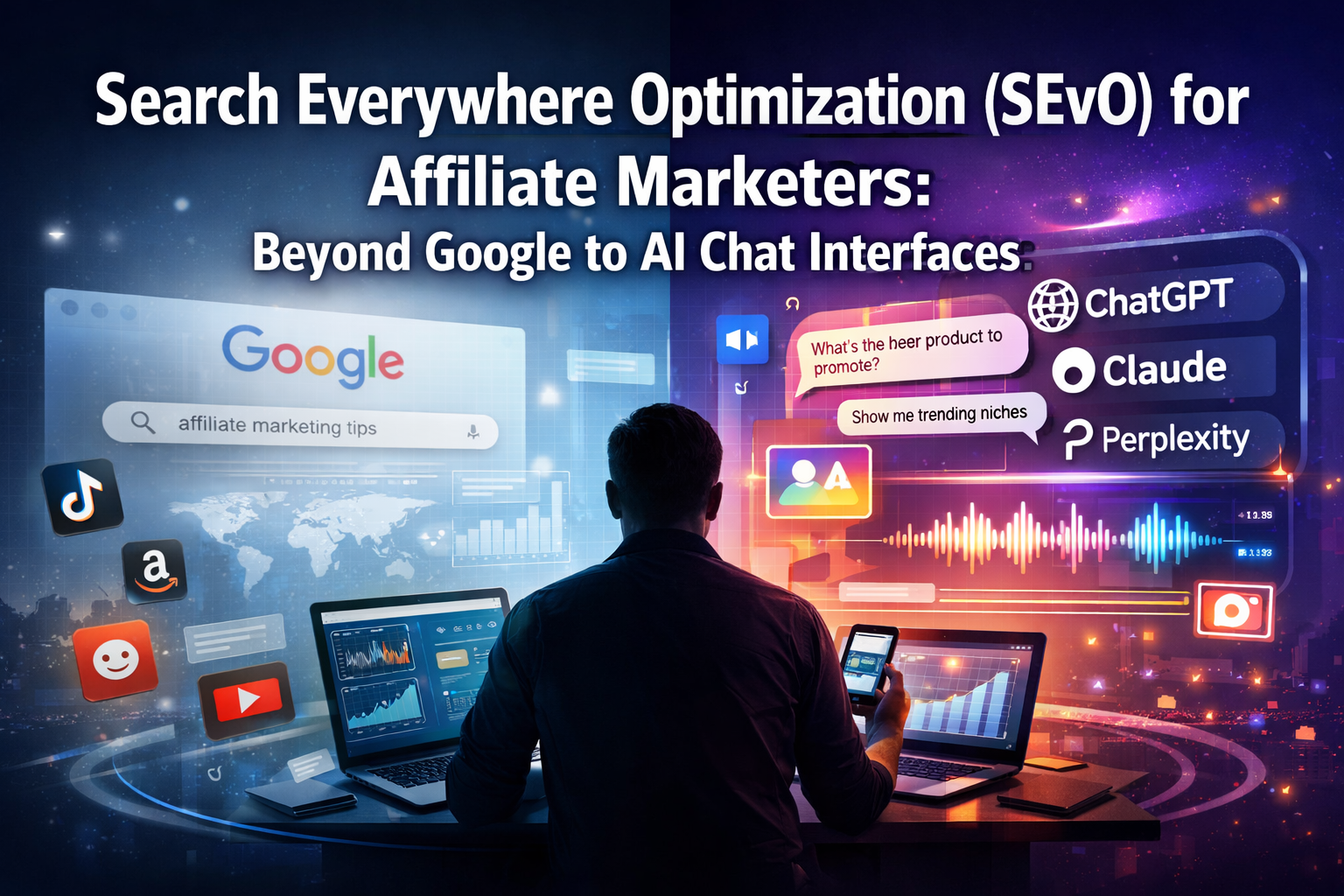
Traditional search volume is projected to drop 25% by the end of 2026 [2], while discovery increasingly begins on TikTok, Amazon, Reddit, ChatGPT, and YouTube—platforms where conventional SEO tactics fail completely. For affiliate marketers, this shift demands a complete strategic overhaul: optimizing content not just for search engine crawlers, but for AI-powered answer engines, voice assistants, social algorithms, and marketplace discovery systems.
Key Takeaways
- AI chat interfaces (ChatGPT, Gemini, Perplexity) now serve as primary discovery entry points, requiring FAQ formats, schema markup, and entity-based content optimization for affiliate inclusion
- Voice and image searches comprise 55% of all queries in 2026, making mobile-friendly, conversational content essential for affiliate marketing effectiveness [1]
- Multi-platform presence across social, AI, and marketplace channels is now mandatory, as customers research products across 4-5 touchpoints before purchasing
- Traditional attribution models fail to capture the fragmented customer journey, requiring unified analytics that track discovery from TikTok to AI consultations to final conversions
- Structured data and entity clarity determine AI citation inclusion, replacing keywords and backlinks as the primary ranking signals for conversational search
Understanding Search Everywhere Optimization (SEvO) for Affiliate Marketers
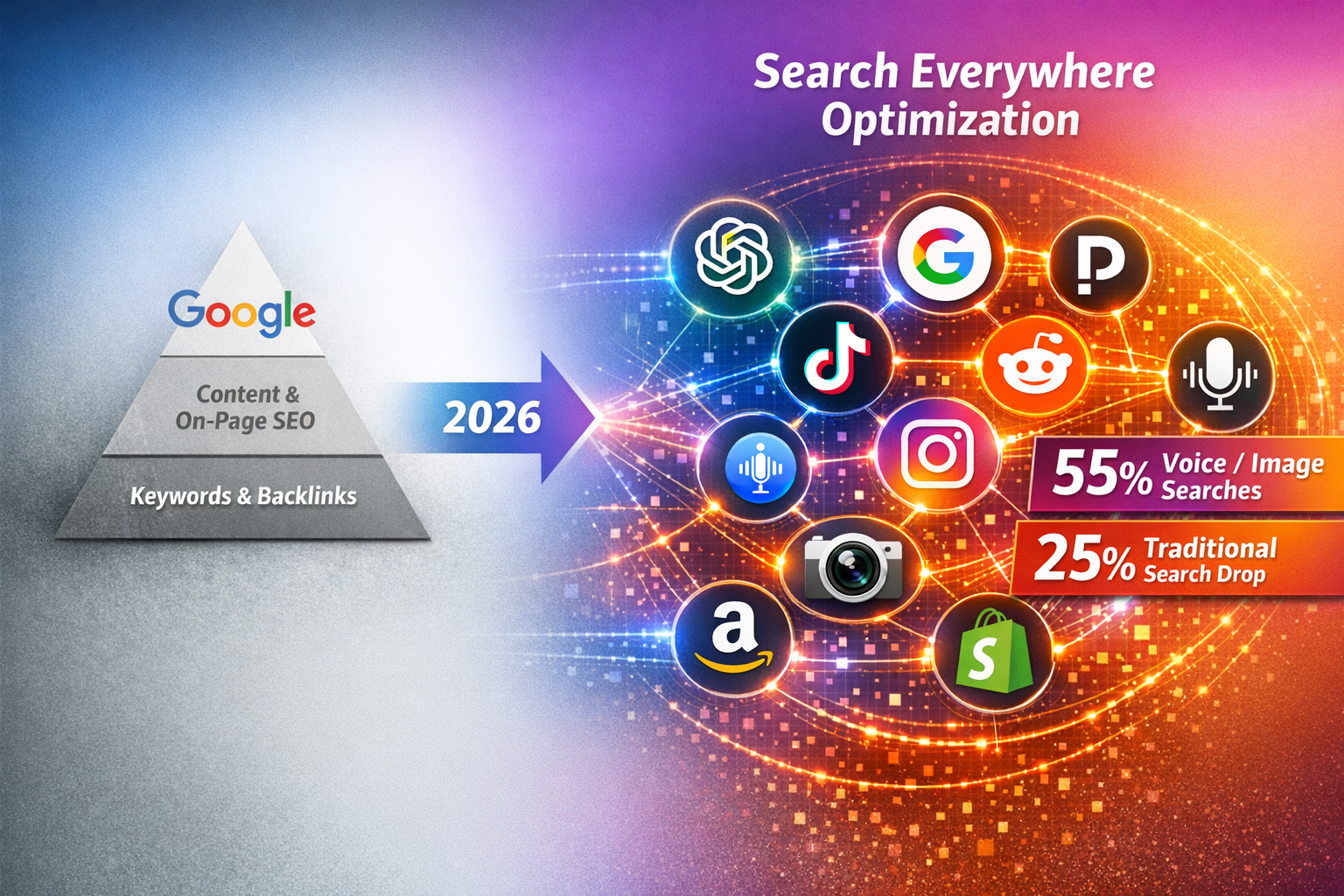
Search Everywhere Optimization (SEvO) represents a paradigm shift from website-centric SEO to total brand visibility across every platform where customers discover, research, and purchase products [3]. For affiliate marketers, this means abandoning the outdated assumption that Google is the primary gateway to conversions.
The Death of the Linear Purchase Funnel
Modern customers no longer follow predictable paths. A typical 2026 buyer journey looks like this:
- 🎥 Discovers product on TikTok through creator content
- 🛒 Checks reviews on Amazon marketplace
- 🤖 Asks ChatGPT for comparison and recommendations
- 📱 Searches Reddit for real user experiences
- 💳 Completes purchase through affiliate link on blog or direct from merchant
This fragmented journey happens within minutes across multiple devices [3], making single-platform optimization obsolete. Affiliate marketers must now ensure visibility at each micro-moment of discovery.
Why Traditional SEO No Longer Suffices
The limitations of conventional SEO for affiliate marketing in 2026:
| Traditional SEO Approach | SEvO Reality |
|---|---|
| Focus on Google rankings | Discovery happens on TikTok, AI chat, Amazon first |
| Keyword-based optimization | Entity clarity and structured data drive AI citations |
| Backlink authority signals | Platform-specific signals (engagement, reviews, shares) matter more |
| Website traffic as primary KPI | Total brand visibility and multi-platform influence |
| Last-click attribution | Multi-touchpoint journey tracking required |
For those just starting their journey, understanding how to become an affiliate marketer in this new landscape requires mastering SEvO fundamentals from day one.
Optimizing for AI Chat Interfaces: The New Frontier for Affiliates
AI-powered answer engines—ChatGPT, Google Gemini, Perplexity, Claude—have become primary discovery entry points where users bypass Google entirely [1]. These platforms generate zero-click summaries that either include your affiliate recommendations or completely exclude you from the conversation.
LLM Engine Optimization (LEO): Core SEvO Subset
LLM Engine Optimization (LEO) is the practice of optimizing content specifically for large language models to ensure your affiliate content gets cited in AI-generated responses [1]. Unlike traditional SEO, LEO prioritizes:
- ✅ FAQ-formatted content that directly answers common product questions
- ✅ Concise, authoritative answers (50-150 words) that AI can quote
- ✅ Entity-based writing that clearly identifies products, brands, features, and comparisons
- ✅ Structured data markup (Schema.org) that helps AI understand content relationships
- ✅ Verified facts and statistics that AI models trust and reference
Practical LEO Strategies for Affiliate Content
1. Create AI-Friendly Product Comparison Content
Structure affiliate reviews using clear comparison frameworks:
## Which is Better: Product A vs Product B?

**For Budget Buyers:** Product A offers better value at $X with features Y and Z.
**For Power Users:** Product B justifies its $X price with advanced capabilities including...
**Winner:** Product A for 70% of users; Product B for professionals needing...
This format allows AI to extract specific recommendations based on user query context.
2. Implement Comprehensive Schema Markup
Use Product, Review, FAQPage, and HowTo schema to structure affiliate content for AI parsing:
- Product schema: Price, availability, ratings, specifications
- Review schema: Aggregate ratings, author credentials, pros/cons
- FAQ schema: Common questions with direct answers
- HowTo schema: Step-by-step guides for product selection
3. Build Entity Authority Through Topical Depth
AI models prioritize sources that demonstrate comprehensive expertise. Instead of thin affiliate pages, create content clusters:
- 📊 Comparison guides (Product A vs B vs C)
- 📚 Buying guides (How to choose the best…)
- 🔧 How-to tutorials (How to use/install/optimize…)
- ❓ FAQ resources (Top 20 questions about…)
This approach mirrors strategies used in high ticket affiliate marketing, where authority and trust are paramount for expensive purchases.
Voice Search Optimization for Affiliate Marketers
With 55% of searches now voice or image-based [1], conversational optimization is non-negotiable:
Voice Search Best Practices:
- 🗣️ Use natural, conversational language matching how people speak
- 📍 Include location-specific terms for local product availability
- ❓ Structure content around question phrases ("What is the best…", "How do I…")
- 📱 Ensure mobile-first, fast-loading pages for voice search results
- 🎯 Target long-tail, specific queries ("affordable noise-canceling headphones under $100")
Voice queries typically convert 3x higher than text searches because they indicate immediate purchase intent—making them especially valuable for affiliate marketers.
Multi-Platform SEvO Strategies Beyond Traditional Search
Search Everywhere Optimization (SEvO) for Affiliate Marketers: Beyond Google to AI Chat Interfaces requires presence optimization across social platforms, marketplaces, and video channels where discovery increasingly begins.
Social Search Optimization: TikTok, Reddit, Instagram
Social platforms have evolved into primary search engines where users discover products before ever visiting Google [1]. Each platform requires unique optimization:
TikTok Discovery Optimization:
- 🎬 Create native video content showcasing products in authentic use cases
- #️⃣ Use trending hashtags + niche product hashtags (#TechReviews #BudgetGaming)
- 🔗 Include affiliate links in bio with clear CTAs in video
- 💬 Engage with comments to boost algorithmic visibility
- ⏱️ Post during peak engagement windows (6-9 PM local time)
Reddit Community Engagement:
- 💎 Provide genuine value in relevant subreddits before promoting
- 🔍 Answer product questions with detailed comparisons (include affiliate disclosure)
- 📊 Share data-driven reviews that match community standards
- 🚫 Avoid direct promotion—focus on helpful recommendations
- 🏆 Build karma and credibility before including affiliate links
Instagram Visual Discovery:
- 📸 High-quality product photography with lifestyle context
- 📝 Keyword-rich captions with natural product mentions
- 🏷️ Strategic hashtag combinations (broad + niche + branded)
- 📍 Location tags for local product availability
- 🔗 Link stickers in Stories directing to affiliate content
Marketplace Search Optimization: Amazon, Shopify, Etsy
E-commerce search directly on marketplace platforms now drives purchases before consumers reach affiliate websites [1]. While you may not control product listings, you can optimize your affiliate strategy:
Amazon Affiliate Optimization:
- 🔍 Target products with 4+ star ratings and 100+ reviews
- 📊 Monitor Best Sellers Rank (BSR) for trending opportunities
- 🎯 Create content around Amazon's own search suggestions
- 💰 Focus on products with 30-60 day cookie windows
- 📈 Track seasonal trends and Prime Day opportunities
Marketplace Content Strategy:
- Create comparison content that includes marketplace links alongside direct merchant links
- Highlight marketplace-exclusive deals and bundles
- Address marketplace-specific concerns (shipping, returns, Prime eligibility)
- Use marketplace review data as social proof in your content
For comprehensive strategies across different channels, explore our guide on affiliate marketing programs that work best with marketplace integration.
Video Commerce and YouTube Optimization
YouTube remains the second-largest search engine, with unique optimization requirements:
YouTube SEO for Affiliates:
- 🎯 Keyword-rich titles: Front-load primary keywords ("Best Budget Laptops 2026: Top 5 Under $500")
- 📝 Detailed descriptions: First 150 characters crucial; include affiliate links with disclosure
- 🏷️ Strategic tags: Mix broad and specific (laptop, budget laptop, student laptop, HP Pavilion)
- 📊 Timestamps: Chapter markers improve watch time and user experience
- 💬 Engagement signals: Pin comments, respond quickly, encourage likes/subscribes
- 🔔 Playlists: Group related product reviews to increase session duration
Video Content Formats That Convert:
- 📦 Unboxing and first impressions
- ⚖️ Head-to-head product comparisons
- 🛠️ Setup and installation tutorials
- 💡 "Best of" roundups by category or price point
- ❌ Common mistakes and how to avoid them
Implementing Unified Analytics for Multi-Platform Attribution
Traditional attribution models no longer capture accurate influence because customers discover products on TikTok, research via Amazon reviews, consult AI for guidance, then complete purchases elsewhere [3]. Affiliate marketers must track multi-platform touchpoints to understand which channels drive early-stage discovery versus final conversions.
Building a Comprehensive Attribution Framework
Key Metrics to Track Across Platforms:
| Platform | Discovery Metrics | Consideration Metrics | Conversion Metrics |
|---|---|---|---|
| TikTok/Instagram | Video views, shares, saves | Profile visits, link clicks | Swipe-up conversions |
| AI Chat (ChatGPT) | Brand mentions, citations | Follow-up queries | Direct traffic spikes |
| YouTube | Impressions, CTR, watch time | Engagement rate, comments | Description link clicks |
| Post upvotes, comments | Profile clicks | Direct referrals | |
| Blog/Website | Organic traffic, rankings | Time on page, scroll depth | Affiliate link clicks |
Tools for Multi-Platform Tracking:
- 📊 Google Analytics 4: Cross-device tracking with custom events
- 🔗 UTM parameters: Platform-specific tracking codes for each channel
- 📈 Affiliate network dashboards: Click-through and conversion data
- 🎯 Social platform analytics: Native insights for TikTok, Instagram, YouTube
- 🔄 Customer journey mapping tools: Visualize multi-touchpoint paths
For deeper insights into tracking and optimization, review our Google Search Engine Optimization fundamentals that complement SEvO strategies.
Abandoning Last-Click Attribution
The last-click model falsely credits the final touchpoint before purchase, ignoring the TikTok video that created awareness or the Reddit discussion that built trust. First-touch, multi-touch, and time-decay attribution models provide more accurate pictures of channel effectiveness.
Recommended Attribution Approach:
- 🥇 First-touch: Credit discovery channels (social, video, AI)
- 🤝 Multi-touch: Distribute credit across all touchpoints
- ⏱️ Time-decay: Weight recent interactions higher
- 📊 Data-driven: Use machine learning to assign credit algorithmically
This comprehensive view reveals which platforms deserve more content investment and budget allocation.
Technical Implementation: Structured Data and Entity Optimization
Zero-click summaries from AI tools require structured data for inclusion [2]. Affiliate marketers must implement entity clarity and platform-specific signals rather than relying solely on keywords and backlinks.
Essential Schema Markup for Affiliate Content
Implement these Schema.org types to maximize AI and search visibility:
1. Product Schema
{
  "@type": "Product",
  "name": "Product Name",
  "description": "Detailed description",
  "brand": "Brand Name",
  "offers": {
    "@type": "Offer",
    "price": "99.99",
    "priceCurrency": "USD",
    "availability": "InStock"
  },
  "aggregateRating": {
    "@type": "AggregateRating",
    "ratingValue": "4.5",
    "reviewCount": "127"
  }
}
2. Review Schema
{
  "@type": "Review",
  "itemReviewed": {
    "@type": "Product",
    "name": "Product Name"
  },
  "author": {
    "@type": "Person",
    "name": "Your Name"
  },
  "reviewRating": {
    "@type": "Rating",
    "ratingValue": "4",
    "bestRating": "5"
  }
}
3. FAQPage Schema
{
  "@type": "FAQPage",
  "mainEntity": [{
    "@type": "Question",
    "name": "What is the best budget laptop?",
    "acceptedAnswer": {
      "@type": "Answer",
      "text": "The HP Pavilion 15 offers the best value..."
    }
  }]
}
These structured data implementations help AI models understand and cite your content accurately. For platform-specific optimization, see our guide on Google Sites Search Engine Optimization.
Entity-Based Content Strategy
AI models prioritize entity clarity—clear identification of products, brands, features, and relationships. Structure content around entities:
- 🏷️ Product entities: Specific model numbers, SKUs, official names
- 🏢 Brand entities: Consistent brand mentions with official spelling
- 🔧 Feature entities: Specific technical specifications and capabilities
- 🔗 Relationship entities: Comparisons, alternatives, complementary products
Example Entity-Optimized Paragraph:
"The Sony WH-1000XM5 (entity: product) offers superior active noise cancellation (entity: feature) compared to the Bose QuietComfort 45 (entity: competing product). Sony's (entity: brand) proprietary V1 processor (entity: technical specification) delivers 30% better ambient sound filtering than previous generations."
This structure allows AI to extract precise facts and relationships for citation in conversational responses.
Measuring SEvO Success: Beyond Traditional Metrics
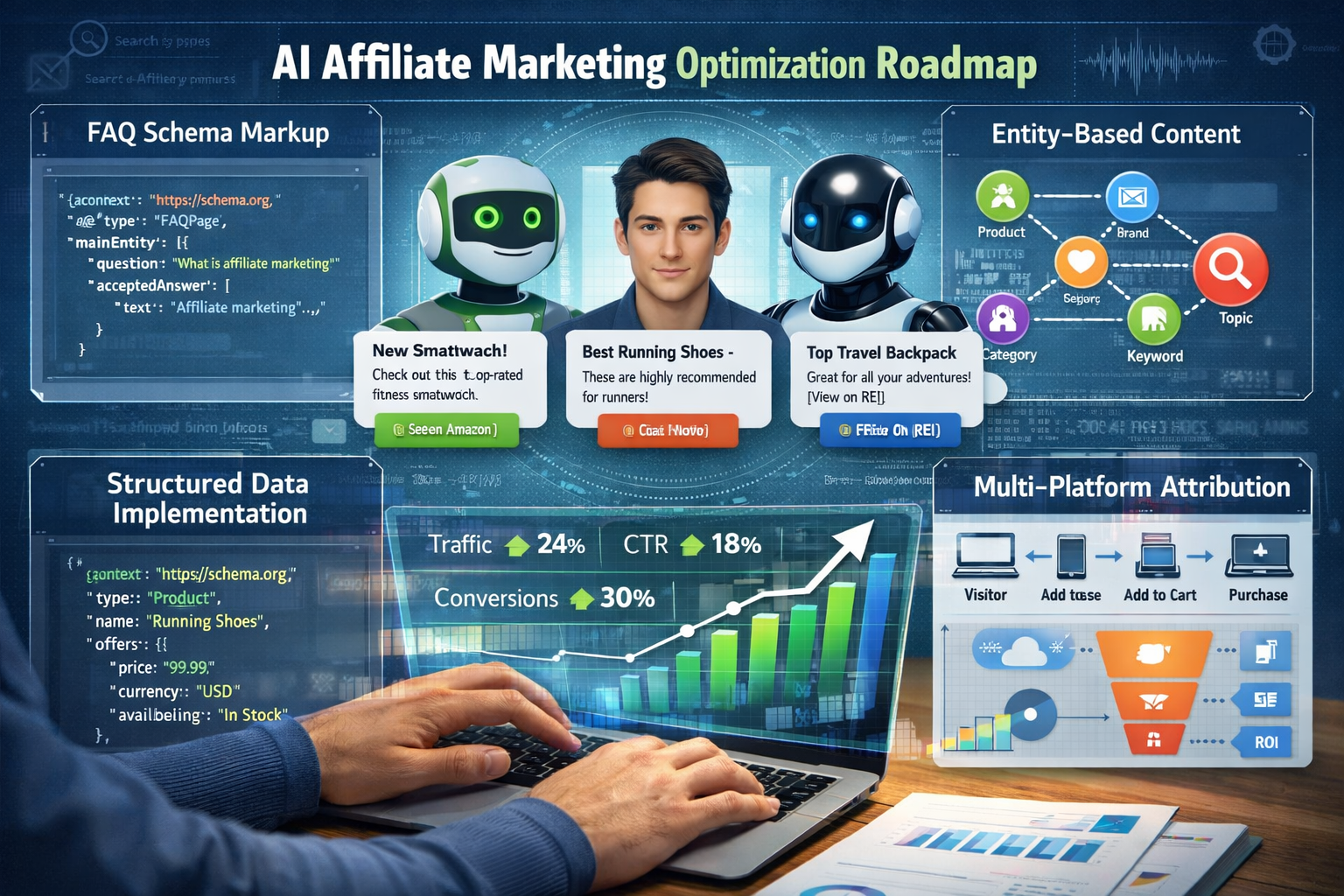
SEvO prioritizes total brand visibility and influence across platforms rather than website traffic alone [2][3]. Affiliate marketers must redefine success metrics to capture multi-platform impact.
New KPIs for Search Everywhere Success
Discovery & Awareness Metrics:
- 🎯 Brand mention volume across social platforms and AI citations
- 👁️ Total impression share across search, social, video, and AI
- 📊 Share of voice in target product categories
- 🔍 Featured snippet and AI citation frequency
Engagement & Consideration Metrics:
- 💬 Cross-platform engagement rate (comments, shares, saves)
- ⏱️ Average customer journey length (touchpoints before conversion)
- 🔗 Multi-channel click-through rate
- 📈 Content performance by platform (which channels drive discovery vs. conversion)
Conversion & Revenue Metrics:
- 💰 Multi-touch attributed revenue (not just last-click)
- 🎯 Platform-specific conversion rates
- 📊 Customer lifetime value by discovery channel
- 🔄 Return visitor rate from different platforms
Quarterly SEvO Audit Checklist
Conduct comprehensive audits every quarter:
- ✅ AI citation check: Search your brand/content in ChatGPT, Perplexity, Gemini
- ✅ Social presence audit: Active profiles on TikTok, Instagram, Reddit, YouTube?
- ✅ Schema validation: All structured data implemented and error-free?
- ✅ Voice search testing: How do products rank for voice queries?
- ✅ Marketplace visibility: Products appearing in Amazon, Etsy searches?
- ✅ Cross-platform analytics: Unified tracking capturing all touchpoints?
- ✅ Mobile optimization: Fast loading, responsive design across devices?
Regular audits ensure your SEvO strategy evolves with platform algorithm changes and consumer behavior shifts.
Conclusion
Search Everywhere Optimization (SEvO) for Affiliate Marketers: Beyond Google to AI Chat Interfaces represents the fundamental evolution required for affiliate marketing success in 2026 and beyond. With traditional search volume declining 25% and 55% of queries now voice or image-based [1][2], affiliate marketers cannot afford to rely solely on conventional SEO tactics.
The modern affiliate strategy demands multi-platform presence optimization across AI chat interfaces, social platforms, marketplaces, and video channels—each requiring unique content formats, optimization techniques, and measurement approaches. Success depends on implementing structured data for AI citations, creating entity-based content for conversational search, and building comprehensive attribution frameworks that capture the fragmented customer journey.
Actionable Next Steps
Start implementing SEvO today:
- 🤖 Audit AI citations: Search your brand in ChatGPT, Perplexity, and Gemini to see current visibility
- 📊 Implement schema markup: Add Product, Review, and FAQ schema to top-performing content
- 🎥 Expand to video: Create YouTube product reviews with optimized titles and descriptions
- 📱 Test social platforms: Launch TikTok or Instagram presence with native product content
- 🔍 Build FAQ content: Create conversational, question-based content for voice search
- 📈 Set up multi-touch attribution: Implement UTM tracking and cross-platform analytics
- 🔄 Conduct quarterly audits: Review presence, citations, and performance across all channels
The affiliate marketers who thrive in 2026 will be those who recognize that search happens everywhere—and optimize accordingly. Begin your SEvO transformation today to capture revenue across every touchpoint where your customers discover, research, and purchase products.
For comprehensive strategies on building a sustainable affiliate business in this new landscape, explore our guides on affiliate marketing programs and high ticket affiliate marketing approaches that leverage multi-platform visibility.
References
[1] Search Everywhere Optimization – https://www.saffronedge.com/blog/search-everywhere-optimization/
[2] Search Everywhere Optimization – https://localdominator.co/search-everywhere-optimization/
[3] Search Everywhere Optimization – https://azariangrowthagency.com/search-everywhere-optimization/
 dfyadmin