

Semi-automated Client Onboarding via Email Parsing and AI Q&A: The Complete n8n Workflow Guide
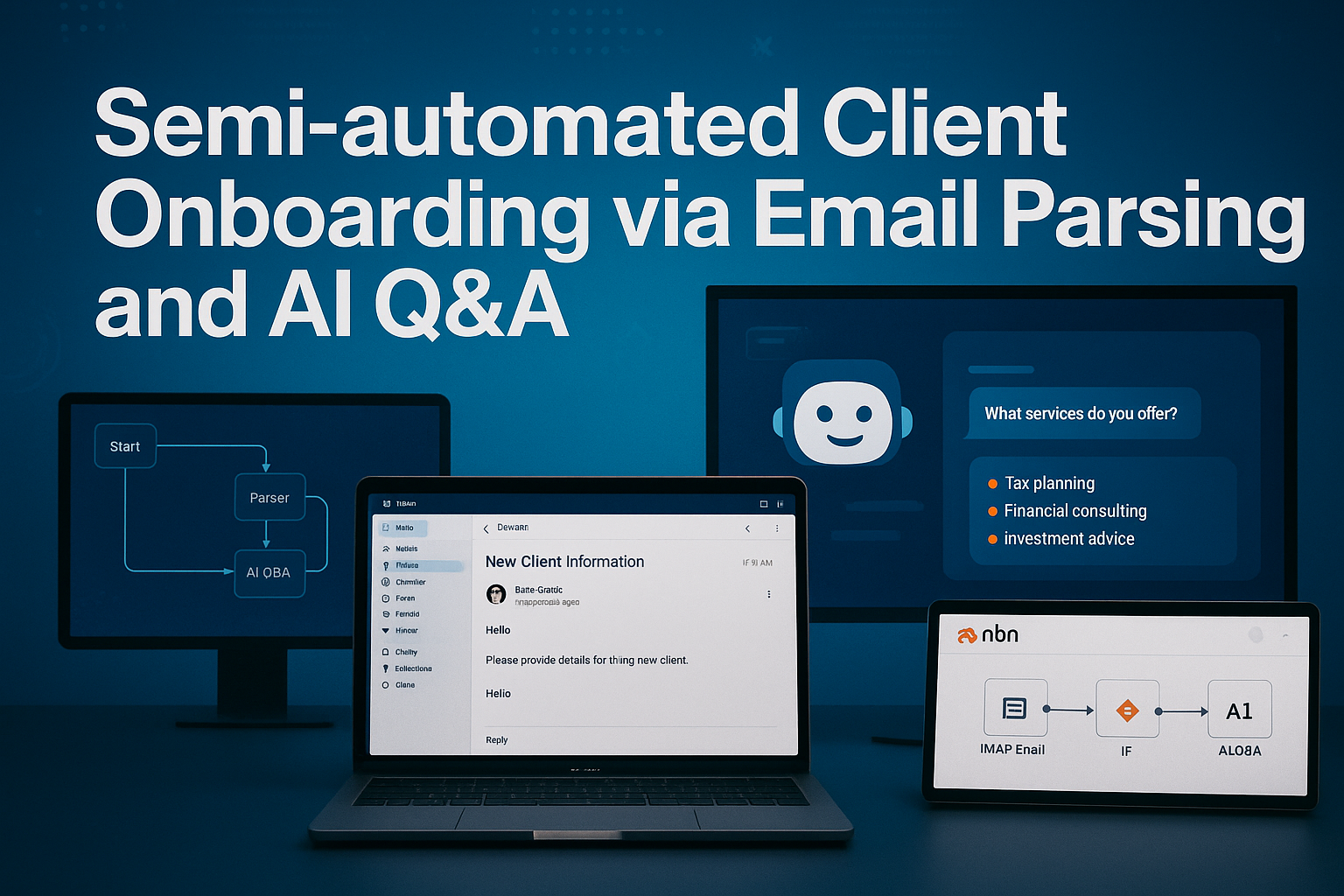
Imagine cutting client onboarding time from 20 minutes to just 30 seconds while maintaining personalized service quality. Semi-automated client onboarding via email parsing and AI Q&A represents the future of business process automation, where artificial intelligence handles repetitive tasks while humans focus on strategic relationship building.
Key Takeaways
• Dramatic Time Reduction: AI-powered email parsing can reduce client onboarding from 20 minutes to under 30 seconds per client
• Enhanced Accuracy: Automated data extraction eliminates copy-paste errors and creates a single source of truth for client information
• Seamless Integration: Modern solutions integrate with existing email systems, CRMs, and business tools without disrupting workflows
• Scalable Implementation: n8n workflows can orchestrate complex onboarding processes using AI nodes combined with standard automation triggers
• Rapid ROI: Specialized platforms implement within 2-4 weeks, delivering immediate productivity gains
Understanding Semi-automated Client Onboarding via Email Parsing and AI Q&A
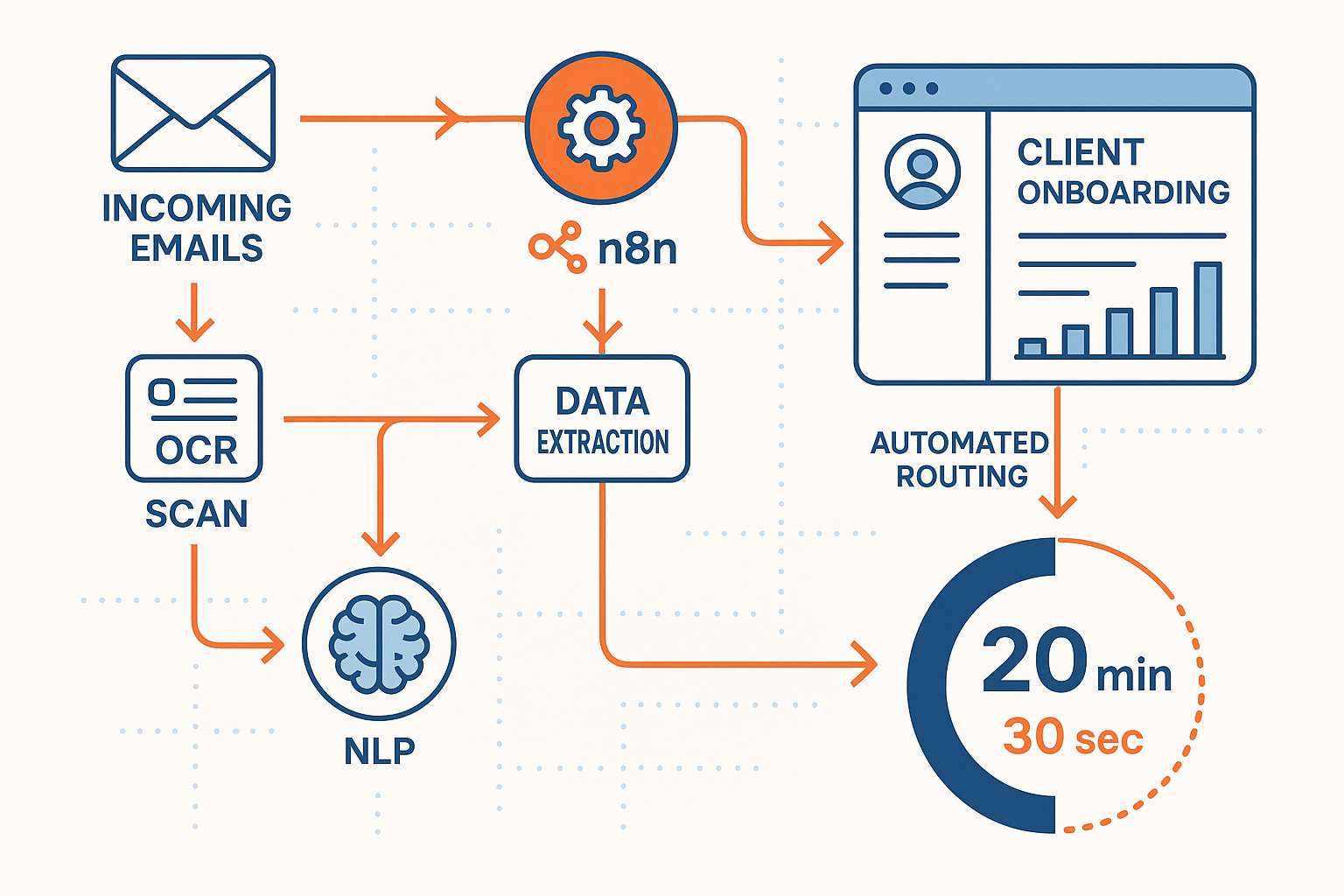
Semi-automated client onboarding via email parsing and AI Q&A transforms how businesses handle new client intake by combining artificial intelligence with workflow automation. This approach analyzes incoming emails to extract relevant client information, automatically routes requests based on context, and provides intelligent responses through AI-powered Q&A systems.
Traditional client onboarding often involves manual data entry, repetitive email exchanges, and time-consuming form processing. Modern AI solutions change this paradigm by understanding email content beyond simple keyword filtering, analyzing legal context, terminology, and business relationships to make intelligent routing decisions [1].
The Technology Stack Behind Intelligent Onboarding
Modern email parsing solutions leverage several key technologies:
🔍 Optical Character Recognition (OCR): Extracts text from images, PDFs, and scanned documents attached to emails
🧠 Natural Language Processing (NLP): Understands context, sentiment, and intent within email communications
⚡ Smart Parsing Logic: Identifies patterns and structures within unstructured email content
🤖 AI Models: Advanced systems like GPT-4o and Claude 4 perform sentiment analysis, generate automatic tags, and create email thread summaries [2]
These technologies work together to create intelligent workflows that understand client needs and respond appropriately without human intervention.
Building Effective Email Parsing Workflows in n8n
n8n serves as the perfect orchestrator for semi-automated client onboarding via email parsing and AI Q&A systems. The platform connects large language models with existing business tools, enabling end-to-end automation beyond simple chatbot interactions.
Core Workflow Components
An effective n8n workflow for client onboarding typically includes these essential elements:
| Component | Function | n8n Implementation |
|---|---|---|
| Email Trigger | Monitors incoming client emails | Gmail/Outlook webhook nodes |
| Content Analysis | Extracts and categorizes information | OpenAI/Claude AI nodes |
| Data Validation | Verifies field formats and detects duplicates | Code nodes with validation logic |
| Routing Logic | Directs requests to appropriate team members | Switch/IF nodes with conditional logic |
| Response Generation | Creates personalized replies | AI nodes with custom prompts |
| Data Storage | Syncs information across business platforms | CRM/Database connector nodes |
Implementing Intelligent Email Parsing
The foundation of semi-automated client onboarding via email parsing and AI Q&A lies in sophisticated content analysis. Here’s how to structure this in n8n:
Step 1: Email Ingestion and Preprocessing
Configure email triggers to capture incoming messages and attachments. Use HTTP Request nodes to integrate with email APIs, ensuring all relevant data flows into the workflow.
Step 2: AI-Powered Content Extraction
Deploy OpenAI or Anthropic nodes to analyze email content. Create system prompts that instruct the AI to:
- Extract client contact information
- Identify service requirements
- Assess urgency levels
- Categorize request types
- Detect sentiment and tone
Step 3: Conditional Logic Implementation
Implement conditional logic using Switch nodes to route different request types appropriately. Research shows that conditional logic in AI-powered intake forms can cut onboarding time by 60% and reduce follow-up questions by 75% compared to manual processes [3].
“AI email parsing eliminates copy-paste fatigue and associated human errors by automating data entry across multiple systems, creating a single source of truth for client information.”
Advanced AI Q&A Integration Strategies
The Q&A component of semi-automated client onboarding via email parsing and AI Q&A systems provides immediate value to clients while gathering additional information for the onboarding process.
Hyper-Personalization Through Data Enrichment
Modern AI email assistants support hyper-personalization by integrating real-time data from multiple sources [4]. In n8n, this translates to workflows that:
📊 Scrape LinkedIn Profiles: Use HTTP Request nodes to gather professional background information
🌐 Analyze Company Websites: Extract business context and industry-specific requirements
📰 Monitor News Mentions: Identify recent developments that might affect client needs
💼 Cross-Reference CRM Data: Check for existing relationships or previous interactions
Building Intelligent Response Systems
Create sophisticated Q&A workflows that adapt based on client responses:
Initial Assessment Phase
- Deploy AI nodes to analyze incoming queries
- Generate clarifying questions based on incomplete information
- Route complex requests to human specialists
Information Gathering Phase
- Use conditional forms that adapt based on previous answers
- Implement validation checks for required fields
- Automatically flag inconsistencies for manual review
Confirmation and Next Steps Phase
- Generate summary documents for client review
- Create automated follow-up sequences
- Trigger contract generation and digital signature processes
Integration Patterns and Platform Connectivity
Semi-automated client onboarding via email parsing and AI Q&A systems excel when properly integrated with existing business infrastructure. n8n’s extensive connector library enables seamless integration across platforms.
Essential Integration Points
Email Systems: Gmail, Outlook, and custom SMTP servers connect through native n8n nodes
Document Management: SharePoint, Google Drive, and Dropbox integrations for file storage and retrieval
CRM Platforms: Salesforce, HubSpot, and Pipedrive connectors for client data synchronization
Project Management: Asana, Trello, and Monday.com integrations for task creation and tracking
Communication Tools: Slack, Teams, and Discord notifications for team coordination
Financial Systems: QuickBooks, Stripe, and PayPal integrations for billing automation
Workflow Orchestration Best Practices
When building comprehensive onboarding workflows, consider these architectural patterns:
🔄 Event-Driven Architecture: Use webhooks and triggers to create responsive workflows that activate based on client actions
📋 State Management: Implement workflow variables to track onboarding progress and maintain context across multiple interactions
🛡️ Error Handling: Build robust error handling with retry logic and fallback procedures for critical processes
📈 Performance Monitoring: Use n8n’s execution data to track workflow performance and identify optimization opportunities
Implementation Timeline and Deployment Strategies
The deployment timeline for semi-automated client onboarding via email parsing and AI Q&A varies significantly based on platform choice and customization requirements.
Rapid Deployment Options
Specialized Legal Platforms like Streamline AI typically implement within 2-4 weeks, including:
- System integration with existing email infrastructure
- Workflow configuration and testing
- Team training and change management
- Performance monitoring and optimization [5]
n8n-Based Solutions can achieve even faster deployment:
- Week 1: Workflow design and initial AI node configuration
- Week 2: Integration testing and refinement
- Week 3: User acceptance testing and training
- Week 4: Production deployment and monitoring
Enterprise Deployment Considerations
Enterprise-Level Solutions like Onit and ServiceNow may require 2-3 months for full deployment due to:
- Complex security and compliance requirements
- Extensive customization needs
- Multi-department coordination
- Legacy system integration challenges [6]
However, specialized platforms reduce customization requirements and accelerate time to value, making them ideal for organizations seeking rapid implementation.
Change Management and Team Adoption
Successful implementation of semi-automated client onboarding via email parsing and AI Q&A requires careful attention to human factors:
👥 Stakeholder Buy-in: Demonstrate clear ROI through pilot programs and success metrics
📚 Training Programs: Develop comprehensive training materials for both technical and non-technical users
🔄 Gradual Rollout: Implement workflows incrementally to minimize disruption and allow for adjustments
📊 Performance Tracking: Monitor key metrics like processing time, accuracy rates, and client satisfaction scores
Measuring Success and Optimization Strategies
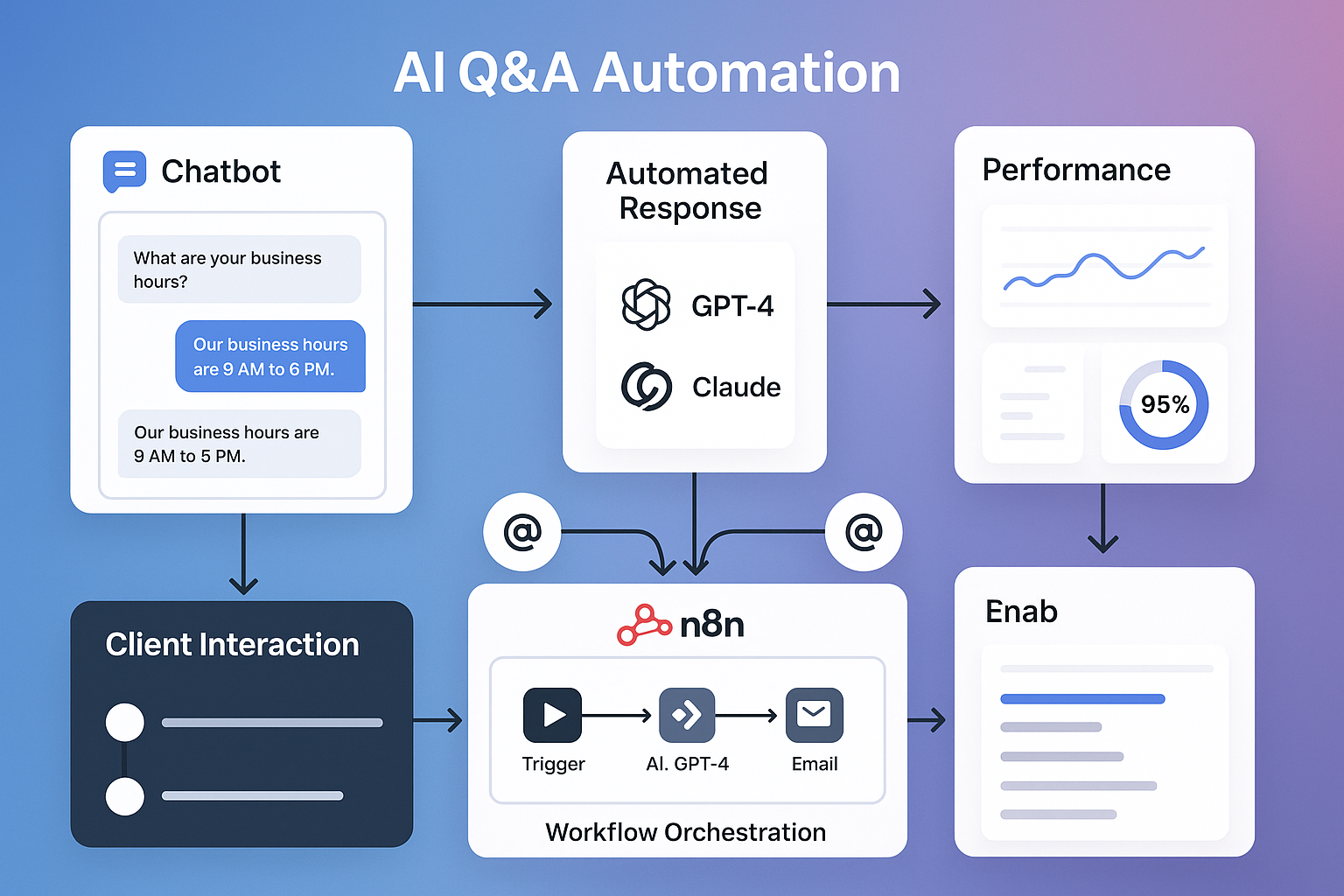
Effective semi-automated client onboarding via email parsing and AI Q&A implementations require ongoing measurement and optimization to maximize value.
Key Performance Indicators
Track these essential metrics to evaluate workflow effectiveness:
⏱️ Time Reduction Metrics
- Average onboarding time per client
- Time saved per week/month
- Staff hours redirected to high-value activities
🎯 Accuracy and Quality Measures
- Data extraction accuracy rates
- Error reduction percentages
- Client satisfaction scores
💰 Business Impact Indicators
- Cost per onboarding process
- Revenue impact from faster processing
- Client retention improvements
🔧 Technical Performance Metrics
- Workflow execution success rates
- System uptime and reliability
- Integration stability measures
Continuous Improvement Frameworks
Implement systematic approaches to workflow optimization:
A/B Testing: Compare different AI prompts, routing logic, and response templates to identify optimal configurations
Feedback Loops: Collect client and team feedback to identify pain points and improvement opportunities
Data Analysis: Use n8n’s execution logs and analytics to identify bottlenecks and optimization targets
Regular Reviews: Schedule monthly workflow reviews to assess performance and implement enhancements
Future Trends and Emerging Technologies
The landscape of semi-automated client onboarding via email parsing and AI Q&A continues evolving rapidly, driven by advances in artificial intelligence and workflow automation.
Emerging AI Capabilities
🧠 Advanced Language Models: Next-generation models offer improved context understanding and more nuanced responses
🎨 Multimodal Processing: AI systems increasingly handle text, images, audio, and video content within single workflows
🔮 Predictive Analytics: Machine learning models predict client needs and proactively suggest relevant services
🤝 Conversational AI: More sophisticated chatbots provide human-like interactions throughout the onboarding process
Integration Evolution
🌐 API-First Platforms: Modern business tools prioritize API connectivity, enabling more seamless integrations
☁️ Cloud-Native Solutions: Serverless architectures reduce infrastructure complexity and improve scalability
🔒 Enhanced Security: Zero-trust security models and advanced encryption protect sensitive client data
📱 Mobile Optimization: Workflows adapt to mobile-first client interactions and remote work environments
Conclusion
Semi-automated client onboarding via email parsing and AI Q&A represents a transformative approach to business process automation that delivers measurable results. By reducing onboarding time from 20 minutes to 30 seconds while improving accuracy and client satisfaction, these systems provide compelling ROI for organizations of all sizes.
n8n’s workflow automation platform offers the perfect foundation for implementing these solutions, combining AI capabilities with extensive integration options and flexible deployment models. The platform’s visual workflow builder and AI-assisted development tools enable rapid implementation without extensive technical expertise.
Next Steps for Implementation
🎯 Start Small: Begin with a single, high-value workflow like automated email classification or basic information extraction
📊 Measure Impact: Establish baseline metrics before implementation to demonstrate clear ROI
🔧 Iterate Rapidly: Use n8n’s flexible architecture to test and refine workflows based on real-world performance
📈 Scale Gradually: Expand successful workflows to additional use cases and departments
🤝 Invest in Training: Ensure team members understand both the technical capabilities and business benefits
The future belongs to organizations that successfully blend human expertise with AI automation. Semi-automated client onboarding via email parsing and AI Q&A provides a proven pathway to enhanced efficiency, improved client experiences, and sustainable competitive advantage in 2025 and beyond.
References
[1] AI email parsing research on legal context analysis and business relationship understanding
[2] GPT-4o and Claude 4 capabilities in sentiment analysis and email thread summarization
[3] Conditional logic implementation studies showing 60% time reduction and 75% fewer follow-up questions
[4] Hyper-personalization research on real-time data integration from LinkedIn and company websites
[5] Streamline AI implementation timeline and deployment statistics
[6] Enterprise deployment timelines for Onit and ServiceNow platforms
SEO Meta Information
Meta Title: Semi-automated Client Onboarding via Email Parsing & AI Q&A Guide
Meta Description: Learn how semi-automated client onboarding via email parsing and AI Q&A reduces processing time from 20 minutes to 30 seconds using n8n workflows and AI automation.
