

Imagine creating 20 professional product demo videos in a single afternoon—each one tailored to a different audience segment, tested across multiple platforms, and generating measurable conversions. For affiliate marketers in 2026, this isn't science fiction. Sora and Veo 3 for Affiliate Video Creatives: Generating High-ROI Product Demos in Minutes represents a fundamental shift in how performance-driven content gets produced, tested, and scaled.
The affiliate marketing landscape has evolved dramatically. Video content now drives 3x higher engagement than static images, yet traditional video production remains expensive and time-consuming. Enter OpenAI's Sora 2 and Google's Veo 3—two AI video generation platforms that are transforming how affiliate marketers create compelling product demonstrations without cameras, actors, or production crews.
This hands-on guide walks through the practical workflows, cost structures, A/B testing strategies, and platform compliance requirements that make Sora and Veo 3 for Affiliate Video Creatives: Generating High-ROI Product Demos in Minutes the competitive advantage savvy affiliates are leveraging right now.
Key Takeaways
- 🎯 Veo 3 offers unbeatable economics at €1.12 per 8-second HD video, with Fast mode reducing costs to €0.22—enabling rapid testing of multiple product demo variations
- ⚡ Generation speed enables real-time optimization, with videos rendering in 60-180 seconds, allowing affiliates to test 15-20 variations per hour
- 📊 A/B testing workflows are critical for identifying winning creative variations before scaling ad spend across platforms
- ✅ Platform compliance requirements differ significantly between YouTube, Facebook, Instagram, and TikTok—requiring specific disclosure and labeling strategies
- 🎬 Broadcast-quality output is now achievable, with the first AI-generated Super Bowl ad validating commercial viability for affiliate-produced content
Understanding Sora and Veo 3: The Affiliate Marketer's Perspective
What Makes These Platforms Different for Affiliates
Both Sora 2 and Veo 3 generate video from text prompts, but their positioning and economics create distinct advantages for affiliate marketing strategies.
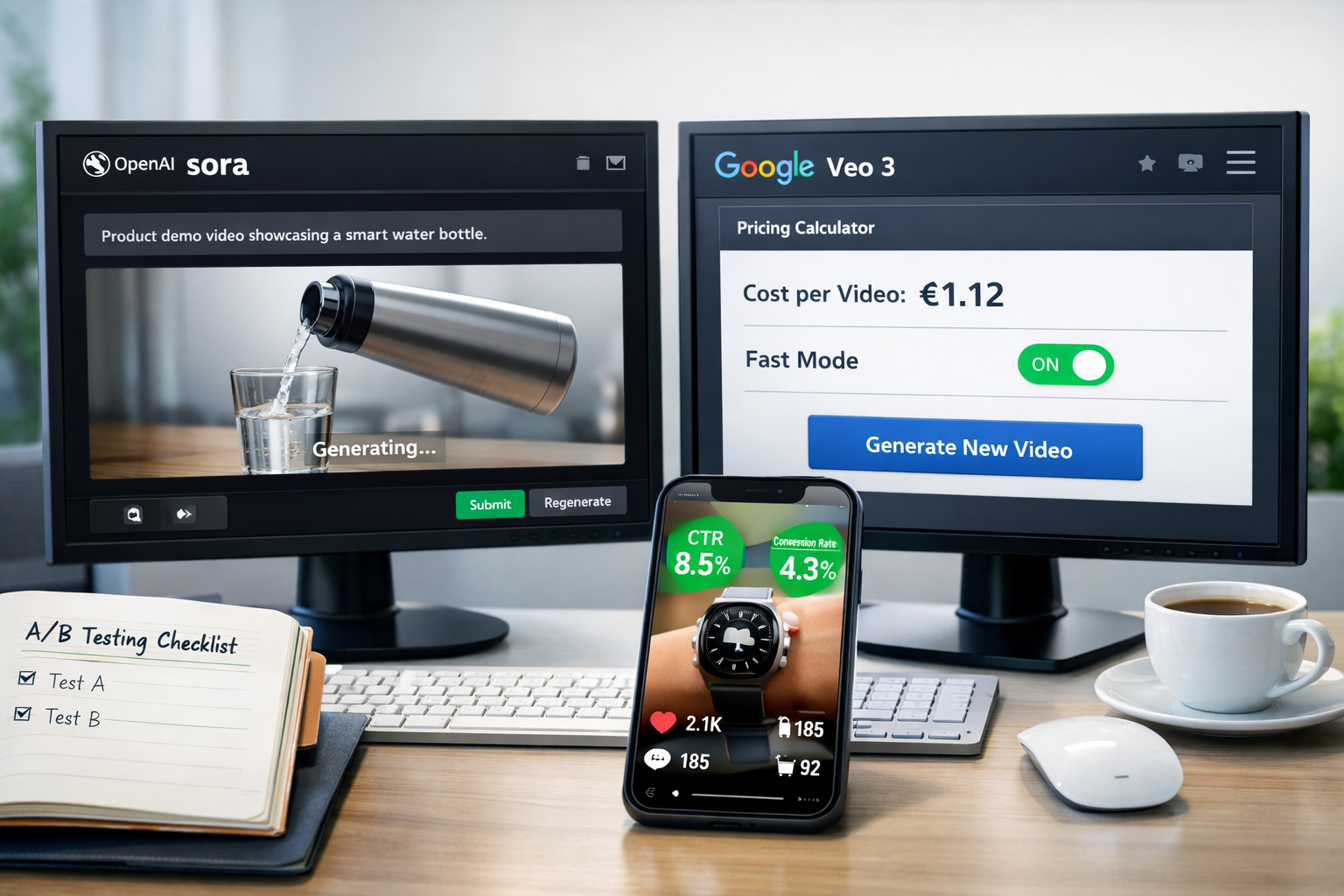
Google Veo 3 dominates the price-to-performance ratio for high-volume affiliate content. At €1.12 per 8-second HD video (720p), it significantly undercuts competitors while requiring no monthly subscription minimum [1]. The pay-as-you-go model aligns perfectly with affiliate workflows that demand rapid testing before committing to scaled campaigns.
The newly introduced Fast/Turbo mode consumes only 20 credits per video compared to 150 credits for quality mode, enabling rapid iteration at €0.22 per 8-second video [2]. For affiliates testing product demo variations across different angles, CTAs, and audience segments, this 80% cost reduction makes previously impossible testing volumes economically viable.
OpenAI Sora 2 positions itself at a premium tier, emphasizing cinematic quality and complex scene generation. Industry professionals report that Sora 2 is "changing UGC forever," enabling single creators to produce videos that previously required full production teams [3]. For high ticket affiliate marketing campaigns where production value signals credibility, Sora's capabilities justify the premium.
Technical Capabilities That Matter for Product Demos
Recent February 2026 breakthroughs in Veo 3 achieved 95%+ prompt accuracy in complex multi-subject scenes [1]. This matters enormously for product positioning—affiliates can now specify exact placement of products, call-to-action elements, and brand messaging with reliable execution.
Temporal consistency eliminates the flickering and artifact problems that plagued earlier AI video tools. Veo 3 maintains smooth object transitions with accurate physics simulation [1], removing the "AI-generated" appearance that damaged affiliate credibility in user-generated content workflows.
Both platforms support 4K-ready workflows, though most affiliate applications prioritize 720p or 1080p for faster generation and smaller file sizes optimized for social media compression algorithms.
Setting Up Your Sora and Veo 3 Workflow for Affiliate Video Production
Platform Access and Account Configuration
Veo 3 operates through Google's AI Test Kitchen and ImageFX platforms, accessible across 180+ countries [1]. This global availability removes geographic barriers for international affiliate networks. Account setup requires:
- Google account verification
- Credit purchase (minimum €10, no subscription required)
- Platform terms acceptance
- Optional API access for automation workflows
Sora 2 requires OpenAI account access, currently available through ChatGPT Plus or Pro subscriptions. The integration with ChatGPT enables conversational prompt refinement—particularly valuable for affiliates without video production backgrounds.
Prompt Engineering for Product Demos
Effective product demo prompts follow a structured format that maximizes both platforms' capabilities:
Essential Prompt Components:
- Scene setting: "Modern kitchen with natural lighting"
- Product specification: "Stainless steel blender, brand visible on base"
- Action sequence: "Ingredients being added, blending process, pouring smoothie"
- Camera movement: "Slow pan from ingredients to finished product"
- Mood/style: "Clean, professional, Instagram-worthy aesthetic"
Example Veo 3 Prompt for Fitness Supplement:
"Close-up shot of athletic woman in gym mixing protein powder in shaker bottle. Camera starts on product packaging showing brand logo, pulls back to show mixing action with visible powder texture, ends with satisfied expression while drinking. Bright gym lighting, motivational energy, 8 seconds, smooth transitions."
Example Sora 2 Prompt for Tech Gadget:
"Cinematic product reveal of wireless earbuds. Camera orbits around sleek charging case on minimalist desk, case opens to reveal earbuds with subtle LED glow, hand enters frame to pick up earbud showing size scale. Premium lighting with soft shadows, tech commercial aesthetic, emphasize build quality and design details."
Cost Structure and Budget Planning
Understanding the economics of Sora and Veo 3 for Affiliate Video Creatives: Generating High-ROI Product Demos in Minutes requires mapping generation costs to testing volume:
| Platform | Mode | Cost per 8s | Videos per €100 | Best Use Case |
|---|---|---|---|---|
| Veo 3 | Fast | €0.22 | 454 | Rapid A/B testing |
| Veo 3 | Quality | €1.12 | 89 | Final production |
| Sora 2 | Standard | ~$0.80 | 125 | Premium campaigns |
For a typical affiliate marketing program testing workflow:
- Initial testing phase: 20 variations × €0.22 (Veo 3 Fast) = €4.40
- Refinement phase: 5 variations × €1.12 (Veo 3 Quality) = €5.60
- Final production: 3 winners × $0.80 (Sora 2) = $2.40
Total investment to identify winning creative: Under €15 compared to traditional production costs of €500-2,000 per video.
Hands-On Tutorial: Creating Your First Affiliate Product Demo
Step 1: Product Research and Angle Selection
Before generating videos, successful affiliates identify the specific benefit or transformation that resonates with their audience. This aligns with proven affiliate marketing optimization techniques.
Research checklist:
- ✅ Review top-performing competitor videos
- ✅ Identify unique product features vs. generic benefits
- ✅ Determine primary objection to address
- ✅ Select demonstration scenario (unboxing, before/after, tutorial, comparison)
Step 2: Prompt Creation and Iteration
Start with Veo 3 Fast mode for rapid iteration. Generate 3-5 variations testing different:
- Camera angles (overhead, eye-level, close-up)
- Pacing (quick cuts vs. smooth transitions)
- Context (lifestyle setting vs. product-focused)
- Emotional tone (energetic vs. calm, aspirational vs. practical)
Generation timeline: Each video renders in 60-180 seconds [1], enabling 15-20 test variations per hour.
Step 3: Review and Selection Criteria
Evaluate generated videos against affiliate-specific metrics:
Technical quality:
- Product visibility and brand recognition
- Smooth motion without artifacts
- Appropriate lighting and color accuracy
- Text/CTA placement compatibility
Marketing effectiveness:
- Clear value proposition communication
- Attention retention (first 3 seconds critical)
- Call-to-action clarity
- Platform-specific optimization (vertical for TikTok/Reels, horizontal for YouTube)
Step 4: Enhancement and Editing
While AI-generated videos often work as standalone content, most affiliates enhance them with:
- Text overlays: Product benefits, pricing, urgency elements
- Voiceover: Personal testimonials or explanations (easily added via tools like ElevenLabs)
- Music: Royalty-free tracks matching platform requirements
- End screens: Clear CTAs with affiliate links and disclosures
Standard video editing tools (CapCut, DaVinci Resolve, Adobe Premiere) integrate seamlessly with AI-generated footage.
A/B Testing Workflows for Maximum ROI
Setting Up Systematic Testing
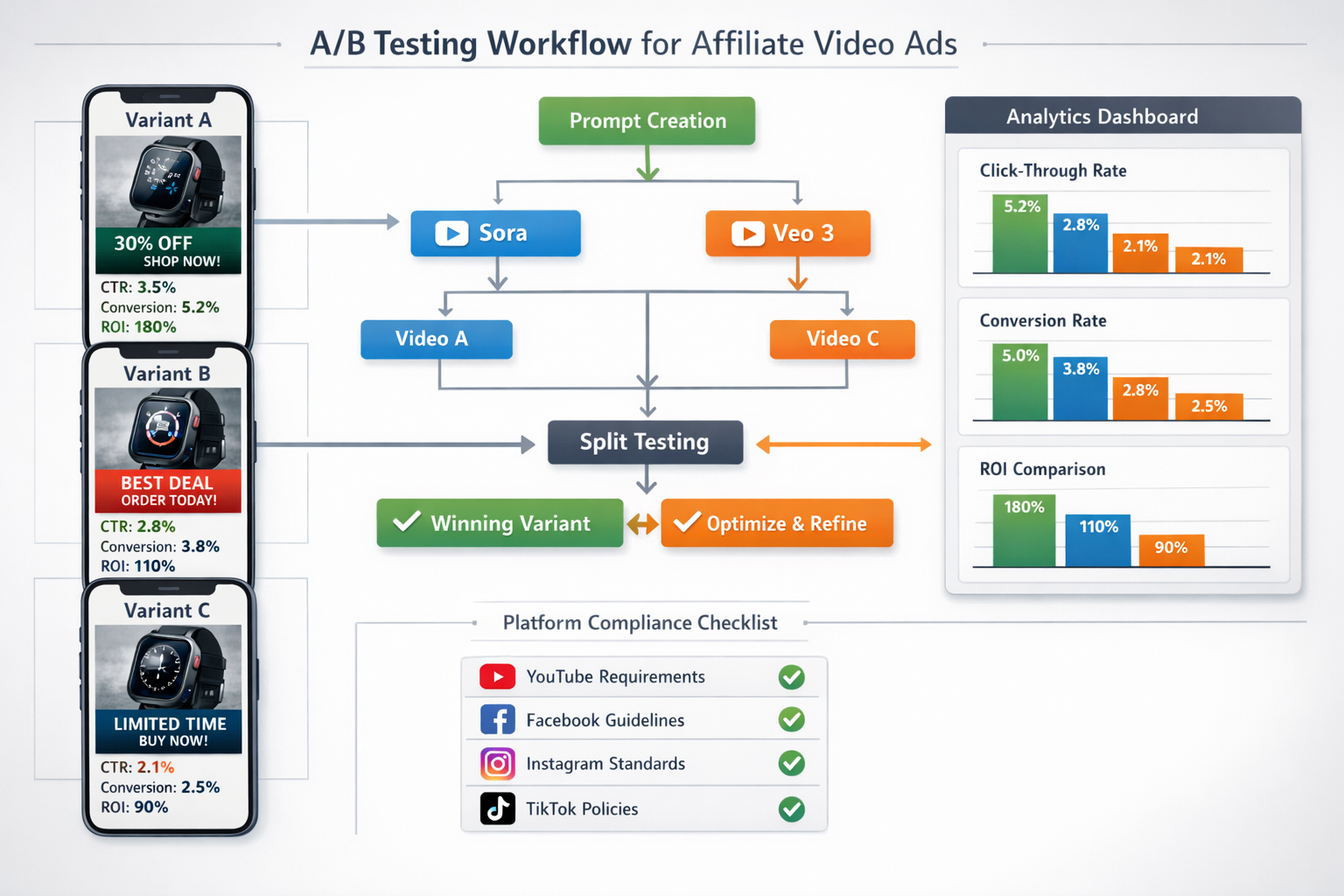
The economics of Sora and Veo 3 for Affiliate Video Creatives: Generating High-ROI Product Demos in Minutes enable testing volumes previously impossible for solo affiliates or small teams.
Structured testing framework:
Phase 1: Broad Variation Testing (Veo 3 Fast)
- Generate 15-20 variations testing major differences
- Run each as low-budget ads ($5-10 spend per variation)
- Measure CTR, view-through rate, engagement rate
- Identify top 3-5 performers
Phase 2: Refinement Testing (Veo 3 Quality)
- Create refined versions of winners
- Test CTA variations, pacing adjustments, different hooks
- Increase ad spend to $25-50 per variation
- Measure conversion rate, cost per acquisition
Phase 3: Scale Production (Sora 2 or Veo 3 Quality)
- Produce final versions of proven winners
- Scale ad spend based on ROI metrics
- Create platform-specific variations
Platform-Specific Testing Considerations
Different platforms require distinct optimization approaches, similar to strategies outlined in how to do affiliate marketing:
YouTube:
- Longer-form content performs better (30-60 seconds)
- First 5 seconds determine retention
- End screens with channel subscribe CTAs
Facebook/Instagram:
- Vertical format (9:16) for Reels and Stories
- Captions essential (85% watch without sound)
- First 3 seconds critical for stopping scroll
TikTok:
- Native, authentic aesthetic outperforms polished
- Trending audio integration boosts discovery
- Shorter (15-30 seconds) optimal
Measuring What Matters
Track these affiliate-specific metrics:
Engagement metrics:
- Click-through rate (CTR)
- View-through rate (VTR)
- Average watch time
- Engagement rate (likes, comments, shares)
Conversion metrics:
- Cost per click (CPC)
- Cost per acquisition (CPA)
- Conversion rate
- Return on ad spend (ROAS)
Creative insights:
- Which product angles drive clicks
- Optimal video length by platform
- CTA effectiveness
- Audience demographic response
Platform Compliance and Disclosure Requirements
FTC Guidelines for AI-Generated Affiliate Content
The Federal Trade Commission requires clear and conspicuous disclosure of affiliate relationships. AI-generated content adds another layer of transparency requirements emerging in 2026.
Required disclosures:
- Affiliate relationship: "This video contains affiliate links. I earn a commission if you purchase."
- AI generation (platform-dependent): Some platforms now require labeling of AI-generated content
Placement requirements:
- Visible without expanding "more" sections
- Readable font size and contrast
- Positioned before CTA when possible
Platform-Specific Content Policies
YouTube:
- Requires disclosure in video description
- Recommends verbal disclosure in video
- Allows AI-generated content with proper labeling
Facebook/Instagram:
- "Paid partnership" tag required for sponsored content
- AI-generated content allowed in ads with disclosure
- Misleading content policies apply regardless of generation method
TikTok:
- Disclosure in video caption required
- Branded content toggle for partnerships
- Emerging AI labeling requirements in select markets
Google Ads:
- Accepts AI-generated video in ad campaigns
- Requires compliance with standard advertising policies
- Product claims must be substantiated regardless of production method
Avoiding Common Compliance Pitfalls
⚠️ Critical mistakes to avoid:
- Using AI to create false testimonials or reviews
- Generating misleading before/after comparisons
- Creating content that mimics real user experiences without disclosure
- Failing to disclose material connections to products
For those new to these requirements, reviewing common affiliate marketing mistakes provides essential context.
Advanced Strategies for Scaling Video Production
Batch Production Workflows
Once you've identified winning formulas, scale production efficiently:
Template-based generation:
- Create prompt templates with variable placeholders
- Swap product names, features, and contexts
- Generate multiple product demos using proven structures
- Maintain brand consistency across campaigns
Example template:
"[Product category] product showcase in [setting]. Camera [movement] showing [key feature 1], [key feature 2], and [key feature 3]. [Lifestyle context] with [target demographic]. [Mood/style] aesthetic, [duration] seconds."
Multi-Product Campaign Coordination
For affiliates promoting multiple products within a niche, create cohesive visual branding:
- Consistent color grading across all videos
- Standardized intro/outro sequences
- Unified music and pacing
- Recognizable visual style that builds brand equity
Automation and API Integration
Advanced users can leverage Veo 3's API access for programmatic video generation:
- Automated product demo creation from product feeds
- Scheduled content generation for promotional calendars
- Integration with AI marketing tools for end-to-end automation
- Dynamic video personalization based on audience segments
Real-World Performance Benchmarks
Case Study Metrics from Early Adopters
Affiliates implementing Sora and Veo 3 for Affiliate Video Creatives: Generating High-ROI Product Demos in Minutes report significant performance improvements:
Typical results:
- 40-60% reduction in content production costs
- 3-5x increase in testing volume
- 25-35% improvement in CTR vs. static images
- 15-20% boost in conversion rates for video-first campaigns
The first AI-generated Super Bowl ad created entirely with Sora 2 validates that AI video meets broadcast-quality standards [3], establishing precedent for affiliate-generated content legitimacy.
ROI Calculation Framework
Calculate your potential ROI using this framework:
Traditional approach:
- Production cost: €500 per video
- Testing capacity: 2-3 variations per campaign
- Time to market: 1-2 weeks
AI-powered approach:
- Production cost: €5-15 per tested variation
- Testing capacity: 15-20 variations per campaign
- Time to market: 1-2 days
Break-even analysis:
If AI-generated videos achieve even 70% of traditional video performance while costing 97% less to produce, the ROI improvement is substantial—especially for best affiliate marketing programs for beginners with limited budgets.
Future-Proofing Your Affiliate Video Strategy
Emerging Capabilities to Watch
Both platforms continue rapid development:
Veo 3 roadmap indicators:
- Extended video lengths beyond current limits
- Enhanced text-to-video precision for product-specific details
- Improved multi-shot sequencing for storytelling
Sora 2 development trajectory:
- Greater control over specific object manipulation
- Enhanced physics simulation for product demonstrations
- Improved consistency across longer-form content
Building Sustainable Competitive Advantages
The true competitive advantage isn't just using these tools—it's developing systematic processes that compound over time:
- Build prompt libraries of proven formulas
- Document performance data to identify patterns
- Develop testing frameworks that accelerate learning
- Create brand assets that differentiate your content
- Establish compliance workflows that scale safely
This systematic approach aligns with comprehensive affiliate marketing strategies that build long-term value.
Conclusion
Sora and Veo 3 for Affiliate Video Creatives: Generating High-ROI Product Demos in Minutes represents more than just new tools—it's a fundamental shift in the economics and accessibility of professional video content creation. The ability to test 20 product demo variations for under €15, receive results within hours, and scale winners immediately creates competitive advantages that compound over time.
The platforms' technical capabilities—95%+ prompt accuracy, broadcast-quality output, and elimination of visual artifacts—have reached the threshold where AI-generated content competes directly with traditional production. The first AI-generated Super Bowl ad proves the commercial viability. The €0.22 per video economics in Veo 3 Fast mode enable testing volumes that were economically impossible just months ago.
Actionable Next Steps
This week:
- Create accounts on both Veo 3 and Sora 2 platforms
- Generate your first 5 product demo variations using Veo 3 Fast mode
- Test one variation as a low-budget ad ($10 spend) to establish baseline metrics
This month:
- Implement systematic A/B testing across 15-20 variations
- Document winning formulas in prompt templates
- Scale top performers with increased ad spend
- Establish compliance workflows for all platforms
This quarter:
- Build a library of 50+ tested prompt templates
- Develop platform-specific optimization playbooks
- Integrate video workflows into your broader affiliate marketing program
- Measure and optimize for ROAS across all campaigns
The affiliate marketers who master these AI video generation platforms in 2026 won't just save money on production—they'll fundamentally outpace competitors who remain limited by traditional video creation constraints. The barrier to entry for professional video content has collapsed. The question isn't whether to adopt these tools, but how quickly you can integrate them into systematic, scalable workflows that drive measurable ROI.
Start testing today. The competitive advantage belongs to those who move first.
References
[1] Ai Video Models Guide 2025 – https://ulazai.com/ai-video-models-guide-2025/
[2] Veo 3 Vs Top Ai Video Generators – https://www.imagine.art/blogs/veo-3-vs-top-ai-video-generators
[3] Watch – https://www.youtube.com/watch?v=rmO6ywgoRsc
[4] Sora 2 Vs Veo 3 Which Ai Video Model Should Creators Use – https://cybernews.com/ai-tools/sora-2-vs-veo-3-which-ai-video-model-should-creators-use/