

}
The affiliate marketing landscape has reached a critical turning point in 2026. While early adopters of generative AI celebrated their ability to produce hundreds of articles per week, they're now discovering a harsh reality: volume without substance has become a liability, not an advantage. Strategic Generative AI Adoption: Moving Beyond Speed to Substance in Affiliate Content Creation represents the fundamental shift separating tomorrow's leaders from yesterday's tactics.
Over 80% of large language model citations now originate from ad-funded websites rather than brand-owned content, positioning affiliates as influential voices in AI-powered discovery[1]. However, this opportunity belongs exclusively to those who've moved beyond treating AI as a content factory and started using it as a strategic amplification tool.
Key Takeaways
- 🎯 Quality context beats quantity output: Affiliates providing richer narrative framing to AI tools generate higher-quality, brand-aligned content that earns citations
- 📊 Citation frequency replaces rankings: With organic click-through rates from AI Overviews dropping over 61%, visibility and mentions matter more than traditional search positions[3]
- 🎥 Multimodal content dominates: AI systems heavily cite YouTube videos, original photography, and social evidence—making visual demonstrations essential[2]
- ✅ First-person experience wins: Google's Reviews Update prioritizes demonstrated expertise with original testing, disclosed methodologies, and authentic insights[2]
- 🤖 Strategic integration outperforms automation: The 2026 advantage comes from amplifying strategic intent, not maximizing production speed
Understanding Strategic Generative AI Adoption in Affiliate Marketing
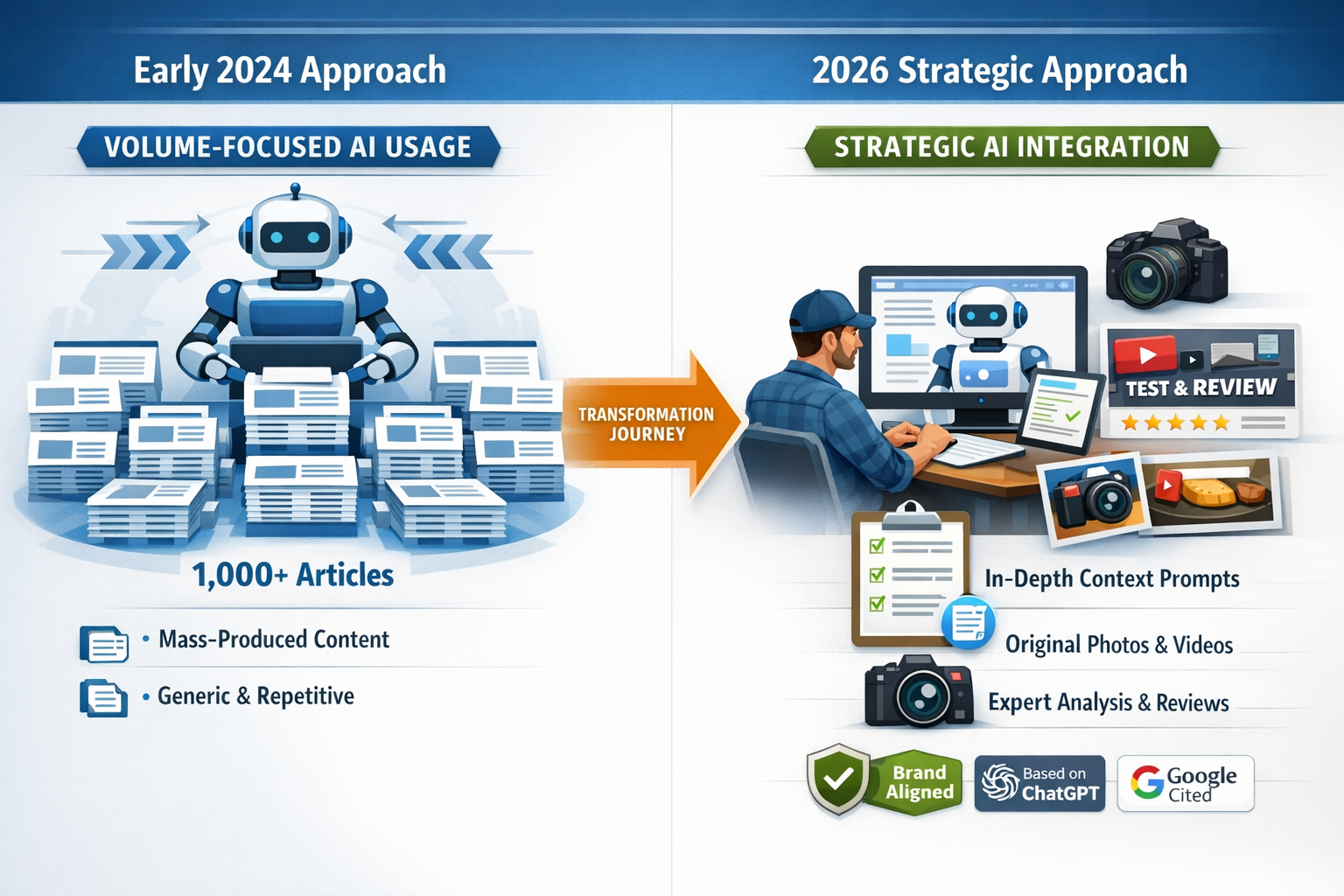
Strategic Generative AI Adoption: Moving Beyond Speed to Substance in Affiliate Content Creation fundamentally redefines how successful affiliates approach content development. The distinction isn't about whether to use AI—it's about how to use it.
The Evolution from Volume to Value
Early generative AI users in 2023-2024 chased impressive metrics: 50 articles per week, 200 product reviews per month, automated content calendars spanning six months. These numbers looked impressive in presentations but delivered diminishing returns in practice.
By 2026, the landscape has transformed:
| 2024 Volume Approach | 2026 Strategic Approach |
|---|---|
| Maximum article output | Maximum value per piece |
| Generic AI prompts | Detailed context and frameworks |
| Minimal human oversight | Strategic human direction |
| Ranking-focused metrics | Citation and visibility metrics |
| Text-only content | Multimodal content integration |
The shift reflects a fundamental truth: AI models reward high-quality, authentic, authoritative content[1]. Platforms like ChatGPT increasingly draw on affiliate and creator material to inform product interpretations and shape recommendations—but only when that content demonstrates genuine expertise.
Why Context Matters More Than Speed
When affiliates provide AI tools with richer context and narrative framing, the outputs transform dramatically. Instead of feeding a simple prompt like "Write a review of Product X," strategic adopters in 2026 provide:
- Detailed testing methodologies they've personally conducted
- Specific audience pain points discovered through research
- Brand voice guidelines ensuring consistency
- Competitive positioning based on market analysis
- Original insights from hands-on experience
This approach aligns perfectly with affiliate marketing strategies that prioritize authenticity and audience trust over pure content volume.
The Substance Revolution: What Google and AI Models Actually Reward
Google's integrated Reviews Update has fundamentally changed the game. The algorithm now prioritizes first-person experience and demonstrated expertise, with affiliate content featuring original photography, testing videos, and disclosed methodologies showing significantly better performance[2].
Elements of Substantive Affiliate Content
Generic AI-generated listicles without firsthand insight have become increasingly uncompetitive in both traditional SEO and AI visibility. Instead, successful affiliates in 2026 focus on:
1. Original Testing and Documentation 📸
High-quality partnership content requires genuine product interaction. This means:
- Taking original photographs of products in use
- Creating testing videos showing real-world applications
- Documenting methodologies transparently
- Sharing actual results with specific metrics
2. Multimodal Content Integration 🎬
AI systems heavily cite content beyond traditional text articles. Multimodal content—including YouTube videos, social media, and original photography—is heavily cited by AI systems[2], making visual demonstrations critical components of effective affiliate marketing.
Successful affiliates now create:
- YouTube product reviews with detailed demonstrations
- Instagram posts showing real-world use cases
- TikTok videos addressing common questions
- Pinterest pins linking to comprehensive guides
3. Editorially-Driven Reviews ✍️
Editorially-driven reviews and authentic creator insights provide the depth and credibility that large language models favor[1]. This approach helps brands earn both visibility and trust in AI-driven discovery.
Key elements include:
- Personal anecdotes and experiences
- Comparative analysis based on actual testing
- Honest discussion of limitations and drawbacks
- Specific use-case recommendations
- Transparent affiliate disclosures
"High-quality partnership content, thoughtful reviews, and creator perspectives are becoming the most powerful differentiators as AI reshapes discovery." [1]
Measuring Success: New Metrics for Strategic AI Adoption
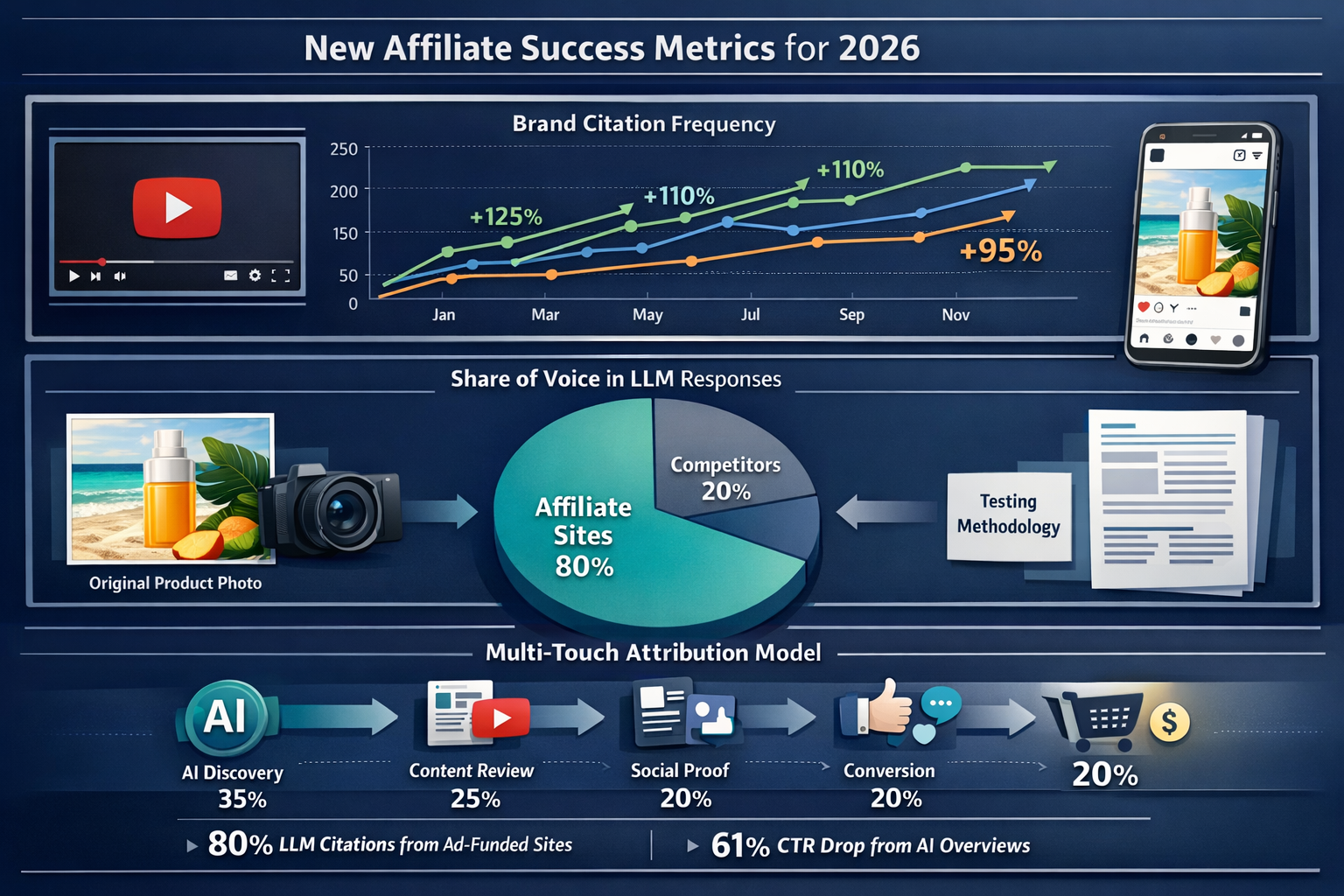
The fundamental metrics for affiliate success have transformed. Brand visibility and citation frequency have become the critical competitive metrics, replacing traditional ranking-based measurements[2].
Share of Voice Across Large Language Models
Traditional affiliate marketers obsessed over Google rankings. Strategic adopters in 2026 track:
- Citation frequency in ChatGPT responses
- Mention rates in Perplexity AI answers
- Inclusion in Google AI Overviews
- Brand visibility across multiple AI platforms
With organic click-through rates from AI Overviews dropping over 61%[3], citation optimization and brand visibility have become the primary SEO goals rather than ranking itself.
Enhanced Attribution Models
Enhanced attribution models with improved tracking and multi-touch attribution are providing better insights into customer journeys[6]. This ensures affiliates receive fair compensation for their contributions across the entire conversion path.
Modern attribution tracking reveals:
- Initial discovery through AI-powered search
- Social proof validation on Instagram or YouTube
- Detailed review consumption on affiliate sites
- Final conversion through affiliate links
Understanding this journey helps affiliates optimize content for each touchpoint rather than focusing solely on final-click attribution.
Implementing Strategic AI Adoption: Practical Framework
Moving beyond speed to substance requires a systematic approach. Here's how leading affiliates are implementing Strategic Generative AI Adoption in 2026:
Step 1: Develop Comprehensive Content Briefs
Before engaging AI tools, create detailed briefs that include:
- Target audience persona with specific pain points
- Product testing results from personal experience
- Competitive landscape analysis
- Unique value proposition for the content
- Brand voice guidelines and tone requirements
- SEO requirements including semantic keywords
- Multimodal elements to include (videos, images, social proof)
Step 2: Use AI for Strategic Amplification
Rather than asking AI to create content from scratch, use it to:
- Expand on your original insights
- Reorganize complex information for clarity
- Generate variations for different platforms
- Optimize existing content for voice search queries
- Create social media adaptations of core content
Voice search optimization for conversational queries is becoming essential[6], helping affiliate sites rank for long-tail keywords as voice assistants drive new discovery patterns.
Step 3: Layer in Authentic Elements
After AI generates initial drafts, enhance with:
- Original photography from product testing
- Personal anecdotes and experiences
- Video demonstrations embedded in content
- Social proof from actual user interactions
- Expert quotes or interviews
This approach aligns with SEO fundamentals while leveraging AI's efficiency advantages.
Step 4: Optimize for AI Discovery
Ensure content appears in LLM citations by:
- Using clear, authoritative language
- Structuring information hierarchically
- Including specific data points and statistics
- Creating quotable insights and takeaways
- Building topical authority through comprehensive coverage
Step 5: Track New Success Metrics
Monitor performance using:
- Brand mention tracking across AI platforms
- Citation frequency in LLM responses
- Multi-touch attribution data
- Engagement metrics across multimodal content
- Conversion rates by discovery channel
The Future: Agentic AI and Strategic Partnership Management
Looking ahead, agentic AI systems managing workflows and campaigns autonomously represent the new frontier[3]. The ROI from basic content creation has plateaued, with the emerging 98% ROI opportunity lying in autonomous systems.
This shift requires affiliates to evolve from content creators to strategic partnership managers. Future success depends on:
- Orchestrating AI systems rather than operating them manually
- Building authentic relationships with brands and audiences
- Creating proprietary frameworks that AI tools amplify
- Developing unique perspectives that algorithms can't replicate
- Establishing thought leadership in specific niches
For those becoming affiliate marketers in 2026, this represents both challenge and opportunity. The barrier to entry for volume-based approaches has collapsed, but the opportunity for strategic, substantive content has never been greater.
Conclusion: Choosing Substance Over Speed
Strategic Generative AI Adoption: Moving Beyond Speed to Substance in Affiliate Content Creation isn't just a tactical shift—it's a fundamental reimagining of affiliate marketing's value proposition. The affiliates thriving in 2026 have stopped competing on content volume and started competing on content value.
The data is clear: AI models favor authentic, authoritative content with demonstrated expertise. Google rewards first-person experience and original insights. Audiences trust creators who provide genuine value rather than generic recommendations.
Actionable Next Steps
Ready to implement strategic AI adoption? Start here:
- Audit your current content for authenticity and original insights
- Develop detailed content frameworks that provide rich context to AI tools
- Invest in multimodal content creation including video and original photography
- Implement citation tracking across major AI platforms
- Build enhanced attribution models to understand your full customer journey
- Focus on depth over breadth in your content strategy
The race to the bottom through AI-generated volume is over. The race to the top through AI-amplified substance has just begun. Those who recognize this shift and adapt accordingly will dominate affiliate marketing for years to come.
For more insights on building a sustainable affiliate business, explore our guide on top strategies for affiliate marketers and learn how to leverage AI effectively in your marketing efforts.
References
[1] Ai Affiliate Marketing – https://www.accelerationpartners.com/resources/ai-affiliate-marketing/
[2] The State Of Ai And Seo In 2026 With Lily Ray – https://www.affiliatesummit.com/blogs/the-state-of-ai-and-seo-in-2026-with-lily-ray
[3] Ai Marketing Guide – https://www.yotpo.com/blog/ai-marketing-guide/
[6] Affiliate Marketing – https://www.imd.org/blog/marketing/affiliate-marketing/