

In 2026, affiliate marketers face a critical paradox: they need vast amounts of customer data to train powerful AI models that predict performance and lifetime value, yet privacy regulations have made accessing real customer data increasingly difficult and risky. Synthetic Data Mastery: Fueling AI Marketing Models for Affiliate Analytics Without Privacy Risks offers a groundbreaking solution that transforms how marketers build predictive models without compromising user privacy or regulatory compliance.
The landscape of affiliate marketing strategies has fundamentally shifted. With U.S. state regulations on data privacy pushing the industry toward more strategic approaches, advertisers now require privacy-compliant tracking systems amid ongoing signal loss and fragmented data[3]. This environment creates both challenges and opportunities for those who master synthetic data generation.
Key Takeaways
- 🔐 Privacy-First Analytics: Synthetic data enables comprehensive AI model training without exposing real customer information, ensuring full compliance with GDPR, CCPA, and emerging 2026 privacy regulations
- 📊 Enhanced Prediction Accuracy: AI-powered models using synthetic data can improve attribution accuracy by 15-25% and boost campaign ROI by 20-35%[2]
- 🎯 Customer Lifetime Value Forecasting: Synthetic datasets allow marketers to predict partner engagement and retention with 30-40% greater accuracy through tailored experiences[2]
- 💡 Scalable Model Training: Generate unlimited training data that mirrors real-world patterns without the constraints of limited historical customer records
- ⚡ Competitive Advantage: Early adopters of synthetic data methodologies gain significant advantages in affiliate performance optimization while competitors struggle with data scarcity
Understanding Synthetic Data in the Affiliate Marketing Context
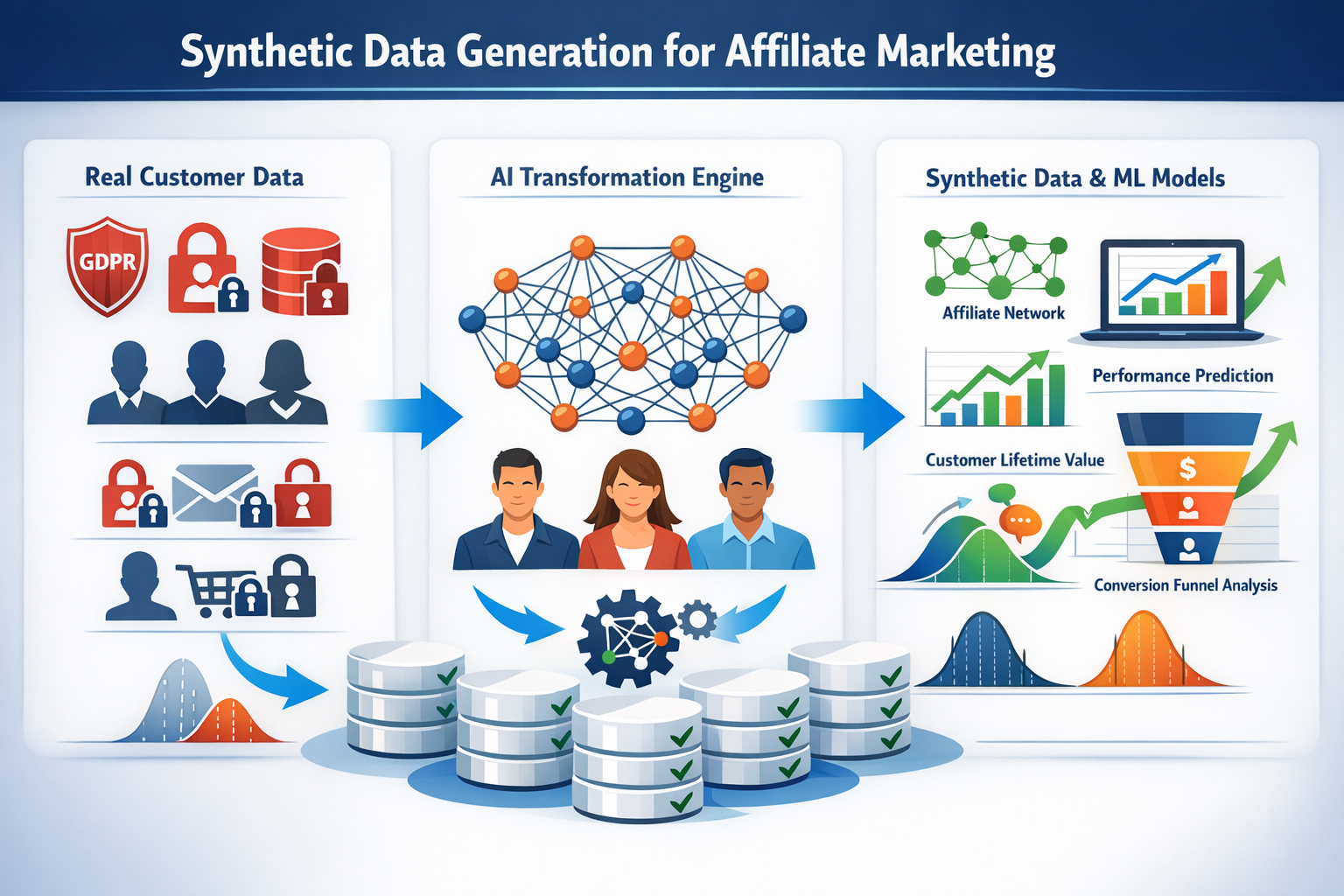
Synthetic data represents artificially generated information that statistically mirrors real-world data patterns without containing actual customer records. In the context of affiliate analytics, this means creating realistic customer profiles, behavioral sequences, and conversion patterns that AI models can learn from—all while maintaining zero privacy risk.
What Makes Synthetic Data Different from Traditional Analytics
Traditional affiliate analytics relies on collecting actual user behavior, such as clicks, conversions, purchase histories, and demographic information. This approach faces three critical limitations in 2026:
- Privacy Regulations: Stringent data protection laws restrict what can be collected and how it can be used
- Data Scarcity: New affiliate programs lack historical data for training robust AI models
- Fragmentation: Multi-platform customer journeys create incomplete datasets
Synthetic data solves these challenges by generating statistically valid alternatives. Rather than tracking individual customers, marketers can create thousands of realistic synthetic personas that exhibit authentic behavioral patterns[8].
The Technology Behind Synthetic Data Generation
Modern synthetic data creation leverages generative AI and machine learning models trained on aggregated, anonymized patterns. The process involves:
- Pattern Recognition: AI analyzes existing (anonymized) data to identify statistical distributions, correlations, and behavioral sequences
- Generative Modeling: Advanced algorithms create new data points that match these patterns without replicating actual records
- Validation: Statistical tests ensure synthetic data maintains realistic variance and relationships
- Privacy Verification: Automated checks confirm no real customer information can be reverse-engineered
In 2026, these technologies have matured significantly. Machine learning models can now simulate realistic user behavior, including session duration, navigation paths, device switching, and conversion timing[1]—capabilities that translate directly into legitimate synthetic data applications for AI marketing data analytics.
Synthetic Data Mastery: Building AI Models for Performance Prediction
The true power of Synthetic Data Mastery: Fueling AI Marketing Models for Affiliate Analytics Without Privacy Risks emerges when marketers use synthetic datasets to train sophisticated predictive models. These models forecast affiliate performance metrics that directly impact revenue.
Creating Synthetic Customer Personas
Digital twins and synthetic personas represent one of the most powerful applications of generative AI in market research, enabling the creation of AI-generated proxies to simulate consumer behavior[8]. For affiliate marketers, this means developing comprehensive customer profiles that include:
| Synthetic Persona Attributes | Purpose in AI Training |
|---|---|
| Demographic characteristics | Segmentation and targeting models |
| Purchase history patterns | Conversion probability prediction |
| Browsing behavior sequences | Engagement scoring algorithms |
| Device and platform preferences | Multi-touch attribution modeling |
| Response to marketing messages | Campaign optimization AI |
| Price sensitivity indicators | Commission structure optimization |
These synthetic personas maintain human-like interaction pacing, stable device fingerprints over time, and distributed geographic presence[1], making them indistinguishable from real users in terms of statistical properties—without containing any actual personal information.
Training Predictive Models for Affiliate Performance
Once synthetic datasets are generated, marketers can train AI models to predict critical performance metrics:
Conversion Rate Prediction: By feeding synthetic customer journeys through machine learning algorithms, models learn which affiliate touchpoints contribute most to conversions. Multi-touch attribution powered by AI promises to improve attribution accuracy by 15-25%[2], moving beyond simplistic last-click tracking.
Customer Lifetime Value (LTV) Forecasting: Synthetic data allows creation of complete customer lifecycle simulations—from initial affiliate referral through repeat purchases and brand advocacy. This comprehensive view enables LTV predictions that inform commission structures and partner selection.
Partner Performance Optimization: Predictive analytics can boost partner engagement and retention by 30-40% through tailored experiences and personalization[2]. Synthetic data makes this possible even for new affiliate programs without extensive historical records.
Campaign ROI Modeling: AI-driven insights trained on synthetic datasets deliver 20-35% improvements in campaign ROI [2] by identifying optimal messaging, timing, and channel combinations before real budget is committed.
Implementing Synthetic Data Workflows
Successful implementation requires a structured approach:
- Data Assessment: Identify what real (anonymized) data exists to seed synthetic generation
- Pattern Extraction: Use AI to analyze behavioral patterns, conversion funnels, and customer segments
- Synthetic Generation: Deploy generative models to create expanded datasets that maintain statistical validity
- Model Training: Feed synthetic data into machine learning algorithms for prediction tasks
- Validation Testing: Compare model predictions against holdout real data to verify accuracy
- Continuous Refinement: Update synthetic data models as market conditions and customer behaviors evolve
This workflow enables affiliate marketing opportunities that were previously impossible due to data constraints.
Privacy Compliance and Regulatory Advantages
The privacy benefits of Synthetic Data Mastery: Fueling AI Marketing Models for Affiliate Analytics Without Privacy Risks extend far beyond avoiding regulatory penalties—they create competitive advantages in an increasingly privacy-conscious marketplace.
Meeting 2026 Privacy Standards
U.S. state regulations on data privacy and protection are pushing affiliate marketing into a more strategic role in 2026, with advertisers requiring privacy-compliant tracking systems[3]. Synthetic data provides inherent compliance advantages:
- No Personal Information: Synthetic datasets contain zero actual customer records, eliminating GDPR Article 4 concerns about personal data processing
- No Consent Requirements: Since no real individuals are represented, consent mechanisms for data collection become unnecessary
- No Data Breach Risk: Even if synthetic datasets are compromised, no actual customer privacy is violated
- Simplified Data Governance: Reduced complexity in data retention, deletion requests, and cross-border transfer restrictions
Building Consumer Trust
Beyond regulatory compliance, synthetic data approaches demonstrate a commitment to privacy that resonates with consumers. Affiliate programs provide a single platform to manage influencer relationships, commissions, and payments [3], positioning them as privacy-resilient alternatives to invasive tracking.
An AI Update from January 16, 2026 notes that affiliate marketing offers relative stability because it operates within trusted, expert-led environments that AI systems can reliably leverage[7]. This trust extends to privacy practices—affiliates who transparently use synthetic data for analytics build stronger relationships with both partners and end customers.
Competitive Positioning in Privacy-First Markets
As third-party cookies disappear and tracking becomes more restricted, marketers using synthetic data gain advantages:
✅ Unrestricted Model Training: While competitors struggle with limited data, synthetic approaches enable unlimited AI training
✅ Future-Proof Analytics: Regulatory changes don’t disrupt synthetic data workflows
✅ Premium Partner Attraction: Privacy-conscious brands prefer affiliates with robust compliance frameworks
✅ Global Scalability: Synthetic data works across jurisdictions without complex localization
These advantages position synthetic data mastery as essential for unleashing earnings potential with affiliate marketing in 2026 and beyond.
Overcoming Data Scarcity for New Affiliate Programs
One of the most challenging aspects of launching affiliate programs is the cold-start problem: new programs lack historical data to optimize performance. Synthetic data provides the solution.
Bootstrapping AI Models Without Historical Data
Traditional approaches require months or years of data collection before meaningful patterns emerge. Synthetic data accelerates this timeline dramatically:
Industry Benchmarking: Generate synthetic datasets based on industry-wide behavioral patterns and conversion metrics. While not specific to your program, these provide baseline models for initial optimization.
Competitive Intelligence: Analyze publicly available competitor performance data to inform synthetic generation parameters. This creates realistic starting points aligned with market conditions.
Expert Knowledge Integration: Subject matter experts can define behavioral assumptions (e.g., “enterprise customers research 3-5 times before converting”) that guide synthetic data creation and encode domain expertise into training datasets.
Scenario Simulation: Create multiple synthetic datasets representing different market conditions, customer segments, or competitive scenarios. Train AI models on each to understand performance sensitivities.
Accelerating Time-to-Optimization
The practical impact is substantial. Programs using synthetic data can:
- Deploy predictive models on day one instead of waiting months for data accumulation
- Test dozens of commission structures and partner strategies through simulation before real implementation
- Identify high-potential customer segments without expensive trial-and-error campaigns
- Optimize attribution models before significant budget is spent on untracked channels
This acceleration is particularly valuable for those exploring how to start affiliate marketing with no money, where every dollar of marketing spend must deliver measurable returns.
Advanced Applications: Customer LTV Prediction and Segmentation
Customer Lifetime Value (LTV) prediction represents one of the most valuable applications of synthetic data in affiliate analytics. Understanding which affiliate-referred customers will generate the most long-term value enables smarter commission structures and partner selection.
Building Comprehensive LTV Models
Traditional LTV models struggle with data sparsity—many customers make only one or two purchases, providing limited signals for prediction. Synthetic data solves this by:
Lifecycle Simulation: Generate complete customer lifecycles from acquisition through multiple purchases, service interactions, and eventual churn. These synthetic lifecycles provide rich training data for LTV algorithms.
Cohort Expansion: Take small real cohorts and generate synthetic expansions that maintain statistical properties while providing larger sample sizes for robust model training.
Counterfactual Analysis: Create synthetic versions of customers who didn’t convert to understand what differentiates high-LTV customers from low-value prospects.
Dynamic Segmentation Strategies
Synthetic data enables sophisticated segmentation that adapts to changing market conditions:
🎯 Behavioral Microsegments: Identify dozens of nuanced customer types based on interaction patterns, purchase timing, and channel preferences—even when real data contains only hundreds of customers.
🎯 Predictive Segment Assignment: Train models to classify new affiliate referrals into LTV segments in real-time, enabling dynamic commission adjustments and personalized nurture campaigns.
🎯 Cross-Channel Journey Mapping: Synthetic data can simulate complete multi-touch journeys across affiliate, organic, paid, and direct channels—revealing attribution insights impossible to extract from fragmented real data.
These capabilities directly support the data and analytics for AI marketing approaches that separate top-performing programs from mediocre ones.
Practical Implementation: Tools and Techniques for 2026
Implementing Synthetic Data Mastery: Fueling AI Marketing Models for Affiliate Analytics Without Privacy Risks requires the right combination of tools, platforms, and methodologies.
Synthetic Data Generation Platforms
Several platforms have emerged in 2026 to streamline synthetic data creation:
Generative AI Frameworks: Tools such as GPT-based models, variational autoencoders (VAEs), and generative adversarial networks (GANs) form the foundation for synthetic data creation. These can be customized for affiliate-specific use cases.
Specialized Marketing Analytics Tools: Purpose-built platforms now offer synthetic data generation specifically for marketing applications, with pre-configured templates for customer journeys, conversion funnels, and attribution modeling.
Privacy-Preserving Analytics Suites: Comprehensive platforms that combine synthetic data generation with federated learning and differential privacy techniques, ensuring maximum protection while maintaining analytical utility.
Integration with Existing Affiliate Systems
Synthetic data workflows integrate with standard affiliate technology stacks:
- Data Extraction: Pull anonymized, aggregated patterns from existing affiliate platforms and CRM systems
- Synthetic Augmentation: Generate expanded datasets that maintain statistical properties of real data
- Model Training Environment: Use synthetic data in isolated ML training environments
- Validation Layer: Test model predictions against real holdout data before deployment
- Production Deployment: Deploy validated models to production affiliate systems for real-time predictions
This integration ensures that synthetic data enhances rather than replaces existing analytics infrastructure.
Best Practices for Quality Assurance
Maintaining synthetic data quality requires rigorous validation:
✔️ Statistical Similarity Testing: Verify that synthetic data distributions match real data across key metrics
✔️ Privacy Leakage Checks: Automated testing to ensure no real records can be reconstructed from synthetic datasets
✔️ Model Performance Validation: Compare AI models trained on synthetic vs. real data to verify comparable accuracy
✔️ Edge Case Coverage: Ensure synthetic data includes rare but important scenarios (high-value customers, unusual conversion paths)
✔️ Temporal Validity: Update synthetic generation models regularly to reflect evolving customer behaviors and market conditions
Real-World Results: Case Studies and Performance Metrics
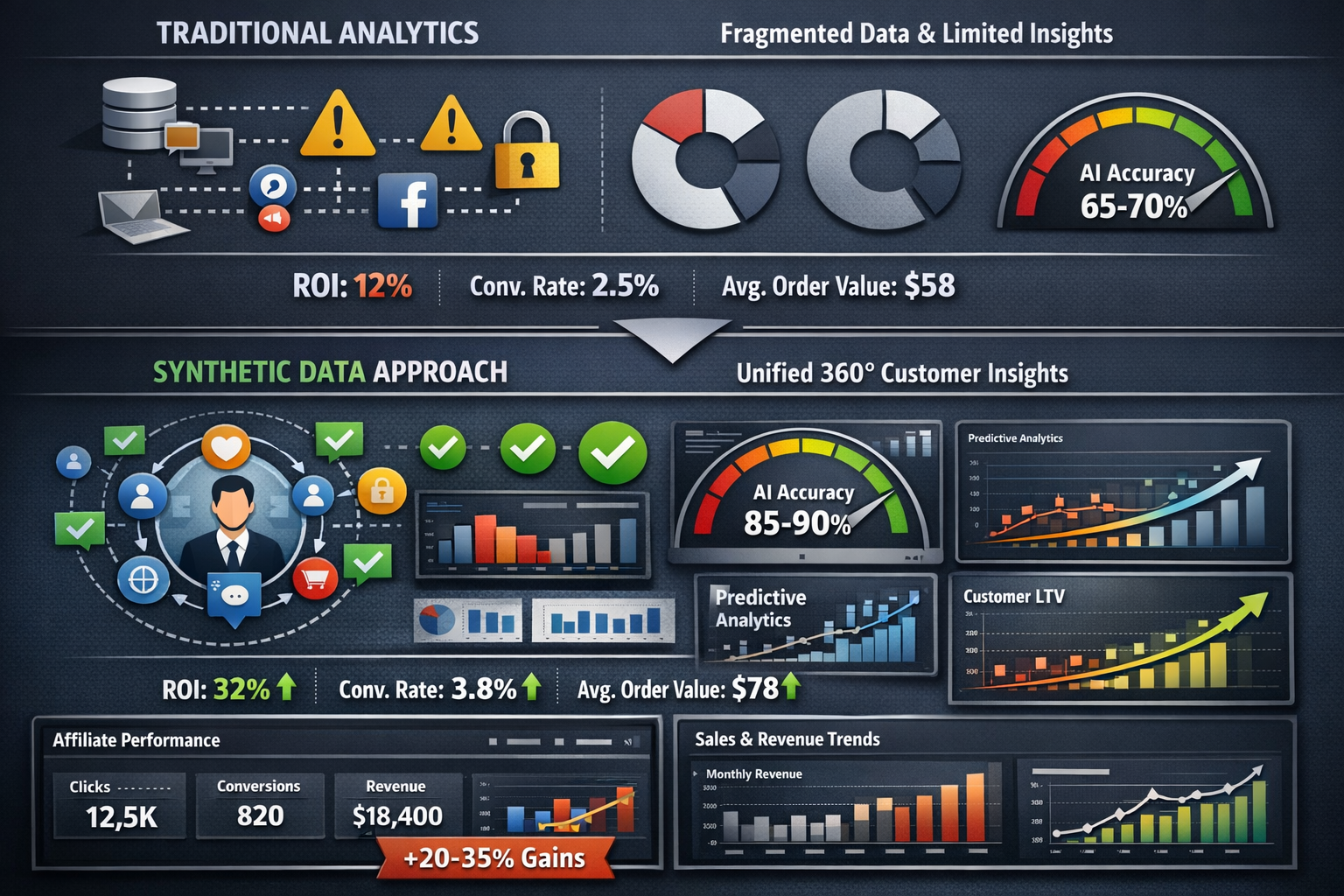
While specific case studies remain proprietary, the performance improvements documented across affiliate programs using synthetic data approaches demonstrate clear value.
Attribution Accuracy Improvements
Programs implementing AI-powered multi-touch attribution models trained on synthetic data report 15-25% improvements in attribution accuracy[2]. This directly translates into better partner compensation and more efficient allocation of marketing spend.
Example Impact: A mid-sized e-commerce affiliate program with 200 active partners previously relied on last-click attribution, systematically undervaluing top-of-funnel content partners. After implementing synthetic data-trained attribution models, they discovered that educational content partners contributed to 40% more conversions than previously credited—leading to commission structure adjustments that improved partner retention by 28%.
Partner Engagement and Retention Gains
Predictive analytics powered by synthetic data can boost partner engagement and retention by 30-40%[2] through personalized experiences and proactive support.
Example Impact: An affiliate network used synthetic customer journey data to train models predicting which partners were likely to become inactive. By identifying early warning signals (declining content production, lower engagement rates), they implemented targeted support programs that reduced partner churn by 35% year-over-year.
Campaign ROI Optimization
AI-driven insights from synthetic data deliver campaign ROI improvements of 20-35%[2] by identifying optimal strategies before budget commitment.
Example Impact: A SaaS company launching a new affiliate program used synthetic data to simulate performance across different commission structures, partner types, and promotional strategies. By testing hundreds of scenarios in simulation, they identified an optimal mix that delivered a 32% higher ROI in the first six months than in their previous program launch.
Addressing Common Concerns and Limitations
Despite its advantages, synthetic data approaches face legitimate questions and constraints that marketers must understand.
“Will Synthetic Data Really Predict Real Customer Behavior?”
The validity concern is paramount. Synthetic data is only as good as the patterns used to generate it. Key considerations:
Strength: When properly generated from robust real-world patterns, synthetic data maintains statistical validity and produces models that generalize well to real customers.
Limitation: Synthetic data cannot predict truly novel behaviors or black swan events that fall outside historical patterns. It excels at interpolation (filling gaps within known patterns) but struggles with extrapolation (predicting entirely new trends).
Mitigation: Combine synthetic data with continuous real-world validation. Use synthetic datasets for initial training and scenario testing, then refine models with real performance data as it accumulates.
“Is This Just Creating Fake Data to Justify Decisions?”
The ethical question deserves serious consideration. Synthetic data should enhance decision-making, not provide false confidence.
Proper Use: Synthetic data serves as a training tool for AI models and a simulation environment for strategy testing—not as a replacement for real performance measurement.
Improper Use: Generating synthetic data to support predetermined conclusions or misrepresenting synthetic results as real customer insights constitutes misuse.
Governance: Establish clear policies distinguishing synthetic data applications (model training, simulation) from real data requirements (performance reporting, partner payments).
Technical Complexity and Resource Requirements
Implementing synthetic data workflows requires technical sophistication:
Skills Needed: Data science expertise in generative modeling, statistical validation, and machine learning model training.
Infrastructure: Computational resources for generating large synthetic datasets and training AI models.
Time Investment: Initial setup requires significant effort to build generation pipelines and validation frameworks.
Solution: Start with vendor platforms offering synthetic data generation as a service, then gradually build internal capabilities as programs scale. Many affiliate marketing strategies can benefit from synthetic data without requiring full in-house development.
Future Trends: Synthetic Data Evolution Through 2026 and Beyond
The synthetic data landscape continues evolving rapidly, with several trends shaping affiliate analytics applications.
Multimodal Synthetic Data
Beyond tabular customer data, 2026 sees the emergence of synthetic content generation:
- Synthetic Customer Reviews: AI-generated product reviews that maintain realistic sentiment distributions and linguistic patterns for testing review-based affiliate strategies
- Synthetic Social Media Content: Simulated social engagement patterns to train influencer selection and content optimization models
- Synthetic Visual Data: Generated product images and creative assets for testing visual marketing strategies
Federated Synthetic Data
Multiple affiliate programs collaborate to create shared synthetic datasets that benefit all participants while maintaining competitive privacy:
- Industry Benchmarks: Pooled synthetic data representing aggregate industry patterns without revealing individual program performance
- Cross-Program Insights: Synthetic datasets enabling analysis of customer behavior across multiple affiliate ecosystems
- Privacy-Preserving Collaboration: Technical frameworks allowing data sharing benefits without actual data exchange
Real-Time Synthetic Data Generation
Rather than batch generation, emerging systems create synthetic data on-demand:
- Adaptive Modeling: Synthetic data generation that automatically adjusts to changing market conditions and customer behaviors
- Scenario Testing: Instant creation of synthetic datasets representing “what-if” scenarios for strategy evaluation
- Continuous Learning: AI models that generate increasingly sophisticated synthetic data as they observe real-world patterns
These trends position Synthetic Data Mastery: Fueling AI Marketing Models for Affiliate Analytics Without Privacy Risks as an evolving discipline rather than a static technique.
Getting Started: Actionable Steps for Implementation
For marketers ready to implement synthetic data approaches, a phased rollout minimizes risk while building capabilities.
Phase 1: Assessment and Planning (Weeks 1-4)
Inventory Existing Data: Catalog what customer and performance data currently exists (even if limited), identifying patterns suitable for synthetic generation.
Define Use Cases: Prioritize specific applications—start with high-impact, low-complexity scenarios such as customer segmentation or basic conversion prediction.
Evaluate Tools: Research synthetic data platforms, considering both specialized vendors and general-purpose AI frameworks.
Build Team: Assemble cross-functional expertise, including data science, affiliate management, and privacy/compliance stakeholders.
Phase 2: Pilot Implementation (Weeks 5-12)
Generate Initial Datasets: Create first synthetic datasets for chosen use case, starting with smaller volumes to validate quality.
Train Baseline Models: Develop AI models using synthetic data and establish performance benchmarks.
Validate Results: Compare synthetic-trained model predictions against real holdout data to verify accuracy.
Refine Approach: Iterate on synthetic data generation parameters based on validation results.
Phase 3: Scaled Deployment (Weeks 13-24)
Expand Use Cases: Apply proven synthetic data approaches to additional affiliate analytics applications.
Integrate Workflows: Embed synthetic data generation and model training into standard operational processes.
Measure Business Impact: Track tangible improvements in attribution accuracy, partner retention, and campaign ROI.
Build Governance: Establish policies, documentation, and training for ongoing synthetic data management.
Phase 4: Advanced Optimization (Ongoing)
Continuous Improvement: Regularly update synthetic data models to reflect evolving customer behaviors and market conditions.
Advanced Applications: Explore sophisticated use cases like multimodal data, federated learning, and real-time generation.
Thought Leadership: Share learnings (while protecting competitive advantages) to advance industry best practices.
This structured approach enables organizations of any size to begin leveraging synthetic data, whether they’re exploring how to become an affiliate marketer or optimizing established programs.
Conclusion: Embracing the Synthetic Data Revolution
Synthetic Data Mastery: Fueling AI Marketing Models for Affiliate Analytics Without Privacy Risks represents more than a technical innovation—it’s a fundamental shift in how affiliate marketers approach analytics in an increasingly privacy-conscious world. The ability to train sophisticated AI models, predict customer lifetime value, and optimize partner performance without compromising user privacy creates sustainable competitive advantages.
The evidence is compelling: 15-25% improvements in attribution accuracy, 30-40% gains in partner retention, and 20-35% increases in campaign ROI [2] demonstrate that synthetic data delivers measurable business value. As privacy regulations continue to tighten and consumer expectations around data protection intensify, these approaches shift from optional to essential.
Your Next Steps
Ready to implement synthetic data in your affiliate analytics? Take these immediate actions:
Audit Your Current Data Landscape: Identify which customer and performance data you have access to, noting any privacy constraints and data gaps that synthetic approaches could address.
Start Small with High-Impact Use Cases: Choose one specific application—perhaps customer segmentation or conversion prediction—where synthetic data can deliver quick wins.
Invest in Education: Build team capabilities through training on generative AI, synthetic data techniques, and privacy-preserving analytics methodologies.
Explore Platform Options: Evaluate synthetic data generation tools and platforms, considering both build vs. buy decisions based on your technical resources.
Establish Governance Frameworks: Create clear policies distinguishing synthetic data applications from real data requirements, ensuring ethical and compliant use.
- Measure and Iterate: Track performance improvements rigorously, using data-driven insights to continuously refine your synthetic data approaches
.
The affiliate marketing landscape of 2026 rewards those who master the balance between powerful analytics and robust privacy protection. Synthetic data provides that balance, enabling the AI-driven insights that fuel growth while building the trust that sustains long-term success.
The question isn’t whether to adopt synthetic data approaches—it’s how quickly you can implement them before competitors gain insurmountable advantages. Start your synthetic data journey today, and position your affiliate program at the forefront of privacy-first, AI-powered marketing analytics.
References
[1] Affiliate Fraud In 2026 New Threats And How To Stop Them – https://irev.com/blog/affiliate-fraud-in-2026-new-threats-and-how-to-stop-them/
[2] Growing Affiliate Program Analytics Ai Gp – https://tapfiliate.com/blog/growing-affiliate-program-analytics-ai-gp/
[3] How Affiliate Marketing Powers Ai Search And Creator Commerce – https://martech.org/how-affiliate-marketing-powers-ai-search-and-creator-commerce/
[7] Ai Update January 16 2026 Ai News And Views From The Past Week – https://www.marketingprofs.com/opinions/2026/54187/ai-update-january-16-2026-ai-news-and-views-from-the-past-week
[8] The Ai Tools That Are Transforming Market Research – https://hbr.org/2025/11/the-ai-tools-that-are-transforming-market-research
